Global Crypto Reporting Expands As 48 Countries Prep For CARF 2027

bitcoinistPublicado a 2026-01-02Actualizado a 2026-01-02

Resumen

A coordinated effort among 48 jurisdictions to implement the Crypto-Asset Reporting Framework (CARF) has begun, with standardized crypto transaction and user data collection starting January 1, 2026. The first automatic cross-border exchanges between tax authorities are expected in 2027. Service providers, including exchanges, brokers, and crypto ATMs, must collect account details, transaction histories, and users’ tax residency information. This framework aims to enhance tax transparency and enforcement of existing rules, not create new taxes. While larger platforms are adapting systems, smaller ones face operational burdens, and privacy concerns have been raised regarding data storage and access. An additional 27 jurisdictions plan to begin collection in 2027, with exchanges following in 2028. For users, this means more detailed onboarding processes and clearer record-keeping requirements from providers.

A coordinated effort to gather crypto tax records has begun in a group of jurisdictions preparing to take part in the Crypto-Asset Reporting Framework (CARF).

According to official monitoring from the Organization for Economic Co-operation and Development (OECD), 48 jurisdictions committed to start collecting standardized crypto transaction and user data from January 1, 2026, with the first automatic cross-border exchanges expected to take place in 2027.

Countries Begin Collecting Data

Based on reports, service providers such as major exchanges, some broker platforms, crypto ATMs and certain custody services will be obliged to record account details, transaction histories and users’ tax residency information for reporting to domestic tax authorities.

That information will be formatted so it can be shared automatically with partner tax offices once the exchange phase starts. The OECD monitoring update lays out the kinds of fields that must be gathered and stored for future reporting.
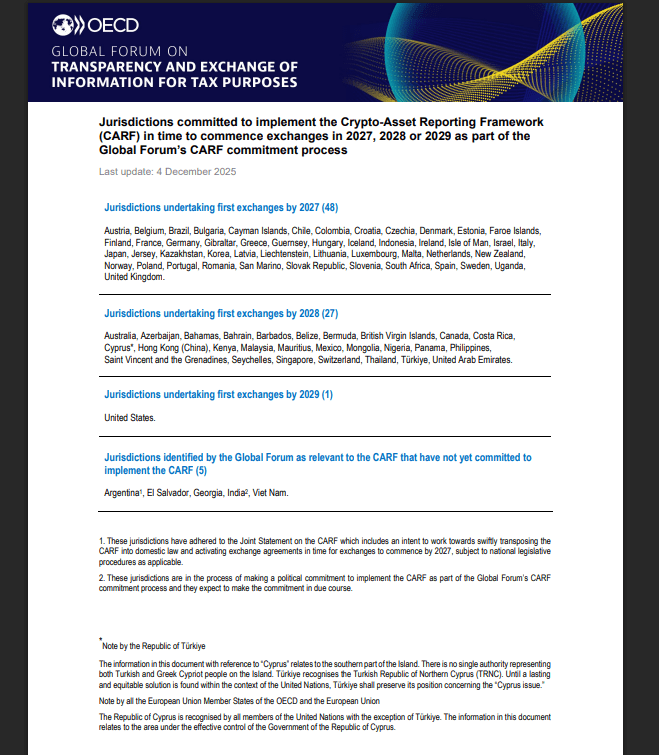
Source: OECD

What Exchanges Must Report

According to news outlets tracking the rollout, exchanges are already adjusting onboarding forms and internal compliance systems to verify customers’ tax residency and capture wallet-level activity.

Some jurisdictions, led by the United Kingdom, have moved faster to require platforms to keep detailed purchase and sale records for users in scope. Tax authorities will then receive yearly reports covering balances, transfers and gains for listed accounts.

Operational Strain And Privacy Questions

The new rules create practical burdens. Smaller platforms will need to upgrade systems or hire compliance staff to track the new data points.

Based on reports, privacy advocates and parts of the crypto industry are warning that the depth of data collection could raise concerns about how long sensitive transaction records are held and who can access them.

Some legal teams are already studying how domestic data-privacy laws interact with automatic information exchange.

Total crypto market cap currently at $2.99 trillion. Chart: TradingView

Middle Nations Join The Second Wave

A further group of jurisdictions has said it will begin domestic collection later. Reports note that an additional 27 jurisdictions have timelines that target January 1, 2027 for starting to collect, with exchanges of information to follow in 2028 for that batch.

At least one analysis of national updates also indicates that a handful of countries are planning to stagger implementation because of local legislative calendars.

How This Will Play Out For Users

For ordinary crypto users, the immediate change will be more questions during account setup and clearer record-keeping demands from providers.

Based on official guidance, CARF itself does not create new taxes; rather, it gives tax offices the data they need to enforce existing rules. For some investors, that means past reporting gaps will be easier for authorities to spot.

Reports have disclosed that implementation will vary by country. Some tax administrations are ready to receive standardized files in 2027, while others are still finishing domestic law changes.

Observers say the rollout marks a major step toward treating crypto transactions like other financial accounts when it comes to cross-border tax transparency.

Featured image from Unsplash, chart from TradingView

Preguntas relacionadas

QWhat is the Crypto-Asset Reporting Framework (CARF) and when will the first automatic cross-border exchanges begin?

AThe Crypto-Asset Reporting Framework (CARF) is a coordinated effort to gather standardized crypto tax records. According to the OECD, the first automatic cross-border exchanges of this data are expected to take place in 2027.

QHow many jurisdictions have committed to start collecting standardized crypto transaction data from January 1, 2026?

A48 jurisdictions have committed to start collecting standardized crypto transaction and user data from January 1, 2026.

QWhat specific information will crypto service providers be obliged to record and report under CARF?

AService providers such as exchanges, broker platforms, crypto ATMs, and custody services will be obliged to record account details, transaction histories, and users' tax residency information for reporting to domestic tax authorities.

QWhat are two major concerns or challenges raised by the implementation of CARF?

ATwo major concerns are the practical burden and operational strain on smaller platforms, which will need to upgrade systems or hire compliance staff, and the privacy concerns regarding how long sensitive transaction records are held and who can access them.

QHow will the CARF implementation affect ordinary crypto users according to the article?

AFor ordinary crypto users, the immediate change will be more questions during account setup and clearer record-keeping demands from their service providers. CARF does not create new taxes but gives tax offices the data to enforce existing rules, making it easier for authorities to spot past reporting gaps.

Lecturas Relacionadas

Google and Amazon Simultaneously Invest Heavily in a Competitor: The Most Absurd Business Logic of the AI Era Is Becoming Reality

In a span of four days, Amazon announced an additional $25 billion investment, and Google pledged up to $40 billion—both direct competitors pouring over $65 billion into the same AI startup, Anthropic. Rather than a typical venture capital move, this signals the latest escalation in the cloud wars. The core of the deal is not equity but compute pre-orders: Anthropic must spend the majority of these funds on AWS and Google Cloud services and chips, effectively locking in massive future compute consumption. This reflects a shift in cloud market dynamics—enterprises now choose cloud providers based on which hosts the best AI models, not just price or stability. With OpenAI deeply tied to Microsoft, Anthropic’s Claude has become the only viable strategic asset for Google and Amazon to remain competitive. Anthropic’s annualized revenue has surged to $30 billion, and it is expanding into verticals like biotech, positioning itself as a cross-industry AI infrastructure layer. However, this funding comes with constraints: Anthropic’s independence is challenged as it balances two rival investors, its safety-first narrative faces pressure from regulatory scrutiny, and its path to IPO introduces new financial pressures. Globally, this accelerates a "tri-polar" closed-loop structure in AI infrastructure, with Microsoft-OpenAI, Google-Anthropic, and Amazon-Anthropic forming exclusive model-cloud alliances. In contrast, China’s landscape differs—investments like Alibaba and Tencent backing open-source model firm DeepSeek reflect a more decoupled approach, though closed-source models from major cloud providers still dominate. The $65 billion bet is ultimately about securing a seat at the table in an AI-defined future—where missing the model layer means losing the cloud war.

marsbitHace 2 hora(s)

Google and Amazon Simultaneously Invest Heavily in a Competitor: The Most Absurd Business Logic of the AI Era Is Becoming Reality

marsbitHace 2 hora(s)

Computing Power Constrained, Why Did DeepSeek-V4 Open Source?

DeepSeek-V4 has been released as a preview open-source model, featuring 1 million tokens of context length as a baseline capability—previously a premium feature locked behind enterprise paywalls by major overseas AI firms. The official announcement, however, openly acknowledges computational constraints, particularly limited service throughput for the high-end DeepSeek-V4-Pro version due to restricted high-end computing power. Rather than competing on pure scale, DeepSeek adopts a pragmatic approach that balances algorithmic innovation with hardware realities in China’s AI ecosystem. The V4-Pro model uses a highly sparse architecture with 1.6T total parameters but only activates 49B during inference. It performs strongly in agentic coding, knowledge-intensive tasks, and STEM reasoning, competing closely with top-tier closed models like Gemini Pro 3.1 and Claude Opus 4.6 in certain scenarios. A key strategic product is the Flash edition, with 284B total parameters but only 13B activated—making it cost-effective and accessible for mid- and low-tier hardware, including domestic AI chips from Huawei (Ascend), Cambricon, and Hygon. This design supports broader adoption across developers and SMEs while stimulating China's domestic semiconductor ecosystem. Despite facing talent outflow and intense competition in user traffic—with rivals like Doubao and Qianwen leading in monthly active users—DeepSeek has maintained technical momentum. The release also comes amid reports of a new funding round targeting a valuation exceeding $10 billion, potentially setting a new record in China’s LLM sector. Ultimately, DeepSeek-V4 represents a shift toward open yet realistic infrastructure development in the constrained compute landscape of Chinese AI, emphasizing engineering efficiency and domestic hardware compatibility over pure model scale.

marsbitHace 3 hora(s)

Computing Power Constrained, Why Did DeepSeek-V4 Open Source?

marsbitHace 3 hora(s)

Trading

Spot
Futuros
活动图片