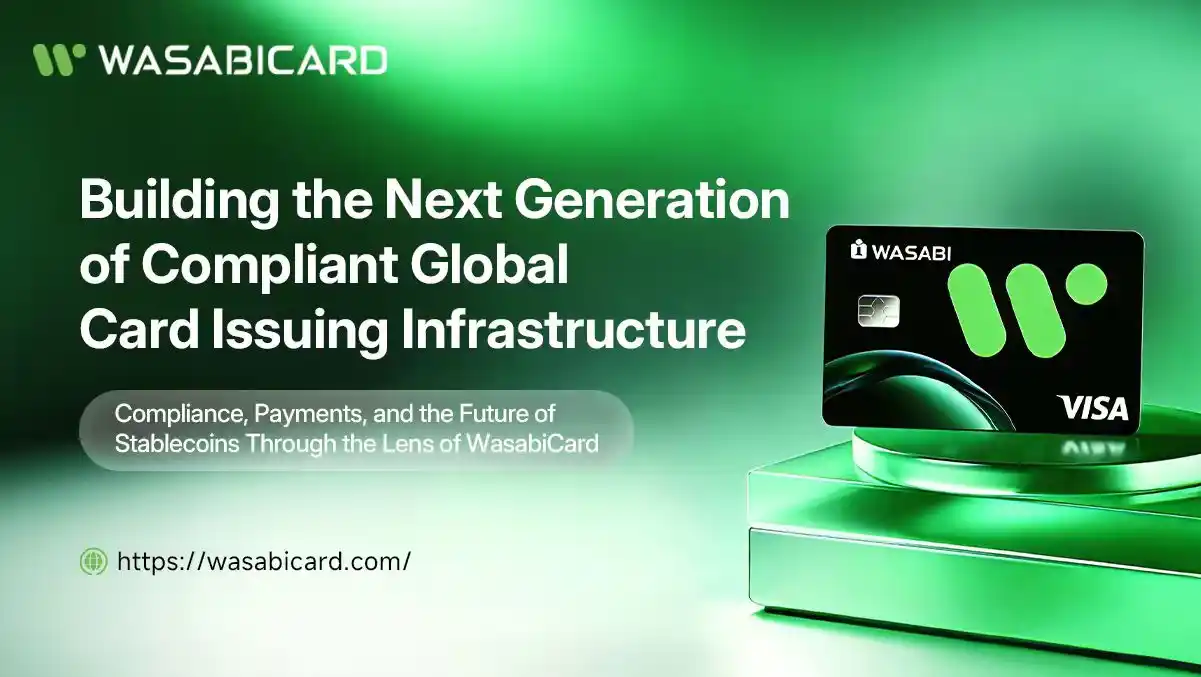
Global Card Issuance Enters a Compliance-Driven Era: WasabiCard is Building the Next-Generation Payment Infrastructure

marsbitPublicado a 2026-06-02Actualizado a 2026-06-02

Resumen

Global card issuance is entering a compliance-driven era, with WasabiCard building next-generation payment infrastructure. The platform asserts that as stablecoins increasingly enter cross-border payments, corporate settlements, and global commerce, the industry is shifting focus from "availability" and "growth-driven" models to long-term, compliant operation under global frameworks. Competition will center on sustainable compliance and global infrastructure capabilities. Stablecoins are evolving from on-chain assets into key payment tools in global business, with card issuance acting as critical infrastructure connecting digital assets to traditional payment networks like Visa and Mastercard. This expansion has revealed structural issues, including cross-regional issuance, BIN resource management, and insufficient AML and risk controls. In response, the industry is moving away from reliance on "grey efficiency" towards prioritizing compliance, risk management, and long-term operational stability. WasabiCard outlines its strategy: collaborating with licensed principals and local partners for localized operations, building robust KYC/AML systems, strictly separating commercial and consumer BIN usage, and enhancing global issuance, payment, and cross-border fund flow infrastructure. The goal is to build stable, scalable payment infrastructure amid evolving global regulations, shifting industry competition from scale to infrastructure capability. As stablecoins integrate furt...

Recently, WasabiCard released its latest industry perspective on the global card issuance sector and stablecoin payment infrastructure, stating that as stablecoins gradually enter cross-border payments, corporate settlements, and global business scenarios, the global card issuance industry is transitioning from a "growth-driven" phase to a "compliance-driven" stage.

WasabiCard indicated that in the past few years, the core issue in the stablecoin payment industry has largely revolved around "availability," whereas future industry competition will gradually shift its focus to "whether it can operate stably and sustainably under global compliance frameworks."

Ray, Co-founder of WasabiCard, stated: "Stablecoins are evolving from on-chain assets into important payment vehicles in global commerce. The competition in the next phase is no longer just about product efficiency or growth speed, but about whether companies possess the capacity for long-term compliant operations and the capability of globalized infrastructure."

As stablecoin applications extend from trading scenarios into the real business world, global card issuance capabilities are also becoming crucial infrastructure connecting digital assets with traditional payment networks. Through global payment networks like Visa and Mastercard, stablecoins and digital assets are further integrated into daily consumption, corporate payments, and cross-border capital flow scenarios.

Meanwhile, WasabiCard believes that the industry's rapid expansion has exposed increasingly structural issues, including risks related to cross-regional card issuance, BIN resource management, anonymous issuance, and insufficient anti-money laundering and risk control capabilities.

Against this backdrop, the industry is gradually shifting from a growth model reliant on "grey-area efficiency" to a development path that places greater emphasis on compliance, risk control, and long-term operational capabilities.

Centered on this trend, WasabiCard also disclosed its long-term infrastructure strategy, which includes: establishing localized operational systems through collaboration with licensed principal members and local partners; building robust KYC and AML risk control systems; strictly distinguishing between commercial BIN and consumer BIN usage scenarios; and continuously enhancing capabilities in global card issuance, payments, and cross-border capital flow infrastructure.

WasabiCard stated that the core objective of these strategies is not merely to improve short-term efficiency but to build payment infrastructure with long-term stability and scalability amid the evolving global regulatory landscape. The competitive logic of the future global card issuance industry will also gradually shift from "scale competition" to "infrastructure capability competition." As stablecoins further integrate with global commerce, payment infrastructure will no longer be just a financial tool but will gradually become an underlying capability embedded in internet commerce. Companies with global compliant operations, resource integration, and platformization capabilities will occupy more significant positions in the industry's next phase of development.

In the future, WasabiCard will continue to enhance its infrastructure capabilities, focusing on global card issuance, stablecoin payments, cross-border capital flows, and API-driven financial workflows.

About WasabiCard

WasabiCard is a stablecoin payment infrastructure platform for global business scenarios, dedicated to providing secure, reliable, and scalable global payment and capital flow capabilities for enterprises and individual users through the integration of stablecoins and the traditional financial system.

Addressing the needs for global payments and cross-border capital management, WasabiCard has built an integrated capability system covering card issuance, payments, and fund distribution, supporting enterprises in achieving a complete process from consumption to fund management across different usage scenarios.

Through its API-driven payment system, WasabiCard helps businesses and users quickly access global payment networks and continuously promotes the large-scale application of stablecoins in the real business world.

Read the full article:"Global Card Issuance Industry Enters a Compliance-Driven Era"

Disclaimer

This content is for informational purposes only and does not constitute any legal, tax, or professional advice provided by WasabiCard, nor should it substitute for seeking relevant professional advice independently. WasabiCard makes no express or implied representations, warranties, or commitments regarding the accuracy, completeness, or timeliness of the content herein.

If you wish to suggest updates to the relevant content, please contact us via the following email: [email protected]


Criptos en tendencia

Preguntas relacionadas

QWhat does WasabiCard identify as the main shift in the global card issuance industry, according to the article?

AWasabiCard states that the global card issuance industry is shifting from a 'growth-driven' phase to a 'compliance-driven' phase.

QAccording to WasabiCard co-founder Ray, what will the next stage of competition in the stablecoin industry focus on?

ARay states that the next stage of competition will focus on whether enterprises possess the capability for long-term compliant operations and global infrastructure, not just product efficiency or growth speed.

QWhat structural problems did the rapid expansion of the industry expose, as mentioned in the article?

AThe rapid expansion exposed structural problems including cross-regional card issuance, BIN resource management, anonymous card issuance, and insufficient AML and risk control capabilities.

QWhat are the core goals of WasabiCard's long-term infrastructure strategy?

AThe core goals are to build a payment infrastructure with long-term stability and scalability in the evolving global regulatory environment, not merely to improve short-term efficiency.

QWhat business does WasabiCard describe itself as?

AWasabiCard describes itself as a stablecoin payment infrastructure platform for global commercial scenarios, dedicated to integrating stablecoins with the traditional financial system to provide safe, reliable, and scalable global payment and capital flow capabilities for enterprises and individual users.

Lecturas Relacionadas

The Clarity Act's Journey Through Congress: The Thorny Path of Bipartisan Compromise in the U.S.

The U.S. Congress is struggling to advance the crypto market structure bill known as the Clarity Act, with bipartisan compromise proving difficult. Key hurdles include unresolved disputes over "yield" products and, more critically, the inclusion of strong ethics provisions for elected officials—a non-negotiable demand for many Democrats. While a compromise on yield was reached in May, securing only limited Democratic support in committee, the separate Senate Agriculture Committee version later passed with no Democratic votes due to the ethics impasse. As Republicans push for a full Senate vote in July, demands for ethics rules have expanded, and other contentious issues like developer protections and concerns from law enforcement and large banks further complicate negotiations. Despite consensus on the need for legislation, the path forward is unclear. Recent discussions between senators and White House officials aim to find acceptable ethics language. Some lawmakers question whether a compromise text can garner enough bipartisan support, with one Democrat stating the current proposal lacks the strong ethics provisions required for their vote. Potential short-term goals for the crypto community include symbolic Senate action before the August recess, a longer-term aim for passage by 2026, or establishing a detailed framework that addresses ethics and other compromises. The process remains arduous, relying on the traditional, vote-by-vote effort to build bipartisan support.

marsbitHace 19 min(s)

The Clarity Act's Journey Through Congress: The Thorny Path of Bipartisan Compromise in the U.S.

marsbitHace 19 min(s)

Are Kalshi and Polymarket Founders at Odds? This Business Rivalry Is More Brutal Than You Think

"The Rivalry Between Kalshi and Polymarket Founders Turns Bitter and Litigious" The intense feud between Tarek Mansour, CEO of Kalshi, and Shayne Coplan, founder of Polymarket, has escalated far beyond typical business competition into personal animosity and regulatory battles. Both lead billion-dollar prediction market platforms, but their approaches differ sharply. Kalshi positions itself as the compliant operator, securing U.S. regulatory approval before launching. In contrast, Polymarket initially operated offshore, allowing U.S. users to access its platform via VPN, which drew regulatory scrutiny. The conflict reached a peak in November 2024 when FBI agents raided Coplan's New York apartment. While Coplan publicly blamed political motives, his team privately suspected Kalshi was involved. According to sources, Kalshi's lawyers had previously reported Polymarket's operations to federal prosecutors, highlighting its accessibility to U.S. users despite a ban. This incident fueled mutual accusations and underhanded tactics, including social media smear campaigns and attempts to sabotage each other's major business deals. Their rivalry also played out in Washington, influencing regulatory debates. Kalshi actively lobbied against Polymarket's practices, framing them as illegal and unethical. Polymarket, after facing a CFTC fine and investigation, later acquired a licensed U.S. firm to launch a domestic app, regaining a foothold. Despite the hostility, both companies have seen massive growth, with combined trading volumes soaring. However, increased regulatory scrutiny, particularly around insider trading on Polymarket's platform, continues to pose challenges. The founders' deep-seated mutual disdain ensures their battle for market dominance remains as much a personal vendetta as a commercial one.

marsbitHace 28 min(s)

Are Kalshi and Polymarket Founders at Odds? This Business Rivalry Is More Brutal Than You Think

marsbitHace 28 min(s)

Trading

Spot

Artículos destacados

Cómo comprar ERA

¡Bienvenido a HTX.com! Hemos hecho que comprar Caldera (ERA) sea simple y conveniente. Sigue nuestra guía paso a paso para iniciar tu viaje de criptos.Paso 1: crea tu cuenta HTXUtiliza tu correo electrónico o número de teléfono para registrarte y obtener una cuenta gratuita en HTX. Experimenta un proceso de registro sin complicaciones y desbloquea todas las funciones.Obtener mi cuentaPaso 2: ve a Comprar cripto y elige tu método de pagoTarjeta de crédito/débito: usa tu Visa o Mastercard para comprar Caldera (ERA) al instante.Saldo: utiliza fondos del saldo de tu cuenta HTX para tradear sin problemas.Terceros: hemos agregado métodos de pago populares como Google Pay y Apple Pay para mejorar la comodidad.P2P: tradear directamente con otros usuarios en HTX.Over-the-Counter (OTC): ofrecemos servicios personalizados y tipos de cambio competitivos para los traders.Paso 3: guarda tu Caldera (ERA)Después de comprar tu Caldera (ERA), guárdalo en tu cuenta HTX. Alternativamente, puedes enviarlo a otro lugar mediante transferencia blockchain o utilizarlo para tradear otras criptomonedas.Paso 4: tradear Caldera (ERA)Tradear fácilmente con Caldera (ERA) en HTX's mercado spot. Simplemente accede a tu cuenta, selecciona tu par de trading, ejecuta tus trades y monitorea en tiempo real. Ofrecemos una experiencia fácil de usar tanto para principiantes como para traders experimentados.

421 Vistas totalesPublicado en 2025.07.17Actualizado en 2026.06.02

Cómo comprar ERA

Discusiones

Bienvenido a la comunidad de HTX. Aquí puedes mantenerte informado sobre los últimos desarrollos de la plataforma y acceder a análisis profesionales del mercado. A continuación se presentan las opiniones de los usuarios sobre el precio de ERA (ERA).

活动图片