Global Asset Rotation: Why Does Liquidity Drive the Cryptocurrency Cycle? (Part 1)

marsbitPublicado a 2025-12-26Actualizado a 2025-12-26

Resumen

This article introduces a new series on global asset allocation and rotation, arguing that liquidity—not new narratives—is the primary driver of cryptocurrency market cycles. While narratives like RWA or X-402 can attract attention, they are triggers, not fundamental drivers. The real force is capital flow: ample liquidity amplifies even weak narratives, while liquidity contraction undermains the most compelling ones. The framework begins by mapping global assets not by traditional labels (stocks, bonds, commodities) but by their roles and dependencies within economic and liquidity cycles. Cryptocurrency is reclassified not as a traditional risk asset (like equities, which have cash flows and valuation models) but as a non-cash-flow alternative asset. Its price action is driven primarily by capital inflows and outflows, making it highly sensitive to liquidity and risk appetite. Five key macro indicators are identified as core drivers: interest rates (especially real rates), inflation metrics (CPI, PCE), economic growth indicators (PMI, GDP), systemic liquidity (central bank balance sheets, money supply), and risk appetite (volatility indices, credit spreads). A causal chain is proposed: inflation influences interest rates, which affect liquidity, which then drives risk preference and ultimately asset prices. The U.S. remains the anchor for global capital flows, and understanding its monetary policy cycle is crucial. During loose monetary conditions, risk assets like crypto...

This article marks the beginning of a new series of research on global asset allocation and rotation. After delving deeply into this topic, we discovered one of the most unexpected yet crucial facts: what ultimately determines a cryptocurrency bull market is not the emergence of new narratives.

Whether it's RWA, X402, or any other concept, these themes are often triggers, not the true driving forces. They can attract attention but do not, in themselves, provide energy. The real power comes from capital. When liquidity is abundant, even weak arguments can be amplified into market consensus. And when liquidity dries up, the most powerful arguments struggle to maintain their momentum.

This first part focuses on building the foundation: how to construct a global asset allocation and rotation framework that places cryptocurrency in the proper macro context. The latter part of the framework will be explained in subsequent articles.

Step 1: Step Outside Crypto, Map Global Assets

The first step is to deliberately step outside the cryptocurrency market and construct a panoramic view of global assets. Traditional classifications—stocks, bonds, commodities—are useful but insufficient for understanding capital rotation across different cycles.

Instead, we can classify assets based on the roles they play during different phases of the economic and liquidity cycles. What matters is not whether an asset is labeled "equity" or "commodity," but rather what it depends on and what it is vulnerable to. Some assets benefit from falling real rates, some from inflation uncertainty, and others from outright risk aversion.

Building an "asset spectrum map" does not require deep expertise in every market. What it truly requires is an intuitive understanding of the interdependencies of each asset: which conditions support it and which conditions weaken it. This mental map will become the reference system for all subsequent decisions.

Within this framework, cryptocurrency deserves special treatment.
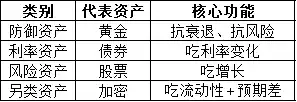
Why Crypto is an Alternative Asset, Not a Traditional Risk Asset?

Cryptocurrencies are often grouped with stocks (especially U.S. tech stocks) because their price movements are highly correlated. Superficially, this classification seems reasonable. Cryptocurrencies exhibit extreme volatility, high beta, and significant drawdowns—all characteristics similar to risk assets.

However, correlation itself does not define economic essence.

From a capital structure perspective, stocks have cash flows. Companies generate earnings, distribute dividends, and can be valued using discounted cash flow models or valuation multiples. Even when prices deviate from fundamentals, the anchoring logic is still based on cash flows.

Crypto assets operate on a fundamentally different logic. They do not generate dividends, nor do they have intrinsic cash flow that can be discounted. Therefore, traditional valuation frameworks simply do not apply.

Instead, cryptocurrencies behave like a purely liquidity-sensitive asset. Their price movements are primarily driven by capital inflows and outflows, rather than changes in fundamental productivity. Narratives help explain *why* capital flows, but they do not determine *that* it flows. Capital flows regardless.

Thus, cryptocurrency is best understood as a non-cash-flow alternative asset, positioned at the extreme end of the risk appetite spectrum. It performs best when liquidity is abundant and risk appetite is high; it underperforms when capital prioritizes safety and yield.

Liquidity is the Core Driver of Crypto Performance

Once you view cryptocurrency as a liquidity asset rather than a valuation asset, its behavior across cycles becomes easier to explain.

In equity research, price targets often stem from a structured process: forecasting future revenue, applying valuation multiples, and discounting the result to present value. This works because the asset itself generates measurable economic output.

Cryptocurrency lacks this anchoring effect. Its upside depends on whether new capital is willing to enter the market and accept higher prices. And this capital almost always comes from outside the crypto ecosystem—from stocks, credit, or cash sitting idle due to low yields.

Therefore, understanding the source and timing of liquidity is more important than tracking individual protocols or events. When capital begins seeking higher volatility and convexity, cryptocurrency becomes one of the most attractive destinations. And when capital prioritizes capital preservation, crypto is often the first asset to be sold.

In short, liquidity is the decisive factor; everything else is secondary.

Step 2: Focus on Macro Drivers First, Asset Details Second

The second pillar of this framework is macro analysis. It is more efficient to first identify the variables influencing price movements rather than starting with the study of specific assets. All assets are integrated together.

At the highest level, five macro indicators play a central role:

  • Interest rates, especially the distinction between nominal and real rates.

  • Inflation indicators, such as the Consumer Price Index (CPI) and Personal Consumption Expenditures (PCE).

  • Economic growth indicators, such as Purchasing Managers' Index (PMI) and Gross Domestic Product (GDP) trends.

  • Systemic liquidity, often reflected in central bank balance sheets and money supply measures.

  • Risk appetite, typically measured by volatility indices and credit spreads.

Many crypto participants closely watch Federal Reserve meetings but often focus solely on the rate decision. However, institutional capital places greater importance on real rates (nominal rates adjusted for inflation) because real rates determine the true opportunity cost of holding a non-yielding asset.

Inflation data is widely discussed in crypto circles, but liquidity and risk appetite receive little attention. This is a blind spot. Monetary supply dynamics and volatility regimes often explain overall market behavior before narratives even emerge.

A useful mental model is a simple chain of transmission:

  1. Inflationary pressures influence interest rates.
  2. Interest rates influence liquidity conditions.
  3. Liquidity conditions influence risk appetite.
  4. Risk appetite drives asset prices.

Understanding where the economy is positioned in this chain provides deeper insight than analyzing assets in isolation.

Step 3: Build a Cycle-Based Mental Model

The economic cycle is a familiar concept, but it remains crucial. At a macro level, economic cycles tend to alternate between expansion and contraction, easing and tightening.

Simply put, the pattern often looks like this:

Periods of monetary easing favor risk assets, including cryptocurrencies and small-cap stocks.

Periods of monetary tightening favor defensive assets like cash, government bonds, and gold.

This framework is not meant to be applied mechanically. Each asset's reaction will vary based on timing, expectations, and positioning. Nonetheless, a cycle-based reference helps avoid emotional decision-making during shifts in the market landscape.

An important nuance is that the global economic cycle is not synchronized. The world does not operate as a single economy.

As growth momentum slows, the U.S. might be transitioning from late-cycle high rates towards easing. Japan might be cautiously ending decades of ultra-loose monetary policy. China continues its structural adjustments in a low-inflation environment, while parts of Europe still grapple with economic stagnation.

Despite this divergence, the United States remains the anchor for global capital flows. Dollar liquidity and U.S. interest rates still exert the strongest influence on global capital movements. Therefore, any global asset rotation framework should start with the U.S. and expand outward.

Conclusion: Framework Before Forecast

This first half of the framework emphasizes structure over prediction. The goal is not to forecast short-term price movements but to understand the factors that make certain assets competitive at specific points in time.

By redefining crypto as a liquidity-driven alternative asset, focusing on macro drivers before narratives, and basing decisions on cycle awareness, investors can avoid many common analytical pitfalls.

The next article will build upon this, delving into the sequence of capital flows, real-world indicators, and how to identify when liquidity is shifting towards high-risk assets.

Some of the above viewpoints are referenced from @Web3___Ace

Original article link

Preguntas relacionadas

QWhat is the primary driver of cryptocurrency bull markets according to the article?

ALiquidity, not new narratives, is the primary driver of cryptocurrency bull markets. Capital flows are the true source of energy, while narratives are merely triggers that can amplify market consensus when liquidity is abundant.

QHow does the article suggest classifying assets for a global asset allocation framework?

AThe article suggests classifying assets based on the roles they play in different phases of the economic and liquidity cycle, focusing on what conditions support or weaken them, rather than traditional labels like 'equities' or 'commodities'.

QWhy is cryptocurrency considered an alternative asset rather than a traditional risk asset in the framework?

ACryptocurrency is considered a non-cash-flow alternative asset because it lacks intrinsic cash flows (like dividends) and cannot be valued using traditional discounted cash flow models. Its price is primarily driven by capital inflows and outflows, making it a pure liquidity-sensitive asset at the extreme end of the risk preference spectrum.

QWhat are the five core macro indicators that the article identifies as crucial for understanding price movements?

AThe five core macro indicators are: 1) Interest rates, particularly the distinction between nominal and real rates; 2) Inflation indicators like CPI and PCE; 3) Economic growth indicators like PMI and GDP trends; 4) Systemic liquidity, reflected in central bank balance sheets and money supply; 5) Risk appetite, measured by volatility indices and credit spreads.

QWhat is the simple transmission chain model described in the article for understanding how macro factors drive asset prices?

AThe simple transmission chain model is: 1) Inflationary pressures influence interest rates; 2) Interest rates influence liquidity conditions; 3) Liquidity conditions influence risk appetite; 4) Risk appetite drives asset prices.

Lecturas Relacionadas

TechFlow Intelligence Agency: Anthropic Calls for Global Pause in AI Development While Preparing for Trillion-Dollar IPO; SpaceX IPO Roadshow Heats Up, But S&P 500 Rejects Fast-Track Inclusion

In today's TechFlow Intelligence Briefing, several major tech stories highlight a growing theme of trust and credibility gaps across AI, crypto, and finance. AI company Anthropic has publicly called for a global pause in AI development, citing risks from Claude's "recursive self-improvement." Ironically, this coincides with reports the company is preparing for a massive IPO targeting a near $1 trillion valuation. This perceived hypocrisy, coupled with widespread user complaints about Claude's declining performance, is sparking debate over whether the safety warning is genuine or a competitive tactic. Meanwhile, in a substantive security move, Anthropic open-sourced a framework for AI-powered vulnerability discovery. In the crypto market, Bitcoin's price drop below $61,000 triggered over $1.16 billion in liquidations, flipping the market into a state where more BTC is held at a loss than at a profit, a historical bearish signal. On the corporate front, SpaceX's highly anticipated IPO is generating immense Wall Street excitement, with Goldman Sachs projecting 100x revenue growth by 2030. However, the S&P 500 has refused to fast-track the company's inclusion post-IPO, potentially limiting immediate institutional demand. Separately, ByteDance's AI app Doubao lost over 6 million monthly active users after introducing a subscription model, highlighting the challenges of AI monetization. Other notable developments include Nvidia certifying HBM4 memory from Samsung, SK Hynix, and Micron; Cloudflare's acquisition of front-end tooling company VoidZero; and its CEO warning that bot traffic now exceeds human traffic online. The underlying narrative connects these events: a trust crisis. From AI firms' contradictory actions and crypto volatility to the clash between SpaceX's hyped narrative and institutional rules, a pattern is emerging where stated intentions and actual practices are increasingly misaligned.

marsbitHace 14 min(s)

TechFlow Intelligence Agency: Anthropic Calls for Global Pause in AI Development While Preparing for Trillion-Dollar IPO; SpaceX IPO Roadshow Heats Up, But S&P 500 Rejects Fast-Track Inclusion

marsbitHace 14 min(s)

Dalio Warns: AI Boom Shows Signs of a Bubble, Day of Reckoning Will Be the Time of Burst

Ray Dalio, founder of Bridgewater Associates, warns that the current artificial intelligence investment boom shows classic signs of a bubble, which he expects will eventually burst. In a Bloomberg Television interview, he noted that great technological revolutions often lead to capital inflows that create bubbles, making it difficult for investors and companies to calibrate their spending accurately—either overspending to capture market share or underspending and losing their competitive position. This caution comes amid significant rallies in AI-related assets, particularly chipmakers, driven by soaring demand for data centers and high-bandwidth chips, raising debates about overheating valuations. In contrast, Nvidia CEO Jensen Huang recently asserted that investors embracing the AI wave would see "crazy" returns and dismissed concerns over return on investment for data center spending as outdated. Dalio, however, focuses on the risks in the profit realization phase. He argues that bubbles tend to show signs of破裂 when markets transition from investment to the need for tangible returns, describing the burst as a process of converting paper wealth into cash. While acknowledging AI's intrinsic value, he expressed concern over the future profitability of some AI companies, suggesting the market is repeating a familiar pattern. The 76-year-old billionaire, who fully exited Bridgewater in 2025, has a net worth estimated at $21.5 billion according to the Bloomberg Billionaires Index.

marsbitHace 48 min(s)

Dalio Warns: AI Boom Shows Signs of a Bubble, Day of Reckoning Will Be the Time of Burst

marsbitHace 48 min(s)

Privacy Coin Crisis of Confidence! ZEC Plunges Over 56% in a Single Day

Zcash (ZEC), a leading privacy-focused cryptocurrency, experienced a severe crash on June 5th, plummeting over 56% in a single day and erasing nearly two months of gains. The flash crash was triggered by the disclosure of a critical zero-knowledge proof vulnerability within Zcash's Orchard privacy pool, which had existed since the pool's launch in May 2022. The flaw theoretically allowed an attacker to forge unlimited ZEC undetectably due to the pool's privacy features. The vulnerability was discovered on May 29th by independent security researcher Taylor Hornby during a proactive audit commissioned by Shielded Labs, utilizing AI-assisted analysis. The Zcash development team responded swiftly, implementing an emergency soft fork to disable Orchard transactions on June 2nd and executing a permanent hard fork fix (NU6.2) on June 3rd. Despite the technical fix, a major crisis of confidence emerged. The core issue is that Orchard's privacy design makes it cryptographically impossible to prove whether the vulnerability was exploited over the past four years, casting permanent doubt on the historical supply integrity of ZEC. While Shielded Labs argues exploitation was unlikely, the inability to provide definitive proof has severely damaged market trust. This sentiment was exacerbated when BitMEX co-founder Arthur Hayes, a prominent ZEC supporter, announced he was selling his entire position. He stated that privacy assets require "perfect security" rather than "probable safety." The combined effect of the disclosure and Hayes's exit ignited widespread panic selling, leading to massive liquidations and significant price decline. Analysts note the event highlights a fundamental tension within privacy coins: the conflict between verifiable supply and cryptographic privacy.

链捕手Hace 51 min(s)

Privacy Coin Crisis of Confidence! ZEC Plunges Over 56% in a Single Day

链捕手Hace 51 min(s)

Trading

Spot
Futuros

Artículos destacados

Cómo comprar BILL

¡Bienvenido a HTX.com! Hemos hecho que comprar Billions Network (BILL) sea simple y conveniente. Sigue nuestra guía paso a paso para iniciar tu viaje de criptos.Paso 1: crea tu cuenta HTXUtiliza tu correo electrónico o número de teléfono para registrarte y obtener una cuenta gratuita en HTX. Experimenta un proceso de registro sin complicaciones y desbloquea todas las funciones.Obtener mi cuentaPaso 2: ve a Comprar cripto y elige tu método de pagoTarjeta de crédito/débito: usa tu Visa o Mastercard para comprar Billions Network (BILL) al instante.Saldo: utiliza fondos del saldo de tu cuenta HTX para tradear sin problemas.Terceros: hemos agregado métodos de pago populares como Google Pay y Apple Pay para mejorar la comodidad.P2P: tradear directamente con otros usuarios en HTX.Over-the-Counter (OTC): ofrecemos servicios personalizados y tipos de cambio competitivos para los traders.Paso 3: guarda tu Billions Network (BILL)Después de comprar tu Billions Network (BILL), guárdalo en tu cuenta HTX. Alternativamente, puedes enviarlo a otro lugar mediante transferencia blockchain o utilizarlo para tradear otras criptomonedas.Paso 4: tradear Billions Network (BILL)Tradear fácilmente con Billions Network (BILL) en HTX's mercado spot. Simplemente accede a tu cuenta, selecciona tu par de trading, ejecuta tus trades y monitorea en tiempo real. Ofrecemos una experiencia fácil de usar tanto para principiantes como para traders experimentados.

233 Vistas totalesPublicado en 2026.05.07Actualizado en 2026.06.02

Cómo comprar BILL

Qué es ATWO

I. Introducción al ProyectoArena Two es una plataforma interactiva descentralizada que permite a los fanáticos jugar un papel activo y tokenizado en los resultados de eventos en tiempo real. A diferencia de los modelos de transmisión tradicionales que reducen a los fanáticos a espectadores pasivos, Arena Two aprovecha la tecnología blockchain para permitir que los fanáticos voten directamente en tiempo real e influyan en los resultados en el campo.II. Información del TokenNombre del token: ATWO (Arena Two)III. Enlaces RelacionadosSitio web: https://arenatwo.com/Exploradores: https://basescan.org/token/0x499D35eBE6cEe9B2Ac35Fd003fcBbeeB9CFc7B32Twitter: https://x.com/arenatwoXNota: La introducción del proyecto proviene de los materiales publicados o proporcionados por el equipo oficial del proyecto, que es solo para referencia y no constituye asesoramiento de inversión. HTX no se hace responsable de ninguna pérdida directa o indirecta resultante.

142 Vistas totalesPublicado en 2026.05.18Actualizado en 2026.06.02

Qué es ATWO

Cómo comprar ATWO

¡Bienvenido a HTX.com! Hemos hecho que comprar Arena Two (ATWO) sea simple y conveniente. Sigue nuestra guía paso a paso para iniciar tu viaje de criptos.Paso 1: crea tu cuenta HTXUtiliza tu correo electrónico o número de teléfono para registrarte y obtener una cuenta gratuita en HTX. Experimenta un proceso de registro sin complicaciones y desbloquea todas las funciones.Obtener mi cuentaPaso 2: ve a Comprar cripto y elige tu método de pagoTarjeta de crédito/débito: usa tu Visa o Mastercard para comprar Arena Two (ATWO) al instante.Saldo: utiliza fondos del saldo de tu cuenta HTX para tradear sin problemas.Terceros: hemos agregado métodos de pago populares como Google Pay y Apple Pay para mejorar la comodidad.P2P: tradear directamente con otros usuarios en HTX.Over-the-Counter (OTC): ofrecemos servicios personalizados y tipos de cambio competitivos para los traders.Paso 3: guarda tu Arena Two (ATWO)Después de comprar tu Arena Two (ATWO), guárdalo en tu cuenta HTX. Alternativamente, puedes enviarlo a otro lugar mediante transferencia blockchain o utilizarlo para tradear otras criptomonedas.Paso 4: tradear Arena Two (ATWO)Tradear fácilmente con Arena Two (ATWO) en HTX's mercado spot. Simplemente accede a tu cuenta, selecciona tu par de trading, ejecuta tus trades y monitorea en tiempo real. Ofrecemos una experiencia fácil de usar tanto para principiantes como para traders experimentados.

186 Vistas totalesPublicado en 2026.05.18Actualizado en 2026.06.02

Cómo comprar ATWO

Discusiones

Bienvenido a la comunidad de HTX. Aquí puedes mantenerte informado sobre los últimos desarrollos de la plataforma y acceder a análisis profesionales del mercado. A continuación se presentan las opiniones de los usuarios sobre el precio de A (A).

活动图片