Glassnode: BTC Rally a 'False Breakout', Fragile Bottom Still Awaiting Formation

marsbitPublicado a 2026-01-22Actualizado a 2026-01-22

Resumen

Glassnode's analysis indicates that the recent Bitcoin price rebound is a "false breakout," with the market remaining structurally fragile and lacking a confirmed bottom. Despite some signs of seller exhaustion in early January 2026, the rally faced strong resistance near the $98K level—the cost basis for short-term holders—where profit-taking and break-even selling intensified. On-chain data reveals persistent overhead supply from both short-term and long-term holders, creating sustained selling pressure and limiting upward momentum. While spot flows have turned slightly positive with reduced exchange outflows, demand remains selective and not yet broad-based. Corporate treasury inflows are sporadic and event-driven, failing to provide consistent buying support. Derivatives markets show low participation, with muted futures volume and cautious leverage usage. Options markets saw only short-term volatility spikes in response to events, while longer-term implied volatility remained stable. Dealer gamma positioning turned net short below $90K, increasing downside vulnerability. In summary, the market is in a low-engagement consolidation phase, driven more by a lack of selling rather than strong buying interest. A durable bottom has yet to form, and any sustained recovery will require a robust catalyst to absorb overhead supply and boost investor conviction.

Entering early January 2026, the market showed signs of seller exhaustion, creating an opportunity for a price rebound towards the upper boundary of the current trading range. However, this rally comes with elevated risk as prices approach the ~$98k zone, where recent investors have formed active 'breakeven' selling pressure around their cost basis.

Core Insights

· On-chain structure remains fragile: Price hovers near key cost basis levels, lacking sustained confirmation of conviction from long-term holders.

· Supply overhang persists: Recent buyers face overhead resistance, limiting the sustainability of any advance and making rallies prone to sell-offs.

· Spot flows turn positive: Selling pressure on major exchanges has eased, but buying remains selective, not broad-based.

· Treasury inflows are patchy: Treasury activity is sporadic and event-driven, not yet forming a coordinated buying trend, with limited impact on overall demand.

· Derivatives participation is low: Futures volume is contracting, leverage use is cautious, and the market is in a low-engagement state.

· Options market sees only short-term pressure: Short-term implied volatility reacted to risk events, while medium-to-long-term volatility remains stable.

· Hedging demand spikes then normalizes: The surge in the Put/Call Volume Ratio has subsided, indicating risk aversion was tactical.

· Dealer gamma positioning is net short: This weakens mechanical support for price stability and increases market sensitivity to liquidity shocks.

On-Chain Deep Dive

Over the past two weeks, the anticipated technical rebound has largely played out, with price stalling below the Short-Term Holder cost basis after touching resistance, once again confirming substantial overhead selling pressure. This report will focus on the structure and behavior of this 'overhead' supply to reveal emerging seller dynamics.

Technical Rebound Meets Resistance

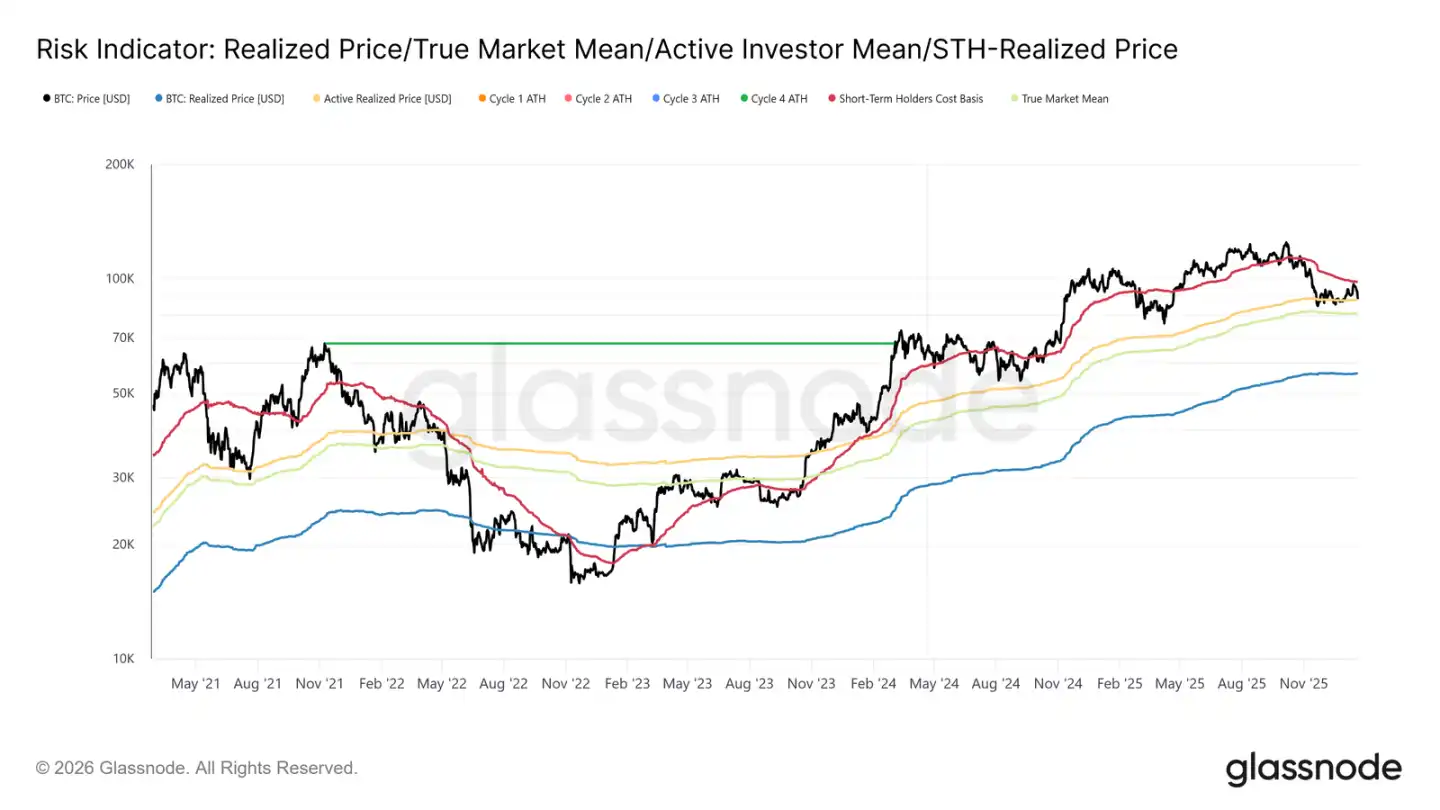
A clear narrative has emerged: the market has been in a mild bearish phase. Its lower bound is supported by the ~$81.1k Realized Mean, while the upper bound is capped by the average cost basis of Short-Term Holders. This range creates a fragile equilibrium where downside pressure is absorbed, but upside attempts are repeatedly sold into by investors who bought between Q1 and Q3 2025.

Entering early January 2026, the exhaustion of seller momentum opened a window for price to rebound towards the range high. However, this rally is at high risk as prices near the ~$98k zone, where recent investors show increased willingness to sell around their breakeven point.

The recent rejection around ~$98.4k (the STH cost basis) mirrors the market structure seen in Q1 2022. Back then, the market repeatedly failed to decisively break above the cost basis of recent buyers, leading to a prolonged consolidation period. This similarity underscores the fragile nature of the current recovery attempt.
Overhead Supply Pressure Remains

Building on the observation of price rejection at key cost levels, a closer look at the on-chain supply distribution provides clearer insight into why upward momentum has repeatedly faltered.

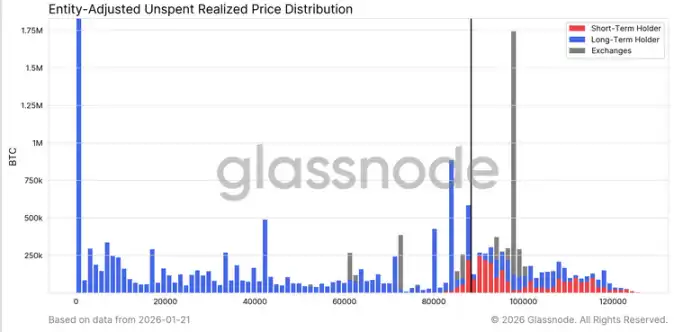
The URPD (Unrealized Profit/Loss Distribution) chart clearly illustrates why the excess supply above $98k remains the primary force capping near-to-mid-term rallies. The recent rebound partially filled the 'vacuum zone' between ~$93k and $98k, primarily through early buyers distributing to new entrants, forming a new cluster of Short-Term Holder supply.

However, the supply distribution above $100k reveals a broad and dense supply zone, with these coins gradually aging into Long-Term Holder status. This undigested 'overhead' supply is a persistent source of selling pressure, likely keeping price suppressed below the $98.4k (STH cost basis) and $100k psychological levels. Thus, a significant and sustained acceleration in demand momentum is required for a decisive breakout.
Long-Term Holders Also Present Resistance

Expanding the view from Short-Term Holders to longer-term holdings, we find the same structural constraints persist.

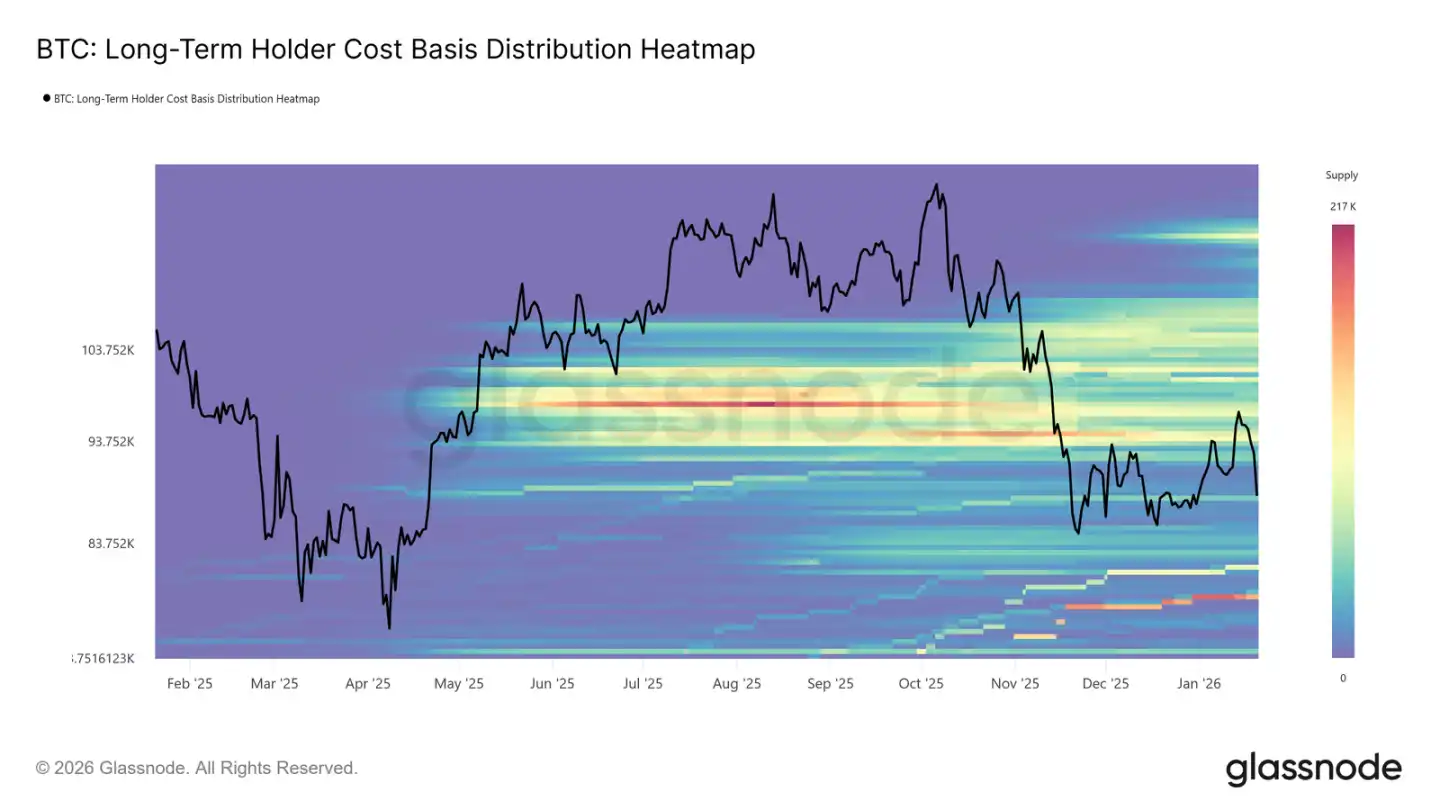
The Long-Term Holder cost basis distribution heatmap shows a dense cluster of long-term coin acquisition costs above the current spot price. This zone represents a significant source of potential seller liquidity when price rallies towards these historical entry levels.

Long-Term Holders will remain a potential source of resistance until new, sufficiently strong demand emerges to absorb this overhead supply. Therefore, upside potential is likely to remain capped, and any rally vulnerable to renewed selling, until this 'overhead' supply is thoroughly digested.
Rally Meets Profit-Taking and Stop-Loss Selling

Going further, we can identify which investor cohorts were actively distributing (for profit or stop-losses) during the recent push towards ~$98k, thus capping the price.

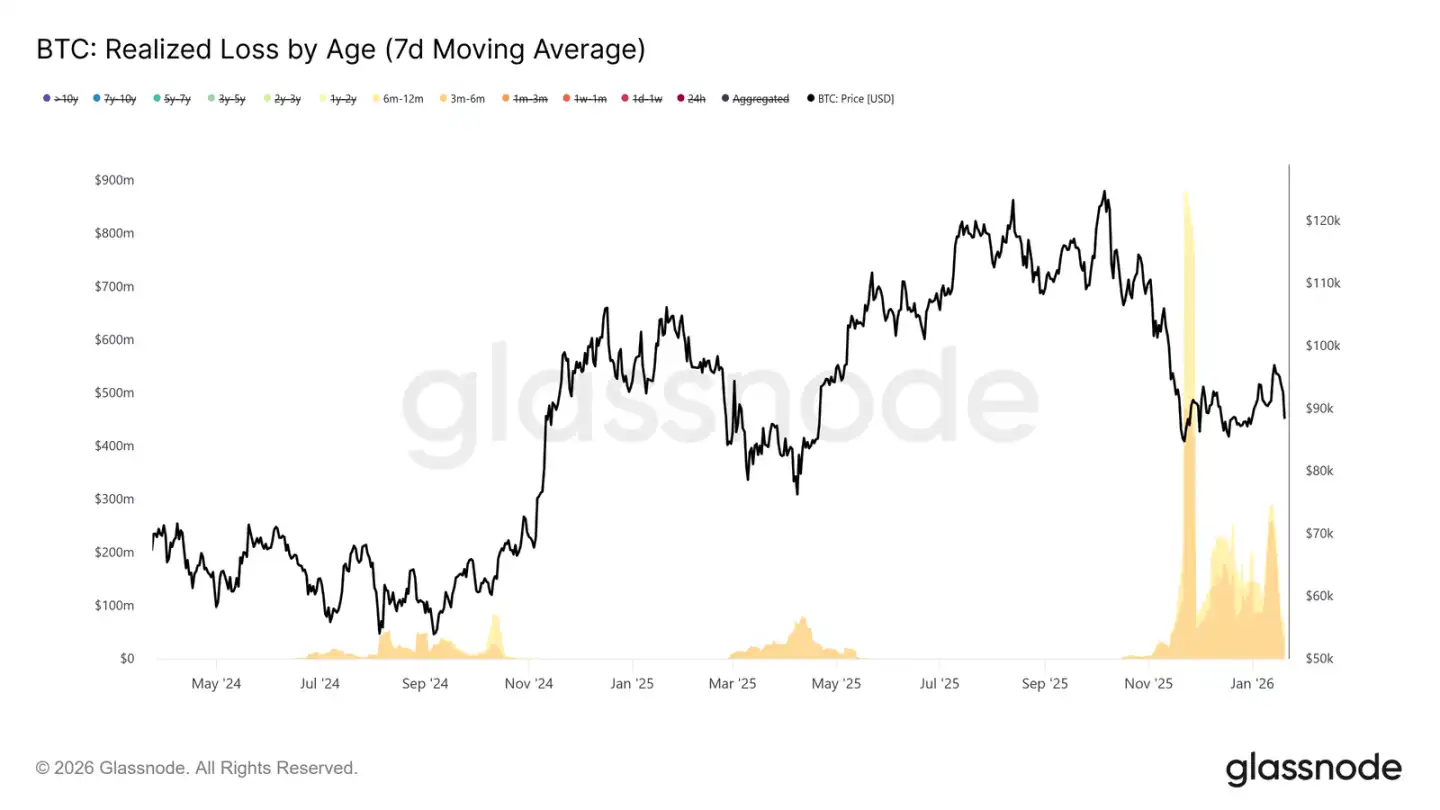
Realized Losses broken down by coin age show that loss-taking was dominated by the 3-6 month cohort, followed by the 6-12 month holders. This pattern is characteristic of 'pain capitulation,' particularly from those who bought above $110k and are now exiting as price approaches their cost basis. This behavior reinforces seller pressure around key recovery levels.
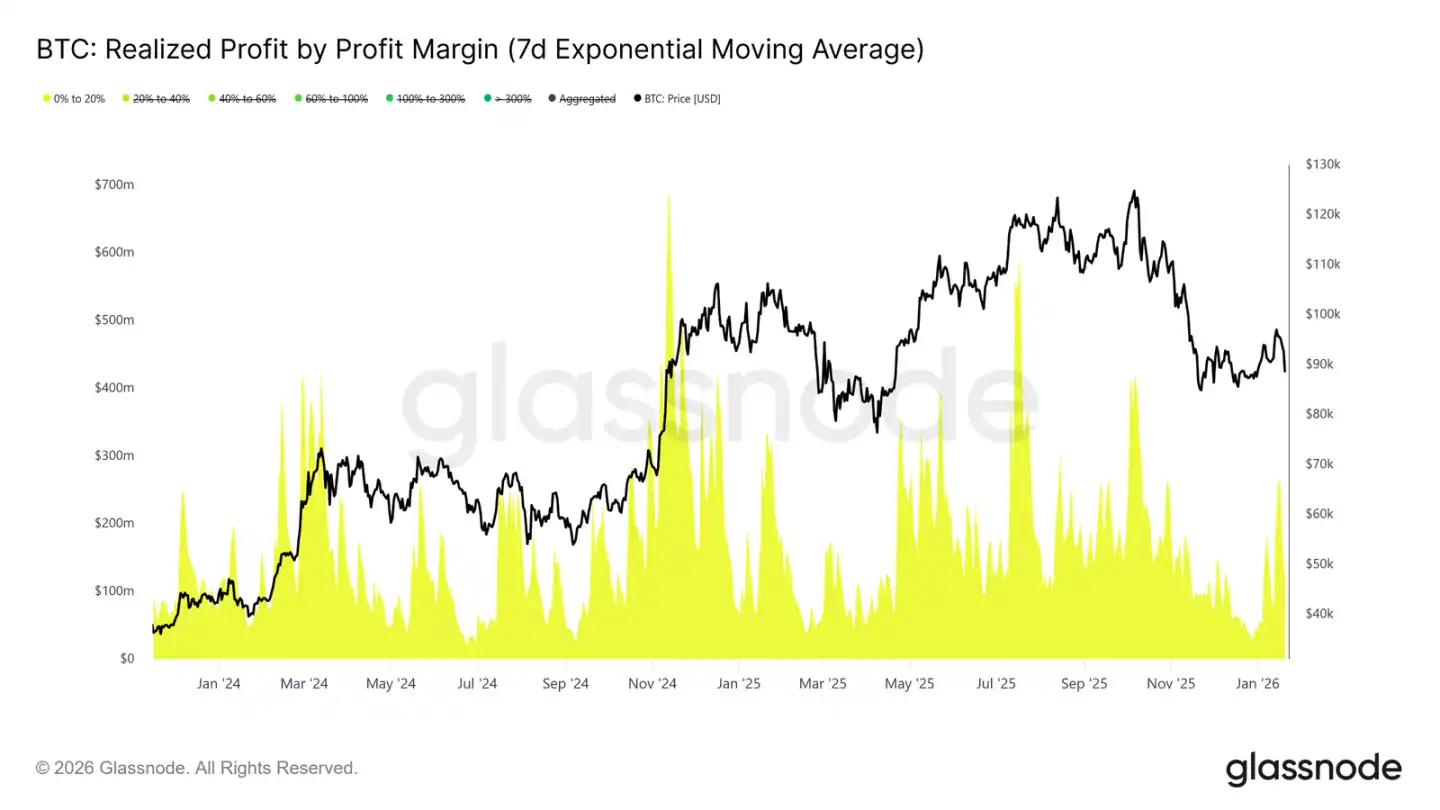
Concurrently, Realized Profits segmented by profit margin show a notable increase in the proportion of profit-taking within the 0% to 20% margin bracket. This highlights the influence of 'breakeven sellers' and short-term swing traders who tend to exit upon modest gains rather than waiting for trend continuation.

This behavior is common during market transitions where investor conviction is fragile, prioritizing capital preservation and tactical profits. This increase in low-margin selling continuously undermines upward momentum as supply is released around cost basis.
Off-Chain Market Watch

Spot Flows Turn Positive

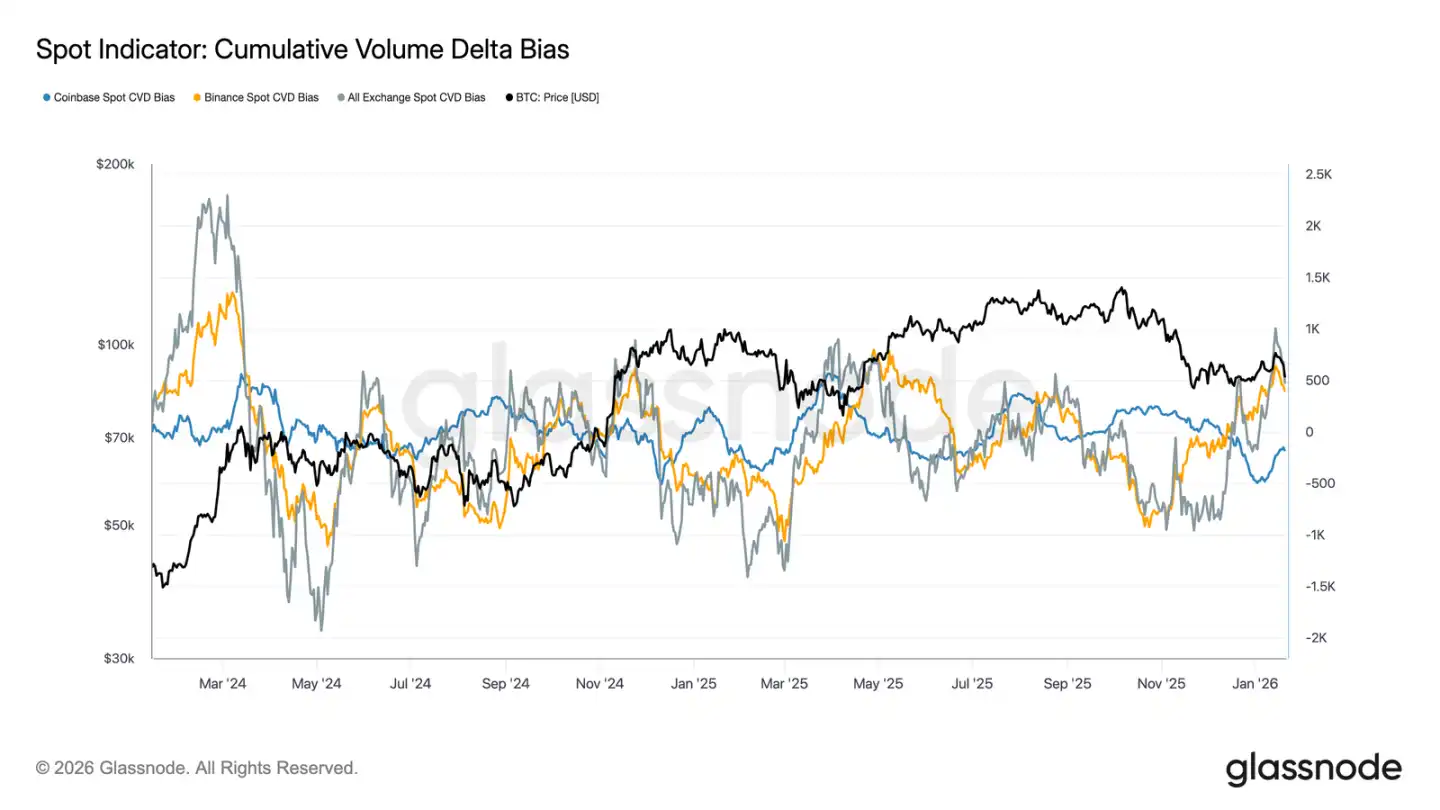
Spot market behavior has improved following the recent decline. The Binance and Exchange Composite CVD (Cumulative Volume Delta) metrics have flipped back to net buying, indicating spot participants are starting to re-accumulate rather than sell into strength, contrasting with the persistent selling pressure seen in earlier consolidation phases.

Coinbase, which had been a primary source of sell pressure during the range-bound trading, has also seen a significant slowdown in its net selling pace. The abatement of selling from Coinbase helps reduce overhead supply, stabilizing price action and supporting the recent bounce.

Although spot participation hasn't yet shown the sustained, aggressive buying typical of a trending expansion phase, the shift back to net buying on major platforms marks a positive improvement in the underlying spot market structure.
Digital Asset Treasury Inflows Remain Patchy

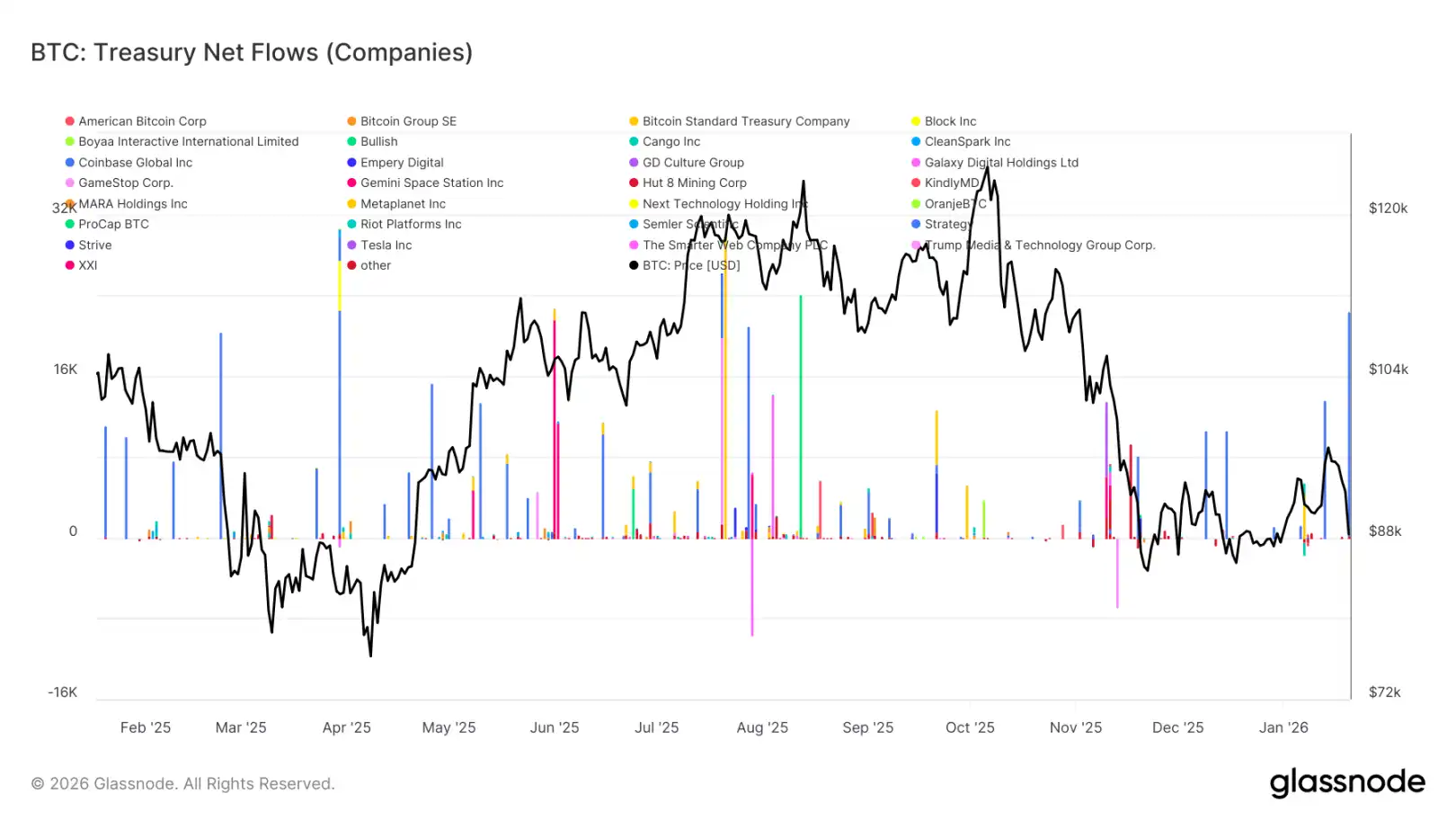
Recent net flows for digital asset treasuries remain patchy and uneven, characterized by isolated event-driven activity rather than broad trend buying. While there have been notable buying spikes from individual companies over the past few weeks, overall corporate demand has not yet entered a sustained accumulation mode.

Overall, digital asset treasury flows are oscillating narrowly around the zero line, indicating most corporate treasuries are currently in a wait-and-see or opportunistic mode, not systematically accumulating. This contrasts with earlier phases where multiple corporations bought in concert, driving trend acceleration.

Overall, the latest data shows corporate treasuries are only a marginal, selective source of demand, with an intermittent impact that is not yet decisive for overall price dynamics.
Derivatives Markets Are Quiet

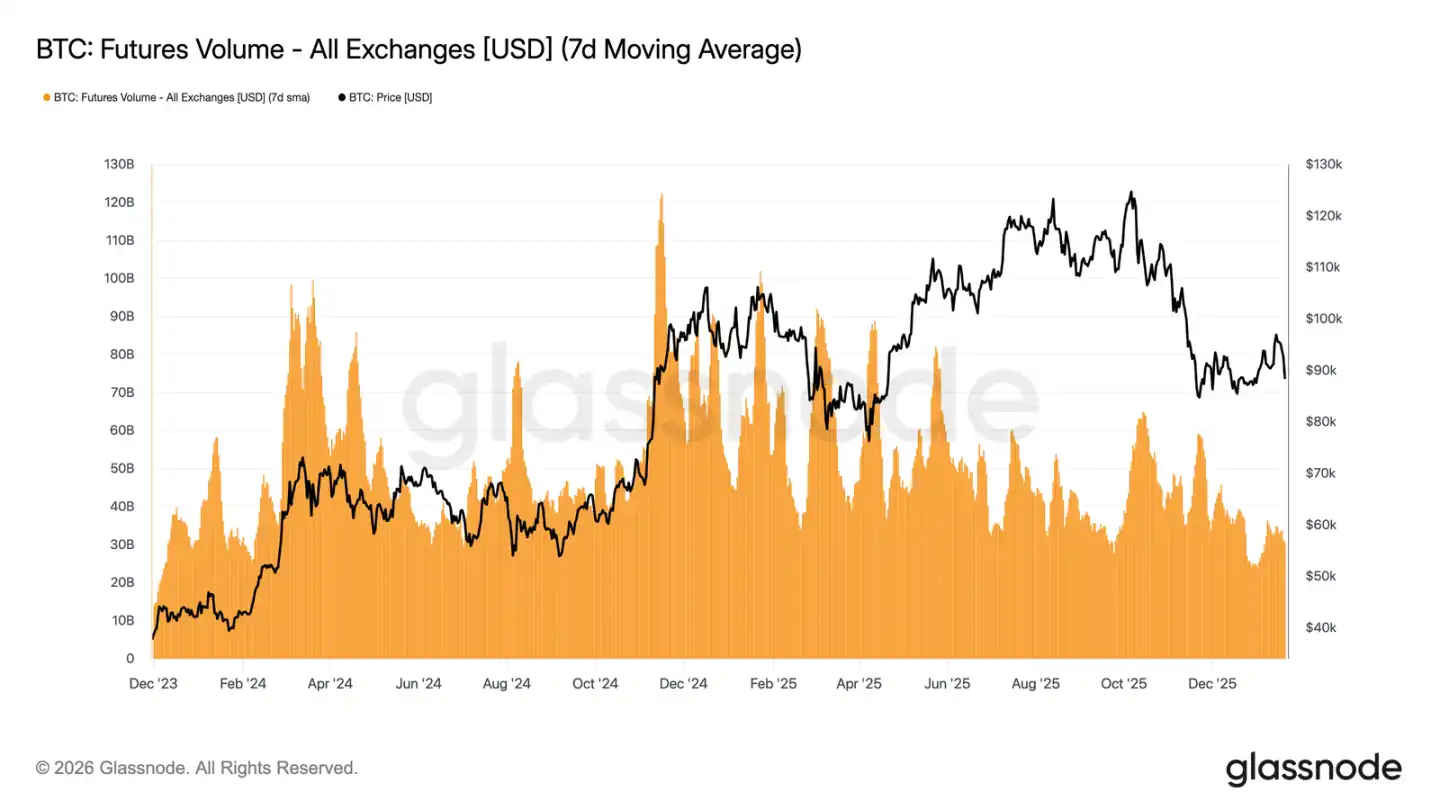
Bitcoin futures' 7-day moving average volume continues to contract, remaining well below levels typically associated with trending markets. The recent price volatility has not been accompanied by a meaningful expansion in volume, highlighting the low participation and lack of confidence in the derivatives market.

The current market structure suggests recent price action is more driven by sparse liquidity than aggressive positioning. Adjustments in Open Interest also lack concurrent volume growth, reflecting more the adjustment and rebalancing of existing risk rather than the deployment of new leverage.

In summary, the derivatives market is currently in a low-engagement 'quiet' state with sparse speculative interest. This 'ghost market' characteristic means the market could be very sensitive to any recovery in trade volume, but its influence on price discovery is currently limited.
Implied Volatility Spikes Only Short-Term

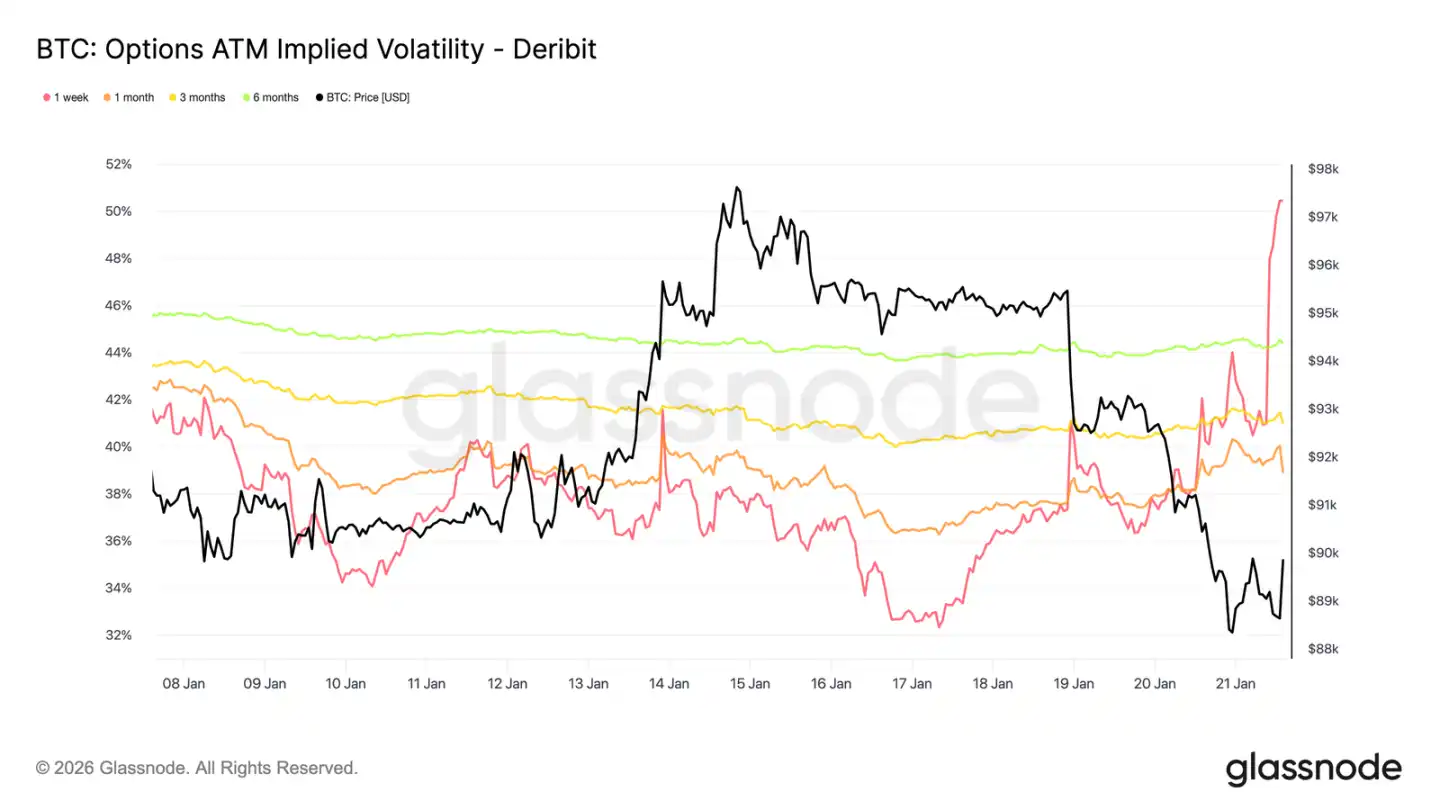
The spot sell-off triggered by macro and geopolitical news only stimulated a rise in short-term volatility. Since Sunday's drop, 1-week implied volatility rose by over 13 volatility points, while 3-month implied volatility rose only ~2 points, and 6-month implied volatility barely moved.

This acute steepening at the very front of the volatility curve indicates traders are engaging tactically, not reassessing the medium-term risk structure. Only short-term vol adjusted, reflecting event-driven uncertainty, not a shift across the volatility complex.

The market is pricing transient risk, not lasting turmoil.
Short-Dated Skew Experiences Wild Swings

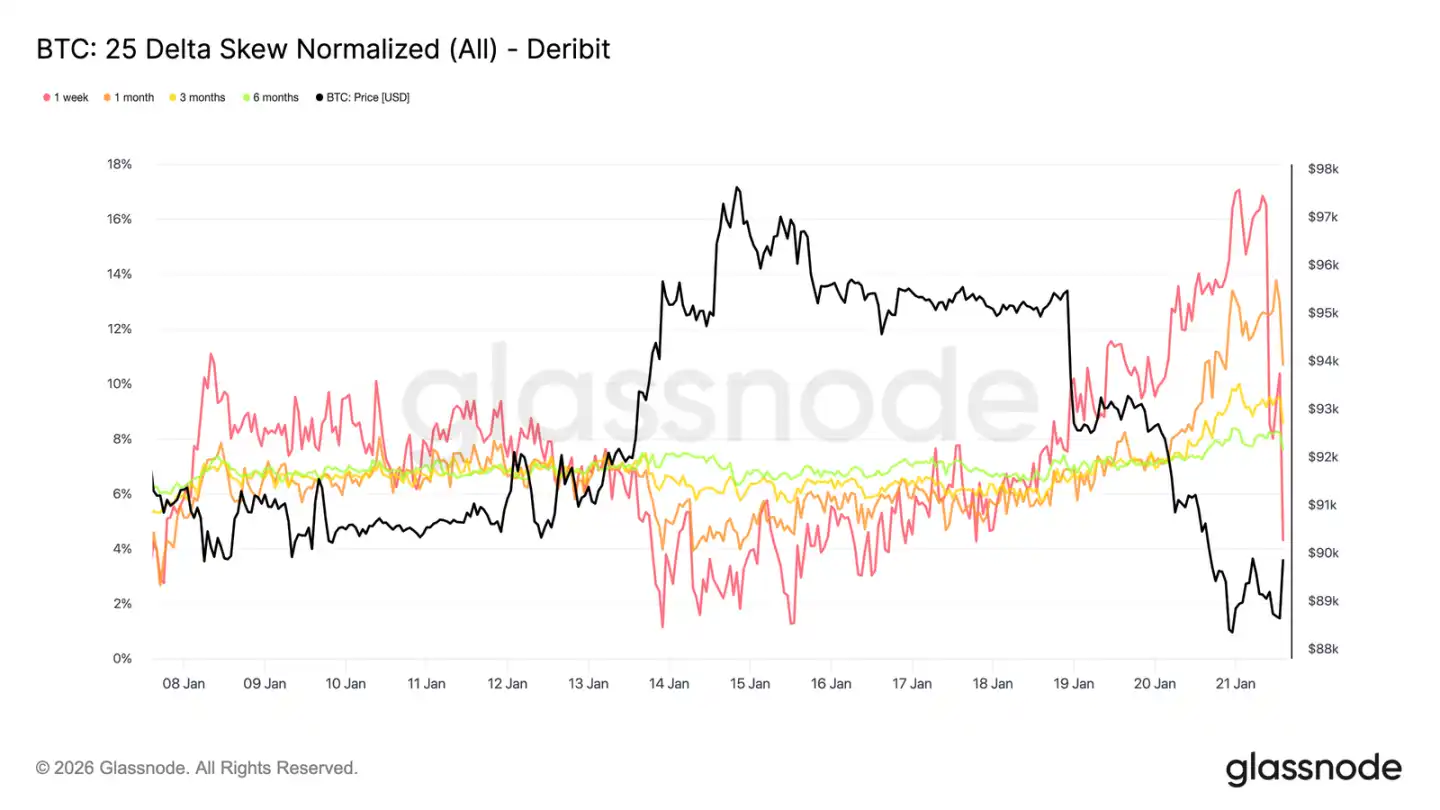
Similar to at-the-money volatility, short-dated skew also dominated this adjustment. The 1-week 25 Delta skew, which was near equilibrium a week ago, has sharply pivoted to a 'puts richer' state.

Since last week, this skew measure has moved ~16 volatility points towards puts, reaching a put premium of nearly 17%. The 1-month skew also reacted, while longer-dated skews, already in put territory, only deepened slightly.

Such a violent skew inversion often accompanies local extremes where the market is over-positioned and the prevailing trend is difficult to sustain. As the market digested the impact of Davos-related commentary, the downside premium was partially taken profit on, and skew began retracing rapidly.
Volatility Risk Premium Holds High

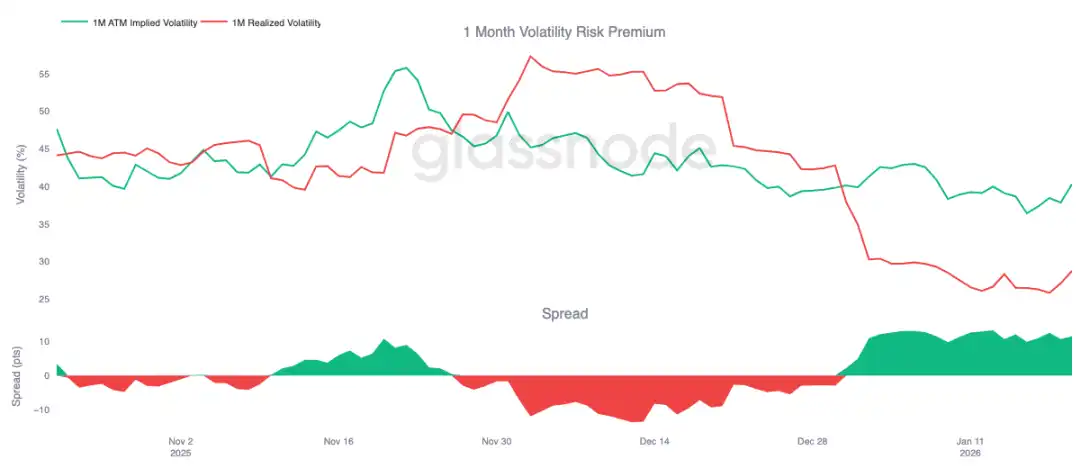
The 1-month Volatility Risk Premium has held in positive territory since the start of the year. Despite implied volatility being at historically absolute lows, its pricing remains consistently higher than actual realized volatility. In other words, options remain 'expensive' relative to the price volatility actually occurring.

The Volatility Risk Premium captures the difference between implied and realized volatility. A positive premium means option sellers are compensated for assuming volatility risk. This creates a favorable environment for 'short vol' strategies – holding short gamma positions can generate returns as long as realized vol remains contained.

This dynamic is self-reinforcing, suppressing volatility. As long as selling volatility is profitable, more participants will join, keeping implied vol suppressed. As of Jan 20, the 1-month vol spread sits at ~11.5 volatility points in favor of sellers, which speaks volumes about the continued friendliness of the environment for selling volatility.
Dealer Positioning Flips Net Short

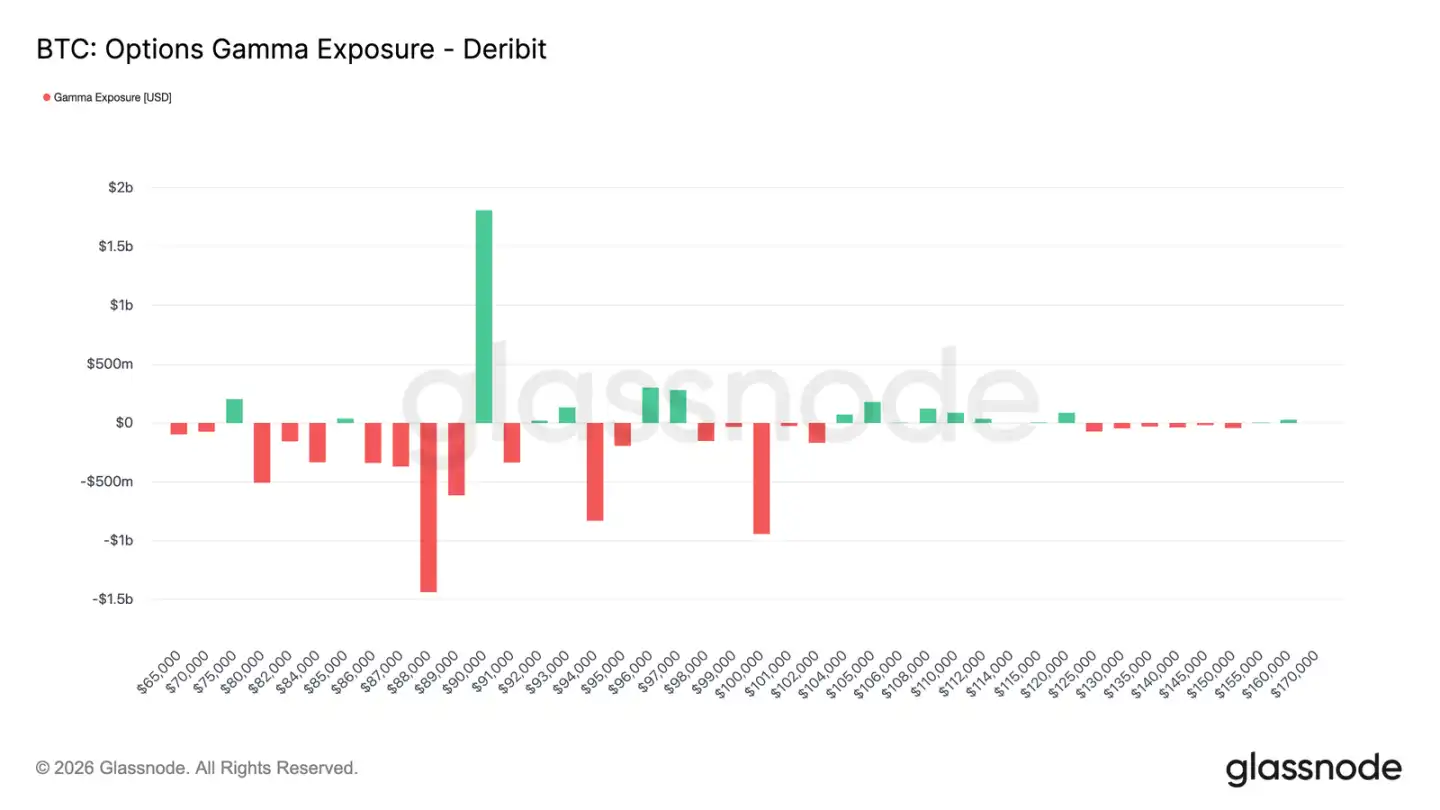
Dealer gamma positioning is a key structural force influencing short-term price action. Recent flow data shows investors actively bought downside protection, leaving dealers net short gamma below $90k. Concurrently, some investors financed this by selling upside calls, leaving dealers net long gamma above $90k.

This creates an asymmetric setup: Below $90k, dealers are net short gamma, meaning price declines could be self-accelerating due to their hedging activity (selling futures or spot). Above $90k, dealers' net long gamma acts as a stabilizer, as rallies trigger their hedging buys, dampening the move.

Thus, price action below $90k is likely to remain fragile, while the $90k level itself becomes a key friction point. A decisive and sustained break above this level would require sufficient market momentum and confidence to digest the dealer hedging flows and push their gamma exposure to higher strikes.
Conclusion

The Bitcoin market remains in a state of low participation, with current price action stemming more from 'reduced selling pressure' than 'aggressive buying.' On-chain data continues to reveal issues of supply overhang and fragile structural support. Spot flows, while improved, have not yet translated into a sustained buying trend.

Institutional demand remains cautious, with treasury flows stabilizing around the zero line and activity dominated by sporadic trades. Derivatives markets are quiet, with futures volume contraction and constrained leverage use, collectively creating a low-liquidity environment where price is hypersensitive to slight positioning changes.

The options market also reflects this restraint. Volatility repricing was confined to the short term, hedging demand has normalized, and elevated volatility risk premiums continue to anchor overall vol levels.

Overall, the market appears to be quietly building a base. The current consolidation stems not from overheated participation but from a temporary pause in investor conviction, as they await the next catalyst capable of inspiring broad engagement.


Preguntas relacionadas

QAccording to Glassnode, why is the recent BTC rebound considered a 'false breakout'?

AThe rebound is considered a 'false breakout' because the price has stalled below the cost basis of short-term holders (around $98k), confirming substantial overhead selling pressure. The market lacks sustained confirmation from long-term holders and faces persistent supply overhang from investors who bought at higher prices, making any rally vulnerable to renewed sell-offs.

QWhat key resistance level is currently capping Bitcoin's price upside as per the on-chain analysis?

AThe key resistance level capping Bitcoin's price upside is the Short-Term Holder (STH) cost basis at approximately $98,400, along with the psychological $100,000 level. Above this, there is a dense supply zone from coins acquired at higher prices that act as a persistent source of selling pressure.

QHow does the article describe the current state of demand from corporate treasuries?

ADemand from corporate treasuries is described as sporadic, event-driven, and uneven. Activity is characterized by isolated buying spikes from individual companies rather than a broad, coordinated trend of accumulation. Overall, corporate treasury flows are oscillating near the zero line, indicating a观望or opportunistic stance rather than systematic buying.

QWhat is the significance of the '9k gamma level' mentioned in the derivatives market analysis?

AThe '9k gamma level' is a key friction point identified from dealer positioning. Below $90,000, dealers hold negative gamma, meaning price declines could be self-accelerating due to their hedging activities (selling futures or spot). Above $90,000, dealers hold positive gamma, which acts as a stabilizer as price rises trigger their hedging buys. This creates an asymmetric market structure where moves below $90k are more fragile.

QWhat does the low participation in the derivatives market, described as a 'ghost market', imply for price action?

AThe low participation in the derivatives market, or 'ghost market' state, implies that recent price action is more driven by thin liquidity rather than aggressive new positioning. It means the market is in a low-conviction environment with subdued speculative interest, making prices highly sensitive to any influx of volume, though such influence is currently limited.

Lecturas Relacionadas

Dialogue with ViaBTC CEO Yang Haipo: Is the Essence of Blockchain a Libertarian Experiment?

"ViaBTC CEO Yang Haipo: Blockchain as a Hardcore Libertarian Experiment" In a deep-dive interview, ViaBTC CEO Yang Haipo reframes the essence of blockchain, arguing it is not merely a new technology or infrastructure but a hardcore libertarian experiment. This experiment, born from the 2008 financial crisis and decades of cypherpunk ideology, tests a fundamental question: to what extent can freedom and self-organization exist without centralized trust? The discussion highlights the experiment's verified outcomes. On one hand, it has proven its core value of censorship resistance, providing critical financial lifelines for entities like WikiLeaks and individuals in hyperinflationary or sanctioned countries via tools like stablecoins. However, Yang points out a key paradox: the most successful product, USDT, is itself a centralized compromise, showing users prioritize a less-controlled pipeline over pure decentralization. On the other hand, the experiment has exposed the severe costs of this freedom—a "dark forest" without safeguards. Events like the collapses of LUNA, Celsius, and FTX, resulting in massive wealth destruction and prison sentences for founders, underscore the system's fragility and the inherent risks of an unregulated environment. Yang observes that despite decentralized protocols, human nature inevitably recreates centralized power structures, speculative frenzies, and narrative-driven cycles (from ICOs to Meme coins), where emotion and belonging often trump technological substance. Looking forward, he believes blockchain's future is significant but niche. Its real value lies in serving specific, real-world needs for financial sovereignty and bypassing traditional controls, not as a universal infrastructure replacing all centralized systems. For the average participant, Yang's crucial advice is to cultivate independent judgment. True freedom is not holding a crypto wallet, but possessing a mind resilient to groupthink and narrative hype in a high-risk, often irrational market.

marsbitHace 10 min(s)

Dialogue with ViaBTC CEO Yang Haipo: Is the Essence of Blockchain a Libertarian Experiment?

marsbitHace 10 min(s)

North Korean Hackers Loot $500 Million in a Single Month, Becoming the Top Threat to Crypto Security

North Korean hackers, particularly the notorious Lazarus Group and its subgroup TraderTraitor, have stolen over $500 million from cryptocurrency DeFi platforms in less than three weeks, bringing their total theft for the year to over $700 million. Recent major attacks on Drift Protocol and KelpDAO, resulting in losses of approximately $286 million and $290 million respectively, highlight a strategic shift: instead of targeting core smart contracts, attackers are now exploiting vulnerabilities in peripheral infrastructure. For instance, the KelpDAO attack involved compromising downstream RPC infrastructure used by LayerZero's decentralized validation network (DVN), allowing manipulation without breaching core cryptography. This sophisticated approach mirrors advanced corporate cyber-espionage. Additionally, North Korea has systematically infiltrated the global crypto workforce, with an estimated 100 operatives using fake identities to gain employment at blockchain companies, enabling long-term access to sensitive systems and facilitating large-scale thefts. According to Chainalysis, North Korean-linked hackers stole a record $2 billion in 2025, accounting for 60% of all global crypto theft that year. Their total historical crypto theft has reached $6.75 billion. Post-theft, they employ specialized money laundering methods, heavily relying on Chinese OTC brokers and cross-chain mixing services rather than standard decentralized exchanges. Security experts, while acknowledging the increased sophistication, emphasize that many attacks still exploit fundamental weaknesses like poor access controls and centralized operational risks. Strengthening private key management, limiting privileged access, and enhancing coordination among exchanges, analysts, and law enforcement immediately after an attack are critical to improving defense and fund recovery chances. The industry's challenge now extends beyond secure smart contracts to safeguarding operational security at the infrastructure level.

marsbitHace 1 hora(s)

North Korean Hackers Loot $500 Million in a Single Month, Becoming the Top Threat to Crypto Security

marsbitHace 1 hora(s)

Trading

Spot
Futuros

Artículos destacados

Qué es BITCOIN

Entendiendo HarryPotterObamaSonic10Inu (ERC-20) y Su Posición en el Espacio Cripto En los últimos años, el mercado de criptomonedas ha sido testigo de un aumento en la popularidad de las monedas meme, capturando el interés no solo de los comerciantes, sino también de aquellos que buscan compromiso comunitario y valor de entretenimiento. Entre estos tokens únicos se encuentra HarryPotterObamaSonic10Inu (ERC-20), un proyecto intrigante que mezcla referencias culturales en el tejido de las criptomonedas. Este artículo profundiza en los aspectos clave de HarryPotterObamaSonic10Inu, explorando sus mecanismos, ethos impulsado por la comunidad y su relación con el paisaje cripto más amplio. ¿Qué es HarryPotterObamaSonic10Inu (ERC-20)? Como su nombre sugiere, HarryPotterObamaSonic10Inu es una moneda meme construida sobre la blockchain de Ethereum, clasificada bajo el estándar ERC-20. A diferencia de las criptomonedas tradicionales que pueden enfatizar la utilidad práctica o el potencial de inversión, este token prospera en el valor de entretenimiento y la fuerza de su comunidad. El proyecto tiene como objetivo fomentar un entorno donde los usuarios comprometidos puedan reunirse, compartir ideas y participar en actividades inspiradas por diversos fenómenos culturales. Una característica notable de HarryPotterObamaSonic10Inu es su cero impuestos en las transacciones. Este atractivo elemento tiene como objetivo incentivar el comercio y la participación comunitaria, sin cargos adicionales que puedan disuadir a los comerciantes de pequeña escala. El suministro total de la moneda está establecido en mil millones de tokens, una cifra que marca su intención de mantener una circulación sustancial dentro de la comunidad. Creador de HarryPotterObamaSonic10Inu (ERC-20) Los orígenes de HarryPotterObamaSonic10Inu están algo envueltos en misterio; los detalles sobre el creador siguen siendo desconocidos. El desarrollo de este token carece de un equipo identificable o de un plan explícito, lo cual no es inusual dentro del sector de monedas meme. En cambio, el proyecto ha surgido de manera orgánica, con su progreso muy dependiente del entusiasmo y la participación de su comunidad. Inversores de HarryPotterObamaSonic10Inu (ERC-20) En cuanto a inversiones externas y respaldo, HarryPotterObamaSonic10Inu también sigue siendo ambiguo. El token no lista ninguna fundación de inversión conocida o apoyo organizacional significativo. En cambio, la savia del proyecto es su comunidad de base, que informa su crecimiento y sostenibilidad a través de la acción colectiva y el compromiso en el espacio cripto. ¿Cómo Funciona HarryPotterObamaSonic10Inu (ERC-20)? Como una moneda meme, HarryPotterObamaSonic10Inu opera principalmente fuera de los marcos tradicionales que a menudo rigen el valor de los activos. Hay varios aspectos distintivos que definen cómo funciona el proyecto: Transacciones Sin Impuestos: Sin tarifas impositivas en las transacciones, los usuarios pueden comprar y vender el token libremente sin preocuparse por costos ocultos. Compromiso Comunitario: El proyecto prospera en la interacción comunitaria, aprovechando plataformas de redes sociales para crear entusiasmo y facilitar la participación. Las discusiones, el intercambio de contenido y el compromiso son elementos cruciales que ayudan a expandir su alcance y fomentar la lealtad entre los seguidores. Sin Utilidad Práctica: Cabe señalar que HarryPotterObamaSonic10Inu no ofrece utilidad concreta dentro del ecosistema financiero. Más bien, se clasifica como un token principalmente para actividades de entretenimiento y comunitarias. Referencia Cultural: El token incorpora astutamente elementos de la cultura popular para atraer interés, conectando con entusiastas de los memes y seguidores de las criptomonedas por igual. HarryPotterObamaSonic10Inu ejemplifica cómo las monedas meme operan de manera diferente a los proyectos de criptomonedas más tradicionales, ingresando al mercado como construcciones sociales innovadoras en lugar de activos utilitarios. Cronología de HarryPotterObamaSonic10Inu (ERC-20) La historia de HarryPotterObamaSonic10Inu está marcada por varios hitos notables: Creación: El token surgió de un meme viral, capturando la imaginación de muchos entusiastas de las criptomonedas. Las fechas específicas de creación no están disponibles, subrayando su ascenso orgánico. Listado en Exchanges: HarryPotterObamaSonic10Inu ha llegado a varios exchanges, permitiendo un acceso y comercio más fácil por parte de la comunidad. Iniciativas de Compromiso Comunitario: Actividades continuas destinadas a mejorar la interacción comunitaria, incluyendo concursos, campañas en redes sociales y generación de contenido por parte de fanáticos y defensores. Planes de Expansión Futuros: La hoja de ruta del proyecto incluye el lanzamiento de una colección de NFT, mercancía y un sitio de comercio electrónico relacionado con sus temas culturales, involucrando aún más a la comunidad e intentando añadir más dimensiones a su ecosistema. Puntos Clave Sobre HarryPotterObamaSonic10Inu (ERC-20) Naturaleza Impulsada por la Comunidad: El proyecto prioriza la participación colectiva y la creatividad, asegurando que la involucración de los usuarios esté a la vanguardia de su desarrollo. Clasificación como Moneda Meme: Representa la epítome de las criptomonedas basadas en el entretenimiento, diferenciándose de los vehículos de inversión tradicionales. Sin Afiliación Directa con Bitcoin: A pesar de la similitud en el nombre del ticker, HarryPotterObamaSonic10Inu es distinto y no tiene relación con Bitcoin u otras criptomonedas establecidas. Enfoque en la Colaboración: HarryPotterObamaSonic10Inu está diseñado para crear un espacio para la colaboración y el intercambio de historias entre sus poseedores, proporcionando una vía para la creatividad y el vínculo comunitario. Perspectivas Futuras: La ambición de expandirse más allá de su premisa inicial hacia NFTs y mercancías describe un camino para que el proyecto potencialmente ingrese a avenidas más tradicionales dentro de la cultura digital. A medida que las monedas meme continúan capturando la imaginación de la comunidad de criptomonedas, HarryPotterObamaSonic10Inu (ERC-20) se destaca debido a sus lazos culturales y su enfoque centrado en la comunidad. Si bien puede no encajar en el molde típico de un token impulsado por la utilidad, su esencia radica en la alegría y la camaradería fomentadas entre sus seguidores, destacando la naturaleza en evolución de las criptomonedas en una era cada vez más digital. A medida que el proyecto continúa desarrollándose, será importante observar cómo las dinámicas comunitarias influyen en su trayectoria en el cambiante paisaje de la tecnología blockchain.

1.3k Vistas totalesPublicado en 2024.04.01Actualizado en 2024.12.03

Qué es BITCOIN

Cómo comprar BTC

¡Bienvenido a HTX.com! Hemos hecho que comprar Bitcoin (BTC) sea simple y conveniente. Sigue nuestra guía paso a paso para iniciar tu viaje de criptos.Paso 1: crea tu cuenta HTXUtiliza tu correo electrónico o número de teléfono para registrarte y obtener una cuenta gratuita en HTX. Experimenta un proceso de registro sin complicaciones y desbloquea todas las funciones.Obtener mi cuentaPaso 2: ve a Comprar cripto y elige tu método de pagoTarjeta de crédito/débito: usa tu Visa o Mastercard para comprar Bitcoin (BTC) al instante.Saldo: utiliza fondos del saldo de tu cuenta HTX para tradear sin problemas.Terceros: hemos agregado métodos de pago populares como Google Pay y Apple Pay para mejorar la comodidad.P2P: tradear directamente con otros usuarios en HTX.Over-the-Counter (OTC): ofrecemos servicios personalizados y tipos de cambio competitivos para los traders.Paso 3: guarda tu Bitcoin (BTC)Después de comprar tu Bitcoin (BTC), guárdalo en tu cuenta HTX. Alternativamente, puedes enviarlo a otro lugar mediante transferencia blockchain o utilizarlo para tradear otras criptomonedas.Paso 4: tradear Bitcoin (BTC)Tradear fácilmente con Bitcoin (BTC) en HTX's mercado spot. Simplemente accede a tu cuenta, selecciona tu par de trading, ejecuta tus trades y monitorea en tiempo real. Ofrecemos una experiencia fácil de usar tanto para principiantes como para traders experimentados.

4.7k Vistas totalesPublicado en 2024.12.12Actualizado en 2025.03.21

Cómo comprar BTC

Qué es $BITCOIN

ORO DIGITAL ($BITCOIN): Un Análisis Integral Introducción al ORO DIGITAL ($BITCOIN) ORO DIGITAL ($BITCOIN) es un proyecto basado en blockchain que opera en la red Solana, cuyo objetivo es combinar las características de los metales preciosos tradicionales con la innovación de las tecnologías descentralizadas. Aunque comparte un nombre con Bitcoin, a menudo referido como “oro digital” debido a su percepción como un refugio de valor, ORO DIGITAL es un token separado diseñado para crear un ecosistema único dentro del paisaje Web3. Su meta es posicionarse como un activo digital alternativo viable, aunque los detalles sobre sus aplicaciones y funcionalidades aún están en desarrollo. ¿Qué es ORO DIGITAL ($BITCOIN)? ORO DIGITAL ($BITCOIN) es un token de criptomoneda diseñado explícitamente para su uso en la blockchain de Solana. A diferencia de Bitcoin, que proporciona un papel de almacenamiento de valor ampliamente reconocido, este token parece centrarse en aplicaciones y características más amplias. Aspectos notables incluyen: Infraestructura Blockchain: El token está construido sobre la blockchain de Solana, conocida por su capacidad para manejar transacciones de alta velocidad y bajo costo. Dinámicas de Suministro: ORO DIGITAL tiene un suministro máximo limitado a 100 cuatrillones de tokens (100P $BITCOIN), aunque los detalles sobre su suministro circulante no se han divulgado actualmente. Utilidad: Si bien las funcionalidades precisas no están delineadas explícitamente, hay indicios de que el token podría ser utilizado para diversas aplicaciones, potencialmente involucrando aplicaciones descentralizadas (dApps) o estrategias de tokenización de activos. ¿Quién es el Creador de ORO DIGITAL ($BITCOIN)? En la actualidad, la identidad de los creadores y el equipo de desarrollo detrás de ORO DIGITAL ($BITCOIN) sigue siendo desconocida. Esta situación es típica entre muchos proyectos innovadores dentro del espacio blockchain, particularmente aquellos alineados con las finanzas descentralizadas y fenómenos de monedas meme. Si bien tal anonimato puede fomentar una cultura impulsada por la comunidad, intensifica las preocupaciones sobre la gobernanza y la responsabilidad. ¿Quiénes son los Inversores de ORO DIGITAL ($BITCOIN)? La información disponible indica que ORO DIGITAL ($BITCOIN) no tiene patrocinadores institucionales conocidos ni inversiones destacadas de capital de riesgo. El proyecto parece operar en un modelo de peer-to-peer centrado en el apoyo y la adopción de la comunidad en lugar de rutas de financiamiento tradicionales. Su actividad y liquidez se sitúan principalmente en intercambios descentralizados (DEX), como PumpSwap, en lugar de plataformas de trading centralizadas establecidas, lo que resalta aún más su enfoque de base. Cómo Funciona ORO DIGITAL ($BITCOIN) Los mecanismos operativos de ORO DIGITAL ($BITCOIN) pueden elaborarse en función de su diseño blockchain y atributos de red: Mecanismo de Consenso: Al aprovechar el único proof-of-history (PoH) de Solana combinado con un modelo de proof-of-stake (PoS), el proyecto asegura una validación de transacciones eficiente que contribuye al alto rendimiento de la red. Tokenómica: Si bien los mecanismos deflacionarios específicos no se han detallado extensamente, el vasto suministro máximo de tokens implica que podría atender microtransacciones o casos de uso nicho que aún están por definirse. Interoperabilidad: Existe el potencial de integración con el ecosistema más amplio de Solana, incluyendo varias plataformas de finanzas descentralizadas (DeFi). Sin embargo, los detalles sobre integraciones específicas permanecen no especificados. Cronología de Eventos Clave Aquí hay una cronología que destaca hitos significativos relacionados con ORO DIGITAL ($BITCOIN): 2023: El despliegue inicial del token ocurre en la blockchain de Solana, marcado por su dirección de contrato. 2024: ORO DIGITAL gana visibilidad al estar disponible para trading en intercambios descentralizados como PumpSwap, permitiendo a los usuarios comerciar contra SOL. 2025: El proyecto presencia actividad de trading esporádica y potencial interés en compromisos liderados por la comunidad, aunque no se han documentado asociaciones notables o avances técnicos hasta el momento. Análisis Crítico Fortalezas Escalabilidad: La infraestructura subyacente de Solana soporta altos volúmenes de transacciones, lo que podría mejorar la utilidad de $BITCOIN en varios escenarios de transacción. Accesibilidad: El potencial bajo precio de trading por token podría atraer a inversores minoristas, facilitando una participación más amplia debido a oportunidades de propiedad fraccionada. Riesgos Falta de Transparencia: La ausencia de patrocinadores, desarrolladores o un proceso de auditoría conocidos públicamente puede generar escepticismo sobre la sostenibilidad y confiabilidad del proyecto. Volatilidad del Mercado: La actividad de trading depende en gran medida del comportamiento especulativo, lo que puede resultar en una volatilidad de precios significativa y en incertidumbre para los inversores. Conclusión ORO DIGITAL ($BITCOIN) surge como un proyecto intrigante pero ambiguo dentro del ecosistema de Solana en rápida evolución. Si bien intenta aprovechar la narrativa del “oro digital”, su alejamiento del papel establecido de Bitcoin como refugio de valor subraya la necesidad de una diferenciación más clara de su utilidad y estructura de gobernanza previstas. La aceptación y adopción futura dependerán probablemente de abordar la actual opacidad y de definir sus estrategias operativas y económicas de manera más explícita. Nota: Este informe abarca información sintetizada disponible hasta octubre de 2023, y pueden haber ocurrido desarrollos más allá del período de investigación.

83 Vistas totalesPublicado en 2025.05.13Actualizado en 2025.05.13

Qué es $BITCOIN

Discusiones

Bienvenido a la comunidad de HTX. Aquí puedes mantenerte informado sobre los últimos desarrollos de la plataforma y acceder a análisis profesionales del mercado. A continuación se presentan las opiniones de los usuarios sobre el precio de BTC (BTC).

活动图片