When HSBC launched its distributed ledger gold platform and J.P. Morgan enabled cross-border collateral settlement of tokenized gold bars through the Onyx network, the restructuring of underlying assets initiated by traditional financial giants had already begun. This trend has found the most direct confirmation in the capital markets: Ondo Finance (SLVon) secured heavy investment from Peter Thiel's Founders Fund and Coinbase Ventures; meanwhile, PAXG, through its deep compliance partnerships with PayPal and Mastercard, has directly integrated the trust of traditional payment systems into the digital asset space.
This article uses recent market movements in gold and silver as a case study to illustrate why institutions are increasingly favoring tokenized assets.
Entering February 2026, the global gold and silver markets are undergoing a stress test. After gold prices peaked at $5,600 at the end of January, the market experienced a brutal long squeeze influenced by consecutive hawkish statements from Fed officials. As of yesterday (February 5th), spot gold, after a rebound, fell back into high volatility, currently retreating to around $4,980, failing to hold above the $5,000 mark; silver's trajectory was similarly turbulent, currently quoted at $86.5.
This vertical drop followed by a price correction has become the ultimate proving ground for RWA (Real World Asset) assets. It not only tests investors' holding endurance but also vividly reveals how on-chain investment, backed by industry giants, fundamentally enhances capital control, granting professional investors superior disposal efficiency in extreme market conditions compared to traditional physical assets.
1. The Liquidity Premium During Price Volatility
In traditional physical or paper gold trading, price corrections are accompanied by significant liquidity lag. Firstly, there is a dual constraint of time and space: physical gold buybacks are typically limited by business hours and physical location; even Gold ETFs cannot respond to selling waves triggered by macro news, such as the nomination of Kevin Warsh for Fed Chair, during weekends or non-trading hours.
Secondly, the two-way cost erosion is particularly pronounced during volatile periods. In traditional channels, buyback premiums often expand asymmetrically during price declines, meaning investors bear not only paper losses but also higher realization spreads. Coupled with the T+n settlement system of the traditional financial system, the ability to quickly rotate funds between asset classes is severely limited. In contrast, gold and silver assets within a Web3 architecture offer 24/7 instant settlement capability, a form of liquidity with极高的 risk avoidance value during corrective markets.
2. The Positioning and Deep Advantages of On-Chain Assets
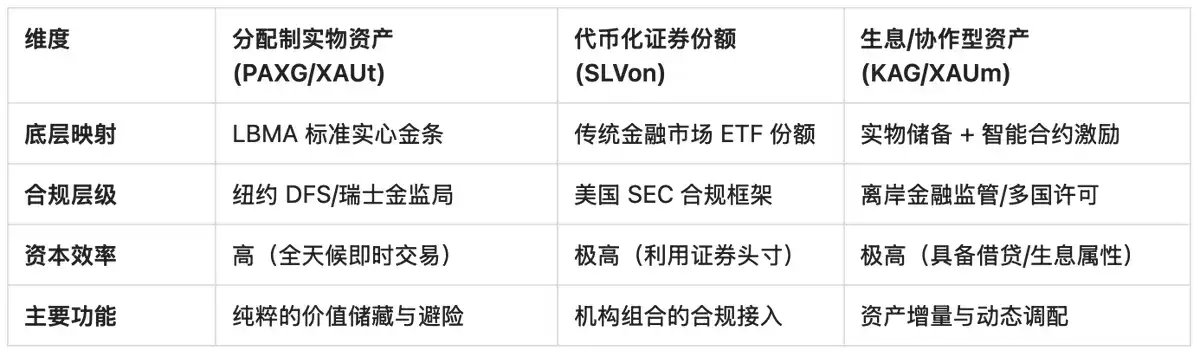
Based on research of current mainstream RWA projects, we can categorize on-chain precious metals into three complementary investment tracks according to their underlying structure and functional attributes, and explore their generational advantages over traditional models.
Category A: Digitized Form of Physical Holding (PAXG, XAUt, CGO)
The core logic of this track is the securitization of physical ownership through blockchain technology. Its advantages first manifest in extremely low operational thresholds and asset flexibility. Compared to the typical 3%-5% physical premium and high shipping/insurance costs associated with physical gold transactions, on-chain assets significantly reduce friction costs.
- Quantitative Support: Represented by Comtech Gold (CGO), it supports investments starting from 1 gram (approx. $160), whereas the standard entry threshold for institutional-grade vaults is typically 12.4 kilograms (delivery bar). According to January 2026 data, PAXG's 24-hour trading volume surged to $1.2 billion during the gold price volatility, proving the real demand from institutions for "second-level position replenishment" using on-chain assets during extreme fluctuations.
- Audit Premium: On-chain Proof of Reserve transforms the traditional quarterly spot checks into minute-by-minute logical verification. PAXG, combined with real-time reserve data provided by the Chainlink oracle, maintains its secondary market discount/premium consistently within ±0.1%, far superior to the buy-sell spreads in the physical market, which can fluctuate up to 2% during panic periods.
Category B: Tokenized Securitized Products (SLVon)
As an on-chain representation of traditional compliant financial products, SLVon (launched by Ondo Finance) demonstrates dimensional superiority in cross-market arbitrage and risk hedging. Its strategic value lies in introducing the stability of traditional securities assets into the 24-hour crypto trading logic.
- Quantitative Support: In early February 2026, when silver prices unexpectedly plummeted during U.S. market closure, the turnover rate of SLVon on-chain reached 45% of its total supply, while traditional iShares Silver Trust (SLV) holders could only passively wait for the U.S. market to open.
- Efficiency Comparison: Traditional ETF settlement cycles are T+1 or T+2, whereas SLVon, based on Solana or Ethereum layers, achieves instant settlement functionality. This means investors can immediately deploy funds from sold silver shares into DeFi protocols to capture short-term volatility opportunities yielding 15% or more, increasing capital turnover efficiency by more than 50 times compared to traditional brokerage accounts.
Category C: Yield-Bearing and High-Efficiency Collaborative Assets (KAG, XAUm)
This track彻底终结了 (completely ends) the history of zero yield on precious metals, transforming them into income-generating productive assets. In corrective markets, this positive yield characteristic acts as a buffer against price declines.
- Quantitative Support: The fee-sharing model employed by Kinesis Silver (KAG) provided holders with an average annual yield (Yield) of 1.8% - 3.2% in 2025, which not only covered the holding cost of gold but also achieved asset appreciation.
- Capital Reuse Rate: The performance of Matrixdock (XAUm) is even more significant. During this recent period of sharp gold price fluctuations, XAUm's Loan-to-Value (LTV) ratio remained at a稳健的 (robust) level of 85%. This means holders can borrow stablecoins for liquidity mining with yields above 10% without selling their gold positions. This strategy allows the internal rate of return (IRR) of the asset portfolio to maintain positive growth even during price corrections, demonstrating the collaborative depth of RWA assets in extreme market conditions.
3. Comprehensive Analysis of the Three Strategic Paths
4. Conclusion: Correction Periods are Opportunities for Asset Structure Upgrades
The market correction in early 2026 once again proves that the right to dispose of an asset is as important as ownership itself. The true value of on-chain assets lies in their provision of instant risk hedging tools during price declines, asset productivity during sideways movement, and seamless profit-taking channels during price increases.
For operators committed to building professional market analysis pages, emphasizing asset liquidity efficiency rather than单纯的 (mere) price predictions will be the core logic for establishing a professional barrier. The current price retracement provides a window to observe the liquidity performance of different on-chain metal projects under extreme stress tests, which holds significant reference value for establishing long-term, robust asset allocation plans.






