Giants Enter the Arena and Asset Restructuring: The Logic of On-Chain Investment Against the Backdrop of Precious Metals Volatility

marsbitPublicado a 2026-02-11Actualizado a 2026-02-11

Resumen

The entry of major financial institutions like HSBC and J.P. Morgan into tokenized gold, alongside significant investments in platforms like Ondo Finance and PAXG, marks a shift toward blockchain-based real-world assets (RWA). This trend is particularly relevant amid recent volatility in gold and silver markets, where prices experienced sharp corrections in early 2026. Tokenized precious metals offer three key advantages over traditional forms: 1) **Enhanced Liquidity**: Assets like PAXG enable 24/7 trading, avoiding the time and spatial constraints of physical gold trading. During recent price swings, PAXG’s trading volume surged to $1.2 billion, demonstrating demand for instant rebalancing. 2) **Operational Efficiency**: Tokenized securities such as Ondo’s SLVon allow immediate settlement and capital reuse, unlike traditional T+2 ETF settlements. During a silver price crash, SLVon saw 45% turnover while traditional markets were closed. 3) **Yield Generation**: Assets like KAG and XAUm offer yields (e.g., 1.8%–3.2% annually) and enable collateralization for additional DeFi yield opportunities, maintaining portfolio returns even during corrections. In summary, tokenized metals provide superior liquidity, efficiency, and utility—transforming gold and silver into dynamic, productive assets especially valuable during market stress.

When HSBC launched its distributed ledger gold platform and J.P. Morgan enabled cross-border collateral settlement of tokenized gold bars through the Onyx network, the restructuring of underlying assets initiated by traditional financial giants had already begun. This trend has found the most direct confirmation in the capital markets: Ondo Finance (SLVon) secured heavy investment from Peter Thiel's Founders Fund and Coinbase Ventures; meanwhile, PAXG, through its deep compliance partnerships with PayPal and Mastercard, has directly integrated the trust of traditional payment systems into the digital asset space.

This article uses recent market movements in gold and silver as a case study to illustrate why institutions are increasingly favoring tokenized assets.

Entering February 2026, the global gold and silver markets are undergoing a stress test. After gold prices peaked at $5,600 at the end of January, the market experienced a brutal long squeeze influenced by consecutive hawkish statements from Fed officials. As of yesterday (February 5th), spot gold, after a rebound, fell back into high volatility, currently retreating to around $4,980, failing to hold above the $5,000 mark; silver's trajectory was similarly turbulent, currently quoted at $86.5.

This vertical drop followed by a price correction has become the ultimate proving ground for RWA (Real World Asset) assets. It not only tests investors' holding endurance but also vividly reveals how on-chain investment, backed by industry giants, fundamentally enhances capital control, granting professional investors superior disposal efficiency in extreme market conditions compared to traditional physical assets.

1. The Liquidity Premium During Price Volatility

In traditional physical or paper gold trading, price corrections are accompanied by significant liquidity lag. Firstly, there is a dual constraint of time and space: physical gold buybacks are typically limited by business hours and physical location; even Gold ETFs cannot respond to selling waves triggered by macro news, such as the nomination of Kevin Warsh for Fed Chair, during weekends or non-trading hours.

Secondly, the two-way cost erosion is particularly pronounced during volatile periods. In traditional channels, buyback premiums often expand asymmetrically during price declines, meaning investors bear not only paper losses but also higher realization spreads. Coupled with the T+n settlement system of the traditional financial system, the ability to quickly rotate funds between asset classes is severely limited. In contrast, gold and silver assets within a Web3 architecture offer 24/7 instant settlement capability, a form of liquidity with极高的 risk avoidance value during corrective markets.

2. The Positioning and Deep Advantages of On-Chain Assets

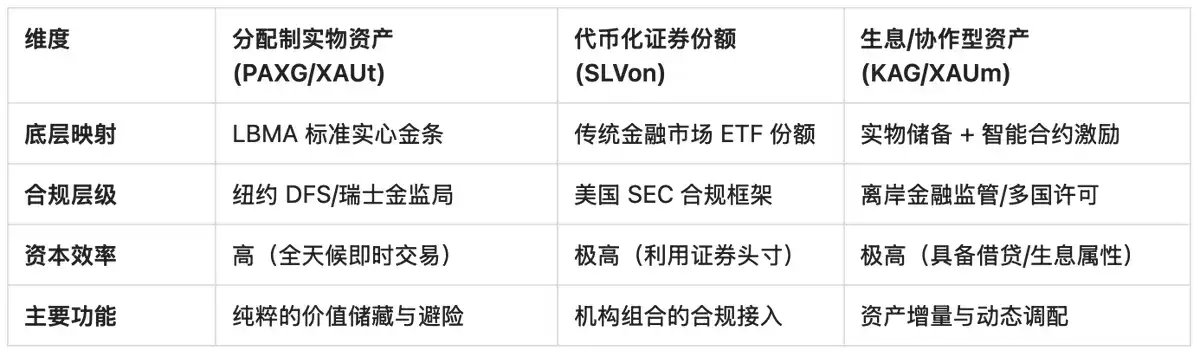
Based on research of current mainstream RWA projects, we can categorize on-chain precious metals into three complementary investment tracks according to their underlying structure and functional attributes, and explore their generational advantages over traditional models.

Category A: Digitized Form of Physical Holding (PAXG, XAUt, CGO)

The core logic of this track is the securitization of physical ownership through blockchain technology. Its advantages first manifest in extremely low operational thresholds and asset flexibility. Compared to the typical 3%-5% physical premium and high shipping/insurance costs associated with physical gold transactions, on-chain assets significantly reduce friction costs.

  • Quantitative Support: Represented by Comtech Gold (CGO), it supports investments starting from 1 gram (approx. $160), whereas the standard entry threshold for institutional-grade vaults is typically 12.4 kilograms (delivery bar). According to January 2026 data, PAXG's 24-hour trading volume surged to $1.2 billion during the gold price volatility, proving the real demand from institutions for "second-level position replenishment" using on-chain assets during extreme fluctuations.
  • Audit Premium: On-chain Proof of Reserve transforms the traditional quarterly spot checks into minute-by-minute logical verification. PAXG, combined with real-time reserve data provided by the Chainlink oracle, maintains its secondary market discount/premium consistently within ±0.1%, far superior to the buy-sell spreads in the physical market, which can fluctuate up to 2% during panic periods.

Category B: Tokenized Securitized Products (SLVon)

As an on-chain representation of traditional compliant financial products, SLVon (launched by Ondo Finance) demonstrates dimensional superiority in cross-market arbitrage and risk hedging. Its strategic value lies in introducing the stability of traditional securities assets into the 24-hour crypto trading logic.

  • Quantitative Support: In early February 2026, when silver prices unexpectedly plummeted during U.S. market closure, the turnover rate of SLVon on-chain reached 45% of its total supply, while traditional iShares Silver Trust (SLV) holders could only passively wait for the U.S. market to open.
  • Efficiency Comparison: Traditional ETF settlement cycles are T+1 or T+2, whereas SLVon, based on Solana or Ethereum layers, achieves instant settlement functionality. This means investors can immediately deploy funds from sold silver shares into DeFi protocols to capture short-term volatility opportunities yielding 15% or more, increasing capital turnover efficiency by more than 50 times compared to traditional brokerage accounts.

Category C: Yield-Bearing and High-Efficiency Collaborative Assets (KAG, XAUm)

This track彻底终结了 (completely ends) the history of zero yield on precious metals, transforming them into income-generating productive assets. In corrective markets, this positive yield characteristic acts as a buffer against price declines.

  • Quantitative Support: The fee-sharing model employed by Kinesis Silver (KAG) provided holders with an average annual yield (Yield) of 1.8% - 3.2% in 2025, which not only covered the holding cost of gold but also achieved asset appreciation.
  • Capital Reuse Rate: The performance of Matrixdock (XAUm) is even more significant. During this recent period of sharp gold price fluctuations, XAUm's Loan-to-Value (LTV) ratio remained at a稳健的 (robust) level of 85%. This means holders can borrow stablecoins for liquidity mining with yields above 10% without selling their gold positions. This strategy allows the internal rate of return (IRR) of the asset portfolio to maintain positive growth even during price corrections, demonstrating the collaborative depth of RWA assets in extreme market conditions.

3. Comprehensive Analysis of the Three Strategic Paths
4. Conclusion: Correction Periods are Opportunities for Asset Structure Upgrades

The market correction in early 2026 once again proves that the right to dispose of an asset is as important as ownership itself. The true value of on-chain assets lies in their provision of instant risk hedging tools during price declines, asset productivity during sideways movement, and seamless profit-taking channels during price increases.

For operators committed to building professional market analysis pages, emphasizing asset liquidity efficiency rather than单纯的 (mere) price predictions will be the core logic for establishing a professional barrier. The current price retracement provides a window to observe the liquidity performance of different on-chain metal projects under extreme stress tests, which holds significant reference value for establishing long-term, robust asset allocation plans.


Preguntas relacionadas

QWhat are the three main categories of on-chain precious metal assets discussed in the article, and what is the core advantage of each?

AThe three categories are: A) Digitized form of physical holdings (e.g., PAXG, XAUt, CGO), with the core advantage of low operational thresholds and asset flexibility; B) Tokenized securitized products (e.g., SLVon), with the core advantage of enabling cross-market arbitrage and 24/7 risk hedging; C) Yield-bearing and high-efficiency collaborative assets (e.g., KAG, XAUm), with the core advantage of generating cash flow and allowing for capital reuse through lending and yield farming.

QHow did the article quantify the liquidity advantage of a tokenized asset like PAXG during a period of price volatility?

AThe article stated that during the gold price volatility in January 2026, PAXG's 24-hour trading volume surged to $1.2 billion. This demonstrated the real institutional demand for using on-chain assets for 'second-level position replenishment' during extreme market swings.

QAccording to the article, what key limitation of traditional gold ETFs does a tokenized product like SLVon solve?

ASLVon solves the limitation of traditional ETFs being bound by market trading hours and T+1 or T+2 settlement cycles. For example, when the silver price crashed during a U.S. stock market closure, SLVon holders could trade immediately on-chain, while iShares Silver Trust (SLV) holders had to wait for the U.S. market to open.

QWhat specific benefit do yield-bearing RWA assets like KAG and XAUm provide during a market correction, as per the article?

ADuring a market correction, the yield provided by assets like KAG and XAUm acts as a buffer against price depreciation. For instance, KAG provided an annual yield of 1.8%-3.2% in 2025, and XAUm maintained a high loan-to-value (LTV) ratio of 85%, allowing holders to borrow stablecoins for liquidity mining without selling their gold positions, thus maintaining positive portfolio returns.

QWhat major event triggered the sharp correction in gold and silver prices at the beginning of 2026, as described in the article?

AThe sharp correction was triggered by hawkish comments from Federal Reserve officials, following gold prices reaching a peak of $5,600 at the end of January. This led to a severe long squeeze, causing prices to fall, with spot gold eventually retreating to around $4,980.

Lecturas Relacionadas

Annual Salary of Millions Competing for Electricians, Meta Rushes to Open Its Own Technical School

The AI boom is facing an unexpected bottleneck: a severe shortage of skilled construction workers and electricians. As tech giants like Meta, OpenAI, and Alphabet race to build massive data centers—such as OpenAI's $16 billion "Stargate" project—they are hitting a critical labor wall. The U.S. needs an estimated 130,000 more electricians, 240,000 construction workers, and 150,000 supervisors by 2030 for AI infrastructure alone, but tens of thousands of electrician jobs go unfilled each year. While AI companies offer high premiums, with electricians earning up to $280,000 annually, worker scarcity still causes massive losses—delays on a single project can cost $14.2 million per month. The complexity of building AI data centers, which require immense power (equivalent to powering hundreds of thousands of homes), sophisticated electrical systems, and advanced liquid cooling solutions, demands highly skilled technicians who are in short supply. To combat this, companies are investing heavily in training. Meta has committed $115 million to a free training school offering tuition, housing, and stipends, targeting 5,000 new workers. OpenAI is partnering with unions to secure skilled labor. These efforts are paying off, with a significant rise in Gen Z interest in trade schools over college. However, the power demands are staggering. AI data centers are driving a rapid surge in electricity consumption, projected to account for up to 12% of U.S. power use by 2028 and raising costs for consumers. Furthermore, the construction boom is project-based, leading to a potential future glut of trained workers once building peaks, which could depress wages industry-wide. The race for AI supremacy now depends as much on skilled hands as on advanced chips.

marsbitHace 6 min(s)

Annual Salary of Millions Competing for Electricians, Meta Rushes to Open Its Own Technical School

marsbitHace 6 min(s)

OpenAI No Longer Sells Its Most Expensive Model for Profit

OpenAI is shifting its business strategy away from promoting its most expensive, flagship models for every task. Recent price cuts—80% for GPT-5.6 Luna and 20% for Terra—signal a deeper change: the company now actively advises users that many tasks don't require the most powerful model. Instead, OpenAI recommends a tiered approach: use the high-end GPT-5.6 Sol for complex planning and analysis, then delegate execution to cheaper models like Luna. This mirrors moves by Anthropic, which recently launched Claude Opus 5 at half the price of its top model, Fable 5. Both companies are de-emphasizing flagship models as primary revenue drivers, using them instead for brand prestige and technological showcases. The industry is entering a "mass-market" phase, similar to automotive, where high-volume, cost-effective models handle daily operations and drive scale. OpenAI's price reductions are partly enabled by AI models themselves optimizing underlying code and infrastructure, creating a self-reinforcing cycle of efficiency gains and cost reduction. Competition is shifting from "who is smartest" to "who offers the best value." The goal is no longer selling individual models but fostering widespread API adoption and ecosystem lock-in. By making AI calls cheap and ubiquitous, companies like OpenAI aim to become the indispensable, utility-like infrastructure powering automated workflows—the "water and electricity" of software, quietly embedded everywhere.

marsbitHace 6 min(s)

OpenAI No Longer Sells Its Most Expensive Model for Profit

marsbitHace 6 min(s)

Will the Fed Definitely Raise Interest Rates in September? How Will Crypto and U.S. Stocks Withstand the Pressure?

The market's expectation for a September Fed rate hike surged dramatically in early August, jumping from under 50% to over 80% within a week. This shift followed a contentious July FOMC meeting, where a 9-3 vote to hold rates revealed growing dissent from hawkish members advocating for an immediate hike to combat persistent inflation. The primary catalyst for this repricing is rising oil prices, driven by renewed geopolitical tensions around the Strait of Hormuz, which threaten global supply. Energy costs directly influence inflation metrics, making the upcoming July CPI report (due August 12th) a critical data point. If it shows inflation reaccelerating, the probability of a September hike will solidify. For Bitcoin and crypto assets, this is typically bearish news. Bitcoin continues to behave as a high-beta, liquidity-sensitive risk asset. A rate hike raises the opportunity cost of holding non-yielding assets and could drive capital toward money markets, pressuring crypto prices in the short term. However, historical patterns suggest that if a hike is perceived as the end of a tightening cycle rather than the start, any negative price impact may be brief. U.S. stocks, particularly crypto-linked equities like Coinbase and growth-oriented tech stocks, are also vulnerable. Higher rates increase discount rates in valuation models, putting pressure on high-multiple companies. This coincides with a pivotal tech earnings season where investor focus has shifted from massive AI capital expenditure to tangible revenue and cash flow generation. Companies with negative cash flow and weak growth narratives could face heightened volatility if borrowing costs rise in September. In summary, a September Fed hike has evolved into a mainstream market scenario. Key factors to watch are oil prices, the July CPI report, and Fed communications, which will determine the final decision and its impact on volatile crypto and equity markets.

marsbitHace 17 min(s)

Will the Fed Definitely Raise Interest Rates in September? How Will Crypto and U.S. Stocks Withstand the Pressure?

marsbitHace 17 min(s)

Trading

Spot
活动图片




