Ghana Crypto Sandbox: SEC Kicks Off 12‑Month Regulated Trading Pilot

bitcoinistPublicado a 2026-03-11Actualizado a 2026-03-11

Resumen

Ghana's Securities and Exchange Commission (SEC) has launched a 12-month regulatory sandbox for Virtual Asset Service Providers (VASPs), marking the country's first operational step to formalize crypto trading. The pilot allows 11 approved firms—including exchanges, custodians, and tokenization projects—to operate under close regulatory supervision. Over the 12-month period, the SEC will monitor participant performance, investor behavior, and compliance with anti-money laundering standards. Firms deemed "market ready" after six months may transition to full licenses, while others can continue testing. The initiative aims to balance innovation with investor protection and market integrity, using real-world data to shape future crypto regulations in Ghana.

Ghana is launching a 12-month virtual-asset sandbox, the country’s first operational step to formalize crypto trading and related services.

A Regulatory Crypto Sandbox

On March 10, the Securities and Exchange Commission of Ghana (SEC) announced that it has finalized its regulatory sandbox framework for Virtual Asset Service Providers (VASPs), Bloomberg reports. The framework will allow 11 approved firms to pilot their products and services in a controlled environment under the direct oversight of the Commission, the announcement states. This new sandbox sits under Ghana’s recently enacted Virtual Asset Service Providers Act, 2025 (Act 1154), which sets the legal basis for licensing and monitoring crypto‐asset businesses in the country.

How The Sandbox Will Work

The official announcement details that the sandbox will run for 12 months, during which a limited group of approved Virtual Asset Service Providers (VASPs) can offer real products and services to users under close regulatory supervision. After the first 6 months, firms that are considered “market ready” and fully compliant may start transitioning toward full activity‐based licenses or registrations, while others can continue testing for the remainder of the period.

What It Means For Regulators

From the regulator’s perspective, the sandbox is a way to encourage innovation without sacrificing core objectives such as investor protection, market integrity, and AML/CFT standards. As stated in the announcement:

This sandbox period aims to support responsible innovation while strengthening investor protection, market integrity, and compliance with anti-money laundering and counter-terrorism financing standards.

Instead of relying only on theoretical impact assessments or industry lobbying, regulators can use the sandbox to gather real‐world data on investor behavior, platform resilience, and market abuse risks. The pilot will also allow the SEC to validate and refine detailed guidelines for each licensing category defined under the Virtual Asset Service Providers Act, 2025 (Act 1154), before opening the regime to the wider market. The announcements claims that “lessons from the pilot will inform future policy and licensing frameworks for virtual assets services”.

By limiting participation to a small, vetted group, the SEC can respond quickly to issues (e.g., security incidents, mis‐selling, liquidity problems) and adjust rules or technical requirements before granting full licenses.

What It Means For Participants

The SEC press released details the 11 firms that have been admitted in the pilot. The list includes tokenization projects, custodial services and exchanges, such as WhiteBit, a centralized exchange with spot trading, custody and fiat/crypto gateways.

The 11 participants must operate within predefined risk, disclosure, and compliance parameters, giving the regulator a controlled environment to observe how their trading, custody, and tokenization models behave in practice. The successful sandbox participants will effectively become the reference models for what a “good” licensed VASP should look like.

The 12‐month sandbox is a probation period: if they perform well, they move to full licensing; if they fall short, they risk being shut out of a regulated Ghanaian market once the framework is fully rolled out.

Ghana In The African Crypto Context

Multiple African countries are rolling out new crypto laws and sandbox regimes, with Ghana now joining peers like Zambia that are already testing crypto regulation technology to supervise services before they enter the market, signaling a broader African shift toward sandbox‐style oversight. Ghana, one of Africa’s biggest gold producers, is seeing a rapid virtual‐asset uptake, with local estimates suggesting millions of adults already trade crypto. Bitcoinist has also covered how Ghana’s central bank has been working on draft crypto rules to move the sector into a formal regulatory framework.

If the sandbox delivers clean data and limited incidents, Ghana could fast‐track a fully regulated environment for exchanges and tokenization platforms.
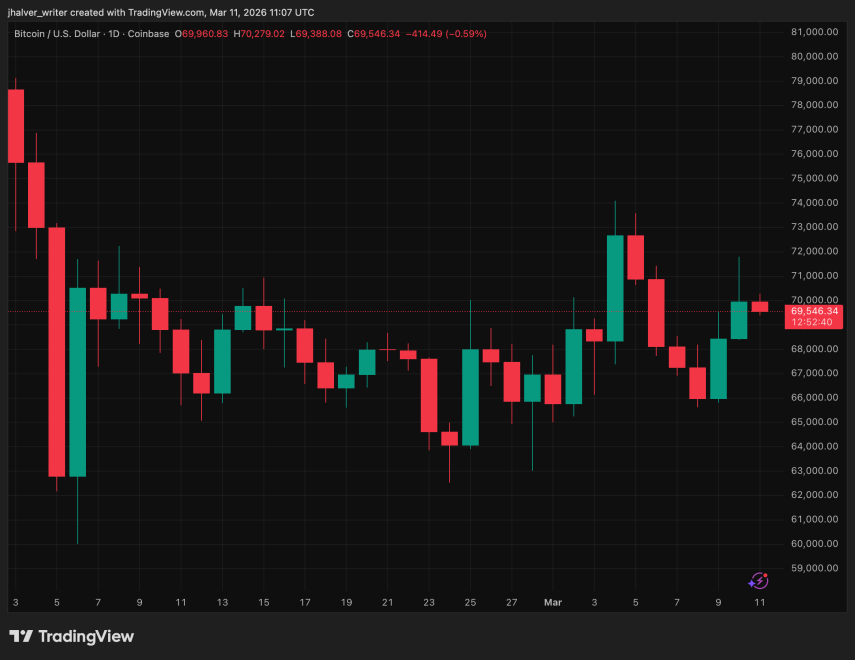
BTC’s price trends to the downside on the daily chart. Source: BTCUSD on Tradingview

Cover image from Perplexity, BTCUSD chart from Tradingview

Preguntas relacionadas

QWhat is the main purpose of Ghana's 12-month virtual-asset sandbox?

AThe main purpose is to formalize crypto trading and related services by allowing approved Virtual Asset Service Providers (VASPs) to pilot their products in a controlled environment under regulatory oversight, while ensuring investor protection, market integrity, and compliance with AML/CFT standards.

QHow many firms have been approved to participate in Ghana's crypto sandbox pilot?

A11 firms have been approved to participate in the crypto sandbox pilot.

QWhat happens to firms that are considered 'market ready' after the first 6 months of the sandbox?

AFirms considered 'market ready' and fully compliant after the first 6 months may start transitioning toward full activity-based licenses or registrations.

QWhich African country is mentioned as already testing crypto regulation technology similar to Ghana's approach?

AZambia is mentioned as a peer country that is already testing crypto regulation technology to supervise services before they enter the market.

QWhat legislation provides the legal basis for Ghana's Virtual Asset Service Providers sandbox?

AThe Virtual Asset Service Providers Act, 2025 (Act 1154) provides the legal basis for licensing and monitoring crypto-asset businesses and the regulatory sandbox in Ghana.

Lecturas Relacionadas

OpenAI Post-Training Engineer Weng Jiayi Proposes a New Paradigm Hypothesis for Agentic AI

OpenAI engineer Weng Jiayi's "Heuristic Learning" experiments propose a new paradigm for Agentic AI, suggesting that intelligent agents can improve not just by training neural networks, but also by autonomously writing and refining code based on environmental feedback. In the experiment, a coding agent (powered by Codex) was tasked with developing and maintaining a programmatic strategy for the Atari game Breakout. Starting from a basic prompt, the agent iteratively wrote code, ran the game, analyzed logs and video replays to identify failures, and then modified the code. Through this engineering loop of "code-run-debug-update," it evolved a pure Python heuristic strategy that achieved a perfect score of 864 in Breakout and performed competitively with deep reinforcement learning (RL) algorithms in MuJoCo control tasks like Ant and HalfCheetah. This approach, termed Heuristic Learning (HL), contrasts with Deep RL. In HL, experience is captured in readable, modifiable code, tests, logs, and configurations—a software system—rather than being encoded solely into opaque neural network weights. This offers potential advantages in explainability, auditability for safety-critical applications, easier integration of regression tests to combat catastrophic forgetting, and more efficient sample use in early learning stages, as demonstrated in broader tests on 57 Atari games. However, the blog acknowledges clear limitations. Programmatic strategies struggle with tasks requiring long-horizon planning or complex perception (e.g., Montezuma's Revenge), areas where neural networks excel. The future vision is a hybrid architecture: specialized neural networks for fast perception (System 1), HL systems for rules, safety, and local recovery (also System 1), and LLM agents providing high-level feedback and learning from the HL system's data (System 2). The core proposition is that in the era of capable coding agents, a significant portion of an AI's learned experience could be maintained as an auditable, evolving software system.

marsbitHace 26 min(s)

OpenAI Post-Training Engineer Weng Jiayi Proposes a New Paradigm Hypothesis for Agentic AI

marsbitHace 26 min(s)

Your Claude Will Dream Tonight, Don't Disturb It

This article explores the recent phenomenon of AI companies increasingly using anthropomorphic language—like "thinking," "memory," "hallucination," and now "dreaming"—to describe machine learning processes. Focusing on Anthropic's newly announced "Dreaming" feature for its Claude Agent platform, the piece explains that this function is essentially an automated, offline batch processing of an agent's operational logs. It analyzes past task sessions to identify patterns, optimize future actions, and consolidate learnings into a persistent memory system, akin to a form of reinforcement learning and self-correction. The article draws parallels to similar features in other AI agent systems like Hermes Agent and OpenClaw, which also implement mechanisms for reviewing historical data, extracting reusable "skills," and strengthening long-term memory. It notes a key difference from human dreaming: these AI "dreams" still consume computational resources and user tokens. Further context is provided by discussing the technical challenges of managing AI "memory" or context, highlighting the computational expense of large context windows and innovations like Subquadratic's new model claiming drastically longer contexts. The core critique argues that this strategic use of human-centric vocabulary does more than market products; it subtly reshapes user perception. By framing algorithms with terms associated with consciousness, companies blur the line between tool and autonomous entity. This linguistic shift can influence user expectations, tolerance for errors, and even perceptions of responsibility when systems fail, potentially diverting scrutiny from the companies and engineers behind the technology. The article concludes by speculating that terms like "daydreaming" for predictive task simulation might be next, continuing this trend of embedding the idea of an "inner life" into computational processes.

marsbitHace 28 min(s)

Your Claude Will Dream Tonight, Don't Disturb It

marsbitHace 28 min(s)

Trading

Spot
Futuros
活动图片





