Gemini, Winklevoss Twins Hit With Class-Action Lawsuit Over Post-IPO Strategy Pivot, Stock Decline

bitcoinistPublicado a 2026-03-21Actualizado a 2026-03-21

Resumen

Shareholders have filed a class action lawsuit in New York against crypto exchange Gemini, its co-founders the Winklevoss twins, and other executives. The suit alleges the company misled investors during its September 2025 IPO by presenting a growth strategy focused on expanding its user base and international presence. The complaint claims that just months after the IPO, Gemini abruptly pivoted its business model to prioritize prediction markets, announced a 25% workforce reduction, and exited key international markets in the UK, EU, and Australia. This "Gemini 2.0" strategy, announced in February 2026, allegedly caused the company's stock price to drop over 8%. The stock fell a further 12.9% following the departure of three senior executives and has declined more than 80% from its all-time high. The plaintiffs seek damages for significant losses suffered due to these alleged misleading statements and omissions.

Shareholders filed a class action lawsuit in New York against crypto exchange Gemini, co-founders Tyler and Cameron Winklevoss, and multiple executives, alleging that the exchange misled investors during its 2025 initial public offering (IPO).

Gemini Accused Of Misleading Investors

This week, crypto exchange Gemini and several executives were hit with a class action lawsuit for allegedly misleading investors before and after the exchange’s September 2025 IPO due to its strategy pivot.

Filed on Wednesday in the US District Court for the Southern District of New York, the complaint claims that the IPO documents were “negligently prepared and, as a result, contained untrue statements of material fact or omitted to state other facts necessary to make the statements made not misleading and were not prepared in accordance with the rules and regulations governing their preparation.”
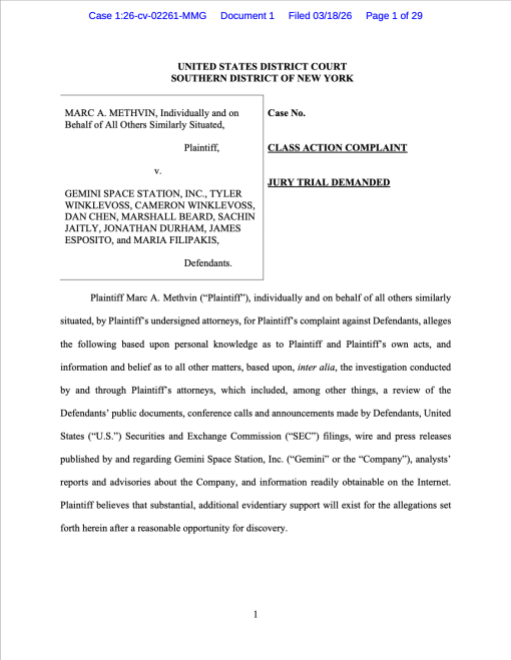
Shareholder files class action lawsuit agaisnt Gemini. Source: courtlistener

Gemini has primarily generated revenues through transactions, deposits, and fees charged to users of its crypto platform, the Plaintiff highlighted, noting that the IPO documents reportedly described the company’s revenue growth strategy as “predominantly focused on expanding [its] exchange platform via increased MTUs [monthly transacting users] (...) increased average daily trading volume, and increasing the number of assets available on [its] platform.”

The documents stated that Gemini would increase monthly transacting users through acquiring new retail and institutional users and expanding internationally.

Additionally, the lawsuit argues that throughout the Class Period, from September 12, 2025, to February 17, 2026, Gemini and its executives made statements that were “materially false” and misleading regarding the company’s business operations and prospects.

The ‘Gemini 2.0’ Strategy Pivot

The complaint emphasized the exchange “gave no indication that the Company was poised for an abrupt corporate pivot to a prediction-market-centric business model” or that it would abandon its international growth strategy just months after the IPO.

According to the lawsuit, “the truth began to emerge” in February 2026, when the crypto exchange co-founders, Tyler and Cameron Winklevoss, announced a corporate pivot to “Gemini 2.0.”

In a blog post, they described three crucial changes to the exchange’s operations: prediction market would be “more front and center in our experience”; its workforce would be reduced by 25%; and it would exit the UK, European Union (EU), and Australian markets.

The Winklevoss twins acknowledged the challenges Gemini has faced in the international market, arguing that the crypto exchange needed to simplify its structure to stay competitive.

However, the lawsuit alleges that, on this news, Gemini’s Class A common stock price fell 8.72%, to close at $6.70 per share on February 5, 2026. Similarly, it noted that the stock price fell 12.9% on February 17, 2026, on the news of the departure of three senior leaders.

Last month, the firm disclosed in a regulatory filing that Chief Operating Officer (COO) Marshall Beard, Chief Financial Officer (CFO) Dan Chen, and Chief Legal Officer (CLO) Tyler Meade were departing the company effective immediately.

In addition, the firm reported operating expenses of $520 million to $530 million, a 40% increase from the previous fiscal year, the lawsuit added. It’s worth noting that Gemini’s stock price briefly dropped to an all-time low of $5.51 on March 20, before bouncing to the $5.75 area. This represents a more than 80% drop from its September all-time high of $40.

“As a result of Defendants’ wrongful acts and omissions, and the precipitous decline in the market value of the Company’s securities, Plaintiff and other Class members have suffered significant losses and damages,” the lawsuit stated, seeking a jury trial and damages for investors who bought shares during the IPO and the Class Period.
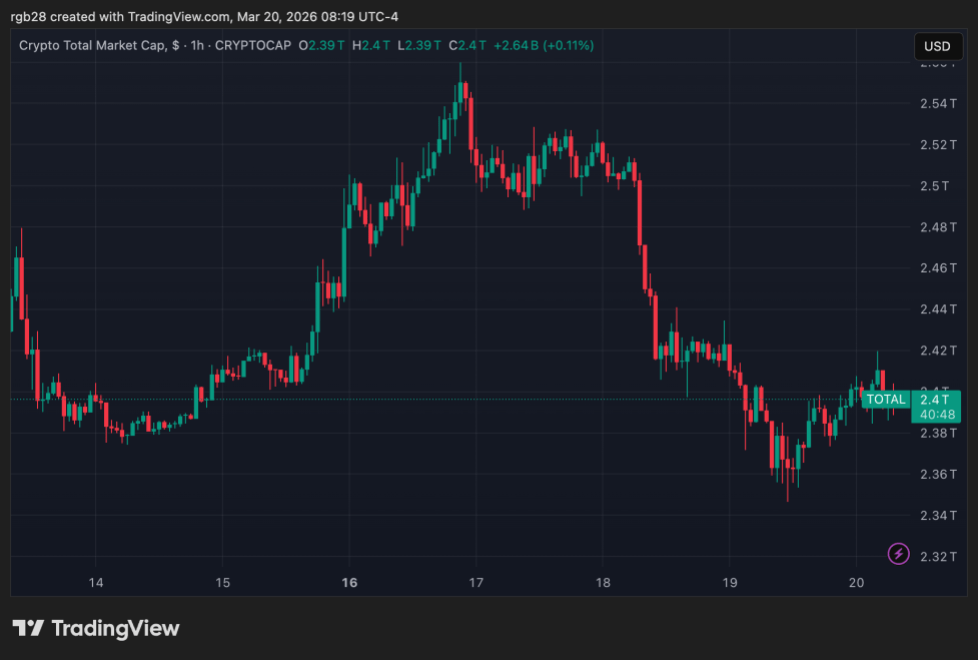
The total crypto market capitalization is at $2.4 trillion in the one-week chart. Source: TOTAL on TradingView


Preguntas relacionadas

QWhat is the main allegation in the class-action lawsuit filed against Gemini and the Winklevoss twins?

AThe lawsuit alleges that Gemini and its executives misled investors during its 2025 IPO by providing IPO documents that were 'negligently prepared' and contained untrue statements of material fact or omitted necessary facts, particularly concerning the company's business strategy and prospects.

QWhat was the 'Gemini 2.0' strategy pivot that triggered the lawsuit?

AThe 'Gemini 2.0' strategy pivot involved three major changes: making prediction markets more central to its platform, reducing its workforce by 25%, and exiting the UK, EU, and Australian markets, which represented an abrupt shift from the international growth strategy outlined in its IPO.

QHow did Gemini's stock price react to the announcement of the corporate pivot and the departure of senior leaders?

AGemini's Class A common stock price fell 8.72% to $6.70 per share on February 5, 2026, following the pivot announcement. It fell another 12.9% on February 17, 2026, on the news of the departure of three senior leaders, and later hit an all-time low of $5.51, representing an over 80% drop from its all-time high.

QWhich key executives were reported to have departed from Gemini, as mentioned in the lawsuit?

AThe departing executives were Chief Operating Officer (COO) Marshall Beard, Chief Financial Officer (CFO) Dan Chen, and Chief Legal Officer (CLO) Tyler Meade.

QWhat was the original revenue growth strategy for Gemini as described in its IPO documents?

AThe IPO documents described the company's revenue growth strategy as predominantly focused on expanding its exchange platform by increasing monthly transacting users (MTUs), increasing average daily trading volume, and increasing the number of assets available on its platform, primarily by acquiring new retail and institutional users and expanding internationally.

Lecturas Relacionadas

Polymarket's "2028 Presidential Election" Volume King Is... LeBron James???

An article from Odaily Planet Daily, authored by Azuma, discusses a peculiar phenomenon observed on the prediction market platform Polymarket regarding the "2028 US Presidential Election" event. Despite having a real-time probability of less than 1%, unlikely candidates such as NBA star LeBron James (with $48.41 million in trading volume), celebrity Kim Kardashian ($33.84 million), and even ineligible figures like Elon Musk ($23.14 million) and New York City Mayor Zohran Mamdani ($18.39 million) account for approximately 70% of the total trading volume. In contrast, high-probability candidates like Vice President JD Vance ($10.58 million), California Governor Gavin Newsom ($15.71 million), and Secretary of State Marco Rubio ($9.32 million) have significantly lower trading activity. The article explains that this counterintuitive trend is not driven by irrational speculation but by rational strategies. Polymarket offers a 4% annualized holding reward for certain markets, including the 2028 election, to maintain long-term pricing accuracy. This yield exceeds the current 5-year US Treasury rate (3.98%), attracting large investors ("whales") to hold "NO" shares on low-probability candidates for risk-free returns. Additionally, some users utilize a platform feature that allows converting a set of "NO" shares into corresponding "YES" shares for better liquidity or pricing efficiency, rather than directly buying "YES" shares for their preferred candidates. Thus, the seemingly absurd trading activity is strategically motivated.

marsbitHace 49 min(s)

Polymarket's "2028 Presidential Election" Volume King Is... LeBron James???

marsbitHace 49 min(s)

Dialogue with ViaBTC CEO Yang Haipo: Is the Essence of Blockchain a Libertarian Experiment?

"ViaBTC CEO Yang Haipo: Blockchain as a Hardcore Libertarian Experiment" In a deep-dive interview, ViaBTC CEO Yang Haipo reframes the essence of blockchain, arguing it is not merely a new technology or infrastructure but a hardcore libertarian experiment. This experiment, born from the 2008 financial crisis and decades of cypherpunk ideology, tests a fundamental question: to what extent can freedom and self-organization exist without centralized trust? The discussion highlights the experiment's verified outcomes. On one hand, it has proven its core value of censorship resistance, providing critical financial lifelines for entities like WikiLeaks and individuals in hyperinflationary or sanctioned countries via tools like stablecoins. However, Yang points out a key paradox: the most successful product, USDT, is itself a centralized compromise, showing users prioritize a less-controlled pipeline over pure decentralization. On the other hand, the experiment has exposed the severe costs of this freedom—a "dark forest" without safeguards. Events like the collapses of LUNA, Celsius, and FTX, resulting in massive wealth destruction and prison sentences for founders, underscore the system's fragility and the inherent risks of an unregulated environment. Yang observes that despite decentralized protocols, human nature inevitably recreates centralized power structures, speculative frenzies, and narrative-driven cycles (from ICOs to Meme coins), where emotion and belonging often trump technological substance. Looking forward, he believes blockchain's future is significant but niche. Its real value lies in serving specific, real-world needs for financial sovereignty and bypassing traditional controls, not as a universal infrastructure replacing all centralized systems. For the average participant, Yang's crucial advice is to cultivate independent judgment. True freedom is not holding a crypto wallet, but possessing a mind resilient to groupthink and narrative hype in a high-risk, often irrational market.

marsbitHace 1 hora(s)

Dialogue with ViaBTC CEO Yang Haipo: Is the Essence of Blockchain a Libertarian Experiment?

marsbitHace 1 hora(s)

Trading

Spot
Futuros
活动图片