Gemini nabs US license to offer prediction markets

cointelegraphPublicado a 2025-12-11Actualizado a 2025-12-11

Resumen

Crypto exchange Gemini, founded by the Winklevoss twins, has received a designated contract market license from the CFTC, allowing it to offer prediction markets in the US. Through its affiliate Gemini Titan, the company plans to let users trade event contracts and expand into crypto derivatives like futures and options. The announcement caused Gemini's stock to surge 13.7% in after-hours trading. The license marks the end of a five-year application process and could significantly boost the company, which has seen its stock decline since its public debut. President Cameron Winklevoss stated that prediction markets could potentially rival or exceed traditional capital markets in size.

Crypto exchange Gemini, founded by billionaire twins Tyler and Cameron Winklevoss, has scored a license from the Commodity Futures Trading Commission to offer prediction markets in the US.

Gemini said on Wednesday that its affiliate, Gemini Titan, received a designated contract market license from the CFTC and “plans to enter into the prediction markets space.”

The company said that “starting shortly,” its US users would be able to trade event contracts on its web platform and could expand its US derivatives offerings to include crypto futures, options, and perpetual contracts.

Gemini joins a number of crypto companies that have begun to offer prediction markets, allowing users to bet on the outcomes of a range of events, including sports and geopolitics.

Shares in Gemini (GEMI) shot up 13.7% in after-hours trading on Wednesday to $12.92 after ending the day’s trading session down 0.7%.
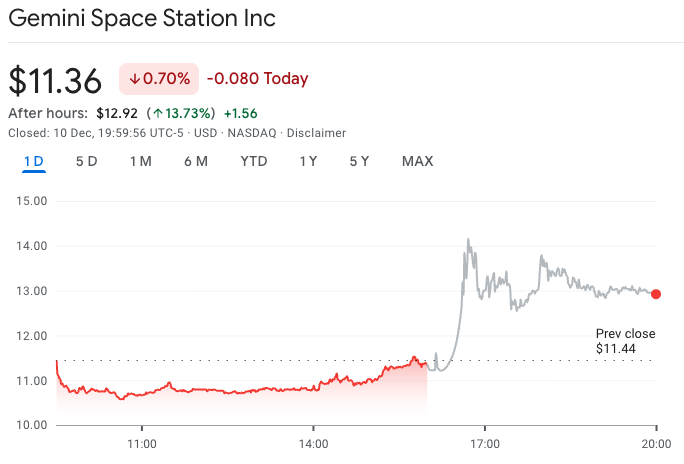
Shares in Gemini jumped on the company’s announcement that it will offer prediction markets. Source: Google Finance

The license could be a major boost for Gemini, whose stock is down 64.5% since its public debut on Sept. 12 as the crypto market has struggled to sustain a rally.

Related: ‘Elite’ traders hunt dopamine-seeking retail on prediction markets: 10x Research

“Prediction markets have the potential to be as big or bigger than traditional capital markets,” said Gemini’s president, Cameron Winklevoss.

Gemini CEO Tyler Winklevoss said it first applied for the license in March 2020, and the approval “marks the culmination of a 5-year licensing process and the beginning of a new chapter for Gemini.”

Magazine: Can Robinhood or Kraken’s tokenized stocks ever be truly decentralized?

Preguntas relacionadas

QWhat license did Gemini receive and from which US regulatory body?

AGemini received a designated contract market license from the Commodity Futures Trading Commission (CFTC).

QWhich Gemini affiliate was specifically granted the license to operate prediction markets?

AGemini Titan, an affiliate of the crypto exchange Gemini, was granted the license.

QHow did the announcement of the license affect Gemini's stock price in after-hours trading?

AGemini's stock (GEMI) shot up 13.7% in after-hours trading to $12.92.

QAccording to Cameron Winklevoss, how big does he believe prediction markets can become?

ACameron Winklevoss stated that prediction markets 'have the potential to be as big or bigger than traditional capital markets.'

QWhen did Gemini first apply for this license, according to CEO Tyler Winklevoss?

ACEO Tyler Winklevoss said the company first applied for the license in March 2020.

Lecturas Relacionadas

WEEX TradFi Trading Competition Kicks Off, 50,000 USDT Prize Pool First-Come, First-Served, Open a Position and Get 5 U

WEEX Exchange Launches "TradFi Trading Competition" with a 50,000 USDT Prize Pool Amidst a crypto market downturn, WEEX Exchange highlights the growth of tokenized traditional finance (TradFi) assets as a key trend, allowing users to trade stocks, ETFs, and commodities using crypto. The platform has launched a "TradFi Trading Competition" from July 9th to 23rd, featuring a 50,000 USDT prize pool. The campaign offers three reward tiers: 1. **New User Bonus (25,000 USDT pool):** New users depositing ≥100 USDT, completing a specified spot trade, and one TradFi contract trade (margin ≥10 USDT) receive 200 USDT. 2. **Volume-Based Rewards (20,000 USDT pool):** All users can earn tiered bonuses for achieving TradFi contract trading volumes of 5,000 USDT (3 USDT), 20,000 USDT (10 USDT), and 100,000 USDT (50 USDT). Rewards are stackable. 3. **Participation Reward:** Any user opening a TradFi contract trade during the event receives 5 USDT instantly. The article promotes WEEX's TradFi features, which include trading tokenized shares of companies like NVIDIA and Tesla using USDT, 24/7 trading, fractional share investing starting from $5, and high leverage up to 100x for hedging. It positions these features as solutions to traditional investing barriers like high fees, strict trading hours, and high share prices. The summary concludes by encouraging users to join the competition and leverage WEEX's platform to access global TradFi markets.

marsbitHace 1 hora(s)

WEEX TradFi Trading Competition Kicks Off, 50,000 USDT Prize Pool First-Come, First-Served, Open a Position and Get 5 U

marsbitHace 1 hora(s)

Switching Chains for Another Shot at Success: Can It Really 'Change One's Destiny'?

Recent months have witnessed a wave of established blockchain projects migrating to new public chains, notably Base and Arbitrum, coupled with strategic pivots in their business models—essentially "re-starting" elsewhere. Examples include Sophon (moving from ZKsync to Base to cut $3M+ annual costs and focus on consumer apps), Moonbeam (shifting from Polkadot to Base to pursue decentralized AI), and Secret Network (planning a move from Cosmos to Arbitrum to explore privacy-AI integrations, though its token price plunged 30% post-announcement). A common thread is that these migrating projects are primarily layer-1 or layer-2 chains now seeking relevance in AI and real-world consumer applications. This trend highlights the relative stagnation of ecosystems like Polkadot and Cosmos, which are seeing significant outflows. However, the community remains skeptical about whether such chain-hopping truly enables a turnaround. Historical cases like y00ts NFTs (which moved from Solana to Polygon and back to Ethereum) and Synthetix (which retreated from a multi-chain strategy) show that migration often fails to deliver expected benefits and can add complexity. In today's more rational market, devoid of easy narrative or airdrop红利, simply changing chains is unlikely to be a silver bullet. For both migrating projects and destination chains, the real challenge lies not in attracting projects but in developing actual use cases that retain users.

marsbitHace 1 hora(s)

Switching Chains for Another Shot at Success: Can It Really 'Change One's Destiny'?

marsbitHace 1 hora(s)

Trading

Spot
活动图片