Galaxy General: 34 Months Since Establishment, 6 Rounds of Financing Totaling 7 Billion: The Confidence and Concerns of the "Capital Harvester" in the Embodied AI Track

marsbitPublicado a 2026-09-11Actualizado a 2026-09-11

Resumen

Galaxy General Intelligence, founded by Peking University researcher Wang He in May 2023, has emerged as a top-funded player in China's Embodied AI sector, raising approximately 70 billion yuan across six funding rounds in just 34 months, with a valuation exceeding 200 billion yuan. The company's leadership features a "capital + industry" governance structure, with founder/CTO Wang He, AI model expert Zhang Zhizheng, and Chairman Yin Fangming. It adopts a "heavy brain, light body" strategy, focusing on its core AstraBrain embodied AI model while utilizing third-party hardware like Unitree's. Key products include the industrial Galbot S1, service-oriented Galbot G1, and the home-use ET1 robot. Commercial deployments include partnerships with CATL for factory automation and expansion of "Galaxy Space Pod" convenience stores. Its funding evolution mirrors the sector's shift: early VC backing from firms like Matrix Partners transitioned to heavy participation from state-owned capital (e.g., National AI Industry Investment Fund, CNOOC Capital) and strategic industrial investors (e.g., CATL, SAIC, China Mobile). This reflects the market's view of Embodied AI as a strategic national priority. However, concerns persist. The rapid fundraising pace creates pressure to continuously justify valuation with milestones. Heavy state capital involvement brings strategic support but may constrain governance and complicate future public market valuation logic. Questions remain about whether ...

In May 2023, Peking University researcher Wang He founded a robotics company named "Galaxy General." At that time, embodied AI in China was still a seed in the making. Three years later, this company has cumulatively raised approximately 7 billion RMB in financing, with its valuation surpassing 20 billion RMB, making it the company with the highest financing in China's embodied AI field.

This is not merely a simple story of "technological entrepreneurship"; it resembles more of a multi-layered game revolving around technological narratives, capital strategies, and industry expectations.

Who is at the Helm?

In public accounts, the central figure of Galaxy General is founder and CTO Wang He. He holds a Stanford Ph.D. and is currently a researcher at Peking University, a Boya Young Scholar, and a national-level high-caliber overseas talent. Before entrepreneurship, Wang He had long been deeply involved in the fields of embodied AI and robotic manipulation, making him one of the few founders in this track with both top-tier academic credentials and industrial ambition.

Co-founder Zhang Zhizheng is responsible for the large model direction. He led the construction of the "Galaxy Star Data" ultra-large-scale embodied AI dataset and is also the deputy director of the Beijing Key Laboratory of Embodied AI Large Models.

Notably, there has been a change in the Chairman position.

In July 2026, Galaxy General underwent a management change: 10 management personnel, including former Chairman Guo Xiaoliang, exited, while 9 new members joined, with Yin Fangming taking over as Chairman.

According to public information, Yin Fangming's career spans MediaTek, Sogou, and 360. He founded the robotics company ROOBO, turned to investment after exiting, with his most notable investment being the angel round of Unitree.

This personnel arrangement itself is a signal—Galaxy General is transitioning from a "founder-driven" structure to a "capital + industry" hybrid governance model.

The academic committee is led by Chinese Academy of Engineering academician Gao Wen, with members covering top-tier scholars in China's embodied AI field such as Zhang Jianwei, Zeng Wenjun, Wang Tianmiao, and Chen Baoquan. This lineup carries substantial weight at the academic level.

Product Strategy: Prioritize the Brain, Lightweight Body

Galaxy General has chosen a route distinctly different from Unitree's—"Prioritize the Brain, Lightweight Body."

The company's technological core is its self-developed end-to-end embodied large model, "Galaxy Star Brain" (AstraBrain), constructing a complete closed loop of "Brain—Cerebellum—Neural Control."

At the cognitive level, it launched the world's first general-purpose brain base model, AstraBrain WAM 0.5, unifying the Vision-Language-Action and World Model pathways. At the motion control level, AstraBrain-WBC 0.5 reached the scale of GPT-1, for the first time validating the Scaling Law in the field of motion control.

In March 2026, the team achieved the world's first instance of a humanoid robot playing tennis autonomously—the robot could autonomously complete ball recognition, trajectory prediction, full-body balance control, and continuous hitting. Elon Musk called it the "AlphaGo moment for embodied AI."

At the hardware level, Galaxy General is not fixated on developing the robot body from scratch, but instead uses mature hardware solutions from companies like Unitree as carriers.

In 2025, Galaxy General contributed over 18 million RMB in sales to Unitree.

The advantage of this strategy is concentrating resources on algorithms and data, avoiding the long cycles of hardware R&D that can hinder iteration speed. The trade-off is the lack of proprietary barriers at the hardware body level, with core competitiveness highly dependent on the actual generalization capabilities of the large models.

Galaxy's current product line includes three models: the heavy-duty industrial robot Galbot S1 (priced around 1.05 million RMB on JD.com), the wheeled dual-arm robot for general services Galbot G1 (around 700,000 RMB), and the bipedal robot for home scenarios "Galaxy Star Kid" ET1 (in pre-sale stage) released in August 2026.

Among these, the G1 appeared on the stage of the CCTV Spring Festival Gala in 2026, partnering with Shen Teng and Ma Li, and overnight became the "Spring Festival Gala Robot."

In terms of commercial deployment, the S1 has entered CATL's battery factory achieving 7×24 hours of normalized operation. The G1 is being deployed in retail, pharmacy, and medical scenarios, with "Galaxy Space Capsule" convenience stores having landed in over 40 cities with more than 170 outlets. Furthermore, Galaxy General signed a global strategic cooperation agreement with Ningjia Service, a subsidiary of CATL, where its 1300+ service stations will undertake the installation, deployment, operation, maintenance, and repair of Galaxy General's robots.

Financing Journey: A "Relay Race" from VC to State Capital

The financing journey of Galaxy General itself serves as a microcosm of the capital evolution in the embodied AI track.
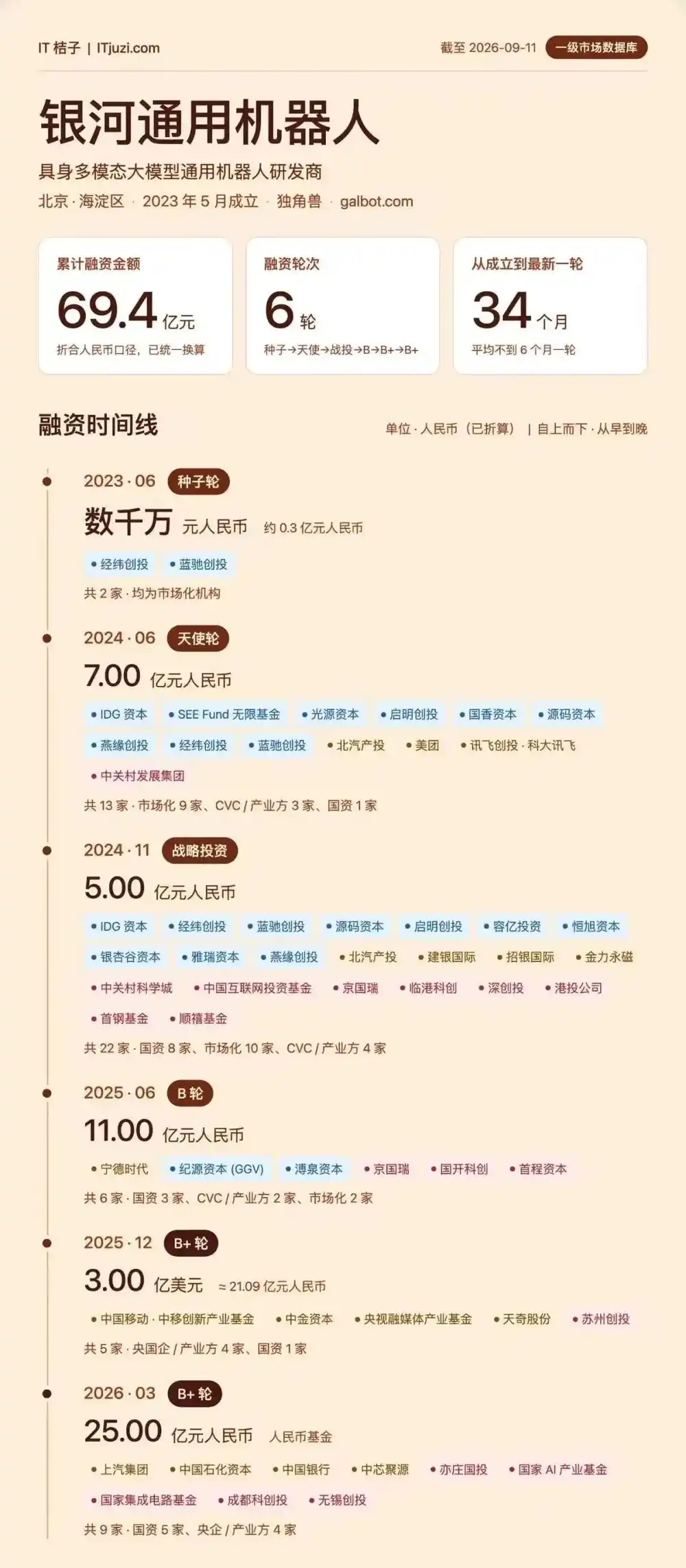
June 2023, Seed Round—tens of millions of RMB, with two market-oriented institutions, Matrix Partners China and Lanchi Ventures, joining. This represents the most classic early-stage VC logic: betting on founder background and technical direction.

June 2024, Angel Round—700 million RMB, with the investor lineup expanding dramatically. Nine market-oriented institutions including IDG Capital, SEE Fund, Lighthouse Capital, Qiming Venture Partners, Guoxiang Capital, Source Code Capital, and Yanyuan Capital joined. Simultaneously, three industrial strategic investors—Meituan, iFlytek Capital, and BAIC Group's industrial investment arm—participated, along with Zhongguancun Development Group as the first state-owned capital entity. The 700 million scale was already at the top tier in the robotics sector at the time.

November 2024, Strategic Investment—500 million RMB, with 22 investors rushing in. The key change in this round was the concentrated entry of state-owned capital: eight state-owned institutions including Shenzhen Capital Group, Zhongguancun Science City, China Internet Investment Fund, Jing Guorui, Lingang Science & Technology Venture Capital, Port Investment Company, Shougang Fund, and Shunxi Fund entered. Coupled with industrial strategic investors like CCB International, CMBI, and JL Mag Rare-Earth, along with existing shareholders continuing to invest, state-owned and quasi-state-owned investors already constituted over half of the investor composition in this round.

June 2025, Series B—1.1 billion RMB. CATL and GGV Capital joined, with Jing Guorui and CDB Capital continuing to invest. CATL's first-time entry was particularly crucial—it not only acted as a financial investor but also directly brought thousand-unit level robot orders and subsequent global after-sales service cooperation.

December 2025, Series B+—over 300 million USD (approximately 2.1 billion RMB). China Mobile, CICC Capital, CCTV Media Convergence Industry Fund, Tianqi Shares, and Suzhou Venture Capital entered. The leading role of central and state-owned enterprises and national-level funds further increased.

March 2026, Series B++—2.5 billion RMB. Nine investors including the National AI Industry Investment Fund, Sinopec Capital, CITIC Group, Bank of China, SAIC Motor, and SMIC Capital participated. State-owned capital and central state-owned enterprises dominated this round—five state-owned funds (National AI Industry Fund, National Integrated Circuit Industry Fund, Yizhuang State-Owned Capital Operation, Chengdu Science and Technology Innovation Investment Group, Wuxi Venture Capital), plus four central state-owned enterprises/industrial strategic investors.

34 months, 6 financing rounds, cumulatively approximately 7 billion RMB. After deduplication across all rounds, there are about 47 investors: around 15 market-oriented institutions, around 17 state-owned/government-guided funds, and around 15 industrial strategic investors/CVCs.
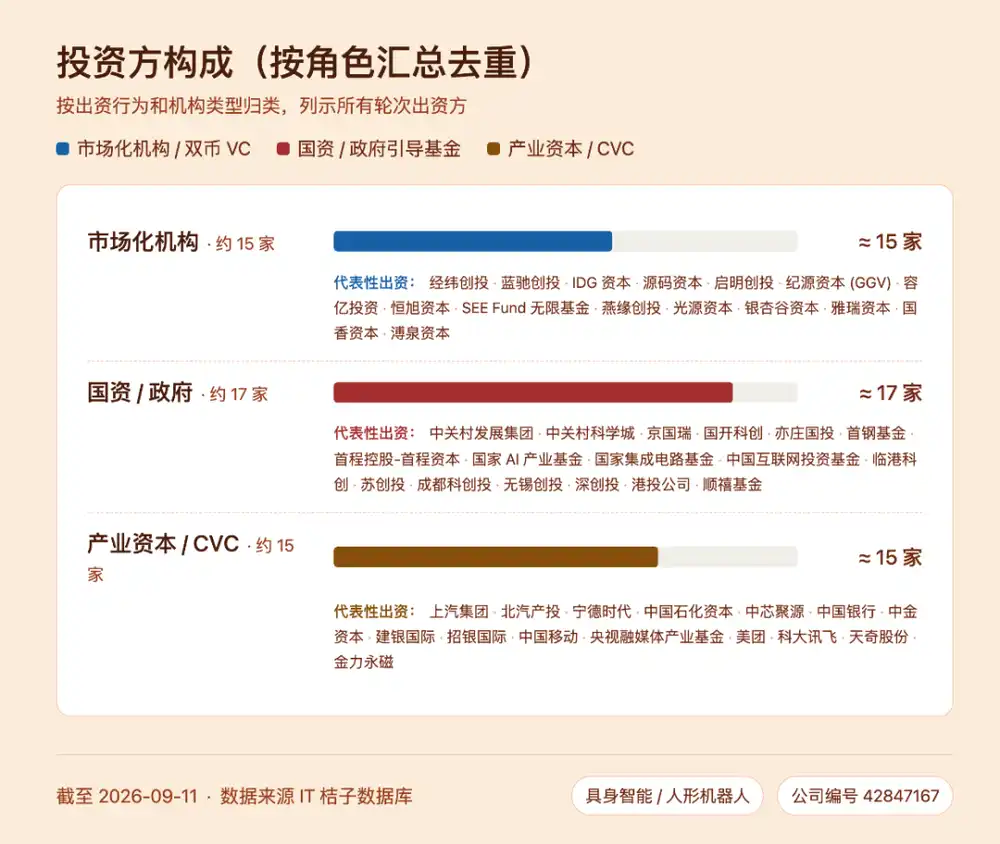
From being led by early-stage market-oriented VCs, to a massive influx of state-owned capital in the mid-phase, to recent national-level industry funds and central state-owned enterprises becoming the main force—this path clearly reflects the evolving judgment of the capital market on China's embodied AI track: from a "technological direction worth betting on" to a "strategic high ground that needs to be captured."

Cold Reflection: Amid Confidence, Where Lie the Concerns?

First, high-frequency financing implies sustained pressure to deliver.

With an average of less than six months between financing rounds, each round requires delivering new milestones to support the valuation leap. From the team and direction in the seed round, to the product prototype in the angel round, to industrial customers in the strategic round, and on to the national-level laboratory in the Series B round—Galaxy General has indeed managed to have a "new story to tell" for each round.

But after the stories are told, the next question to answer is even more brutal: can revenue scale match a valuation exceeding 20 billion RMB?

Second, the "state-ownership" shift in the investor structure is a double-edged sword.

The substantial entry of state-owned capital provides Galaxy General with credit endorsements, scenario resources (such as order synergy from CATL and China Mobile), and policy support.

However, state-owned capital's requirements for exit certainty, asset security, and audit compliance will also impose constraints on corporate governance and strategic choices. More importantly, when a company's financing body shifts from being dominated by "market-oriented VC investment" to "state-owned capital + national-level funds," the valuation logic has already begun to change—from "venture capital return expectations" to "national strategic asset allocation." The convergence of these two valuation systems will face tests when the company goes public in the future.

Third, the "investment-driven order" model of industrial capital needs validation.

The entry of industrial strategic investors like CATL, SAIC, China Mobile, and Sinopec could theoretically bring orders and customers to Galaxy General.

However, currently verifiable, scaled commercial revenue remains limited—the G1 sells for about 700,000 RMB, the S1 for about 1.05 million RMB. Even with cumulative deliveries in the hundreds of units, the multiple relationship with the 20 billion RMB valuation remains staggering.

Whether industrial capital investment truly translates into sustainable commercial revenue, rather than merely serving as a valuation endorsement, is a point requiring continuous tracking.

Fourth, industry controversy has already emerged.

On September 10, 2026, Shao Tianlan, founder of Hong Kong-listed company Mech-Mind, publicly questioned the business models of some embodied AI companies on his WeChat Moments, stating that some "high-profile, high-valuation companies that appeared on the Spring Festival Gala" create revenue through methods like "data collection centers" and related-party transactions, and promote IPOs with the help of local governments and state-owned capital investments, directly pointing to Galaxy General.

Galaxy General subsequently issued a statement in response, emphasizing the company's adherence to genuine R&D, real scenarios, and authentic commercial closed loops. The merits of this controversy await the test of time, but it reflects an industry-wide issue: when embodied AI moves from high valuations in the primary market to public scrutiny in the secondary market, commercialization capability will become the watershed.

Galaxy General is not an isolated case; it is a typical sample of the capital frenzy in China's embodied AI track from 2023 to 2026. The pace of raising 7 billion RMB in 34 months reflects not just market recognition of this particular company, but the overheated state of the entire track driven jointly by policy expectations, technological narratives, and capital momentum. When the fever subsides and commercialization becomes the hard metric, those who can truly stand firm will find the answer not in financing rounds, but in every real operation on production lines, in pharmacies, and in convenience stores.

This article is from WeChat public account: IT Juzi , Author: Judy, Original Title: "Galaxy General: 34 Months Since Establishment, 6 Rounds of Financing Totaling 7 Billion—The Confidence and Concerns of the 'Capital Harvester' in the Embodied AI Track"


Preguntas relacionadas

QWho is the core founding team of Galaxy Universal, and what are their backgrounds?

AThe core founding team includes Founder and CTO Wang He, a researcher at Peking University with a Stanford Ph.D. background, specializing in embodied intelligence and robotics. Co-founder Zhang Zhizheng leads the large model direction and the development of the "Galaxy Star Data" dataset. Chairman Yin Fangming, who took over in July 2026, has a career spanning companies like MediaTek, Sogou, and 360, and previously founded the robotics company ROOBO. The academic committee is led by academician Gao Wen.

QWhat is Galaxy Universal's core product strategy, and how does it differ from companies like Unitree?

AGalaxy Universal's strategy is "heavy on the brain, light on the body." It focuses on developing its core "AstraBrain" end-to-end embodied large model, forming a complete "brain-cerebellum-neural control" closed loop. Instead of developing hardware from scratch, it uses mature hardware solutions from partners like Unitree as carriers. This allows it to concentrate resources on algorithms and data, avoiding the long cycles of hardware R&D.

QDescribe the evolution of Galaxy Universal's funding sources over its 6 financing rounds.

AGalaxy Universal's funding evolved from market-driven VCs to a dominance of state capital. The early seed and angel rounds were led by venture capital firms like Matrix Partners and IDG Capital. From the strategic investment round onward, state-owned capital and government guidance funds (e.g., Shenzhen Capital Group, China Internet Investment Fund) began pouring in. The later B+ and B++ rounds were dominated by national-level industrial funds (e.g., National AI Industry Investment Fund) and central state-owned enterprises (e.g., China Petrochemical Capital, SAIC Motor).

QWhat are the main concerns or potential risks highlighted for Galaxy Universal in the article?

AKey concerns include: 1) The pressure to continuously deliver new milestones to justify rapid valuation increases. 2) The double-edged nature of heavy state capital involvement, which provides support but also imposes governance constraints and shifts valuation logic. 3) The need to verify whether investments from industrial partners (like CATL) translate into sustainable commercial revenue, not just valuation support. 4) Industry controversy over business model authenticity and commercialization capabilities, as exemplified by public criticism from a competitor's founder.

QWhat significant technical achievement did Galaxy Universal accomplish in March 2026, and how was it recognized?

AIn March 2026, Galaxy Universal's team achieved the world's first instance of a humanoid robot autonomously playing tennis. The robot could independently complete ball recognition, trajectory prediction, whole-body balance control, and continuous hitting. Elon Musk referred to this achievement as the "AlphaGo moment for embodied intelligence."

Lecturas Relacionadas

Founders Fund Leads $5 Million Token Purchase of ANVL: What Exactly is This "Non-Lending" DeFi Protocol Doing?

On October 6th, Founders Fund, led by Peter Thiel, invested $5 million to purchase ANVL tokens from the DeFi protocol Anvil's treasury. The round included participation from Pantera Capital and others, alongside angel investors like Compound founder Robert Leshner. Anvil is not a lending protocol. Instead, users lock assets like ETH or USDC into its vault to generate a verifiable on-chain "Letter of Credit" (LOC). This LOC acts as an economic guarantee, proving the user has sufficient locked collateral to back financial commitments, without borrowing funds. The protocol applies this mechanism to use cases like payment guarantees for merchants (via integration with Flexa) and enabling instant deposits for traders on exchanges like Bullish. Anvil's economic model is unique: it charges zero protocol fees. Its native token, ANVL, derives value solely from governance rights over parameters like supported collateral types. The total supply is 100 billion tokens. Despite an 83% price surge on the investment news, ANVL remains down approximately 89% from its all-time high. The protocol's Total Value Locked (TVL) has also fallen about 87% from its peak of ~$109 million in July 2025 to around $14 million currently. The investment represents a strategic bet that on-chain credit guarantees could become a significant category. Key factors to watch include the rate of real enterprise adoption through Anvil's SDK, the long-term sustainability of its zero-fee model, and the broader migration of traditional trade finance needs to blockchain infrastructure.

marsbitHace 35 min(s)

Founders Fund Leads $5 Million Token Purchase of ANVL: What Exactly is This "Non-Lending" DeFi Protocol Doing?

marsbitHace 35 min(s)

Mathematical Explosion: OpenAI Overnight Solves 722 Math Problems, Quasi-Riemann Hypothesis Proven

OpenAI has stunned the global mathematics and AI communities by releasing a GitHub repository containing 722 manuscripts addressing 372 previously unresolved major mathematical problem families, all reportedly generated by an unreleased internal AI model. The announcement, made without prior peer review, has provoked both excitement and alarm among mathematicians. The most notable breakthrough claims to be a proof of a "quasi-Riemann Hypothesis," establishing a zero-free region for Dirichlet L-functions with real part greater than 7/8 and eliminating the Landau-Siegel zeros—a significant leap in analytic number theory. The work has reportedly undergone formal verification using Lean. Other highlighted results include: unconditionally proving the NP-hardness of the basic semidefinite programming (SDP) threshold for approximation algorithms, based solely on P ≠ NP and circumventing the Unique Games Conjecture; proving the rational Hodge conjecture for abelian varieties with complex multiplication (CM); and resolving both the symmetric and asymmetric Mahler conjectures in convex geometry. According to OpenAI, most proofs were generated automatically by the model, with an average "thinking" time of just three hours per problem. This unprecedented scale and speed have sparked intense debate about the future of human mathematicians. While some express fear about the concentration of intellectual power, others see it as the dawn of a new era of discovery driven by AI. The mathematical world is now tasked with scrutinizing these claims, which, if verified, would represent historic milestones.

marsbitHace 1 hora(s)

Mathematical Explosion: OpenAI Overnight Solves 722 Math Problems, Quasi-Riemann Hypothesis Proven

marsbitHace 1 hora(s)

As Midterm Elections Approach, the Real Trade in U.S. Stocks Isn't About Who Wins

With the US midterm elections approaching in early November, political uncertainty has re-emenrged as a market variable. While market participants are weighing potential shifts in congressional control and policy direction, historical data suggests midterm elections themselves are not a definitive negative catalyst for US equities. Since 1937, the S&P 500 has averaged a positive gain of 9.2% in midterm election years, though this lags behind the 13.3% average for non-election years. A more consistent historical pattern is increased market volatility and a tendency for stronger performance concentrated in the fourth quarter, as political uncertainty is resolved. The article, citing analysis from J.P. Morgan and Capital Group, argues that the market's primary concern is policy path uncertainty rather than which party wins. This uncertainty tends to depress markets in the run-up to the vote, with a potential rebound afterward as the political risk premium dissipates. However, the article cautions against attributing market performance solely to the election. Recent midterm years like 2018 and 2022 saw significant market declines primarily driven by factors like Federal Reserve tightening and inflation, not the election outcome itself. The core argument is that the midterm election's impact on markets is often secondary to more fundamental drivers. Regardless of whether the result is a unified or divided government, the market's longer-term trajectory has historically been determined by underlying economic conditions. For the current environment, the key variables to watch post-election are not political labels but the path of interest rates, corporate earnings trends, and whether any actual policy changes materially alter cash flow expectations for businesses. The election may influence sentiment and policy expectations, but the sustainability of any year-end rally will ultimately depend on these core fundamentals of profitability, rates, and economic data.

marsbitHace 1 hora(s)

As Midterm Elections Approach, the Real Trade in U.S. Stocks Isn't About Who Wins

marsbitHace 1 hora(s)

AI Can't Change 'DNA': How Long Can SanDisk Stay Strong?

**AI Cannot Alter the "DNA": How Much Longer Can Western Digital's Run Last?** This analysis examines the sustainability of the current "super cycle" for NAND flash memory, driven by AI, with a focus on Western Digital (WD). The core argument is that while AI demand has fundamentally shifted NAND's role from a data warehouse to an essential component on the compute path, especially for AI inference, this does not eliminate the industry's cyclical nature. The piece first assesses the supply-demand dynamics. On the supply side, major producers are showing capital expenditure restraint for NAND, prioritizing DRAM/HBM. Capacity growth through 2028 relies heavily on technological upgrades (increasing 3D layers to 300+) and expansion primarily from China's YMTC, rather than new fabs. Global new fab capacity from players like Samsung and WD/Kioxia is concentrated post-2029. This results in estimated bit supply growth (CAGR ~24% for 2026-2028) largely driven by higher per-wafer output. Demand is undergoing a structural shift. AI-related NAND demand (for data lakes, KV cache, and staging) is forecast to grow at a 75% CAGR from 2025-2028, becoming the dominant driver. Data center demand will surpass 50% of total NAND demand in 2026. Consumer demand (PC, smartphone) is being squeezed and is expected to decline or stagnate. A key 2027 demand catalyst is NVIDIA's Rubin platform with its dedicated contextual memory storage (ICMS). The analysis concludes that a supply-demand deficit will persist into 2027. However, 2028 is identified as a potential inflection point where supply (led by YMTC's new fab) could outpace demand, ending the price rally. For Western Digital, the analysis models a more conservative path than management's guidance. It forecasts Average Selling Price (ASP) peaking in FY28 (ending June 2028) before declining in FY29-30 as the market loosens, though supported by long-term agreements (LTAs) and a higher mix of data center products. Consequently, margins and profits are expected to peak in FY28 and then contract. The valuation suggests WD's current price largely reflects a neutral scenario, with limited short-term upside unless the market becomes convinced that prices will remain stable post-2028. The fundamental takeaway is that despite AI's transformative impact, NAND's cyclical "DNA" remains intact.

marsbitHace 1 hora(s)

AI Can't Change 'DNA': How Long Can SanDisk Stay Strong?

marsbitHace 1 hora(s)

Trading

Spot
活动图片