From Precious Metals to U.S. Stocks: Crypto Platforms Are Reshaping Global Asset Pricing Power

marsbitPublicado a 2026-03-17Actualizado a 2026-03-17

Resumen

Amidst geopolitical tensions and attacks on Middle Eastern facilities, cryptocurrency platforms are rapidly gaining influence in global asset pricing, particularly for commodities like oil. While traditional markets were closed over a weekend, platforms such as MEXC saw surging activity in WTI oil perpetual futures, with prices to spike ahead of formal market reopenings. These crypto-based perpetual contracts—leveraged, speculative, and operating 24/7—allow instant reactions to breaking news, attracting a new generation of traders unwilling to wait for conventional exchanges. The trend extends beyond oil. Tokenized stocks and perpetual contracts for assets like gold, silver, and U.S. equities (e.g., AMD) are increasingly available on crypto exchanges, appealing to investors seeking real-time responsiveness. This shift highlights a broader movement toward digitized, continuous trading, challenging traditional market hours and structures. However, this high-leverage, always-on model carries significant risks, including extreme volatility and forced liquidations. Despite these challenges, the integration of crypto mechanisms into traditional finance appears inevitable, positioning crypto platforms at the forefront of a new, borderless financial paradigm.

When geopolitical black swans take flight on weekends, traditional financial market investors often find themselves helpless. Recently, attacks on facilities in the UAE and other regions have intensified oil price volatility. Since the U.S. and Israel launched airstrikes against Iran, numerous traders have flocked to crypto platforms to trade oil perpetual contracts. While traditional energy investors were counting down the hours last weekend, waiting for the futures market to reopen on Sunday, overseas cryptocurrency traders had already begun betting on oil price trends.
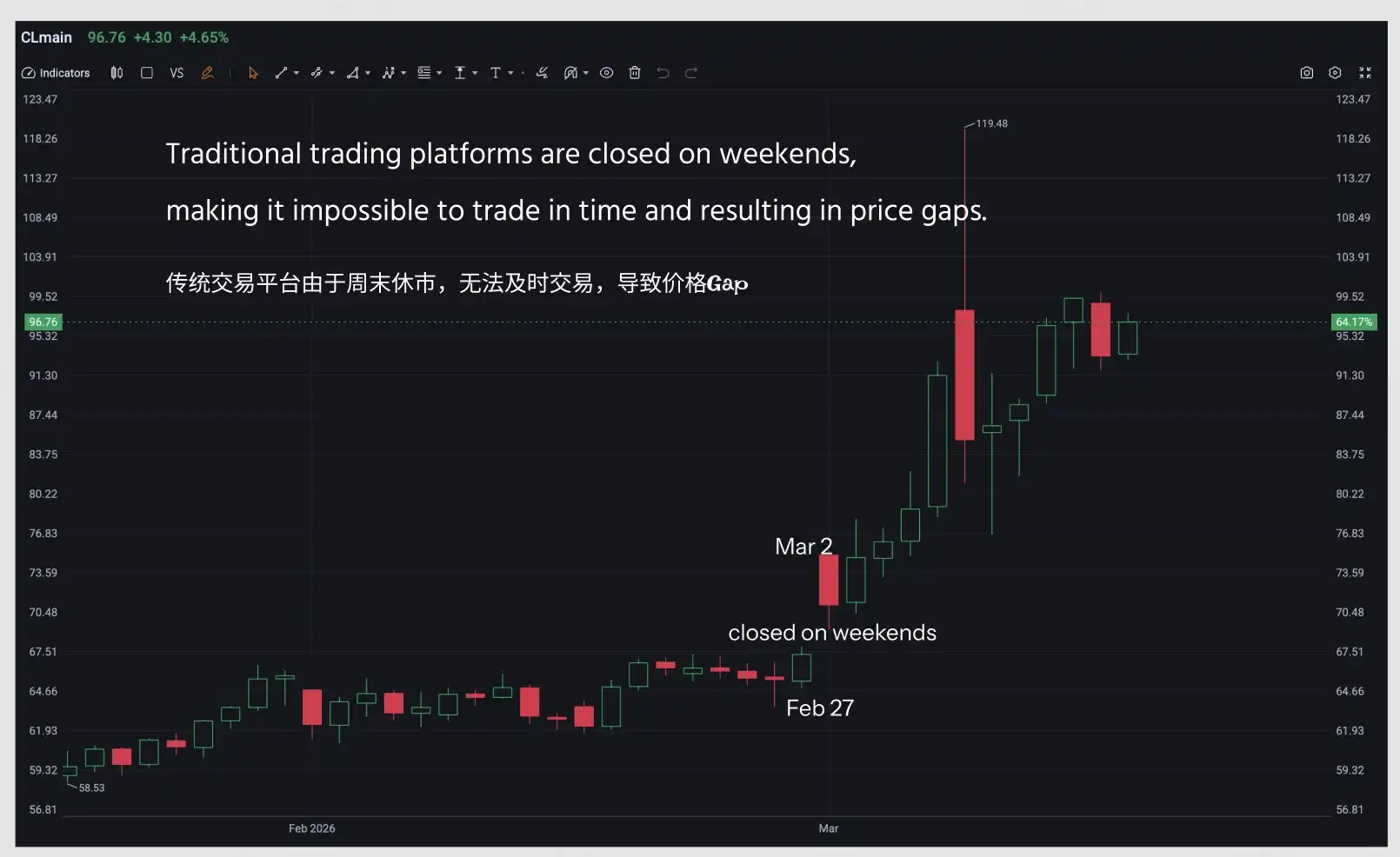
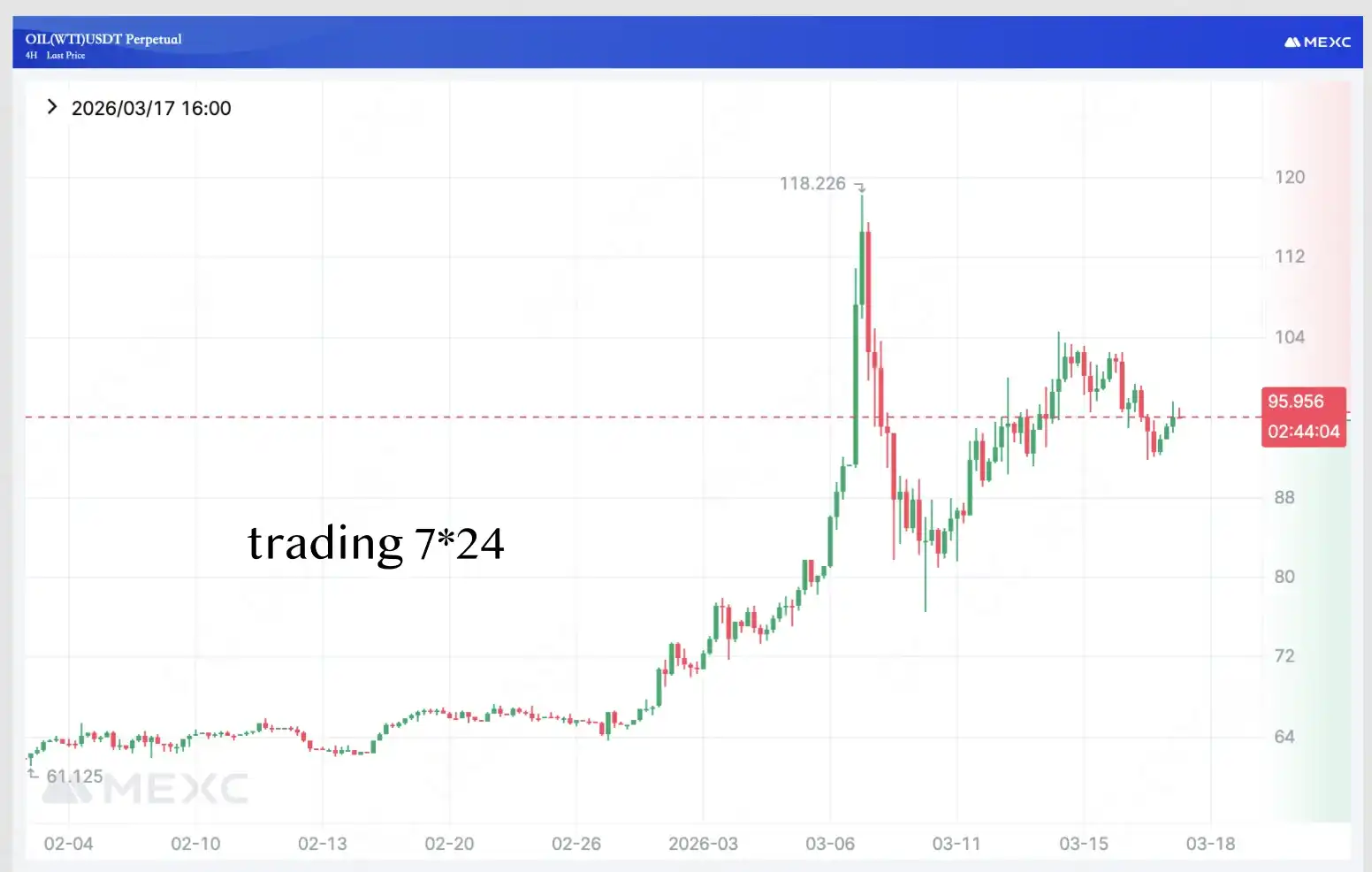
Last Saturday evening, about 20 hours before the opening of mainstream derivatives markets, the price of WTI crude oil perpetual futures on the MEXC platform surged to approximately $96 per barrel, higher than the regular crude oil futures closing price of $90.90 on Friday afternoon. In this market movement triggered by sudden conflict, crypto platforms were the first to complete the repricing of assets. Their seamless operating mechanisms made the fixed closing hours of traditional exchanges appear incredibly outdated.
The Wall Street Journal: Accelerating Integration of Traditional and Digital Finance

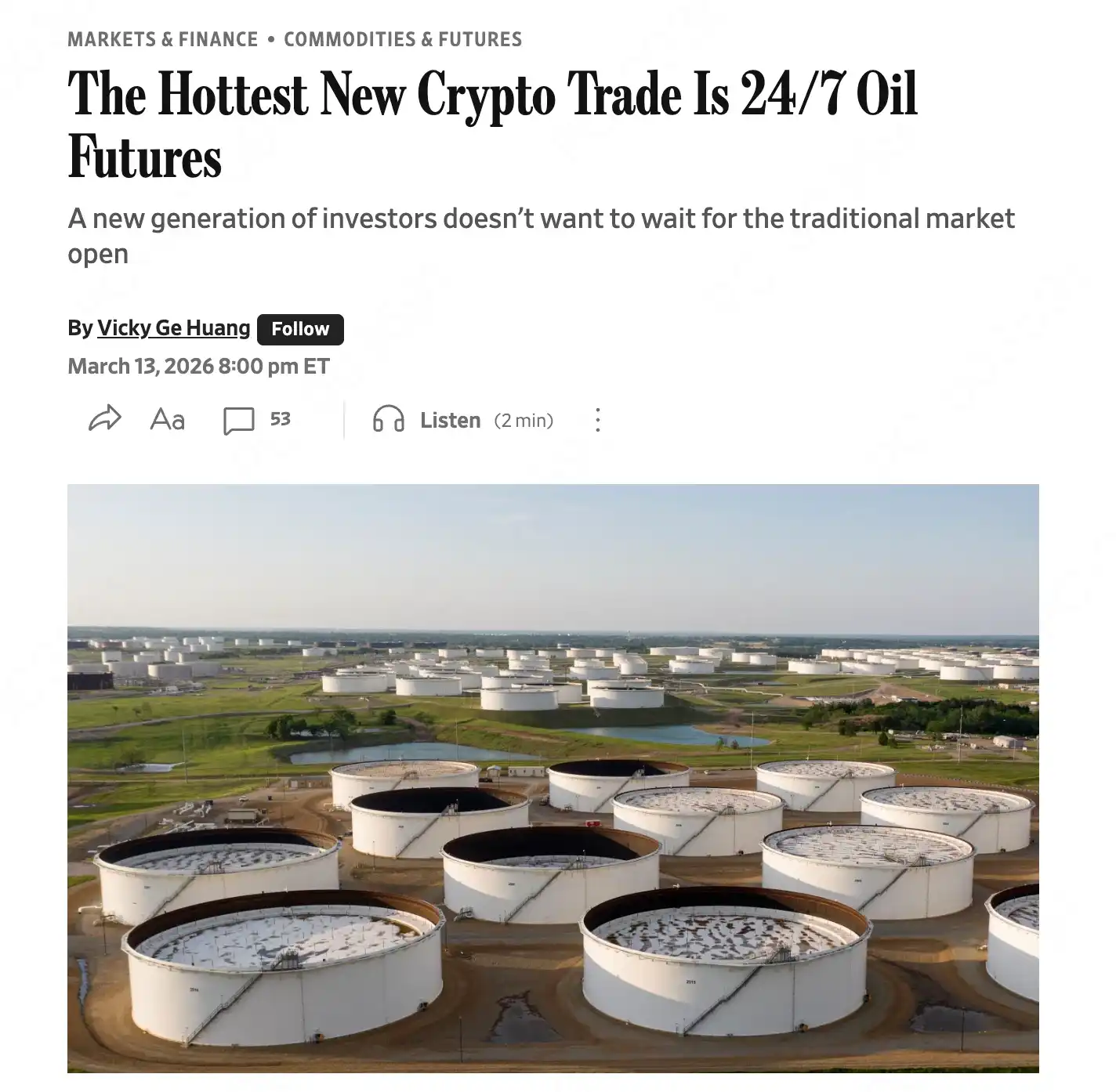
This disruptive market phenomenon quickly caught the attention of The Wall Street Journal. The report pointed out that a new generation of investors is no longer willing to wait for traditional markets to open. Crypto platforms now offer perpetual futures that track commodities, a highly speculative derivative.
Perpetual contracts never expire and have no strike price (the point at which the contract becomes effective). They also allow traders to use extremely high leverage, which can amplify profits but also lead to the loss of the entire investment. As industry professionals have stated: "You don't need to wait until Monday for the market to open before everyone starts acting." This is changing the traditional model, enabling real participants to take action when weekend events occur.

Market data vividly reflects this vote of confidence with capital. In just a few days, the cumulative trading volume of oil futures surged from $339 million on February 28th to approximately $7.3 billion on Thursday.

Crossing Asset Boundaries: The 24/7 Wave from Crude Oil to U.S. Stocks

Time arbitrage in the oil market is just the beginning. Round-the-clock trading is already commonplace for cryptocurrency investors. For modern traders, the trading mechanisms provided by crypto platforms are demonstrating significant appeal for U.S. stocks and other commodities.

Wall Street is racing to utilize the digital ledger technology underpinning Bitcoin and other cryptocurrencies to tokenize stocks and other traditional assets. Similar to digital assets and prediction markets, so-called tokenized stocks are increasingly attracting the younger generation of investors who wish to trade 24/7 and react in real-time to geopolitical events and breaking company news. For example, investors can now trade contracts for popular U.S. stocks like AMD on crypto platforms at any time.
In addition to oil, crypto platforms have recently launched perpetual contracts for gold and silver, and the prices of these precious metals have also experienced abnormal volatility. Both metals saw their prices soar to historic highs, only to plummet subsequently.

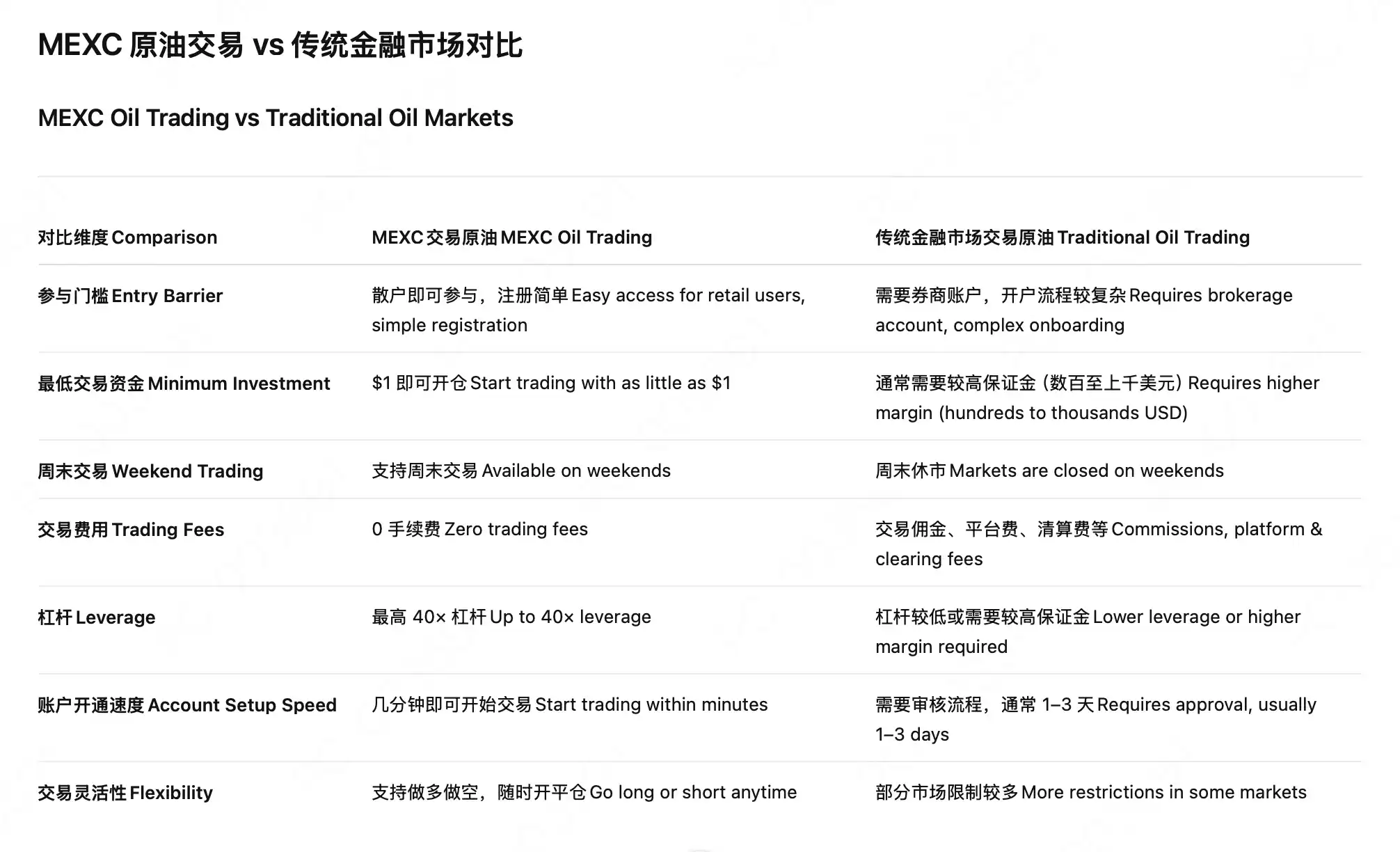
As liquidity and trading habits migrate, an irreversible trend is emerging: Crypto platforms, with their advantages of seamless 24/7 trading, high capital efficiency, and disregard for geographical and time limitations, are continuously eating into the market share of traditional trading platforms. While traditional financial institutions remain constrained by rigid operating hours, the crypto ecosystem is gradually accommodating the trading needs of a massive volume of global assets, becoming the core hub for a new generation of pricing power.

A New Paradigm of Coexisting Opportunities and Challenges

Objectively speaking, this trading model combining high leverage and 24/7 operation is a double-edged sword. The author believes that cryptocurrency traders have short attention spans, so they desire quick returns and also crave volatility. On Sunday, the author observed that oil had reached unsustainable levels and began shorting—a judgment confirmed correct: On Monday, after President Trump stated that the war with Iran was "pretty much over," crude oil futures prices fell back below $100 per barrel.

This volatility can backfire once problems arise.

For many traders, the ability to trade these assets with leverage 24/7 is highly attractive, especially on weekends when traditional markets are closed. That said, trading highly volatile assets with leverage carries genuine market risks, and the author has also noted large-scale liquidations during sudden price swings.

Despite the challenges, the recent debut of oil futures contracts on multiple crypto platforms foreshadows a future of integration between traditional and digital finance—a time when all forms of assets can be traded at any time. In this historical process, crypto exchanges are at the forefront of this transformation. For traders eager to always maintain market initiative, a trading ecosystem that never sleeps is undoubtedly the most attractive battleground for the future.


Preguntas relacionadas

QWhat key advantage do cryptocurrency platforms offer over traditional financial markets for trading commodities like oil, according to the article?

ACryptocurrency platforms offer 24/7 trading, allowing investors to react to geopolitical events and market-moving news in real-time, even when traditional markets are closed, thus enabling faster asset repricing.

QWhat specific financial instrument on crypto platforms is highlighted as being used to speculate on oil prices during the recent Middle East conflict?

AOil perpetual futures contracts are the instrument used, which never expire, have no strike price, and allow for the use of high leverage.

QBesides oil, what other traditional assets are mentioned as being available for trading on crypto platforms?

AThe article mentions that crypto platforms also offer perpetual contracts for gold, silver, and tokenized stocks of companies like AMD.

QWhat is one of the major risks associated with the high-leverage, 24/7 trading model described in the article?

AA major risk is the potential for massive liquidations (forced closing of positions) during periods of sudden price volatility, which can lead to traders losing their entire investment.

QWhat broader trend does the article suggest is an irreversible shift in global finance?

AThe article suggests an irreversible trend of crypto platforms, with their 24/7 operation and high capital efficiency, reshaping global asset pricing power and eroding the market share of traditional trading platforms.

Lecturas Relacionadas

Must-Watch Events Next Week|CLARITY Act Could Face Senate Vote; SpaceX, Circle to Report Earnings (8.3-8.9)

**Summary: Key Events and Developments to Watch (August 3-9)** The upcoming week is marked by significant financial disclosures, key legislative deadlines, and notable product updates. **Major Financial Events:** Several companies are scheduled to release their Q2 2026 earnings. American Bitcoin (ABTC) will report on August 3, followed by SpaceX and Hut 8 Mining Corp. on August 4, and Circle on August 5. Notably, a significant portion of SpaceX shares (up to 12% of total shares) will be unlocked on August 6 following their earnings release. **Key Legislative Deadline:** The U.S. Senate faces an August 7 deadline to secure 60 votes for the CLARITY Act, a bipartisan bill aiming to establish a federal regulatory framework for cryptocurrencies. The Senate may hold a full vote on the bill during the week. **Economic Data:** The U.S. July Non-Farm Payrolls report will be released on August 7, providing crucial labor market data. **Technology & Product Updates:** * **Shutdowns:** DeFi portfolio tracker Zapper and wallet app Ctrl Wallet will cease operations on August 3. * **Upgrades:** LayerZero will deprecate its v1 relayers on August 3. XRP Ledger's new version 3.3.0, featuring five new functions, is expected next week. * **AI:** Elon Musk announced that the advanced Grok 4.6 AI model is set for release around August 7. * **Bitcoin:** The BIP-110 forced signaling for a potential Bitcoin network change is scheduled to begin around August 8. **Other Notable Events:** Chinese robotics firm Unitree Tech has set its preliminary price inquiry for its IPO for August 5. South Korean exchange Upbit will delist AQT and AERGO tokens on August 3.

marsbitHace 1 hora(s)

Must-Watch Events Next Week|CLARITY Act Could Face Senate Vote; SpaceX, Circle to Report Earnings (8.3-8.9)

marsbitHace 1 hora(s)

Stocks Are Plummeting More Sharply Than Cryptocurrencies. Where Has the Money Gone?

Stock Markets Plunge Deeper Than Cryptocurrencies: Where Did the Money Go? In late July, Seoul's Kospi index triggered circuit breakers for two consecutive days, plummeting over 40% from its June high. The collapse was led by heavyweight stocks like SK Hynix, whose record profits still disappointed investors, and devastating leveraged ETFs, with one major product losing over 83% of its value. This signaled a global, forced deleveraging targeting the most crowded trades. Interestingly, while stocks exhibited extreme volatility akin to crypto markets, Bitcoin rose nearly 15% in July after a prior steep drop. Analysis shows the money fleeing equities did not flow into Bitcoin. Instead, Bitcoin had already absorbed its sell-off in May-June, when U.S. spot Bitcoin ETFs saw historic outflows. The true safe-haven beneficiary was gold, whose price rose over 20% year-on-year, highlighting a decoupling between Bitcoin and gold as "digital gold." The sell-off was a targeted unwinding of leveraged positions in tech and semiconductors, accelerated by broker-dealer risk management and shifts in the AI narrative, including new competition from Chinese memory chipmakers. The retreat path was clear: from high-valuation tech stocks to cash and U.S. Treasuries, then to gold. For Bitcoin to attract sustained institutional inflows, conditions like eased global liquidity pressure, a "soft-landing" Fed rate cut, and U.S. regulatory clarity via legislation like the stalled CLARITY Act are needed. Currently, Bitcoin is not a safe haven but an already-cleared asset. Its low correlation with tech stocks, however, makes it a potential diversification play for institutional portfolios once the storm passes. The money isn't here yet, but the positioning is underway.

marsbitHace 1 hora(s)

Stocks Are Plummeting More Sharply Than Cryptocurrencies. Where Has the Money Gone?

marsbitHace 1 hora(s)

In Conversation with Ray Dalio: We Are Currently in an AI Bubble, with 1% of My Portfolio in Bitcoin

Ray Dalio, founder of Bridgewater Associates, warns in an interview that the current AI boom shows classic bubble characteristics, which could lead to significant economic downturns as seen in past cycles like 1929 or 2000. He explains that speculative enthusiasm, fueled by debt and overvaluation, often precedes a crash when rising rates or taxation force asset sales, causing widespread losses and recession. Dalio also outlines his "Big Cycle" theory, describing an approximate 80-year pattern where widening wealth gaps, massive government deficits, and shifting geopolitical power (like China's rise) create internal conflict and global instability. He emphasizes that we are in a late-cycle, transitional phase where traditional powers like the US and UK face decline. For personal wealth protection, Dalio advises diversification beyond cash into assets like stocks, bonds, real estate, and particularly gold, which he prefers over Bitcoin. While he holds about 1% of his portfolio in Bitcoin as a non-printable hard asset, he views gold as more secure from technological or governmental threats. Regarding AI's impact, Dalio believes it will disproportionately benefit capital owners, worsening inequality by replacing both physical and cognitive labor. He suggests that human intuition and emotional intelligence, combined with AI, will be key for future workers. On taxation, Dalio argues that wealth taxes are impractical and risk triggering asset sell-offs, reducing productive investment. He points to the UK as a cautionary example of debt, low productivity, and political strife. Geopolitically, Dalio foresees a more regionalized world, with the US showing weakness in prolonged conflicts like with Iran, akin to past imperial declines. The ideal outcome, he suggests, is coexisting powerful blocs (e.g., Americas, China-Asia Pacific) without major war.

marsbitHace 5 hora(s)

In Conversation with Ray Dalio: We Are Currently in an AI Bubble, with 1% of My Portfolio in Bitcoin

marsbitHace 5 hora(s)

Trading

Spot
活动图片




