From PolyMarket to Hyperliquid: App Chain Is Becoming the New Alpha

marsbitPublicado a 2026-01-24Actualizado a 2026-01-24

Resumen

The article discusses the trend of successful applications, such as PolyMarket and Hyperliquid, building their own dedicated App Chains. Initially, deploying on established public blockchains is efficient for product validation. However, as applications scale, they face challenges like network congestion, unpredictable fees, and a lack of control over their user experience and economic model. An App Chain allows them to own their infrastructure, optimizing for performance, cost, and value capture. Yet, the real challenge shifts from the technical ability to launch a chain to overcoming its cold start: attracting users, facilitating seamless asset transfers, and preventing liquidity fragmentation. The piece highlights Caldera as a solution that simplifies chain deployment and, crucially, integrates new chains into an interconnected network from day one through its Metalayer technology. This system reduces onboarding friction and uses its token, $ERA, to align incentives and create a flywheel effect where each new chain strengthens the entire ecosystem. The key takeaway is that the new competitive advantage (Alpha) is not merely launching an App Chain, but successfully integrating it into a broader network to ensure immediate usability and growth.

Over the past period, the popularity of the prediction market project PolyMarket has taught the industry a lesson: when a truly in-demand, well-designed application takes off, it not only brings users and buzz but can even push a long-dormant network back into the spotlight—Polygon once topping Chain Revenue, surpassing Base, is a highly representative signal. But more notably, it's the "top priority" that PolyMarket repeatedly emphasized amid the hype: building its own chain.
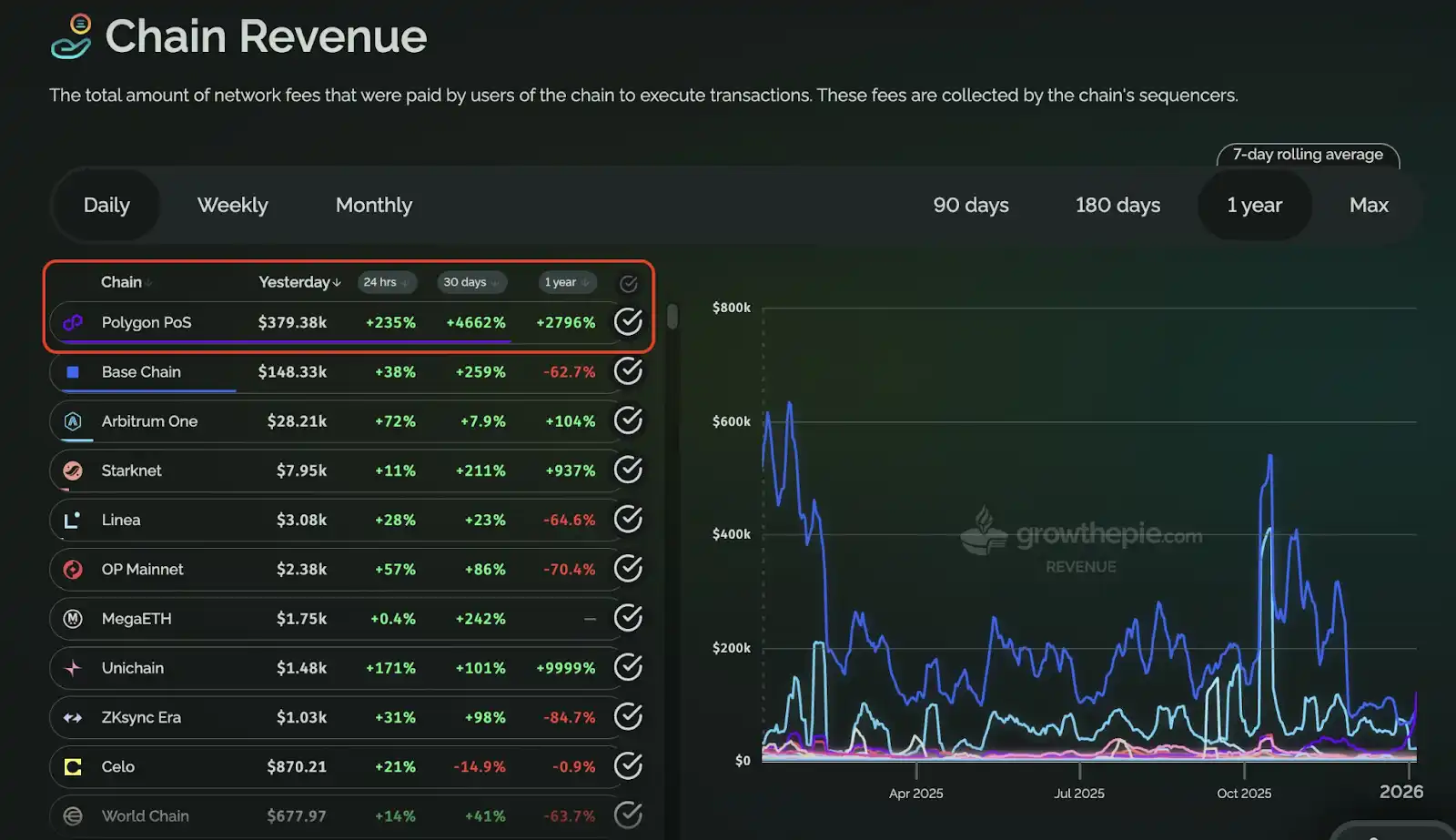
This sounds like a further technical upgrade, but in essence, it's an inevitable choice as applications enter the deep end of growth. Once product validation is complete, transaction behaviors stabilize, and user scale expands, applications begin to feel dissatisfied with "renting someone else's underlying infrastructure" and instead want to control key experiences and revenue streams. The same path has appeared in another more typical case: the leading Perp DEX, Hyperliquid. It didn't settle for being just an "application" on mainstream public chains but directly built its own App Chain to unify the trading system, execution environment, and user experience, ultimately achieving near "centralized exchange-level" smoothness and throughput, thereby establishing a moat.

Looking at these two cases together, they point to the same trend: App Chain is becoming the new Alpha.

Why "The More Successful the Application, the More It Wants to Build Its Own Chain"?

The more successful an application is, the more likely it is to reach the point of "building its own chain," for practical reasons: when you move from "validating whether the product can run" to the "scaled operation" stage, public chains no longer bring just traffic and tool dividends but a bunch of external variables you can't control. Choosing a public chain early on is, of course, the most cost-effective—quick deployment, mature ecosystem, users and assets are already there; the most important thing is to get the product running and ensure users are willing to keep using it. But once the business explodes, your key paths will be increasingly affected by congestion, fee fluctuations, confirmation times, and other public network conditions. The uncertainty of experience begins to directly erode conversion and retention. At the same time, costs shift from "user complaints" to "financial structure": in high-frequency, high-volume scenarios, gas and infrastructure expenses become a curve that must be meticulously calculated, managed, and that can fluctuate wildly with external conditions.

Furthermore, successful applications care more about "value closure" and "iteration speed." The transactions and growth you generate often have a significant portion captured by the underlying and middle layers, yet you struggle to accurately redirect incentives back to the core users who contribute liquidity and trading. You want to customize rules for key processes and optimize the execution environment but can only make patchwork fixes within the public framework. Thus, projects like PolyMarket, which have already gained momentum, treat "building their own chain" as the main task for the next phase; strong trading products like Hyperliquid directly use App Chain to bind the execution environment, experience, and economic system together, turning controllability into a moat. At this stage, the chain is no longer just a deployment location but part of the product.

The Chain Can Be Launched, but Network Effects May Not Follow

App Chain is indeed becoming a trend, but that doesn't mean the barriers have lowered—more accurately, "launching a chain" is getting easier, while "making the chain actually work" is getting harder. Many teams think that after building their own chain, they can reclaim control over experience, costs, and rules, only to find after launch that the hardest part has shifted from engineering implementation to network management: users won't migrate just because you have an extra chain, and funds won't automatically flow in just because you changed the execution environment. Once the chain becomes independent, it immediately faces the reality of "starting from scratch": how to onboard the first batch of users, how to ensure assets flow smoothly, how to stabilize transaction and usage frequency—none of these are solved simply by launching a chain.

More specifically, App Chains often hit three walls:

  • Cold Start: New chains lack default entry points and positioning; users need extra learning, extra switching, and extra trust.
  • Liquidity Fragmentation: Once assets are cross-chain, versions and paths proliferate; pools get split, depth becomes insufficient, and the user experience becomes more expensive, slower, and more complex, even leading to confusion like "the same token has different prices in different places."
  • Weak Ecological Synergy: You can make your product more specialized and extreme, but if it can't be seen by larger networks and can't form smooth asset and user flows with other chains and applications, it easily becomes a "functionally strong but isolated" new island.

Therefore, the truly scarce capability in the App Chain era is shifting from "can you launch a chain" to "can you make the chain part of the network from day one," ensuring that user and fund flows feel as natural as if they were on the same chain.

Getting App Chain into the Flywheel Faster—From "Launching" to "Using"

The difficulty of App Chain is no longer just "can you launch a chain" but whether it can be used immediately after launch: how users come in, how assets get there, how liquidity is承接, and whether the cross-chain experience will be dragged down by fragmentation. Many ambitious teams consider appchain essentially to "own their own infrastructure" (sequencing, block rhythm, execution model, RPC, transaction revenue, etc.), using more controllable block space to create better products and business; but in reality, poor interoperability and chain-to-chain fragmentation often turn onboarding into a cost black hole, making new chain launches feel like "new islands" rather than "network nodes."

Caldera's entry point is to turn this path into a reusable product组合: using the Rollup Engine to lower the deployment and operational barriers, making chain launches a more controllable routine action rather than heavy engineering; then using Metalayer to make "connection" a default configuration, equipping each chain from day one with a full set of capabilities like cross-chain message passing, fast bridging, bridge aggregation, and development tools, reducing the friction of user and fund cross-chain flows, making "launching" closer to "joining a ready-made interconnected ecosystem." On this basis, Caldera's growth logic isn't single-point SaaS but a network flywheel: each new chain brings new users and liquidity sources, and Metalayer makes these increments更容易 flow within the ecosystem and feed back into existing chains, thereby enhancing the entire network's appeal to the next batch of teams.

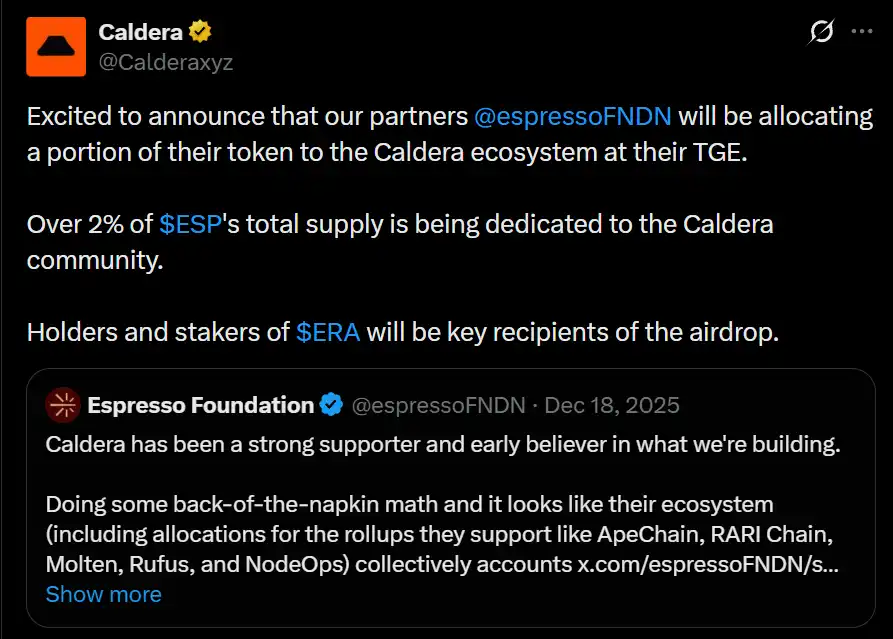
The design around $ERA further "accelerates and compounds" the flywheel: it is both the universal participation and economic coordination carrier for Metalayer (the basis for fee pricing of cross-chain interactions, etc.) and, through staking/node participation and governance, binds the incentives of chains, applications, users, and infrastructure participants within the same network, turning collaboration and growth from "possible" to "easier to sustain and roll." A more直观 example is that ecological联动 incentives themselves reinforce network effects in return. For instance, Espresso allocated over 2% of the total $ESP supply to the Caldera community during its TGE and made $ERA holders and stakers key airdrop targets: the value回流 from external high-quality partners enhances the appeal of participating in the $ERA ecosystem; and more holding and staking further strengthen network cohesion and collaboration expectations, in turn促成 more partnerships and more chains choosing to "join the network." Ultimately, Caldera aims to solve this: making App Chain not only launchable but also usable smoothly from day one, entering the growth flywheel faster.
The Alpha of App Chain Isn't in "Launching the Chain" but in "Networking"

From PolyMarket to Hyperliquid, the industry is seeing one thing越来越 clearly: as applications enter the scaled operation stage, the "chain" upgrades from a deployment location to part of the product, with experience, cost structure, iteration speed, and value回流 all being rewritten around it. But the real barrier for App Chain也随之 changes: launching a chain is getting easier; the hard part is ensuring the chain has entry points, asset paths, liquidity, and collaboration from the moment it goes live. Therefore, the next phase's Alpha isn't "who launched more chains" but who can turn "new chain cold start" into an action of "joining the network," reducing fragmentation friction enough that users can naturally complete funding, trading, and cross-chain use as if on the same chain. When this connectivity and incentive mechanism (e.g., participation around $ERA and external partnership回流) can continuously self-reinforce, App Chain will move from single-point success to replicable systemic victory and become a truly sustainable new Alpha.


Preguntas relacionadas

QWhat is the main trend discussed in the article regarding successful applications?

AThe main trend is that App Chains are becoming the new Alpha, where successful applications are increasingly building their own dedicated blockchains to gain control over user experience, cost structure, and value capture.

QWhy do successful applications like PolyMarket and Hyperliquid consider building their own chains?

ASuccessful applications build their own chains to overcome limitations of public blockchains, such as congestion, fee volatility, and lack of control over key experiences. It allows them to optimize performance, manage costs, and create a closed-loop value system for users and incentives.

QWhat are the common challenges faced by App Chains after launch?

ACommon challenges include cold start (lack of initial users and trust), liquidity fragmentation (broken pools and asset depth), and weak ecological synergy (isolation from broader networks, making asset and user flow difficult).

QHow does Caldera aim to address the challenges of App Chains?

ACaldera provides a product suite including a Rollup Engine to simplify chain deployment and Metalayer for seamless cross-chain messaging, bridging, and tooling. It focuses on integrating new chains into an existing network from day one, reducing friction and enabling faster growth flywheels through incentives like $ERA.

QWhat is the key to sustainable success for App Chains according to the article?

AThe key is not just launching a chain, but effectively integrating it into a network from the start, minimizing fragmentation, and ensuring smooth user onboarding, asset flow, and cross-chain interactions. Sustainable success relies on connection capabilities and incentive mechanisms that reinforce network effects.

Lecturas Relacionadas

He Just Raised 2.7 Billion, and Li Fei-Fei Also Invested

Pete Florence, a former senior research scientist at Google DeepMind and a key contributor to the Vision-Language-Action (VLA) model architecture, is deliberately distancing his startup, Generalist AI, from the trendy "world model" label. He argues that the industry should prioritize concrete goals over buzzwords. His goal is to create robots that can perform a vast range of unseen tasks with high speed and success rates, without needing task-specific training data. Recently, his company raised $400 million (¥2.7 billion) at a $2 billion valuation. Notable investors include NVIDIA's NVentures, Bezos Expeditions, NFDG, as well as Xiaomi co-founder Lin Bin, Zoom founder Eric Yuan, and renowned AI scientist Fei-Fei Li. Florence's approach stems from his academic background at MIT under Professor Russ Tedrake, focusing on understanding the physical world. After joining DeepMind, he developed models like Transporter Network and co-created the VLA framework. He left in 2025 to found Generalist AI. The company has launched two models: GEN-0, which demonstrated that scaling laws apply to physical motion, and GEN-1. GEN-1 was trained on over 500,000 hours of physical interaction data collected via a specialized wearable device. It achieves a 99% success rate on precise mechanical tasks like folding boxes and maintains performance three times faster than its predecessor. Florence believes GEN-1 is reaching a commercial utility threshold similar to the GPT-3 inflection point. The substantial funding round, following GEN-1's release, signifies strong investor confidence in Generalist AI's practical, goal-driven path to creating versatile, useful robots, regardless of the "world model" terminology.

marsbitHace 5 min(s)

He Just Raised 2.7 Billion, and Li Fei-Fei Also Invested

marsbitHace 5 min(s)

Two Legends Lost in Three Days: Is Google's AI Talent Dam Cracking?

In three days, Google lost two AI legends. On June 18, Noam Shazeer, co-author of the seminal "Attention is All You Need" paper and Gemini co-lead, left for OpenAI. Just 48 hours later, John Jumper, 2024 Nobel laureate and AlphaFold lead, departed DeepMind for Anthropic. This follows Andrej Karpathy joining Anthropic in May. These moves highlight a structural trend: top AI talent is concentrating at mission-driven, pre-IPO firms like OpenAI and Anthropic, while Google becomes a primary source. The exodus stems from a core mission mismatch. Google's ad-centric model often subordinates AI research to product and revenue goals, creating friction for pioneers like Shazeer, who returned in 2024 only to leave again. In contrast, OpenAI and Anthropic offer singular focus on pushing AI boundaries, whether towards AGI or safety-aligned models, which deeply appeals to top researchers like Jumper. Financial incentives amplify the pull. With both OpenAI and Anthropic nearing IPO, employees stand to gain immensely from equity, an upside Google's mature stock cannot match. Furthermore, the 2023 merger of Google Brain and DeepMind, intended to consolidate strength, has instead created cultural tension and slowed the path from research to product, as evidenced by Gemini's pace. This talent redistribution is reshaping the AI landscape. While Google retains vast data and compute resources, its true crisis is the quiet, continuous loss of the people who define the field's future. The real moat in AI is not infrastructure, but the concentration of brilliant minds—a battle Google is currently losing.

marsbitHace 2 hora(s)

Two Legends Lost in Three Days: Is Google's AI Talent Dam Cracking?

marsbitHace 2 hora(s)

Behind the AI Report Card, Lies a Chinese 'Exam Setter'

Beyond the familiar performance charts like MMLU-Pro and MMMU, which major AI models strive to ace, stands a key "examiner": Chinese-Canadian researcher Wenhu Chen. An assistant professor at the University of Waterloo and founder of TIGERLab, Chen addresses the crucial need for more rigorous AI evaluation. As models like GPT-4 began scoring near-perfect results on older benchmarks like MMLU, it became difficult to distinguish their true capabilities. In response, Chen introduced MMLU-Pro in 2024, featuring harder, more reasoning-focused questions with more answer choices, successfully reintroducing meaningful performance gaps. His work extends to multi-modal evaluation with MMMU and its enhanced version, MMMU-Pro. These benchmarks test a model's ability to understand and reason with complex information from images, charts, and text across diverse academic subjects, exposing the significant challenges even top models face in genuine comprehension. Chen's background in complex QA, table reasoning, and his experience at Google DeepMind on projects like Gemini inform his approach. He understands that effective benchmarks must anticipate how models might "cheat" by memorizing data or avoiding visual analysis. His lab also actively researches video understanding and generation models (e.g., UniVideo, Vamba), ensuring his evaluation work is grounded in practical model-building challenges. Now at Meta's Super Intelligence Lab, Chen continues his focus on multi-modal data and evaluation, representing the deep yet often unseen contributions of Chinese talent in shaping the fundamental tools of the AI industry.

marsbitHace 2 hora(s)

Behind the AI Report Card, Lies a Chinese 'Exam Setter'

marsbitHace 2 hora(s)

Alliance Co-founder's Letter to Entrepreneurs: Written at the Moment Cursor Sold for $600 Billion

Alliance Co-founder's Letter to Entrepreneurs: On Cursor's $60 Billion Sale Many aspiring founders see massive exits like Cursor's $60B sale and wonder why they can't achieve the same, often concluding opportunities are exhausted. But great companies aren't built in obvious, crowded spaces. Cursor, like Stripe, Figma, and Shopify before it, started with a non-consensus belief about the future. Before ChatGPT, they believed AI would transform knowledge work. They focused on a genuinely exciting domain, became their own customer, and obsessed over power users. Their journey involved years of "glass-chewing" effort before the market was ready. The pattern is consistent: identify a long-term technological shift, find a missed entry point, and execute for years before the trend becomes obvious. First-generation products (PayPal, Adobe, Amazon) prove a market exists. Second-generation winners (Stripe, Figma, Shopify) rebuild that market around new insights, technology, or changing customer behaviors. Founders must identify their phase in the cycle. Early entrants like Coinbase or Cursor focus on making new technology usable for power users. Later entrants find the "yin" to the established "yang"—the blind spots incumbents miss as they grow distant from individual users. The key is deep market immersion. Use every product in your space. Talk to users. Build an audience. Stop looking for ideas and start *seeing* them everywhere. Then, choose one. The idea must offer a 10x improvement or solve a "hair-on-fire" pain point—something severe enough that users are already crafting workarounds. When building, avoid feature bloat. Ask: why would someone switch? Great startups rarely force new behaviors; they improve familiar workflows with drastically lower friction (e.g., Cursor forked VS Code instead of creating a new editor). Distribution is the underestimated moat. Before product-market fit, achieve distribution-market fit. How do customers discover new tools? Founders like those at Airbnb, Stripe, and Cursor did unscalable, manual work to recruit early users. The final, unteachable ingredient is resilience. Cursor built for years pre-market, faced rejection, and persisted. So did Airbnb, Nvidia, and Rain (which launched post-FTX collapse). The lesson isn't that these founders were smarter, but that they stayed in the game long enough for their insights to compound. Framework: Spot technological cycles. Cultivate unique insight. Obsess over your market. Talk to customers. Find a hair-on-fire problem. Build the simplest wedge. Win your distribution channel. Above all, don't quit when it gets hard. Most people won't do these things consistently. The few who do build the next generation of great companies. Go build.

marsbitHace 2 hora(s)

Alliance Co-founder's Letter to Entrepreneurs: Written at the Moment Cursor Sold for $600 Billion

marsbitHace 2 hora(s)

Trading

Spot
Futuros
活动图片