From "National Shrimp Farming" to the Intelligent Economy: The 2026 Hong Kong Web3 Carnival AI x Web3 Summit Agenda Unveiled!

marsbitPublicado a 2026-04-08Actualizado a 2026-04-08

Resumen

The 2026 Hong Kong Web3 Carnival will host a pivotal forum titled "Web3×AI: Value Reconstruction in the Intelligent Era" on the afternoon of April 20. This event brings together global pioneers in AI and Web3 to explore the deep integration of these transformative technologies. Discussions will cover topics ranging from Silicon Valley’s innovative uses of AI lobsters to practical implementation of AI and Web3 beyond the lab. Industry leaders from TON Foundation, Qtum, Cobo, MaxQuant, and Anoma will share insights on security, financial applications, and decentralized AI ecosystems. Key roundtables will address critical questions: Does AI truly need Web3? Experts will debate issues like data privacy, decentralized computing, and value attribution. Another session will focus on AI Agents and the future of human-computer interaction, examining how agentic AI could reshape industries by moving beyond traditional interfaces. This forum aims to cut through the hype and provide actionable insights into how AI and Web3 can move from technological overlap to symbiotic value creation.

The explosive popularity of OpenClaw has ignited a "national shrimp farming" trend. When the "intelligent emergence" of artificial intelligence meets the "trust machine" of Web3 head-on, what we are ushering in is far more than just a technological overlay—it is a profound revolution in value creation, distribution, and revaluation. When AI Agents make interfaces "disappear," what is the ultimate form of human-computer interaction? Does AI really need Web3?

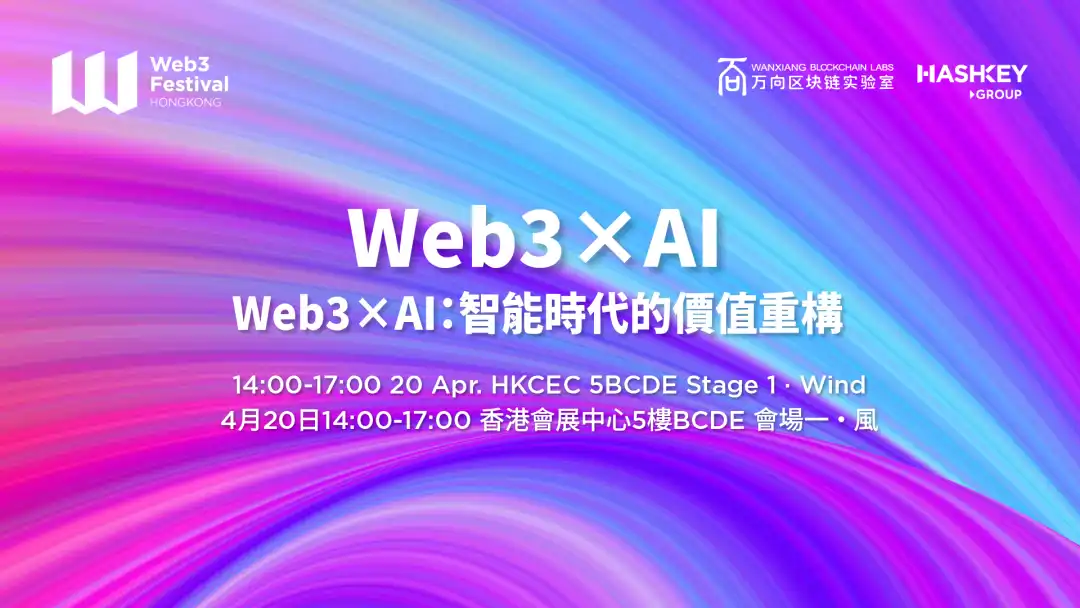
On the afternoon of April 20th, Venue 1·Feng at the 2026 Hong Kong Web3 Carnival will host the "Web3 x AI: Value Reconstruction in the Intelligent Era" thematic forum. It will bring together pioneering forces from the global AI and Web3 fields, from the "lobster secrets" at the Silicon Valley frontier to the underlying logic of enterprise practice, from practical experience in security collaboration to future previews of human-machine symbiosis. It will provide in-depth analysis and forward-looking insights, exploring the new possibilities of Web3 and AI integration in the intelligent era.

Silicon Valley AI tech blogger Lang Hanwei will reveal what Silicon Valley is using lobsters for, decoding the wildest cutting-edge trends overseas from a unique tech blogger's perspective. John, Head of Asia-Pacific at TON Foundation, will share innovative explorations of TON ecosystem and AI collaboration. Qtum Co-founder Miguel Palencia will break down how to drive AI and Web3 from the "lab" to the "application field," building efficient and collaborative technical bridges for developers and enterprises.

Cobo Co-founder and CTO Changhao Jiang, based on practical experience, will thoroughly explain the collaboration between Web3 security and AI, safeguarding the steady progress of the integrated ecosystem. MaxQuant CEO Jeffery Zeng will focus on the innovative application of AI technology in asset analysis and risk control, showcasing the new value of finance and technology integration. Anoma Co-founder Adrian Brink will also explore the future blueprint of AI and Web3 symbiosis, leading the decentralized ecosystem to new intelligent heights.

In addition to keynote speeches that address core issues, high-quality roundtable discussions will bring together industry elites to discuss the central topics of current AI and Web3 integration.

On one side is AI's centralized reliance on data, computing power, and models; on the other is Web3's pursuit of decentralization, privacy, and rights confirmation. Are the two naturally complementary, or is it a "forced match"? Hosted by Gen Labs Limited CEO He Xiaoyang, alongside guests including Keywolf, Partner and Product Head of SlowMist, and Michael Yung, Strategic Advisor at Google Cloud, the roundtable discussion "Does AI Really Need Web3?" will take place. From data privacy and decentralized computing power to value rights, it will dissect the complementary space between AI and Web3, explore possible paths from "technological overlay" to "value symbiosis," and interpret the new changes in Web3 security in the AI era.

As AI Agents rapidly penetrate various industries, human-computer interaction is undergoing a revolution of "disappearing interfaces." From the "you-click, I-search" GUI, to the "you-say, I-do" conversational interface, and further to the "you-think, I-act" autonomous Agent, what exactly does the ultimate form of human-computer interaction look like? Guests including Zolo Xiong, Co-founder of Deep Chao TechFlow, KK, COO of Virtuals Protocol, Cindy Shi, CMO of Kite AI, and Bob, CEO of Questflow, will discuss topics such as the autonomy of AI Agents, user incentives, and experience. They will break down how AI Agents are breaking the boundaries of traditional human-computer interaction and reconstructing new paradigms for production, life, and industrial operations.

Value reconstruction in the intelligent era does not wait for bystanders; the best opportunities are always reserved for those who are present. This time, stand shoulder-to-shoulder with top global tech guests, penetrate the fog of technology, decode the core secrets of Web3 and AI integration, and jointly discover new possibilities for value in the intelligent era.


Preguntas relacionadas

QWhat is the main theme of the 'Web3×AI: Value Reconstruction in the Intelligent Era' forum at the 2026 Hong Kong Web3 Festival?

AThe forum focuses on the convergence of AI and Web3 technologies, exploring how their integration can revolutionize value creation, distribution, and re-evaluation, featuring discussions on AI agents, decentralized ecosystems, security, and practical applications.

QWhich speakers will discuss the practical implementation of AI and Web3 technologies moving from 'laboratory to application field'?

AMiguel Palencia, Co-founder of Qtum, will address how to drive AI and Web3 from the 'laboratory' to the 'application field,' building efficient technical bridges for developers and enterprises.

QWhat specific topic will Changhao Jiang, CTO of Cobo, cover regarding AI and Web3 integration?

AChanghao Jiang will share practical experiences on the synergy between Web3 security and AI, focusing on safeguarding the robust development of the integrated ecosystem.

QWhat is the central debate question in the roundtable discussion 'Does AI Really Need Web3?'

AThe roundtable debates whether AI's centralized reliance on data, computing power, and models is naturally complementary or fundamentally incompatible with Web3's pursuit of decentralization, privacy, and value attribution.

QHow will the panel on AI Agents address the evolution of human-computer interaction?

AThe panel, featuring experts like Zolo Xiong and KK, will discuss how AI Agents are transforming interaction from GUI to conversational interfaces and autonomous agents, breaking traditional boundaries and reshaping paradigms in production and daily life.

Lecturas Relacionadas

Ethereum Q1 2026 Report: Fees Decline, Users and Transaction Volume Hit New Highs

Ethereum Q1 2026 Report: Fees Down, Users & Transactions Hit New Highs Token Terminal's Q1 2026 report on Ethereum presents a pivotal development: the network achieved record highs in monthly active users (13.2M, +85.9% YoY), total transactions (200.4M, +81.5% YoY), and throughput (25.78 TPS), while transaction fees on the mainnet plummeted by 47.9% quarter-over-quarter. This shift is attributed to the network's strategic move into a "low fees for scale" phase, exemplified by the Fusaka upgrade which increased data capacity and lowered block space costs, releasing pent-up demand (a manifestation of Jevons's Paradox). The report highlights a core narrative shift for Ethereum: from a DeFi-centric blockchain to a global financial settlement layer. It maintains a dominant position in tokenized assets, holding majority market shares among top chains in stablecoins (61.8%), tokenized funds (73.0%), and tokenized commodities (84.0%). Growth in tokenized funds (+73.1% YoY) and commodities (+325.9% YoY) was particularly strong, driven by institutions like BlackRock and JPMorgan entering the space. Contrasting these usage gains, several USD-denominated value metrics declined in Q1: fully diluted market cap fell 30.3% QoQ, total value locked (TVL) dropped 11.0%, and ecosystem transaction volume decreased 24.0%. The report interprets this as Ethereum prioritizing long-term network expansion and cementing its role as the default settlement layer for finance over short-term fee capture. The commentary from Etherealize argues that, much like the early internet, Ethereum's open, permissionless model is poised to win over closed alternatives as institutional tokenization accelerates.

marsbitHace 20 min(s)

Ethereum Q1 2026 Report: Fees Decline, Users and Transaction Volume Hit New Highs

marsbitHace 20 min(s)

He Just Raised 2.7 Billion, and Li Fei-Fei Also Invested

Pete Florence, a former senior research scientist at Google DeepMind and a key contributor to the Vision-Language-Action (VLA) model architecture, is deliberately distancing his startup, Generalist AI, from the trendy "world model" label. He argues that the industry should prioritize concrete goals over buzzwords. His goal is to create robots that can perform a vast range of unseen tasks with high speed and success rates, without needing task-specific training data. Recently, his company raised $400 million (¥2.7 billion) at a $2 billion valuation. Notable investors include NVIDIA's NVentures, Bezos Expeditions, NFDG, as well as Xiaomi co-founder Lin Bin, Zoom founder Eric Yuan, and renowned AI scientist Fei-Fei Li. Florence's approach stems from his academic background at MIT under Professor Russ Tedrake, focusing on understanding the physical world. After joining DeepMind, he developed models like Transporter Network and co-created the VLA framework. He left in 2025 to found Generalist AI. The company has launched two models: GEN-0, which demonstrated that scaling laws apply to physical motion, and GEN-1. GEN-1 was trained on over 500,000 hours of physical interaction data collected via a specialized wearable device. It achieves a 99% success rate on precise mechanical tasks like folding boxes and maintains performance three times faster than its predecessor. Florence believes GEN-1 is reaching a commercial utility threshold similar to the GPT-3 inflection point. The substantial funding round, following GEN-1's release, signifies strong investor confidence in Generalist AI's practical, goal-driven path to creating versatile, useful robots, regardless of the "world model" terminology.

marsbitHace 26 min(s)

He Just Raised 2.7 Billion, and Li Fei-Fei Also Invested

marsbitHace 26 min(s)

Two Legends Lost in Three Days: Is Google's AI Talent Dam Cracking?

In three days, Google lost two AI legends. On June 18, Noam Shazeer, co-author of the seminal "Attention is All You Need" paper and Gemini co-lead, left for OpenAI. Just 48 hours later, John Jumper, 2024 Nobel laureate and AlphaFold lead, departed DeepMind for Anthropic. This follows Andrej Karpathy joining Anthropic in May. These moves highlight a structural trend: top AI talent is concentrating at mission-driven, pre-IPO firms like OpenAI and Anthropic, while Google becomes a primary source. The exodus stems from a core mission mismatch. Google's ad-centric model often subordinates AI research to product and revenue goals, creating friction for pioneers like Shazeer, who returned in 2024 only to leave again. In contrast, OpenAI and Anthropic offer singular focus on pushing AI boundaries, whether towards AGI or safety-aligned models, which deeply appeals to top researchers like Jumper. Financial incentives amplify the pull. With both OpenAI and Anthropic nearing IPO, employees stand to gain immensely from equity, an upside Google's mature stock cannot match. Furthermore, the 2023 merger of Google Brain and DeepMind, intended to consolidate strength, has instead created cultural tension and slowed the path from research to product, as evidenced by Gemini's pace. This talent redistribution is reshaping the AI landscape. While Google retains vast data and compute resources, its true crisis is the quiet, continuous loss of the people who define the field's future. The real moat in AI is not infrastructure, but the concentration of brilliant minds—a battle Google is currently losing.

marsbitHace 2 hora(s)

Two Legends Lost in Three Days: Is Google's AI Talent Dam Cracking?

marsbitHace 2 hora(s)

Behind the AI Report Card, Lies a Chinese 'Exam Setter'

Beyond the familiar performance charts like MMLU-Pro and MMMU, which major AI models strive to ace, stands a key "examiner": Chinese-Canadian researcher Wenhu Chen. An assistant professor at the University of Waterloo and founder of TIGERLab, Chen addresses the crucial need for more rigorous AI evaluation. As models like GPT-4 began scoring near-perfect results on older benchmarks like MMLU, it became difficult to distinguish their true capabilities. In response, Chen introduced MMLU-Pro in 2024, featuring harder, more reasoning-focused questions with more answer choices, successfully reintroducing meaningful performance gaps. His work extends to multi-modal evaluation with MMMU and its enhanced version, MMMU-Pro. These benchmarks test a model's ability to understand and reason with complex information from images, charts, and text across diverse academic subjects, exposing the significant challenges even top models face in genuine comprehension. Chen's background in complex QA, table reasoning, and his experience at Google DeepMind on projects like Gemini inform his approach. He understands that effective benchmarks must anticipate how models might "cheat" by memorizing data or avoiding visual analysis. His lab also actively researches video understanding and generation models (e.g., UniVideo, Vamba), ensuring his evaluation work is grounded in practical model-building challenges. Now at Meta's Super Intelligence Lab, Chen continues his focus on multi-modal data and evaluation, representing the deep yet often unseen contributions of Chinese talent in shaping the fundamental tools of the AI industry.

marsbitHace 2 hora(s)

Behind the AI Report Card, Lies a Chinese 'Exam Setter'

marsbitHace 2 hora(s)

Trading

Spot
Futuros
活动图片