From Macro to Allocation: Key Variables for TradFi × Crypto in 2026

比推Publicado a 2026-01-22Actualizado a 2026-01-22

Resumen

CoinFound's "TradFi x Crypto 2026 Outlook" report identifies key trends shaping the convergence of traditional finance and crypto. It highlights 2025 as an inflection point of integration, with 2026 accelerating into a phase of "programmable finance." The report outlines eight major macro forces, including a crisis of trust in fiat systems driving demand for hard assets like Bitcoin and gold, geopolitical shifts fostering parallel blockchain-based settlement systems, and AI automation creating demand for machine-to-machine payments using stablecoins. Additionally, energy scarcity is turning mining firms into critical infrastructure, while Real-World Assets (RWA) are evolving from issuance to utility, enhancing liquidity and serving as programmable collateral. Seven key investment trends for 2026 are projected: the RWA market will structurally expand, led by stablecoins and new growth in equities and commodities; stablecoins will compete as global payment infrastructure; tokenized stock liquidity will grow; and private credit RWA will become more transparent and asset-driven due to default risks. Furthermore, gold and commodity RWAs will enable new collateralized finance, RWA liquidity will centralize on major exchanges, and crypto equities (DATs) will see both differentiation and consolidation. The report concludes that 2026 will be defined by secondary market expansion and credit growth, with risks centered on the complexity of managing off-chain defaults triggering on-ch...

Author: CoinFound, TradFi × Crypto Data Technology Company

Original Title: 2026 TradFi x Crypto Outlook: 8 Macro Forces and 7 Investment Trends Driving 2026


On January 21, CoinFound officially released the "CoinFound Annual Report: TradFi x Crypto 2026 Outlook," which focuses on the deep integration trends between TradFi and Crypto. The following is a summary of the report:

2025 is the "tipping point for integration," and 2026 will enter an accelerated period of "programmable finance."

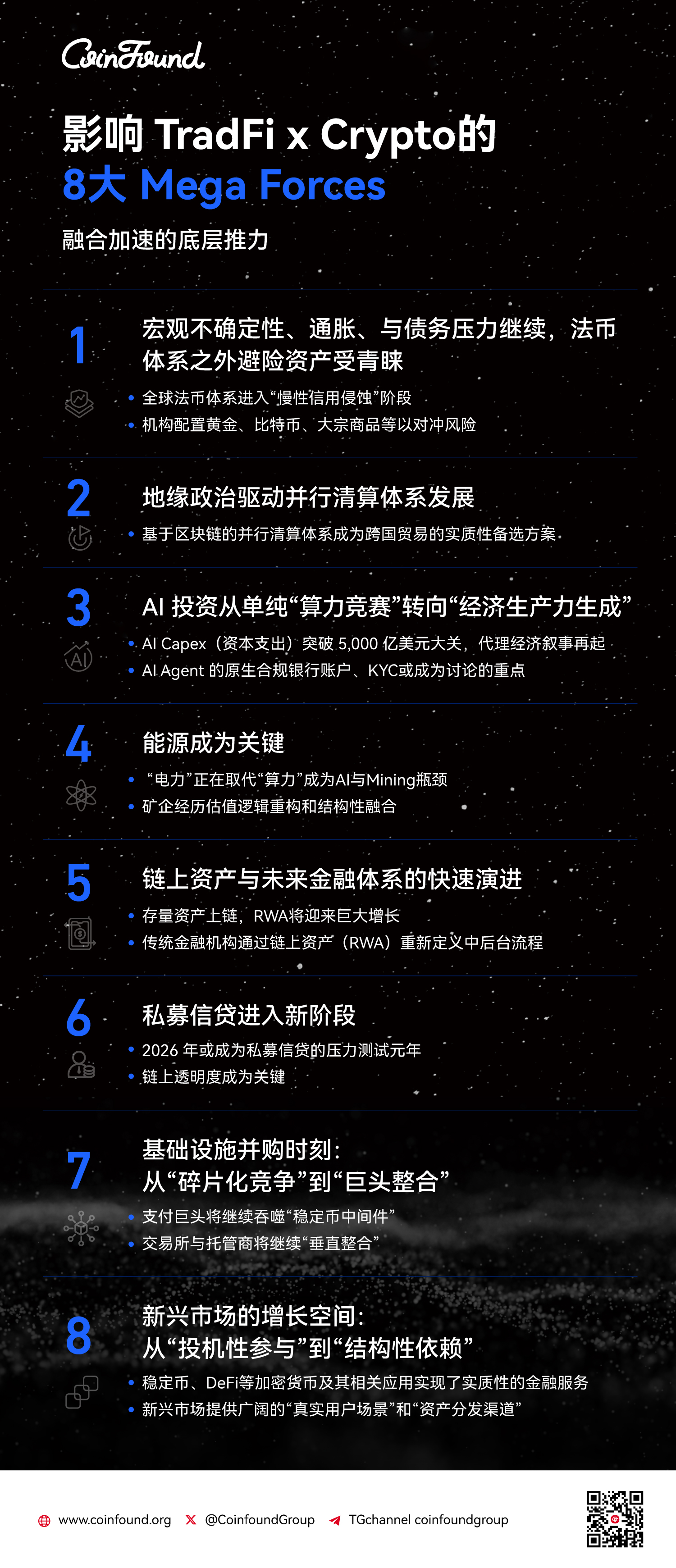
The report distills 8 Mega Forces and 7 trend outlooks: from Stablecoin 2.0 competing for global payment infrastructure, to RWA evolving from "issuance" to "utility," and key variables such as stock tokenization, DAT differentiation, and concentration.

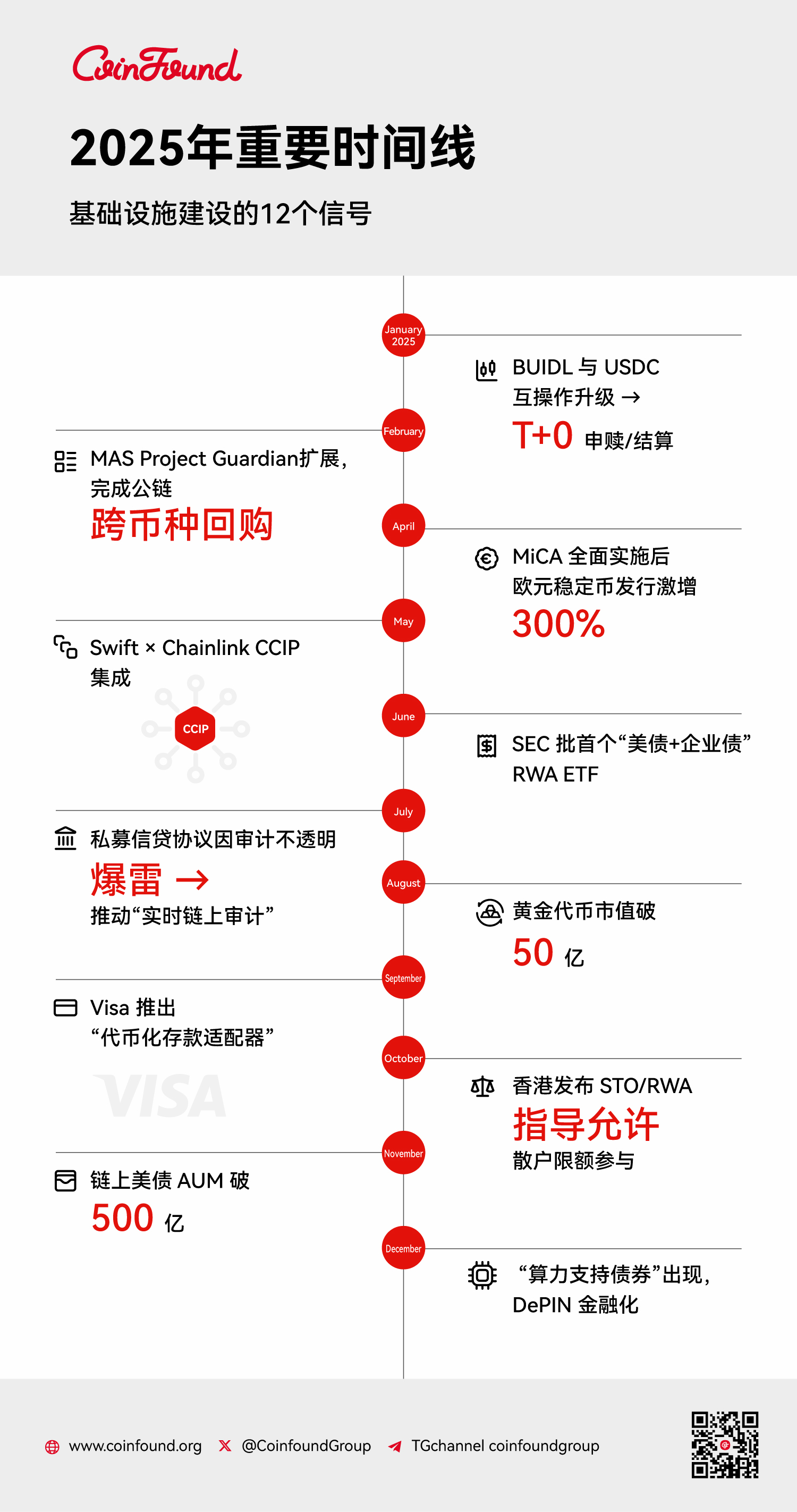
2025 Timeline of Key Events in Traditional Finance x Crypto
In 2026, the following macro trends will impact the TradeFi x Crypto field:

  • Fiat System Trust Crisis and Hard Asset Resurgence: Facing the global debt spiral and "fiscal dominance" risks, institutions are accelerating allocations to "hard assets" such as gold, Bitcoin, and commodities to hedge against fiat currency credit erosion.

  • Geopolitics Driving Parallel Settlement Systems: The need for "de-weaponization" of financial infrastructure is pushing blockchain as an alternative settlement solution independent of SWIFT, with atomic settlement mechanisms effectively reducing trust and counterparty risks in cross-border transactions.

  • AI Productivity Monetization and Machine Payment Emergence: The focus of AI investment is shifting from computing hardware to economic productivity generation, creating a rigid demand for compliant stablecoins and on-chain automated settlements by AI Agents to achieve value attribution between machines.

  • Energy as a Core Asset and Miner Infrastructure Transformation: Power shortages are driving mining companies to transform into "hybrid computing centers," with their scarce power access rights (Time-to-Power) triggering acquisitions by tech giants and driving a revaluation of mining companies towards data center infrastructure.

  • On-Chain Assets (RWA) Moving from Issuance to Utility: Asset tokenization is entering the "programmable finance" stage, where RWA is no longer just a digital certificate but serves as 24/7 core collateral, significantly enhancing the capital efficiency of repo markets and overall liquidity.

  • Private Credit Stress Testing and Transparency Transformation: The 2026 debt maturity wave may trigger default risks, forcing the industry to shift from "black boxes" to real-time on-chain transparent audits based on zero-knowledge proofs (ZK) to avoid DeFi chain liquidation crises.

  • Infrastructure Moving from Fragmented Competition to Giant Integration: The market is entering a consolidation phase similar to the telecommunications industry, with payment and financial giants acquiring stablecoin middleware and custodians to secure their positions, eliminate redundancy, and build compliance moats. Emerging markets are shifting from speculation to structural dependence: Crypto assets have deepened into underlying tools for payments and remittances in emerging markets, with vast real user scenarios making them a core hub connecting traditional financial assets with global retail liquidity.

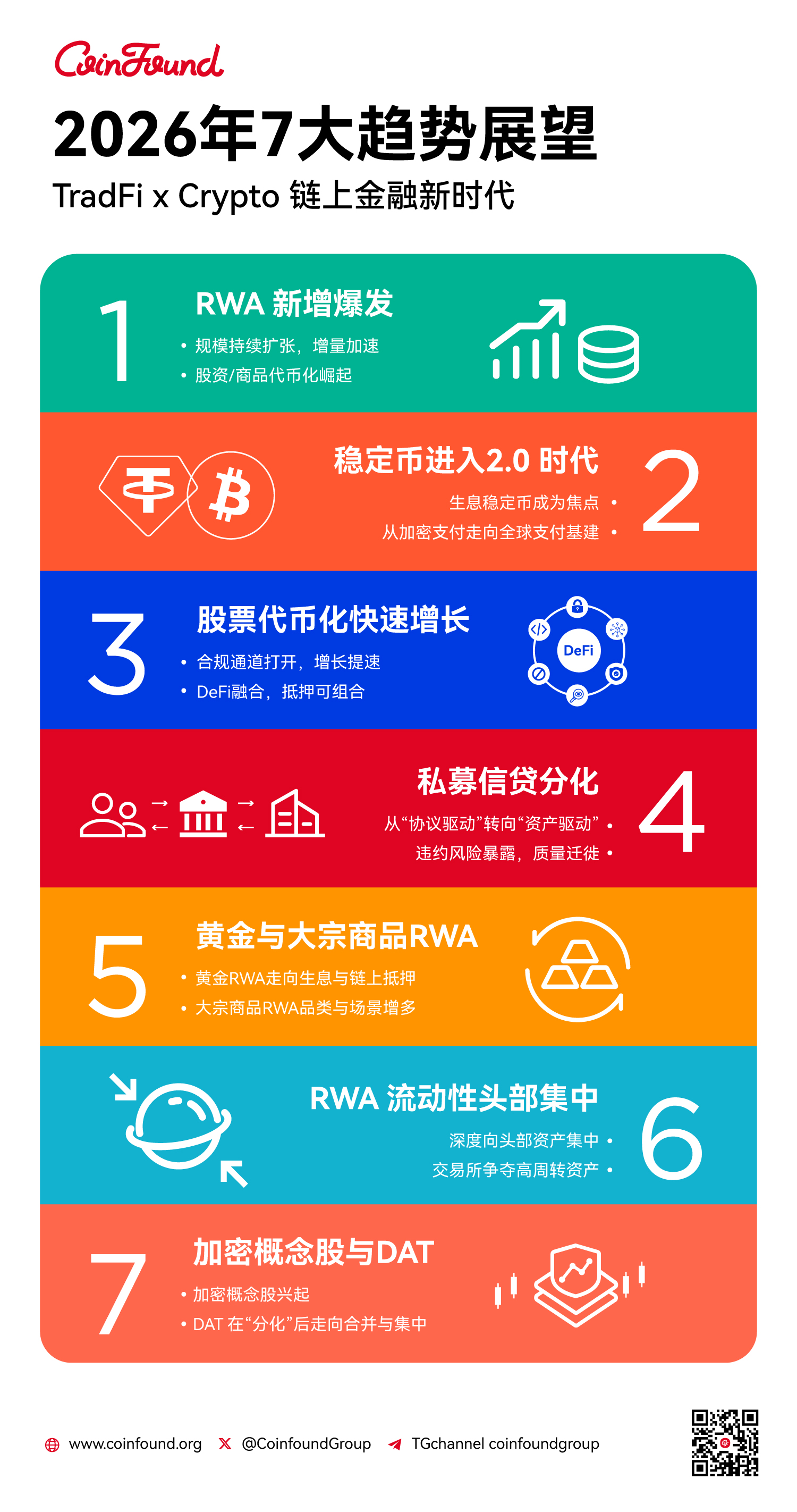
The trend outlook for 2026 is as follows:

1. Structural explosion in the RWA market, stablecoins laying the foundation for a $320 billion market, with equities and commodities becoming new growth points

2. Stablecoins enter the 2.0 era, moving from crypto payments to competing for global payment infrastructure

3. Stock tokenization liquidity may grow rapidly, with DeFi integration becoming key

4. Private credit RWA shifts to "asset-driven," potentially accelerating differentiation under "default" risk pressure

5. Gold and commodity RWA usher in a new era of "full-asset collateral"

6. RWA liquidity will further concentrate, with three types of RWA assets gaining favor among exchanges

7. The "rise" of crypto concept stocks, and the "differentiation" and "concentration" of DAT
Summary

2025 Summary: 2025 was a year of "demystification and integration" for TradeFi and Crypto. Blockchain technology is being reduced from its "revolutionary"光环 to an efficient bookkeeping and settlement technology. The success of Treasury RWA has demonstrated the feasibility of traditional assets on-chain, while the full entry of giants like BlackRock has provided irreversible credit endorsement for the industry.

2026 Prediction: 2026 will be a year of "secondary market explosion and credit expansion." We judge:

  • Liquidity Explosion: With the improvement of infrastructure, RWA will shift from "holding for yield" to "high-frequency trading."

  • Credit Downward Drift: Asset classes will drift downward from high-credit government bonds to corporate bonds, stocks, and emerging market credit, with risk premium becoming a new source of return.

  • Risk Warning: As the scale of RWA expands, the complexity of off-chain default transmission to on-chain liquidation will be the biggest systemic risk.

In 2026, both TradeFi and Crypto will be unified under the banner of "On-chain Finance."


Twitter:https://twitter.com/BitpushNewsCN

Bitpush TG Discussion Group:https://t.me/BitPushCommunity

Bitpush TG Subscription: https://t.me/bitpush

Original link:https://www.bitpush.news/articles/7605062

Preguntas relacionadas

QWhat are the 8 Mega Forces that will influence the TradFi x Crypto landscape in 2026 according to the CoinFound report?

AThe 8 Mega Forces are: 1. Fiat system trust crisis and the return to hard assets, 2. Geopolitically driven parallel clearing systems, 3. AI productivity monetization and the rise of machine payments, 4. Energy as a core asset and the infrastructuralization of mining companies, 5. On-chain assets (RWA) moving from issuance to utility, 6. Stress testing and transparency transformation in private credit, 7. Infrastructure consolidation from fragmented competition to giant integration, and 8. Emerging markets shifting from speculation to structural dependence.

QWhat is the projected market size for stablecoins in 2026, and what is driving this growth?

AThe stablecoin market is projected to have a base of 3200 billion USD. This growth is driven by stablecoins evolving from crypto payments to competing for global payment infrastructure, entering what the report calls the 'Stablecoin 2.0' phase.

QHow does the report characterize the year 2025 versus the year 2026 for TradFi and Crypto?

AThe report characterizes 2025 as the 'inflection point for integration,' where blockchain technology was demystified and seen as efficient settlement tech. In contrast, 2026 is predicted to be a year of 'secondary market explosion and credit expansion,' marking an acceleration period for 'programmable finance'.

QWhat major shift is expected in the RWA (Real World Assets) market in 2026?

AThe major shift is that RWA will move from 'issuance' to 'utility.' It will no longer be just digital certificates but will function as 24/7 core collateral, significantly enhancing the capital efficiency of repo markets and overall liquidity. The asset class will also expand from high-credit government bonds to include corporate bonds, stocks, and emerging market credit.

QWhat does the report identify as the biggest systemic risk for the expanding RWA market?

AThe biggest systemic risk identified is the complexity of off-chain asset defaults being transmitted to on-chain liquidations as the scale of RWA expands.

Lecturas Relacionadas

Misjudged A-Shares: Resilience, Expectations, and Confidence

China's A-share market recently faced selling pressure, especially in tech sectors, initially triggered by a global tech sell-off that began in South Korea. However, the article argues this is a case of "mistaken injury" and highlights the market's underlying resilience. This resilience stems from three main pillars: **1) Tech Sector Fundamentals:** Unlike Korea's market dominated by a few memory chip stocks, China's tech sector is diversified across computing, communications, electronics, and semiconductors, supported by dual narratives of global AI supply chains and domestic substitution. Core areas like optical modules and fiber optics continue to show strong earnings growth. **2) "National Team" Support:** State-backed institutions and large corporations have made significant market purchases and announced buybacks, providing liquidity and signaling confidence. This is seen as a stabilizing policy signal, often associated with market bottoms. **3) Broader Market Pillars:** Other major sectors are showing endogenous recovery momentum. Consumer stocks benefit from stabilizing CPI and signs of sector recovery (e.g., liquor price hikes). Cyclical sectors like aluminum have high earnings, potential price increases due to tight supply, and low valuations. The financial sector offers stable dividends and low valuations. The conclusion is that the sell-off was driven by external contagion, not a collapse in fundamentals. With strong policy support and recovering momentum across key sectors, the A-share market possesses the toughness to regain stability.

marsbitHace 30 min(s)

Misjudged A-Shares: Resilience, Expectations, and Confidence

marsbitHace 30 min(s)

The Clarity Act's Journey Through Congress: The Thorny Path of Bipartisan Compromise in the U.S.

The U.S. Congress is struggling to advance the crypto market structure bill known as the Clarity Act, with bipartisan compromise proving difficult. Key hurdles include unresolved disputes over "yield" products and, more critically, the inclusion of strong ethics provisions for elected officials—a non-negotiable demand for many Democrats. While a compromise on yield was reached in May, securing only limited Democratic support in committee, the separate Senate Agriculture Committee version later passed with no Democratic votes due to the ethics impasse. As Republicans push for a full Senate vote in July, demands for ethics rules have expanded, and other contentious issues like developer protections and concerns from law enforcement and large banks further complicate negotiations. Despite consensus on the need for legislation, the path forward is unclear. Recent discussions between senators and White House officials aim to find acceptable ethics language. Some lawmakers question whether a compromise text can garner enough bipartisan support, with one Democrat stating the current proposal lacks the strong ethics provisions required for their vote. Potential short-term goals for the crypto community include symbolic Senate action before the August recess, a longer-term aim for passage by 2026, or establishing a detailed framework that addresses ethics and other compromises. The process remains arduous, relying on the traditional, vote-by-vote effort to build bipartisan support.

marsbitHace 49 min(s)

The Clarity Act's Journey Through Congress: The Thorny Path of Bipartisan Compromise in the U.S.

marsbitHace 49 min(s)

Are Kalshi and Polymarket Founders at Odds? This Business Rivalry Is More Brutal Than You Think

"The Rivalry Between Kalshi and Polymarket Founders Turns Bitter and Litigious" The intense feud between Tarek Mansour, CEO of Kalshi, and Shayne Coplan, founder of Polymarket, has escalated far beyond typical business competition into personal animosity and regulatory battles. Both lead billion-dollar prediction market platforms, but their approaches differ sharply. Kalshi positions itself as the compliant operator, securing U.S. regulatory approval before launching. In contrast, Polymarket initially operated offshore, allowing U.S. users to access its platform via VPN, which drew regulatory scrutiny. The conflict reached a peak in November 2024 when FBI agents raided Coplan's New York apartment. While Coplan publicly blamed political motives, his team privately suspected Kalshi was involved. According to sources, Kalshi's lawyers had previously reported Polymarket's operations to federal prosecutors, highlighting its accessibility to U.S. users despite a ban. This incident fueled mutual accusations and underhanded tactics, including social media smear campaigns and attempts to sabotage each other's major business deals. Their rivalry also played out in Washington, influencing regulatory debates. Kalshi actively lobbied against Polymarket's practices, framing them as illegal and unethical. Polymarket, after facing a CFTC fine and investigation, later acquired a licensed U.S. firm to launch a domestic app, regaining a foothold. Despite the hostility, both companies have seen massive growth, with combined trading volumes soaring. However, increased regulatory scrutiny, particularly around insider trading on Polymarket's platform, continues to pose challenges. The founders' deep-seated mutual disdain ensures their battle for market dominance remains as much a personal vendetta as a commercial one.

marsbitHace 58 min(s)

Are Kalshi and Polymarket Founders at Odds? This Business Rivalry Is More Brutal Than You Think

marsbitHace 58 min(s)

Trading

Spot
活动图片