Original author: Dong Jing
Original source: Wall Street News
Since the beginning of August, gold has staged a robust rebound of up to 17%. However, UBS believes that more important than the magnitude of the rise is the fundamental shift in the underlying logic driving this gold rally—the market is transitioning from the traditional 'interest rate trade' to the 'dollar debasement trade.'
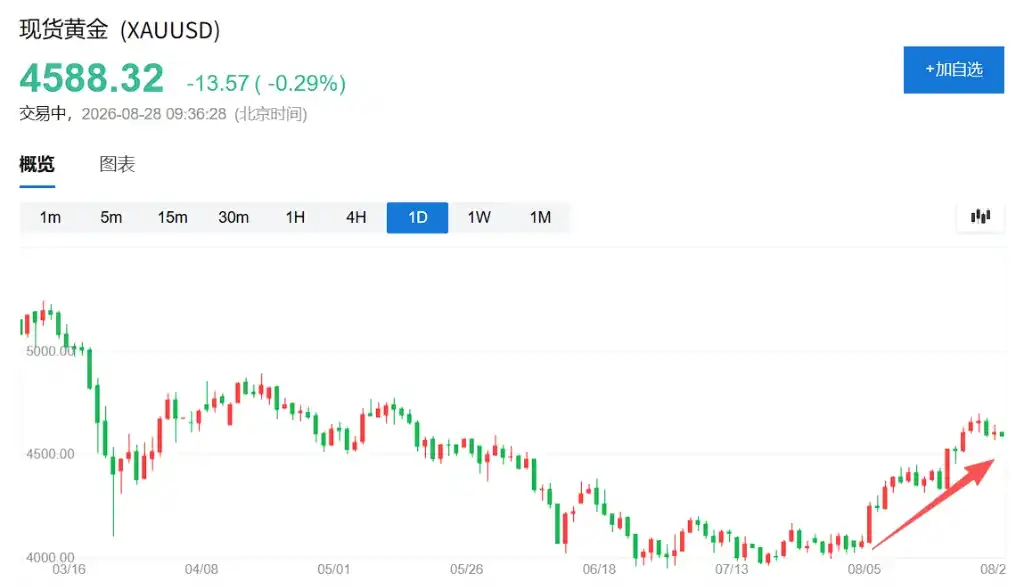
(Spot Gold Daily Chart)
According to information from Wind Trading Desk, UBS's August 27 precious metals research report dissects this late-summer gold rebound into a "two-act play": Act One was a technically-driven rebound fueled by fundamental repair, catalyzed by extremely light positioning, resilient physical demand, central bank gold buying, and softening U.S. economic data. Act Two is a qualitatively different "currency debasement trade"—the U.S. Treasury's announcement to double its long-term bond repurchase program triggered deep-seated market concerns about fiscal sustainability, causing the traditional negative correlation between gold and interest rates to loosen.
The bank argues that gold's pricing logic has shifted from the "opportunity cost framework" (where higher real rates pressure gold) to a "fiscal credibility framework." Even if long-term real interest rates remain high, as long as the market perceives that high rates stem from fiscal risks rather than a strong economy, gold may continue to rise.
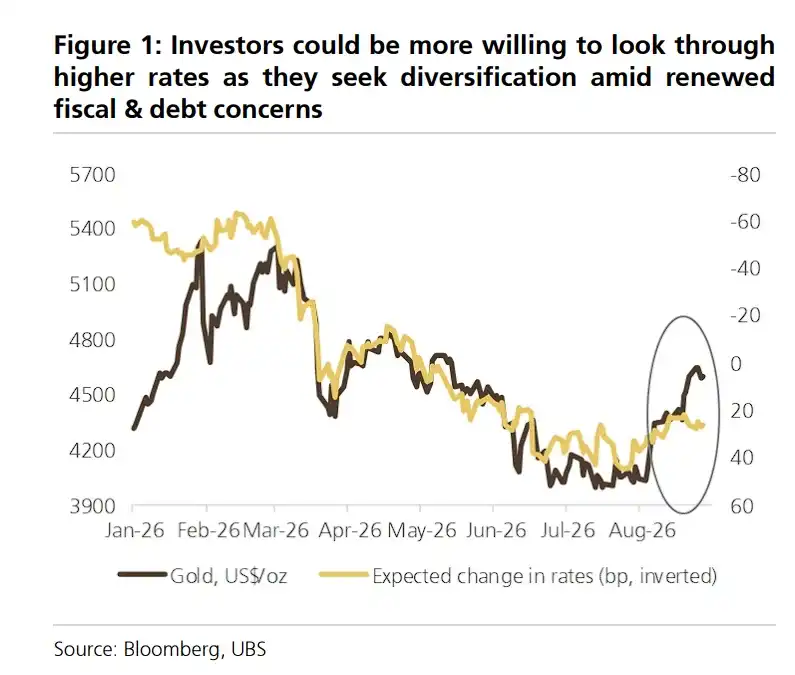
UBS maintains its bullish outlook on gold prices and explicitly states that upside risks to medium- to long-term forecasts are rising. UBS lowered its year-end 2026 gold price target from $5,000/oz to $4,675/oz (a 6.5% cut) but kept its 2027 and beyond forecasts unchanged, with an upside scenario target reaching as high as $6,500/oz. Notably, the bank identifies a hawkish Fed stance as the primary near-term downside risk. However, UBS clearly states that any pullback triggered by rising rate hike expectations should be viewed as a buying opportunity, not a trend reversal.
Act One: Fundamental Repair Forms a Bottom—Positioning, Demand, and Central Banks Provide Triple Support
The report states that before the August rally began, net positioning in the gold market was extremely light. Persistent inflation pressures fueled concerns that the Fed might restart rate hikes, leaving investors hesitant to buy aggressively but also lacking conviction to short, resulting in a wait-and-see stance. Despite a roughly 30% pullback from the year's highs, sentiment among medium- to long-term investors remained biased towards bullishness, with many waiting for better entry points.
UBS believes that gold's repeated failed attempts to breach the $4,000/oz level gradually rebuilt market confidence and established a solid bottom. This bottom formation was aided by stronger-than-expected demand resilience:
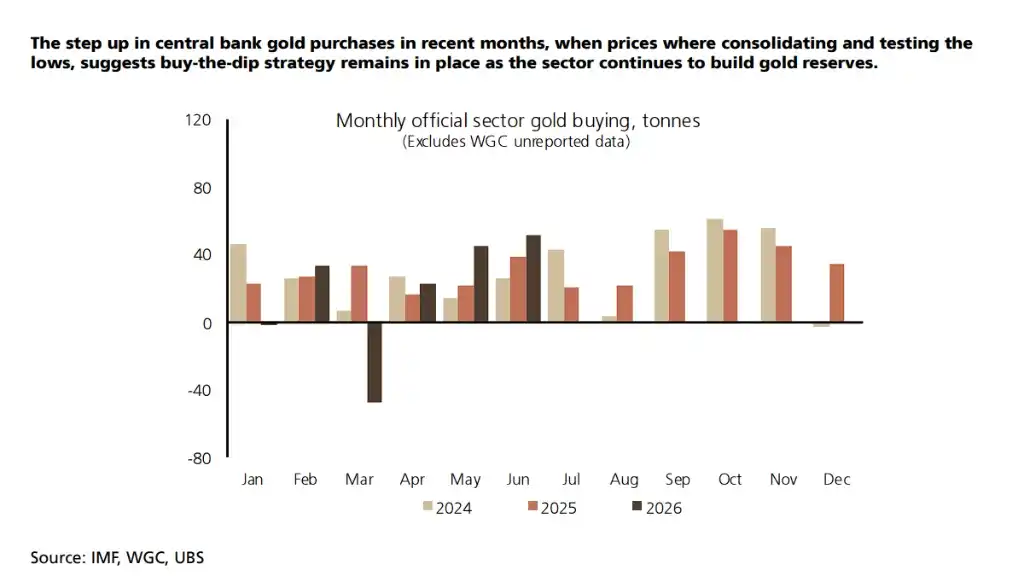
- Official Sector Buying on Dips: More importantly, the official sector (i.e., central banks) accelerated purchases during price declines, providing substantive support for this bottom—the People's Bank of China's gold purchases increased as prices fell, showing a clear "buy the dip" strategy.
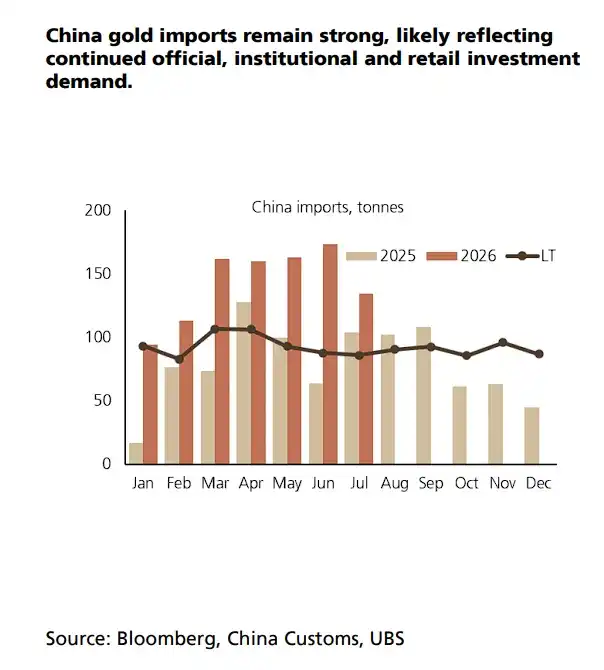
- Robust Physical Demand: China's gold imports remained consistently above both last year's levels and historical averages, reflecting support from official, institutional, and retail investment demand. In India, imports were suppressed by regulatory hurdles, but seasonal demand patterns are emerging, with stronger fundamental support expected in the second half of the year and during festive seasons.
- Soft U.S. Economic Data Provides Catalyst: Weak U.S. economic data released in early August prompted markets to scale back Fed rate hike expectations, becoming the direct trigger for gold's breakout. The initial move was driven by short covering, followed by new long entries. However, due to thin summer liquidity, market participants were generally cautious, and profit-taking was relatively swift.
Act Two: Narrative Shift—The "Currency Debasement Trade" Returns to Center Stage
The report points out that as gold prices stabilized and consolidated around $4,400/oz, the catalyst for the second leg higher emerged: the U.S. Treasury's announcement to double its long-term bond repurchase program.
While the scale of this measure itself is not large relative to the entire U.S. Treasury market, and its original purpose was merely liquidity management, the signal it sent far exceeded the operation itself—the market interpreted it as the Treasury's intent to actively intervene when long-end rates are under pressure, bringing discussions of fiscal sustainability and debt credibility back to the forefront.
Under the traditional framework, rising real interest rates mean a higher opportunity cost of holding gold, pressuring prices. But this time was different: the reason for rising rates changed. When the rise in long-end yields reflects fiscal risks and declining confidence in sovereign debt, rather than economic strength, investors become more willing to "look through" this opportunity cost and continue holding gold.
Concurrently, a weakening dollar provided an additional tailwind, further strengthening gold's role as a fiat currency alternative. Whether this logic is termed "de-dollarization," "de-fiatization," or "currency debasement hedging," its portfolio implication is consistent: gold can serve as a diversification tool, hard asset, and source of resilience under a broader range of macro scenarios.
Upside Risks Are Accumulating: What Scenarios Would Make UBS More Bullish?
UBS explicitly states it maintains its basic call for higher gold prices and acknowledges that upside risks to medium- to long-term forecasts have increased.
The clearest upside scenario is: Fiscal and debt issues become embedded in strategic asset allocation decisions, driving broader and more persistent increases in gold holdings, causing the rally to exceed baseline forecasts in both magnitude and duration. The following factors would reinforce this outcome:
- Evidence of continued central bank gold buying;
- Sustained resilience in Asian physical demand;
- Further dollar weakness.
Other bullish scenarios include: persistently soft economic data, a surprisingly dovish pivot by the Fed, or a resurgence of market concerns about Fed independence.
Notably, current monetary and fiscal policy signals are diverging: The Fed remains focused on inflation control, while the Treasury has already acted to ease long-end pressure.
The market will closely parse Fed Chair Kevin Warsh's speech at Jackson Hole and subsequent statements from the Treasury. Due to the lack of forward guidance, every economic data release will have a greater impact on Fed policy expectations and gold price movements.
Biggest Near-Term Risk: A Hawkish Fed, But Pullbacks Are Opportunities
UBS clearly states that gold is not immune to a hawkish Fed. A rate hike this year, or signals from the Fed that significantly raise the probability of hikes, could trigger a sharp decline in gold prices by pushing real rates and the dollar higher. Thin summer liquidity and the rapid August gains could amplify the magnitude of such a correction.
However, UBS's judgment is: Such corrections should be viewed as buying opportunities, not the beginning of a sustained bear market.
A more critical downside risk lies in: If AI investments deliver far stronger-than-expected economic growth, the Fed would have ample room to hike rates significantly to suppress inflation. This scenario would have a more profound and lasting impact on gold.
In summary, the report states that when the market begins to view gold as a hedge against fiscal credibility risk and currency debasement, rather than merely an inflation hedge or interest rate trade, its strategic position in investment portfolios undergoes a qualitative change.
UBS research indicates that overall market allocation to gold remains low, and growth in assets under management creates room for further portfolio diversification. If fiscal and debt sustainability issues become a more enduring driver of strategic allocation, gold's upside potential could far exceed current baseline forecasts.