From Hot Storage to Cold Memory: Decentralized Storage in the AI Era's Storage Boom

marsbitPublicado a 2026-07-27Actualizado a 2026-07-27

Resumen

"From Hot Storage to Cold Memory: Decentralized Storage in the Era of AI Storage Boom" This article explores the divergent market trajectories of AI-driven centralized storage and Web3's decentralized storage. It argues that while AI storage is experiencing a massive revaluation focused on "hot data efficiency" — maximizing computational throughput via technologies like HBM, enterprise SSDs, and sophisticated data pipelines — decentralized storage projects like Filecoin and Arweave are currently sidelined. Their core value proposition lies in "cold data trust," prioritizing data integrity, censorship resistance, and long-term archival over raw speed. The piece details the AI storage architecture, emphasizing its role as a "performance engine" critical for feeding GPUs, contrasted with decentralized storage's focus on serving as a permanent, verifiable ledger for humanity's collective memory. It analyzes the challenges decentralized storage faces, including product-market fit, enterprise readiness, and token economic misalignment, but concludes that its fundamental value in preserving provenance, public datasets, and civilizational archives positions it for potential long-term revaluation as issues of data sovereignty, AI auditability, and historical preservation become more acute. The current market rewards efficiency, but the pendulum may eventually swing back towards trust.

Author: Jacob Zhao @ IOSG


Today, "China's first domestic memory stock," Changxin Storage Technology (CXMT), officially debuted on the ChiNext board, igniting the market with a staggering 500% surge. Although the overall storage sector is still experiencing some residual volatility from recent corrections, AI storage continues to be frantically revalued by capital amid the current wave of tech narrative. At the same time, decentralized storage in the Web3 realm has fallen into a prolonged period of silence and despondency. Why do entities both bearing the name "storage" exhibit such a stark contrast in market performance? The fundamental answer lies in a complete divergence of their underlying value functions.

The revaluation of storage in the AI era is essentially a frenzy surrounding "hot data efficiency," serving the ultimate maximization of computing utilization and commercial realization. What decentralized storage adheres to, however, is the value proposition of "cold data trustworthiness," defending data fairness, censorship resistance, and the long-term memory of human civilization. The former is an efficiency system for hot data; the latter is a trustworthiness system for cold data. The current capital market undoubtedly stands firmly on the side of "efficiency," but human civilization ultimately still needs a tamper-proof memory foundation. The long-term value of trustworthy cold storage has never disappeared; it merely lies dormant in the dark side of the cycle, waiting to be repriced by the times.

Why Storage Has Regained Spotlight in the AI Industry Chain

In the traditional IT era, storage was a "capacity business." Enterprise CIOs focused on cost per unit capacity, hard drive reliability, disaster recovery solutions, archival strategies, and equipment refresh cycles spanning 3-5 years. Storage was seen as an accessory accompanying server procurement.

This round of storage fervor is not a traditional cyclical recovery but rather a repricing of data flow capabilities by AI. In the era of large models, the storage logic has qualitatively shifted from "capacity first" to "efficiency supreme," relentlessly pursuing extreme metrics such as GPU feeding rate, Checkpoint write speeds, and ultra-low latency for RAG. This signifies that the value of storage is leaping from "the final parking place for data" to "the high-speed channel for data entry into computation."

The evolution of resource bottlenecks in AI infrastructure is essentially a battle to fill the gaps in the "barrel effect." The real utilization of computing power is not a linear sum of individual assets but a stringent multiplicative effect: Real Compute Utilization = GPU × HBM × DRAM × SSD × Network × File System. A shortfall in any single link can cause overall computing efficiency to collapse. In the AI era, storage has transformed for the first time from a "cost center" to an "efficiency engine." This is the fundamental logic behind storage's repricing.
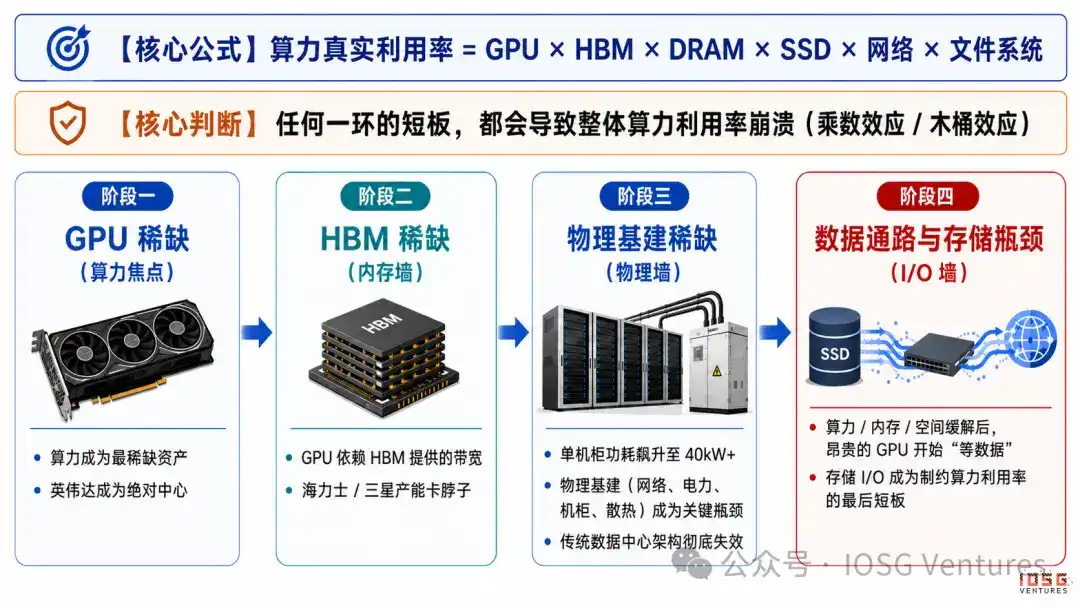
Panorama of AI Storage Architecture: From HBM Bandwidth Organ to Data Lake Foundation

AI storage is by no means a mere pile of individual hardware components; it is a complex, tightly coupled, and hierarchically managed system. Within this system, industrial value and capital focus are highly concentrated on HBM, enterprise SSDs, SSD controllers, NVMe/CXL protocols, and high-performance storage systems. To clearly deconstruct its value flow, we divide the AI storage architecture into four core hierarchical layers:
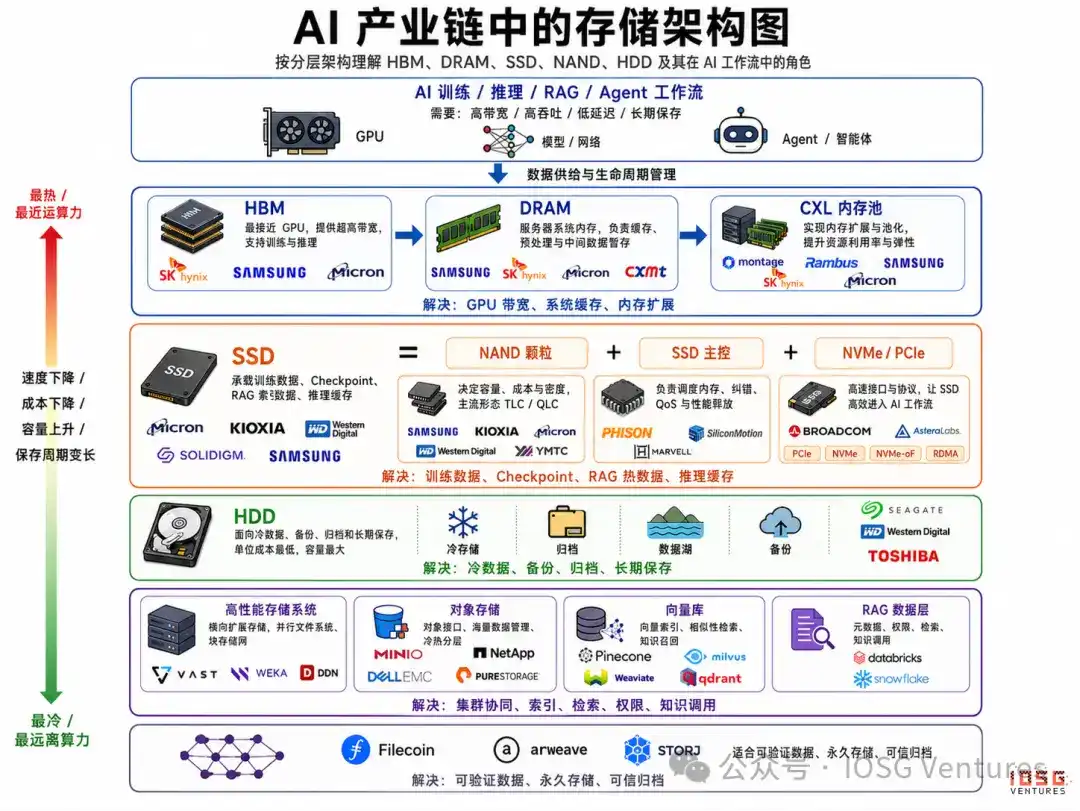
  • Compute-Near Memory Layer (Bandwidth Core): Dominated by HBM, supplemented by DRAM and CXL memory pooling technology. This layer is directly attached to GPU/CPU packaging or the bus, aiming to break the "memory wall." It is the first gate determining whether computing power can be fully unleashed.

  • High-Speed Persistent Storage Layer (I/O Hub): The core logic is Enterprise SSD = NAND Flash + SSD Controller + NVMe/PCIe Data Path. This layer handles high-frequency Checkpoint writes, massive training dataset loading, and RAG hot data caching. It represents the most definitive increment in persistent storage for AI data centers.

  • Low-Cost, High-Capacity Storage Layer (Capacity Base): Consisting of HDDs, cold storage, and data lake archival systems. Faced with the exponential growth of multimodal raw data, historical logs, and compliance backups, this layer still provides irreplaceable TCO (Total Cost of Ownership) advantages.

  • AI Storage Systems & Data Software (Scheduling Brain): Includes high-performance parallel file systems, distributed object storage, vector databases, and RAG data governance layers. What AI truly consumes is not bare hardware, but the data availability efficiently organized, indexed, and secured by the software stack.

As an ecosystem extension, decentralized storage does not directly engage in the millisecond-level race of AI hot data. Instead, it anchors positions like public dataset attestation, AI training data provenance, and long-term cold memory archival, establishing its unique niche as the "trustworthy cold layer."

HBM: The "Bandwidth Organ" Closest to Compute in the AI Storage Chain

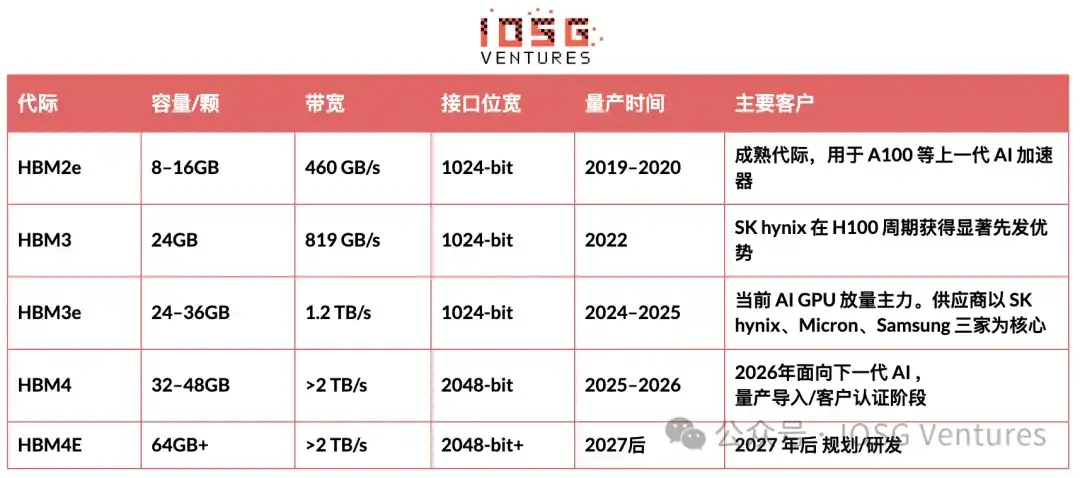
High Bandwidth Memory (HBM) is not traditional storage; it is a high-bandwidth memory layer proximate to the GPU. Its core mission is not to save data, but to continuously "feed" data to the compute units with extremely high bandwidth. HBM is the link in the AI storage chain that is closest to compute, with the highest certainty. It directly determines whether GPUs can be "fed adequately" and is the most critical supply chain bottleneck currently.

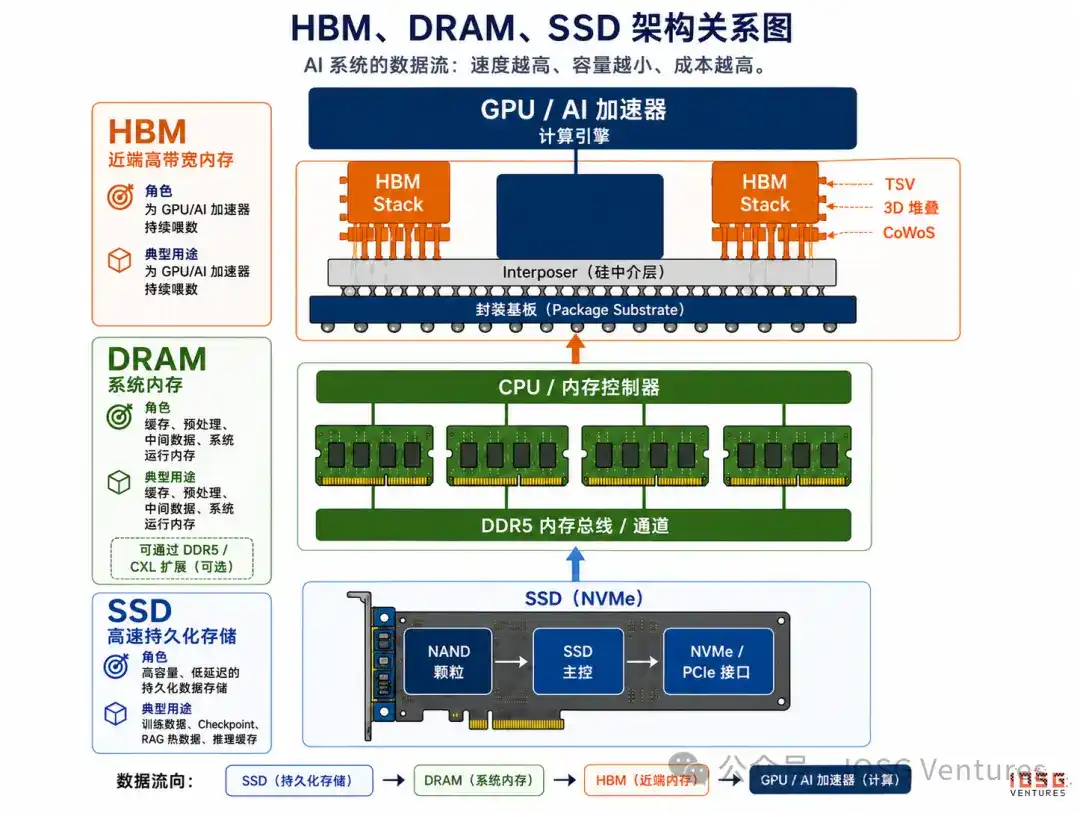
The core architecture of HBM is "3D DRAM stacking + 2.5D advanced packaging": Through TSV vertical stacking and CoWoS heterogeneous integration, the distance between memory and compute is compressed to the extreme, achieving generational leaps in bandwidth. Its industrial barriers encompass not just DRAM design, but a system engineering effort involving DRAM process technology, TSV, ultra-thin stacking, packaging, thermal management, testing, and customer certification. A defect in any single link can cause the entire HBM stack to be scrapped.

Currently, only three giants worldwide can stably mass-produce HBM: SK hynix, Samsung, and Micron, who have built a triple moat of top-tier DRAM process, packaging capabilities, and NVIDIA/AMD customer certifications.
DRAM & CXL: The System Memory Base and Memory Pooling Engine

HBM solves the extreme bandwidth problem near the GPU, DRAM solidifies the server's system memory foundation, while CXL attempts to break physical boundaries and reorganize memory resource allocation within data centers.

  • DRAM: Primarily handles CPU-side caching, data preprocessing, intermediate state storage, and system operation. It is the most fundamental system memory layer in servers. The global DRAM market is highly concentrated among three giants: SK hynix, Samsung, and Micron; Changxin Storage (CXMT) is the core variable in China's domestic DRAM substitution strategy.

  • CXL (Compute Express Link): A new-generation cache-coherent interconnect protocol for data centers, aiming to overcome the limitations of traditional DIMM slots, local memory capacity, and server memory resource silos, driving memory architecture towards expansion, pooling, and sharing. CXL is currently still in its early stages, transitioning from platform support to scaled deployment, but holds significant medium-to-long-term architectural value. Key companies include Astera Labs and Montage Technology.
Enterprise SSD: The Data Hub Built on NAND, Controllers, and NVMe

Enterprise SSDs represent the most critical high-throughput persistent storage increment in AI data centers. They continuously "feed" data to GPUs with extremely high throughput, ultra-low latency, and stable QoS, covering the entire lifecycle including training data loading, Checkpoint writes, RAG retrieval, inference caching, and log streaming.

Within the AI storage architecture, SSDs are not isolated hardware but a highly coupled system, which can be distilled into an industrial formula: Enterprise SSD = NAND Flash + SSD Controller + NVMe/PCIe Data Path. These three layers represent independent industrial chain segments:

  • NAND Flash (Raw Material Layer): Determines storage density and unit cost. Representative companies: Samsung, SK hynix (Solidigm), Micron, Kioxia, Western Digital, Yangtze Memory Technologies (YMTC).

  • SSD Controller (Performance Enablement Layer): Determines performance delivery, data error correction, QoS stability, and wear-leveling. Representative companies: Phison, Silicon Motion, Marvell, Maxio (Rayson).

  • NVMe/PCIe (Data Path Layer): Determines the efficiency of data transfer from storage to compute. Combined with technologies like GPUDirect Storage, it reduces CPU memory bounce buffers and CPU involvement, significantly alleviating I/O bottlenecks. Representative companies: Broadcom, Marvell, Astera Labs.

HDD / Cold Storage / Archival: The Low-Cost Base for AI Data Lakes

AI will not eliminate HDDs. With multimodal large models' voracious appetite for video and image data, and the exponential growth of enterprise compliance logs and historical datasets, demand for low-cost cold data storage is simultaneously exploding. In AI storage architecture, SSDs and HDDs collaborate based on a tiered business value approach: SSDs handle hot data and high throughput, while HDDs handle low cost and long-term preservation. Representative companies include Seagate, Western Digital, and Toshiba.

AI Storage Software Stack: The Scheduling Hub for Data Availability

What AI truly consumes is never bare drives, but "data services" meticulously organized by the software stack. This architecture transforms underlying hardware into knowledge assets directly callable by upper-layer AI. It can be divided into four specific layers:

  • High-Performance Storage Systems (Feeding System): Focus on concurrent throughput and low latency. Parallel file systems address the GPU cluster's "data hunger," ensuring rapid flow for training and inference. Representative companies: VAST Data, WEKA, Pure Storage.

  • Object Storage (Raw Data Lake): Core concepts are Object, Key, and Metadata management, hosting massive unstructured data. It doesn't pursue extreme low latency but builds capacity bases with low cost and cloud-native characteristics. Representative company: AWS S3.

  • Vector Databases (Semantic Indexing Layer): Vector databases store, index, and retrieve vectors generated by embedding models, enabling AI to precisely locate relevant content from vast knowledge bases. Representative companies: Pinecone, Milvus.

  • RAG Data Layer (Knowledge Invocation Layer): Goes beyond simple retrieval, encompassing data chunking, cleaning, access control, and citation provenance, ensuring enterprise data can be safely, accurately, and traceably invoked by large models. Representative company: Databricks.

From AI Hot Storage to Decentralized Cold Memory: Efficiency Maximization vs. Trust Maximization

AI Storage is an extreme efficiency-driven system whose value function focuses on maximizing computational output. HBM bandwidth determines whether GPUs can be fed adequately, SSD throughput determines dataset and Checkpoint read/write efficiency, and low latency is critical for RAG and real-time inference experiences. These metrics ultimately converge into GPU utilization and per-Token cost, directly deciding the commercial profitability of AI applications. The ultimate goal of AI storage is not preservation but acceleration, serving productivity.

Conversely, the value function of decentralized storage is fundamentally different. It questions whether data will still exist in ten years, whether it has been tampered with, and whether it can resist single-point censorship. Through cryptographic proofs and distributed networks, it builds an openly accessible, permanently preserved public data foundation. Its ultimate goal is to defend the absolute truth and sovereign independence of data, serving fairness, censorship resistance, and civilizational memory.
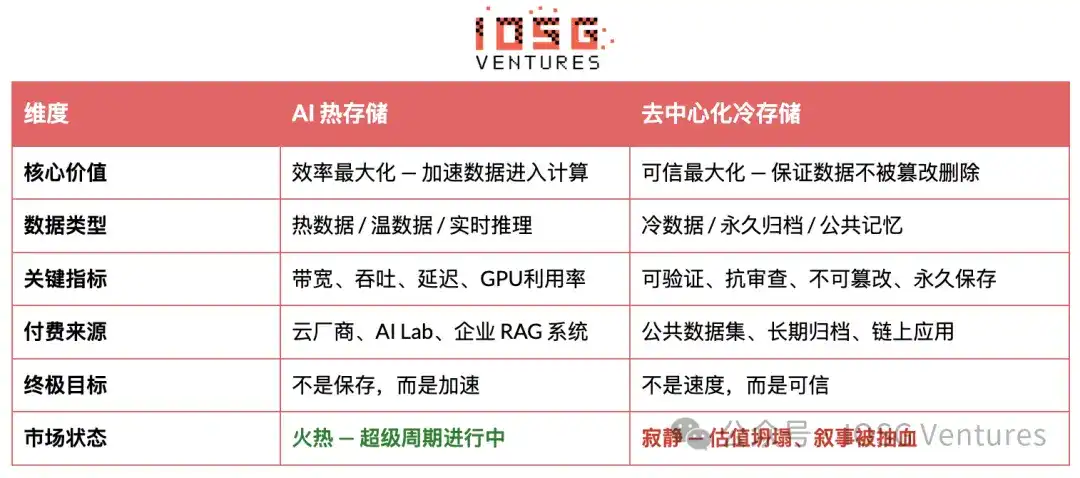
AI storage is "hot storage" providing fuel for future productivity; decentralized storage is "cold memory" preserving undeletable historical records for human civilization. The former serves efficiency, pursuing extreme speed; the latter serves trustworthiness, defending silent memory. The former determines how fast models run; the latter determines whether memories might be deleted. Currently, market mechanisms reward productive efficiency. AI storage is at the forefront of the wave, while decentralized storage seems to be experiencing a silence of valuation collapse and narrative bloodletting.

The Vision and Reality of Decentralized Storage

There are numerous decentralized storage projects, but in terms of industry mindshare and ecosystem depth, the core representatives remain Filecoin and Arweave. Although both fall under "decentralized storage," their underlying architectural philosophies are almost entirely divergent paths—the former approximates AWS-like elasticity through market-based contracts, while the latter approximates the permanence of a library through a one-time social contract.

  • Filecoin: Has built the most complete verifiable economic system through PoRep and PoSt. It should not continue to compete directly with AWS on consumer-grade cloud storage. Instead, it should pivot towards AI data provenance, public dataset hosting, and compliance archiving, providing verifiable chains for model auditing and copyright proof. The necessary path is to package itself as an S3-compatible API supporting fiat payments, upgrading from a "cheap storage marketplace" to "verifiable computational infrastructure."

  • Arweave: With its "pay once, store forever" narrative, it uses Blockweave and SPoRA mechanisms to incentivize miners to preserve and quickly access as much data as possible, especially scarce historical data. Its best fit is as a public memory foundation for human civilization—preserving human rights records, evidence of war crimes, cultural archives, archiving legal and financial history, and providing permanent, accessible long-term memory for AI Agents. Arweave's value lies not in speed but in its capacity to carry civilizational memory across cycles.
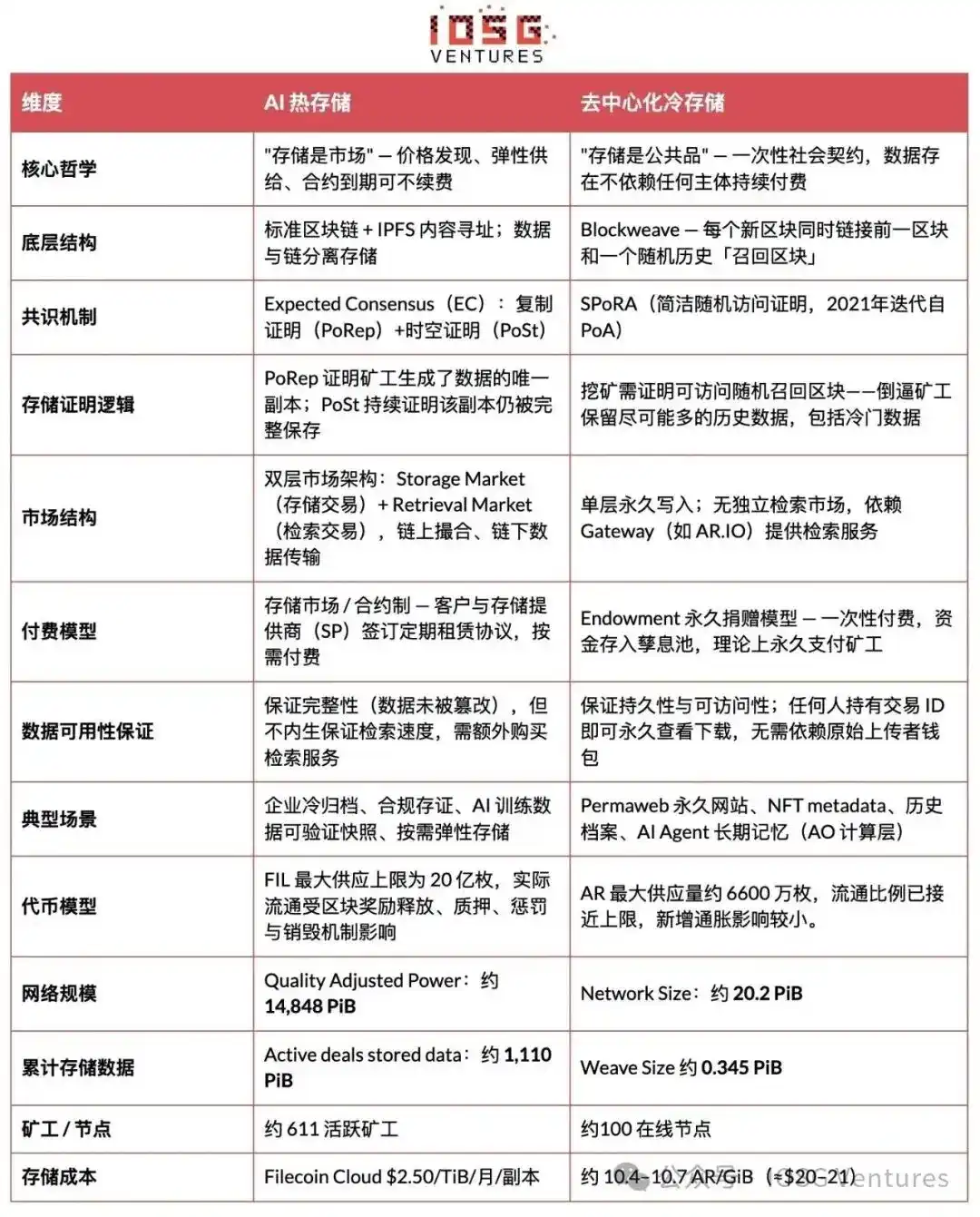
The predicament of decentralized storage projects like Filecoin and Arweave lies not in a flawed value proposition, but in the long-term misalignment among productization, retrieval experience, real-world demand, and token incentives. This reveals a significant gap between geek idealism and mainstream commercial adoption:

  • Supply-Demand Incentive Misalignment: Early networks like Filecoin rapidly expanded capacity via token incentives but failed to build sufficiently strong paid demand, resulting in vast capacity but low utilization and conversion. It rewards "I can store" rather than "need me to store."

  • Lack of Enterprise-Grade Service Capabilities: AWS's moat isn't hard drives, but the "data operating system" composed of APIs, SLAs, access management, compliance auditing, and technical support. Enterprises buy "peace of mind," not experimental infrastructure requiring them to handle keys and node selection themselves.

  • Retrieval Experience Shortcomings: "Storing in" does not equal "retrieving stably and with low latency." Distributed nodes, complex topology, and a lack of unified SLAs make it difficult to handle AI hot data workflows. It's more suitable for trustworthy cold archiving and data provenance.

  • Inadequate Privacy & Compliance: Enterprise private data cannot simply be written to a public, permanent network; the right to be forgotten inherently conflicts with permanent immutability. Decentralized storage is better suited for public data and long-term archives, not indiscriminately hosting core private data.

  • Token Economics Amplifying Cycles: Bull market financialization masks insufficient demand; bear market ROI decline for miners exposes commercialization shortcomings. Tokens can bootstrap supply but cannot automatically create demand and sustainable revenue.

Other decentralized storage projects mostly focus on specific ecosystems or niche segments: Storj/Sia have weaker cross-cycle industry mindshare and Web3 narrative influence compared to Filecoin/Arweave; BNB Greenfield/Walrus are tied to specific public chain ecosystems like BNB or SUI; Celestia/EigenDA belong to the Data Availability (DA) layer, serving Rollup transaction confirmation rather than long-term archival; AI/DA hybrid narrative projects like 0G attempt to integrate storage, data availability, computation, and AI agent settlement into an AI-native modular infrastructure, but their real-world demand, developer adoption, and commercial closure remain to be validated.

Future Opportunities for Decentralized Storage: The Long-Term Pendulum of Efficiency and Trust

During periods of technological红利爆发, capital frantically chases efficiency. Assets like GPUs and HBM are assigned extremely high premiums, while decentralized storage advocating "trust and fairness" is naturally marginalized. However, history's pendulum will not remain forever on the side of efficiency. Unjustifiable platform bans and content takedowns, AI copyright lawsuits forcing data provenance, geopolitical conflicts sparking data sovereignty disputes, data monopolies leading to the disappearance of public archives, and regulatory pressure for compliance auditing of model training data—all such events could potentially brew a repricing of "trustworthy storage." Decentralized storage's future opportunities may still manifest unique value in the following directions:

  • AI Data Provenance: Combining cryptographic proofs to build "data lineage proofs," addressing regulatory and audit pressures.

  • Public Datasets & Civilizational Archives: Anchoring censored archives and cultural heritage, building irreplaceable, undeletable memory.

  • Trustworthy Archival & Compliance Attestation: Achieving trustworthy self-attestation through hash storage, providing high-grade digital notarization.

  • Integration with ZK/TEE/DID Technologies: Mitigating privacy tensions, upgrading from a single "storage protocol" to "trustworthy data infrastructure."

  • Invisible Product Route: Offering S3-compatible APIs and fiat billing, allowing users to directly purchase "trustworthy archival" services.

AI storage and decentralized storage—one pursues ultimate efficiency, providing fuel for our sprint into the future; the other defends silent memory, safeguarding our right to look back at the past. The current market unhesitatingly rewards efficiency, which is why decentralized storage appears silent, even collapsing. However, when the AI era further amplifies data monopolies, copyright disputes, and the fragility of historical memory, decentralized storage may experience a revaluation as a "trustworthy cold layer." Those memories that cannot be easily erased by platforms, corporations, or any single authority might transition from an idealistic romance, from a fringe belief, into necessary infrastructure.


Criptos en tendencia

Preguntas relacionadas

QWhat is the fundamental difference between the value proposition of AI storage and decentralized storage, according to the article?

AThe core difference lies in their value functions. AI storage is driven by efficiency maximization, focusing on maximizing GPU utilization and lowering per-token costs to accelerate computing power and serve productivity. Decentralized storage is driven by trust maximization, focusing on data permanence, censorship resistance, authenticity, and serving as a long-term, immutable memory base for fairness and civilizational heritage.

QWhy is HBM considered a critical and bottleneck component in the AI storage chain?

AHBM is critical because it is the 'bandwidth organ' closest to the compute unit (GPU/CPU). Its core mission is not to preserve data but to feed data to the compute unit with extremely high bandwidth, directly determining whether the GPU can be fully utilized ('fed'). Its production involves complex system engineering with high barriers including advanced DRAM process, TSV technology, ultra-thin stacking, packaging, thermal management, and customer certification. Currently, only SK hynix, Samsung, and Micron can produce it stably.

QWhat are the four core layers of the AI storage architecture as outlined in the article?

AThe four core layers are: 1) Compute-proximate memory layer (Bandwidth Core), primarily HBM, supplemented by DRAM and CXL memory pooling. 2) High-speed persistent storage layer (I/O Hub), centered on enterprise SSD components. 3) Low-cost, high-capacity storage layer (Capacity Base), consisting of HDDs and cold storage/archive systems. 4) AI storage system and data software (Orchestration Brain), including parallel file systems, object storage, vector databases, and RAG data governance layers.

QWhat are the main challenges or mismatches currently facing decentralized storage projects like Filecoin and Arweave?

AThe main challenges include: 1) Supply-demand incentive mismatch, where networks incentivize storage capacity but lack strong paying demand. 2) Lack of enterprise-grade service capabilities like comprehensive APIs, SLA guarantees, permission management, and support. 3) Poor retrieval experience, making them unsuitable for hot data workflows. 4) Privacy and compliance issues, as permanent storage conflicts with deletion rights. 5) Token economies amplifying market cycles, where bull market speculation masks weak fundamentals.

QAccording to the article, what are the potential future opportunities for decentralized storage to demonstrate unique value?

APotential opportunities include: 1) AI Data Provenance: Providing cryptographic proof for data lineage and model training data to meet audit and regulatory needs. 2) Public Datasets & Civilizational Archives: Hosting censored records, cultural heritage, and public data. 3) Trusted Archiving & Compliance Attestation: Offering immutable hash-based proof for digital notarization. 4) Integration with technologies like ZK, TEE, and DID to enhance privacy and evolve into trusted data infrastructure. 5) An 'invisible' product route, offering S3-compatible APIs and fiat billing for easy enterprise adoption of 'trusted archive' services.

Lecturas Relacionadas

SemiAnalysis on the Epic Plunge: It's Not Over Yet

SemiAnalysis Weekly discusses the recent sharp correction in the semiconductor market after a historic first half. Analysts Doug O'Loughlin and Dylan note that despite healthy fundamentals, markets like South Korea's KOSPI have plunged 40%, wiping out leveraged retail investors. A core debate focuses on AI demand versus supply constraints. Dylan cites SemiAnalysis's internal use of AI coding agents, leading to a 100x increase in AI spending, as evidence of powerful demand. Doug agrees demand is strong but questions its exact magnitude, calling it a "trillion-dollar question." His primary concern is physical and financial bottlenecks: a shortage of 100,000 electricians in the US, massive $450B in corporate debt issuance by hyperscalers (funded by a shrinking pension pool), and labor/scale limits in regions like Taiwan, where TSMC constitutes 20% of GDP. The conversation covers market dynamics, including the typical semiconductor cycle where over-ordering leads to crashes, China's growing memory capacity, and the potential for older chips like the H100 to lose value as models scale. Politically, AI is seen as a likely scapegoat in upcoming elections, though not a top-tier voter priority. The analysts conclude that while the long-term potential is significant, the scaling path is narrowing. The challenge is matching exponential compute demands with real-world constraints on capital, labor, and permits, risking scenarios where massive investment outpaces near-term revenue generation.

marsbitHace 12 min(s)

SemiAnalysis on the Epic Plunge: It's Not Over Yet

marsbitHace 12 min(s)

After Robinhood's Aggressive Entry, Why is PUMP Defying the Trend and Rising?

Amid a prolonged crypto bear market that has strained many projects, Pump.fun stands out by maintaining strong profitability. Despite a major token unlock in mid-July that was expected to cause selling pressure, its native token PUMP has risen nearly 48% over the past month. Analysis shows only a small portion of unlocked tokens were sold, with 92% of investor allocations still held. A buyback-and-burn mechanism has also supported the price, though daily回购 funds have declined by 77.5% from their peak, partly due to a change in tokenomics and lower platform revenue. Pump.fun remains a top revenue generator in crypto, with annualized revenue of around $450 million, ranking just behind giants like Tether and Circle. However, its daily revenue is down about 69% from its all-time high, reflecting dependence on meme coin market cycles. The platform also faces a class-action lawsuit alleging market manipulation and securities violations. New competition has emerged with Robinhood Chain's launchpad, which recently saw higher weekly volume and active addresses than Pump.fun. While Pump.fun's metrics haven't declined yet, it has responded with a new token launch mechanism called BOOST to improve liquidity. This has increased platform activity but raised community concerns about potential exploitation for short-term pumps. Ultimately, Pump.fun's success remains tightly linked to meme coin speculation and broader market sentiment.

marsbitHace 12 min(s)

After Robinhood's Aggressive Entry, Why is PUMP Defying the Trend and Rising?

marsbitHace 12 min(s)

China Business Journal Unveils Cryptocurrency Extortion Scheme

China Business Journal, a state-run Chinese newspaper, has issued a warning about scammers using its name to extort cryptocurrency from companies. According to the publication, fraudsters are sending emails impersonating its journalists. These emails threaten to publish damaging information about a company unless a Bitcoin payment is made. The scammers, using Proton Mail addresses, claim to possess compromising material from a secretive investigation. The newspaper's representatives have clarified that it has no involvement with these messages. They emphasized that the publication does not engage in such practices, never demands payment to suppress stories, and does not negotiate in this manner. The editorial team believes the criminals are exploiting the newspaper's authoritative reputation to pressure companies into making hasty decisions under threat of reputational harm. China Business Journal stated it is collecting evidence of this brand misuse, analyzing the fraudulent emails, and preparing materials for law enforcement. It reserves the right to pursue both civil and criminal liability against the scheme's organizers. Companies are urged to carefully verify any communication purportedly from the newspaper, avoid transferring cryptocurrency to unknown recipients, and report such incidents to the authorities. The newspaper confirmed it will continue its own investigation into the matter.

cryptonews.ruHace 47 min(s)

China Business Journal Unveils Cryptocurrency Extortion Scheme

cryptonews.ruHace 47 min(s)

Trading

Spot

Artículos destacados

Qué es $S$

Entendiendo SPERO: Una Visión General Completa Introducción a SPERO A medida que el panorama de la innovación continúa evolucionando, la aparición de tecnologías web3 y proyectos de criptomonedas juega un papel fundamental en la configuración del futuro digital. Un proyecto que ha atraído la atención en este campo dinámico es SPERO, denotado como SPERO,$$s$. Este artículo tiene como objetivo reunir y presentar información detallada sobre SPERO, para ayudar a entusiastas e inversores a comprender sus fundamentos, objetivos e innovaciones dentro de los dominios web3 y cripto. ¿Qué es SPERO,$$s$? SPERO,$$s$ es un proyecto único dentro del espacio cripto que busca aprovechar los principios de descentralización y tecnología blockchain para crear un ecosistema que promueva la participación, la utilidad y la inclusión financiera. El proyecto está diseñado para facilitar interacciones de igual a igual de nuevas maneras, proporcionando a los usuarios soluciones y servicios financieros innovadores. En su esencia, SPERO,$$s$ tiene como objetivo empoderar a los individuos al proporcionar herramientas y plataformas que mejoren la experiencia del usuario en el espacio de las criptomonedas. Esto incluye habilitar métodos de transacción más flexibles, fomentar iniciativas impulsadas por la comunidad y crear caminos para oportunidades financieras a través de aplicaciones descentralizadas (dApps). La visión subyacente de SPERO,$$s$ gira en torno a la inclusividad, buscando cerrar brechas dentro de las finanzas tradicionales mientras aprovecha los beneficios de la tecnología blockchain. ¿Quién es el Creador de SPERO,$$s$? La identidad del creador de SPERO,$$s$ sigue siendo algo oscura, ya que hay recursos públicos limitados que proporcionan información de fondo detallada sobre su(s) fundador(es). Esta falta de transparencia puede derivarse del compromiso del proyecto con la descentralización, una ética que muchos proyectos web3 comparten, priorizando las contribuciones colectivas sobre el reconocimiento individual. Al centrar las discusiones en torno a la comunidad y sus objetivos colectivos, SPERO,$$s$ encarna la esencia del empoderamiento sin señalar a individuos específicos. Como tal, comprender la ética y la misión de SPERO sigue siendo más importante que identificar a un creador singular. ¿Quiénes son los Inversores de SPERO,$$s$? SPERO,$$s$ cuenta con el apoyo de una diversa gama de inversores que van desde capitalistas de riesgo hasta inversores ángeles dedicados a fomentar la innovación en el sector cripto. El enfoque de estos inversores generalmente se alinea con la misión de SPERO, priorizando proyectos que prometen avances tecnológicos sociales, inclusión financiera y gobernanza descentralizada. Estas fundaciones de inversores suelen estar interesadas en proyectos que no solo ofrecen productos innovadores, sino que también contribuyen positivamente a la comunidad blockchain y sus ecosistemas. El respaldo de estos inversores refuerza a SPERO,$$s$ como un contendiente notable en el dominio de proyectos cripto que evoluciona rápidamente. ¿Cómo Funciona SPERO,$$s$? SPERO,$$s$ emplea un marco multifacético que lo distingue de los proyectos de criptomonedas convencionales. Aquí hay algunas de las características clave que subrayan su singularidad e innovación: Gobernanza Descentralizada: SPERO,$$s$ integra modelos de gobernanza descentralizada, empoderando a los usuarios para participar activamente en los procesos de toma de decisiones sobre el futuro del proyecto. Este enfoque fomenta un sentido de propiedad y responsabilidad entre los miembros de la comunidad. Utilidad del Token: SPERO,$$s$ utiliza su propio token de criptomoneda, diseñado para servir diversas funciones dentro del ecosistema. Estos tokens permiten transacciones, recompensas y la facilitación de servicios ofrecidos en la plataforma, mejorando la participación y la utilidad general. Arquitectura en Capas: La arquitectura técnica de SPERO,$$s$ apoya la modularidad y escalabilidad, permitiendo la integración fluida de características y aplicaciones adicionales a medida que el proyecto evoluciona. Esta adaptabilidad es fundamental para mantener la relevancia en el cambiante paisaje cripto. Participación de la Comunidad: El proyecto enfatiza iniciativas impulsadas por la comunidad, empleando mecanismos que incentivan la colaboración y la retroalimentación. Al nutrir una comunidad sólida, SPERO,$$s$ puede abordar mejor las necesidades de los usuarios y adaptarse a las tendencias del mercado. Enfoque en la Inclusión: Al ofrecer tarifas de transacción bajas e interfaces amigables para el usuario, SPERO,$$s$ busca atraer a una base de usuarios diversa, incluyendo a individuos que anteriormente pueden no haber participado en el espacio cripto. Este compromiso con la inclusión se alinea con su misión general de empoderamiento a través de la accesibilidad. Cronología de SPERO,$$s$ Entender la historia de un proyecto proporciona información crucial sobre su trayectoria de desarrollo y hitos. A continuación se presenta una cronología sugerida que mapea eventos significativos en la evolución de SPERO,$$s$: Fase de Conceptualización e Ideación: Las ideas iniciales que forman la base de SPERO,$$s$ fueron concebidas, alineándose estrechamente con los principios de descentralización y enfoque comunitario dentro de la industria blockchain. Lanzamiento del Whitepaper del Proyecto: Tras la fase conceptual, se lanzó un whitepaper completo que detalla la visión, los objetivos y la infraestructura tecnológica de SPERO,$$s$ para generar interés y retroalimentación de la comunidad. Construcción de Comunidad y Primeras Interacciones: Se realizaron esfuerzos de divulgación activa para construir una comunidad de primeros adoptantes y posibles inversores, facilitando discusiones en torno a los objetivos del proyecto y obteniendo apoyo. Evento de Generación de Tokens: SPERO,$$s$ llevó a cabo un evento de generación de tokens (TGE) para distribuir sus tokens nativos a los primeros seguidores y establecer liquidez inicial dentro del ecosistema. Lanzamiento de la dApp Inicial: La primera aplicación descentralizada (dApp) asociada con SPERO,$$s$ se puso en marcha, permitiendo a los usuarios interactuar con las funcionalidades centrales de la plataforma. Desarrollo Continuo y Alianzas: Actualizaciones y mejoras continuas a las ofertas del proyecto, incluyendo alianzas estratégicas con otros actores en el espacio blockchain, han moldeado a SPERO,$$s$ en un jugador competitivo y en evolución en el mercado cripto. Conclusión SPERO,$$s$ se erige como un testimonio del potencial de web3 y las criptomonedas para revolucionar los sistemas financieros y empoderar a los individuos. Con un compromiso con la gobernanza descentralizada, la participación comunitaria y funcionalidades diseñadas de manera innovadora, allana el camino hacia un paisaje financiero más inclusivo. Como con cualquier inversión en el espacio cripto que evoluciona rápidamente, se anima a los posibles inversores y usuarios a investigar a fondo y participar de manera reflexiva con los desarrollos en curso dentro de SPERO,$$s$. El proyecto muestra el espíritu innovador de la industria cripto, invitando a una mayor exploración de sus innumerables posibilidades. Mientras el viaje de SPERO,$$s$ aún se desarrolla, sus principios fundamentales pueden, de hecho, influir en el futuro de cómo interactuamos con la tecnología, las finanzas y entre nosotros en ecosistemas digitales interconectados.

159 Vistas totalesPublicado en 2024.12.17Actualizado en 2024.12.17

Qué es $S$

Qué es AGENT S

Agent S: El Futuro de la Interacción Autónoma en Web3 Introducción En el paisaje en constante evolución de Web3 y las criptomonedas, las innovaciones están redefiniendo constantemente cómo los individuos interactúan con las plataformas digitales. Uno de estos proyectos pioneros, Agent S, promete revolucionar la interacción humano-computadora a través de su marco agente abierto. Al allanar el camino para interacciones autónomas, Agent S busca simplificar tareas complejas, ofreciendo aplicaciones transformadoras en inteligencia artificial (IA). Esta exploración detallada profundizará en las complejidades del proyecto, sus características únicas y las implicaciones para el dominio de las criptomonedas. ¿Qué es Agent S? Agent S se presenta como un marco agente abierto innovador, diseñado específicamente para abordar tres desafíos fundamentales en la automatización de tareas informáticas: Adquisición de Conocimiento Específico del Dominio: El marco aprende inteligentemente de diversas fuentes de conocimiento externas y experiencias internas. Este enfoque dual le permite construir un rico repositorio de conocimiento específico del dominio, mejorando su rendimiento en la ejecución de tareas. Planificación a Largo Plazo de Tareas: Agent S emplea planificación jerárquica aumentada por la experiencia, un enfoque estratégico que facilita la descomposición y ejecución eficiente de tareas complejas. Esta característica mejora significativamente su capacidad para gestionar múltiples subtareas de manera eficiente y efectiva. Manejo de Interfaces Dinámicas y No Uniformes: El proyecto introduce la Interfaz Agente-Computadora (ACI), una solución innovadora que mejora la interacción entre agentes y usuarios. Utilizando Modelos de Lenguaje Multimodal de Gran Escala (MLLMs), Agent S puede navegar y manipular diversas interfaces gráficas de usuario sin problemas. A través de estas características pioneras, Agent S proporciona un marco robusto que aborda las complejidades involucradas en la automatización de la interacción humana con las máquinas, preparando el terreno para una multitud de aplicaciones en IA y más allá. ¿Quién es el Creador de Agent S? Si bien el concepto de Agent S es fundamentalmente innovador, la información específica sobre su creador sigue siendo elusiva. El creador es actualmente desconocido, lo que resalta ya sea la etapa incipiente del proyecto o la elección estratégica de mantener a los miembros fundadores en el anonimato. Independientemente de la anonimidad, el enfoque sigue siendo en las capacidades y el potencial del marco. ¿Quiénes son los Inversores de Agent S? Dado que Agent S es relativamente nuevo en el ecosistema criptográfico, la información detallada sobre sus inversores y patrocinadores financieros no está documentada explícitamente. La falta de información disponible públicamente sobre las bases de inversión u organizaciones que apoyan el proyecto plantea preguntas sobre su estructura de financiamiento y hoja de ruta de desarrollo. Comprender el respaldo es crucial para evaluar la sostenibilidad del proyecto y su posible impacto en el mercado. ¿Cómo Funciona Agent S? En el núcleo de Agent S se encuentra una tecnología de vanguardia que le permite funcionar de manera efectiva en diversos entornos. Su modelo operativo se basa en varias características clave: Interacción Humano-Computadora Similar a la Humana: El marco ofrece planificación avanzada de IA, esforzándose por hacer que las interacciones con las computadoras sean más intuitivas. Al imitar el comportamiento humano en la ejecución de tareas, promete elevar las experiencias de los usuarios. Memoria Narrativa: Empleada para aprovechar experiencias de alto nivel, Agent S utiliza memoria narrativa para hacer un seguimiento de las historias de tareas, mejorando así sus procesos de toma de decisiones. Memoria Episódica: Esta característica proporciona a los usuarios una guía paso a paso, permitiendo que el marco ofrezca apoyo contextual a medida que se desarrollan las tareas. Soporte para OpenACI: Con la capacidad de ejecutarse localmente, Agent S permite a los usuarios mantener el control sobre sus interacciones y flujos de trabajo, alineándose con la ética descentralizada de Web3. Fácil Integración con APIs Externas: Su versatilidad y compatibilidad con varias plataformas de IA aseguran que Agent S pueda encajar sin problemas en ecosistemas tecnológicos existentes, convirtiéndolo en una opción atractiva para desarrolladores y organizaciones. Estas funcionalidades contribuyen colectivamente a la posición única de Agent S dentro del espacio cripto, ya que automatiza tareas complejas y de múltiples pasos con una intervención humana mínima. A medida que el proyecto evoluciona, sus posibles aplicaciones en Web3 podrían redefinir cómo se desarrollan las interacciones digitales. Cronología de Agent S El desarrollo y los hitos de Agent S pueden encapsularse en una cronología que resalta sus eventos significativos: 27 de septiembre de 2024: El concepto de Agent S fue lanzado en un documento de investigación integral titulado “Un Marco Agente Abierto que Usa Computadoras Como un Humano”, mostrando las bases del proyecto. 10 de octubre de 2024: El documento de investigación fue puesto a disposición del público en arXiv, ofreciendo una exploración profunda del marco y su evaluación de rendimiento basada en el benchmark OSWorld. 12 de octubre de 2024: Se lanzó una presentación en video, proporcionando una visión visual de las capacidades y características de Agent S, involucrando aún más a posibles usuarios e inversores. Estos marcadores en la cronología no solo ilustran el progreso de Agent S, sino que también indican su compromiso con la transparencia y la participación comunitaria. Puntos Clave Sobre Agent S A medida que el marco Agent S continúa evolucionando, varios atributos clave destacan, subrayando su naturaleza innovadora y potencial: Marco Innovador: Diseñado para proporcionar un uso intuitivo de las computadoras similar a la interacción humana, Agent S aporta un enfoque novedoso a la automatización de tareas. Interacción Autónoma: La capacidad de interactuar de manera autónoma con las computadoras a través de GUI significa un salto hacia soluciones informáticas más inteligentes y eficientes. Automatización de Tareas Complejas: Con su metodología robusta, puede automatizar tareas complejas y de múltiples pasos, haciendo que los procesos sean más rápidos y menos propensos a errores. Mejora Continua: Los mecanismos de aprendizaje permiten a Agent S mejorar a partir de experiencias pasadas, mejorando continuamente su rendimiento y eficacia. Versatilidad: Su adaptabilidad en diferentes entornos operativos como OSWorld y WindowsAgentArena asegura que pueda servir a una amplia gama de aplicaciones. A medida que Agent S se posiciona en el paisaje de Web3 y criptomonedas, su potencial para mejorar las capacidades de interacción y automatizar procesos significa un avance significativo en las tecnologías de IA. A través de su marco innovador, Agent S ejemplifica el futuro de las interacciones digitales, prometiendo una experiencia más fluida y eficiente para los usuarios en diversas industrias. Conclusión Agent S representa un audaz avance en la unión de la IA y Web3, con la capacidad de redefinir cómo interactuamos con la tecnología. Aunque aún se encuentra en sus primeras etapas, las posibilidades para su aplicación son vastas y atractivas. A través de su marco integral que aborda desafíos críticos, Agent S busca llevar las interacciones autónomas al primer plano de la experiencia digital. A medida que nos adentramos más en los reinos de las criptomonedas y la descentralización, proyectos como Agent S sin duda desempeñarán un papel crucial en la configuración del futuro de la tecnología y la colaboración humano-computadora.

567 Vistas totalesPublicado en 2025.01.14Actualizado en 2025.01.14

Qué es AGENT S

Cómo comprar S

¡Bienvenido a HTX.com! Hemos hecho que comprar Sonic (S) sea simple y conveniente. Sigue nuestra guía paso a paso para iniciar tu viaje de criptos.Paso 1: crea tu cuenta HTXUtiliza tu correo electrónico o número de teléfono para registrarte y obtener una cuenta gratuita en HTX. Experimenta un proceso de registro sin complicaciones y desbloquea todas las funciones.Obtener mi cuentaPaso 2: ve a Comprar cripto y elige tu método de pagoTarjeta de crédito/débito: usa tu Visa o Mastercard para comprar Sonic (S) al instante.Saldo: utiliza fondos del saldo de tu cuenta HTX para tradear sin problemas.Terceros: hemos agregado métodos de pago populares como Google Pay y Apple Pay para mejorar la comodidad.P2P: tradear directamente con otros usuarios en HTX.Over-the-Counter (OTC): ofrecemos servicios personalizados y tipos de cambio competitivos para los traders.Paso 3: guarda tu Sonic (S)Después de comprar tu Sonic (S), guárdalo en tu cuenta HTX. Alternativamente, puedes enviarlo a otro lugar mediante transferencia blockchain o utilizarlo para tradear otras criptomonedas.Paso 4: tradear Sonic (S)Tradear fácilmente con Sonic (S) en HTX's mercado spot. Simplemente accede a tu cuenta, selecciona tu par de trading, ejecuta tus trades y monitorea en tiempo real. Ofrecemos una experiencia fácil de usar tanto para principiantes como para traders experimentados.

1.1k Vistas totalesPublicado en 2025.01.15Actualizado en 2026.06.02

Cómo comprar S

Discusiones

Bienvenido a la comunidad de HTX. Aquí puedes mantenerte informado sobre los últimos desarrollos de la plataforma y acceder a análisis profesionales del mercado. A continuación se presentan las opiniones de los usuarios sobre el precio de S (S).

活动图片