From "Heaven-Sent Public Chain" to "Heaven-Forsaken Public Chain": What Led to the Collapse of Berachain?

比推Publicado a 2026-01-15Actualizado a 2026-01-15

Resumen

Once hailed as a "top-tier public chain," Berachain has seen a dramatic decline, with its new nickname "doomed chain" reflecting its severe downturn. Launched in February 2025 with an innovative Proof-of-Liquidity (PoL) consensus mechanism aimed at boosting DeFi efficiency, the project initially attracted significant interest. Its TVL surged to $3.3 billion, with over 140,000 active addresses. However, the ecosystem quickly deteriorated. TVL has since collapsed to $180 million, and the chain’s daily revenue dropped to just $84. The sharp decline is attributed to several critical issues. The tokenomics heavily favored venture capitalists (VCs), who received 34.31% of the total token supply, while retail participants received minimal allocations. This high Fully Diluted Valuation (FDV) and low circulating supply model led to artificial price spikes followed by a steep crash—BERA fell from a high of $9 to around $0.7, a drop of over 90%. Internal challenges also mounted. The foundation cut most of its retail-focused marketing team and saw key developers, including the chief developer, leave. Community trust eroded further when a Balancer protocol vulnerability forced a network halt in November 2025. Additionally, major token unlocks are scheduled starting February 2026, with 12.16% of supply—including significant VC holdings—set to be released, likely increasing selling pressure. Despite attempts at strategic shifts, including a partnership to use BERA as a reserve asset, the...

Author: Ma He, Foresight News

Original Title: Token Price Crash, Layoffs, Developers Fleeing—Is Berachain Becoming a Heaven-Forsaken Public Chain?


On January 14, BERA experienced a sudden surge, rising from $0.5 to $0.9, a rare occurrence amid a previous 12-week consecutive decline. That day, the Berachain Foundation released its year-end summary for 2025, highlighting ecosystem expansion, technical optimization, and community engagement after the mainnet launch, but also candidly acknowledging the pressures brought by market volatility.

After the Berachain mainnet launch, both TVL and token price experienced severe fluctuations. This may not only be due to market cycles but also the combined result of internal strategies and external pressures.

TVL Drops from $3 Billion to $180 Million, Chain Revenue $84 in 24 Hours

In February 2025, Berachain officially launched its mainnet, introducing an innovative Proof of Liquidity (PoL) consensus mechanism. This mechanism aims to incentivize application and user participation through liquidity proof rather than traditional Proof of Stake, making Berachain a Layer 1 chain designed specifically for DeFi applications, intended to enhance capital efficiency and user adoption. Initially, the ecosystem expanded rapidly, attracting hundreds of dApps, including DEXs like BEX, lending protocols, and NFT markets.

TVL once soared to $3.3 billion, with over 140,000 active addresses and 9.59 million transactions. The Foundation also supported multiple ecosystem projects through the RFA (Request for Application) and RFC (Request for Comment) programs and collaborated with institutions like BitGo to provide custody services, enhancing the project's professionalism. Additionally, Berachain's community building and marketing strategies were outstanding in the early stages. Bear-themed NFT series (such as Bong Bears) attracted a large number of users, and airdrops and incentive programs further stimulated participation. These initiatives helped Berachain become a hotspot in the DeFi space in the first half of 2025, ranking as the sixth-largest DeFi chain.
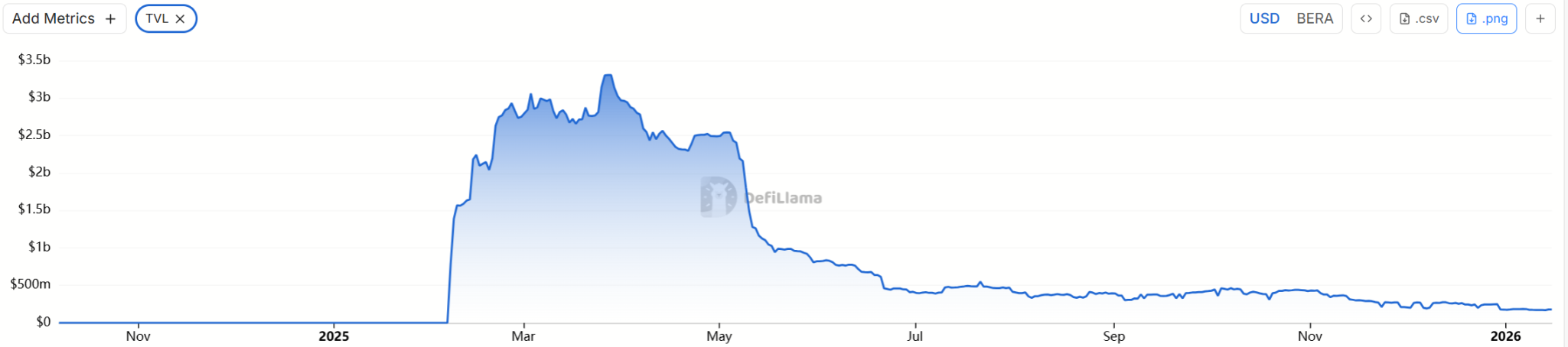
However, as the token price continued to decline, data from DefiLlama shows that its TVL has fallen to $180 million, with 24-hour chain revenue at $84, and the total stablecoin supply on the chain is $153.5 million.

Retail First? Majority of Tokens Allocated to VCs, Major Unlock in February

In its year-end update, the Berachain Foundation admitted that the "retail first" strategy in the crypto market had generally underperformed, leading to a reallocation of resources. This directly triggered a series of issues. First, layoffs and team changes. As part of the strategic adjustment, the Berachain Foundation cut most of its retail marketing team, shifting focus to foundational development. Berachain's lead developer, Alberto, is also leaving to co-found a Web2 company with former banking colleagues.

The Foundation emphasized that the departure was amicable, but this undoubtedly weakens the project's core technical strength. In the community, some developers have already moved to other chains like Monad, further exacerbating the talent drain.

Perhaps the "retail first" strategy promoted by the Berachain Foundation never truly took off.

The project initially emphasized community-driven approaches, but in practice, the incentive mechanisms failed to consistently attract users, and token allocation left retail investors out in the cold.

Although the PoL mechanism is innovative, its complexity (such as the multi-token model, including BERA and BGT) deterred users, leading to a sharp decline in network activity. In November 2025, the project paused the network due to a Balancer protocol vulnerability, fortunately without affecting user funds.

The BERA token price has fallen from a high of $9 to the current $0.7, a drop of over 10 times in just one year for the once so-called "heaven-sent" public chain token.
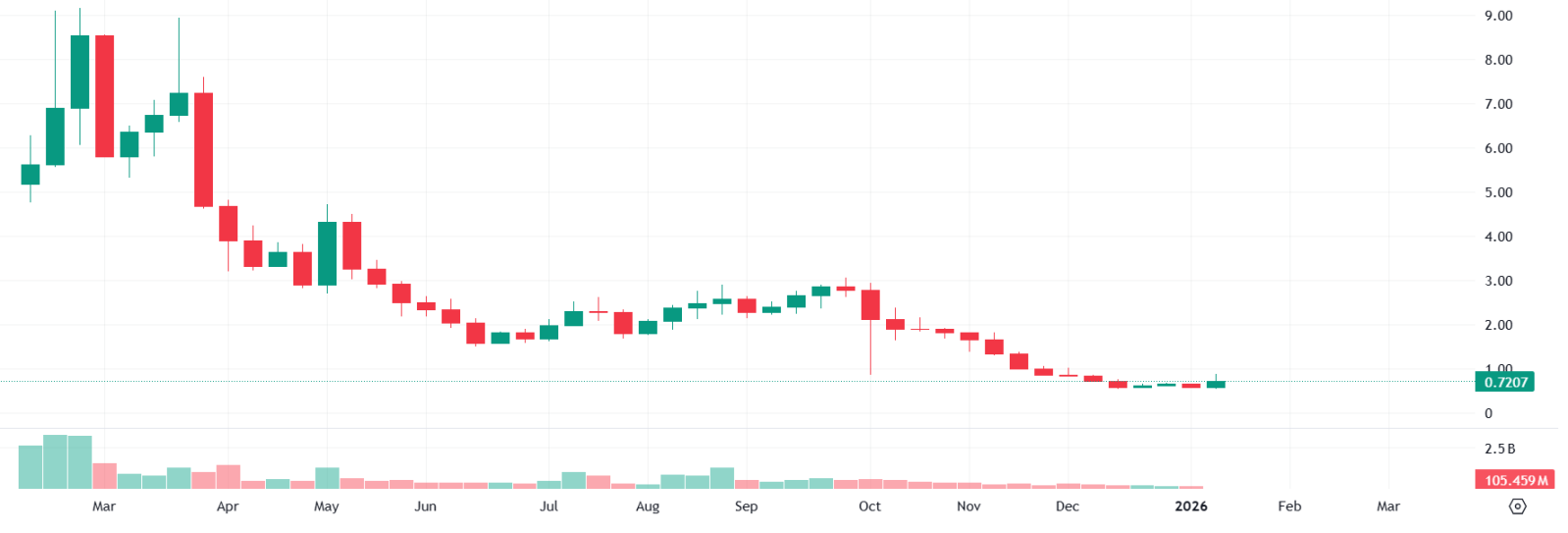
This collapse stems from a low circulation and high FDV model, leading to artificially inflated prices followed by a rapid crash, and these issues are rooted in Berachain's token distribution mechanism. Early contributors received 16.82% of the total supply, while private sale investors received a staggering 34.31% of the token share, typical of a VC coin. Additionally, NFT holders could receive tens of millions of dollars in tokens, while testnet users received only $60 in airdrops, sparking controversy over "wealth disparity" and marginalizing some loyal users.
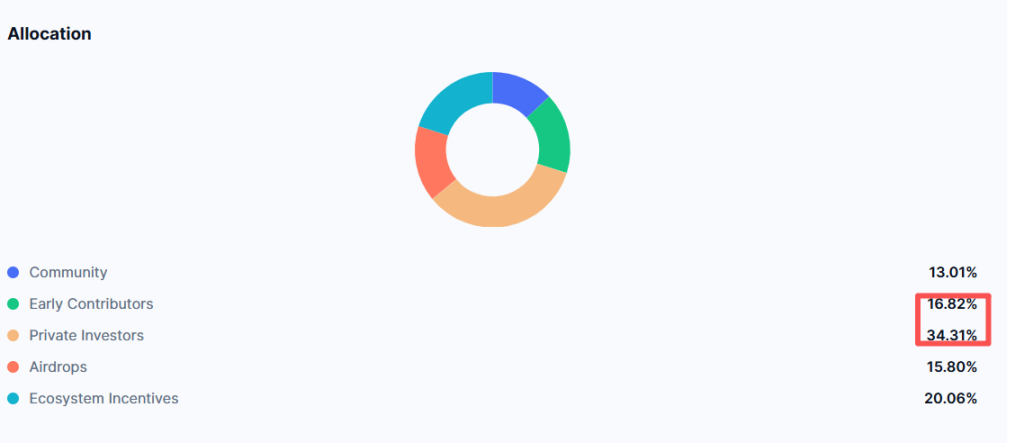
This runs counter to the "retail first" slogan; the project is essentially a VC-dominated low-circulation, high-FDV model: early investors entered at $0.82, achieving 10-15x returns, while retail investors bear the crash. Foundation founder Smokey admitted that if done over, he would not sell so many tokens to VCs and has repurchased some to reduce dilution. In October 2025, the Berachain Foundation partnered with Greenlane Holdings to launch BeraStrategy, making BERA a reserve asset, but this failed to reverse the token's decline.

Furthermore, VCs like Brevan Howard's Nova fund hold refund rights, allowing them to request a full refund of $25 million before February 2026, further highlighting Berachain's tilt toward VCs.

Community dissatisfaction is high, with many users calling it the "ultimate fraudulent L1."
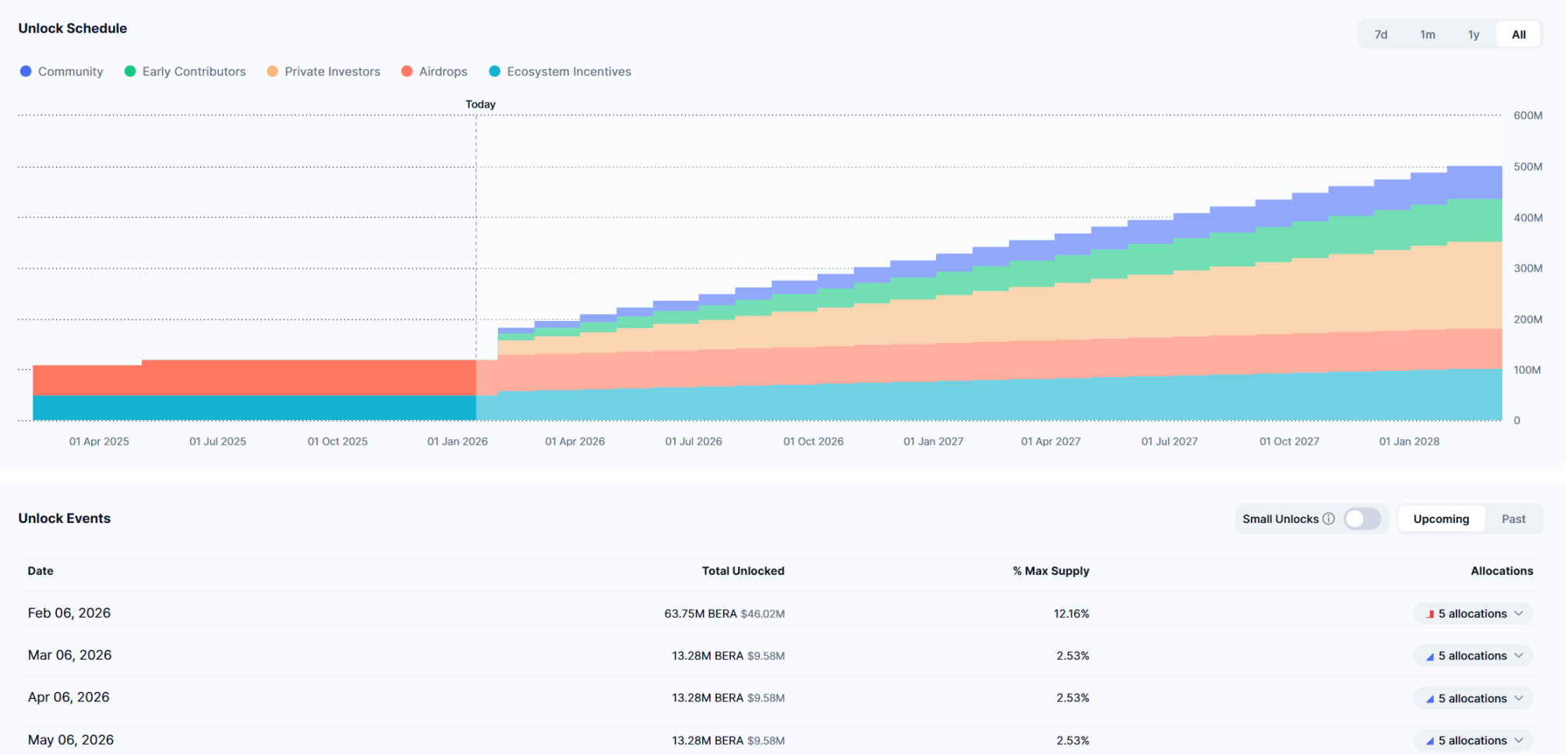
On February 6 this year, Berachain will unlock 63.75 million BERA, approximately 12.16% of the total supply. Of the unlocked portion, private sale investors account for 28.58 million. Starting from March this year, BERA will unlock 2.53% of the total supply each month. Given the current liquidity drought, the continuous large unlocks this year may trigger significant selling pressure.


Twitter:https://twitter.com/BitpushNewsCN

BitPush TG Discussion Group:https://t.me/BitPushCommunity

BitPush TG Subscription: https://t.me/bitpush

Original Link:https://www.bitpush.news/articles/7603193

Preguntas relacionadas

QWhat were the main factors that led to the collapse of Berachain's token price and TVL?

AThe collapse was driven by a combination of internal strategy flaws and external market pressures. Key factors included the project's high Fully Diluted Valuation (FDV) with low initial circulation, significant token allocations to venture capitalists (VCs) rather than retail users, the complexity of its Proof-of-Liquidity (PoL) mechanism, loss of key developers, and upcoming large token unlocks that created selling pressure.

QHow did Berachain's token distribution model contribute to its problems?

ABerachain's token distribution was heavily skewed towards VCs and early contributors, with 34.31% allocated to private sale investors and 16.82% to early contributors. This left retail users with minimal allocations, contradicting the project's 'retail-first' marketing. The low circulation and high FDV model artificially inflated the price initially, leading to a sharp decline when early investors began selling.

QWhat was the significance of the upcoming token unlocks in February for Berachain?

AOn February 6, Berachain was scheduled to unlock 63.75 million BERA tokens, representing 12.16% of the total supply. This included 28.58 million tokens for private sale investors. Given the already low liquidity and declining price, these unlocks were expected to create substantial selling pressure, further depressing the token value.

QWhy did Berachain's innovative Proof-of-Liquidity (PoL) consensus mechanism fail to sustain user engagement?

AThe PoL mechanism, while innovative, was complex and involved a multi-token system (BERA and BGT) that confused users. This complexity reduced network activity and participation, as users found it difficult to engage with the ecosystem effectively, leading to a decline in TVL and overall chain activity.

QWhat internal challenges did Berachain face regarding its development team and community?

ABerachain experienced significant internal challenges, including the departure of key developers such as Chief Developer Alberto, who left to start a Web2 company. The foundation also cut most of its retail marketing team, shifting focus to core development. Additionally, community developers migrated to other chains like Monad, exacerbating talent loss and reducing project momentum.

Lecturas Relacionadas

Dialogue with Jia Hang | Looking Back at Two Decades of Chinese Payment Going Global

**Summary: A Conversation with Jia Hang on Two Decades of China's Payment Globalization** Jia Hang, a veteran with over twenty years in payments, reflects on China's attempts to build a global payment network through three key phases: UnionPay (card networks), Alipay+ (digital wallets), and now, stablecoins. His journey began at UnionPay International, aiming to establish China's card network abroad. While successful in following Chinese tourists ("where Chinese go, UnionPay goes"), it struggled to achieve true global scale. The core lesson: card networks like Visa/Mastercard's unassailable advantage isn't just technical standards, but their deeply entrenched **governance and profit-sharing models** that create powerful network effects. Competing as the "same species" is nearly impossible. At Ant Group, he led Alipay+, a strategy to bypass card networks by interconnecting local e-wallets worldwide. While innovative, it faced a similar ceiling. Mobile QR payments and card swipes were essentially **the same species competing for the same pie**, lacking a disruptive value proposition for users or a sustainable new incentive model to replace the card networks' established flywheel. Today, at Singapore's DCS, Jia focuses on stablecoin-based payments. He argues stablecoins represent a fundamental shift. They are not competing with Visa for consumer payments but challenging the **traditional banking and account system for value movement**. Products like "U Cards" (stablecoin-linked payment cards) are transitional, leveraging existing card networks for acceptance while building new rails. The real potential lies in stablecoins enabling seamless, low-cost global value transfer, potentially reorganizing the financial infrastructure around **accounts rather than cards**. Jia believes stablecoin adoption for local retail payments, cross-border transactions, and as high-yield savings vehicles is becoming irreversible. This could gradually reduce reliance on traditional fiat channels, especially in regions with weak currencies or capital controls. The quest for the "next global payment network" continues, now centered on whether stablecoins can successfully bridge Web2 and Web3, establish new governance, and create compelling user value beyond mere cost reduction.

marsbitHace 14 min(s)

Dialogue with Jia Hang | Looking Back at Two Decades of Chinese Payment Going Global

marsbitHace 14 min(s)

Circle's Stock Price Plunges 76%, Hong Kong Dollar Stablecoin Set to Launch Within Two Weeks

Circle's stock price has plunged approximately 76% from its 2023 peak, reflecting a major market revaluation. Despite this, Circle President Heath Tarbert emphasized the company's focus on long-term execution and its dominant position with USDC's $73 billion circulation across 34 blockchains. The competitive landscape is intensifying. A new consortium-backed stablecoin, Open USD, is attempting to challenge incumbents by sharing reserve yields with partners. More significantly, Visa's new stablecoin platform, initially supporting Open USD while also being compatible with USDC, could erode Circle's network effects. In response, Circle is expanding into real-world payments through partnerships like the one with Japan's JCB. Separately, Tether (USDT) faces a two-year compliance window under new U.S. regulations, requiring it to adjust its reserve composition away from assets like Bitcoin and loans towards cash and U.S. Treasuries. Meanwhile, in Hong Kong, Standard Chartered-backed fintech firm Dian Dian is poised to launch a licensed HKD-pegged stablecoin (HKDAP), moving the industry into a phase where the real test is integrating licensed stablecoins into actual payment flows and corporate treasury systems. The sharp decline in Circle's stock underscores a broader shift: the stablecoin market is moving from a winner-takes-all dynamic to a multi-player competitive arena where execution, compliance, and real-world utility are becoming paramount.

marsbitHace 15 min(s)

Circle's Stock Price Plunges 76%, Hong Kong Dollar Stablecoin Set to Launch Within Two Weeks

marsbitHace 15 min(s)

Amidst Capital's Encirclement, Decentralization is the Sole Defense for Public Blockchains

In a landscape dominated by power and profit motives, the author argues that decentralization is not merely one desirable feature among many in blockchain design—it is the singular, non-negotiable defense against corporate and capital capture. The article adopts a Machiavellian, realist perspective on human institutions, positing that businesses will inevitably attempt to co-opt any valuable network to protect their profits and dominance. While external attacks like 51% forks are often discussed, the greater existential risk is internal capture—the gradual erosion of a protocol’s neutrality by vested interests, as seen historically with platforms like Visa and Google. The piece critiques permissioned chains, highly centralized “permissionless” layer-1s, and layer-2s without sufficient decentralization (e.g., single sequencers) as inherently vulnerable. These compromised systems, promoted by established financial players, are framed as delaying tactics to stifle truly open networks that threaten existing high-fee, inefficient business models. Real-world examples, such as closed enterprise consortiums that exclude competitors, illustrate how such systems cement oligopolies rather than foster innovation. The author concludes that while decentralized protocols like Ethereum are imperfect and costly to operate, they represent the only viable long-term equilibrium. In a market where value naturally flows to the most secure and neutral settlement layer, only maximally decentralized public blockchains can resist being subsumed by capital and powerful incumbents.

Foresight NewsHace 25 min(s)

Amidst Capital's Encirclement, Decentralization is the Sole Defense for Public Blockchains

Foresight NewsHace 25 min(s)

Trading

Spot
活动图片