From "Heaven-Sent Public Chain" to "Heaven-Forsaken Public Chain": What Led to the Collapse of Berachain?

比推Publicado a 2026-01-15Actualizado a 2026-01-15

Resumen

Once hailed as a "top-tier public chain," Berachain has seen a dramatic decline, with its new nickname "doomed chain" reflecting its severe downturn. Launched in February 2025 with an innovative Proof-of-Liquidity (PoL) consensus mechanism aimed at boosting DeFi efficiency, the project initially attracted significant interest. Its TVL surged to $3.3 billion, with over 140,000 active addresses. However, the ecosystem quickly deteriorated. TVL has since collapsed to $180 million, and the chain’s daily revenue dropped to just $84. The sharp decline is attributed to several critical issues. The tokenomics heavily favored venture capitalists (VCs), who received 34.31% of the total token supply, while retail participants received minimal allocations. This high Fully Diluted Valuation (FDV) and low circulating supply model led to artificial price spikes followed by a steep crash—BERA fell from a high of $9 to around $0.7, a drop of over 90%. Internal challenges also mounted. The foundation cut most of its retail-focused marketing team and saw key developers, including the chief developer, leave. Community trust eroded further when a Balancer protocol vulnerability forced a network halt in November 2025. Additionally, major token unlocks are scheduled starting February 2026, with 12.16% of supply—including significant VC holdings—set to be released, likely increasing selling pressure. Despite attempts at strategic shifts, including a partnership to use BERA as a reserve asset, the...

Author: Ma He, Foresight News

Original Title: Token Price Crash, Layoffs, Developers Fleeing—Is Berachain Becoming a Heaven-Forsaken Public Chain?


On January 14, BERA experienced a sudden surge, rising from $0.5 to $0.9, a rare occurrence amid a previous 12-week consecutive decline. That day, the Berachain Foundation released its year-end summary for 2025, highlighting ecosystem expansion, technical optimization, and community engagement after the mainnet launch, but also candidly acknowledging the pressures brought by market volatility.

After the Berachain mainnet launch, both TVL and token price experienced severe fluctuations. This may not only be due to market cycles but also the combined result of internal strategies and external pressures.

TVL Drops from $3 Billion to $180 Million, Chain Revenue $84 in 24 Hours

In February 2025, Berachain officially launched its mainnet, introducing an innovative Proof of Liquidity (PoL) consensus mechanism. This mechanism aims to incentivize application and user participation through liquidity proof rather than traditional Proof of Stake, making Berachain a Layer 1 chain designed specifically for DeFi applications, intended to enhance capital efficiency and user adoption. Initially, the ecosystem expanded rapidly, attracting hundreds of dApps, including DEXs like BEX, lending protocols, and NFT markets.

TVL once soared to $3.3 billion, with over 140,000 active addresses and 9.59 million transactions. The Foundation also supported multiple ecosystem projects through the RFA (Request for Application) and RFC (Request for Comment) programs and collaborated with institutions like BitGo to provide custody services, enhancing the project's professionalism. Additionally, Berachain's community building and marketing strategies were outstanding in the early stages. Bear-themed NFT series (such as Bong Bears) attracted a large number of users, and airdrops and incentive programs further stimulated participation. These initiatives helped Berachain become a hotspot in the DeFi space in the first half of 2025, ranking as the sixth-largest DeFi chain.
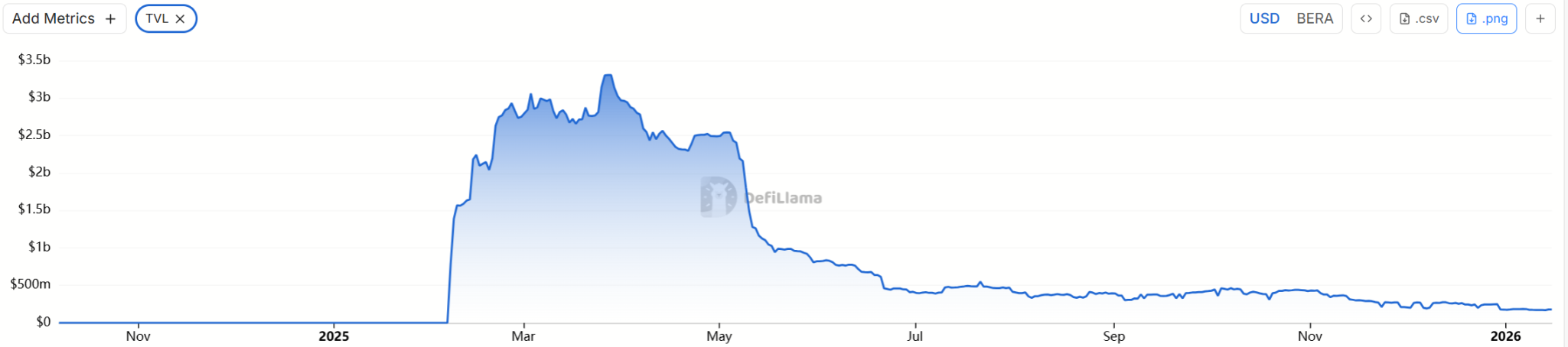
However, as the token price continued to decline, data from DefiLlama shows that its TVL has fallen to $180 million, with 24-hour chain revenue at $84, and the total stablecoin supply on the chain is $153.5 million.

Retail First? Majority of Tokens Allocated to VCs, Major Unlock in February

In its year-end update, the Berachain Foundation admitted that the "retail first" strategy in the crypto market had generally underperformed, leading to a reallocation of resources. This directly triggered a series of issues. First, layoffs and team changes. As part of the strategic adjustment, the Berachain Foundation cut most of its retail marketing team, shifting focus to foundational development. Berachain's lead developer, Alberto, is also leaving to co-found a Web2 company with former banking colleagues.

The Foundation emphasized that the departure was amicable, but this undoubtedly weakens the project's core technical strength. In the community, some developers have already moved to other chains like Monad, further exacerbating the talent drain.

Perhaps the "retail first" strategy promoted by the Berachain Foundation never truly took off.

The project initially emphasized community-driven approaches, but in practice, the incentive mechanisms failed to consistently attract users, and token allocation left retail investors out in the cold.

Although the PoL mechanism is innovative, its complexity (such as the multi-token model, including BERA and BGT) deterred users, leading to a sharp decline in network activity. In November 2025, the project paused the network due to a Balancer protocol vulnerability, fortunately without affecting user funds.

The BERA token price has fallen from a high of $9 to the current $0.7, a drop of over 10 times in just one year for the once so-called "heaven-sent" public chain token.
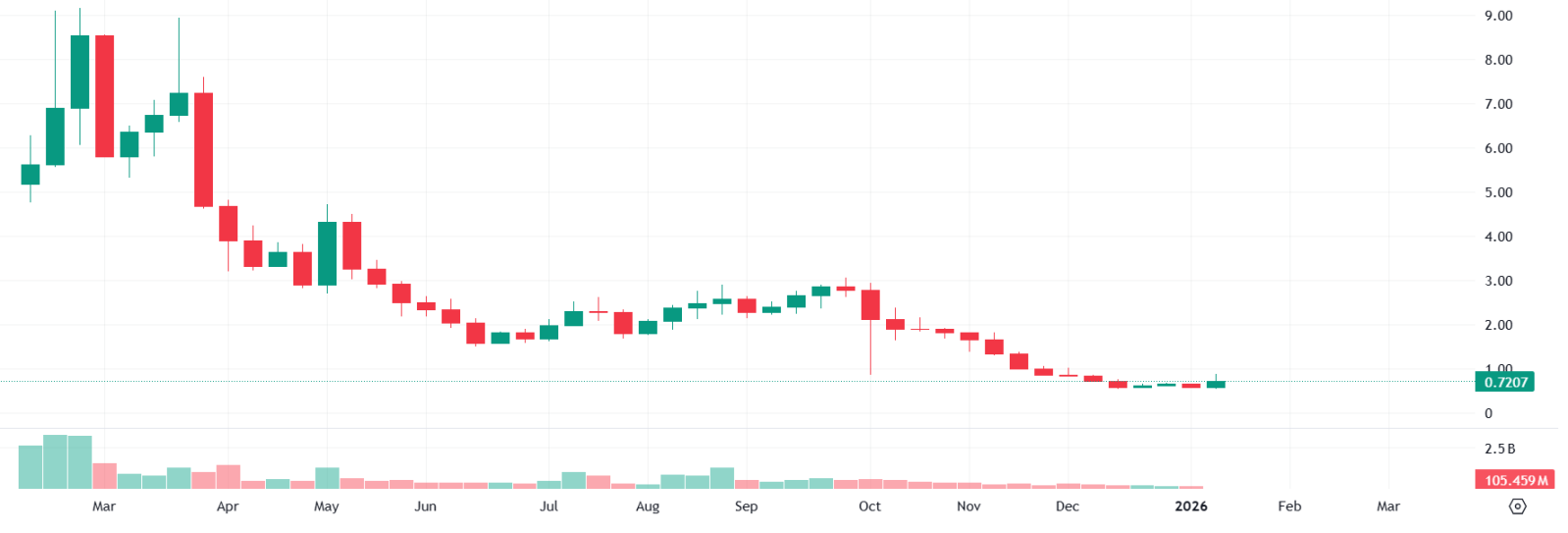
This collapse stems from a low circulation and high FDV model, leading to artificially inflated prices followed by a rapid crash, and these issues are rooted in Berachain's token distribution mechanism. Early contributors received 16.82% of the total supply, while private sale investors received a staggering 34.31% of the token share, typical of a VC coin. Additionally, NFT holders could receive tens of millions of dollars in tokens, while testnet users received only $60 in airdrops, sparking controversy over "wealth disparity" and marginalizing some loyal users.
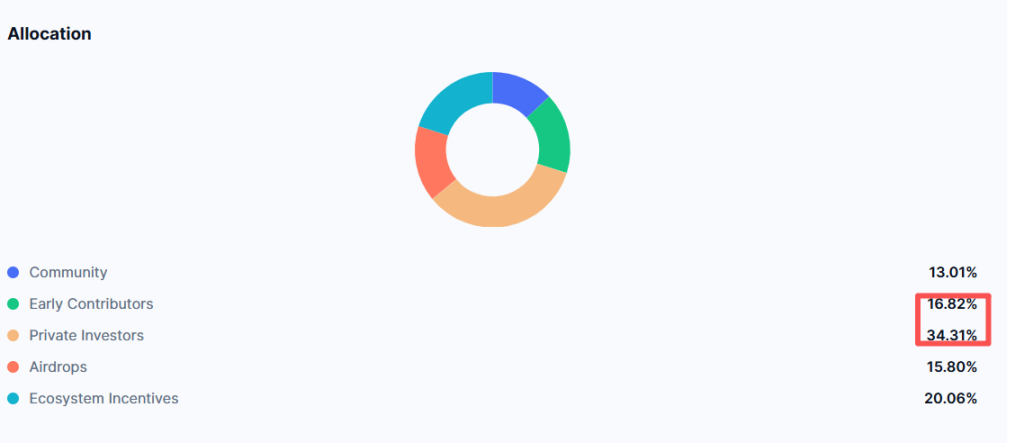
This runs counter to the "retail first" slogan; the project is essentially a VC-dominated low-circulation, high-FDV model: early investors entered at $0.82, achieving 10-15x returns, while retail investors bear the crash. Foundation founder Smokey admitted that if done over, he would not sell so many tokens to VCs and has repurchased some to reduce dilution. In October 2025, the Berachain Foundation partnered with Greenlane Holdings to launch BeraStrategy, making BERA a reserve asset, but this failed to reverse the token's decline.

Furthermore, VCs like Brevan Howard's Nova fund hold refund rights, allowing them to request a full refund of $25 million before February 2026, further highlighting Berachain's tilt toward VCs.

Community dissatisfaction is high, with many users calling it the "ultimate fraudulent L1."
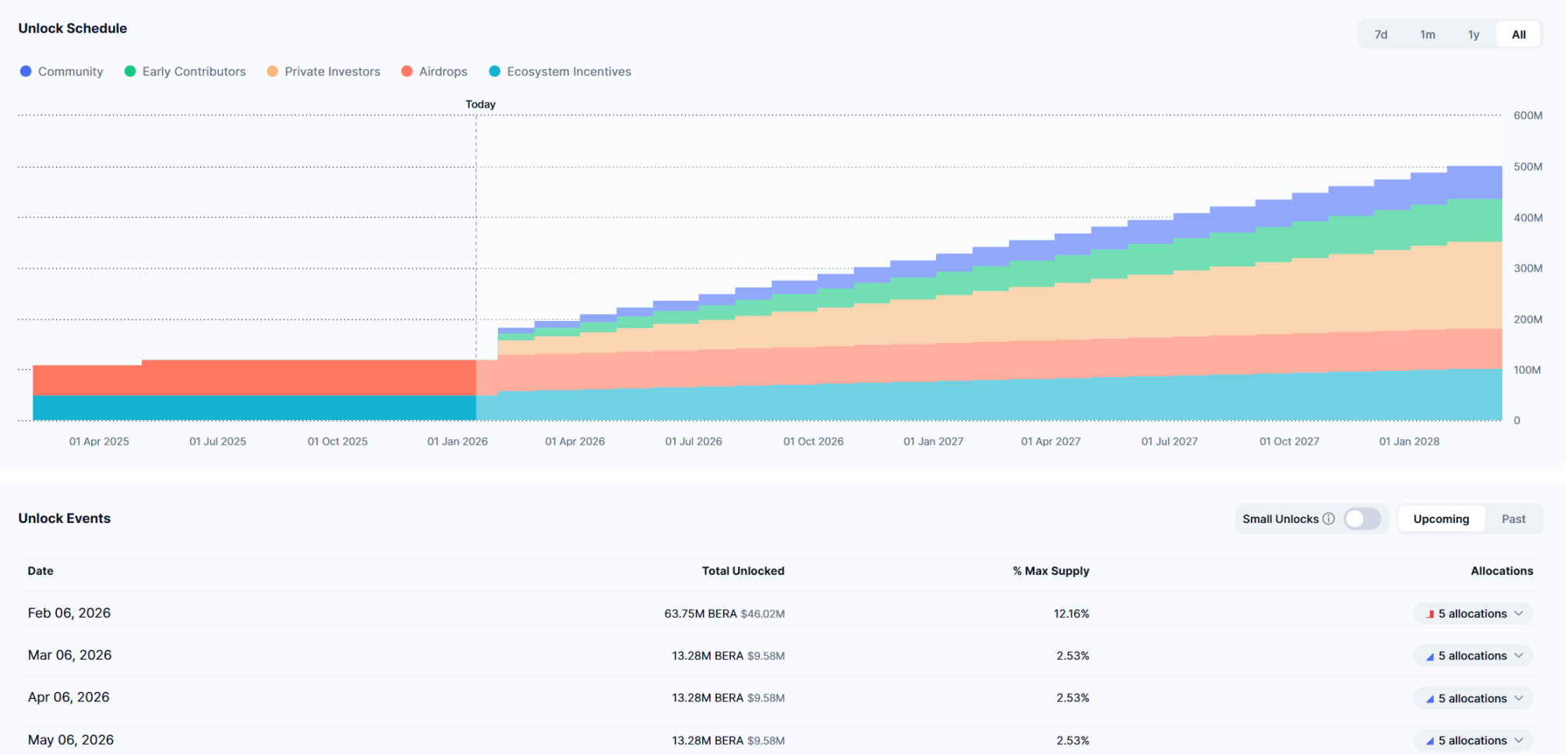
On February 6 this year, Berachain will unlock 63.75 million BERA, approximately 12.16% of the total supply. Of the unlocked portion, private sale investors account for 28.58 million. Starting from March this year, BERA will unlock 2.53% of the total supply each month. Given the current liquidity drought, the continuous large unlocks this year may trigger significant selling pressure.


Twitter:https://twitter.com/BitpushNewsCN

BitPush TG Discussion Group:https://t.me/BitPushCommunity

BitPush TG Subscription: https://t.me/bitpush

Original Link:https://www.bitpush.news/articles/7603193

Preguntas relacionadas

QWhat were the main factors that led to the collapse of Berachain's token price and TVL?

AThe collapse was driven by a combination of internal strategy flaws and external market pressures. Key factors included the project's high Fully Diluted Valuation (FDV) with low initial circulation, significant token allocations to venture capitalists (VCs) rather than retail users, the complexity of its Proof-of-Liquidity (PoL) mechanism, loss of key developers, and upcoming large token unlocks that created selling pressure.

QHow did Berachain's token distribution model contribute to its problems?

ABerachain's token distribution was heavily skewed towards VCs and early contributors, with 34.31% allocated to private sale investors and 16.82% to early contributors. This left retail users with minimal allocations, contradicting the project's 'retail-first' marketing. The low circulation and high FDV model artificially inflated the price initially, leading to a sharp decline when early investors began selling.

QWhat was the significance of the upcoming token unlocks in February for Berachain?

AOn February 6, Berachain was scheduled to unlock 63.75 million BERA tokens, representing 12.16% of the total supply. This included 28.58 million tokens for private sale investors. Given the already low liquidity and declining price, these unlocks were expected to create substantial selling pressure, further depressing the token value.

QWhy did Berachain's innovative Proof-of-Liquidity (PoL) consensus mechanism fail to sustain user engagement?

AThe PoL mechanism, while innovative, was complex and involved a multi-token system (BERA and BGT) that confused users. This complexity reduced network activity and participation, as users found it difficult to engage with the ecosystem effectively, leading to a decline in TVL and overall chain activity.

QWhat internal challenges did Berachain face regarding its development team and community?

ABerachain experienced significant internal challenges, including the departure of key developers such as Chief Developer Alberto, who left to start a Web2 company. The foundation also cut most of its retail marketing team, shifting focus to core development. Additionally, community developers migrated to other chains like Monad, exacerbating talent loss and reducing project momentum.

Lecturas Relacionadas

How to Do Research Well: Deliberately Practice the Real Skills That Matter

No one truly teaches you how to do research. You're often given a desk, a pre-selected problem, and vague instructions to "create something new." Consequently, many people reverse-engineer the job based on visible outputs—papers, posts, announcements—learning only how to *appear* like a researcher rather than how to *become* one. True research capability is built from stacking small, trainable skills, nearly all of which can be developed through deliberate practice. **Pick Your Own Problem:** Most researchers absorb problems from advisors or trends, lacking the underlying reasoning. Choosing a problem you genuinely care about, as John Schulman advises, leads to original work. Develop "taste" like a muscle: predict experiment outcomes, guess paper results from methods, and track which findings remain important over time. **Upgrade Your Inputs:** Relying on shared reading lists (arXiv hot lists, filtered group chats) leads to unoriginal conclusions. Undervalued old literature often holds crucial insights (e.g., MoE, LSTM, backpropagation). Richard Sutton's "The Bitter Lesson" or Claude Shannon's 1952 talk on creative thinking are more predictive than lengthy modern surveys. Breadth matters as much as depth: draw from neuroscience, mechanism design, hardware knowledge, and honest statistics. Read papers directly, especially appendices and limitations sections. **Write Everything Down:** As Paul Graham noted, writing exposes flaws in seemingly mature ideas. Writing is the cheapest defense against self-deception. Following Feynman's principle, Darwin programmatically wrote down facts contradicting his theory to combat memory bias. Maintain a detailed log of hypotheses, setups, predictions, results, and updated understandings. Reviewing past logs fosters essential humility.

marsbitHace 1 hora(s)

How to Do Research Well: Deliberately Practice the Real Skills That Matter

marsbitHace 1 hora(s)

Following US Ban on Fable 5, Zhipu AI's Stock Soars 47%

On June 15th, shares of Zhipu AI surged dramatically on the Hong Kong stock market, peaking at a 47.6% gain before closing 32.82% higher. This sharp increase was directly triggered by two recent industry events. On June 12th, Anthropic announced it was suspending global access to its latest flagship models, Claude Fable 5 and Claude Mythos 5, to comply with a U.S. government export control order. The next day, Zhipu AI announced it would open access to its latest open-source flagship model, GLM-5.2, under the permissive MIT license. The Anthropic incident highlighted a critical issue beyond raw model capability: the risk of sudden, unpredictable loss of access to advanced AI models, especially for developers and enterprises deeply integrated with them. This has shifted industry and market focus toward factors like stability, sustainable access, and controllability. Zhipu's move, promoting "frontier intelligence for all," positions its openly available model as a reliable and accessible alternative. The GLM-5.2 model emphasizes "Long Horizon Task" capabilities with a 1M context window, targeting complex, multi-step coding and engineering workflows where maintaining context is crucial. Analysts note this event exposes the risk of dependency on closed-source models subject to single jurisdictional controls, potentially accelerating a shift toward domestic base models and localized deployments. The market's reaction signals a new valuation dimension in AI: providers who can offer stable, long-term, and sustainably accessible AI capabilities are gaining strategic importance.

marsbitHace 1 hora(s)

Following US Ban on Fable 5, Zhipu AI's Stock Soars 47%

marsbitHace 1 hora(s)

Fully Entering the AI Era: Alipay Bets on Conversation, WeChat Holds Fast to Social

In May 2026, Alipay announced over 300 million AI payment transactions. Shortly after, WeChat opened its mini-programs for AI integration, sparking controversy by requiring developer source code access. This highlights their diverging approaches to AI integration. Alipay is testing "Project Treasure," an optional AI-native interface replacing traditional app grids with a conversational window. Users can command complex tasks (e.g., "book a ride and order coffee") handled end-to-end by AI. This shift follows an abandoned standalone AI app, focusing instead on enhancing its existing user base. For unmodified mini-programs, Alipay's AI uses "screen-reading" to simulate user interactions, bypassing the need for developer overhaul. It also introduced "Token Pay" for micro-transactions and "AI Wallets" for autonomous agent spending. WeChat, prioritizing its core social function, is taking an embedded approach. Its AI agent will operate within existing contexts like group chats and official accounts, assisting without a separate interface. To enable this, WeChat offers developers two paths: granting source code access for direct AI control ("Automatic Mode") or manually encapsulating services into standardized "Skills." Both place significant burden on developers. Key differences emerge in handling legacy services: WeChat demands developer cooperation (code or labor), while Alipay's screen-reading offers immediate, if potentially less stable, compatibility. Alipay's 3 billion AI transactions demonstrate user acceptance of AI-driven commercial actions. The divergent strategies may reshape mini-program ecosystems—Alipay passively "AI-fying" services, WeChat potentially favoring resource-rich developers—and set competing technical standards. Ultimately, the competition centers on where users entrust the command to "help me get things done."

marsbitHace 1 hora(s)

Fully Entering the AI Era: Alipay Bets on Conversation, WeChat Holds Fast to Social

marsbitHace 1 hora(s)

Trading

Spot
Futuros
活动图片





