From Grunt Engineer to Crypto Billionaire: A Deep Dive into Solana Founder Toly's Personal Fortune

marsbitPublicado a 2026-02-19Actualizado a 2026-02-19

Resumen

Anatoly Yakovenko, the founder of Solana, has become a leading figure in the blockchain industry and a known billionaire. This article explores his personal wealth, estimated to be between $500 million and $1.2 billion in 2026, heavily tied to the performance of SOL. Born in the Soviet Union, Yakovenko immigrated to the U.S. and studied computer science. He worked for over a decade at Qualcomm, gaining expertise in distributed systems, which later proved crucial for his work on blockchain. His initial involvement in crypto began with Bitcoin mining, which led him to identify scalability issues in existing networks. In 2017, he authored a whitepaper introducing Proof of History, a key innovation that became the foundation for the high-throughput Solana blockchain. He co-founded Solana Labs in 2018 with former colleagues. His on-chain holdings are significant. A wallet rumored to be his holds over 136,725 staked SOL (worth over $11M). Analysis suggests other addresses linked to him could hold millions more SOL, potentially valued near $122 million. He also owns the toly.sol domain. Off-chain, Yakovenko holds an estimated 5-10% equity in Solana Labs, a private company valued between $5-8 billion, making his stake worth $250-800 million. He is also an active angel investor in over 40 crypto companies. His net worth is highly volatile and mirrors SOL's price. It likely peaked at over $2 billion during the 2021 bull run and fell sharply during the 2022 crypto winter. Despite a...

This article is from:Arkham

Translator|Moni

Anatoly Yakovenko (@toly), the creator of the Solana blockchain, has become a leading figure in the blockchain industry and a well-known billionaire. This article will take a deep dive into his personal fortune.

As one of the most influential figures in the cryptocurrency space, Anatoly Yakovenko founded Solana, one of the most widely used blockchain platforms. Based on available information, the number of tokens he personally holds, and his equity stake in Solana Labs, his estimated net worth in 2026 could be between $500 million and $1.2 billion. The wide range is primarily due to significant recent volatility in the price of Solana's token.

Anatoly Yakovenko's Early Life

Anatoly Yakovenko was born in the Soviet Union and immigrated to the United States with his family in the early 1990s, settling in Illinois. He showed an early aptitude for computer science and engineering, eventually earning a degree in computer science from the University of Illinois at Urbana-Champaign, one of the top institutions in the field in the US.

Yakovenko's academic background focused on distributed systems and compression algorithms, technical areas that later proved crucial to his innovations in blockchain. According to his profile on LinkedIn (shown below), after graduation, he joined Qualcomm, where he worked on operating system-level software and distributed systems for over a decade—a period he might call his "grunt work" years. However, this experience at a leading communications technology company gave him deep expertise in building systems that handle massive scale and high throughput.
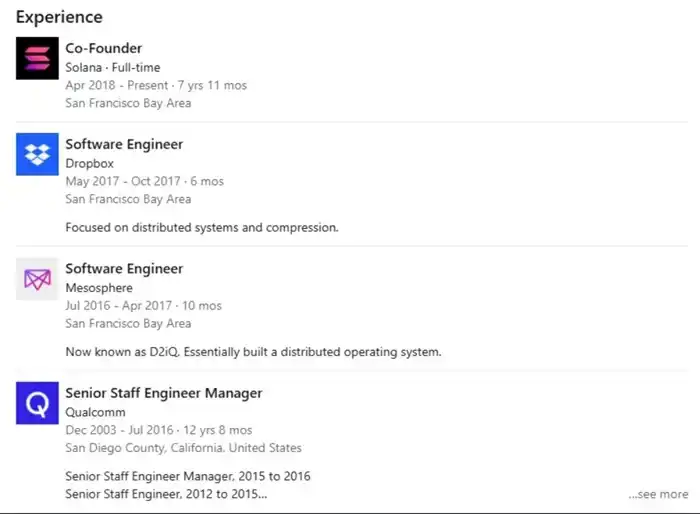
During his time at Qualcomm, Yakovenko also worked on technologies that required coordination across multiple devices and maintaining precise timing—a challenge conceptually similar to blockchain consensus mechanisms. He later had a brief stint at Dropbox, further deepening his understanding of distributed computing challenges in consumer-facing applications.

How Did Anatoly Yakovenko Get Involved in Cryptocurrency?

Like many others, Anatoly Yakovenko's initial foray into cryptocurrency began with Bitcoin mining. It's reported that he and a friend used the profits from mining to subsidize the cost of graphics processors for a side project they were developing together. This experience also gave him firsthand insight into the scalability limitations of Bitcoin and Ethereum, networks that could only process a small number of transactions per second, creating bottlenecks and high fees that seemed incompatible with mainstream adoption.

Rather than seeing these limitations as inherent flaws in blockchain technology, Yakovenko began exploring whether techniques from other fields could solve the throughput problem. He drew inspiration from his telecom background, specifically the concept of using time itself as a reliable reference point in distributed systems.

In November 2017, Anatoly Yakovenko published a white paper detailing a technology called "Proof of History" (PoH)—a cryptographic method for creating verifiable passage of time between events. This innovation allows network validators to process transactions in a predetermined order without requiring extensive communication between nodes, significantly increasing potential throughput. The Solana blockchain is fundamentally built upon this concept.

Yakovenko quickly recruited former Qualcomm colleagues Greg Fitzgerald and Stephen Akridge to help build a prototype. The team formally established Solana Labs in 2018 and secured initial funding to develop the protocol. Another co-founder, Raj Gokal, joined the project shortly after the Proof-of-History white paper was released, becoming the Chief Operating Officer of Solana Labs (the core founding team is shown in the image above). Solana Labs launched its first testnet in 2018, followed by the mainnet beta in March 2020, entering the market during the early stages of the COVID-19 pandemic.

Tracking Anatoly Yakovenko's On-Chain Holdings

At its launch, Solana minted 500 million SOL tokens, with 12.5% allocated to the founding team, including Anatoly Yakovenko. A Solana address starting with "9QgXq" is widely rumored to be associated with Anatoly Yakovenko (as shown below), though this has not been officially confirmed. This wallet holds over 136,725 SOL tokens, most of which are staked. Early transactions saw millions of dollars worth of SOL transferred to this address. This wallet address is over five years old. If it indeed belongs to Solana co-founder Anatoly Yakovenko, his held SOL would be worth over $11 million.

Furthermore, by tracking the history of transactions from staking accounts associated with Anatoly Yakovenko, it appears that large amounts of SOL were moved to various Solana addresses. For example, between August 2024 and November 2024, over 3 million SOL tokens were unstaked and transferred. Over 1.5 million SOL remain staked across multiple addresses, including 9E8zG, JQ5jC, A6mJn, and 7pgzZ. If these addresses also belong to Yakovenko, his SOL holdings would far exceed current estimates, nearing $122 million at current prices.

Another address potentially linked to Anatoly Yakovenko is the owner of the Solana domain name toly.sol, as his username on X is Toly. Tracing this domain reveals an owner address starting with "86xCn". This address currently holds various tokens worth over $1.3 million, but its value is primarily in illiquid tokens, so its actual spendable value is only about $16,500, equivalent to 203.8 SOL.

Tracking Anatoly Yakovenko's Off-Chain Holdings

In addition to holding tokens, Anatoly Yakovenko holds a significant equity stake in Solana Labs, the company primarily responsible for developing the Solana protocol and its related infrastructure. Although the exact percentage is not publicly disclosed, it is estimated that he holds approximately 5% to 10% of Solana Labs.

As a private company, Solana Labs' valuation has not been publicly disclosed. Solana Labs has conducted multiple funding rounds in the past, with investments from prominent venture capital firms like a16z (Andreessen Horowitz), Polychain Capital, and Multicoin Capital. These investments have valued the company in the billions of dollars, with many estimates placing its value between $5 billion and $8 billion. Based on these valuations, Yakovenko's equity could be worth between $250 million and $800 million, not including his personal token holdings.
Although the company's valuation is still partially tied to the market performance of the SOL token, this dual ownership structure—personal tokens and company equity—provides some diversification for Yakovenko's wealth. SOL token prices can be highly volatile, but company equity represents a more stable asset, especially as Solana Labs' business expands beyond protocol development to other blockchain infrastructure projects.

Beyond his stake in Solana Labs, Anatoly Yakovenko is an active angel investor and has invested in over 40 companies to date. Some of these have grown into giants within the Solana ecosystem, including liquid staking service providers Jito Labs and Solayer, perpetual DEX Drift Protocol and Infinex, and staking infrastructure project Helius.

Who Owns the Most Solana?

As an emerging blockchain, Solana has come a long way since its inception. Today, SOL token distribution is diverse, including institutional investors, exchanges, founders, and retail participants. Major institutional holders include the Solana Foundation Treasury, cryptocurrency exchanges holding tokens on behalf of users, Solana ETFs, and staking service providers.

However, based on available data, the largest holder of SOL tokens is likely the winning bidders from the FTX bankruptcy auction. Following the collapse of the centralized exchange FTX, the SOL tokens held in its assets were auctioned off as part of the liquidation process. In this process, 41 million SOL tokens were sold, with Galaxy Digital and Pantera Capital acquiring the majority. Although these tokens were subject to lock-up and vesting schedules, about 60-70% of the sold SOL has likely been unlocked and may have been sold. Considering this, Galaxy Digital might still hold around 6-8 million SOL, while Pantera might hold around 3-5 million SOL.

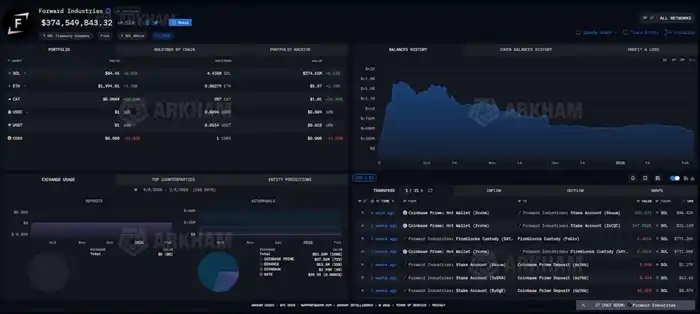
In 2025, the Solana Foundation Treasury companies came into focus. Due to highly publicized holdings, the largest SOL holder among these treasury companies is Forward Industries (shown below), which currently holds 6.9 million SOL tokens (worth $583 million), representing 1.115% of the total SOL supply. Other treasury companies lag far behind; the next nine companies combined hold only about 1.5% of the total SOL supply.
Regarding custodial service providers, some centralized exchanges also hold SOL on behalf of users. For instance, Binance's latest proof-of-reserves shows the exchange holds over 24.2 million SOL tokens. Similarly, ETF providers have become major SOL holders. The Bitwise Solana Staking ETF (BSOL) holds over 5.5 million SOL tokens and is currently the largest spot SOL ETF.

Among individual holders, while Anatoly Yakovenko likely ranks highly, he may not be the individual holding the most SOL tokens. Other Solana Labs co-founders and early team members also received significant allocations of SOL. Furthermore, some early private investors might hold larger positions in SOL than the Solana Labs co-founders themselves.

Anatoly Yakovenko's Net Worth Fluctuates Significantly with the Market

Over time, Anatoly Yakovenko's net worth has likely been closely tied to Solana's market performance, experiencing its dramatic volatility (the chart below shows Solana's token price movement in recent years). In November 2021, when SOL prices reached a cycle high of around $260, his combined token holdings and company equity could have pushed his net worth over $2 billion, potentially even approaching $3 billion, depending on the valuation of his Solana Labs equity.
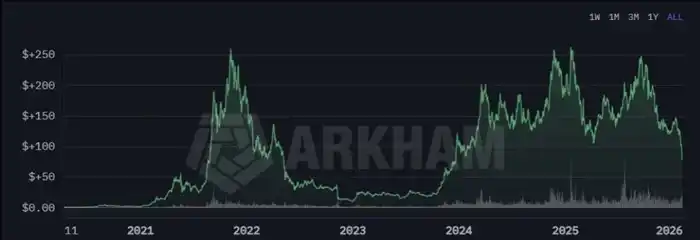
Conversely, the crypto bear market of 2022 severely compressed the value of Anatoly Yakovenko's assets. With SOL prices dropping below $10 at one point, the value of his token holdings fell more than 95% from their peak. Network outages during this period, coupled with Solana's close association with FTX and Alameda Research, added further negative pressure on the token's price and ecosystem sentiment. Assuming his net worth moved in line with market fluctuations, it might have dipped below $100 million during the bear market.

However, as markets rebounded into a bull run between 2023 and 2025, Yakovenko's net worth likely recovered significantly. Combined with the maturing equity value of Solana Labs (now estimated between $4 billion and $10 billion), it likely pushed his net worth back into the multi-billion dollar range.

At the beginning of 2026, the cryptocurrency market experienced a sharp crash, with Solana's price falling below $100. Estimates for Anatoly Yakovenko's net worth are largely in the range of $500 million to $1.2 billion, depending on the liquidity of the held tokens and the valuation of his Solana Labs equity.

Conclusion

As of early 2026, Anatoly Yakovenko remains one of the core architects of the digital economy, with a net worth that has fluctuated alongside the maturation of the Solana ecosystem. Although the crypto market crash in early 2026 reduced his fortune from its multi-billion dollar peak, his financial standing remains robust, underpinned by his equity in Solana Labs and a portfolio of early-stage investments.

From a grunt engineer working for a decade in networking companies to a crypto billionaire building a blockchain that rivals Bitcoin and Ethereum, Anatoly Yakovenko's influence on the crypto industry is evident. Solana has evolved from a high-speed blockchain into a hub for institutional finance, stablecoin payments, trading, and more. Yet, it seems like it's only just the beginning.


Preguntas relacionadas

QWho is Anatoly Yakovenko and what is his estimated net worth in 2026?

AAnatoly Yakovenko is the creator of the Solana blockchain and a leading figure in the crypto industry. His estimated net worth for 2026 is between $500 million and $1.2 billion, depending on the volatility of the SOL token price and the valuation of his stake in Solana Labs.

QWhat was the key technical innovation Anatoly Yakovenko introduced in the Solana whitepaper?

AThe key technical innovation described in his 2017 whitepaper was 'Proof of History' (PoH), a cryptographic technique that creates a verifiable record of time elapsed between events. This allows the network to process transactions in a predetermined order without extensive communication between nodes, significantly increasing throughput.

QWhat are the two main components that make up the majority of Anatoly Yakovenko's wealth?

AThe two main components of his wealth are his personal holdings of SOL tokens (estimated to be worth tens of millions to over $100 million) and his equity stake in the private company Solana Labs, which is estimated to be between 5-10% and valued at $2.5 billion to $8 billion.

QWhich company is currently the largest known holder of SOL tokens according to the article?

AAccording to the article, the largest known holder of SOL tokens is the Solana treasury company Forward Industries, which holds 6.9 million SOL tokens, worth approximately $583 million and representing 1.115% of the total SOL supply.

QHow did the 2022 crypto bear market and the FTX collapse affect Anatoly Yakovenko's net worth?

AThe 2022 crypto bear market severely impacted his net worth. With the price of SOL falling below $10, the value of his token holdings dropped by over 95% from their peak. Combined with the negative sentiment from Solana's association with FTX and Alameda Research, his net worth may have fallen below $100 million during this period.

Lecturas Relacionadas

Wall Street's Most Famous 'Cassandra' Now Has His Sights Set on Nvidia

Michael Burry, the famed "Big Short" investor, has once again captured Wall Street's attention with a series of short positions against major tech and semiconductor stocks, most notably Nvidia. In late June and July, through his "Cassandra Unchained" newsletter, Burry disclosed short bets against Nvidia, Tesla, Applied Materials, Caterpillar, the SOXX semiconductor ETF, and later, Micron Technology. His core thesis revolves around potential distortions in the AI infrastructure boom, specifically questioning whether extended depreciation schedules (e.g., 6 years vs. a realistic 2-3 years for AI chips) by cloud giants like Microsoft and Google artificially inflate profits. He also raises concerns about possible "off-balance-sheet circular financing," where chip demand might be propped up by vendor-backed funding to clients. Nvidia's stock experienced volatility following these disclosures, briefly dipping but largely holding near Burry's reported entry points, leaving his positions roughly flat or slightly underwater as of late July. This move is part of a pattern for Burry, whose track record since his legendary 2008 bet is mixed. He has faced notable losses, such as on Tesla in 2021, while scoring on broader market turns like the 2020 pandemic crash. His methodology focuses intensely on free cash flow and scrutinizing original financial documents to spot overvaluation and structural risks, but it often struggles with timing the market. The article contrasts Burry's stance with other prominent investors. Steve Eisman, another "Big Short" figure, is not shorting Nvidia, citing strong fundamentals but expressing nervousness about sustainability. Jim Chanos agrees with the broad "accounting mismatch" concern—comparing it to the dot-com bubble—but targets financial leverage in private equity firms rather than the chip stocks themselves. While Nvidia's short interest remains relatively low at 1.3-1.4% of float, the massive stock size means absolute short losses have been significant, exceeding $5 billion earlier this year. The piece concludes that for ordinary investors, the key takeaway is not replicating specific short bets but learning from the critical frameworks these investors use: questioning rosy accounting, identifying structural vulnerabilities, and maintaining skepticism during market euphoria, even if pinpointing the exact catalyst for a downturn remains elusive.

marsbitHace 9 min(s)

Wall Street's Most Famous 'Cassandra' Now Has His Sights Set on Nvidia

marsbitHace 9 min(s)

Weekly Selection丨Epic Stock Market Volatility, Changxin Tech's IPO Reshapes Storage Landscape, Saylor Aims to Re-Anchor STRC Around September 8th

PANews Weekly Digest: Market Turmoil, Tech Breakthroughs, and Crypto Developments. The week saw significant volatility across global markets. South Korea's KOSPI index experienced extreme turbulence, including multiple trading halts, largely driven by sharp declines in AI hardware stocks like SK Hynix. In contrast, China's Changxin Xinqiao (CXC) achieved a landmark IPO with a market cap surpassing 4 trillion yuan, marking a major success for the domestic DRAM industry after a decade of losses. In the crypto and Web3 space, several key narratives emerged. AI is driving demand for new infrastructure, with projects like AI agent wallets and programmable payments gaining traction, attracting interest from firms like Coinbase. The Bitcoin mining sector is pivoting, with companies like MARA focusing on energy management as electricity becomes a core AI-era asset. Meanwhile, the RWA (Real World Assets) sector faces a "utilization puzzle," with hundreds of billions in on-chain assets remaining dormant. Notable market movements included a historic single-day surge of over 17% for the KOSPI index and a significant migration of $16.5 billion in staked ETH within the Lido ecosystem. Michael Saylor announced a target to re-peg the STRC stablecoin around September 8th. Other highlights include discussions on Ethereum's ambitious 2030 roadmap for scaling and privacy, analysis showing high protocol revenues not always translating to token price gains, and warnings from Citi about potential extreme commodity price shocks by late 2026.

marsbitHace 14 min(s)

Weekly Selection丨Epic Stock Market Volatility, Changxin Tech's IPO Reshapes Storage Landscape, Saylor Aims to Re-Anchor STRC Around September 8th

marsbitHace 14 min(s)

When the Market Begins to Question AI Capex: A Full Analysis of Q2 Earnings Reports from Five Tech Giants

In late July 2026, five major US tech giants—Alphabet, Intel, Microsoft, Meta, and Apple—released their Q2 earnings reports. While all companies exceeded revenue and profit expectations, driven by strong AI-related business growth, investor reactions diverged sharply due to concerns over escalating AI capital expenditures (capex) and their impact on free cash flow. Alphabet reported strong revenue growth and a surging cloud business, but its stock fell after announcing a doubled year-on-year capex and negative quarterly free cash flow for the first time. Intel posted its strongest revenue growth in over 15 years, but its stock experienced volatile trading after significantly raising its full-year capex guidance. Microsoft saw its stock surge after beating estimates and, crucially, lowering its capex forecast while projecting positive free cash flow. Meta faced the most severe sell-off as its profits declined despite revenue beats, with free cash flow plunging over 90% and its capex guidance raised. Apple reported record June-quarter results, but its stock plummeted after providing Q4 revenue guidance that fell short of expectations, citing supply chain constraints and forex headwinds. The overall takeaway is that the market's focus has shifted from validating AI demand to scrutinizing the timeline for returns on massive AI investments. Companies demonstrating a clearer path to managing capex and preserving free cash flow, like Microsoft, were rewarded, while those signaling continued aggressive spending faced investor skepticism.

Odaily星球日报Hace 23 min(s)

When the Market Begins to Question AI Capex: A Full Analysis of Q2 Earnings Reports from Five Tech Giants

Odaily星球日报Hace 23 min(s)

a16z: From Companies to DAOs, DUNA May Become the Next Generation Organizational Form

This article, "From Companies to DAOs: How DUNA Could Become the Next Organizational Form," traces the 500-year evolution of business collaboration. It begins with medieval structures like the *commenda* and Florentine *compagnia*, which exposed partners to personal risk. The modern corporation, exemplified by the Dutch East India Company (VOC), was a revolutionary leap, enabling large-scale, capital-intensive ventures by offering limited liability and reducing coordination costs. However, corporations introduced new challenges like principal-agent problems and bureaucratic overhead. The piece argues that software and internet-native protocols are now reducing these traditional overheads. Decentralized Autonomous Organizations (DAOs) emerged as a new model for coordination without centralized management. Yet, DAOs face a significant legal vacuum: they lack legal recognition, leaving members exposed to unlimited personal liability, and their tokens are vulnerable to being classified as securities under unclear regulations (e.g., the Howey Test). This has forced projects into suboptimal workarounds like offshore foundations. The article identifies the Decentralized Unincorporated Nonprofit Association (DUNA) as a potential solution. Recently legalized in states like Wyoming, the DUNA provides a legal wrapper for decentralized networks. It grants key protections—legal personality, limited liability, and perpetual existence—to a group without imposing a traditional hierarchical management structure. This allows token-holder communities to govern, hold assets, and contract as a single legal entity, aligning with their decentralized nature. While DUNA doesn't solve all governance challenges or magically resolve securities law questions, it represents a crucial step. It fills the legal recognition gap, offering a native legal form for internet-scale, decentralized collaboration and extending the separation of personal risk from organizational venture into a new domain.

marsbitHace 1 hora(s)

a16z: From Companies to DAOs, DUNA May Become the Next Generation Organizational Form

marsbitHace 1 hora(s)

2026 Mid-Year Report On-Chain RWA: Tokenized Stock Market Cap Doubles in a Year, But 90% of Rights Are Hollow Shells

The 2026 Mid-Year Report on On-Chain RWA highlights a significant growth in tokenized stock market capitalization, which nearly doubled from $951 million in March to $1.89 billion by July. However, the report reveals a fundamental contradiction in this "layer 2.5" ecosystem: products with the strongest legal foundation (like regulated U.S. infrastructure) lack liquidity and distribution, while freely tradable offshored wrapper products often lack substantive ownership rights. The increase is driven largely by a few products (SECZ, FGRS, STRCx) and platforms (Ondo, xStocks, Securitize collectively hold over 85% share). While distributed value across networks like Ethereum, Solana, and BNB Chain has grown, the market remains fragmented. Products referencing the same underlying asset (e.g., Apple stock) are distinct legal liabilities with different intermediaries and jurisdictional rules, offering varying degrees of legal claim. The report cautions that headline numbers are misleading, as they reflect changes in distributed token value—driven by issuance, conversions, and price movements—not pure investor inflows. True "canonical shares" with legal ownership, wide wallet distribution, institutional liquidity, and independent on-chain price discovery do not yet exist at scale. Tokenized treasuries show stronger product-market fit, and ETFs may be easier to scale than single stocks. The core takeaway is a trade-off: legal certainty versus liquidity and composability.

marsbitHace 1 hora(s)

2026 Mid-Year Report On-Chain RWA: Tokenized Stock Market Cap Doubles in a Year, But 90% of Rights Are Hollow Shells

marsbitHace 1 hora(s)

Trading

Spot
活动图片