From Fragmented Components to the Super Layer

marsbitPublicado a 2026-01-27Actualizado a 2026-01-27

Resumen

In recent developments within the decentralized social space, Farcaster and Lens have both undergone significant strategic transitions, highlighting a broader shift toward platformization and operational specialization. Farcaster’s co-founder announced that Neynar, a major infrastructure provider and client, will acquire the protocol. This move reflects a growing consensus that long-term sustainability depends less on protocol-level iteration and more on professionalized infrastructure and execution. Neynar has abstracted away the complexity of running hubs and provides APIs that allow developers to focus on product development rather than protocol mechanics. Similarly, Lens announced that Mask Network will take over as the protocol’s next “steward,” shifting focus from infrastructure to consumer-facing products. Both Lens and Aave emphasized that the transition involves no change in ownership or governance—only a reallocation of responsibility toward productization and user experience. These cases illustrate that as protocols mature into platforms, the key challenge is no longer adding features, but clearly defining roles and optimizing the full operational stack—infrastructure, tooling, and distribution. The trend points toward the emergence of “super layers,” where tightly integrated technical and operational capabilities become essential to compete at scale. The movement signals that Web3 is entering an era of mature ecosystem competition, where independent teams and ...

Author: JayLovesPotato

Compiled by: Block unicorn

Over the past few days, a series of protocol announcements—along with Vitalik's comments—have reignited discussions in the decentralized social space. While these events may seem isolated, together they clearly indicate that the platformization of protocols is now advancing in a "strategic" manner.

1. The News and the Strategic Context Behind Them
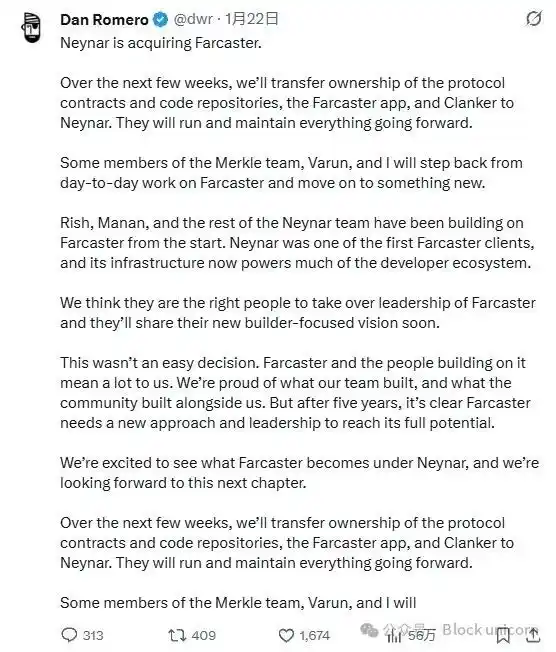
Last Wednesday, Dan Romero, co-founder of the decentralized social platform Farcaster, announced that Neynar, one of Farcaster's earliest and most influential clients, would acquire Farcaster. As part of this transition, ownership of the protocol contracts, core codebase, official applications, and (even) Clanker would be transferred in phases. Meanwhile, Romero noted that the founding team would step back from daily operations to focus on new projects.

Behind Farcaster's decision seems to be a growing internal consensus: the long-term sustainability of social protocols relies less on continuous iteration at the protocol design level and more on increasingly specialized infrastructure and operational execution capabilities at the current stage.

In practice, this means control naturally shifts to infrastructure providers who have successfully aggregated developer resources and traffic—Neynar has been emphasizing the cost and complexity of running Farcaster's hub servers since 2024, abstracting these challenges into APIs and infrastructure layers so developers can focus on product development rather than grappling with protocol internals.
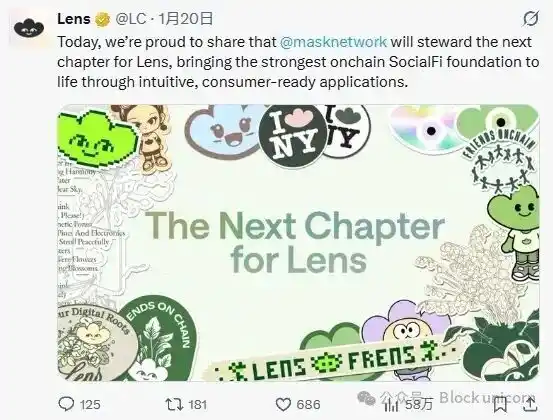
In contrast, Lens has adopted a more advanced—though conceptually aligned with Farcaster—approach. With a relatively richer set of tools, resources, and a mature user base, Lens has chosen to push further in the operational direction.

On January 20, 2026, Lens Labs officially announced that Mask Network would take on the role of "steward" for the next phase of Lens, shifting the project's focus from infrastructure building to consumer-facing products. Mask, for its part, stated that the move aims to translate the protocol's proven achievements into experiences accessible to the mass market.

Notably, both Lens and Aave specifically emphasized that this transition does not involve changes to ownership, financial structure, or governance. The focus is not on the acquisition itself but on a clear reallocation of responsibilities—specifically, who is responsible for turning the protocol into a product people use daily.

2. The Key to Platformization Lies in Clear Role Division

From a broader perspective, both cases point to the same conclusion: as protocols evolve into platforms, the key requirement is no longer adding more features but clearly dividing roles and responsibilities—i.e., how to efficiently optimize the complete operational stack required by a platform, including infrastructure resources, developer onboarding tools, distribution capabilities, and more.

Neynar's core value in the Farcaster ecosystem lies in standardizing social data and user behavior through APIs. Neynar enables developers to immediately start experimenting with products without dealing with the complexities of hub operations or the protocol level. Thus, this acquisition marks Neynar's entry into the next stage—enhancing Farcaster's development and operational layer by integrating the protocol itself.

Lens, though it followed a different path, ultimately landed in a similar framework. With Lens Chain and V3 already establishing the foundational architecture, the next challenge is no longer building more protocols but delivering consumer experiences that users truly engage with daily. The partnership with Mask Network is precisely aimed at bridging this gap.

3. The Battle of the Super Layers

In fact, the integration and consolidation of protocols are not new. Similar patterns have emerged in the Web2 and Web2.5 spaces since around 2025. Wallet providers, crypto payment companies, exchanges, and infrastructure providers are increasingly seeking to integrate adjacent services or make acquisitions to achieve vertical expansion and build so-called "super layers."

However, the most important aspect is not the range of functions these players are trying to bundle. Instead, the decisive shift lies in how they carefully design the integration—selecting the technology stack and operational platforms to integrate based on clearly defined target audiences.

The Neynar–Farcaster and Mask–Lens cases show that the Web3 ecosystem is also moving beyond the stage of loosely connected experimental protocols into an era of large-scale network ecosystems, where organization, operations, and technology are tightly interwoven. Even in the realm of building an open internet, Web3 product teams, long constrained by founder-centric, semi-closed structures, now face the reality of competition: independent team structures, clear division of responsibilities, and the ability to operate products long-term are no longer optional but essential.

Looking ahead, the market dynamics around building super layers (spanning both Web2 and Web3) are likely to become more strategic and more intense.

Criptos en tendencia

Preguntas relacionadas

QWhat is the strategic shift behind Farcaster's acquisition by Neynar?

AThe strategic shift is that the long-term sustainability of social protocols relies more on specialized infrastructure and operational execution rather than continuous iteration at the protocol design level. Control naturally transfers to infrastructure providers like Neynar, which abstracts away the complexity and cost of running hubs, allowing developers to focus on product development.

QHow does the Lens and Mask Network partnership differ from a traditional acquisition?

AThe partnership does not involve changes in ownership, financial structure, or governance. The focus is on a clear reallocation of responsibility—specifically, who is responsible for turning the protocol into a product that people use daily, rather than a merger or acquisition itself.

QWhat is the core value that Neynar provides to the Farcaster ecosystem?

ANeynar's core value lies in standardizing social data and user behavior through APIs, enabling developers to immediately start product experiments without dealing with the complexities of hub operations or the protocol layer.

QWhat broader trend do the Farcaster and Lens cases indicate about Web3 ecosystem evolution?

AThey indicate that the Web3 ecosystem is moving beyond loosely connected experimental protocols into an era of large-scale network ecosystems where organization, operations, and technology are tightly interwoven, with clear role divisions and long-term operational capabilities becoming essential.

QWhat is meant by the 'super layer' in the context of Web2 and Web3?

AThe 'super layer' refers to the trend where providers (like wallets, exchanges, infrastructure companies) integrate adjacent services or make acquisitions to achieve vertical expansion, building comprehensive platforms that bundle functionalities based on carefully selected tech and operational stacks for specific target audiences.

Lecturas Relacionadas

Huang Xiaoming, Li Bin, Lei Jun, Liang Wenfeng... Who Are the Biggest Winners in the CXMT IPO Feast?

Changxin Technology, a leading Chinese memory chip manufacturer, successfully listed on the Shanghai Stock Exchange's STAR Market (科创板) on July 8, 2026. Its share price surged from the IPO price of 8.66 yuan to close at 49 yuan on the first day, catapulting its market capitalization to 3.28 trillion yuan, making it the most valuable A-share company and triggering a massive wealth creation event. The biggest winners were the company's founder, Zhu Yiming, and its employees. Zhu Yiming's family wealth skyrocketed nearly 300% to approximately $13.9 billion, with his direct stake in Changxin valued at around 80 billion yuan. Additionally, over 6700 employees benefited from stock ownership plans, creating at least 237 new millionaires (in CNY). Zhu also pledged to donate 768 million shares, worth over 37.6 billion yuan, for future employee incentives over a ten-year period. Several prominent investors and corporate clients also reaped significant paper gains from the IPO. Notable figures include: * **Liang Wenfeng**, founder of DeepSeek, whose funds netted a paper profit of approximately 827 million yuan. * **Kong Jianping**, founder of Nano Labs, saw his indirect holdings valued at roughly 940 million yuan. * **Li Bin**, founder of Nio, whose company's strategic investment of 158 million yuan is now worth about 740 million yuan. * **Lei Jun**, founder of Xiaomi, whose subsidiary holds shares currently showing a paper gain of over 736 million yuan. Xiaomi clarified this is a corporate investment, not direct personal wealth. The article notes that while this IPO created immense wealth for insiders and large investors, retail investors who were lucky enough to win an allotment in the lottery typically profited by around 20,000 yuan. The listing solidifies Changxin's position as China's premier domestic memory chipmaker.

marsbitHace 10 min(s)

Huang Xiaoming, Li Bin, Lei Jun, Liang Wenfeng... Who Are the Biggest Winners in the CXMT IPO Feast?

marsbitHace 10 min(s)

IOSG: From Hot Storage to Cold Memory – Decentralized Storage in the AI Era's Storage Boom

This article explores the stark contrast between the booming AI storage sector and the currently undervalued decentralized storage market. It argues their core value propositions differ fundamentally: AI storage is a "hot data efficiency" system designed to maximize computational throughput, GPU utilization, and business monetization by accelerating data flow into processors. In contrast, decentralized storage represents a "cold data trust" system, prioritizing data immutability, censorship resistance, and the preservation of long-term human memory. The analysis details the multi-layered AI storage architecture, from high-bandwidth memory (HBM) and enterprise SSDs for high-performance needs to data lakes for capacity. It highlights how AI has repositioned storage from a cost center to a critical efficiency engine. Decentralized storage, exemplified by Filecoin and Arweave, is examined for its distinct philosophies and current challenges, including product-market fit, retrieval latency, and enterprise adoption hurdles. Despite its current quiet phase, the article posits that decentralized storage holds unique future value for AI data provenance, public dataset archiving, compliance, and safeguarding civilizational records against censorship. The conclusion suggests that while the market currently rewards efficiency, the need for trusted, permanent data layers may eventually lead to a revaluation of decentralized storage's role.

marsbitHace 14 min(s)

IOSG: From Hot Storage to Cold Memory – Decentralized Storage in the AI Era's Storage Boom

marsbitHace 14 min(s)

Exploring ChangXin Technology's Hefei Headquarters: The Rising Campus Ignites Changgang CBD, Grassroots Employees 'Witness' Wealth Creation Myth

"On-the-Ground Visit to CXMT's Hefei Headquarters: Campus Boom Ignites Changgang 'CBD,' While Rank-and-File Employees Watch Wealth Creation Myth from the Sidelines." Following CXMT's (ChangXin Memory Technologies Inc., 688825.SH) explosive stock market debut on July 27, where its share price surged over fivefold, a site visit to its Hefei headquarters reveals a stark contrast. While the company's市值 soared, making it A-share's most valuable firm,基层员工 indicate the wealth creation has largely bypassed them. Employees reveal that股权激励 is restricted to managerial levels (Grade 9科长 and above), with most普通员工 at Grades 11 or 12. Salaries, while considered high for Hefei at around 200,000 RMB annually, fall short of the millions speculated online. Work routines remain demanding, with long hours, phone confiscation in sensitive areas, and strict保密 protocols forbidding unauthorized external communication. Simultaneously, CXMT's expansion is visibly transforming the once-rural Changgang area. Ongoing construction includes multiple new phases, with an industrial chain of supporting companies集聚 around the campus. This growth has spurred local development: housing prices initially skyrocketed, and a vibrant commercial district dubbed "Changgang CBD" now thrives, catering to the潮汐效应 of shift workers. The area has evolved from construction sites to a bustling hub, though the company's stringent安保, including high-voltage perimeter fencing, underscores its sensitive nature. The report concludes that while CXMT's rise fuels regional economic activity, the immediate financial rewards of its上市 are not shared by its frontline workforce.

marsbitHace 15 min(s)

Exploring ChangXin Technology's Hefei Headquarters: The Rising Campus Ignites Changgang CBD, Grassroots Employees 'Witness' Wealth Creation Myth

marsbitHace 15 min(s)

Huang Xiaoming, Li Bin, Lei Jun, Liang Wenfeng... Changxin IPO Feast, Who's the Biggest Winner?

Changxin Technology's IPO on the Shanghai STAR Market created significant wealth for its stakeholders. Founder Zhu Yiming and his family saw their wealth surge nearly 300%, with his stake in Changxin alone valued at approximately 80 billion RMB. Over 6700 employees benefited, creating at least 237 new millionaires. Several prominent figures also profited. Liang Wenfeng, founder of Deepseek, saw a paper gain of 827 million RMB through his funds' participation. Kong Jianping, founder of Nano Labs, holds an indirect stake worth around 940 million RMB, representing a roughly 44x return on his 2020 investment. Former Midea executive Huang Xiaoming gained approximately 503 million RMB. Strategic investors included industry partners. Nio, represented by founder William Li, pledged 158 million RMB for shares now showing a paper gain of about 740 million RMB. Similarly, a Xiaomi subsidiary acquired shares resulting in an over 736 million RMB gain, though the company clarified this is a corporate investment, not directly attributable to founder Lei Jun's personal wealth. Founder Zhu Yiming further plans to donate shares worth over 37.6 billion RMB for future employee incentives. The IPO solidified Changxin's position as a leading domestic memory chip maker, triggering a widespread wealth creation event for its network of founders, employees, and investors.

Odaily星球日报Hace 30 min(s)

Huang Xiaoming, Li Bin, Lei Jun, Liang Wenfeng... Changxin IPO Feast, Who's the Biggest Winner?

Odaily星球日报Hace 30 min(s)

Aave's Stable Vault

This article explores Aave's recently launched "Stable Vaults," a product designed to bridge the gap between traditional finance users and DeFi yield. It argues that while DeFi offers transparency and potentially higher returns, its complexity and volatility are major barriers for mainstream adoption. The core problem is that users pay for convenience and simplicity, often accepting lower returns to avoid decision-making and technical hurdles. Stable Vaults allow fintech apps, neobanks, or payment platforms (operators) to integrate with Aave's lending markets once and offer their users a "savings account" with a fixed, predictable yield (e.g., 4%). The operator absorbs the underlying market volatility; if Aave's pool pays 6%, the operator pockets the 2% difference, but if it pays only 2%, the operator covers the shortfall to maintain the promised 4% for users. The piece analyzes this model from three perspectives: 1. **The User:** Gains simplicity, a fixed rate, and familiar app features (customer support, account recovery). However, they lose potential upside, accept a lower fixed yield, and take on new counterparty risks from the operator and its proprietary backend systems. 2. **The Operator (e.g., a neobank):** Can monetize idle user balances easily, generating significant fee income (the spread between the fixed rate and the actual yield) with minimal integration effort, turning a cost center into revenue. 3. **Aave:** Gains "sticky," loyalty-based deposits that are less likely to flee during minor yield fluctuations, securing a stable revenue stream crucial for its tokenomics (like buybacks). It becomes a back-end infrastructure provider for the broader consumer finance ecosystem. The author acknowledges that while sophisticated users can access higher yields directly on Aave, most people prefer convenience and security over optimization. They reference behavioral studies showing that too many choices lead to inaction. Therefore, Stable Vaults represent an acceptance of human nature—prioritizing safety, predictability, and ease—and a strategic move for Aave to capture stable, large-scale deposits from mainstream finance applications. Examples like Rise (payroll) and Kraken are already using similar embedded yield models.

marsbitHace 35 min(s)

Aave's Stable Vault

marsbitHace 35 min(s)

Trading

Spot

Artículos destacados

Cómo comprar LAYER

¡Bienvenido a HTX.com! Hemos hecho que comprar Solayer (LAYER) sea simple y conveniente. Sigue nuestra guía paso a paso para iniciar tu viaje de criptos.Paso 1: crea tu cuenta HTXUtiliza tu correo electrónico o número de teléfono para registrarte y obtener una cuenta gratuita en HTX. Experimenta un proceso de registro sin complicaciones y desbloquea todas las funciones.Obtener mi cuentaPaso 2: ve a Comprar cripto y elige tu método de pagoTarjeta de crédito/débito: usa tu Visa o Mastercard para comprar Solayer (LAYER) al instante.Saldo: utiliza fondos del saldo de tu cuenta HTX para tradear sin problemas.Terceros: hemos agregado métodos de pago populares como Google Pay y Apple Pay para mejorar la comodidad.P2P: tradear directamente con otros usuarios en HTX.Over-the-Counter (OTC): ofrecemos servicios personalizados y tipos de cambio competitivos para los traders.Paso 3: guarda tu Solayer (LAYER)Después de comprar tu Solayer (LAYER), guárdalo en tu cuenta HTX. Alternativamente, puedes enviarlo a otro lugar mediante transferencia blockchain o utilizarlo para tradear otras criptomonedas.Paso 4: tradear Solayer (LAYER)Tradear fácilmente con Solayer (LAYER) en HTX's mercado spot. Simplemente accede a tu cuenta, selecciona tu par de trading, ejecuta tus trades y monitorea en tiempo real. Ofrecemos una experiencia fácil de usar tanto para principiantes como para traders experimentados.

341 Vistas totalesPublicado en 2025.02.11Actualizado en 2026.06.02

Cómo comprar LAYER

Discusiones

Bienvenido a la comunidad de HTX. Aquí puedes mantenerte informado sobre los últimos desarrollos de la plataforma y acceder a análisis profesionales del mercado. A continuación se presentan las opiniones de los usuarios sobre el precio de LAYER (LAYER).

活动图片