From Davos Confrontation to Capitol Hill: How Coinbase Became the Banking Industry's 'Legislative Enemy'

比推Publicado a 2026-01-30Actualizado a 2026-01-30

Resumen

The article details the escalating conflict between Coinbase, the largest U.S. cryptocurrency exchange, and major Wall Street banks, as exemplified by a confrontation between Coinbase CEO Brian Armstrong and JPMorgan Chase CEO Jamie Dimon at the World Economic Forum in Davos. The core dispute centers on whether crypto exchanges should be allowed to pay yields, around 3.5%, to stablecoin holders—a practice banks argue is equivalent to paying interest on deposits and threatens to draw trillions of dollars away from traditional banking. Armstrong and the crypto industry advocate for free market principles, arguing banks could compete by raising their own deposit rates or entering the stablecoin market. This clash is playing out in Washington over the proposed Clarity Act, which could reshape financial regulations. Armstrong has become a powerful advocate, leveraging Coinbase's significant lobbying efforts and political donations to influence legislation. After he withdrew support for a Senate version of the bill that would have effectively banned such yields, a key vote was abruptly postponed, demonstrating his considerable influence. The article explores Armstrong's journey from a soft-spoken tech founder to a central figure in the policy debate, outlining Coinbase's ambition to become a "super app" that replaces traditional banks. With a new administration open to crypto, Armstrong is pushing for a compromise, such as creating a new category of regulated stablecoin issuers p...

Author: Amrith Ramkumar, Dylan Tokar, Gina Heeb, The Wall Street Journal

Compiled by: Luffy, Foresight News

Original title: Coinbase CEO Becomes Wall Street's Public Enemy No. 1


During last week's World Economic Forum in Davos, Brian Armstrong, CEO of the largest U.S. cryptocurrency platform Coinbase, was having coffee with former British Prime Minister Tony Blair when JPMorgan Chase CEO Jamie Dimon suddenly interrupted their conversation.

"You're talking nonsense," Jamie Dimon said, pointing his finger at Brian Armstrong's face. The long-time cryptocurrency-skeptic banker had previously called Bitcoin a fraud.

According to people familiar with the matter, Jamie Dimon's core message was to demand that Brian Armstrong stop spreading false statements on television. Earlier that week, Brian Armstrong had publicly accused the banking industry of trying to block a legislative process to establish a new regulatory framework for digital assets on several business TV programs.

This direct confrontation was at odds with the Davos Forum's original intention of promoting cooperation among global leaders.

As cryptocurrency rapidly integrates into the American financial mainstream, a host of Wall Street giants have finally realized the threat posed by this field. Although banking institutions have embraced some application scenarios of cryptocurrency, such as providing services for clients' Bitcoin investments and using digital assets to improve the efficiency of fund transfers, they have drawn a clear red line when cryptocurrency touches their core business: personal deposit services.

Currently, the banking industry and Coinbase have a fundamental disagreement on a core issue: whether cryptocurrency exchanges have the right to pay regular yields to users holding digital tokens. These so-called yield rewards refer to the payment of ongoing fees to stablecoin holders, with an interest rate of about 3.5%.
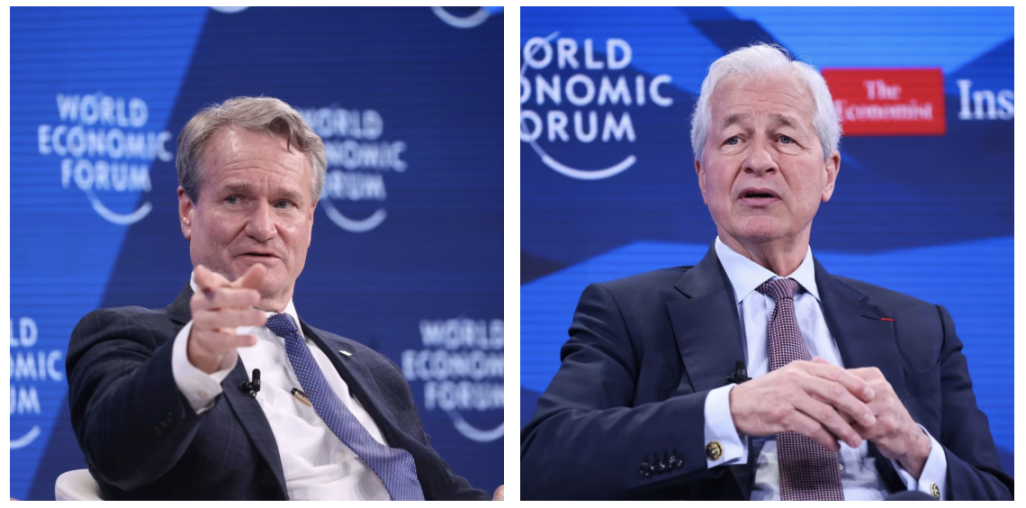
Bank of America CEO Brian Moynihan, JPMorgan Chase CEO Jamie Dimon

The banking industry believes that such yields paid by cryptocurrency exchanges to users are essentially no different from bank deposit interest. The interest rate on bank demand deposits is usually less than 0.1%, far lower than the yield level of cryptocurrency. Therefore, the banking industry worries that consumers will move funds into the cryptocurrency market on a large scale. They say this trend will severely hit community banks and affect the development of corporate lending business. Brian Armstrong and other practitioners in the cryptocurrency industry believe that the market should follow the principle of free competition. If the banking industry wants to counter stablecoins, it can simply raise deposit interest rates or directly enter the stablecoin business.

This legislation, called the "Clarity Act," may reshape the future landscape of daily financial services, covering core areas such as bank deposits and electronic payments.

According to people familiar with the matter, to promote a compromise between the two sides, the White House plans to convene a meeting this Monday with relevant groups from the banking and cryptocurrency industries. David Sacks, the Trump administration's commissioner for artificial intelligence and cryptocurrency affairs, is expected to attend. Some informed sources said that Coinbase's head of U.S. policy, Kara Calvert, is also on the list of attendees.

Brian Armstrong, 43, co-founded Coinbase in 2012 and has for years led the cryptocurrency industry in seeking legitimization and mainstream recognition. As the helm of this enterprise with a market value of about $55 billion, Brian Armstrong has significant say in policy debates related to the industry, and the current legislative game in Washington is one of them. "It's better to have no bill than a bad bill." A Senate committee was originally scheduled to vote on a draft bill. If passed, it would essentially prohibit companies like Coinbase from paying yields to customers, potentially costing Coinbase billions of dollars. Brian Armstrong posted on social platform X the day before the vote. Just a few hours later, the vote was suddenly postponed, causing an uproar throughout the financial world.

"The current situation is interpreted more as a confrontation between Coinbase and the banking industry, rather than the entire cryptocurrency industry versus the banking industry," said Ron Hammond, policy and advocacy director of well-known crypto market maker Wintermute.

Brian Armstrong's counterattack did not stop at the post on platform X on January 14. He reiterated his views in subsequent television interviews, telling Bloomberg that bank lobbyists are "running around trying to kill competitors" and accusing the banking industry of "using customer deposits for lending without the substantive consent of customers." According to people familiar with the matter, these remarks also led to several awkward direct encounters with multiple bank CEOs at the Davos Forum.

"If you want to do banking business, then get a banking license directly." Last week, during a 30-minute meeting between Bank of America CEO Brian Moynihan and Brian Armstrong at the Davos main convention center, Brian Moynihan said. The atmosphere of this meeting was relatively friendly, but the exchange was always slightly stiff.

Citigroup CEO Jane Fraser gave Brian Armstrong even less than a minute to talk. Coinbase is a client of Citigroup and JPMorgan Chase and has also established business cooperation relationships with many other banks.

And Wells Fargo CEO Charlie Scharf was unwilling to give even a minute. When Brian Armstrong proactively approached to talk, Charlie Scharf bluntly said there was nothing to discuss between them. This conversation happened while Charlie Scharf's former boss, Jamie Dimon, was not far away.

Aspiring to "Replace Traditional Banks"

Brian Armstrong graduated from Rice University in Houston, majoring in economics and computer science, and was an early adherent of the concept of digital currency and the underlying blockchain technology. He studied the original Bitcoin white paper published by the mysterious Satoshi Nakamoto in 2008. In 2011, while working at Airbnb, he encountered many difficulties in transferring money to South America.

These experiences laid the groundwork for him to found Coinbase. At that time, many investors were eager to enter the cryptocurrency market but faced a core problem: there was no dedicated platform to store digital assets. The creation of Coinbase was precisely to solve this problem. When some customers wanted to trade Bitcoin rather than just custody assets, Coinbase顺势 transitioned into a cryptocurrency exchange.

Coinbase's starting point was a small apartment in San Francisco, which was also the company's first office. In 2017, after the other co-founder left, Brian Armstrong became the undisputed helm.

Several former colleagues interviewed by The Wall Street Journal previously said that Brian Armstrong is shy and sometimes even has difficulty communicating smoothly with some employees, appearing awkward when reprimanding subordinates. Some former employees described his style as very much like the Vulcans in "Star Trek," an alien race known for their calm restraint and rejection of emotion.
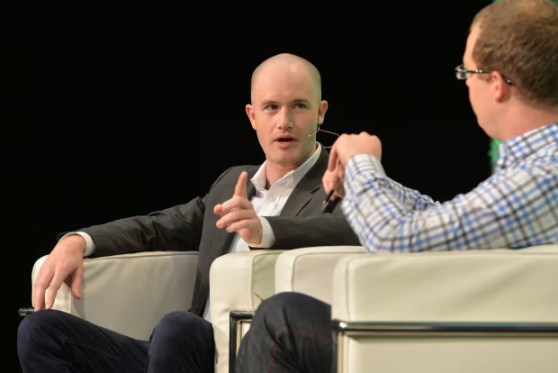
2014, Coinbase CEO Brian Armstrong speaking on stage at the TechCrunch Disrupt Europe conference (London stop)

But regarding Coinbase's development vision, Brian Armstrong has never retreated half a step. He positioned Coinbase as a benchmark enterprise promoting the integration of cryptocurrency into the American mainstream market. Today, Coinbase's business scope covers electronic payments, stock trading, commodity trading, prediction markets, and other fields.

"Our ultimate goal is to become an alternative to traditional banks in people's eyes," he said in an interview with Fox Business last year. "We want to create a super financial application to provide users with various financial services."

As the business territory continues to expand, Brian Armstrong invested millions of dollars to build the largest lobbying team in the cryptocurrency industry. After experiencing several booms and busts in the cryptocurrency industry, Coinbase officially went public in April 2021, with its market value once exceeding $100 billion, and Brian Armstrong's personal shareholding value reached about $13 billion.

2021, Coinbase employees opening champagne to celebrate the company's listing outside the NASDAQ exchange in New York

After surviving the industry collapse crisis in 2022 and withstanding the regulatory crackdown by the Biden administration in 2023, Brian Armstrong began to fight back and gradually found his voice. This manager who once preferred to wear headphones and write code in the office and was reluctant to speak publicly has now become a staunch spokesman for the cryptocurrency industry in Washington, and Washington's attitude towards cryptocurrency is about to undergo a翻天覆地的 change.

Through a series of super PACs (Political Action Committees), Coinbase has invested about $75 million in the 2024 U.S. election, aiming to oppose candidates skeptical of cryptocurrency. It also established grassroots organizations to gain public support for cryptocurrency-related bills. The super PAC said this Wednesday that its current funding规模 has reached $193 million.

Trump's victory in the 2024 election opened a window of opportunity that Brian Armstrong had been waiting for for ten years to争取 policy breakthroughs. He praised Trump for ushering in a "new dawn for cryptocurrency" and attended the "Crypto Gala" featuring Snoop Dogg during Trump's inauguration. Nowadays, this executive至少 takes off his usual T-shirt and black jacket at least every two months, puts on formal attire, and visits Capitol Hill.

"In all matters related to cryptocurrency in the United States, Coinbase is at the forefront," said Anthony Scaramucci, founder of SkyBridge Capital and a long-term cryptocurrency investor.

Last summer, Trump signed the "Genius Act," which cleared the way for many companies to issue stablecoins and directly promoted the explosive growth of the stablecoin business. The act prohibits stablecoin issuers themselves from paying interest to users but does not impose restrictions on exchanges like Coinbase or third-party institutions. Banking groups see this omission as a legal loophole, which directly triggered the fierce game around the "Clarity Act."

The Long Road to Legislation

The U.S. House of Representatives passed its own version of the "Clarity Act" last year, but the bill's advancement in the Senate is considered extremely difficult, partly because lawmakers disagree on the regulatory rules that cryptocurrency companies should follow. The Senate Agriculture Committee, responsible for overseeing legislation related to the Commodity Futures Trading Commission, passed the committee's version of the draft bill this Thursday. Lawmakers ultimately need to push the full Senate to pass a version of the bill and then negotiate with the House of Representatives to resolve differences between the versions.

According to people familiar with the matter, the core point Brian Moynihan expressed to Brian Armstrong is: If cryptocurrency companies like Coinbase want to provide deposit-like services, the banking industry普遍 believes these companies should be subject to the same regulatory constraints as traditional banks. Regulatory agencies such as the U.S. Federal Reserve and the Office of the Comptroller of the Currency strictly review banks' risk profiles, regularly inspect their operations, and set clear rules for capital requirements for banks' lending and investment businesses.

"The current controversy over yield rewards is an exception in our cooperative relationship with the banking industry. We maintain close cooperation with many banks and have announced several cooperation plans," said Coinbase Chief Policy Officer Faryar Shirzad.

Coinbase has established a lucrative partnership with stablecoin issuer Circle. Relying on this exclusive cooperation, Coinbase can obtain huge revenue sharing from the business of the popular stablecoin USDC. Unlike other companies in the cryptocurrency industry, based on this exclusive cooperation, Coinbase pays a 3.5% yield reward to some USDC holders. The company says such incentives help attract users and provide consumers with more choices at a time when bank demand deposit interest rates are extremely low.

"There is no reason to prohibit paying interest to consumers," Brian Armstrong said in an interview with The Wall Street Journal last year.
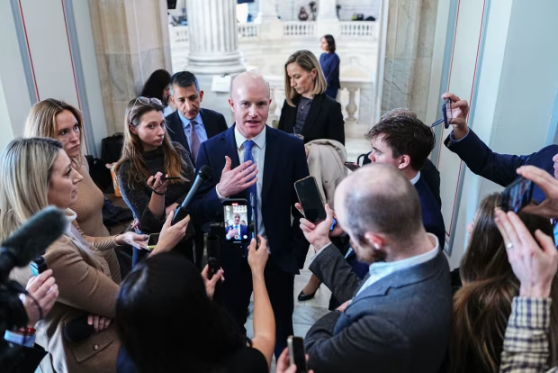
Brian Armstrong speaking to the media on Capitol Hill

As the "Clarity Act" was about to enter the voting stage in Congress, the banking industry began intensive lobbying activities behind the scenes. They cited a government estimate to warn senators that about $6.6 trillion in deposits in the traditional financial system could be at risk of being diverted to the cryptocurrency market. This lobbying achieved significant results. The nearly 300-page draft bill contained several条款 and potential amendments that Brian Armstrong considered unfavorable to the cryptocurrency industry. He immediately withdrew his support for the bill. A few hours later, Senate Banking Committee Chairman, Republican Senator Tim Scott of South Carolina, announced the cancellation of the vote.

According to people familiar with the matter, Brian Armstrong has proposed his own solution to the current僵局. He told Brian Moynihan that a new category of stablecoin issuers could be established. If such issuers can meet stricter regulatory standards, they could be allowed to pay yield rewards to users. This solution could theoretically allow the banking industry and Coinbase to compete fairly in the stablecoin business. Others have suggested prohibiting most yield reward payments, only carving out extremely narrow exemption application scenarios for a few companies like Coinbase.

The advancement of any solution requires Brian Armstrong's support.

"Now, the life and death of this bill is perceived to be in Coinbase's hands," said Hilary Allen, a law professor at American University and securities law expert, who is also a cryptocurrency skeptic. "It's really shocking."


Twitter:https://twitter.com/BitpushNewsCN

Bitpush TG Discussion Group:https://t.me/BitPushCommunity

Bitpush TG Subscription: https://t.me/bitpush

Original article link:https://www.bitpush.news/articles/7607395

Preguntas relacionadas

QWhat was the nature of the confrontation between Coinbase CEO Brian Armstrong and JPMorgan Chase CEO Jamie Dimon at the World Economic Forum in Davos?

AJamie Dimon interrupted a conversation between Brian Armstrong and former UK Prime Minister Tony Blair, accusing Armstrong of spreading falsehoods on television. Dimon demanded that Armstrong stop making public statements alleging that the banking industry was trying to block legislation to create a new regulatory framework for digital assets.

QWhat is the core disagreement between the banking industry and Coinbase regarding user payments for holding digital tokens?

AThe core disagreement is whether cryptocurrency exchanges like Coinbase have the right to pay regular yields, around 3.5%, to users who hold stablecoins. Banks argue these payments are essentially the same as bank deposit interest and pose a threat to their business, as consumers might move funds from low-yield bank accounts (often under 0.1%) to crypto. Coinbase argues for free market competition, suggesting banks could raise their own deposit rates or enter the stablecoin business to compete.

QWhat significant action did Brian Armstrong take that led to the sudden postponement of a Senate committee vote on a draft bill?

ABrian Armstrong publicly withdrew his support for the draft Clarity Act on social media platform X, stating that having no bill was better than a bad bill. This bill, if passed, would have effectively prohibited companies like Coinbase from paying yields to customers, potentially costing them billions. His post was followed hours later by the announcement that the vote was canceled.

QHow has Brian Armstrong's role in the cryptocurrency industry evolved, particularly in relation to policy and Washington, D.C.?

ABrian Armstrong has evolved from a technically-focused, introverted leader into a prominent and vocal advocate for the cryptocurrency industry in Washington, D.C. He has built one of the largest lobbying teams in crypto, invested millions in political action committees to support pro-crypto candidates, and now frequently visits Capitol Hill to influence legislation, a significant change from his earlier aversion to public speaking.

QWhat is the name of the stablecoin that Coinbase has a profitable partnership with, and what is the financial benefit for Coinbase?

ACoinbase has a profitable partnership with the stablecoin issuer Circle for the USDC stablecoin. This exclusive合作 (partnership) allows Coinbase to earn a substantial revenue share from the USDC business. As part of this, Coinbase offers a 3.5% yield reward to some USDC holders to attract users.

Lecturas Relacionadas

Sequoia Dialogue with Jensen Huang: Computing Model Undergoes a 60-Year Transformation; You Won't Be Replaced by AI, But You Will Be Dimensionality-Reduced by 'Those Who Master AI'

NVIDIA founder and CEO Jensen Huang, in a conversation with Sequoia Capital's Konstantine Buhler, argues that we are witnessing the most significant computing shift in 60 years—from retrieval-based to generative computing. Instead of just storing and retrieving data, future systems will generate highly personalized content (text, images, video) on demand, powered by massive "AI factories." Huang envisions a global "intelligence network" that will envelop the planet, following the historical patterns of energy and communication grids. He outlines a five-layer investment framework: 1) Energy, 2) Chips/Computers, 3) Infrastructure (data centers), 4) AI Models, and 5) Applications. He predicts this ecosystem will reach a scale of $20 trillion annually. Crucially, Huang pushes back against fears of AI-driven job loss. He distinguishes between specific "tasks" (e.g., typing, analyzing images) and overall "jobs" (e.g., CEO, radiologist). While AI automates tasks, it increases efficiency and demand for the higher-value problem-solving aspects of professions, thus creating more jobs and "up-leveling" careers. The real risk, he asserts, is not being replaced by AI, but being outperformed by someone who effectively leverages it. He urges everyone to embrace AI as a tool for augmented capability and innovation.

marsbitHace 3 min(s)

Sequoia Dialogue with Jensen Huang: Computing Model Undergoes a 60-Year Transformation; You Won't Be Replaced by AI, But You Will Be Dimensionality-Reduced by 'Those Who Master AI'

marsbitHace 3 min(s)

"I Don't Need a Better Model Anymore": A Panorama of AI Users Under a Reddit Hot Post

Titled "I Don't Need a Better Model Anymore": AI User Reactions on Reddit Anthropic recently released Claude Fable 5, its first publicly available 'Mythos'-tier model, achieving 80.3% on the SWE-Bench Pro benchmark and significantly outperforming its predecessor and competitors. However, a viral Reddit post titled "Claude Fable made me realize I don't need better models anymore" highlighted a growing user sentiment of "good enough." Top comments expressed "model fatigue," with users stating that earlier models like Opus 4.5/4.8 already sufficed for their workflows. High cost was a key concern, as Fable 5's API is nearly twice the price of Opus 4.8, with users questioning the return on investment and suggesting the field has hit a plateau. The most frequent complaint targeted Fable 5's stringent safety filters. Designed to intercept high-risk requests (e.g., cybersecurity), the system was perceived as overly conservative. Users reported frequent rejections for routine security-related tasks, leading to automatic fallbacks to the older Opus model. Paying users were particularly frustrated, feeling they paid a premium for a less usable product. Dissenting voices came from users with heavy, complex tasks. For workloads like high-energy physics simulations with thousands of code lines, Fable 5's improved long-context understanding and error detection represented a significant, worthwhile leap—described as moving from a "college player to an NBA starter." The debate underscores a divergence between benchmark performance and practical utility. For most users, current models meet their needs, making further advances relevant only for extreme use-cases. The discussion also raised concerns about a potential "Public AI Freeze," where the most powerful models (like the restricted Mythos 5) remain exclusive to enterprises and governments, while public offerings stagnate. The launch presents two report cards: one of technical excellence and another of user skepticism. Fable 5's ultimate reception may depend on Anthropic's ability to refine its safety filters and justify its cost for specialized, high-demand users.

marsbitHace 10 min(s)

"I Don't Need a Better Model Anymore": A Panorama of AI Users Under a Reddit Hot Post

marsbitHace 10 min(s)

When AI Traffic Surpasses Humans, How Do You Prove You're Human?

With AI-generated web traffic surpassing human activity, websites face a crisis as AI agents bypass ads, avoid clicks, and scrape data without generating revenue. This disrupts the ad-based internet economy, diverting traffic and reducing site visits. In response, sites are blocking AI crawlers and deploying traps like Cloudflare's "honeypot" pages. Traditional CAPTCHAs are now ineffective against advanced AI. The focus has shifted to behavioral biometrics—analyzing unique human patterns such as cursor movement, typing rhythm, and keystroke dynamics. Companies like IBM and BioCatch use this data to distinguish humans from bots, even detecting fraud through behavioral inconsistencies. Two competing approaches aim to verify human identity centrally. Sam Altman’s World (formerly Worldcoin) uses iris scanning to create unique credentials, though it faces privacy concerns and regulatory bans. Alternatively, cryptographic zero-knowledge proofs offer anonymous verification without revealing personal data, championed by Vitalik Buterin to avoid centralized surveillance. However, both systems have flaws. Centralized solutions risk biometric data misuse, while decentralized models may be exploited through identity rental markets in economically unequal regions. Despite challenges, the author favors cryptographic methods for preserving privacy over pervasive behavioral monitoring that permanently captures and controls personal biometric data.

marsbitHace 19 min(s)

When AI Traffic Surpasses Humans, How Do You Prove You're Human?

marsbitHace 19 min(s)

2026 Landscape of Decentralized AI: Why is Blockchain the Inevitable "Antidote" for AI?

**The 2026 Landscape of Decentralized AI: Why Blockchain is the "Cure" AI Cannot Ignore** Decentralized AI addresses fundamental bottlenecks of centralized AI: scarce and expensive computational resources, excessive control concentration, unverifiable model outputs, and increasing difficulty in acquiring training data due to privacy and regulation. Blockchain offers a path to make intelligence open, verifiable, and economically accessible. The technical stack comprises three layers: 1. **Applications & Services**: The main crypto use cases are "Agentic Finance" (converting natural language into on-chain actions) and "Agentic Payments" for machine-to-machine commerce. Projects like Giza, Infinity Labs, Coinvest AI, and x402 (handling 173M+ transactions) are key players. 2. **Middleware**: This coordination layer enables agents to discover, identify, and transact. Notable projects include Gokite AI (specialized L1), Virtuals (an OS for the agent economy), and especially Bittensor—a network of specialized subnets forming competitive AI micro-economies. 3. **Infrastructure**: The capital-intensive layer providing raw resources. It includes decentralized compute (Akash, Render, Aethir), verifiable inference (Venice AI, OpenGradient), distributed training (Prime Intellect, Templar AI), decentralized storage (Filecoin, Walrus), and privacy/verification layers (Nillion, Arcium, Phala Network) using technologies like ZKPs, MPC, and TEEs. The outlook for 2026-2027 indicates AI demand outpacing infrastructure, with AI agents as a primary growth engine. Computation is becoming an asset class, with on-chain markets as its financial layer. Tokenomics is emerging as a structural advantage for coordinating capital, compute, and data in decentralized AI networks. While still early—with adoption uneven and revenue often trailing token incentives—projects like Bittensor, NEAR, and Virtuals demonstrate a shift from speculative narrative to a new model for coordinating intelligence.

marsbitHace 22 min(s)

2026 Landscape of Decentralized AI: Why is Blockchain the Inevitable "Antidote" for AI?

marsbitHace 22 min(s)

a16z Crypto Partner: Cash Flow is the Moat

Cash Flow as the Moat: A Playbook for Crypto Founders Historically, the most enduring businesses have been built by positioning themselves within the "flow of funds"—facilitating the creation and transfer of value in a network and extracting a portion of it. Cryptocurrency is the first modern technology natively built for this purpose. For startups, failing to architect products and businesses to leverage these principles means missing a major opportunity. Blockchains are inherently network businesses. Each transaction settles on a shared ledger, and every new participant strengthens the underlying network for all. Well-designed network tokens amplify this by aligning users, developers, and validators around growing the network, with value flowing back to contributors in a transparent feedback loop. This model is not new; companies from railroads and Standard Oil to Google, Meta, and AWS have thrived by inserting themselves into critical flows of value (goods, attention, compute). Financial markets make it even clearer: firms like Visa and major market makers generate immense revenue not by predicting markets but by being in the path of transactions. The combination of fund flow and network effects creates one of the most durable business structures. The high margins in traditional finance (payments, custody, lending, FX) represent prime targets. Crypto founders have the opportunity to build the next version—programmable, instant, global, and natively in the flow of funds. The frontier extends beyond finance to areas like computing/GPUs, AI training data, energy, robotics, and space—markets without entrenched intermediaries, ripe for building new, efficient value rails on programmable infrastructure. Founders should ask: Are you in the flow of funds today? Does your revenue scale 10x with the value of activity on your platform? Where in your target market are profit margins highest relative to value created? The opportunity is clear: embed your startup into the new flows of value and let the network effects accumulate.

marsbitHace 24 min(s)

a16z Crypto Partner: Cash Flow is the Moat

marsbitHace 24 min(s)

Trading

Spot
Futuros
活动图片