From Aave to Ether.fi: Who Captures the Most Value in the On-Chain Credit System?

marsbitPublicado a 2025-12-24Actualizado a 2025-12-24

Resumen

In the DeFi lending ecosystem, lending protocols like Aave and SparkLend capture more value than the vaults and asset issuers built on top of them, despite the narrative that distribution is king. Analysis shows that major vaults, including Ether.fi, Fluid, and Mellow, pay more in interest fees to lending protocols than they earn in platform revenue. For example, Ether.fi’s ETH vault pays Aave ~$4.5M annually in interest while earning only ~$1.07M in fees. Even when combining vault strategy revenue and issuer fees (e.g., Lido), lending layer value capture remains higher. Lending protocol income is tied to borrowing scale and remains stable, whereas vault earnings depend heavily on fee structures. The true moat in on-chain credit lies with lending protocols, not distribution or asset issuance.

Author | @SilvioBusonero

Compiled by | Odaily Planet Daily (@OdailyChina)

Translated by | DingDang (@XiaMiPP)

As the market share of Vaults and Curators continues to grow in the DeFi world, the market has begun to question: Are lending protocols having their profit margins constantly squeezed? Is lending no longer a good business?

But if we shift our perspective back to the entire on-chain credit value chain, the conclusion is quite the opposite. Lending protocols still occupy the most solid moat in this value chain. We can quantify this with data.

On Aave and SparkLend, the interest fees paid by Vaults to lending protocols actually exceed the revenue generated by the Vaults themselves. This fact directly challenges the mainstream narrative that "distribution is king".
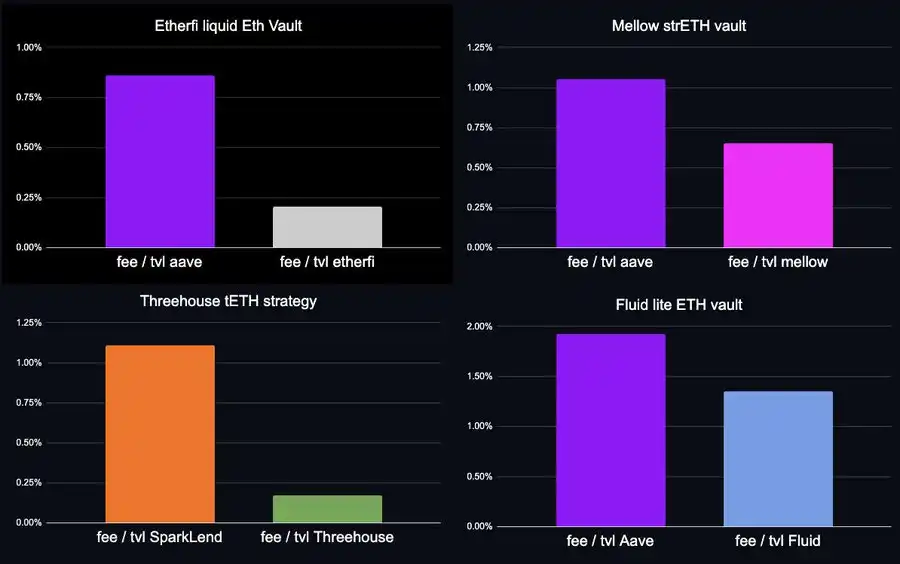
At least in the lending space, distribution is not king.

Simply put: Aave not only earns more than the various Vaults built on top of it, but also more than the issuers of the assets used for lending, such as Lido and Ether.fi.

To understand why, we need to deconstruct the complete value chain of DeFi lending and re-examine the value capture capabilities of various roles by following the flow of funds and fees.

Deconstructing the Lending Value Chain
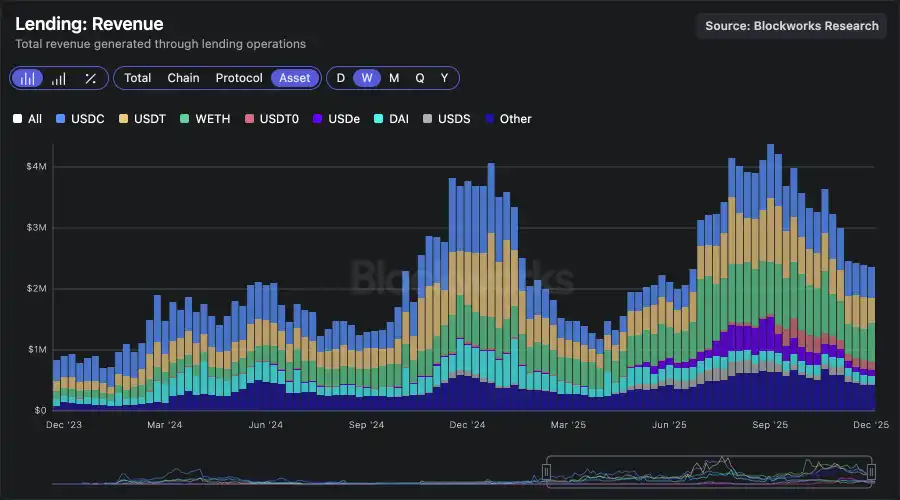
The annualized revenue scale of the entire lending market has exceeded $100 million. This value is not generated by a single link but is composed of a complex stack: the underlying settlement blockchain, asset issuers, capital lenders, the lending protocol itself, and the Vaults responsible for distribution and strategy execution.

As mentioned in previous articles, a large number of use cases in the current lending market originate from basis trading and liquidity mining opportunities, and we have deconstructed the main strategy logic.

So, who actually "demands" the capital in the lending market?

I analyzed the top 50 wallet addresses on Aave and SparkLend and labeled the main borrowers.
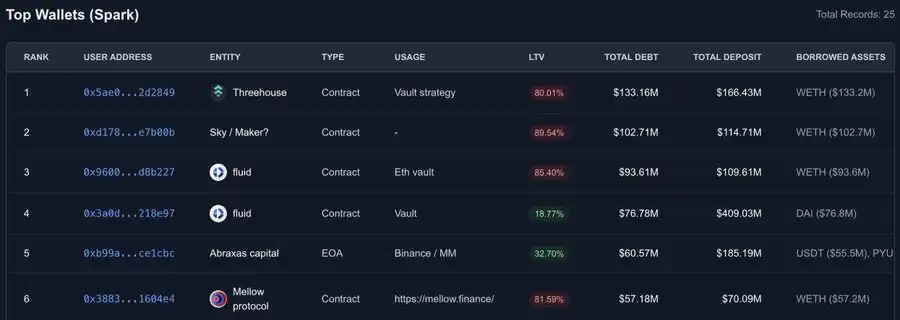
  1. The largest borrowers are various Vaults and strategy platforms like Fluid, Treehouse, Mellow, Ether.fi, Lido (who are also asset issuers). They control the distribution capability to end-users, helping users obtain higher yields without having to manage complex loops and risks themselves.
  2. There are also large institutional capital providers, such as Abraxas Capital, which deploy external capital into similar strategies. Their economic model is essentially very similar to that of Vaults.
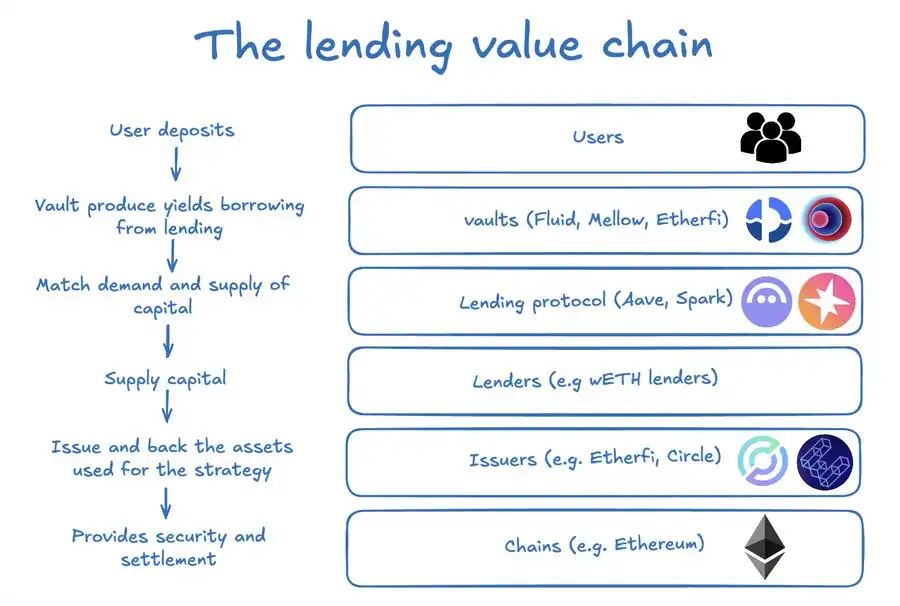
But Vaults are not the whole story. This chain involves at least the following participants:

  • Users: Deposit assets, hoping to obtain additional yield through Vaults or strategy managers.
  • Lending Protocols: Provide infrastructure and liquidity matching, generating protocol revenue by charging interest to the borrowing side and taking a cut.
  • Lenders: Capital suppliers, who can be either ordinary users or other Vaults.
  • Asset Issuers: Most on-chain lending assets have underlying collateral assets that themselves generate yield, part of which is captured by the issuer.
  • Blockchain Network: The underlying "rail" where all activity takes place.

Lending Protocols Earn More Than Downstream Vaults

Take Ether.fi's ETH liquid staking vault as an example. It is the second-largest borrower on Aave, with an outstanding loan size of approximately $1.5 billion. The strategy itself is very typical:

  • Deposit weETH (approx. +2.9%)
  • Borrow wETH (approx. –2%)
  • The vault charges a 0.5% platform management fee on TVL.

Out of Ether.fi's total TVL, approximately $215 million is the net liquidity actually deployed on Aave. This portion of TVL generates about $1.07 million in annual platform fee revenue for the vault.

However, simultaneously, this strategy pays Aave approximately $4.5 million in annual interest fees (calculated as: $1.5B borrowed × 2% borrow APY × 15% reserve factor).

Even for one of the largest and most successful loop strategies in DeFi, the value captured by the lending protocol is still multiples of that captured by the vault.
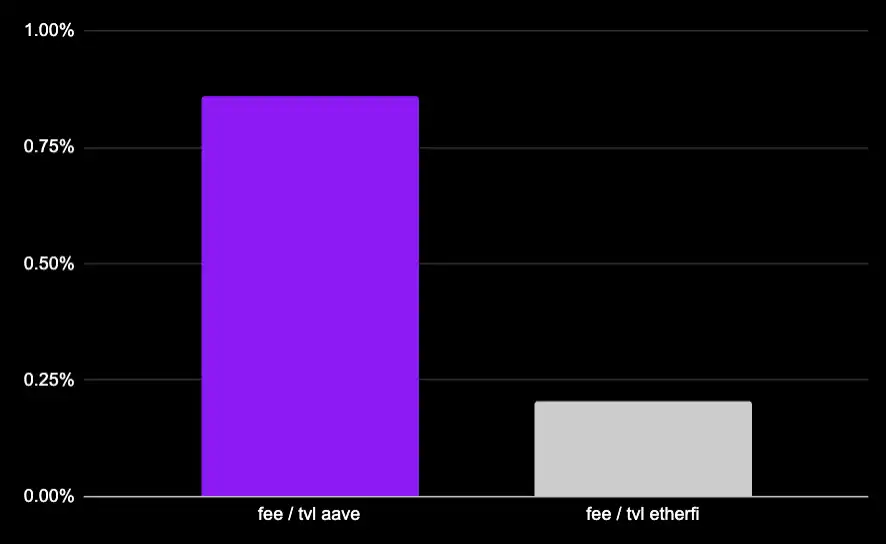
Of course, Ether.fi is also the issuer of weETH, and this vault itself directly creates demand for weETH.
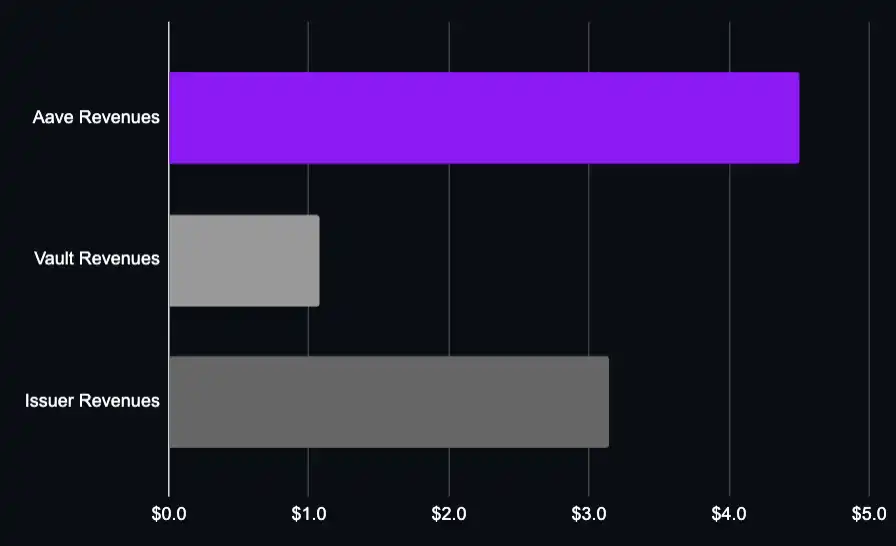
But even considering the vault strategy revenue + asset issuer revenue together, the economic value created by the lending layer (Aave) is still higher.

In other words, the lending protocol is the link in the entire stack that creates the most incremental value.

We can perform the same analysis on other commonly used vaults:

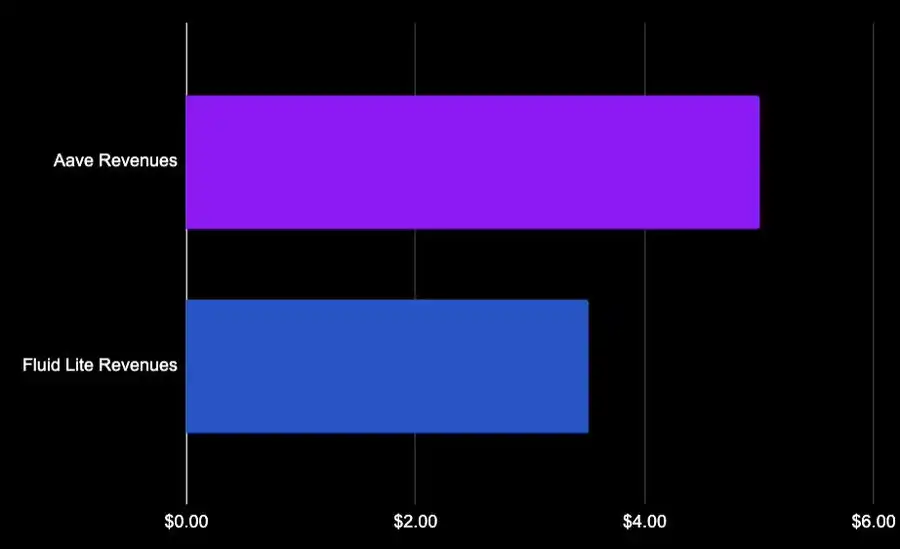
Fluid Lite ETH: 20% performance fee + 0.05% exit fee, no platform management fee. Borrows $1.7B wETH from Aave, paying ~$33M in interest, of which ~$5M goes to Aave. Fluid's own revenue is close to $4M.
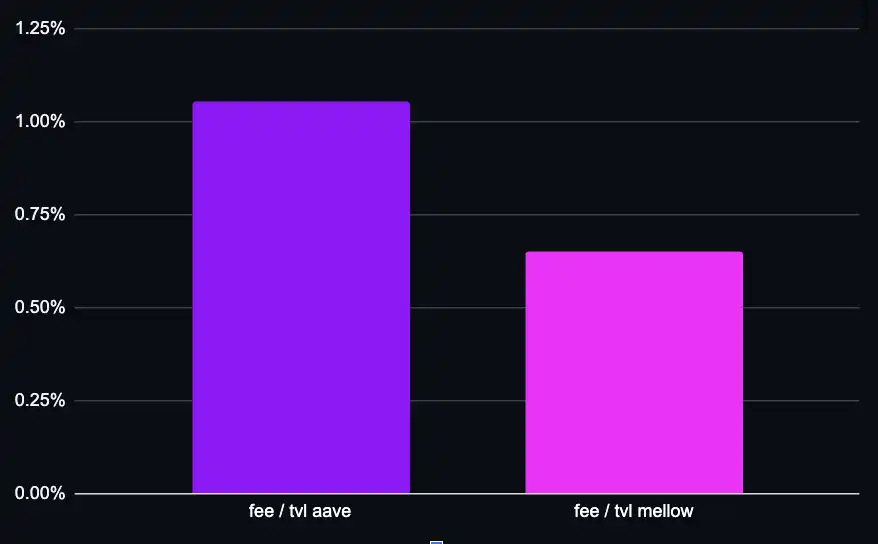
Mellow Protocol strETH charges a 10% performance fee, with a borrow size of $165M and a TVL of only ~$37M. Again, we see that on a TVL basis, Aave captures more value than the vault itself.
Let's look at another example. On SparkLend, the second-largest lending protocol on Ethereum, Treehouse is a key participant, operating an ETH loop strategy:
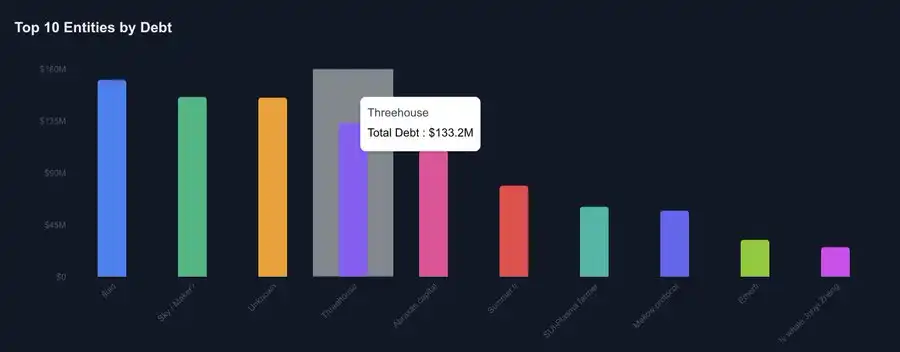
  • TVL ~$34M
  • Borrows $133M
  • Charges performance fee only on marginal yield above 2.6%
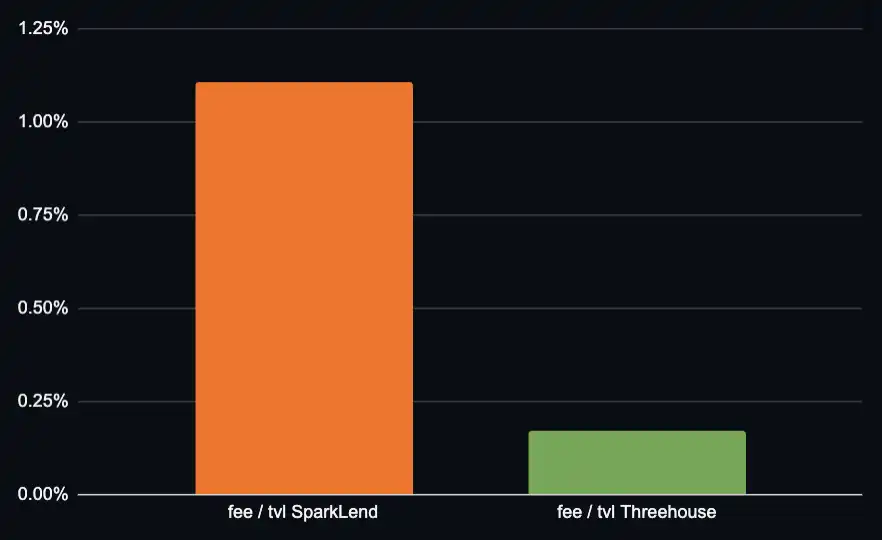
SparkLend, as a lending protocol, captures more value on a TVL basis than the vault.

The pricing structure of a vault greatly influences its own capturable value; but for lending protocols, their revenue depends more on the nominal size of borrowing, which is relatively stable.

Even shifting to USD-denominated strategies, which have lower leverage, the higher interest rates often offset this effect. I don't believe the conclusion would fundamentally change.

In relatively closed markets, more value might flow to curators, such as Stakehouse Prime Vault (26% performance fee, incentives provided by Morpho). But this is not the end state of Morpho's pricing mechanism, and curators themselves also partner with other platforms for distribution.

Lending Protocol vs. Asset Issuer

So the question arises: Is it better to be Aave or Lido?

This question is more complex than comparing vaults because staking assets not only generate yield themselves but also indirectly create stablecoin interest income for the protocol through the lending market. We can only make an approximate estimate.

Lido has approximately $4.42 billion in assets in the core Ethereum market used to support lending positions, generating annualized performance fee revenue of approximately $11 million.

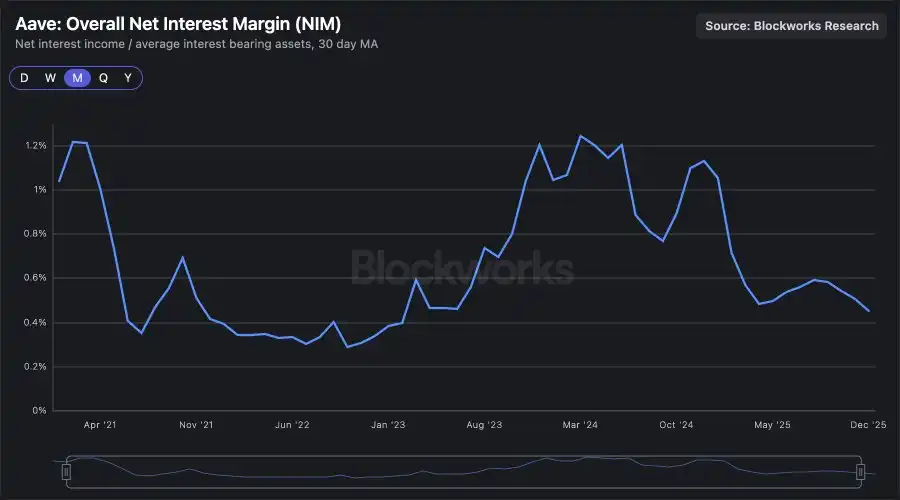
These positions roughly equally support ETH and stablecoin borrowing. At the current net interest margin (NIM) of ~0.4%, the corresponding lending yield is about $17 million, already significantly higher than Lido's direct revenue (and this is at a historically low NIM level).
The True Moat of Lending Protocols

If we only use the traditional financial deposit profitability model for comparison, DeFi lending protocols seem to be a low-margin industry. But this comparison ignores where the real moat lies.

In the on-chain credit system, the value captured by lending protocols exceeds that of the distribution layer downstream and, overall, exceeds that of the upstream asset issuers.

Viewed in isolation, lending seems like a thin-margin business; but placed within the complete credit stack, it is the layer with the strongest value capture capability relative to all other participants—vaults, issuers, distribution channels.


Criptos en tendencia

Preguntas relacionadas

QAccording to the article, which layer in the DeFi lending value chain captures the most value?

AThe lending protocol layer, such as Aave and SparkLend, captures the most value in the entire on-chain credit value chain, even more than the downstream vaults/curators and the upstream asset issuers.

QWhat is the main reason that lending protocols can capture more value than the yield strategies (vaults) built on top of them?

AThe lending protocol's revenue is primarily determined by the nominal size of the loans, which is stable and large. In contrast, a vault's income depends heavily on its specific fee structure (e.g., performance fees) and is often a smaller portion of the total value flow, with a significant portion paid as interest to the lending protocol.

QUsing the Ether.fi vault as an example, how much more value did Aave capture compared to the vault itself?

AThe Ether.fi vault paid approximately $4.5 million in annual interest fees to Aave, while the vault itself only generated about $1.07 million in platform fee revenue from its TVL, meaning Aave captured over 4 times more value.

QBesides vaults, who are the other major borrowers in the DeFi lending market mentioned in the analysis?

AOther major borrowers include large institutional capital providers, such as Abraxas Capital, which deploy external capital into yield strategies that are economically similar to vaults.

QWhat is the key takeaway about the business of DeFi lending protocols when viewed within the entire credit stack?

AWhile lending may appear to be a low-margin business when viewed in isolation through a traditional deposit profitability lens, it actually has the strongest and most defensible moat in the entire on-chain credit value stack, capturing more value than any other participant, including distributors and asset issuers.

Lecturas Relacionadas

Funding Weekly | Crypto.com Secures $400M Investment, CeFi and Stablecoin Sectors Continue to Attract Capital

Crypto Weekly Investment Recap: Funds Converge on CeFi, Stablecoins, and AI Last week's crypto and AI investment landscape saw significant capital concentration, with a few large deals dominating. **Crypto/Web3 Highlights (July 13-19):** Total investment exceeded **$812 million** across 17 deals. Key trends: * **Centralized Finance (CeFi) & Stablecoins** remained a major magnet, led by **Crypto.com**'s massive **$400 million** raise from Citadel Securities, valuing the exchange at $20B. * **Infrastructure & Tools** saw 7 deals, including **Cyclops** ($20M for stablecoin payments) and **ADI Chain** ($50M for stablecoin settlement infrastructure). * **DeFi** had 2 deals, such as AI-native DEX **Quote Trade** ($4M). * Other notable raises: API broker **Alpaca** ($135M), cross-border platform **Flex** ($70M), treasury firm **ORANGE JUICE** ($40M), and prediction market **Pascal** ($9M). * **Acquisitions:** Keyrock bought BlockFills' trading unit, SBI Holdings acquired Singapore exchange Coinhako, and MoonPay bought startup Glide. **AI & Robotics Highlights:** Investment momentum in AI remained very strong. * Nvidia-backed AI cloud service **Fireworks** raised a massive **$1.5 billion** at a $17.5B valuation. * In robotics, **Walden Robotics** (spun out from Toyota) secured **$300 million**, and Chinese humanoid firm ****逐际动力** **(Climax Dynamics) raised nearly **$200 million** in a Pre-IPO round. * Other significant AI raises included Indian programming platform **Emergent** ($130M) and drone company **Brinc** ($125M), backed by Sam Altman. Overall, the trend shows capital flowing heavily into established crypto financial services, stablecoin infrastructure, and large-scale AI/robotics commercialization.

marsbitHace 1 hora(s)

Funding Weekly | Crypto.com Secures $400M Investment, CeFi and Stablecoin Sectors Continue to Attract Capital

marsbitHace 1 hora(s)

The Gentlest Bear Market? BTC Bears Exit, ARK and Bitwise Collectively Bullish

**Title: The Mildest Bear Market? BTC Shorts Exit, ARK and Bitwise Collectively Bullish** Bitcoin continues to consolidate around $75,000 while Ethereum struggles near $1,900. Market data shows $116 million in liquidations over 24 hours, with $62.7 million from short positions, and the Fear & Greed Index remains at 35 (Fear). According to Polymarket, there's a 33% probability BTC falls below $50,000 this year. ARK Invest's Q2 2026 Bitcoin report notes technical weakness but identifies potential bottoming signals, including a record high in long-term holder supply, suggesting selling exhaustion. Bitwise's Juan Leon calls this the "structurally mildest bear market" on record, with a ~50% drawdown from highs, less severe than past cycles. He highlights institutional accumulation and a shift in investor dialogue from survival to entry points. Technical analysis from Bit suggests a potential C-wave low may have formed, with an ideal bottoming range between $50,000-$55,000. However, glassnode's CryptoVizArt warns that failure to break $66,000 could signal a local top, as new buyer accumulation is concentrated there. Analyst Darkfost identifies a critical support band between $59,000-$70,000, where 50% of BTC's circulating supply has changed hands. Notably, trader Doctor Profit announced closing all crypto short positions—including BTC shorts from $115k-$125k and over 100 altcoin shorts—for significant profit. He has begun a phased accumulation of Bitcoin spot starting at $64,000, reversing his previous $40k-$50k target, citing structural positives like regulatory clarity and institutional adoption. He argues the anticipated September/October bottom may arrive earlier than the herd expects.

Foresight NewsHace 1 hora(s)

The Gentlest Bear Market? BTC Bears Exit, ARK and Bitwise Collectively Bullish

Foresight NewsHace 1 hora(s)

The Evolution of Order in the AI & Web3 Era: The Competitive Dimensions and Exploratory Path of m&W

The article explores the evolution of order in the AI & Web3 era, framing the competition around establishing new foundations for human-AI collaboration. It argues that as AI Agents become core economic participants, the existing Web3 infrastructure—focused on assets, identity, and decentralized governance—is insufficient. The core challenge shifts to building trust, assessing complex contributions, and creating fair value distribution among diverse human and AI actors. The analysis positions the m&WDAO project within this landscape by comparing it to existing paradigms: Colony (human-centric DAO governance), SingularityNET (AI service exchange), Gitcoin Passport (Sybil-resistant identity), and Farcaster/Lens (open social graphs). m&W's distinct path, termed EcoFi (Ecological Finance/Order), aims to integrate these layers. Its three-phase evolution is outlined: 1) **m&W 1.0: Credit Anchoring** - filtering high-quality "Builder" nodes and converting their contributions into non-transferable SBTs (Soulbound Tokens) as a bedrock of trust. 2) **m&W 2.0: Collaborative Economy** - deploying the EcoFi protocol to enable verified, complex task collaboration with a hybrid AI/human judgment system for valuation and dispute resolution, creating a closed-loop value system. 3) **m&W 3.0: Intelligent Order** - where human-originated SBT credit enables trusted AI Agent "digital twins" to participate in a mature human-AI co-creation economy. The conclusion asserts that while other projects solve discrete problems (proving identity, governing contributions, exchanging AI capabilities), m&W's ultimate mission is to address the foundational question of a new socio-economic order for the coming era of human-AI collaborative networks.

链捕手Hace 1 hora(s)

The Evolution of Order in the AI & Web3 Era: The Competitive Dimensions and Exploratory Path of m&W

链捕手Hace 1 hora(s)

Trading

Spot

Artículos destacados

Cómo comprar AAVE

¡Bienvenido a HTX.com! Hemos hecho que comprar Aave Protocol (AAVE) sea simple y conveniente. Sigue nuestra guía paso a paso para iniciar tu viaje de criptos.Paso 1: crea tu cuenta HTXUtiliza tu correo electrónico o número de teléfono para registrarte y obtener una cuenta gratuita en HTX. Experimenta un proceso de registro sin complicaciones y desbloquea todas las funciones.Obtener mi cuentaPaso 2: ve a Comprar cripto y elige tu método de pagoTarjeta de crédito/débito: usa tu Visa o Mastercard para comprar Aave Protocol (AAVE) al instante.Saldo: utiliza fondos del saldo de tu cuenta HTX para tradear sin problemas.Terceros: hemos agregado métodos de pago populares como Google Pay y Apple Pay para mejorar la comodidad.P2P: tradear directamente con otros usuarios en HTX.Over-the-Counter (OTC): ofrecemos servicios personalizados y tipos de cambio competitivos para los traders.Paso 3: guarda tu Aave Protocol (AAVE)Después de comprar tu Aave Protocol (AAVE), guárdalo en tu cuenta HTX. Alternativamente, puedes enviarlo a otro lugar mediante transferencia blockchain o utilizarlo para tradear otras criptomonedas.Paso 4: tradear Aave Protocol (AAVE)Tradear fácilmente con Aave Protocol (AAVE) en HTX's mercado spot. Simplemente accede a tu cuenta, selecciona tu par de trading, ejecuta tus trades y monitorea en tiempo real. Ofrecemos una experiencia fácil de usar tanto para principiantes como para traders experimentados.

355 Vistas totalesPublicado en 2024.12.11Actualizado en 2026.06.02

Cómo comprar AAVE

Discusiones

Bienvenido a la comunidad de HTX. Aquí puedes mantenerte informado sobre los últimos desarrollos de la plataforma y acceder a análisis profesionales del mercado. A continuación se presentan las opiniones de los usuarios sobre el precio de AAVE (AAVE).

活动图片