From Aave to Ether.fi: Who Captures the Most Value in the On-Chain Credit System?

marsbitPublicado a 2025-12-24Actualizado a 2025-12-24

Resumen

In the DeFi lending ecosystem, lending protocols like Aave and SparkLend capture more value than the vaults and asset issuers built on top of them, despite the narrative that distribution is king. Analysis shows that major vaults, including Ether.fi, Fluid, and Mellow, pay more in interest fees to lending protocols than they earn in platform revenue. For example, Ether.fi’s ETH vault pays Aave ~$4.5M annually in interest while earning only ~$1.07M in fees. Even when combining vault strategy revenue and issuer fees (e.g., Lido), lending layer value capture remains higher. Lending protocol income is tied to borrowing scale and remains stable, whereas vault earnings depend heavily on fee structures. The true moat in on-chain credit lies with lending protocols, not distribution or asset issuance.

Author | @SilvioBusonero

Compiled by | Odaily Planet Daily (@OdailyChina)

Translated by | DingDang (@XiaMiPP)
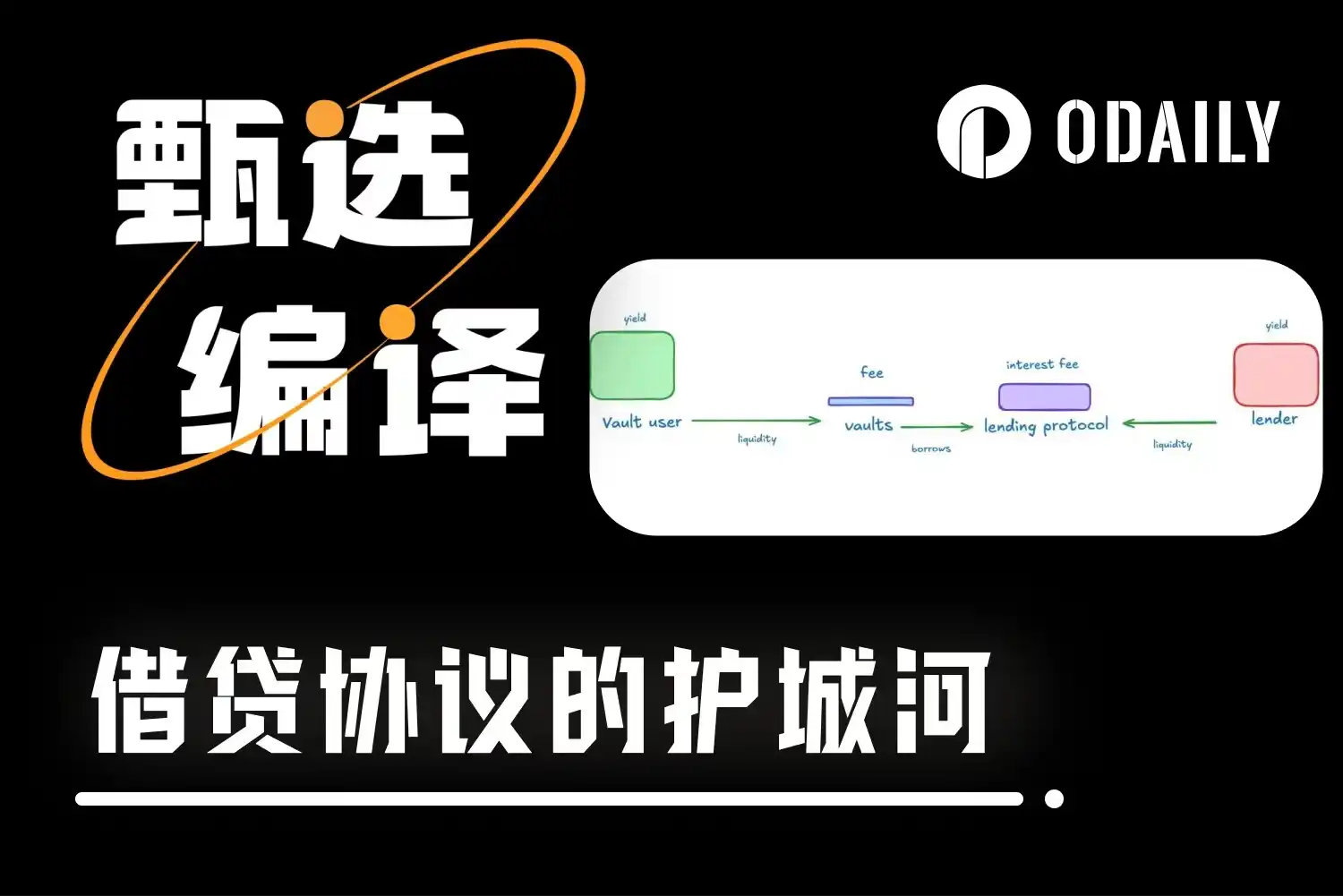
As the market share of Vaults and Curators continues to grow in the DeFi world, the market has begun to question: Are lending protocols having their profit margins constantly squeezed? Is lending no longer a good business?

But if we shift our perspective back to the entire on-chain credit value chain, the conclusion is quite the opposite. Lending protocols still occupy the most solid moat in this value chain. We can quantify this with data.

On Aave and SparkLend, the interest fees paid by Vaults to lending protocols actually exceed the revenue generated by the Vaults themselves. This fact directly challenges the mainstream narrative that "distribution is king".
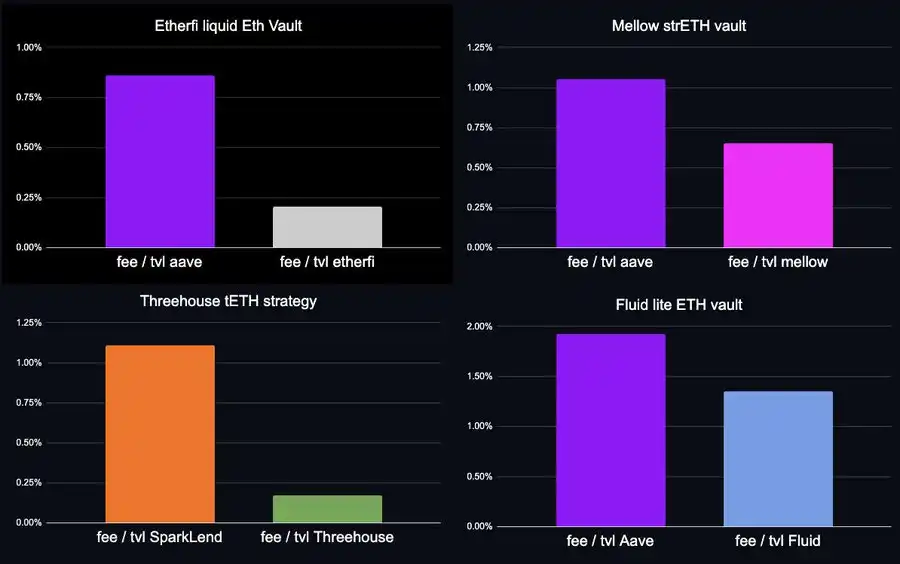
At least in the lending space, distribution is not king.

Simply put: Aave not only earns more than the various Vaults built on top of it, but also more than the issuers of the assets used for lending, such as Lido and Ether.fi.

To understand why, we need to deconstruct the complete value chain of DeFi lending and re-examine the value capture capabilities of various roles by following the flow of funds and fees.

Deconstructing the Lending Value Chain
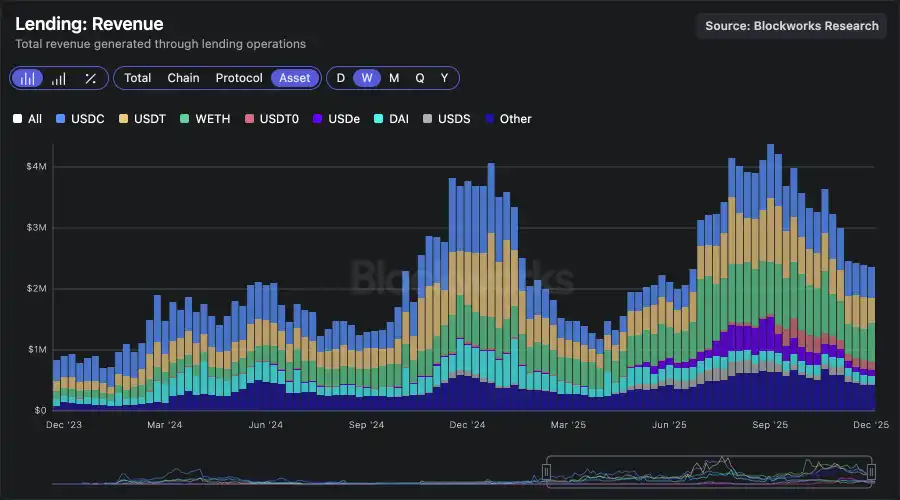
The annualized revenue scale of the entire lending market has exceeded $100 million. This value is not generated by a single link but is composed of a complex stack: the underlying settlement blockchain, asset issuers, capital lenders, the lending protocol itself, and the Vaults responsible for distribution and strategy execution.

As mentioned in previous articles, a large number of use cases in the current lending market originate from basis trading and liquidity mining opportunities, and we have deconstructed the main strategy logic.

So, who actually "demands" the capital in the lending market?

I analyzed the top 50 wallet addresses on Aave and SparkLend and labeled the main borrowers.
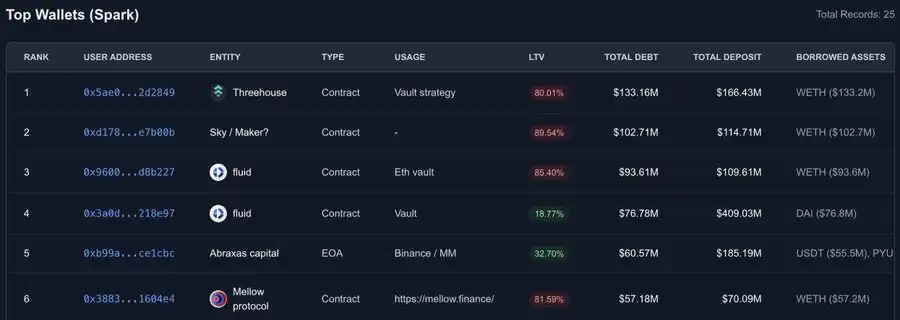
  1. The largest borrowers are various Vaults and strategy platforms like Fluid, Treehouse, Mellow, Ether.fi, Lido (who are also asset issuers). They control the distribution capability to end-users, helping users obtain higher yields without having to manage complex loops and risks themselves.
  2. There are also large institutional capital providers, such as Abraxas Capital, which deploy external capital into similar strategies. Their economic model is essentially very similar to that of Vaults.
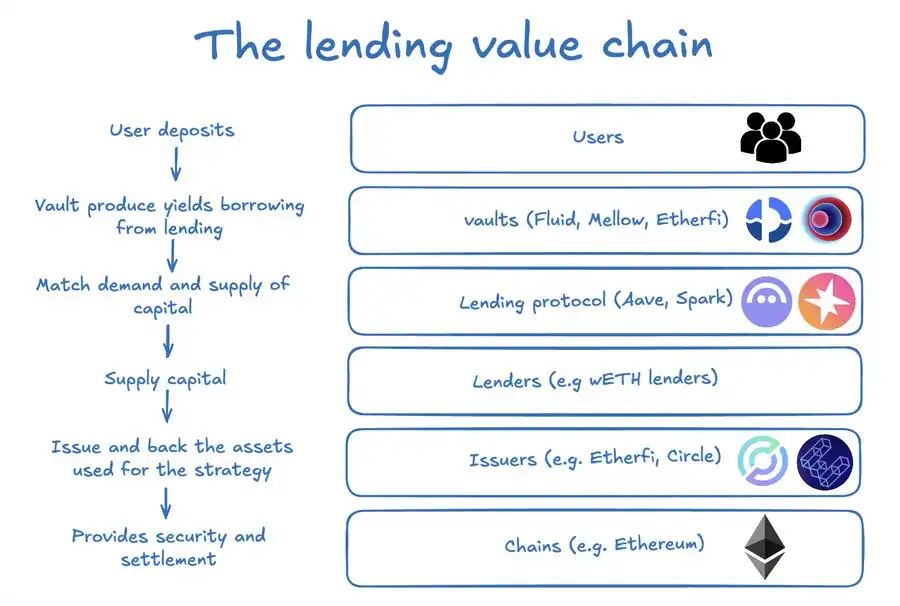
But Vaults are not the whole story. This chain involves at least the following participants:

  • Users: Deposit assets, hoping to obtain additional yield through Vaults or strategy managers.
  • Lending Protocols: Provide infrastructure and liquidity matching, generating protocol revenue by charging interest to the borrowing side and taking a cut.
  • Lenders: Capital suppliers, who can be either ordinary users or other Vaults.
  • Asset Issuers: Most on-chain lending assets have underlying collateral assets that themselves generate yield, part of which is captured by the issuer.
  • Blockchain Network: The underlying "rail" where all activity takes place.

Lending Protocols Earn More Than Downstream Vaults

Take Ether.fi's ETH liquid staking vault as an example. It is the second-largest borrower on Aave, with an outstanding loan size of approximately $1.5 billion. The strategy itself is very typical:

  • Deposit weETH (approx. +2.9%)
  • Borrow wETH (approx. –2%)
  • The vault charges a 0.5% platform management fee on TVL.

Out of Ether.fi's total TVL, approximately $215 million is the net liquidity actually deployed on Aave. This portion of TVL generates about $1.07 million in annual platform fee revenue for the vault.

However, simultaneously, this strategy pays Aave approximately $4.5 million in annual interest fees (calculated as: $1.5B borrowed × 2% borrow APY × 15% reserve factor).

Even for one of the largest and most successful loop strategies in DeFi, the value captured by the lending protocol is still multiples of that captured by the vault.
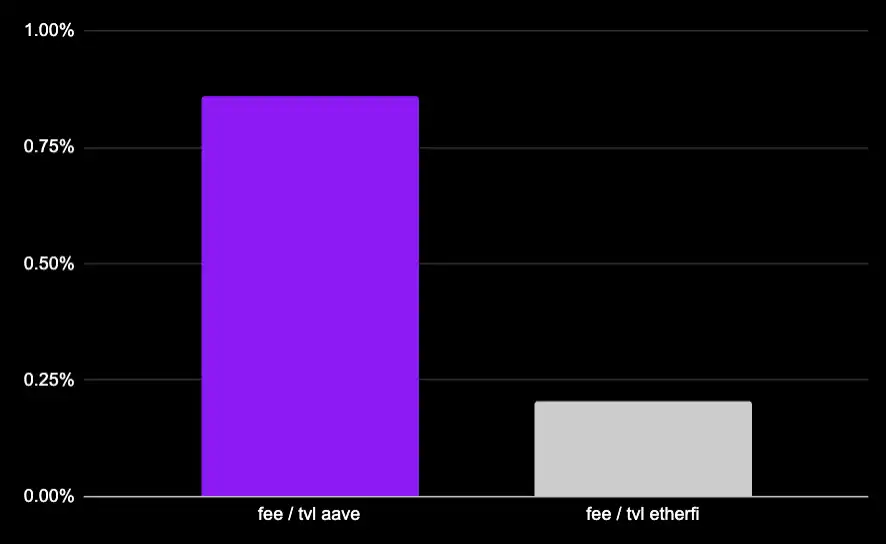
Of course, Ether.fi is also the issuer of weETH, and this vault itself directly creates demand for weETH.
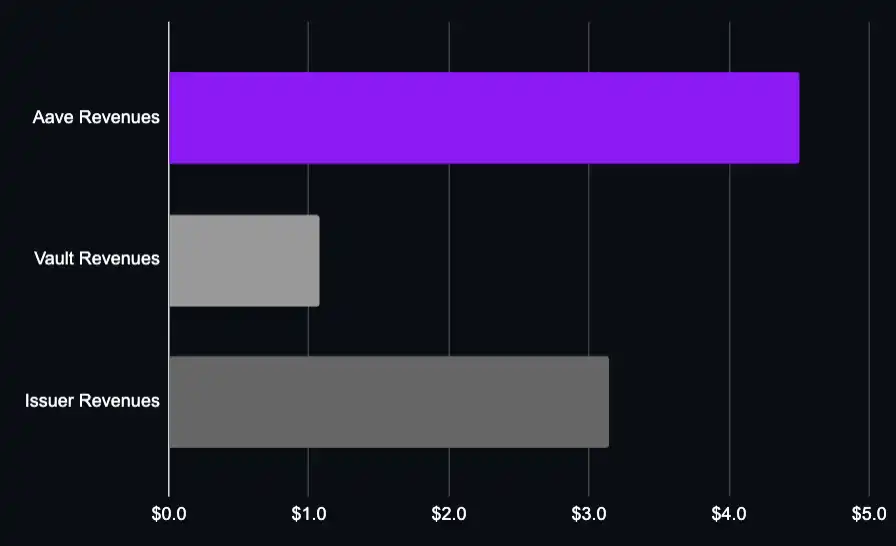
But even considering the vault strategy revenue + asset issuer revenue together, the economic value created by the lending layer (Aave) is still higher.

In other words, the lending protocol is the link in the entire stack that creates the most incremental value.

We can perform the same analysis on other commonly used vaults:

Fluid Lite ETH: 20% performance fee + 0.05% exit fee, no platform management fee. Borrows $1.7B wETH from Aave, paying ~$33M in interest, of which ~$5M goes to Aave. Fluid's own revenue is close to $4M.
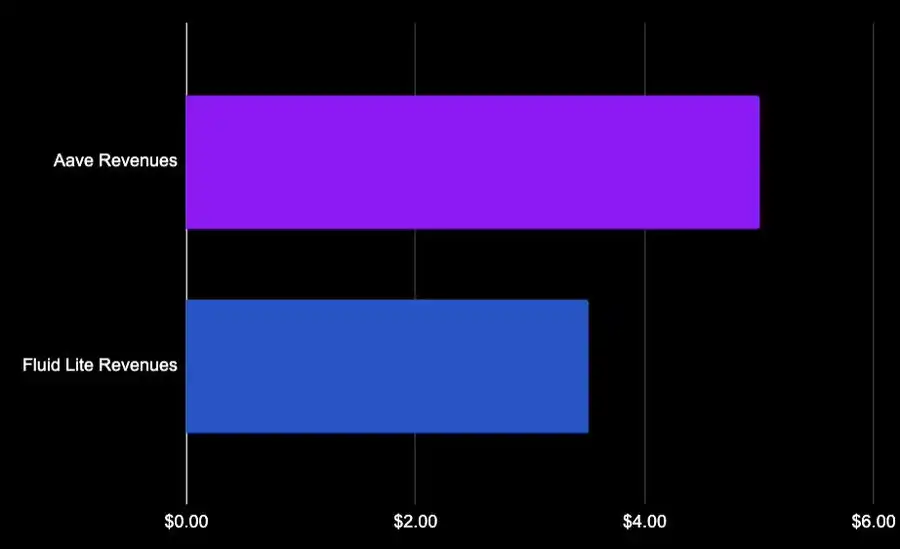
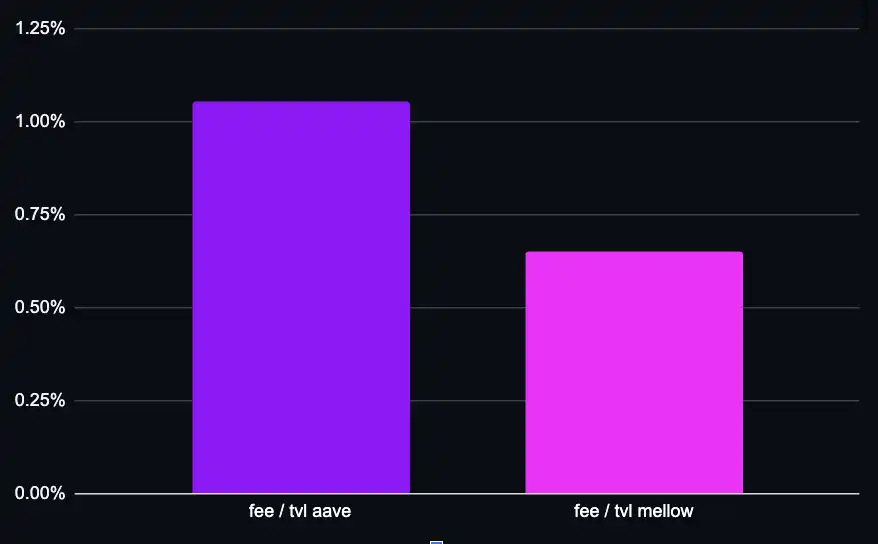
Mellow Protocol strETH charges a 10% performance fee, with a borrow size of $165M and a TVL of only ~$37M. Again, we see that on a TVL basis, Aave captures more value than the vault itself.
Let's look at another example. On SparkLend, the second-largest lending protocol on Ethereum, Treehouse is a key participant, operating an ETH loop strategy:
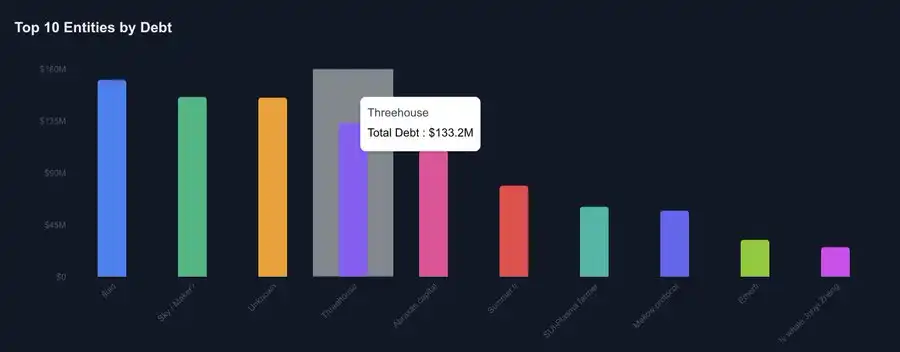
  • TVL ~$34M
  • Borrows $133M
  • Charges performance fee only on marginal yield above 2.6%
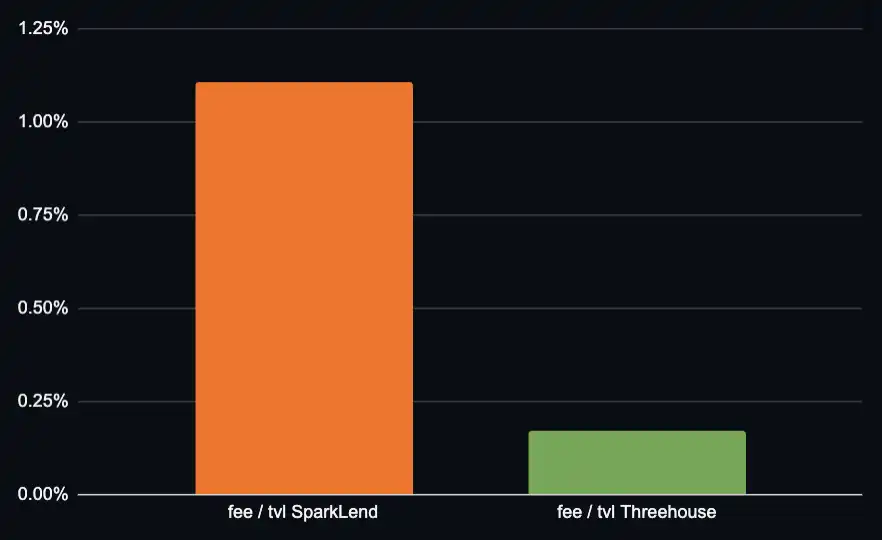
SparkLend, as a lending protocol, captures more value on a TVL basis than the vault.

The pricing structure of a vault greatly influences its own capturable value; but for lending protocols, their revenue depends more on the nominal size of borrowing, which is relatively stable.

Even shifting to USD-denominated strategies, which have lower leverage, the higher interest rates often offset this effect. I don't believe the conclusion would fundamentally change.

In relatively closed markets, more value might flow to curators, such as Stakehouse Prime Vault (26% performance fee, incentives provided by Morpho). But this is not the end state of Morpho's pricing mechanism, and curators themselves also partner with other platforms for distribution.

Lending Protocol vs. Asset Issuer

So the question arises: Is it better to be Aave or Lido?

This question is more complex than comparing vaults because staking assets not only generate yield themselves but also indirectly create stablecoin interest income for the protocol through the lending market. We can only make an approximate estimate.

Lido has approximately $4.42 billion in assets in the core Ethereum market used to support lending positions, generating annualized performance fee revenue of approximately $11 million.

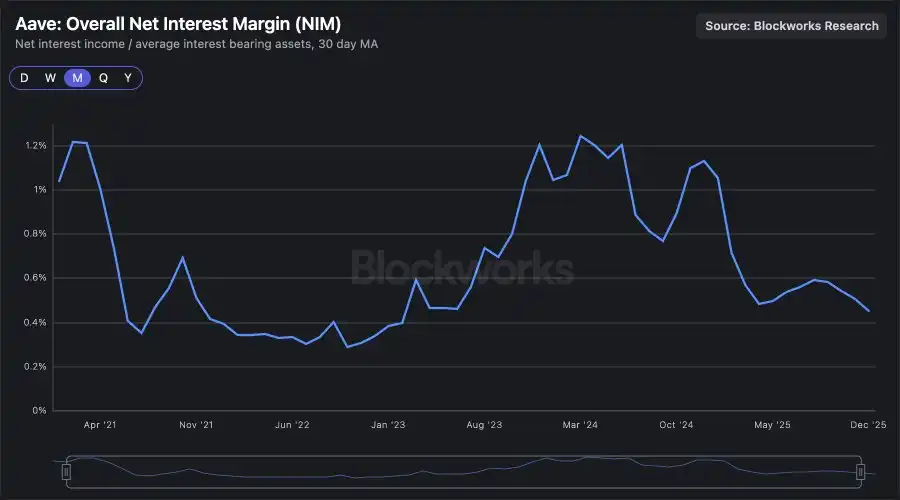
These positions roughly equally support ETH and stablecoin borrowing. At the current net interest margin (NIM) of ~0.4%, the corresponding lending yield is about $17 million, already significantly higher than Lido's direct revenue (and this is at a historically low NIM level).
The True Moat of Lending Protocols

If we only use the traditional financial deposit profitability model for comparison, DeFi lending protocols seem to be a low-margin industry. But this comparison ignores where the real moat lies.

In the on-chain credit system, the value captured by lending protocols exceeds that of the distribution layer downstream and, overall, exceeds that of the upstream asset issuers.

Viewed in isolation, lending seems like a thin-margin business; but placed within the complete credit stack, it is the layer with the strongest value capture capability relative to all other participants—vaults, issuers, distribution channels.


Criptos en tendencia

Preguntas relacionadas

QAccording to the article, which layer in the DeFi lending value chain captures the most value?

AThe lending protocol layer, such as Aave and SparkLend, captures the most value in the entire on-chain credit value chain, even more than the downstream vaults/curators and the upstream asset issuers.

QWhat is the main reason that lending protocols can capture more value than the yield strategies (vaults) built on top of them?

AThe lending protocol's revenue is primarily determined by the nominal size of the loans, which is stable and large. In contrast, a vault's income depends heavily on its specific fee structure (e.g., performance fees) and is often a smaller portion of the total value flow, with a significant portion paid as interest to the lending protocol.

QUsing the Ether.fi vault as an example, how much more value did Aave capture compared to the vault itself?

AThe Ether.fi vault paid approximately $4.5 million in annual interest fees to Aave, while the vault itself only generated about $1.07 million in platform fee revenue from its TVL, meaning Aave captured over 4 times more value.

QBesides vaults, who are the other major borrowers in the DeFi lending market mentioned in the analysis?

AOther major borrowers include large institutional capital providers, such as Abraxas Capital, which deploy external capital into yield strategies that are economically similar to vaults.

QWhat is the key takeaway about the business of DeFi lending protocols when viewed within the entire credit stack?

AWhile lending may appear to be a low-margin business when viewed in isolation through a traditional deposit profitability lens, it actually has the strongest and most defensible moat in the entire on-chain credit value stack, capturing more value than any other participant, including distributors and asset issuers.

Lecturas Relacionadas

Gate Research Institute: The 'Wall Street-ization' Wave of Crypto Financial Products – Competition or Integration?

The article titled "Gate Research Institute: Are Crypto Financial Products Sparking a 'Wall Street' Wave—Competition or Convergence?" explores the evolving relationship between the crypto ecosystem and traditional finance (TradFi). The piece begins by reflecting on Bitcoin's original 2009 vision of decentralization, disintermediation, and moving away from banks. It then contrasts this with the 2024 landscape, where key crypto assets like Bitcoin are increasingly held through Wall Street products like ETFs issued by giants like BlackRock. The article questions whether this signifies that TradFi is systematically taking over the rights to issue, price, custody, and distribute crypto financial assets. The core argument is that this is not a zero-sum takeover but rather a bidirectional convergence where each side addresses the other's weaknesses. Crypto offers 24/7 global markets, programmable settlement, and open access but lacks compliant channels, institutional-grade custody, deep fiat liquidity, and mainstream distribution. TradFi possesses these but is constrained by legacy systems, limited operating hours, and slow settlement. Two primary convergence paths are highlighted: * **Path A (CEX to TradFi):** Exemplified by Gate, which has progressed from offering tokenized stocks and CFDs to providing direct, real stock trading (US, Hong Kong, South Korea) within its platform, using USDT. * **Path B (TradFi to Crypto):** Exemplified by Robinhood, which has integrated crypto trading, acquired exchanges like Bitstamp, and is moving traditional assets like stocks onto the blockchain via tokenization and its own Layer 2. Both paths are ultimately competing to become the next-generation, unified financial account—a "super account" where users can seamlessly trade cryptocurrencies, stocks, ETFs, RWA (Real World Assets), and tokenized treasury products in one interface. The growth of RWA and tokenized treasuries (e.g., BlackRock's BUIDL) is presented as the asset-layer fusion, providing stable, yield-bearing assets on-chain and acting as a bridge between the two worlds. In conclusion, the "Wall Street-ization" of crypto is framed as a mutual transformation. Decentralized ideals persist in the protocol layer, while at the application layer, a more efficient, global, and accessible unified capital market is emerging from this convergence. The future competition lies not between crypto exchanges and stockbrokers, but between platforms vying to offer the most comprehensive asset coverage, liquidity, and user experience within a single account.

marsbitHace 2 min(s)

Gate Research Institute: The 'Wall Street-ization' Wave of Crypto Financial Products – Competition or Integration?

marsbitHace 2 min(s)

Claude's Major New Feature: Screen Recording + Voice, Distilling Your Skills into AI Tasks in One Click

Claude has introduced a major new feature called "Record a Skill," available for Pro, Max, and Team users. This function, found in the Claude desktop app's CoWork menu, allows users to create reusable AI skills simply by recording their screen and providing voice narration while performing a task. Claude then automatically analyzes the recording and generates a functional Skill. A hands-on test confirmed the feature works seamlessly. Users start recording via the Skills manager, perform their workflow while verbally explaining the steps and logic, and avoid including sensitive information. After recording, Claude processes the content and creates the Skill, which can be saved and later invoked with a slash command (/). This eliminates the need for manual adjustments or writing complex instruction files. The innovation goes beyond mere efficiency. Previously, creating a Skill required writing a detailed SKILL.md file in Markdown—a significant barrier for non-technical users. "Record a Skill" bypasses this by directly capturing both actions and the implicit reasoning shared in the narration. This lowers the barrier to knowledge transfer and automation, addressing a core challenge in corporate knowledge management: the difficulty of getting experts to write and maintain documentation. However, the feature also highlights a shift in the nature of work. A case study from March 2026 showed a freelancer whose five-year client relationship was effectively replaced by a hand-coded Claude Skill automating their content workflow. With the even lower barrier of screen recording, the ability to distill personal expertise into automatable skills accelerates this trend. The "moat" for work is moving from simply knowing how to do a task to mastering tasks that are difficult or impossible to automate.

marsbitHace 7 min(s)

Claude's Major New Feature: Screen Recording + Voice, Distilling Your Skills into AI Tasks in One Click

marsbitHace 7 min(s)

Feeding AI "Noise" Can Also Boost Scores, This Work Enables Positive Transfer with Noise

Feeding "Noise" to AI Can Improve Performance: A Method Enables Positive Transfer from Noise This work, Semi-Supervised Noise Adaptation (SSNA), introduces a Noise Adaptation Framework (NAF) that challenges traditional transfer learning. Instead of requiring a labeled source domain of real data (e.g., images, text), NAF uses randomly generated Gaussian noise as the source. For a target task with C classes, it constructs C noise clusters by sampling from Gaussian distributions. Although this synthetic noise contains no semantic meaning, NAF trains it to form a discriminative class structure in a shared representation space—clustering same-class noise and separating different classes. The key is aligning this learned structure from the noise domain to the real, sparsely labeled target domain. A small number of target labels are still essential to establish the correspondence between noise clusters and actual classes. The training objective combines: 1) supervised loss on the few labeled target samples, 2) classification loss for the noise to build its structure, and 3) a distribution alignment loss (using Negative Domain Similarity) to minimize the gap between the noise and target domains in the shared space. Experiments show significant gains in few-label settings. With just 4 labels per class, NAF with a ResNet-18 backbone improves accuracy over a standard supervised baseline (ERM) by +12.35% on CIFAR-10, +7.61% on CIFAR-100, +4.38% on DTD-47, and +2.74% on Caltech-101. It also benefits fine-grained datasets and scales to ImageNet-1K (with 100 labels/class) and text classification (AG News). NAF can be integrated into existing semi-supervised methods like FixMatch for further gains. Ablation studies confirm the transferred benefit comes from the discriminative structure of the noise, not randomness itself. Collapsing all noise into a single point causes negative transfer, while increasing separation between noise cluster centers improves performance. The amount of noise per class is less critical once a basic structure forms. In conclusion, this work demonstrates that for positive transfer, the semantic content of source data may not be necessary. What can be effectively transferred is the *organizational structure* of categories within a representation space. This offers a promising alternative for scenarios where real source data is unavailable due to privacy, copyright, or procurement constraints.

marsbitHace 8 min(s)

Feeding AI "Noise" Can Also Boost Scores, This Work Enables Positive Transfer with Noise

marsbitHace 8 min(s)

Trading

Spot

Artículos destacados

Cómo comprar AAVE

¡Bienvenido a HTX.com! Hemos hecho que comprar Aave Protocol (AAVE) sea simple y conveniente. Sigue nuestra guía paso a paso para iniciar tu viaje de criptos.Paso 1: crea tu cuenta HTXUtiliza tu correo electrónico o número de teléfono para registrarte y obtener una cuenta gratuita en HTX. Experimenta un proceso de registro sin complicaciones y desbloquea todas las funciones.Obtener mi cuentaPaso 2: ve a Comprar cripto y elige tu método de pagoTarjeta de crédito/débito: usa tu Visa o Mastercard para comprar Aave Protocol (AAVE) al instante.Saldo: utiliza fondos del saldo de tu cuenta HTX para tradear sin problemas.Terceros: hemos agregado métodos de pago populares como Google Pay y Apple Pay para mejorar la comodidad.P2P: tradear directamente con otros usuarios en HTX.Over-the-Counter (OTC): ofrecemos servicios personalizados y tipos de cambio competitivos para los traders.Paso 3: guarda tu Aave Protocol (AAVE)Después de comprar tu Aave Protocol (AAVE), guárdalo en tu cuenta HTX. Alternativamente, puedes enviarlo a otro lugar mediante transferencia blockchain o utilizarlo para tradear otras criptomonedas.Paso 4: tradear Aave Protocol (AAVE)Tradear fácilmente con Aave Protocol (AAVE) en HTX's mercado spot. Simplemente accede a tu cuenta, selecciona tu par de trading, ejecuta tus trades y monitorea en tiempo real. Ofrecemos una experiencia fácil de usar tanto para principiantes como para traders experimentados.

356 Vistas totalesPublicado en 2024.12.11Actualizado en 2026.06.02

Cómo comprar AAVE

Discusiones

Bienvenido a la comunidad de HTX. Aquí puedes mantenerte informado sobre los últimos desarrollos de la plataforma y acceder a análisis profesionales del mercado. A continuación se presentan las opiniones de los usuarios sobre el precio de AAVE (AAVE).

活动图片