From 100,000 Losses to Tens of Red Envelopes: Why Are Crypto Enthusiasts Turning to 'Yuanbao Wool'?

比推Publicado a 2026-02-04Actualizado a 2026-02-04

Resumen

Amidst a significant downturn in global financial markets and cryptocurrency prices in early February, many crypto traders, facing substantial losses, have turned to a seemingly more reliable source of small gains: the "Yuanbao Cash Redemption" event. This campaign by Yuanbao, backed by Tencent, offers cash红包 (red envelopes) typically ranging from a few to tens of RMB for simple tasks like referrals and product interactions, providing a psychological escape from market volatility. In contrast, the traditional crypto airdrop landscape has become increasingly fraught with risk and disappointment. The article highlights cases like Infinex, where users invested significant time and money (e.g., over $11,900 and 406 days of engagement) only to face heavy losses during token generation events, with some unable to even recoup costs. This has led to frustration, silent resignation, or even public维权 (rights protection) efforts. The core issue is framed as a shift in the purpose of airdrops: from rewarding early users to merely serving as a growth hack for project teams seeking exits or funding, often with unreliable token promises. Web2 companies like Tencent can offer cash rewards with certainty due to strong cash flow and legal frameworks, whereas Web3 airdrops often come with high costs (time, effort, capital), risks like sybil attacks, unlock periods, and rule changes, resulting in lower effective returns. Both Web2 and Web3 use airdrops for user acquisition, but long-term rete...

Author: Golem

Original Title: The Biggest Airdrop for Crypto Enthusiasts Comes from Yuanbao


"xxx has sent you a cash red envelope!"

After the Yuanbao cash red envelope activity began on February 1st, many long-dead project/research exchange groups have completely transformed into "Yuanbao wool-pulling" mutual aid groups.

For crypto enthusiasts, transitioning from esteemed crypto traders to Yuanbao red envelope wool-pullers is a move born out of necessity.

Starting January 31st, global financial markets plummeted. Precious metals, which had previously surged, crashed rapidly. Spot silver nearly erased its year-to-date gains, and spot gold once fell below $4500. The crypto market fared no better. On February 2nd, Bitcoin broke below the $75,000 support level, hitting a low of $74,604. ETH dropped to a low of $2157.14, and SOL even fell below $100, touching a low of $95.95.

According to Coinglass data, the crypto market saw a total liquidation of $2.5615 billion on January 31st, setting a record for the highest single-day liquidation since the "10/11 crash." Thus, "too devastated to speak" became the true psychological state of many crypto enthusiasts (like the silent Yi Lihua).

For those who just experienced a bloodbath, pulling Yuanbao red envelopes, though a drop in the bucket for recouping losses, offers some psychological comfort and a temporary escape from the harsh market reality.
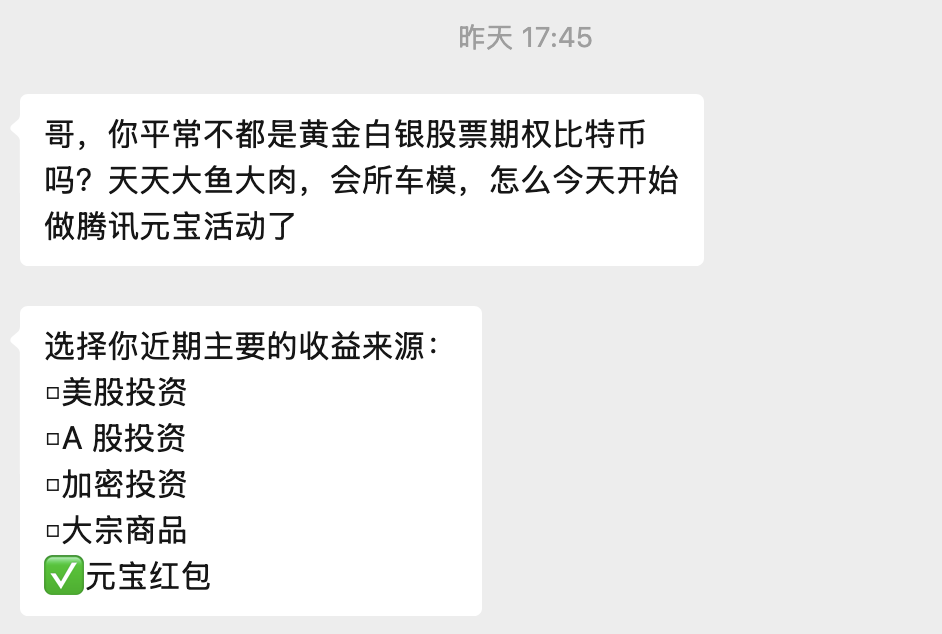
Jokes in group chats

Crypto Airdrops: From Swallowing Losses to Passionate Rights Defense

Calling Yuanbao's cash red envelopes the biggest airdrop for crypto enthusiasts today is not just a gimmick.

The cash red envelope amount Yuanbao distributes to each user isn't large, mostly ranging from a dozen to several tens of RMB. However, its value lies in its simplicity and truly zero cost. Users only need to spend a little time recruiting people and systematically experiencing product features to receive cash red envelopes. The task cycle is short, allowing for quick returns.

In contrast, airdrops from crypto projects are first distributed in the form of tokens. Profit is only realized after the tokens are sold. While the nominal amount received is often much larger than Yuanbao's, after deducting the costs of time, research, opportunity, friction, and potential losses from being stuck with unsellable tokens, how much remains?

A user who accompanied Infinex for 406 days deeply feels this. On January 31st, the decentralized perpetual contract trading platform Infinex announced its TGE and airdrop claims. The project team successfully reached shore, but the community was collectively "rug-pulled."

"Ten Million is a Cat" (X: @RXu107) is a typical example of being rug-pulled. On February 1st, they posted that they spent over $11,900 (approximately 82,000 RMB) participating in this project (4400 U for an NFT, 7500 U for the public sale), and as a community member, deeply accompanied it for 406 days. But on TGE day, not only did they not recoup their costs, but they also faced a paper loss of over 100,000 RMB (2900 U + 11,284 locked INX tokens).

Faced with the rug-pull, the blogger had no choice but to repeatedly express their distress to friends.
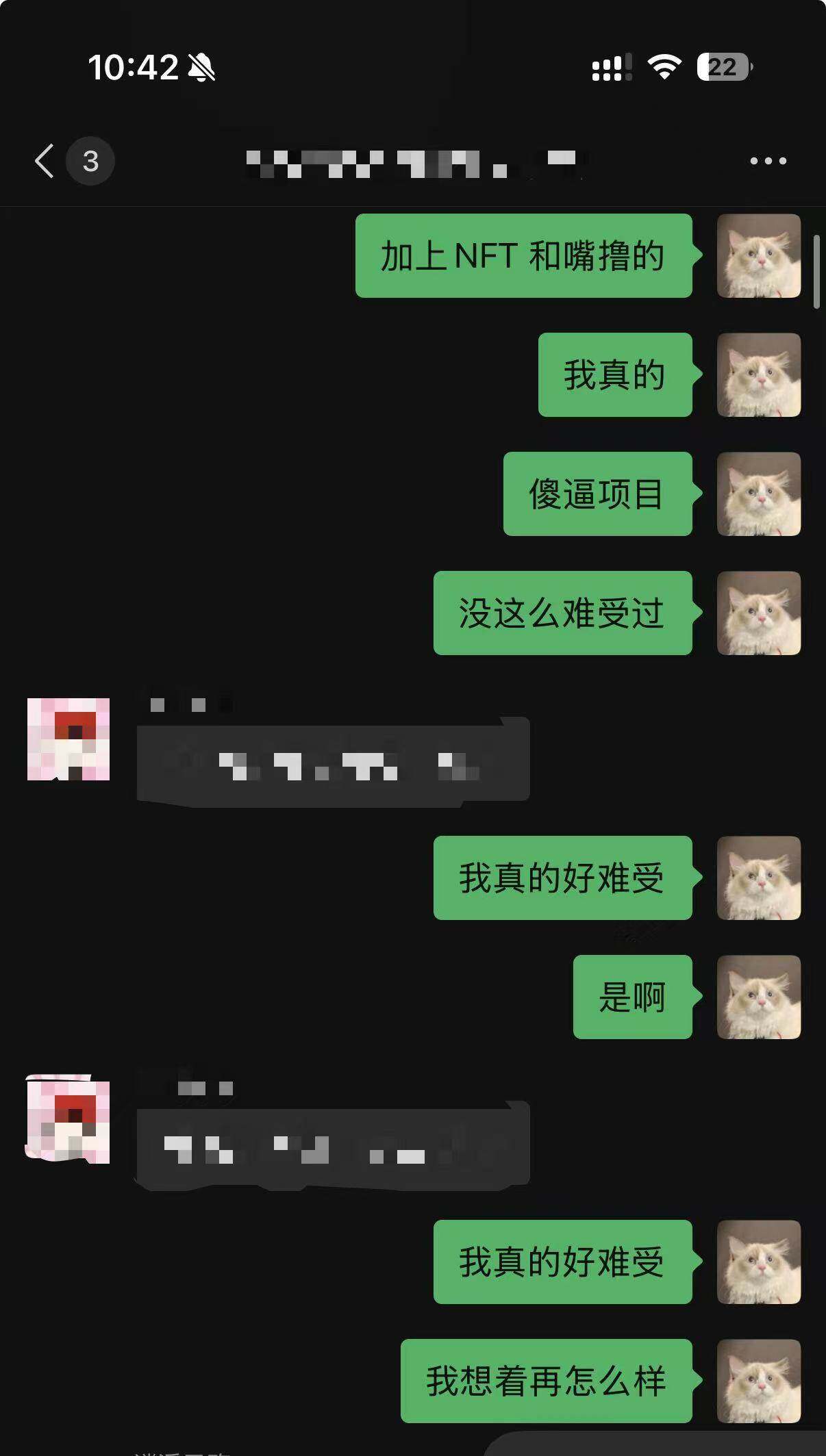
The rug-pulled blogger expresses distress to a friend

At its TGE, Infinex's fully diluted valuation was only $150 million. The total investment in Yuanbao's New Year red envelope activity is approximately $140 million USD. What does this mean? It's equivalent to Tencent directly buying Infinex at its maximum valuation and giving it away for free to the entire nation.

Faced with the pain of being rug-pulled and deceived, most people in the community choose the same approach as "Ten Million is a Cat"—swallowing the bitter pill. However, some choose to stand up and confront the project team.

Crypto blogger Ice Frog (X: @Ice_Frog666666) is a typical representative. He started by airdrop farming, but ironically, in 2025, Ice Frog was either defending airdrop rights or on his way to do so. He is currently still negotiating with the prediction market project Space (Odaily Note: Space raised $20 million in public sale, the team privately took $13 million) and has even taken legal measures.

Web2 Can Afford Airdrops, Web3 Can't Fulfill Promises

The most ironic point is that today's imbalance between "input and return" in crypto airdrops is not due to the "moral bankruptcy" of a single project, but rather the result of a整套 (entire set of) structural changes in the industry.

In 2020, Uniswap opened the era of crypto project airdrops. Since then, there have been constant major "drops" (large airdrops) in the crypto space. Stories of getting a car, buying a house, or reaching A8 (wealth level) from airdrops attracted batch after batch of people into the airdrop farming track, presenting an illusion of "the industry is on the rise."

But by 2025, this changed. Market narratives dried up, primary financing weakened, secondary buying power was insufficient. Airdrops were no longer about sharing the future with early users, but more like mortgaging the future for present data, creating an exit path for the project team itself or securing the next round of financing. Thus, major drops disappeared, small drops shrank, and "being rug-pulled" became the industry norm.

So-called airdrops are essentially just advertising budgets rewritten as reward pools, bypassing third parties to directly establish growth relationships with users. Whether it's the 1 billion RMB from Web2's Yuanbao or the fixed airdrop allocation in Web3 project tokenomics, the essence is the same logic.

But the difference is that Web2 giants use cash to buy user certainty, while Web3 offers token returns as a promise that might be fulfilled. This results in the same tactic leading to two different fates.

The certainty of Yuanbao's cash red envelopes comes from cash flow and constraint mechanisms. Tencent's strong cash flow determines that Yuanbao "can pay out," and the constraint mechanisms under mature law determine that Yuanbao "cannot renege." Coupled with the "simple and brainless" zero-threshold interaction, users naturally perceive it as a "welfare benefit."

In contrast, crypto enthusiasts not only incur costs several times higher than Web2羊毛党 (wool-pullers) (e.g., capital, time, energy) but also worry about being sybil attacked, token lock-up periods, and ever-changing airdrop rules. The most ironic part is that the returns from all this effort ultimately might not even match Yuanbao's.

Therefore, today's crypto airdrops have long degenerated from direct growth rewards into promises where the fulfillment of obligations is constantly postponed, or even unfulfilled. If this situation does not change in 2026, user retention will be sacrificed along with it.

From User Acquisition to Retention, Airdrop Utility Only Lasts the First Half

Using airdrops for user acquisition has always been one of the most common and direct tactics in the business world to compete against powerful rivals.

Tencent invested 1 billion RMB cash to support Yuanbao because its competitor Doubao is strong enough—by the end of 2025, Doubao was the first AI product in China to reach 100 million daily active users. The same goes for Web3. In the prediction market赛道 (track), Polymarket dominates. To compete for users, Opinion, predict.fun, and Limitless also use points airdrops for user acquisition, directly pulling users into their products.

In the short term, airdrops can indeed create a massive user influx. But in the long run, what determines user retention remains product-market fit, user experience, and ecological synergy, among other factors. In Web3's business history, there are no shortage of project cases that were bustling before the airdrop but deserted afterward. Therefore, both Web2 and Web3 face the same "post-airdrop problem": how to retain users.

Ten years ago, Tencent, a company adept at imitating and then surpassing, used "WeChat Red Envelopes" to push WeChat Pay into a national-level入口 (entry point), proving its familiarity with the "user acquisition → retention → habit" chain. Whether they can recreate Yuanbao's miracle in the same way is众说纷纭 (debatable), but they at least have ample experience in "how to convert airdrops into retention."

To this end, Odaily Planet Daily contacted an internal Yuanbao staff member and asked, from a product perspective, how Web3 project airdrops should be improved. The answer was pragmatic:

"As one of the internet companies with the largest market cap, Tencent's experience might not be directly applicable to Web3 projects. But the core of using airdrops for user acquisition is still improving retention. This requires a series of post-airdrop联动 (linkages/synergies). For example, PR and marketing need to think about how to further propagate the玩法 (gameplay/mechanisms), and the product side also needs to take more actions to achieve this."

From the perspective of Web3 practitioners, merely discussing traffic tactics feels superficial. What product features, beyond the token, can actually retain users is worth pondering more deeply.


Twitter:https://twitter.com/BitpushNewsCN

Bitpush TG Discussion Group:https://t.me/BitPushCommunity

Bitpush TG Subscription: https://t.me/bitpush

Original article link:https://www.bitpush.news/articles/7608686

Preguntas relacionadas

QWhy are cryptocurrency investors turning to 'Yuanbao' cash red packets according to the article?

ADue to significant losses in the cryptocurrency market, with Bitcoin dropping below $75,000 and a record $2.56 billion in liquidations on January 31, investors are seeking psychological comfort and a temporary escape by participating in Yuanbao's simple, no-cost cash red packet activities.

QWhat is the key difference between Web2 projects like Yuanbao and Web3 projects in terms of airdrop rewards?

AWeb2 projects like Yuanbao use cash rewards backed by strong cash flow and legal constraints, ensuring certainty and reliability, while Web3 projects often offer token-based airdrops that are uncertain, subject to changes, and may not be honored, leading to potential losses for users.

QHow does the article describe the Infinex airdrop incident and its impact on users?

AThe Infinex airdrop incident resulted in users being 'reverse fleeced,' with one user spending over $11,900 (approximately 82,000 RMB) and suffering a loss of more than 100,000 RMB, highlighting the high costs and risks associated with Web3 airdrops compared to the minimal returns.

QWhat challenge do both Web2 and Web3 projects face after conducting airdrops?

ABoth face the challenge of user retention post-airdrop; while airdrops can drive initial user growth, long-term retention depends on product-market fit, user experience, and ecological integration, rather than just the airdrop incentives.

QWhat suggestion does the Yuanbao insider offer to Web3 projects for improving airdrops?

AThe insider suggests that Web3 projects should focus on improving user retention through post-airdrop initiatives, such as enhancing public relations and marketing efforts to spread awareness, and product-side actions to engage users beyond just token rewards.

Lecturas Relacionadas

The Waged Worker Driven to Poverty by AI Subscriptions

"AI Membership: The Hidden Cost Pushing Workers Toward 'Poverty'" The widespread corporate push for AI adoption is creating a hidden financial burden for employees. Companies, from giants like Alibaba to small firms, are mandating AI use, often tying token consumption to KPIs, but frequently refuse to cover the costs. Workers are forced to pay for subscriptions out of pocket to stay competitive and avoid being replaced. Front-end developer Long Shen spends up to 2000 RMB monthly on tools like Cursor and ChatGPT Plus, seeing it as a necessary 3% salary investment to handle 90% of his coding tasks. While it boosted his performance and led to promotions, he now faces idle time at work, pretending to be busy. Designer Peng Peng navigates strict company firewalls by using personal devices and accounts for AI image generation tools like Midjourney, spending hundreds monthly without reimbursement, while her boss demands faster, more numerous revisions. The pressure creates workplace anxiety and suspicion. Programmer Li Huahua, after a friend's experience of raised KPIs following AI success, fears being branded a "traitor" for using it yet worries about falling behind if she doesn't. The dynamic allows management to demand results without understanding the tools or covering expenses, treating employees like AI "agents." While some, like entrepreneur Jin Tu, find high value in paid AI, building entire systems and winning competitions, for most, it's a trap. Free tools like Kimi and Doubao are introducing fees, closing off alternatives. The initial efficiency gains individual advantage, but as AI becomes ubiquitous, the personal edge disappears, workloads increase, and a cycle of dependency begins. Workers like Long Shen realize they cannot maintain AI-generated code without AI, making stopping harder than continuing to pay. The tool promising liberation is instead becoming a compulsory, costly chain in the modern workplace.

marsbitHace 38 min(s)

The Waged Worker Driven to Poverty by AI Subscriptions

marsbitHace 38 min(s)

SK Hynix's Trillion-Won Empire: The Successors

"SK Hynix's Trillion-Won Empire and Its Heirs" explores the unconventional succession narrative within SK Group, South Korea's second-largest conglomerate, following SK Hynix's dramatic market rise. Unlike traditional chaebol scripts prioritizing the eldest son, ownership, and political marriages, Chairman Choi Tae-won's three children from his first marriage are charting distinct paths. The eldest daughter, Choi Yun-jeong, is considered the most visible candidate. With a background in biology, consulting, and a PhD, she holds executive roles at SK Bioscience and SK Inc.'s growth strategy unit, focusing on biopharma and new businesses. Her marriage is to an AI infrastructure entrepreneur, not a traditional chaebol heir. The second daughter, Choi Min-jeong, took a unique route by voluntarily serving as a South Korean naval officer, including a tour in the Gulf of Aden. She later worked on policy and strategy for SK Hynix in Washington D.C. before co-founding an AI-driven healthcare startup in San Francisco. She married a former U.S. Marine Corps officer, connecting the family to U.S. defense and policy networks. The son, Choi In-geun, who has Type 1 diabetes, followed a more classic preparatory path with a physics degree and a stint at SK E&S but left to join McKinsey's Seoul office. He remains publicly silent and holds no SK shares, defying the traditional "crown prince" archetype. Their paths unfold against the backdrop of their parents' high-profile, contentious divorce and a record-setting asset division lawsuit. The article argues that as SK Hynix becomes a geopolitical asset in the AI era, the conventional rules of chaebol inheritance are changing. The heirs are being groomed not simply to take over, but to navigate a complex global landscape defined by AI, biotech, geopolitics, and policy, forging legitimacy through their own expertise and networks rather than birth order alone.

marsbitHace 46 min(s)

SK Hynix's Trillion-Won Empire: The Successors

marsbitHace 46 min(s)

BitMart Research Institute Weekly Highlights: A Comprehensive Review of Macro Environment, Crude Oil, AI Tech Stocks, and Crypto Market

**Weekly Market Review: Macro, Oil, AI Tech Stocks & Crypto Market** **Macroeconomic & Traditional Finance** The April U.S. Non-Farm Payrolls report of 115K new jobs exceeded expectations, but the data's quality was questioned. Growth was heavily concentrated in healthcare, while other sectors contracted, and manufacturing employment turned negative. A statistical model accounted for a large portion of the gains, conflicting with household survey data showing a loss of 226K jobs. Meanwhile, AI's impact on jobs is emerging, with information sector roles declining, though overall unemployment remains at ~4.3%. Oil prices hovered near $100 per barrel. Global oil buffer inventories have drawn down significantly, supporting prices, but high costs are suppressing demand. China's recent reduction in crude imports acted as a market stabilizer. Geopolitically, the U.S. and Iran are likely to reach a tentative agreement to keep the Strait of Hormuz open and avoid price spikes. For AI tech stocks, short-term prospects are mixed. A potential SpaceX IPO in June could pressure current index heavyweights like Nvidia, while smaller components might benefit. The mid-term focus shifts to Q2 earnings, emphasizing AI's return on investment. Long-term risks include potential election policy shifts and massive IPOs from companies like OpenAI, which could test the sector's sustainability. **Crypto Market & Ecosystem** Crypto markets rose moderately, with BTC climbing from ~$77K to ~$82K, driven by improved risk sentiment. Spot trading volumes remain low, but buying pressure is evident. ETF inflows continued (~$791M last week). However, institutional purchases of BTC and ETH were more modest than expected. The derivatives market shows lingering bearish bets, particularly on alts and ETH. A key trend is the "dual-track" model where projects pursue public listings for traditional funding while also building their own blockchains/tokens to capture crypto liquidity, as seen with Circle's ARC chain. Stablecoins and institutional chains present significant future opportunities. *Disclaimer: This is market analysis, not investment advice.*

marsbitHace 1 hora(s)

BitMart Research Institute Weekly Highlights: A Comprehensive Review of Macro Environment, Crude Oil, AI Tech Stocks, and Crypto Market

marsbitHace 1 hora(s)

Trading

Spot
Futuros

Artículos destacados

Cómo comprar F

¡Bienvenido a HTX.com! Hemos hecho que comprar Synfutures (F) sea simple y conveniente. Sigue nuestra guía paso a paso para iniciar tu viaje de criptos.Paso 1: crea tu cuenta HTXUtiliza tu correo electrónico o número de teléfono para registrarte y obtener una cuenta gratuita en HTX. Experimenta un proceso de registro sin complicaciones y desbloquea todas las funciones.Obtener mi cuentaPaso 2: ve a Comprar cripto y elige tu método de pagoTarjeta de crédito/débito: usa tu Visa o Mastercard para comprar Synfutures (F) al instante.Saldo: utiliza fondos del saldo de tu cuenta HTX para tradear sin problemas.Terceros: hemos agregado métodos de pago populares como Google Pay y Apple Pay para mejorar la comodidad.P2P: tradear directamente con otros usuarios en HTX.Over-the-Counter (OTC): ofrecemos servicios personalizados y tipos de cambio competitivos para los traders.Paso 3: guarda tu Synfutures (F)Después de comprar tu Synfutures (F), guárdalo en tu cuenta HTX. Alternativamente, puedes enviarlo a otro lugar mediante transferencia blockchain o utilizarlo para tradear otras criptomonedas.Paso 4: tradear Synfutures (F)Tradear fácilmente con Synfutures (F) en HTX's mercado spot. Simplemente accede a tu cuenta, selecciona tu par de trading, ejecuta tus trades y monitorea en tiempo real. Ofrecemos una experiencia fácil de usar tanto para principiantes como para traders experimentados.

185 Vistas totalesPublicado en 2024.12.21Actualizado en 2025.03.21

Cómo comprar F

Discusiones

Bienvenido a la comunidad de HTX. Aquí puedes mantenerte informado sobre los últimos desarrollos de la plataforma y acceder a análisis profesionales del mercado. A continuación se presentan las opiniones de los usuarios sobre el precio de F (F).

活动图片













