Friday's Crypto Dark Horse Emerges: BCH Soars 7%, Hiding 65% Upside Potential? SUI and LTC Show Diverging Trends Here

金色财经Publicado a 2025-12-19Actualizado a 2025-12-19

Resumen

Friday brought notable divergence to the crypto market, with Bitcoin Cash (BCH) surging over 7% to lead gains among top-100 assets. The rally was driven by whale accumulation and a confirmed multi-year bullish double-bottom pattern. Analysts suggest a break above the $622.4 neckline could propel BCH toward $972—a potential 65% upside. Key support lies at $541. SUI rebounded 4.5% from monthly lows after Bitwise filed for a spot ETF, accelerating regulatory review timelines. Approval decisions, including one from 21Shares by December 21, could further boost momentum. In contrast, Litecoin (LTC) fell sharply, losing the critical $80-$84 support zone. Weak buying interest suggests any rebound toward $82 may be short-lived, with downside targets near $66. Key takeaways: Monitor BCH’s breakout potential, SUI’s ETF developments, and LTC’s resistance retests for short opportunities. Market conditions remain selective—wait for confirmations at key levels.

Friday finally brought some excitement to the crypto space! Some assets defied the trend with explosive gains to become dark horses, some rebounded on positive developments to recover losses, while others continued to slide, waiting for a bounce.Join Group +Q:3260353596

Dark Horse BCH! Soars 7%+ With Multi-Year Double Bottom, Really Has 65% Upside?

The standout performer on Friday was undoubtedly Bitcoin Cash (BCH), which surged over 7%, leading the pack among the top 100 crypto assets by market cap! This rally isn't without reason; the core catalyst is whales starting to accumulate again, with buying pressure picking up steam.
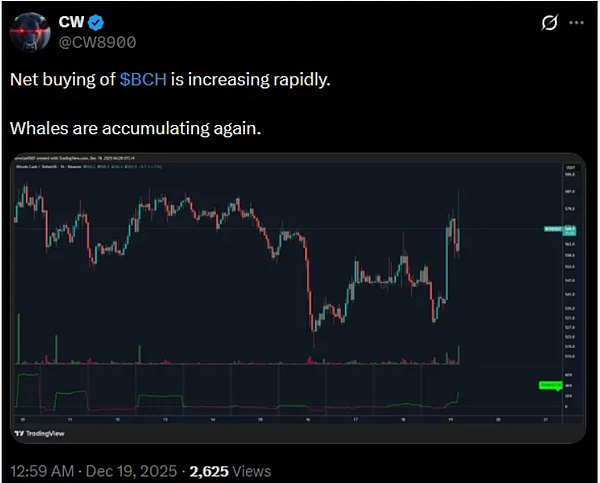
More importantly, BCH has formed a multi-year double bottom pattern—a strong bullish technical signal! According to crypto.news data, BCH gained 7.1% in the past 24 hours, hitting an intraday high of $585, up 28% from the November low and a staggering 118% from this year's lowest point.

Analysts are closely watching a key level: the neckline at $622.4. BCH's price is now just 6% away from breaking through this level. A successful breakout confirming the double bottom pattern could likely propel it towards $972, representing a potential 65% gain from current prices!
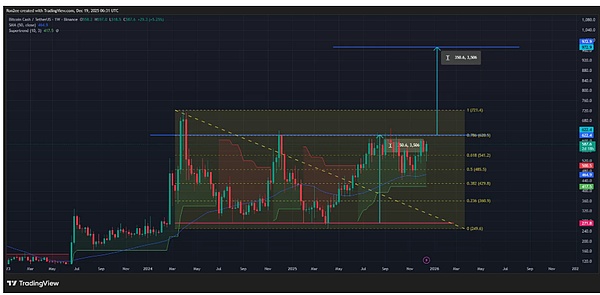
Besides whales, derivatives traders are also contributing. CoinGlass data shows BCH futures open interest surged 20% in the past 24 hours to $766.6 million, while the weighted funding rate dipped into negative territory. If the rally continues, it could trigger a short squeeze, forcing short sellers to cover their positions and giving BCH another boost.
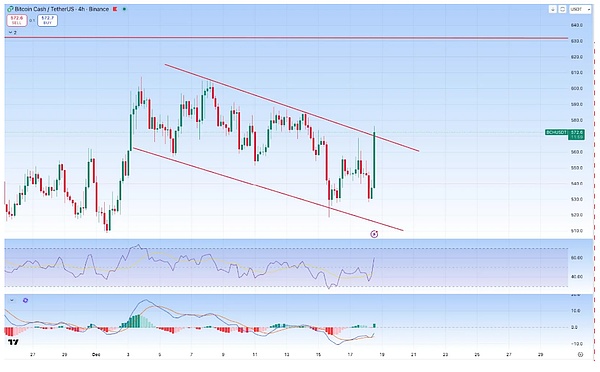
Additionally, BCH has broken out of a multi-week descending trend channel, reclaimed the 50-day moving average, and its SuperTrend indicator has turned green—all clear signals that buying pressure is outweighing selling pressure. However, note that $541 is a crucial support level; if lost, the trend could reverse again, so don't get complacent~

SUI Rebounds and Recovers! Bitwise Applies for ETF, Approval Process Greatly Accelerated

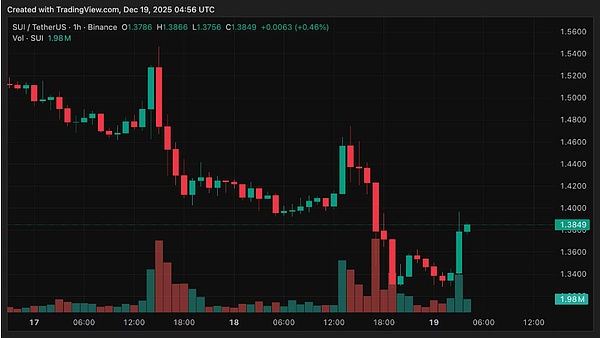
SUI, which had been falling consistently, finally got some good news and bounced back! The reason is that crypto asset management firm Bitwise has applied to launch a spot ETF for the SUI token, submitting the S-1 form to the SEC on Thursday.Join Group +Q:3260353596

This is the first step in the ETF approval process. Under the new rules, the entire review is expected to take only about 75 days, much faster than the previous process which could take up to 240 days. And it's not just Bitwise; Canary Capital, 21Shares, and Grayscale have all applied for a SUI spot ETF. The decision on 21Shares' application is due before December 21st. If approved, it would be the first SUI spot ETF in the US.

Boosted by this positive development, SUI, which had fallen for two consecutive weeks, rebounded from its monthly low of $1.33 and was up 4.5% at the time of writing. Furthermore, Bitwise recently added SUI to its 10 Crypto Index ETF. Whether the rally continues will depend on the progress of the ETF approvals~
LTC Gets Hammered! Loses $80 Support, Bounce to $82 Possible? Bearish View Recommended

Compared to BCH and SUI, Litecoin (LTC) had a rough time. Moving in sync with Bitcoin, it plunged 7.5% within 5-hour window, hitting a new low of $72.64, and is currently hovering around $75.89.

Most critically, LTC bulls lost the long-held $80-84 support zone they had defended for two weeks, and buying power is notably weak. Even being included in Bitwise's 10 Crypto Index ETF did little to move the price. Technically, selling pressure has been persistent since the second week of October, and the On-Balance Volume (OBV) indicator shows that after initially being balanced, sellers have completely overwhelmed buyers.
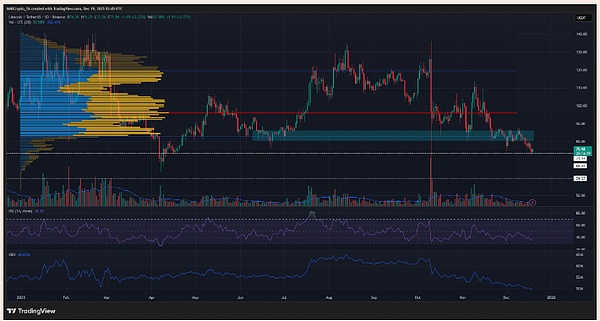
However, there's a small opportunity: the liquidation heatmap shows liquidity around $73 has been cleared out, which could trigger a brief bounce, potentially around $82-83. But be cautious, this is likely just a rebound, not a reversal.
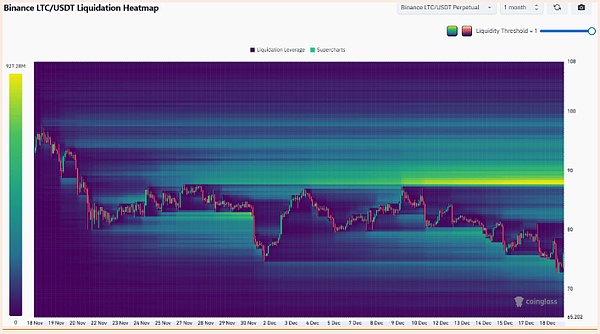
If a rebound tests the $80-84 zone later, this area will likely act as strong resistance and be difficult to break through. Therefore, maintaining a bearish view is recommended. If the price rebounds to these levels, consider shorting, with targets first at $66, and further down at the $59 support level.Join Group +Q:3260353596

Summary: In a Diverging Market, Focus on These Two Signals

1. BCH: Focus on the $622.4 neckline; a breakout opens significant upside. Consider going long only if the $541 support holds;

2. SUI: Follow the ETF approval timeline; the decision on 21Shares' application before Dec 21st is key;

3. LTC: Rebounds are likely selling opportunities; don't be fooled by short-term bounces. Keep a close eye on the $80-84 resistance zone.

The market is clearly diverging, with some assets hiding opportunities and others being traps.建议大家别盲目跟风,盯紧关键价位再动手。 (Advises everyone not to blindly follow the trend and to watch key levels before acting).


Criptos en tendencia

Preguntas relacionadas

QWhat is the main reason for Bitcoin Cash (BCH) price surge of over 7% on Friday?

AThe main reason is that whales have started accumulating again, leading to a resurgence in buying pressure.

QAccording to technical analysis, what key level must BCH break to confirm a double-bottom pattern and potentially target $972?

ABCH needs to break the neckline resistance at $622.4 to confirm the double-bottom pattern and target $972.

QWhy did SUI experience a price rebound, and what is the significance of Bitwise's recent application?

ASUI rebounded due to Bitwise applying for a SUI spot ETF with the SEC, which could accelerate approval under new rules taking about 75 days.

QWhat critical support level did Litecoin (LTC) lose, and what is the suggested trading bias for it?

ALTC lost the long-held support zone of $80-84, and the suggested bias is bearish, with any rebound likely being a selling opportunity.

QWhich cryptocurrency's ETF application result is expected by December 21st, and why is it important?

A21Shares' SUI spot ETF application result is expected by December 21st, and if approved, it would be the first SUI spot ETF in the U.S.

Lecturas Relacionadas

As Consensus Accelerates, What Are Young Investors Betting On?

Title: As Consensus Forms Faster, What Are Young Investors Betting On? In the rapid evolution of tech investment, a new generation of young investors is navigating a landscape where AI, robotics, commercial aerospace, and quantum computing are advancing simultaneously. Traditional investment logic based on financial models is giving way to a need for deep technical understanding and the ability to act before industry consensus forms. An analysis of trends from the "WAIC FUTURE TECH" list of young investment leaders reveals key shifts in focus. The first major trend is the movement of AI from the digital screen into the physical world. Investment is shifting from large language models and chatbots towards embodied AI, robotics, AI hardware, and edge computing. While demonstrations generate excitement, the real challenge lies in achieving scalable, reliable, and cost-effective delivery in complex real-world environments like factories and logistics. Success depends not just on algorithms but on the integration of sensors, actuators, and control systems. Second, the competitive focus for large models is moving beyond raw capability toward building an "intelligence flywheel." The goal is to create self-reinforcing systems where user interaction generates data, improving the model, which in turn enhances the user experience and attracts more engagement. Companies that successfully embed AI into workflows to create these closed-loop systems can build lasting value that isn't easily erased by the next model upgrade. Third, facing a potential bottleneck in high-quality human-generated data, investors are looking at new underlying technologies. Reinforcement learning and self-play, as demonstrated by AlphaGo Zero, offer paths for AI to generate its own experience. Scientific foundation models, which aim to build general AI capabilities for fields like life sciences and materials discovery, represent a non-consensus direction that could unlock new frontiers of knowledge and data. Finally, in deep-tech areas like quantum computing, commercial aerospace, and space-based infrastructure, patient capital is essential. These fields have long, uncertain development and validation cycles involving complex engineering, supply chains, and regulations. Investment here requires a long-term view, focusing on foundational team capabilities and the eventual emergence of market demand, even if commercial returns are distant. Collectively, these trends illustrate how young investors are adapting to a new era. They are learning to make earlier, technically-informed judgments, balance hype with real-world viability, and provide the patient capital needed to build the deep-tech foundations of the future.

marsbitHace 27 min(s)

As Consensus Accelerates, What Are Young Investors Betting On?

marsbitHace 27 min(s)

Can Japan Buy Growth with AI? Will the Bond Market Believe It?

Japan's cabinet has introduced the 2026 Basic Policy on Economic and Fiscal Management and Reform, shifting its primary fiscal target. The new framework moves away from the traditional annual primary balance goal and instead prioritizes a stable reduction of the debt-to-GDP ratio. This change is tied to a strategy of increased "responsible proactive fiscal" spending, aiming to boost long-term growth through investments in strategic sectors like AI, semiconductors, energy, and robotics. The government estimates total public and private investment in 62 key technologies could exceed 370 trillion yen by 2040. The market reaction has been mixed and cautious. While equity markets may respond to policy signals, bond markets are focused on fiscal credibility. Concerns center on whether the weakening of the clear primary balance anchor could lead to looser fiscal discipline. If investors doubt that these strategic investments will generate sufficient productivity gains, tax revenue, and nominal growth to outpace rising interest costs, they may demand higher yields on Japanese Government Bonds (JGBs). Recent volatility in the yen and JGB yields, with the 10-year yield briefly reaching 2.9%, reflects this skepticism. The success of this new framework hinges on two factors: whether Japan can achieve a nominal growth rate consistently higher than its long-term interest rates, and whether future budgets demonstrate disciplined control over bond issuance. The government's narrative is that strategic investment is essential to break Japan's cycle of low growth, aging, and labor shortages. However, the bond market will continuously assess the credibility of this plan, pricing the risk that it may represent fiscal expansion rather than a viable growth strategy.

marsbitHace 1 hora(s)

Can Japan Buy Growth with AI? Will the Bond Market Believe It?

marsbitHace 1 hora(s)

Misjudged A-Shares: Resilience, Expectations, and Confidence

China's A-share market recently faced selling pressure, especially in tech sectors, initially triggered by a global tech sell-off that began in South Korea. However, the article argues this is a case of "mistaken injury" and highlights the market's underlying resilience. This resilience stems from three main pillars: **1) Tech Sector Fundamentals:** Unlike Korea's market dominated by a few memory chip stocks, China's tech sector is diversified across computing, communications, electronics, and semiconductors, supported by dual narratives of global AI supply chains and domestic substitution. Core areas like optical modules and fiber optics continue to show strong earnings growth. **2) "National Team" Support:** State-backed institutions and large corporations have made significant market purchases and announced buybacks, providing liquidity and signaling confidence. This is seen as a stabilizing policy signal, often associated with market bottoms. **3) Broader Market Pillars:** Other major sectors are showing endogenous recovery momentum. Consumer stocks benefit from stabilizing CPI and signs of sector recovery (e.g., liquor price hikes). Cyclical sectors like aluminum have high earnings, potential price increases due to tight supply, and low valuations. The financial sector offers stable dividends and low valuations. The conclusion is that the sell-off was driven by external contagion, not a collapse in fundamentals. With strong policy support and recovering momentum across key sectors, the A-share market possesses the toughness to regain stability.

marsbitHace 1 hora(s)

Misjudged A-Shares: Resilience, Expectations, and Confidence

marsbitHace 1 hora(s)

Trading

Spot

Artículos destacados

Cómo comprar BCH

¡Bienvenido a HTX.com! Hemos hecho que comprar Bitcoin Cash (BCH) sea simple y conveniente. Sigue nuestra guía paso a paso para iniciar tu viaje de criptos.Paso 1: crea tu cuenta HTXUtiliza tu correo electrónico o número de teléfono para registrarte y obtener una cuenta gratuita en HTX. Experimenta un proceso de registro sin complicaciones y desbloquea todas las funciones.Obtener mi cuentaPaso 2: ve a Comprar cripto y elige tu método de pagoTarjeta de crédito/débito: usa tu Visa o Mastercard para comprar Bitcoin Cash (BCH) al instante.Saldo: utiliza fondos del saldo de tu cuenta HTX para tradear sin problemas.Terceros: hemos agregado métodos de pago populares como Google Pay y Apple Pay para mejorar la comodidad.P2P: tradear directamente con otros usuarios en HTX.Over-the-Counter (OTC): ofrecemos servicios personalizados y tipos de cambio competitivos para los traders.Paso 3: guarda tu Bitcoin Cash (BCH)Después de comprar tu Bitcoin Cash (BCH), guárdalo en tu cuenta HTX. Alternativamente, puedes enviarlo a otro lugar mediante transferencia blockchain o utilizarlo para tradear otras criptomonedas.Paso 4: tradear Bitcoin Cash (BCH)Tradear fácilmente con Bitcoin Cash (BCH) en HTX's mercado spot. Simplemente accede a tu cuenta, selecciona tu par de trading, ejecuta tus trades y monitorea en tiempo real. Ofrecemos una experiencia fácil de usar tanto para principiantes como para traders experimentados.

887 Vistas totalesPublicado en 2024.12.11Actualizado en 2026.06.02

Cómo comprar BCH

Discusiones

Bienvenido a la comunidad de HTX. Aquí puedes mantenerte informado sobre los últimos desarrollos de la plataforma y acceder a análisis profesionales del mercado. A continuación se presentan las opiniones de los usuarios sobre el precio de BCH (BCH).

活动图片












