Free Mirror or Land Grab? OpenClaw Founder Blasts Tencent for Copying

Odaily星球日报Publicado a 2026-03-13Actualizado a 2026-03-13

Resumen

OpenClaw founder Peter Steinberger publicly criticized Tencent for creating SkillHub, a localized platform mirroring OpenClaw, accusing the tech giant of copying without supporting the project. Tencent responded by clarifying that SkillHub acts as a local mirror site, properly attributing OpenClaw as the data source and reducing bandwidth strain on the origin server by processing significant traffic locally. It also expressed willingness to become a sponsor. However, Steinberger remained unsatisfied, emphasizing that the core issue was not technical but ethical—Tencent failed to communicate beforehand. The dispute highlights deeper concerns about big tech’s approach to open-source ecosystems: while mirroring is common and often legal under open-source licenses, Tencent’s move is seen as an attempt to control user access, distribution channels, and future commercial influence within the AI agent ecosystem. The incident reflects a broader pattern in China’s internet industry, where major companies rapidly embrace emerging technologies like OpenClaw not purely for innovation, but to capture entry points, traffic, and platform dominance. By offering localized, convenient services, they risk enclosing open ecosystems within their own walled gardens—ultimately dictating which tools get visibility, monetization, and user adoption. As OpenClaw gains explosive popularity in China, the episode underscores a tension between open-source ideals and commercial strategies, where co...

Original | Odaily Planet Daily (@OdailyChina)

Author | Golem (@web 3_golem)

As domestic tech giants rush to launch "one-click OpenClaw installation," controversy has followed.

On March 12, OpenClaw founder Peter Steinberger publicly questioned Tencent's creation of Skillhub on X, accusing it of causing official speed reductions that prevent rapid data scraping, and stating, "they copy but do not support the project in any way."

In response to the controversy, Tencent quickly replied, expressing understanding of Peter Steinberger's concerns. They stated that SkillHub is a localized Skills platform built by Tencent based on the OpenClaw ecosystem. As a local mirror site, it always credits ClawHub as the data source. In its first week, it handled 180GB of traffic for users (870,000 downloads) and only pulled 1GB of non-concurrent requests from the official source. Tencent also expressed willingness to become a sponsor.

Logically, Tencent's response should have clarified the most contentious issue of "whether they are excessively consuming the source site's resources." However, Peter was not satisfied, stating that this was not the main point. He suggested that SkillHub could be made the official fifth mirror to synchronize download statistics, but Tencent should have proactively communicated with him beforehand.

Although the matter ended here, viewing it simply as "the OpenClaw founder's emotional outburst" or "a misunderstanding of a big tech company's normal localization efforts" would be a superficial understanding.

The Problem Isn't the Mirror, But the Big Tech's "High-Handedness"

If you only look at the technical actions, this is not unusual.

In China's developer ecosystem, mirroring open-source projects is a common practice. International open-source infrastructures like npm, PyPI, and Docker Hub have numerous local mirrors in China. Precisely because of this, Tencent denied that its creation of Skillhub was copying, but rather a localized Skills platform. It explained that it was not free-riding or draining the official site but was distributing, accelerating, and adapting to help OpenClaw land in China.

In a sense, Tencent's approach does address the most practical needs of Chinese "lobster farmers." OpenClaw is incredibly popular in China, but not everyone is willing or able to stably access the original community, let alone the fact that the installation, discovery, and retrieval experience for many Skills is still quite primitive.
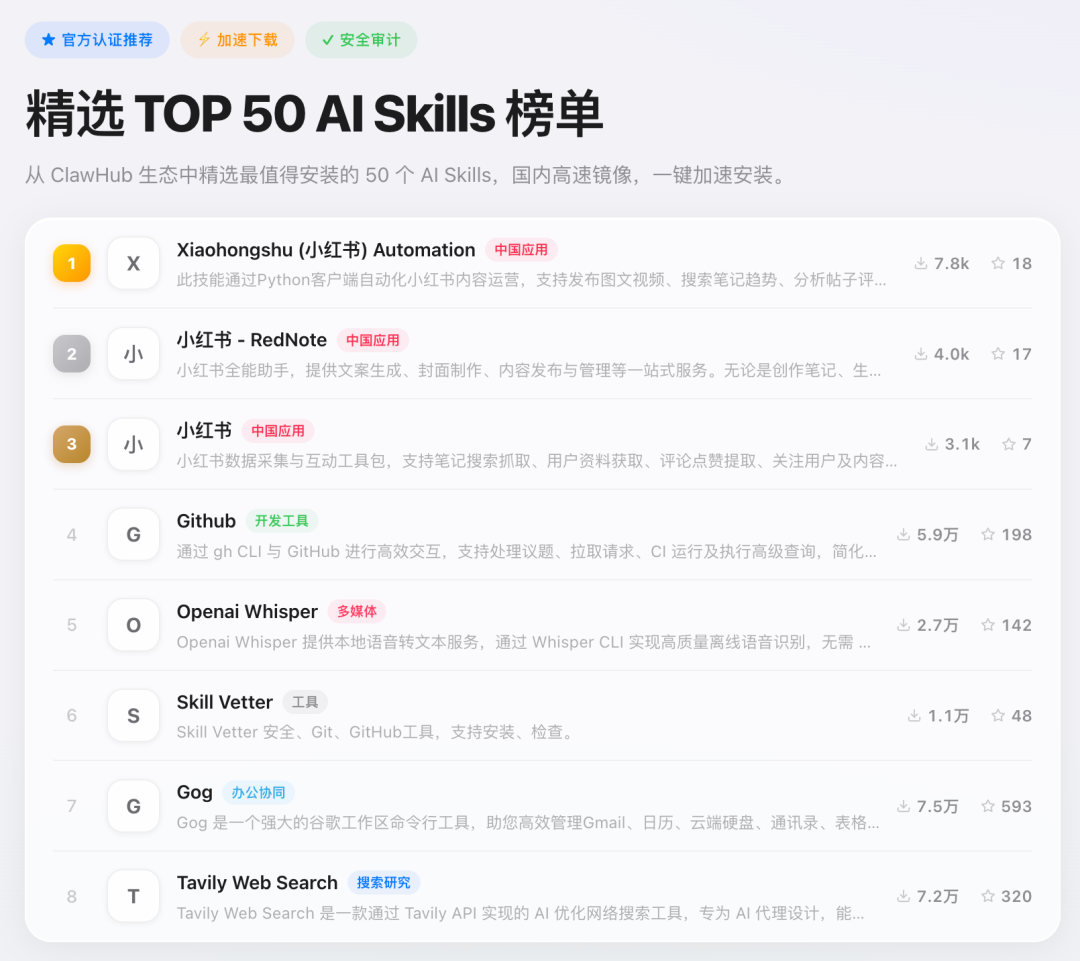
Skillhub

But is a mirror site inherently blameless? The answer is not necessarily.

Because what the open-source license allows, what community ethics accept, and what commercial reality ultimately brings are often three different sets of accounts.

At the license level, as long as the license is followed and the source is credited, many mirroring and redistribution actions are valid. At the community ethics level, Tencent's SkillHub credits the OpenClaw official source and has actively reduced the source site's bandwidth costs, seemingly taking responsibility.

But Tencent forgot that OpenClaw is not a small open-source project needing big tech's deliberate resource injection. It is the hottest project on GitHub with the most stars. In this context, Tencent's action without prior notice becomes "high-handed." It's no longer just a simple mirroring issue but quickly involves three more sensitive questions: Who represents the official ecosystem? Who is taking the user entry point? And who is defining the download, distribution, and statistical metrics?

This is what truly discomforted Peter, who stated that Tencent's behavior directly affects download statistics. Peter isn't opposed to Tencent localizing OpenClaw for China but believes they should have communicated first, rather than building the platform, onboarding users, and then explaining under public pressure that they were actually there to help.

Furthermore, from a commercial reality perspective, once a platform shell like SkillHub gains scale, the official status and statistical authority originally held by the OpenClaw community can easily be marginalized. Today it's a localized Skills platform; tomorrow it could be the "default Skills distribution market"; later, it might be "who decides which Skills are seen, installed, and commercialized."

This is the real danger signal behind this controversy and a scene all too familiar in the Chinese internet over the past decade: the enclosure movement.

Big Tech Isn't "Farming Lobsters"; They're Using Lobsters to Enclose AI Land

In the past period, "farming lobsters" has become the hottest meme in the Chinese AI circle, and OpenClaw has been rapidly pushed into an almost emotional industry symbol. Everyone says lobsters represent the new imagination of the Agent era and the future of personal AI assistants, which sounds very passionate.

But big tech doesn't look at lobsters with idealism; they see entry points, traffic, distribution power, and the shell of the next-generation operating system.

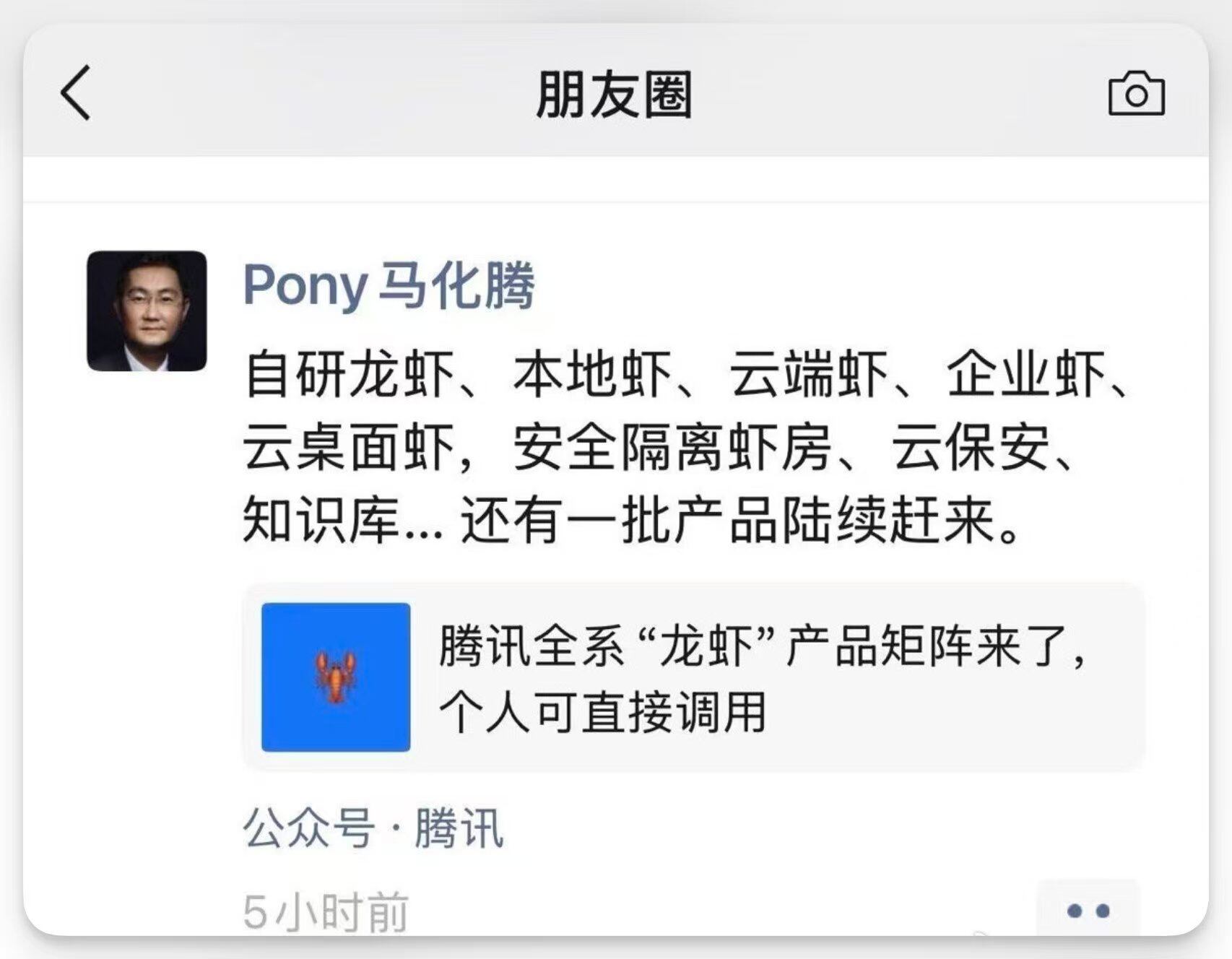
In the early hours of March 11, Pony Ma promoted Tencent's full suite of "lobster" products on his WeChat Moments. Tencent's "Lobster Family Bucket" customizes a "little lobster" for general users, developers, and enterprise users, supporting one-click installation with no threshold. SkillHub was launched simultaneously at this time, built with 13,000 localized Skills for one-click invocation, usable directly in scenarios like Xiaohongshu operations and Baidu search.
Of course, Tencent isn't the only one "smelling the wind and moving." If you stretch the timeline, you'll find that domestic tech giants have almost collectively jumped in to help users solve the "lobster farming"难题, their movements so整齐 they seem to have pressed the same switch, though Tencent is currently the most comprehensive.

On the surface, everyone means well, but in reality, this hides the most familiar path dependency in the commercial playbook of Chinese internet companies. Facing a new ecosystem already validated by the market and heated up by public opinion, the first move isn't about profit and business models, but grabbing the entry point first, building the platform first, onboarding users first.

What Tencent wants is not just to make it easier for Chinese users to "farm lobsters," but to ensure that when Chinese users truly start "using Agents to get things done," their first instinct is to do it within Tencent's product shell.

This is the most intriguing aspect of actions like SkillHub. It表面上 (superficially) is a mirror site, but in essence, it could be the starting point of a larger closed loop. Today users see local Skill search and download; tomorrow it might be default access to some cloud, some account system, some enterprise workbench. Later, developers might slowly realize that although they are still developing within the OpenClaw ecosystem, the real decisions about exposure, recommendation, review, and commercialization paths are made by the platform.

This script has been played out too many times in the Chinese internet. From ride-hailing to food delivery, from short-video platforms to cloud markets, almost every "ecological prosperity"背后 (behind it) has been accompanied by the same structural ending—the platform first uses free, open strategies to attract users, then builds walls, using traffic, advertising, and other means to turn the ecology back into its own附属层 (subsidiary layer).

Big tech companies all know that old entry points like search, social, content, and e-commerce are fiercely competitive to the limit, while Agent might be the most promising new entry point for the next round. In that case, rather than waiting for OpenClaw to grow wildly on its own, it's better to take it over while it's still in its explosive early stages, encapsulate it first, and get users accustomed to "bossing lobsters around" within their own systems.

Therefore, everyone is too familiar with what will happen next after big tech companies争先恐后 (scramble) to help users solve the OpenClaw installation problem. And Peter, who doesn't understand the Chinese internet, naturally can't comprehend why Tencent didn't communicate with him beforehand or synchronize data with him.

OpenClaw originally represented another AI future: local operation, personal control, community extension, open connection. Its most imaginative aspect is making Agents truly the user's own execution layer. But once this ecosystem gets repackaged by big tech with "localized mirrors," "domestic adaptation," "unified distribution," and "security review," the flavor changes. In the product logic of big tech, the entry point belongs to me, distribution belongs to me, so ultimately, payment and commercialization should also belong to me.

To put it more bluntly, big tech companies aren't "embracing lobsters"; they are "using lobsters to enclose territory in the AI era."

And this is the most unsettling aspect behind this small controversy. Walls are never built all at once; they always grow slowly under the guise of "more convenient" and "more stable." By the time developers, users, and traffic are all contained within the same shell, so-called openness and autonomy might ultimately just become a component within the big tech ecosystem.

OpenClaw currently faces the most paradoxical fate in China: The lobster hasn't fully grown yet, but big tech has already started setting up the nets.


Preguntas relacionadas

QWhat was the main criticism raised by OpenClaw founder Peter Steinberger against Tencent?

APeter Steinberger accused Tencent of copying OpenClaw without supporting the project, specifically criticizing their SkillHub platform for not communicating beforehand and potentially affecting official download statistics.

QHow did Tencent respond to the allegations made by the OpenClaw founder?

ATencent stated that SkillHub is a localized Skills platform based on the OpenClaw ecosystem, serving as a mirror site that credited ClawHub as the data source. They claimed to have handled 180GB of traffic for users in the first week while only pulling 1GB from the official source, and expressed willingness to become a sponsor.

QWhat broader concern does the article highlight beyond the technical aspects of mirroring OpenClaw?

AThe article highlights concerns about large tech companies like Tencent potentially seizing user entry points, distribution channels, and statistical control, ultimately leading to a 'walled garden' approach where the platform dictates visibility, installation, and commercialization of Skills, marginalizing the original open ecosystem.

QWhy does the author compare Tencent's actions to a 'land grab' in the AI industry?

AThe author compares it to a 'land grab' because Tencent and other large Chinese tech companies are rapidly integrating OpenClaw into their platforms to control the future AI agent entry points, user habits, and distribution power, rather than purely supporting open ecosystem growth.

QWhat is the ironic situation OpenClaw faces in China according to the article?

AOpenClaw faces the ironic situation where 'the lobster hasn't even grown up yet, but big tech companies are already building fences around it'—meaning the open ecosystem is being enclosed by platforms before it fully matures, risking loss of autonomy and community-driven development.

Lecturas Relacionadas

TechFlow Intelligence Bureau: Chip Stocks Lose Trillions in a Single Day, Bitcoin Falls Below $60,000, US-Iran Conflict Escalates

**Daily Tech & Markets Roundup: AI Advances, Market Turmoil, and Geopolitical Tensions** **AI / LLMs**: Anthropic's internal report on AI self-improvement sparked serious discussions about Recursive Self-Improvement (RSI). Meanwhile, debate continues on AI coding tools after Claude was accused of introducing bugs into the rsync codebase. In positive news, DeepSeek V4 Flash impressed in local deployment tests, and GitHub Copilot now supports custom endpoints for local models. A surprising research turn suggests removing chain-of-thought prompting can sometimes improve LLM performance. **Crypto / Web3**: Bitcoin plunged below $60,000, with its RSI hitting levels last seen during the COVID-19 crash, driven by strong U.S. jobs data reviving interest rate hike fears. Discussions highlight Ethereum DeFi's continued lack of a smooth consumer payment layer. **Chips / Hardware**: Chip stocks suffered a massive sell-off, with the Philadelphia Semiconductor Index posting its worst single-day drop in six years, erasing over a trillion dollars in value. Marvell, Micron, AMD, and Intel were among the biggest losers. **Tech Companies**: A leaked Microsoft document revealing goals to make Copilot "addictive" drew criticism. LinkedIn founder Reid Hoffman left Microsoft's board to focus full-time on his AI agent startup, Manus. Google was revealed to be paying SpaceX $920 million monthly for AI training compute. **Markets & Macro**: A blowout U.S. jobs report (172k vs. 80k expected) crushed hopes for near-term rate cuts, sending Treasury yields soaring and triggering a broad market sell-off. CEOs from Kraft, McDonald's, and Whirlpool simultaneously warned U.S. consumers are exhausting their savings. **Geopolitics**: U.S.-Iran tensions escalated with missile/drone interceptions and U.S. strikes on Iranian radar sites, keeping the critical Strait of Hormuz largely closed since late February and posing ongoing oil supply risks. **The Bottom Line**: The strong jobs data acted as a single trigger for correlated sell-offs across equities, crypto, and chips. Underlying the volatility is a stark contradiction between robust employment data and warnings of consumer weakness, alongside geopolitical risks that could reignite inflation, leaving markets to price in a fraught macro outlook with no clear "soft landing" path.

marsbitHace 14 min(s)

TechFlow Intelligence Bureau: Chip Stocks Lose Trillions in a Single Day, Bitcoin Falls Below $60,000, US-Iran Conflict Escalates

marsbitHace 14 min(s)

It Took Me a Year to See the Bitter Truth About Agent Payments

After a year building infrastructure for the Agent economy, engaging with major players like Stripe, Visa, and Coinbase, the author shares a sobering analysis of the current state of Agent payments. The core finding is a stark lack of genuine, immediate demand across most envisioned use cases. The article breaks down four key market segments: 1. **Agent-to-Merchant (Consumer Shopping):** For most product categories (e.g., clothing, electronics), conversational AI shopping is a step backwards from visual e-commerce interfaces. While agents excel at understanding needs, they can't replace side-by-side product comparison. Real merchant interest is defensive "Agent Engine Optimization," not driven by current customer demand. Potential exists for high-frequency, low-decision purchases (like food delivery) or navigating complex store UIs, but these require massive B2C distribution channels dominated by giants like Amazon. 2. **Agent-to-API (Developer Services):** Developers already have subscriptions and billing relationships for APIs (compute, data). Prepaid balances solve micro-payment issues for low transaction volumes. A deeper structural problem is that major SaaS vendors' business models rely on enterprise contracts, resisting granular pay-per-call pricing. While protocols like MPP and x402 serve the long tail of niche services, this market is small and developers are historically low-willingness-to-pay. 3. **Agent-to-Agent:** This remains largely theoretical with minimal transaction volume. While it represents a long-term bet on a fundamentally new transaction infrastructure (sub-second, micro-penny to million-dollar, multi-party settlements), it does not constitute a present market. 4. **Agent-to-Finance:** This is the only category with existing, paying demand. Integrating AI into financial workflows (trading, portfolio management) is a natural evolution and enables new capabilities like autonomous rebalancing. However, competition favors established, regulated institutions. The "real problem" is not moving money between agents, but the broader challenge of **coordination**—orchestrating work between agents and humans, verifying outcomes, and settling results. Payment is just one component of settlement, which is itself part of coordination. Companies that solve the coordination layer will subsume payment, not the other way around. While well-funded incumbents build defensively for a long-term future, startups must find where the market is today—which, for the author's team, lies outside these four categories in an area of real, growing, and underserved activity.

marsbitHace 57 min(s)

It Took Me a Year to See the Bitter Truth About Agent Payments

marsbitHace 57 min(s)

It Took Me a Year to See the Hard Truth About Agent Payments

**Title: It Took Me a Year to See the Hard Truth About Agent Payments** Over the past year, I've worked on infrastructure for the Agent economy, engaging with major players like Stripe, Visa, Coinbase, and numerous startups. The findings reveal a stark reality: genuine, widespread demand for Agent-based payments does not yet exist. **Key Observations:** * **Agent-to-Merchant (Shopping):** The user experience for AI shopping often falls short, especially for visual product discovery. While AI excels at understanding needs, conversational interfaces can't yet replace browsing and comparing multiple products visually. Current merchant interest is largely defensive ("Agent Engine Optimization") for a future that hasn't arrived. High-frequency, low-friction purchases (like food delivery) are potential fits, but lack open APIs and face high AI inference costs. Simpler, more affordable, or cross-language interactions for complex UIs are a niche opportunity but require massive consumer distribution to scale. * **Agent-to-API (Developer Tools):** Developer payment needs for APIs (computing, data, models) are already met through subscriptions and prepaid credits. The core challenge is not payment friction but supplier economics: most large SaaS providers prefer enterprise contracts over micropayments for API calls. Protocols like MPP and x402 suit the long-tail of smaller services but cater to a developer market historically reluctant to pay for these tools. Major infrastructure needs at the top of the stack are already being addressed. * **Agent-to-Agent (Machine Commerce):** This is a long-term vision with almost no current transaction volume. While a future with high-speed, high-frequency, multi-party machine-to-machine transactions would require novel infrastructure, it remains theoretical. The market is not here yet. * **Agent-to-Finance:** This is the only category with clear, present demand. Financial professionals and DeFi users already pay for tools, and AI augmentation is a natural evolution. Autonomous AI agents can enable entirely new financial strategies. However, competition is fierce from established, regulated incumbents who can more easily layer AI onto their existing products. **The Core Insight:** Companies, especially giants with long time horizons, are building defensively for a potential future of mass machine commerce. For them, early investment is a low-cost hedge. For startups, the current market reality is different. The primary challenge isn't just moving money between agents (payments). The larger, unsolved problem is **orchestration** – coordinating work between agents and humans, verifying outcomes, and then settling. Payment is just a part of settlement, which is just a part of orchestration. Companies that solve the orchestration problem will subsume payments, not the other way around. After a year of building, we see the real, growing, and underserved market opportunity lies in this broader domain of orchestration.

链捕手Hace 1 hora(s)

It Took Me a Year to See the Hard Truth About Agent Payments

链捕手Hace 1 hora(s)

Claude Opus 4.8 Finds a $4.5 Billion Bug: The AI Era is Mass-Producing Hackers

A researcher discovered a critical "infinite mint" vulnerability in the Zcash cryptocurrency's Orchard protocol using Claude Opus 4.8, leading to a swift fix but also a 50% market drop, erasing billions in value. This incident highlights a new era where powerful, accessible AI models are dramatically lowering the barrier to finding software vulnerabilities. Previously, the security community feared specialized models like Claude Mythos Preview, capable of finding decades-old zero-day exploits. The Zcash case, however, involved a publicly available, general-purpose model. This shift makes advanced security auditing—and attack capabilities—accessible to far more people, not just experts. The mass democratization of vulnerability discovery brings a dual challenge: a flood of low-quality, AI-generated false reports that overwhelm maintainers, and the real, rapid uncovering of deep, dangerous bugs. Open-source projects, often understaffed and unfunded, are particularly vulnerable to this "attention DDoS." The article cites examples like curl shutting down its bug bounty program due to the unsustainable workload. Our perceived digital safety has often been luck, relying on the high cost and effort required to find deeply hidden flaws in complex systems, as seen with historical vulnerabilities like Heartbleed or Baron Samedit. AI changes this cost structure, effectively "mass-producing flashlights" to illuminate every corner of our codebase. While large companies operate extensive security chains involving external white-hat hackers and massive defensive operations, the global cybersecurity workforce faces a severe shortage, especially of experienced personnel capable of analyzing complex threats and coordinating fixes. The core dilemma emerges: AI makes *finding* bugs cheap and scalable, but *fixing* them remains a slow, expensive, and human-intensive process. The article concludes that AI won't destroy the internet but acts as a bright light, revealing that our digital existence is not inherently secure but is precariously maintained by ongoing human effort. The true cost in the AI era may not be discovery, but whether there will be enough people left willing and able to do the hard work of repair.

marsbitHace 1 hora(s)

Claude Opus 4.8 Finds a $4.5 Billion Bug: The AI Era is Mass-Producing Hackers

marsbitHace 1 hora(s)

Trading

Spot
Futuros
活动图片

