Fragmentation drains up to $1.3B a year from tokenized assets: Report

cointelegraphPublicado a 2025-12-19Actualizado a 2025-12-19

Resumen

Fragmentation across blockchain networks is causing significant economic drain in the tokenized asset market, with inefficiencies costing up to $1.3 billion annually, according to a report from RWA.io. The lack of interoperability traps liquidity and prevents capital from moving freely, causing identical or economically equivalent real-world assets (RWAs) to trade at price differences of 1% to 3% across different chains. These inefficiencies hinder arbitrage and price discovery. Additionally, moving capital between chains results in transaction losses of 2% to 5% due to fees, slippage, and operational risks. If unresolved, these issues could escalate to $30–75 billion in annual losses as the tokenized RWA market grows to an estimated $16–30 trillion by 2030. Despite these challenges, tokenized assets continue gaining adoption, with recent moves by companies like Securitize and Coinbase to launch onchain stock trading.

Fragmentation across blockchain networks is already imposing a measurable economic cost on the tokenized asset market, with inefficiencies translating into up to $1.3 billion in annual value drag.

In a report sent to Cointelegraph, real-world asset (RWA) data provider RWA.io argued that while blockchains accelerated innovation, they also created walls that trap liquidity and prevent capital from moving freely across networks.

As a result, tokenized RWAs have increasingly behaved like disconnected markets rather than a single, unified financial system. The research found that identical or economically equivalent assets routinely trade at different prices across chains, while moving capital between networks remained costly and complex.

Researchers stated that these inefficiencies hinder the market’s ability to self-correct through arbitrage, a mechanism that facilitates efficient price discovery.

“This fragmentation is the single greatest impediment to the market realizing its multi-trillion-dollar potential,” said Marko Vidrih, co-founder and chief operating officer at RWA.io.

“In traditional finance, the EU-wide SEPA Instant mandate shows how value can move across accounts in seconds. Tokenized assets should be just as frictionless,” Vidrih added.
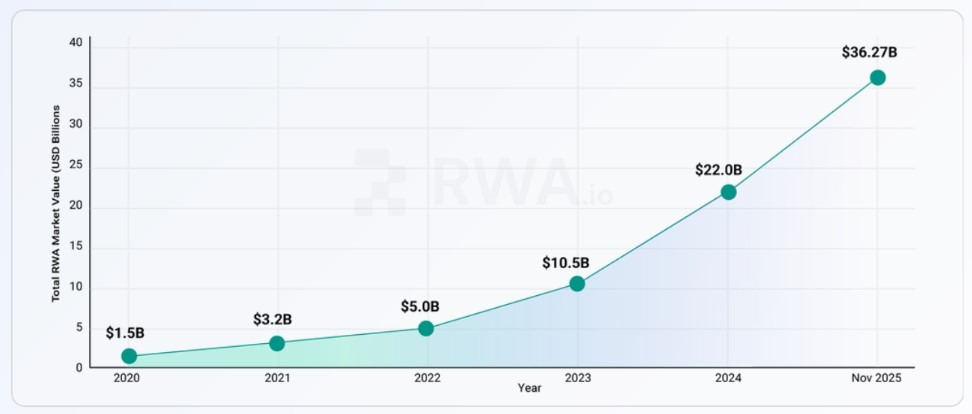
RWA market growth from 2020 to 2025. Source: RWA.io

Price inefficiencies and capital friction across chains

The report states that one of the most obvious consequences of fragmentation is the persistent price divergence for identical assets issued on different blockchains.

According to the report, economically identical tokenized assets often trade at spreads of 1% to 3% across major networks, despite representing claims on the same underlying assets. In traditional finance, arbitrage would quickly eliminate such market gaps.

However, crosschain arbitrage remains unviable due to technical hurdles, fees, delays and operational risks, the report claims. It states that the costs to relocate assets often exceed the price discrepancy, allowing inefficiencies to persist.

Beyond price discovery, RWA.io estimated that moving capital between non-interoperable chains results in losses of 2% to 5% per transaction. This is because of exchange fees, slippage, transfer costs, gas fees and timing risks. In aggregate, the report models an average loss of about 3.5% per capital reallocation.

Should these fragmentation patterns persist, RWA.io estimated that the friction costs could drain between $600 million $1.3 billion from the market annually.
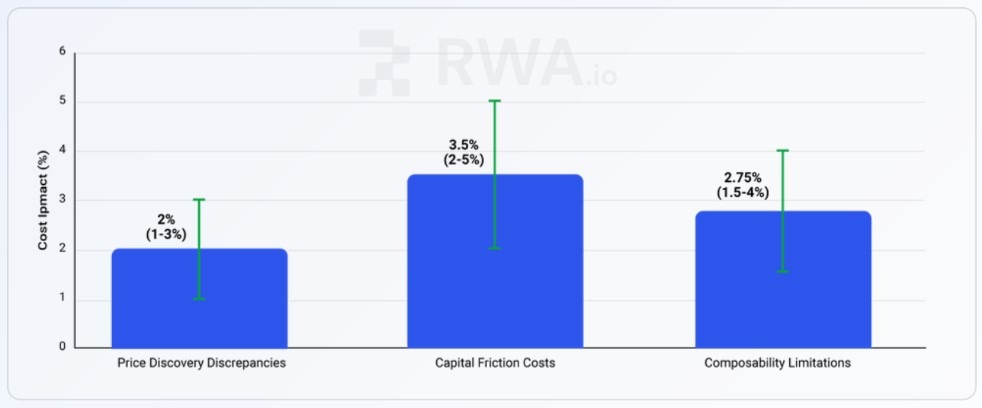
Economic costs of market fragmentation. Source: RWA.io

RWA.io projects that tokenized real-world assets could grow into a $16 trillion to $30 trillion market by 2030, and warns that if current inefficiencies persist, the associated value drag would scale with it.

Applying today’s fragmentation-related frictions to a market of that size implies potential annual losses of $30 billion to $75 billion, turning infrastructure shortcomings into a material constraint on long-term growth.

Related: Tokenized stocks may be onchain, but the SEC still wants the keys

Tokenized assets gain traction despite inefficiencies

Despite claims of inefficiency, tokenized assets continue to gain traction across both crypto-native platforms and traditional financial institutions. Just this week, companies have made moves to tokenize equities.

On Tuesday, RWA-focused company Securitize announced plans to launch compliant, onchain stock trading.

On Thursday, crypto exchange Coinbase launched a stock trading feature, allowing users to invest directly in stocks through its application.

Magazine: Koreans ‘pump’ alts after Upbit hack, China BTC mining surge: Asia Express

Preguntas relacionadas

QWhat is the estimated annual economic cost of fragmentation on the tokenized asset market according to the RWA.io report?

AThe report estimates that fragmentation drains between $600 million and $1.3 billion from the tokenized asset market annually.

QWhat is identified as the 'single greatest impediment' to the tokenized asset market reaching its multi-trillion-dollar potential?

AFragmentation across blockchain networks is identified as the single greatest impediment to the market realizing its multi-trillion-dollar potential.

QWhat is the typical price spread for identical tokenized assets trading on different blockchains?

AEconomically identical tokenized assets often trade at spreads of 1% to 3% across major blockchain networks.

QWhy does cross-chain arbitrage fail to correct price inefficiencies in the tokenized asset market?

ACross-chain arbitrage remains unviable due to technical hurdles, fees, delays, operational risks, and the fact that the costs to relocate assets often exceed the price discrepancy.

QWhat is the projected size of the tokenized real-world asset market by 2030, and what could the associated losses be if fragmentation persists?

ARWA.io projects the market could grow to $16 trillion to $30 trillion by 2030. If current inefficiencies persist, the associated annual losses could scale to $30 billion to $75 billion.

Lecturas Relacionadas

First Batch of Keynote Speakers and Partners Announced! Web2+3 Summit: Defining the Next Generation of Digital Economy

Web2+3 Summit: Defining the Next Generation of Digital Economy The 6th BEYOND International Technology Innovation Expo (BEYOND Expo 2026), Asia's largest tech and ecosystem exhibition, is launching a dedicated Web2+3 stage for the first time. Co-hosted by BEYOND Expo and ChainNeXT Group, the Web3 Summit will take place from May 28–30, 2026. Against the backdrop of accelerating global tech integration, the boundaries between Web2 and Web3 are rapidly blurring. With clearer global regulations for blockchain-driven internet (Web3) and the special issuance of a Hong Kong dollar stable币 license by the Hong Kong SAR government on April 10, 2026, Web3's decentralized principles are quickly merging with traditional industries (Web2) such as e-commerce, finance, and artificial intelligence. Focused on blockchain-driven digital economy elements, the summit will center on three core principles—implementability, commercial viability, and compliance. It will bring together top Web3 experts to discuss key integration areas like stablecoin payment finance (PayFi), real-world asset tokenization (RWA), and decentralized AI (DeAI), unveiling new opportunities for industrial innovation. The first wave of confirmed speakers includes Jack Kong (Director of Hong Kong Cyberport, Chairman of Nano Labs), Yat Siu (Chairman of Animoca Brands), Michael Wu (Co-founder & CEO of Amber Group), Michael Heinrich (Co-founder & CEO of 0G), and Art Abal (Co-founder of Vana). More Web3 ecosystem pioneers, AI, and fintech experts will be announced soon. Core forum topics include: - Web2+DeAI: New AI Paradigms Driven by Decentralized Infrastructure - Web2+RWA: Real-World Asset Tokenization and Global Liquidity - Web2+PayFi: Cross-Border Payments and Financial Innovation Powered by Crypto Infrastructure - Web2+3 AI: Autonomous Agents and the Crypto Economy - Web2+3 Wealth: On-Chain and Off-Chain Integrated Investment Ecosystems - Web2+3 Commerce: A New Landscape for Global Trade Driven by Stablecoins Additional agenda details will be released in the near future.

marsbitHace 4 hora(s)

First Batch of Keynote Speakers and Partners Announced! Web2+3 Summit: Defining the Next Generation of Digital Economy

marsbitHace 4 hora(s)

Trading

Spot
Futuros

Artículos destacados

Cómo comprar MANTRA

¡Bienvenido a HTX.com! Hemos hecho que comprar Mantra (MANTRA) sea simple y conveniente. Sigue nuestra guía paso a paso para iniciar tu viaje de criptos.Paso 1: crea tu cuenta HTXUtiliza tu correo electrónico o número de teléfono para registrarte y obtener una cuenta gratuita en HTX. Experimenta un proceso de registro sin complicaciones y desbloquea todas las funciones.Obtener mi cuentaPaso 2: ve a Comprar cripto y elige tu método de pagoTarjeta de crédito/débito: usa tu Visa o Mastercard para comprar Mantra (MANTRA) al instante.Saldo: utiliza fondos del saldo de tu cuenta HTX para tradear sin problemas.Terceros: hemos agregado métodos de pago populares como Google Pay y Apple Pay para mejorar la comodidad.P2P: tradear directamente con otros usuarios en HTX.Over-the-Counter (OTC): ofrecemos servicios personalizados y tipos de cambio competitivos para los traders.Paso 3: guarda tu Mantra (MANTRA)Después de comprar tu Mantra (MANTRA), guárdalo en tu cuenta HTX. Alternativamente, puedes enviarlo a otro lugar mediante transferencia blockchain o utilizarlo para tradear otras criptomonedas.Paso 4: tradear Mantra (MANTRA)Tradear fácilmente con Mantra (MANTRA) en HTX's mercado spot. Simplemente accede a tu cuenta, selecciona tu par de trading, ejecuta tus trades y monitorea en tiempo real. Ofrecemos una experiencia fácil de usar tanto para principiantes como para traders experimentados.

231 Vistas totalesPublicado en 2026.03.04Actualizado en 2026.03.04

Cómo comprar MANTRA

Cómo comprar OPN

¡Bienvenido a HTX.com! Hemos hecho que comprar Opinion (OPN) sea simple y conveniente. Sigue nuestra guía paso a paso para iniciar tu viaje de criptos.Paso 1: crea tu cuenta HTXUtiliza tu correo electrónico o número de teléfono para registrarte y obtener una cuenta gratuita en HTX. Experimenta un proceso de registro sin complicaciones y desbloquea todas las funciones.Obtener mi cuentaPaso 2: ve a Comprar cripto y elige tu método de pagoTarjeta de crédito/débito: usa tu Visa o Mastercard para comprar Opinion (OPN) al instante.Saldo: utiliza fondos del saldo de tu cuenta HTX para tradear sin problemas.Terceros: hemos agregado métodos de pago populares como Google Pay y Apple Pay para mejorar la comodidad.P2P: tradear directamente con otros usuarios en HTX.Over-the-Counter (OTC): ofrecemos servicios personalizados y tipos de cambio competitivos para los traders.Paso 3: guarda tu Opinion (OPN)Después de comprar tu Opinion (OPN), guárdalo en tu cuenta HTX. Alternativamente, puedes enviarlo a otro lugar mediante transferencia blockchain o utilizarlo para tradear otras criptomonedas.Paso 4: tradear Opinion (OPN)Tradear fácilmente con Opinion (OPN) en HTX's mercado spot. Simplemente accede a tu cuenta, selecciona tu par de trading, ejecuta tus trades y monitorea en tiempo real. Ofrecemos una experiencia fácil de usar tanto para principiantes como para traders experimentados.

209 Vistas totalesPublicado en 2026.03.05Actualizado en 2026.03.05

Cómo comprar OPN

Cómo comprar CFG

¡Bienvenido a HTX.com! Hemos hecho que comprar Centrifuge (CFG) sea simple y conveniente. Sigue nuestra guía paso a paso para iniciar tu viaje de criptos.Paso 1: crea tu cuenta HTXUtiliza tu correo electrónico o número de teléfono para registrarte y obtener una cuenta gratuita en HTX. Experimenta un proceso de registro sin complicaciones y desbloquea todas las funciones.Obtener mi cuentaPaso 2: ve a Comprar cripto y elige tu método de pagoTarjeta de crédito/débito: usa tu Visa o Mastercard para comprar Centrifuge (CFG) al instante.Saldo: utiliza fondos del saldo de tu cuenta HTX para tradear sin problemas.Terceros: hemos agregado métodos de pago populares como Google Pay y Apple Pay para mejorar la comodidad.P2P: tradear directamente con otros usuarios en HTX.Over-the-Counter (OTC): ofrecemos servicios personalizados y tipos de cambio competitivos para los traders.Paso 3: guarda tu Centrifuge (CFG)Después de comprar tu Centrifuge (CFG), guárdalo en tu cuenta HTX. Alternativamente, puedes enviarlo a otro lugar mediante transferencia blockchain o utilizarlo para tradear otras criptomonedas.Paso 4: tradear Centrifuge (CFG)Tradear fácilmente con Centrifuge (CFG) en HTX's mercado spot. Simplemente accede a tu cuenta, selecciona tu par de trading, ejecuta tus trades y monitorea en tiempo real. Ofrecemos una experiencia fácil de usar tanto para principiantes como para traders experimentados.

235 Vistas totalesPublicado en 2026.03.19Actualizado en 2026.03.19

Cómo comprar CFG

Discusiones

Bienvenido a la comunidad de HTX. Aquí puedes mantenerte informado sobre los últimos desarrollos de la plataforma y acceder a análisis profesionales del mercado. A continuación se presentan las opiniones de los usuarios sobre el precio de A (A).

活动图片










