Four Questions on the Zcash Orchard Vulnerability: Was It Exploited? Can Funds Be Recovered? Is the Supply Verifiable? And Are There Others?

marsbitPublicado a 2026-06-15Actualizado a 2026-06-15

Resumen

Zcash Orchard Bug: Four Key Questions Answered A critical forgery vulnerability was discovered in Zcash's Orchard privacy pool, raising four major concerns for users. 1. **Was the Orchard bug exploited?** The likelihood is considered low. The bug was found proactively using advanced AI-assisted tools and was promptly patched, limiting any potential attack window. If exploitation had occurred, evidence would likely have surfaced by now. 2. **Can legitimate Orchard funds be recovered?** It is believed so, based on the assessment that the bug was not exploited. If forgery did happen, existing "turnstile" mechanisms could prevent full recovery of legitimate funds if forged coins were moved out first, though this scenario is deemed unlikely. Users can choose to move funds, but this carries risks like loss of privacy or new wallet/software issues. 3. **Can users verify Zcash's total supply?** Currently, no. The vulnerability's prior existence prevented independent verification of the shielded supply. The proposed "Ironwood" network upgrade will restore this ability by sealing the Orchard pool, allowing anyone running a node to verify that the circulating ZEC does not exceed the correct amount. 4. **Are there other forgery bugs?** Ongoing intensive audits by multiple teams, including AI-assisted analysis, have not found additional forgery vulnerabilities, increasing confidence that none remain. Further work and collaborations are planned to provide additional guarantees. In co...

Original Authors: Jason McGee, CEO of Shielded Labs; Zooko Wilcox, Founder of Zcash

Compiled | Odaily Planet Daily Qin Xiaofeng (@QinXiaofeng 888 )
Editor's Note: On June 5th, Beijing time, the privacy project Zcash was reported to have had a critical forging vulnerability in its new-generation privacy pool, Orchard. The price of Zcash's native token, ZEC, plummeted by nearly half, hitting a low of around $250. After about ten days of developments, market panic has somewhat subsided, and the price of ZEC has rebounded, returning to $500 today.

This morning, Zcash founder Zooko Wilcox published another lengthy article responding to key market concerns. He stated that it is highly likely the Orchard vulnerability was not previously exploited, and legitimate Orchard funds can be recovered. Currently, users cannot independently verify whether the Zcash supply exceeds its limit, but the upcoming Ironwood upgrade will seal the Orchard pool, restoring this verification capability. Ongoing audits have not uncovered other forging vulnerabilities, but absolute certainty requires more work.

Below is the full text by Zooko Wilcox, compiled by Odaily Planet Daily, enjoy~

————————————

The recent Orchard vulnerability has raised critical questions about Zcash's supply and user fund safety. The discussion has conflated several distinct issues, making it difficult to understand the practical impact of the vulnerability on users. This article attempts to separate these questions and explain what each means for users.

The Orchard vulnerability raises four major questions:

  1. Was the Orchard vulnerability ever exploited?
  2. Can legitimate Orchard funds be recovered?
  3. Can users verify that the Zcash supply has not been inflated?
  4. How do we know there aren't other forging vulnerabilities?

Was the Orchard vulnerability ever exploited?

Unknown. We consider it unlikely that it was exploited previously, though we cannot rule it out entirely. We believe the vulnerability likely went unused for three reasons:

Despite years of continuous scrutiny by top cryptographers and security researchers worldwide, the vulnerability was not previously discovered. Its discovery was not accidental; it was found by Taylor Hornby of Shielded Labs with the express purpose of proactively identifying such security flaws before malicious actors could. Taylor used advanced AI-assisted security research techniques and custom-built tools specifically designed to find subtle flaws others might miss, a task that would be more difficult for those not deeply familiar with the Zcash codebase.

Upon discovery, Zcash developers (led by the Zcash Open Development Labs team) quickly coordinated with mining pools to temporarily freeze the Orchard pool and deployed a fix, limiting any potential attack window.

Cryptocurrency exploits are common, and attackers typically cash out as quickly as possible, especially after a vulnerability is made public. For an attacker to profit from this vulnerability, they would need to exchange forged ZEC for valuable assets, which usually involves moving ZEC out of the Orchard pool via the turnstile mechanism. Had the vulnerability been exploited before the fix, we would expect evidence to have surfaced by now. Historically, cryptocurrency exploits tend to be "smash-and-grab" operations rather than "4D chess" strategies hidden for months or years.

Can legitimate Orchard funds be recovered?

We believe so, because we believe the vulnerability was never exploited. If this assessment is correct, all legitimate Orchard funds remain fully recoverable.
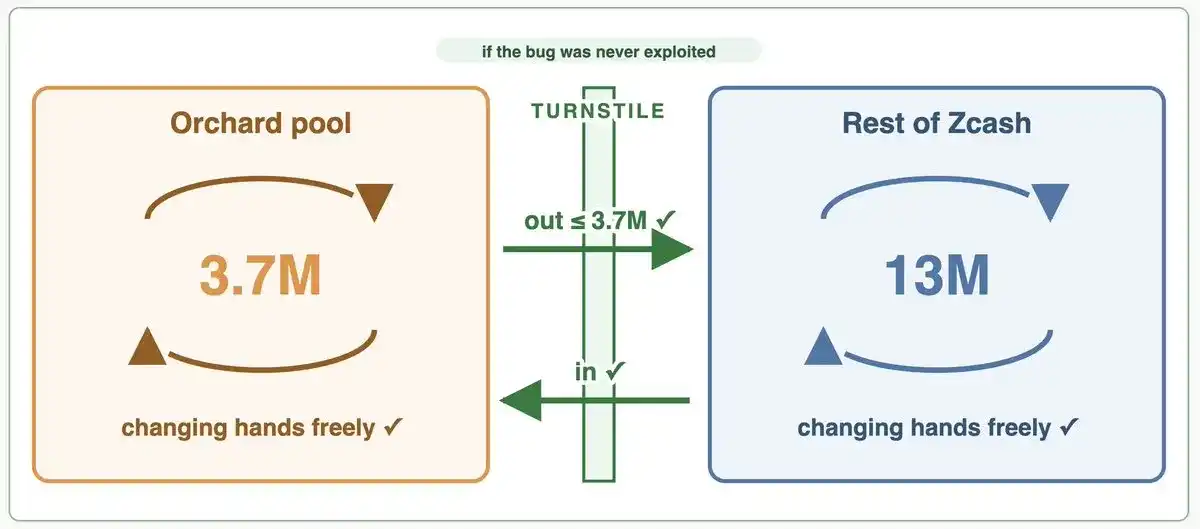
Conversely, if forging did occur within Orchard, the existing turnstile mechanism limits the total migrated amount to the number of ZEC that legitimately entered the pool. Therefore, if forged funds are migrated before legitimate funds, users may be unable to recover some or all of their legitimate Orchard funds.
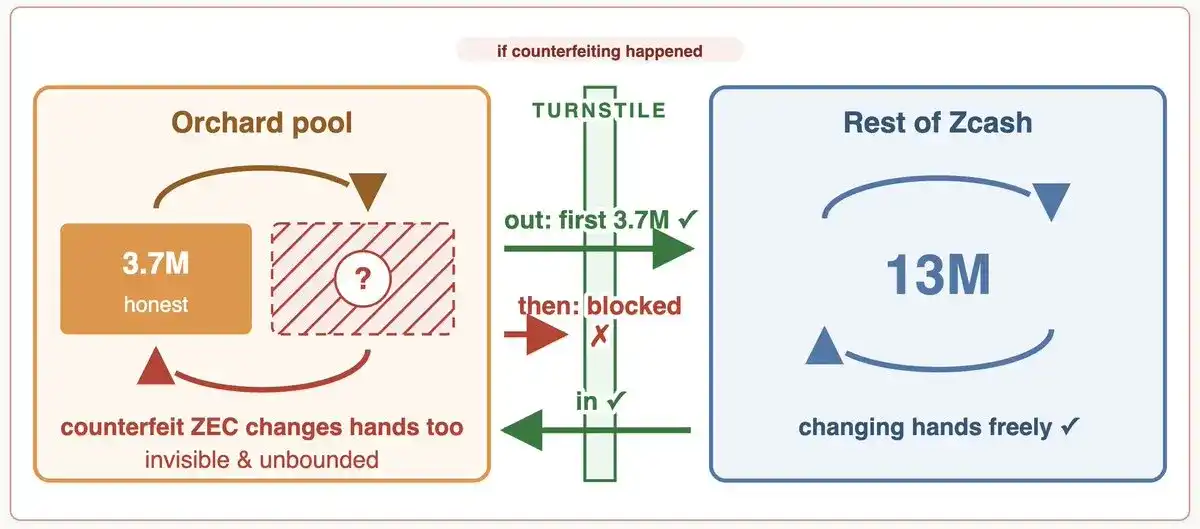
We consider this scenario unlikely. However, for more cautious users, moving their ZEC out of Orchard is still advised. Before doing so, they should understand the following:

  • Moving funds to a transparent pool (i.e., to a t-address) exposes both the transaction amount and the time of the transaction, and the funds become publicly linked to that t-address.
  • Moving funds from the Orchard pool to the Sapling pool exposes the transaction amount and time, but unlike moving to a t-address, it does not link these funds to a specific address or transaction history.
  • The Sapling pool relies on a trusted setup ceremony conducted in 2018. Relying on the security of this trusted setup is an additional risk users should be aware of.
  • To our knowledge, YWallet and Zkool are currently the only widely used, self-custodial Zcash wallets that support the Sapling pool.
  • Moving funds to a new wallet or custodial service introduces additional risks, including user error, software bugs, custodian risk, or other unforeseen issues.

Overall, we consider these risks moderate. If your funds are currently in a shielded, self-custodial wallet, leaving them there is a reasonable choice, given our assessment that prior forging is unlikely. If you have a secure way to move them, that may also be reasonable. Users may arrive at different conclusions based on their own circumstances.

Can users verify that the Zcash supply has not been inflated?

Not currently. The prior existence of the vulnerability prevents users from independently verifying that the ZEC circulating in the current shielded pools does not exceed the correct amount.
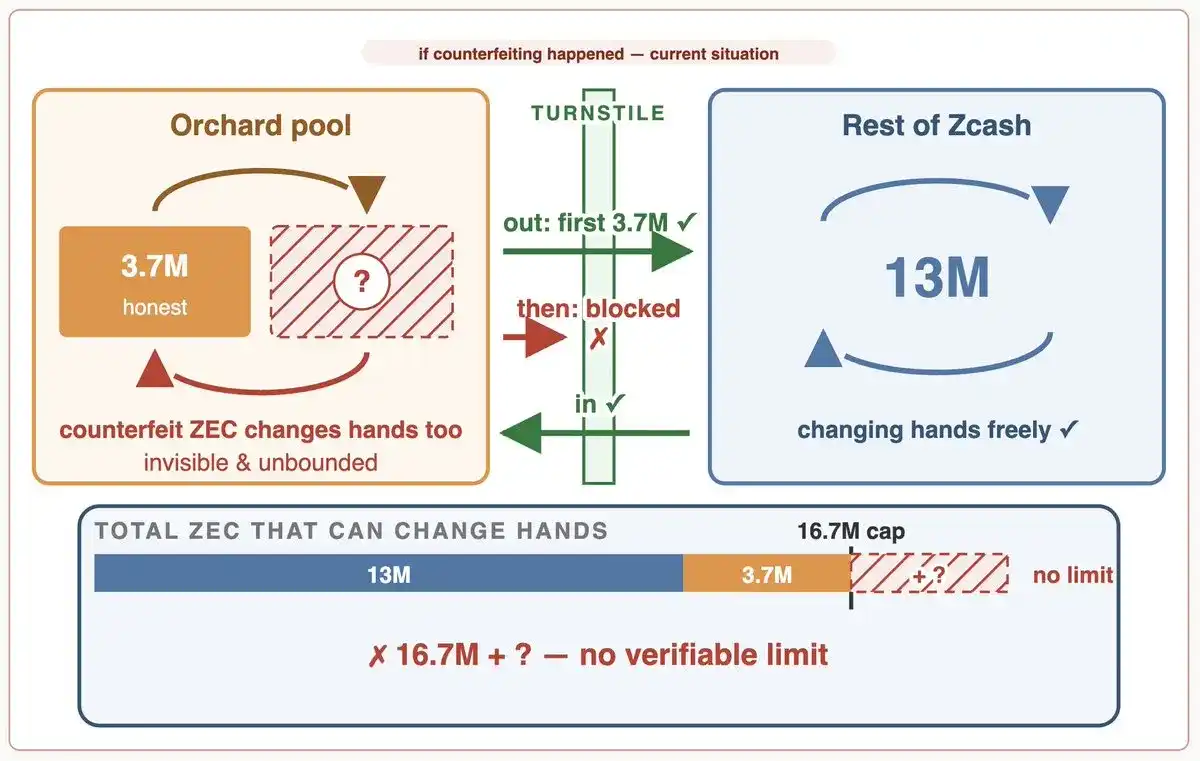
However, as we indicated in our previous post, the Ironwood upgrade restores this ability. The diagram below illustrates why.
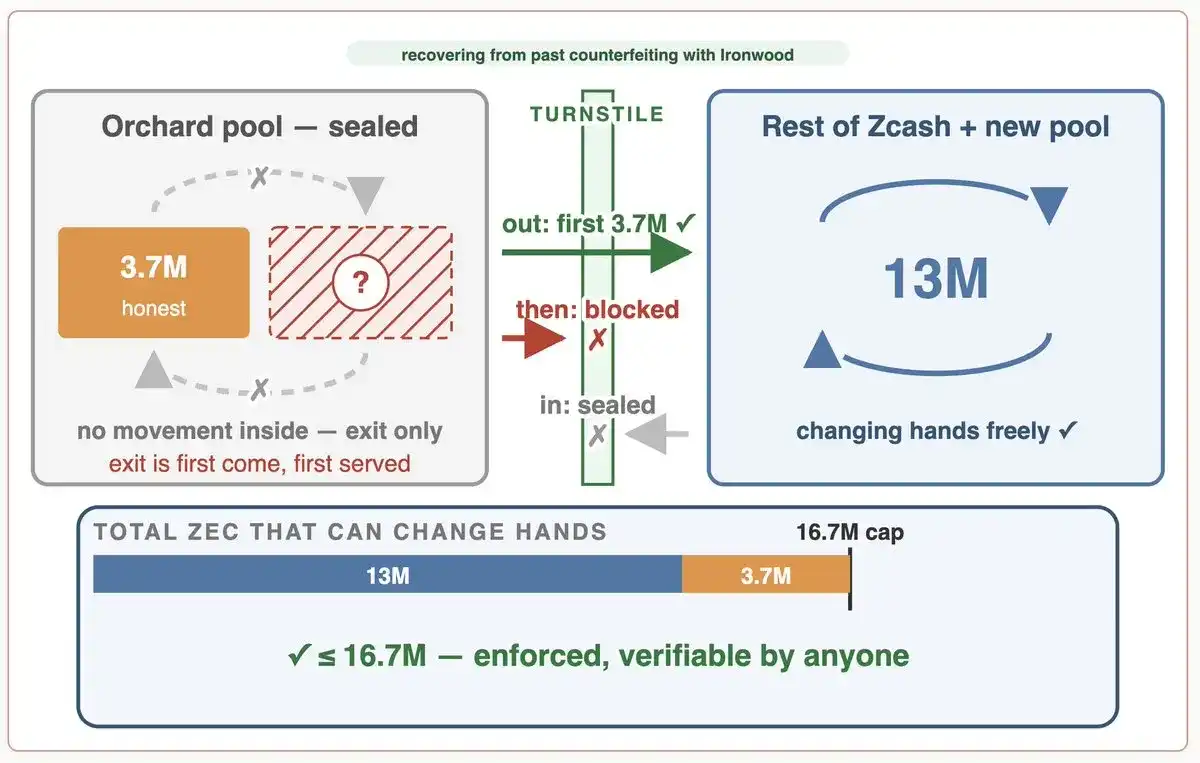
The proposed network upgrade addresses this by adding a guarantee that "no further unknown forging vulnerabilities exist" and by sealing the Orchard pool. New funds cannot enter, and funds within the pool cannot circulate. The only remaining path is exiting via the existing turnstile mechanism, which ensures that no more ZEC leaves the Orchard pool than legitimately entered it.

This change restores the ability to verify the soundness of Zcash's supply.

Currently, if forged funds exist within the Orchard pool, they can continue to circulate within it. After the upgrade, this is no longer possible. Regardless of whether forging occurred, anyone running a node can verify that no more ZEC is circulating than the correct amount.

Users don't need to wait for funds to migrate out of Orchard or speculate on potential actions by attackers or other users. The protocol itself provides a verifiable guarantee: excess ZEC cannot continue circulating within Orchard to inflate the supply.

This is crucial because Zcash's long-term credibility depends on users' ability to independently verify the soundness of its supply. Ironwood restores users' ability to independently verify that the protocol's supply limit is enforced.

How do we know there aren't other forging vulnerabilities?

We can't be completely certain yet, but we have reason to believe none exist. Shielded Labs and multiple other teams have been meticulously auditing the Zcash protocol for other forging vulnerabilities. This includes using a not-yet-released Mythos AI model, with assistance from Anthropic, to search for additional vulnerabilities shortly before Mythos was paused. We plan to share more details about this audit and its findings in a future blog post.

So far, no other forging vulnerabilities have been found. The high level of expertise, effort, and advanced AI-assisted analysis involved in this search gives us increased confidence that no similar vulnerabilities remain undiscovered.

Furthermore, we are collaborating with projects like the Tachyon Project to provide additional assurance that no more forging vulnerabilities exist in Zcash. We will elaborate on this in future posts as well.

Conclusion

The Orchard vulnerability presents four key questions: Was it exploited? Can legitimate Orchard funds be recovered? Can users verify Zcash's supply hasn't been inflated? And are there other undiscovered forging vulnerabilities?

We believe prior exploitation is unlikely, therefore legitimate Orchard funds are recoverable, and the current Zcash supply is safe. Based on ongoing audits by multiple independent researchers and teams, we are also increasingly confident that no other undiscovered forging vulnerabilities exist. However, users cannot currently verify the security of Zcash's supply, and they shouldn't have to rely on our assessment—or anyone else's.

The proposed network upgrade solves this. By sealing the Orchard pool, it restores users' ability to independently verify the security of Zcash's supply. Users no longer need to judge whether forging occurred to verify that the protocol's supply limit is being obeyed.


Preguntas relacionadas

QAccording to the article, what are the four main questions raised by the Orchard vulnerability?

AThe four main questions are: 1) Has the Orchard vulnerability been exploited before? 2) Can legitimate Orchard funds be recovered? 3) Can users verify that the Zcash supply has not been inflated? 4) How do we know there are no other counterfeiting vulnerabilities?

QWhat reasons does Zooko Wilcox give for believing the Orchard vulnerability likely was not exploited?

AThree reasons are given: 1) The vulnerability was only discovered using advanced AI-assisted research and custom tools, making it hard to find. 2) Developers quickly coordinated with mining pools to temporarily freeze the Orchard pool and deploy a fix, limiting the attack window. 3) Cryptocurrency exploits are typically 'smash-and-grab' operations; if exploited, evidence would likely have surfaced by now.

QWhat solution does the proposed Ironwood upgrade provide regarding the Zcash supply?

AThe Ironwood upgrade seals the Orchard pool, preventing new funds from entering and existing funds from circulating. The only remaining path is to exit via the turnstile mechanism, which ensures no more ZEC leaves the pool than legitimately entered. This restores users' ability to independently verify the soundness of the Zcash supply.

QWhat are the risks mentioned for users who choose to move their funds out of the Orchard pool?

ARisks include: exposing transaction amount and time when moving to a transparent (t-address); exposing amount and time when moving to Sapling (though not linking to a specific address/history); relying on Sapling's 2018 trusted setup ceremony; limited wallet support (YWallet, Zkool); and introducing risks from user error, software bugs, custodial risk, or other unforeseen issues with new wallets or services.

QWhat work has been done to check for other counterfeiting vulnerabilities, and what is the current assessment?

AShielded Labs and other teams have been conducting careful reviews, including using an unreleased Mythos AI model from Anthropic to search for additional vulnerabilities. So far, no other counterfeiting vulnerabilities have been found. The high level of expertise, effort, and advanced AI analysis involved provides increased confidence that no similar vulnerabilities remain undetected, though it is not yet considered completely certain.

Lecturas Relacionadas

2026 Altcoin Season Guide: Current Values & Market Signals, Is It Time to Prepare for Altcoin Season?

Altcoin Season Guide 2026: Signals & Timing Analysis This guide explores the dynamics of an "altcoin season," defined as a 90-day period where at least 75% of the top 50 cryptocurrencies outperform Bitcoin (BTC). Historically signaling capital rotation from BTC to alternative assets ("alts"), these periods have evolved. Key differences for the 2026 market cycle include the "ETF Wall," where institutional capital via spot Bitcoin ETFs may remain concentrated in BTC, potentially slowing a broad altseason. A genuine, sustainable altseason now likely requires BTC profit-taking combined with new retail and on-chain liquidity entering the wider market. Analysts use tools like the Altseason Index (values >75 indicate an altseason) but also monitor key pairs like ETH/BTC and SOL/BTC for confirmation. Additional signals include a declining Bitcoin Dominance rate (ideally below 40-50%), accelerating altcoin total market cap growth, and surges in trading volume and social sentiment for alts. Modern altseasons are increasingly narrative-driven and selective, not uniform across all coins. Capital typically rotates in stages: from BTC to major altcoins (like ETH), then into leading narratives (e.g., AI, RWA, DePIN), and finally into mid/small-cap projects and meme coins. The peak phase is often marked by extreme greed, parabolic rises, and high leverage, serving as a cautionary signal. For preparation, investors are advised to build a quality watchlist based on fundamentals, product traction, and team strength. Strategies should include portfolio diversification, disciplined risk management (position sizing, stop-losses, stablecoin reserves), and capitalizing on sector rotations rather than chasing past winners. While precise timing is uncertain, historical patterns suggest strong altcoin rallies often follow Bitcoin halvings by 12-30 months. For the 2024 halving cycle, 2026-2027 could present favorable conditions if supported by macro liquidity, technological narratives, and a sustained drop in Bitcoin Dominance. A true, broad altseason is unlikely if Bitcoin experiences a sharp crash (>20%), as capital tends to flee the entire crypto market.

Foresight NewsHace 50 min(s)

2026 Altcoin Season Guide: Current Values & Market Signals, Is It Time to Prepare for Altcoin Season?

Foresight NewsHace 50 min(s)

This Might Be the Most Stunning Image at This Year's WAIC!

This article introduces Shangtang's newly released multimodal AI model, **SenseNova U1 Pro**, unveiled at WAIC 2026. The model is highlighted for its ability to generate **native 8K-resolution images** with exceptional detail and coherence, even in extremely wide-format compositions. It goes beyond simple image generation by employing a **"图文交错思维" (interleaved image-text reasoning)** workflow, where it can plan, sketch, refine, check, and correct its outputs to achieve a final, deliverable result. Key capabilities demonstrated include generating a long 8K scroll depicting the 9-year history of WAIC, a detailed 24 solar terms illustration, a complex academic poster, a琉璃 (colored glaze)-style landscape, and a ready-to-use movie poster. The model handles intricate prompts involving layout, text clarity, material textures, and stylistic consistency. The article draws a parallel between this evolution in image generation and the progression seen in AI coding—from simple code completion to autonomous project delivery. U1 Pro represents a shift from generating single images to providing **complete content delivery systems** for professional scenarios like infographics, urban planning, and commercial design. While challenges like generation time and professional workflow integration remain, the model signifies a move towards multimodal AI agents that are accountable for producing usable, high-quality outputs.

marsbitHace 2 hora(s)

This Might Be the Most Stunning Image at This Year's WAIC!

marsbitHace 2 hora(s)

How Did This Round of Deleveraging in the Korean Stock Market Occur?

This article details the timeline and mechanisms behind the deleveraging event in the South Korean stock market, focusing on the KOSPI index from late June to mid-July. The core trigger was the market's structure, heavily concentrated in Samsung Electronics and SK Hynix, which comprised over half of the KOSPI. The situation was amplified by the May 27th launch of single-stock double-leveraged ETFs on these two companies, which attracted massive retail investment and concentrated risk. The process unfolded in eight stages: 1. Initial price collapse on June 23rd after regulatory warnings, but without significant debt reduction. 2. A rebound from June 24-25 fueled by retail buying and ETF rebalancing, which actually increased leverage. 3. Foreign and institutional investors selling from June 26-30, with domestic retail investors becoming the marginal buyers, transferring risk to household balance sheets. 4. A shift in global semiconductor sentiment from July 1-3, causing leveraged ETFs to systematically sell during declines. 5. The market failing to rally on strong earnings (July 6-8), signaling a turn from technical correction to concerns over peak profitability. 6. A rise in forced liquidations and the cross-listing of SK Hynix ADRs, spreading leverage risks to US and Hong Kong markets (July 9-10). 7. A cascade of synchronized selling from various players on July 13th, followed by a mechanical, ETF-driven rebound. 8. Institutionalization of deleveraging on July 16th, marked by an interest rate hike and new regulatory restrictions on single-stock leveraged products. The author concludes this was not a simple semiconductor correction but a negative feedback loop involving foreign capital rebalancing, retail margin trading, daily ETF rebalancing, forced liquidations, shifting industry expectations, and tightening monetary and regulatory policy. Leveraged ETFs acted as a critical amplifier, not the initial spark. The price decline (-25%) far exceeded the reduction in margin debt (-11%), indicating the deleveraging was primarily expressed through asset prices rather than immediate balance sheet repair.

marsbitHace 2 hora(s)

How Did This Round of Deleveraging in the Korean Stock Market Occur?

marsbitHace 2 hora(s)

Trading

Spot
活动图片