Fortune Investigates Binance's Iran Fund Flow: $439 Million Chinese VIP Accounts Surface

marsbitPublicado a 2026-03-14Actualizado a 2026-03-14

Resumen

Binance, the world's largest cryptocurrency exchange, is facing renewed scrutiny over its compliance practices following a Fortune investigation. The report reveals that a VIP account, registered under the name of a 79-year-old Chinese resident, transferred $439 million in Tether stablecoins to external wallets. These funds were subsequently moved to wallets linked to Iranian entities, including the Islamic Revolutionary Guard Corps. Despite Binance's $4.3 billion plea deal with the U.S. government in 2023, which it committed to strengthen its compliance programs, these massive transactions did not trigger immediate alerts. A second Chinese VIP account, held by a 38-year-old woman, transferred nearly $200 million to the same Iranian-linked network. Internal investigators found that both accounts were likely accessed from the same device, suggesting possible common control. The funds were funneled through a Hong Kong-based entity, Blessed Trust, which also handled back-office operations for Binance. The exchange has denied that internal investigators were fired for uncovering these activities, stating their departures were due to violations of data policies. The U.S. Department of Justice is reportedly investigating whether Iran used Binance to evade sanctions, though the exchange says it is unaware of any such probe. These findings have prompted a U.S. Senate investigation and raised serious questions about the effectiveness of Binance's compliance program.

Author: Fortune

Compiled by: Deep Tide TechFlow

Deep Tide Introduction: This article is compiled from Fortune's investigative report on March 12. Readers are reminded to note the following background:

Since February this year, Western media outlets including Fortune, The Wall Street Journal, and The New York Times have reported that Binance's internal investigators discovered over $1 billion in funds flowing to entities linked to Iran, and were subsequently fired.

Binance denied firing employees due to compliance whistleblowing, stating that the departures were due to violations of internal data protection policies. On March 11, Binance filed a defamation lawsuit against The Wall Street Journal, demanding a retraction of the related reports.

Concurrently, Binance won two civil lawsuits filed under the U.S. Anti-Terrorism Act—federal courts in the Southern District of New York and Alabama dismissed all claims from the plaintiffs. However, these cases were civil claims by victims' families, which belong to a different legal category than the sanctions compliance disputes discussed in this article.

This article was written by Fortune author Leo Schwartz, who for the first time disclosed specific details of two Chinese VIP accounts: an account under the name of a 79-year-old individual transferred out $439 million, and the two accounts were suspected of sharing the same device.

Binance's stance is: platform accounts did not directly trade with sanctioned entities; the suspicious activity was discovered by Binance itself and reported to law enforcement agencies; the involved accounts have been taken offline. Currently, the U.S. Department of Justice is investigating whether Iran used Binance to evade sanctions, but it is unclear whether Binance itself is the target of the investigation.

Below is the full compilation of the Fortune article:

In early 2025, the embattled Iranian regime increasingly relied on cryptocurrency to circumvent economic sanctions. During this period, a VIP account on the Binance platform, registered under the name of a 79-year-old Chinese resident, transferred $439 million worth of digital tokens from the exchange to external wallets through a series of transactions. These wallets subsequently transferred most of the funds to other wallets—which Binance's internal investigators later identified as being associated with Iranian sanctioned entities, including the Islamic Revolutionary Guard Corps.

As noted in documents reviewed by Fortune, the transfer of hundreds of millions of dollars by an elderly individual was itself highly suspicious. More concerning was that the transactions involved transferring Tether stablecoins on the Tron blockchain—a preferred payment method for cybercriminals and money launderers.

Surprisingly, however, these transfers did not trigger any immediate alerts at Binance. This was despite Binance having reached a $4.3 billion plea agreement with the U.S. government in late 2023, promising to implement a series of stringent compliance procedures.

Amanda Wick, Head of Americas at crypto compliance software firm VerifyVASP and a former federal prosecutor, stated after learning the details of these transactions from Fortune: "This is not just a red flag; it's a trigger event that requires immediate reporting."

The details of this VIP account had not been publicly disclosed before, and its emergence is particularly sensitive for Binance. In February, a series of media reports revealed that Binance had dismissed internal investigators who had reported to senior management—these individuals had discovered that over $1 billion in funds flowed through the platform to wallets linked to Iran, and that a close business partner of Binance—a Hong Kong-based entity responsible for arranging conversions between cryptocurrency and fiat currency—was also involved in these transfers.

These reports have prompted an investigation by the U.S. Senate. Binance responded that the investigators' departures were unrelated to the discovery of Iranian transfers and that the company has been adhering to its 2023 compliance commitments. However, new details involving Chinese and Iranian accounts have again raised doubts about the effectiveness of this compliance program.

Binance did not deny the specific methods investigators used to trace the fund flows. The exchange defended the platform's handling of the违规 (non-compliant) transactions and stated that its compliance program is functioning normally. Meanwhile, according to The Wall Street Journal, the Department of Justice is investigating whether Iran used Binance to evade sanctions. A Binance spokesperson said the exchange is unaware of any such investigation. A DOJ spokesperson declined to comment.

Binance Chief Compliance Officer Noah Perlman said in a statement provided to Fortune: "Binance's compliance program is continuously improving and evolving, with the goal of constantly strengthening and preventing issues from recurring."

China-Linked Network

Like traditional financial institutions, crypto exchanges have specialized compliance procedures to verify user identities and screen for illegal activities. In a February blog post, Binance stated that its compliance program has nearly 600 full-time employees and is "industry-leading."

As part of this process, Binance required this 79-year-old Chinese man to upload identification documents to open a VIP account. (A Binance spokesperson said VIP status is automatically granted based on asset holdings and trading volume.) It was through this ID that the exchange's internal investigators ultimately determined that he had indirectly transferred approximately $400 million to a previously unidentified group of Iran-linked wallets outside Binance—which investigators referred to as "Entity A." Former prosecutor Wick said this type of activity should have been automatically flagged by the system.

"If nearly half a billion dollars moves from a customer account to a single non-custodial wallet and then quickly flows to wallets associated with a sanctioned jurisdiction... this is exactly the type of activity a compliance team should capture," she said.

However, Binance allowed this VIP account to trade freely for months. These transactions, which began in January 2025, were not flagged by the compliance department until August 11 of that year, after Seychelles law enforcement submitted a request to Binance regarding "a serious terrorism financing case." A Binance spokesperson told Fortune that the 79-year-old VIP user's account was blocked in September 2025 and fully taken offline by January 2026.

Other compliance experts expressed surprise that Binance did not handle the account more quickly. Robert Appleton, a partner at law firm Olshan and former head of the Iran sanctions task force at the DOJ, told Fortune that especially given Binance's checkered past and previous legal troubles over sanctions evasion, he would have expected the exchange to be more vigilant about any form of suspicious activity. "The agreement with the government changes everything because it raises their obligations," he said.

Meanwhile, the $439 million transfer in the name of this Chinese elderly individual was only part of the Iran-related activity. Documents reviewed by Fortune show that former Binance employees discovered in their investigation that the Iran-linked wallet cluster, referred to as "Entity A," received a total of $1.7 billion from companies and individuals holding Binance accounts. "Entity A" then transferred part of these funds to Nobitex, Iran's largest cryptocurrency exchange, and to digital wallets associated with U.S.-designated terrorist organizations such as the Islamic Revolutionary Guard Corps and the Houthis). The Binance spokesperson said that at the time of the transactions, none of these wallets were on sanctions lists maintained by global law enforcement agencies, so they did not trigger any alerts.

Although the wallets controlled by "Entity A" and related sanctioned entities were not on the Binance platform, crypto compliance experts told Fortune that the nature of the funds flowing out of Binance itself should have raised alarms.

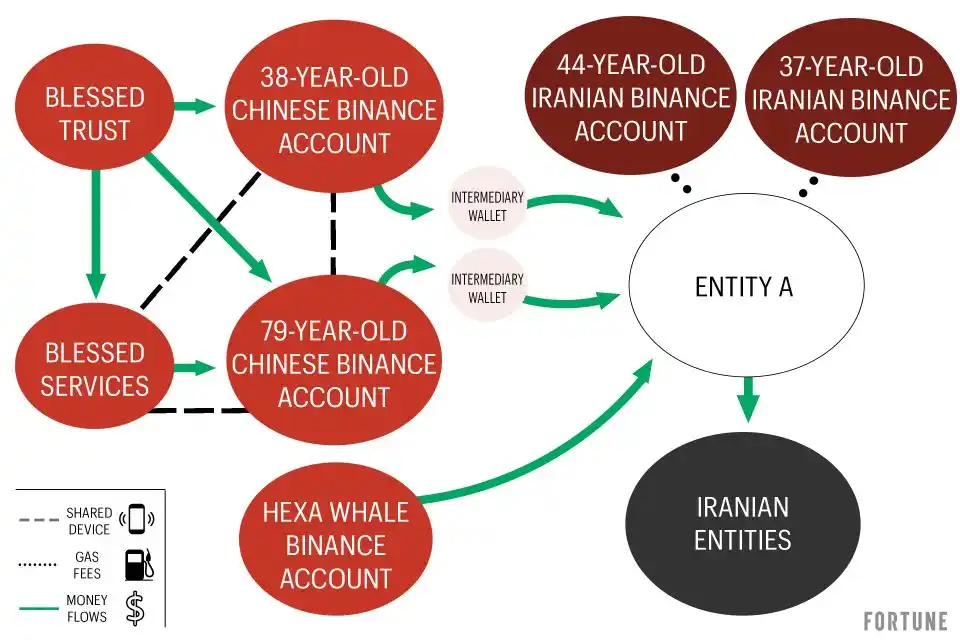
After receiving the request from Seychelles, Binance investigators opened a case and subsequently characterized this series of fund flows as part of a "China-Linked Network"—which also involved another VIP trader. This VIP client was a 38-year-old Chinese woman who transferred nearly $200 million in Tether stablecoins to an intermediate wallet between November and December 2024, which then transferred the funds to "Entity A." (The Binance spokesperson said the term "China-Linked Network" was "an internal, informal designation, not precise, and may have evolved over time," and stated that this VIP account was also taken offline by January 2026.)

More intriguingly, documents reviewed by Fortune indicate that these two VIP accounts were highly likely accessed from the same device—suggesting that the same person, or a third-party entity, might have controlled both accounts. Wick said: "If two ostensibly unrelated VIP clients are found accessing their accounts from the same device, it raises serious questions about beneficial ownership."

In any case, investigators found from blockchain data that both accounts had received funds from Blessed Trust. Blessed Trust is a Hong Kong-based enterprise that helps companies convert crypto funds into fiat currency and also handles back-office tasks like payroll and taxes for Binance. Investigators ultimately concluded that of the total $1.2 billion flowing through Blessed Trust into "Entity A," approximately half came from these two Chinese VIP traders.

Binance attempted to downplay the connection between the platform accounts and the Iran-linked wallets, stating in a recent blog post that there were multiple intermediaries between the exchange and the sanctioned wallets. The post also noted that $1.1 billion of the funds originated from "a large, regulated stablecoin issuer." Investigators concluded in their findings that most of the funds from the two Chinese VIP accounts likely came from stablecoins issued by Circle—a U.S.-listed crypto company. A Circle spokesperson told Fortune: "We take our regulatory obligations seriously," adding that Circle had designated Blessed Trust for termination in 2025.

However, Binance, in its blog post and responses to Fortune and other media, consistently avoided addressing the specific details of these two Chinese VIP accounts on its platform. Furthermore, investigators also found that these two accounts and Blessed Services (another company related to Blessed Trust, which was intermediary in the fund flow to "Entity A") also shared the same device. This evidence suggests the same group might have operated all these accounts. The Binance spokesperson declined to comment on the device-sharing details and stated that Blessed Services has no business relationship with the exchange.

Email addresses associated with Blessed Trust and Blessed Services did not respond to Fortune's requests for comment.

The "China-Linked Network" involved one final link: a Hong Kong-registered company, Hexa Whale Trading Limited, which operated on the Binance platform and transferred approximately $500 million to "Entity A." By the time Binance investigators discovered Hexa Whale's activity, other members of the company's compliance team had already taken the account offline. The Wall Street Journal and The New York Times had previously reported details related to Hexa Whale and Blessed Trust.

Fortune's attempts to contact Hexa Whale and the two Chinese VIP users were unsuccessful.

The investigators involved in the preliminary report were fired by Binance weeks after submitting their initial findings. Binance denied that these employees were dismissed for raising compliance issues and stated in a blog post that the departure of some personnel was decided "after an internal review found violations of company data protection and confidentiality policies." The exchange insisted that it continued the relevant investigation and completed the takedown of Blessed Trust in January 2026.

The investigators declined to comment.
Iran-Linked Clues

Another, smaller set of transaction records also caught the investigators' attention. These transactions were operated by two individuals suspected of Iranian nationality. Compliance experts stated that the mere fact that these two individuals were able to successfully open accounts on Binance and complete transfers already raises questions about the strictness of the company's screening procedures.

The first account was opened in 2021, held by a 44-year-old male whose Dominica ID indicated Iran as his place of birth, and whose name appeared in a 2020 UN Security Council report—a report concerning a gold and cash smuggling network serving Iran and North Korea. The second account was also opened in 2021, held by a 37-year-old male whose uploaded Iraqi ID also indicated Iran as his place of birth. By the time Binance investigators discovered these accounts, they had already been restricted.

The relevant transactions included: each of the two accounts transferring around $100 worth of TRX cryptocurrency to the Iran-linked wallet cluster in 2024—TRX is the native currency used to pay transaction fees on the Tron blockchain. Although the total amount was negligible, this TRX transfer was significant because it likely paid the fees for transfers between the "Entity A" wallet cluster. This situation is roughly analogous to tracking credit card records used to pay for car fuel: if the same card repeatedly pays for gas, it doesn't tell you who is driving, but it can reveal who is footing the bill for the journey.

Lex Fisun, Co-founder and CEO of blockchain analytics firm Global Ledger, said: "Most people only look at large transactions, but small transactions are equally important. On the blockchain, you often can't link a wallet to a real identity. However, when an address repeatedly sends TRX to another wallet to pay fees, it indicates a connection between the two."

Furthermore, Wick pointed out that the association of these accounts with Iran should have triggered more immediate scrutiny. After all, Binance had already pleaded guilty for similar transactions and promised to eradicate such behavior on its platform.

"When multiple high-risk indicators appear simultaneously—especially involving a heavily sanctioned jurisdiction like Iran, or individuals appearing in UN Security Council reports—a properly functioning compliance program should report in real-time," she said. "Account restrictions, enhanced due diligence, blockchain tracing, sanctions risk assessments, these measures should be triggered immediately when the issue occurs, not months later."

The Binance spokesperson said one of the Iranian accounts has been completely taken offline, and the other has been restricted from trading and is in the process of being taken offline. The exchange did not specify whether these accounts were restricted at the time the transactions occurred.

Fortune's attempts to contact the two relevant individuals were unsuccessful.

Exposure to sanctioned entities is a significant risk for any financial institution, and Binance has already paid a heavy price for it. In 2023, it reached a $4.3 billion plea agreement with the U.S. government, partly for failing to maintain an effective anti-money laundering and sanctions compliance program.

Under the plea agreement, co-founder Changpeng Zhao stepped down as CEO and spent four months in federal prison. Binance also agreed to cooperate with a monitor reporting to the Justice and Treasury Departments on its internal operations.

However, the recent dismissal of investigators and the potential Iranian exposure have raised concerns among members of Congress. In late February, Senator Richard Blumenthal (D-Conn.) launched a preliminary investigation into Binance and sent a letter to co-CEO Richard Teng requesting information on the findings of the dismissed investigators and other Iran-related activities.

Blumenthal also specifically mentioned President Trump's pardon of Changpeng Zhao in October—a move that raised conflict-of-interest allegations due to Binance's increasingly close ties to the Trump family's cryptocurrency business.

A White House spokesperson told Fortune: "President Trump's assets are held in a trust managed by his children, and there is no conflict of interest."

However, Blumenthal told Fortune that Binance's connection to the White House presents ongoing ethical concerns: "One of my biggest concerns is that the relationship between Binance and the administration could deter or discourage compliance monitors from exposing and reporting violations, or could hinder the Justice Department from pursuing prosecution."

Preguntas relacionadas

QWhat were the key findings of the Fortune investigation regarding Binance's VIP accounts linked to Iran?

AThe investigation revealed that a VIP account under the name of a 79-year-old Chinese resident transferred $439 million in digital tokens to external wallets, which were later linked to Iranian sanctioned entities, including the Islamic Revolutionary Guard Corps. Another VIP account, a 38-year-old Chinese woman, transferred nearly $200 million in Tether to the same network. Both accounts were suspected of being accessed from the same device, indicating potential common control.

QHow did Binance respond to the allegations of facilitating transactions linked to Iranian sanctions?

ABinance denied that employees were fired for compliance reporting, attributing their departures to violations of internal data protection policies. The exchange stated that its compliance program is continuously improving and that it had offboarded the involved accounts. Binance also filed a defamation lawsuit against The Wall Street Journal for related articles and emphasized that the sanctioned wallets were not on its platform at the time of transactions.

QWhat role did Blessed Trust and Hexa Whale Trading Limited play in the transactions?

ABlessed Trust, a Hong Kong-based entity, facilitated the conversion of crypto to fiat and handled backend operations for Binance. It was involved in transferring $1.2 billion to the Iranian-linked 'Entity A,' with about half originating from the two Chinese VIP accounts. Hexa Whale Trading Limited, another Hong Kong-registered firm, transferred approximately $500 million to Entity A. Both entities were part of the 'China-linked network' identified by investigators.

QWhat were the compliance failures highlighted in the investigation?

AThe investigation pointed out that Binance's compliance systems failed to automatically flag suspicious activities, such as large transfers to wallets linked to sanctioned jurisdictions, despite the 2023 plea agreement with the U.S. government. The exchange did not restrict the VIP accounts until months after the transactions, and it missed red flags like accounts with Iranian identifiers transferring small amounts of TRX to pay for transaction fees related to Entity A.

QWhat broader implications did the investigation have, including U.S. government actions?

AThe findings prompted a U.S. Senate investigation led by Senator Richard Blumenthal, who expressed concerns about Binance's compliance and potential conflicts of interest due to its ties with the Trump administration following the pardon of former CEO Changpeng Zhao. The U.S. Department of Justice is also investigating whether Iran used Binance to evade sanctions, though Binance claims no knowledge of such an investigation.

Lecturas Relacionadas

Trading

Spot
Futuros

Artículos destacados

Qué es $S$

Entendiendo SPERO: Una Visión General Completa Introducción a SPERO A medida que el panorama de la innovación continúa evolucionando, la aparición de tecnologías web3 y proyectos de criptomonedas juega un papel fundamental en la configuración del futuro digital. Un proyecto que ha atraído la atención en este campo dinámico es SPERO, denotado como SPERO,$$s$. Este artículo tiene como objetivo reunir y presentar información detallada sobre SPERO, para ayudar a entusiastas e inversores a comprender sus fundamentos, objetivos e innovaciones dentro de los dominios web3 y cripto. ¿Qué es SPERO,$$s$? SPERO,$$s$ es un proyecto único dentro del espacio cripto que busca aprovechar los principios de descentralización y tecnología blockchain para crear un ecosistema que promueva la participación, la utilidad y la inclusión financiera. El proyecto está diseñado para facilitar interacciones de igual a igual de nuevas maneras, proporcionando a los usuarios soluciones y servicios financieros innovadores. En su esencia, SPERO,$$s$ tiene como objetivo empoderar a los individuos al proporcionar herramientas y plataformas que mejoren la experiencia del usuario en el espacio de las criptomonedas. Esto incluye habilitar métodos de transacción más flexibles, fomentar iniciativas impulsadas por la comunidad y crear caminos para oportunidades financieras a través de aplicaciones descentralizadas (dApps). La visión subyacente de SPERO,$$s$ gira en torno a la inclusividad, buscando cerrar brechas dentro de las finanzas tradicionales mientras aprovecha los beneficios de la tecnología blockchain. ¿Quién es el Creador de SPERO,$$s$? La identidad del creador de SPERO,$$s$ sigue siendo algo oscura, ya que hay recursos públicos limitados que proporcionan información de fondo detallada sobre su(s) fundador(es). Esta falta de transparencia puede derivarse del compromiso del proyecto con la descentralización, una ética que muchos proyectos web3 comparten, priorizando las contribuciones colectivas sobre el reconocimiento individual. Al centrar las discusiones en torno a la comunidad y sus objetivos colectivos, SPERO,$$s$ encarna la esencia del empoderamiento sin señalar a individuos específicos. Como tal, comprender la ética y la misión de SPERO sigue siendo más importante que identificar a un creador singular. ¿Quiénes son los Inversores de SPERO,$$s$? SPERO,$$s$ cuenta con el apoyo de una diversa gama de inversores que van desde capitalistas de riesgo hasta inversores ángeles dedicados a fomentar la innovación en el sector cripto. El enfoque de estos inversores generalmente se alinea con la misión de SPERO, priorizando proyectos que prometen avances tecnológicos sociales, inclusión financiera y gobernanza descentralizada. Estas fundaciones de inversores suelen estar interesadas en proyectos que no solo ofrecen productos innovadores, sino que también contribuyen positivamente a la comunidad blockchain y sus ecosistemas. El respaldo de estos inversores refuerza a SPERO,$$s$ como un contendiente notable en el dominio de proyectos cripto que evoluciona rápidamente. ¿Cómo Funciona SPERO,$$s$? SPERO,$$s$ emplea un marco multifacético que lo distingue de los proyectos de criptomonedas convencionales. Aquí hay algunas de las características clave que subrayan su singularidad e innovación: Gobernanza Descentralizada: SPERO,$$s$ integra modelos de gobernanza descentralizada, empoderando a los usuarios para participar activamente en los procesos de toma de decisiones sobre el futuro del proyecto. Este enfoque fomenta un sentido de propiedad y responsabilidad entre los miembros de la comunidad. Utilidad del Token: SPERO,$$s$ utiliza su propio token de criptomoneda, diseñado para servir diversas funciones dentro del ecosistema. Estos tokens permiten transacciones, recompensas y la facilitación de servicios ofrecidos en la plataforma, mejorando la participación y la utilidad general. Arquitectura en Capas: La arquitectura técnica de SPERO,$$s$ apoya la modularidad y escalabilidad, permitiendo la integración fluida de características y aplicaciones adicionales a medida que el proyecto evoluciona. Esta adaptabilidad es fundamental para mantener la relevancia en el cambiante paisaje cripto. Participación de la Comunidad: El proyecto enfatiza iniciativas impulsadas por la comunidad, empleando mecanismos que incentivan la colaboración y la retroalimentación. Al nutrir una comunidad sólida, SPERO,$$s$ puede abordar mejor las necesidades de los usuarios y adaptarse a las tendencias del mercado. Enfoque en la Inclusión: Al ofrecer tarifas de transacción bajas e interfaces amigables para el usuario, SPERO,$$s$ busca atraer a una base de usuarios diversa, incluyendo a individuos que anteriormente pueden no haber participado en el espacio cripto. Este compromiso con la inclusión se alinea con su misión general de empoderamiento a través de la accesibilidad. Cronología de SPERO,$$s$ Entender la historia de un proyecto proporciona información crucial sobre su trayectoria de desarrollo y hitos. A continuación se presenta una cronología sugerida que mapea eventos significativos en la evolución de SPERO,$$s$: Fase de Conceptualización e Ideación: Las ideas iniciales que forman la base de SPERO,$$s$ fueron concebidas, alineándose estrechamente con los principios de descentralización y enfoque comunitario dentro de la industria blockchain. Lanzamiento del Whitepaper del Proyecto: Tras la fase conceptual, se lanzó un whitepaper completo que detalla la visión, los objetivos y la infraestructura tecnológica de SPERO,$$s$ para generar interés y retroalimentación de la comunidad. Construcción de Comunidad y Primeras Interacciones: Se realizaron esfuerzos de divulgación activa para construir una comunidad de primeros adoptantes y posibles inversores, facilitando discusiones en torno a los objetivos del proyecto y obteniendo apoyo. Evento de Generación de Tokens: SPERO,$$s$ llevó a cabo un evento de generación de tokens (TGE) para distribuir sus tokens nativos a los primeros seguidores y establecer liquidez inicial dentro del ecosistema. Lanzamiento de la dApp Inicial: La primera aplicación descentralizada (dApp) asociada con SPERO,$$s$ se puso en marcha, permitiendo a los usuarios interactuar con las funcionalidades centrales de la plataforma. Desarrollo Continuo y Alianzas: Actualizaciones y mejoras continuas a las ofertas del proyecto, incluyendo alianzas estratégicas con otros actores en el espacio blockchain, han moldeado a SPERO,$$s$ en un jugador competitivo y en evolución en el mercado cripto. Conclusión SPERO,$$s$ se erige como un testimonio del potencial de web3 y las criptomonedas para revolucionar los sistemas financieros y empoderar a los individuos. Con un compromiso con la gobernanza descentralizada, la participación comunitaria y funcionalidades diseñadas de manera innovadora, allana el camino hacia un paisaje financiero más inclusivo. Como con cualquier inversión en el espacio cripto que evoluciona rápidamente, se anima a los posibles inversores y usuarios a investigar a fondo y participar de manera reflexiva con los desarrollos en curso dentro de SPERO,$$s$. El proyecto muestra el espíritu innovador de la industria cripto, invitando a una mayor exploración de sus innumerables posibilidades. Mientras el viaje de SPERO,$$s$ aún se desarrolla, sus principios fundamentales pueden, de hecho, influir en el futuro de cómo interactuamos con la tecnología, las finanzas y entre nosotros en ecosistemas digitales interconectados.

72 Vistas totalesPublicado en 2024.12.17Actualizado en 2024.12.17

Qué es $S$

Qué es AGENT S

Agent S: El Futuro de la Interacción Autónoma en Web3 Introducción En el paisaje en constante evolución de Web3 y las criptomonedas, las innovaciones están redefiniendo constantemente cómo los individuos interactúan con las plataformas digitales. Uno de estos proyectos pioneros, Agent S, promete revolucionar la interacción humano-computadora a través de su marco agente abierto. Al allanar el camino para interacciones autónomas, Agent S busca simplificar tareas complejas, ofreciendo aplicaciones transformadoras en inteligencia artificial (IA). Esta exploración detallada profundizará en las complejidades del proyecto, sus características únicas y las implicaciones para el dominio de las criptomonedas. ¿Qué es Agent S? Agent S se presenta como un marco agente abierto innovador, diseñado específicamente para abordar tres desafíos fundamentales en la automatización de tareas informáticas: Adquisición de Conocimiento Específico del Dominio: El marco aprende inteligentemente de diversas fuentes de conocimiento externas y experiencias internas. Este enfoque dual le permite construir un rico repositorio de conocimiento específico del dominio, mejorando su rendimiento en la ejecución de tareas. Planificación a Largo Plazo de Tareas: Agent S emplea planificación jerárquica aumentada por la experiencia, un enfoque estratégico que facilita la descomposición y ejecución eficiente de tareas complejas. Esta característica mejora significativamente su capacidad para gestionar múltiples subtareas de manera eficiente y efectiva. Manejo de Interfaces Dinámicas y No Uniformes: El proyecto introduce la Interfaz Agente-Computadora (ACI), una solución innovadora que mejora la interacción entre agentes y usuarios. Utilizando Modelos de Lenguaje Multimodal de Gran Escala (MLLMs), Agent S puede navegar y manipular diversas interfaces gráficas de usuario sin problemas. A través de estas características pioneras, Agent S proporciona un marco robusto que aborda las complejidades involucradas en la automatización de la interacción humana con las máquinas, preparando el terreno para una multitud de aplicaciones en IA y más allá. ¿Quién es el Creador de Agent S? Si bien el concepto de Agent S es fundamentalmente innovador, la información específica sobre su creador sigue siendo elusiva. El creador es actualmente desconocido, lo que resalta ya sea la etapa incipiente del proyecto o la elección estratégica de mantener a los miembros fundadores en el anonimato. Independientemente de la anonimidad, el enfoque sigue siendo en las capacidades y el potencial del marco. ¿Quiénes son los Inversores de Agent S? Dado que Agent S es relativamente nuevo en el ecosistema criptográfico, la información detallada sobre sus inversores y patrocinadores financieros no está documentada explícitamente. La falta de información disponible públicamente sobre las bases de inversión u organizaciones que apoyan el proyecto plantea preguntas sobre su estructura de financiamiento y hoja de ruta de desarrollo. Comprender el respaldo es crucial para evaluar la sostenibilidad del proyecto y su posible impacto en el mercado. ¿Cómo Funciona Agent S? En el núcleo de Agent S se encuentra una tecnología de vanguardia que le permite funcionar de manera efectiva en diversos entornos. Su modelo operativo se basa en varias características clave: Interacción Humano-Computadora Similar a la Humana: El marco ofrece planificación avanzada de IA, esforzándose por hacer que las interacciones con las computadoras sean más intuitivas. Al imitar el comportamiento humano en la ejecución de tareas, promete elevar las experiencias de los usuarios. Memoria Narrativa: Empleada para aprovechar experiencias de alto nivel, Agent S utiliza memoria narrativa para hacer un seguimiento de las historias de tareas, mejorando así sus procesos de toma de decisiones. Memoria Episódica: Esta característica proporciona a los usuarios una guía paso a paso, permitiendo que el marco ofrezca apoyo contextual a medida que se desarrollan las tareas. Soporte para OpenACI: Con la capacidad de ejecutarse localmente, Agent S permite a los usuarios mantener el control sobre sus interacciones y flujos de trabajo, alineándose con la ética descentralizada de Web3. Fácil Integración con APIs Externas: Su versatilidad y compatibilidad con varias plataformas de IA aseguran que Agent S pueda encajar sin problemas en ecosistemas tecnológicos existentes, convirtiéndolo en una opción atractiva para desarrolladores y organizaciones. Estas funcionalidades contribuyen colectivamente a la posición única de Agent S dentro del espacio cripto, ya que automatiza tareas complejas y de múltiples pasos con una intervención humana mínima. A medida que el proyecto evoluciona, sus posibles aplicaciones en Web3 podrían redefinir cómo se desarrollan las interacciones digitales. Cronología de Agent S El desarrollo y los hitos de Agent S pueden encapsularse en una cronología que resalta sus eventos significativos: 27 de septiembre de 2024: El concepto de Agent S fue lanzado en un documento de investigación integral titulado “Un Marco Agente Abierto que Usa Computadoras Como un Humano”, mostrando las bases del proyecto. 10 de octubre de 2024: El documento de investigación fue puesto a disposición del público en arXiv, ofreciendo una exploración profunda del marco y su evaluación de rendimiento basada en el benchmark OSWorld. 12 de octubre de 2024: Se lanzó una presentación en video, proporcionando una visión visual de las capacidades y características de Agent S, involucrando aún más a posibles usuarios e inversores. Estos marcadores en la cronología no solo ilustran el progreso de Agent S, sino que también indican su compromiso con la transparencia y la participación comunitaria. Puntos Clave Sobre Agent S A medida que el marco Agent S continúa evolucionando, varios atributos clave destacan, subrayando su naturaleza innovadora y potencial: Marco Innovador: Diseñado para proporcionar un uso intuitivo de las computadoras similar a la interacción humana, Agent S aporta un enfoque novedoso a la automatización de tareas. Interacción Autónoma: La capacidad de interactuar de manera autónoma con las computadoras a través de GUI significa un salto hacia soluciones informáticas más inteligentes y eficientes. Automatización de Tareas Complejas: Con su metodología robusta, puede automatizar tareas complejas y de múltiples pasos, haciendo que los procesos sean más rápidos y menos propensos a errores. Mejora Continua: Los mecanismos de aprendizaje permiten a Agent S mejorar a partir de experiencias pasadas, mejorando continuamente su rendimiento y eficacia. Versatilidad: Su adaptabilidad en diferentes entornos operativos como OSWorld y WindowsAgentArena asegura que pueda servir a una amplia gama de aplicaciones. A medida que Agent S se posiciona en el paisaje de Web3 y criptomonedas, su potencial para mejorar las capacidades de interacción y automatizar procesos significa un avance significativo en las tecnologías de IA. A través de su marco innovador, Agent S ejemplifica el futuro de las interacciones digitales, prometiendo una experiencia más fluida y eficiente para los usuarios en diversas industrias. Conclusión Agent S representa un audaz avance en la unión de la IA y Web3, con la capacidad de redefinir cómo interactuamos con la tecnología. Aunque aún se encuentra en sus primeras etapas, las posibilidades para su aplicación son vastas y atractivas. A través de su marco integral que aborda desafíos críticos, Agent S busca llevar las interacciones autónomas al primer plano de la experiencia digital. A medida que nos adentramos más en los reinos de las criptomonedas y la descentralización, proyectos como Agent S sin duda desempeñarán un papel crucial en la configuración del futuro de la tecnología y la colaboración humano-computadora.

357 Vistas totalesPublicado en 2025.01.14Actualizado en 2025.01.14

Qué es AGENT S

Cómo comprar S

¡Bienvenido a HTX.com! Hemos hecho que comprar Sonic (S) sea simple y conveniente. Sigue nuestra guía paso a paso para iniciar tu viaje de criptos.Paso 1: crea tu cuenta HTXUtiliza tu correo electrónico o número de teléfono para registrarte y obtener una cuenta gratuita en HTX. Experimenta un proceso de registro sin complicaciones y desbloquea todas las funciones.Obtener mi cuentaPaso 2: ve a Comprar cripto y elige tu método de pagoTarjeta de crédito/débito: usa tu Visa o Mastercard para comprar Sonic (S) al instante.Saldo: utiliza fondos del saldo de tu cuenta HTX para tradear sin problemas.Terceros: hemos agregado métodos de pago populares como Google Pay y Apple Pay para mejorar la comodidad.P2P: tradear directamente con otros usuarios en HTX.Over-the-Counter (OTC): ofrecemos servicios personalizados y tipos de cambio competitivos para los traders.Paso 3: guarda tu Sonic (S)Después de comprar tu Sonic (S), guárdalo en tu cuenta HTX. Alternativamente, puedes enviarlo a otro lugar mediante transferencia blockchain o utilizarlo para tradear otras criptomonedas.Paso 4: tradear Sonic (S)Tradear fácilmente con Sonic (S) en HTX's mercado spot. Simplemente accede a tu cuenta, selecciona tu par de trading, ejecuta tus trades y monitorea en tiempo real. Ofrecemos una experiencia fácil de usar tanto para principiantes como para traders experimentados.

740 Vistas totalesPublicado en 2025.01.15Actualizado en 2025.03.21

Cómo comprar S

Discusiones

Bienvenido a la comunidad de HTX. Aquí puedes mantenerte informado sobre los últimos desarrollos de la plataforma y acceder a análisis profesionales del mercado. A continuación se presentan las opiniones de los usuarios sobre el precio de S (S).

活动图片