"Form Over Substance" Fed Hearing: Warsh Avoids Interest Rates, But Offers Reassurance for Crypto

Odaily星球日报Publicado a 2026-04-22Actualizado a 2026-04-22

Resumen

Kevin Wash, nominee for Federal Reserve Chair, testified before the Senate Banking Committee, emphasizing his independence from former President Trump and stating that Trump never asked him to commit to specific interest rate decisions. Wash avoided extensive discussion on monetary policy but called for institutional reforms at the Fed, advocating for a gradual and cautious reduction of the balance sheet without clear signals on rate cuts. The hearing was seen as largely symbolic, with Wash’s confirmation hinging on political negotiations offstage, particularly whether Trump drops his investigation into current Chair Powell. Notably, Wash expressed a crypto-friendly stance, acknowledging digital assets as part of the U.S. financial services industry and committing to divest his own crypto holdings if confirmed. This marks a positive signal for the crypto market from a potential Fed leader.

Original | Odaily Planet Daily (@OdailyChina)

Author | Golem (@web3_golem)
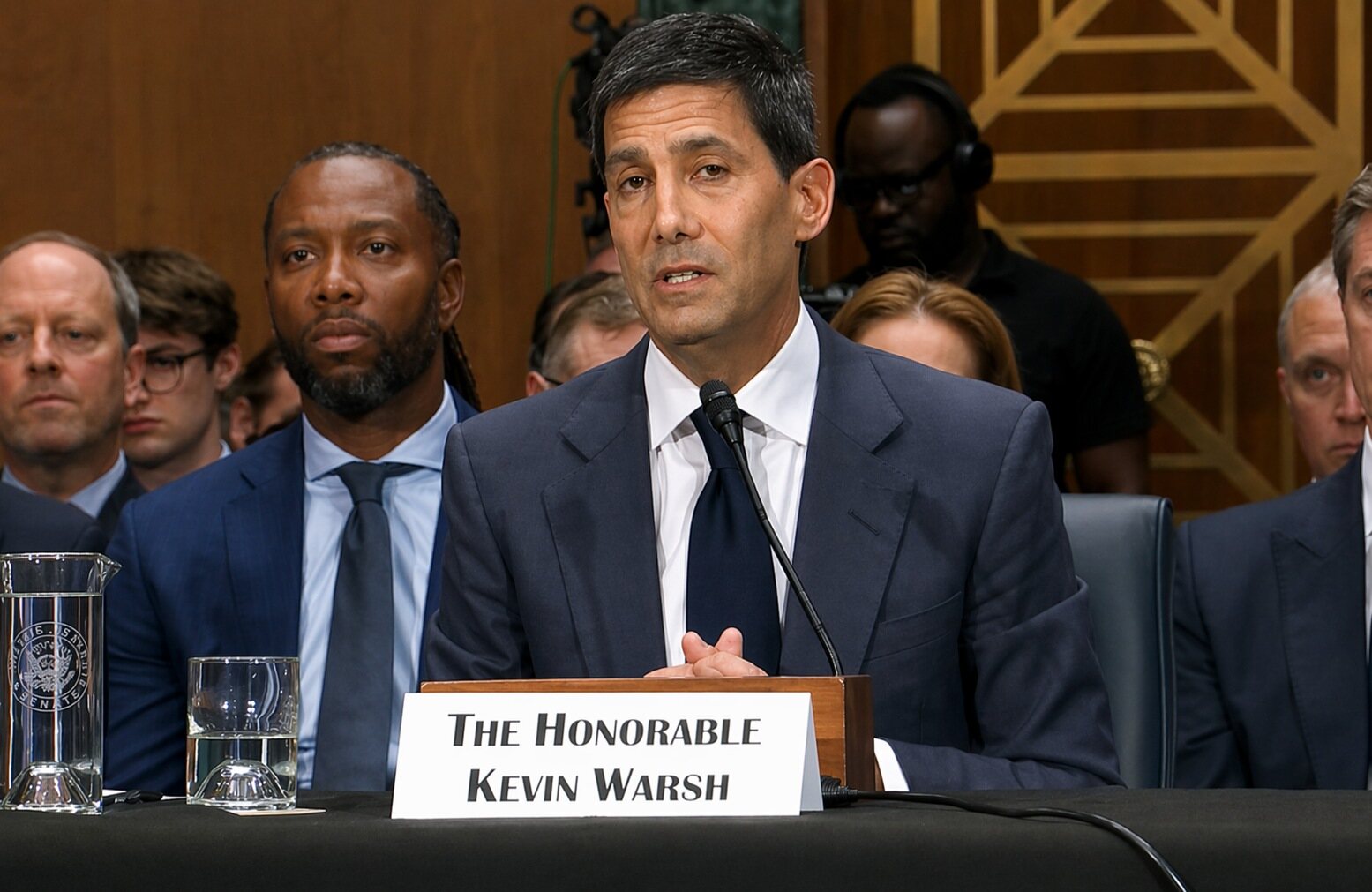
At 10 PM Beijing time on April 21, Federal Reserve Chair nominee Kevin Warsh attended a confirmation hearing before the Senate Banking Committee, where he faced questioning on his commitment to monetary policy and the Fed's independence, according to The Wall Street Journal.

During the hearing, when addressing the issue of the Fed's independence, Warsh stated that he would be independent of Trump, and that Trump had never asked him to commit to any specific interest rate decisions. He further argued that even if Trump had asked, he would never have agreed. Beyond such statements, Warsh largely avoided answering questions related to Trump. On monetary policy, Warsh heavily criticized the Federal Reserve's institutions, arguing that the Fed needs institutional changes in its decision-making processes. However, he made very few specific statements on monetary policy itself, mentioning only that the Fed needs to gradually and cautiously reduce its balance sheet, with no clear statements indicating interest rate cuts.

This might have been intentional on Warsh's part. According to his opening statement obtained in advance by Bloomberg, although Warsh's prepared testimony was nearly 2000 words long—far exceeding the approximately 850 to 900 words of Powell's and former Chair Yellen's initial hearings—it contained very little substantive discussion on the direction of monetary policy. This move by Warsh is consistent with his long-held stance that Fed officials should not pre-commit to interest rate positions.

But for investors following this hearing, regardless of their expectations, the outcome was likely disappointing. In terms of both content and results, the substantive significance of this hearing was minimal. Bloomberg columnist John Authers even characterized it as a political performance of "form over substance" before the hearing began. Ultimately, whether Warsh's nomination is successfully confirmed by the Senate depends on off-stage political maneuvering, not on anything Warsh says at the podium.

The Stubborn Trump and the Innocent Warsh

As previously analyzed by Odaily Planet Daily, the importance of this hearing lay in its potential to decide whether Powell would stay or go after his term ends on May 15. If Warsh's nomination was not confirmed by the Senate this time, Powell would very likely remain as interim Fed Chair after his term expires. (Related reading:Powell's Chance of Staying Soars to 98%, Is Trump's "Firing Order" Just Bluster?)

However, after this hearing, the market still cannot determine whether Warsh's nomination for Fed Chair will be confirmed by the Senate as scheduled, because the main figure obstructing Warsh's nomination, Thom Tillis, didn't even engage in effective dialogue with Warsh.

Thom Tillis had previously stated publicly that he would not support moving Warsh's nomination process to a full Senate vote unless Trump dropped his investigation into Powell. During the April 21 hearing, Thom Tillis did not even question Warsh. Instead, he used a set of slides to justify the cost overruns in the Fed building renovation project. Finally, he stated that his dissatisfaction was not directed at Warsh, whom he called "exceptionally qualified, impeccable," but that he needed this investigation to end before he could support Warsh's confirmation.

Therefore, the content of the hearing could no longer decide the outcome. Whether Trump can finally get rid of Powell on schedule now hinges on whether the Senate confirms Warsh's nomination in time, and whether Warsh's nomination proceeds smoothly again depends on whether Trump is willing to drop the investigation into Powell.

On April 21, Trump also discussed the Fed and interest rates in a new interview. He said he would be disappointed if the new Fed Chair (Warsh) did not cut rates quickly, but he also must get to the bottom of the Fed building cost overruns. Pressuring the new Fed Chair Warsh to cut rates and investigating Powell are parallel actions; Trump shows no sign of backing down.

As John Authers said, the real game is happening outside the hearing room, and Warsh is even "collateral damage." The impasse will be broken either if Thom Tillis concedes, or if Warsh uses the prospect of rate cuts as leverage to persuade Trump to drop the investigation into Powell, allowing Warsh to take charge of the Fed sooner. Warsh's relationship with Trump is not ordinary. Warsh's father-in-law, Ronald Steven Lauder, is the sole heir to the international cosmetics giant Estée Lauder Companies, and he is also a Republican donor and Trump's college classmate. Therefore, if Warsh truly wants to take charge of the Fed soon, he might be able to persuade Trump to drop the investigation.

Otherwise, if this stalemate continues until Powell's term expires and Trump chooses to fire Powell to resolve it, as Odaily Planet Daily previously analyzed, the result would probably be in Powell's favor. It is worth mentioning that, according to monitoring by the Odaily Seer channel, the probability of Powell stepping down as Fed Chair after his term expires on Polymarket remains at 2%. However, upon closer inspection of the settlement rules for this event contract, if Powell's resignation/removal is announced before the market end date, the market will immediately settle to "Yes" regardless of when the announced resignation/removal takes effect.
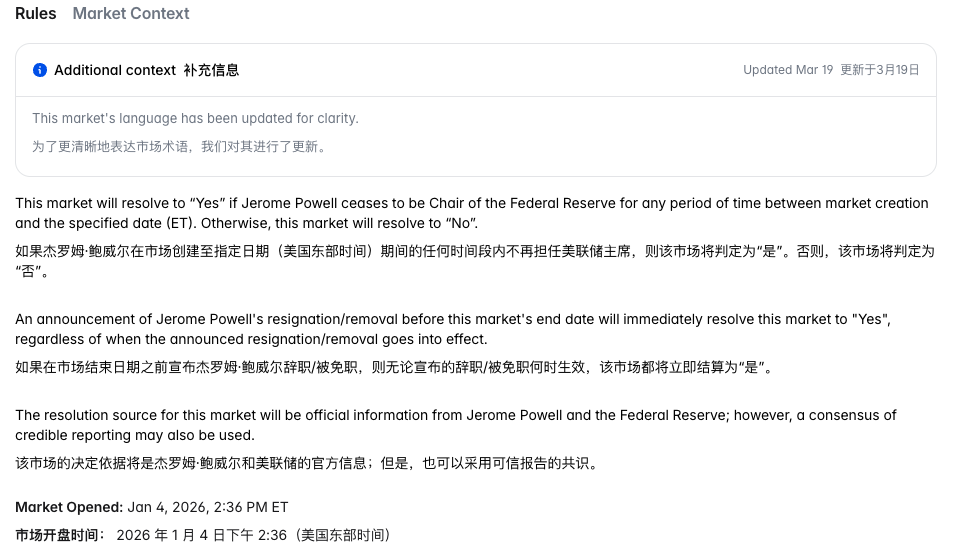
Settlement rules for the market on whether Powell will step down as Fed Chair after his term expires

This means that as soon as Trump announces the firing of Powell, the event would be settled. Although Powell could file a lawsuit to challenge the legal effect of the President's removal during the litigation process, litigation is a lengthy process. Therefore, the rule stating "the market is immediately settled to Yes regardless of when the announced resignation/removal takes effect" becomes a potential loophole. (Odaily Note: The above is only the author's personal judgment and does not constitute any advice)

Warsh: Digital Assets Are Part of the US Financial Services Industry

But for the crypto industry, there was some substance in this hearing. It was previously disclosed that Warsh holds a series of assets including cryptocurrency, Polymarket, and SpaceX stock, which was seen as a sign of his friendly attitude towards the crypto industry.

During the hearing, when questioned about his financial disclosures exceeding $100 million and potential conflicts of interest, Warsh promised to divest related assets before taking office if his nomination is approved. But he further stated that digital assets are part of the US financial services industry, affirming the legitimacy and importance of the crypto industry in the United States. Although it was only briefly mentioned, having someone poised to take one of the most powerful positions in the global economy indicate that they are crypto-friendly is definitely good news.


Preguntas relacionadas

QWhat was the main focus of Kevin Warsh's Senate confirmation hearing for Fed Chair nominee?

AThe hearing focused on his commitment to monetary policy, Fed independence, and his relationship with Trump, but provided little substantive discussion on specific interest rate policies.

QHow did Kevin Warsh address his holdings in cryptocurrencies during the hearing?

AWarsh pledged to divest his crypto assets if confirmed, but also stated that digital assets are part of the U.S. financial services industry, affirming their legitimacy and importance.

QWhat political obstacle threatens Kevin Warsh's confirmation as Fed Chair?

ASenator Thom Tillis opposes Warsh's confirmation unless Trump drops his investigation into current Fed Chair Jerome Powell, creating a political stalemate.

QWhat did Bloomberg columnist John Authers characterize Kevin Warsh's hearing as?

AJohn Authers characterized the hearing as a political performance 'more form than substance,' with the outcome depending on off-stage political bargaining rather than Warsh's statements.

QAccording to the article, what is the significance of Warsh expressing crypto-friendly views?

AIt is positive news for the crypto industry as the potential head of the world's most powerful economic institution acknowledged its legitimacy and role within U.S. financial services.

Lecturas Relacionadas

Annual Salary of Millions Competing for Electricians, Meta Rushes to Open Its Own Technical School

The AI boom is facing an unexpected bottleneck: a severe shortage of skilled construction workers and electricians. As tech giants like Meta, OpenAI, and Alphabet race to build massive data centers—such as OpenAI's $16 billion "Stargate" project—they are hitting a critical labor wall. The U.S. needs an estimated 130,000 more electricians, 240,000 construction workers, and 150,000 supervisors by 2030 for AI infrastructure alone, but tens of thousands of electrician jobs go unfilled each year. While AI companies offer high premiums, with electricians earning up to $280,000 annually, worker scarcity still causes massive losses—delays on a single project can cost $14.2 million per month. The complexity of building AI data centers, which require immense power (equivalent to powering hundreds of thousands of homes), sophisticated electrical systems, and advanced liquid cooling solutions, demands highly skilled technicians who are in short supply. To combat this, companies are investing heavily in training. Meta has committed $115 million to a free training school offering tuition, housing, and stipends, targeting 5,000 new workers. OpenAI is partnering with unions to secure skilled labor. These efforts are paying off, with a significant rise in Gen Z interest in trade schools over college. However, the power demands are staggering. AI data centers are driving a rapid surge in electricity consumption, projected to account for up to 12% of U.S. power use by 2028 and raising costs for consumers. Furthermore, the construction boom is project-based, leading to a potential future glut of trained workers once building peaks, which could depress wages industry-wide. The race for AI supremacy now depends as much on skilled hands as on advanced chips.

marsbitHace 6 min(s)

Annual Salary of Millions Competing for Electricians, Meta Rushes to Open Its Own Technical School

marsbitHace 6 min(s)

OpenAI No Longer Sells Its Most Expensive Model for Profit

OpenAI is shifting its business strategy away from promoting its most expensive, flagship models for every task. Recent price cuts—80% for GPT-5.6 Luna and 20% for Terra—signal a deeper change: the company now actively advises users that many tasks don't require the most powerful model. Instead, OpenAI recommends a tiered approach: use the high-end GPT-5.6 Sol for complex planning and analysis, then delegate execution to cheaper models like Luna. This mirrors moves by Anthropic, which recently launched Claude Opus 5 at half the price of its top model, Fable 5. Both companies are de-emphasizing flagship models as primary revenue drivers, using them instead for brand prestige and technological showcases. The industry is entering a "mass-market" phase, similar to automotive, where high-volume, cost-effective models handle daily operations and drive scale. OpenAI's price reductions are partly enabled by AI models themselves optimizing underlying code and infrastructure, creating a self-reinforcing cycle of efficiency gains and cost reduction. Competition is shifting from "who is smartest" to "who offers the best value." The goal is no longer selling individual models but fostering widespread API adoption and ecosystem lock-in. By making AI calls cheap and ubiquitous, companies like OpenAI aim to become the indispensable, utility-like infrastructure powering automated workflows—the "water and electricity" of software, quietly embedded everywhere.

marsbitHace 6 min(s)

OpenAI No Longer Sells Its Most Expensive Model for Profit

marsbitHace 6 min(s)

Will the Fed Definitely Raise Interest Rates in September? How Will Crypto and U.S. Stocks Withstand the Pressure?

The market's expectation for a September Fed rate hike surged dramatically in early August, jumping from under 50% to over 80% within a week. This shift followed a contentious July FOMC meeting, where a 9-3 vote to hold rates revealed growing dissent from hawkish members advocating for an immediate hike to combat persistent inflation. The primary catalyst for this repricing is rising oil prices, driven by renewed geopolitical tensions around the Strait of Hormuz, which threaten global supply. Energy costs directly influence inflation metrics, making the upcoming July CPI report (due August 12th) a critical data point. If it shows inflation reaccelerating, the probability of a September hike will solidify. For Bitcoin and crypto assets, this is typically bearish news. Bitcoin continues to behave as a high-beta, liquidity-sensitive risk asset. A rate hike raises the opportunity cost of holding non-yielding assets and could drive capital toward money markets, pressuring crypto prices in the short term. However, historical patterns suggest that if a hike is perceived as the end of a tightening cycle rather than the start, any negative price impact may be brief. U.S. stocks, particularly crypto-linked equities like Coinbase and growth-oriented tech stocks, are also vulnerable. Higher rates increase discount rates in valuation models, putting pressure on high-multiple companies. This coincides with a pivotal tech earnings season where investor focus has shifted from massive AI capital expenditure to tangible revenue and cash flow generation. Companies with negative cash flow and weak growth narratives could face heightened volatility if borrowing costs rise in September. In summary, a September Fed hike has evolved into a mainstream market scenario. Key factors to watch are oil prices, the July CPI report, and Fed communications, which will determine the final decision and its impact on volatile crypto and equity markets.

marsbitHace 17 min(s)

Will the Fed Definitely Raise Interest Rates in September? How Will Crypto and U.S. Stocks Withstand the Pressure?

marsbitHace 17 min(s)

Trading

Spot
活动图片




