Forbes Editorial: The Most Accurate Short Signal in the Crypto World?

marsbitPublicado a 2026-02-06Actualizado a 2026-02-06

Resumen

Forbes magazine covers have become an infamous bearish signal in the crypto world, often marking the peak of market cycles just before major crashes. The article highlights three key examples: 1. **CZ (2018)**: Featured on the cover during Bitcoin's downturn from its late-2017 high. Bitcoin fell 58% after the issue. 2. **SBF (2021)**: Called "crypto's most powerful man" before FTX collapsed 13 months later, wiping out billions. 3. **Michael Saylor (2025)**: Dubbed "The Bitcoin Alchemist" near Bitcoin's $104K peak. A year later, Bitcoin dropped 40%, and his company faced $6.5B in unrealized losses. The "magazine cover indicator" suggests mainstream media attention often coincides with market euphoria and impending reversals. While Sun Yuchen’s March 2025 cover briefly defied the trend (as Bitcoin continued rising), multiple crypto covers in quick succession were themselves a signal of overheated sentiment. The conclusion: bull markets don’t end in panic—they end on magazine covers. When a trend becomes too popular and even non-traders are talking about it, it may be time to reconsider positions.

Author: Curry, Deep Tide TechFlow
Bitcoin recently hit $60,000, marking the largest single-day drop since the FTX collapse.

Michael Saylor's company, Strategy (formerly MicroStrategy), holds 713,000 bitcoins with an average cost of $76,052. As of last night, the unrealized loss reached $6.5 billion. The stock price has plummeted from a high of $457 last year to $110, wiping out more than three-quarters of its value.

However, a year ago, Saylor graced the cover of the renowned magazine Forbes. The headline read:

The Bitcoin Alchemist. At that time, Bitcoin was priced at $104,000, and Saylor's net worth was $9.4 billion.

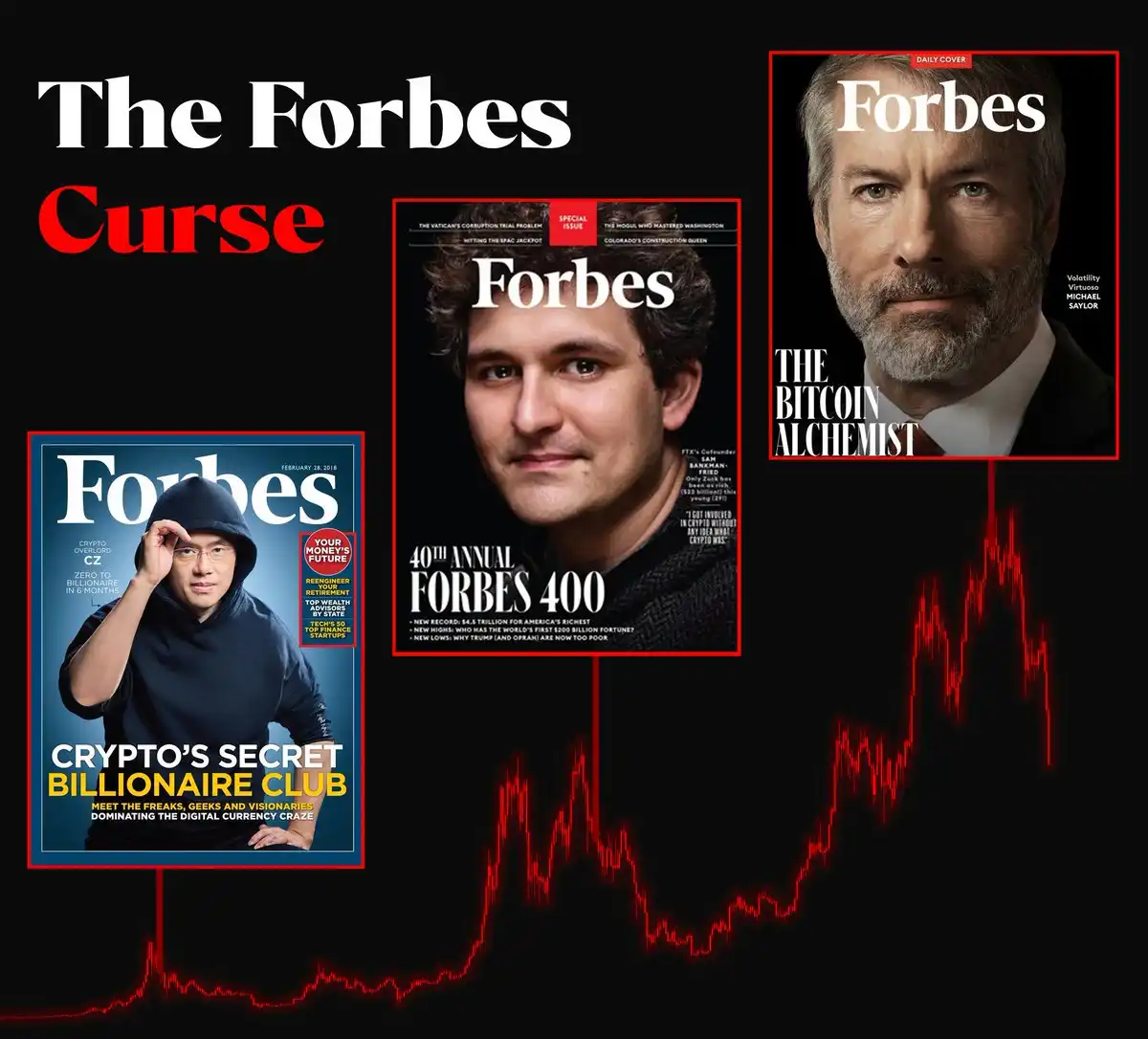
Now, a chart circulating on Twitter lines up three Forbes covers with Bitcoin's price chart. Each cover perfectly marks the starting point of a sharp decline.

Of these three individuals, one has been to prison, one is currently in prison, and the third just lost $6.5 billion.

The Cover: Captured at the Peak of Hype

The first crypto figure to appear on a Forbes cover was CZ.

In February 2018, Forbes featured a cover titled "Crypto's Secret Billionaire Club," with CZ standing in the center, hoodie on, exuding a rugged aura. The fine print read:

From zero to billionaire in just 6 months.

At that time, Bitcoin had just fallen from nearly $20,000 at the end of 2017 to around $7,600. Forbes estimated CZ's net worth to be at least $1.1 billion. Binance, only six months old, was already the world's largest exchange by trading volume.

After the cover was released, Bitcoin briefly rebounded to $10,000. Then, it went nowhere but down.

By December 2018, Bitcoin had fallen to $3,156. From the day the cover was published, the decline was:

58%.

CZ's later story is well-known. On Forbes' 2025 global billionaires list, CZ's net worth was $62.9 billion, ranking first in the crypto industry.

But he hasn't appeared on the cover since.

The second Forbes cover featured Sam Bankman-Fried.

In October 2021, Forbes released its 40th Forbes 400 Richest Americans list, with SBF as the cover star. Under 30 years old, with a net worth of $26.5 billion, he ranked as the 41st richest person in the U.S.

On the cover, he wore his signature gray T-shirt, with curly hair, looking like a college student who had just pulled an all-nighter playing League of Legends.

In hindsight, the magazine's tone was surreal. Forbes called him "the most powerful person in the crypto industry," praising him for building an exchange while donating to charity, a blend of Wall Street and Silicon Valley.

When the cover was released, Bitcoin was around $60,000, just a step away from its then-all-time high of $69,000.

Thirteen months later, FTX collapsed.

SBF had misappropriated over $8 billion in customer funds to cover losses at his other company, Alameda Research. In November 2022, users rushed to withdraw their assets, and FTX couldn't meet the demand. Within a week, the world's third-largest exchange went bankrupt. Bitcoin plummeted from $20,000 to $16,000.

Eventually, SBF was arrested in his luxury apartment in the Bahamas.

He was convicted on all seven charges and sentenced to 25 years in prison. Forbes later created a "30 Under 30 Hall of Shame," with SBF prominently featured.

From cover to handcuffs:

13 months.

The third was Michael Saylor.

On January 30, 2025, the Forbes cover featured "The Bitcoin Alchemist." Bitcoin had just broken through $100,000, and Saylor's net worth had surged from $1.9 billion the previous year to $9.4 billion, nearly a fivefold increase. His company, MicroStrategy, saw its stock price rise 700% in a year and was newly included in the Nasdaq 100 index.

The Forbes article recorded a detail:

On New Year's Eve, Saylor hosted a 500-person party at his estate in Miami. Dancers waved orange Bitcoin glow balls, and outside, a 154-foot yacht named Usher ferried institutional investors and crypto industry leaders to the event.

At the time, Saylor told Forbes:

"We've put a crypto reactor in the middle of the company, sucking in capital and spinning it. Volatility drives everything." This statement was, of course, sincere. Saylor's alchemy boils down to one thing: issuing debt to buy Bitcoin.

When the Forbes cover was released, Bitcoin was at $104,000. One year and six days later, it's at $63,000. A decline of:

40%.

Saylor said on an earnings call that Strategy had built a "digital fortress."

The last crypto mogul to call his company a "fortress" was SBF. That was in June 2022. Five months later, FTX went bankrupt.

The Cover: Both Praise and Curse

There's an old Wall Street concept called the "magazine cover indicator":

When a trend makes it to the cover of a mainstream magazine, that trend has often already peaked.

The reasoning is simple. Forbes editors aren't prophets; like all retail investors, they only notice a story when it's at its most hyped.

The moment a magazine deems "someone in some industry worthy of a cover" is precisely the moment when market frenzy has reached its peak.

The cover isn't the cause of the curse; it's a symptom of the bubble.

However, there was one brief exception to this rule.

In March of last year, Justin Sun graced the Forbes cover with the headline "The Crypto Billionaire Who Helped the Trump Family Make $400 Million."

When the cover was released, Bitcoin was at $87,000. It didn't crash; instead, it rallied to a historic high of $126,000 in October.

Did the curse fail?

Not entirely. When Sun appeared on the cover, it was only two months after Saylor's. One cover in January, another in March—the密集 appearance of crypto figures on mainstream magazine covers was itself a signal. It indicated that the industry's narrative had become so hot that even Forbes editors felt one issue wasn't enough.

When covers start appearing in clusters, in hindsight, the peak of a bull market might have a checklist of symptoms:

Forbes covers, taxi drivers discussing crypto, relatives asking how to open an account... If two out of three signals appear, it's time to think about your position.

So, the real question isn't "Is the Forbes cover accurate?" but rather:

When everyone around you is telling the same story, when that story is so good that even people who don't trade crypto have heard of it, when mainstream media starts deifying figures in an industry...

Are you the one still buying, or the one already selling?

Bull markets don't end in panic. They end on magazine covers.

It's just that the cover stars may change, but the long bear market is always paid for by me.

Criptos en tendencia

Preguntas relacionadas

QWhat is the 'magazine Cover Indicator' mentioned in the article, and how does it relate to the cryptocurrency market?

AThe 'Magazine Cover Indicator' is an old Wall Street concept suggesting that when a trend or person makes the cover of a mainstream magazine like Forbes, it often signals that the trend has peaked and is about to reverse. In the context of the cryptocurrency market, the article argues that Forbes covers featuring crypto billionaires like CZ, SBF, and Michael Saylor have each coincided with the start of a major price crash, as the cover is a symptom of peak market euphoria and mainstream attention.

QAccording to the article, what happened to Bitcoin's price after Michael Saylor appeared on the cover of Forbes?

AAccording to the article, when Michael Saylor appeared on the cover of Forbes on January 30, 2025, Bitcoin was priced at $104,000. One year and six days later, the price had fallen to $63,000, representing a decline of 40%.

QWho were the three crypto figures featured on Forbes covers, and what were their respective outcomes?

AThe three crypto figures featured on Forbes covers were: 1. CZ (Changpeng Zhao): Featured in February 2018. Bitcoin fell 58% after his cover. He later became the wealthiest person in crypto but faced legal issues. 2. Sam Bankman-Fried (SBF): Featured in October 2021. FTX collapsed 13 months later, and SBF was arrested and sentenced to 25 years in prison. 3. Michael Saylor: Featured in January 2025. His company, MicroStrategy, faced billions in unrealized losses on its Bitcoin holdings, and the price fell 40% after the cover.

QWhy does the article claim that a Forbes cover is a symptom of a market top and not the cause of a crash?

AThe article claims that a Forbes cover is a symptom, not a cause, because magazine editors are not prophets. They only feature a trend or person on the cover when the story is at its most popular and mainstream attention is at its peak. This moment of maximum hype and widespread recognition often coincides with the top of a market cycle, making the cover an indicator of excessive euphoria rather than a catalyst for the subsequent decline.

QWhat exception to the 'Forbes cover curse' does the article mention, and how does it explain this anomaly?

AThe article mentions that Justin Sun (Sun Yuchen) appeared on the cover of Forbes in March of an unspecified year (likely 2025), and instead of crashing, Bitcoin's price continued to rise to a new all-time high of $126,000 by October. The article explains this anomaly by stating that the curse wasn't entirely broken. The fact that crypto figures appeared on Forbes covers so frequently (Saylor in January, Sun in March) was itself a signal that the market narrative was overheated. The high frequency of covers was a symptom of the peak, even if the immediate crash for one specific cover was delayed.

Lecturas Relacionadas

Within Strategy's Framework, STRC's Dividend Yield Remains at 12% as Share Price Stays Below Par Value

Michael Saylor, Executive Chairman of Strategy (MSTR), confirmed that the dividend rate for its STRC perpetual preferred shares will remain at 12.00% through August 2026. The rate has increased from 9% at its July 2025 launch to the current high via a "ratchet" mechanism, which permanently raises the rate by 0.5% whenever the share price falls below $95. This mechanism is intended to push the price back toward its $100 par value and support Strategy's "at-the-market" (ATM) program for issuing new shares to fund Bitcoin purchases. However, the mechanism has not worked as intended. STRC shares closed at $89.46 on July 31, remaining about 10-11% below par value despite the record-high dividend. Competition from rival Strive's higher-yielding SATA securities has pressured demand. The persistent discount has forced Strategy to suspend new STRC issuances via its ATM program, limiting this funding channel for Bitcoin acquisitions. STRC's struggles reflect Bitcoin's own volatility, as the preferred shares historically move in tandem. Analysts have warned the ratchet structure carries long-term, one-way risk. A law firm is investigating Strategy's ability to maintain dividend payments if Bitcoin's price stays low. Retail investors own roughly 83% of outstanding STRC shares, a group seen as prone to panic selling during downturns. In response, Strategy has established financial reserves, including a liquidity cushion covering about 26 months of dividend/interest obligations, and a $2 billion share buyback program alongside a Bitcoin monetization framework, though the company emphasized it is not obligated to sell any Bitcoin.

cryptonews.ruHace 37 min(s)

Within Strategy's Framework, STRC's Dividend Yield Remains at 12% as Share Price Stays Below Par Value

cryptonews.ruHace 37 min(s)

Analyst: Bitcoin's Price Will Drop to $60k in August, Then Rebound to $70k

Financial analyst Andrey Poroshin has provided a new forecast for Bitcoin's price dynamics in August. Poroshin, an analyst at the Bitbanker exchange, expects the cryptocurrency market to experience a downturn this month, with prices retesting the $60,000 level due to a lack of supportive macroeconomic catalysts. He noted that the recent US Federal Reserve decision to hold interest rates did not significantly impact the market, while inflation remains above the 2% target. Poroshin stated that Bitcoin is ending July under pressure from moderate volatility and a lack of new macroeconomic stimuli, leading to continued market caution. According to his base scenario, Bitcoin will drop to a range of $60,000 to $62,000 before recovering to $70,000. He pointed out that even $70,000 remains below the cost of mining in the US, which has prompted some miners to shift towards AI data center operations. Poroshin cited the winding down of BitMEX's operations as a potential catalyst for a price rebound, suggesting the exit of weaker players often coincides with market reversals and reduced short-term selling pressure. He believes Bitcoin is currently less susceptible to geopolitical shocks, such as the Iran-US conflict, and does not expect significant market changes in August related to the pending CLARITY Act. Looking ahead, Poroshin forecasts that September will bring more active price fluctuations driven by potential Fed rate decisions and possible discussions or approval of the CLARITY Act.

cryptonews.ruHace 37 min(s)

Analyst: Bitcoin's Price Will Drop to $60k in August, Then Rebound to $70k

cryptonews.ruHace 37 min(s)

Trading

Spot

Artículos destacados

Cómo comprar LA

¡Bienvenido a HTX.com! Hemos hecho que comprar Lagrange (LA) sea simple y conveniente. Sigue nuestra guía paso a paso para iniciar tu viaje de criptos.Paso 1: crea tu cuenta HTXUtiliza tu correo electrónico o número de teléfono para registrarte y obtener una cuenta gratuita en HTX. Experimenta un proceso de registro sin complicaciones y desbloquea todas las funciones.Obtener mi cuentaPaso 2: ve a Comprar cripto y elige tu método de pagoTarjeta de crédito/débito: usa tu Visa o Mastercard para comprar Lagrange (LA) al instante.Saldo: utiliza fondos del saldo de tu cuenta HTX para tradear sin problemas.Terceros: hemos agregado métodos de pago populares como Google Pay y Apple Pay para mejorar la comodidad.P2P: tradear directamente con otros usuarios en HTX.Over-the-Counter (OTC): ofrecemos servicios personalizados y tipos de cambio competitivos para los traders.Paso 3: guarda tu Lagrange (LA)Después de comprar tu Lagrange (LA), guárdalo en tu cuenta HTX. Alternativamente, puedes enviarlo a otro lugar mediante transferencia blockchain o utilizarlo para tradear otras criptomonedas.Paso 4: tradear Lagrange (LA)Tradear fácilmente con Lagrange (LA) en HTX's mercado spot. Simplemente accede a tu cuenta, selecciona tu par de trading, ejecuta tus trades y monitorea en tiempo real. Ofrecemos una experiencia fácil de usar tanto para principiantes como para traders experimentados.

278 Vistas totalesPublicado en 2025.06.04Actualizado en 2026.06.02

Cómo comprar LA

Discusiones

Bienvenido a la comunidad de HTX. Aquí puedes mantenerte informado sobre los últimos desarrollos de la plataforma y acceder a análisis profesionales del mercado. A continuación se presentan las opiniones de los usuarios sobre el precio de LA (LA).

活动图片













