Following the Clues: Guess What Projects a16z with $15 Billion Will Invest In?

marsbitPublicado a 2026-01-12Actualizado a 2026-01-12

Resumen

a16z Raises $15 Billion, Signaling Major Crypto Investments Ahead Venture capital giant Andreessen Horowitz (a16z) has raised $15 billion in new funding, its largest round to date. The firm emphasized that winning the next century of technological competition hinges on advancements in AI and crypto. The capital will be allocated across six funds, with significant implications for the crypto sector: * **App Fund ($1.7B):** Targets consumer applications, including Web3, fintech, and AI apps. * **Infrastructure Fund ($1.7B):** Focuses on foundational tech, including blockchain protocols (L1s, L2s), developer tools, and AI infrastructure. * **Growth Fund ($6.75B):** Will back mature, late-stage companies, such as established crypto exchanges and unicorns (e.g., Coinbase). A review of a16z's 2025 investments revealed heavy bets on prediction markets (Kalshi), wallet services, privacy blockchains, stablecoins, and AI-crypto intersections. Looking to 2026, a16z's published "big ideas" highlight key areas of excitement, suggesting these will be prime investment targets. These include: * Enhanced privacy as a core crypto feature. * The expansion of smarter prediction markets. * "Crypto-native" stablecoins and real-world asset (RWA) tokenization. * Improved on/off-ramps for stablecoins. * The convergence of AI and crypto, specifically around agentic systems ("know your agent"). * The concept of the internet evolving into a bank. In summary, a16z's massive new war...

Original | Odaily Planet Daily (@OdailyChina)

Author | Azuma (@azuma_eth)

On January 9, amidst a highly active cryptocurrency market, the venture capital giant Andreessen Horowitz (a16z) announced the completion of a new $15 billion fundraising round. This is the largest fundraising effort in the firm's history, accounting for over 18% of the total venture capital raised in the United States in 2025.

In the relatively brief official announcement, a16z mentioned cryptocurrency twice. The most critical statement, "Our mission is to ensure that the United States wins the technological competition of the next 100 years, which begins with winning the key architectures of the future—artificial intelligence and cryptocurrency technology," indicates that a16z, now well-funded, will continue to actively invest in the cryptocurrency market.

Breakdown of Six Major Directions

According to a16z's plan, this batch of funds will be allocated across six major directions: the American Dynamism fund will receive $1.176 billion, the App fund $1.7 billion, the Bio + Health fund $700 million, the Infrastructure fund $1.7 billion, the Growth fund $6.75 billion, and the Other Venture Strategies fund $3 billion.

Although a16z did not explicitly designate a dedicated cryptocurrency fund in this fundraising, these six directions actually have significant overlap with cryptocurrency.

First is the American Dynamism fund. This is a direction with a clear "political" focus that a16z has been promoting in recent years. Its core goal is to use venture capital to rebuild America's "hard power" and national competitiveness. The fund will primarily invest in aerospace, defense, public safety, education, housing, supply chain, industry, and manufacturing—objectively speaking, this fund has little crossover with cryptocurrency.

Next is the App fund. This is one of a16z's most traditional and VC-centric funds. Its core goal is to focus on application-layer products that can be directly used by consumers. The fund will mainly invest in consumer internet products, AI applications, creator tools, social products, content services, gaming, fintech, and Web3 applications—this is also the direction where a16z's cryptocurrency narrative is most easily realized.

Then comes the Bio + Health fund. This is a long-term bet for a16z beyond "pure technology." Its core goal is to use software, data, and engineering thinking to transform the life sciences and healthcare systems. The fund's main investment areas include biotechnology, drug development platforms, gene editing, synthetic biology, medical data and AI diagnostics, and healthcare infrastructure software—this part has little direct overlap with cryptocurrency, but DeSci could be a potential intersection point.

The Infrastructure fund focuses on infrastructure. Its core goal is to provide an irreplaceable technological foundation for the next generation of applications and platforms. The fund's main investment areas are cloud computing and distributed systems, AI infrastructure, data platforms, developer tools, network protocols, and blockchain underlying protocols (L1, L2, other tools)—this is another core battleground for a16z in the cryptocurrency space, alongside the App fund.

The Growth fund primarily invests in Series C and later stages, as well as Pre-IPO stages. Its core goal is not to find new opportunities but to amplify returns by supporting proven winners. The fund mainly invests in mature tech companies, AI platforms, fintech unicorns, and mature Web3 infrastructure or applications—a16z's official website shows that Coinbase, Kalshi, and others are explicitly categorized here.

The Other Venture Strategies fund is relatively special. It does not have a single theme but is more like a flexible "tactical capital pool," often used for special structure transactions, cross-fund collaborative investments, emerging field experimentation, secondary market opportunities, regional or thematic experimental funds, etc.—this fund has little direct crossover with cryptocurrency, but it cannot be ruled out that temporary associations may occur at special junctures, such as responsive moves during certain policy windows.

Looking at the six intended directions for this $15 billion, the App fund, Infrastructure fund, and Growth fund will be the main channels for a16z to inject capital into the cryptocurrency primary market. Among them, the App fund and Infrastructure fund will focus more on native application-layer and protocol-layer projects in the cryptocurrency market, respectively; while the Growth fund will focus more on platform-type services such as exchanges and prediction markets, and its investments will tend to favor leading players in sectors that have already shown advantages.

a16z's Investment Review for 2025

According to incomplete statistics from Odaily Planet Daily, a16z made a total of 31 investments in the broader cryptocurrency field over the past year, with two investments each in prediction market Kalshi, AI security company Doppel, and privacy blockchain Seismic—especially Kalshi. a16z first co-led a $300 million Series D funding round for the company in October with Sequoia, at a valuation of $5 billion; it invested again in November, participating in the company's $1 billion Series E funding round at a valuation of $11 billion—this was a16z's biggest bet in the cryptocurrency field last year.
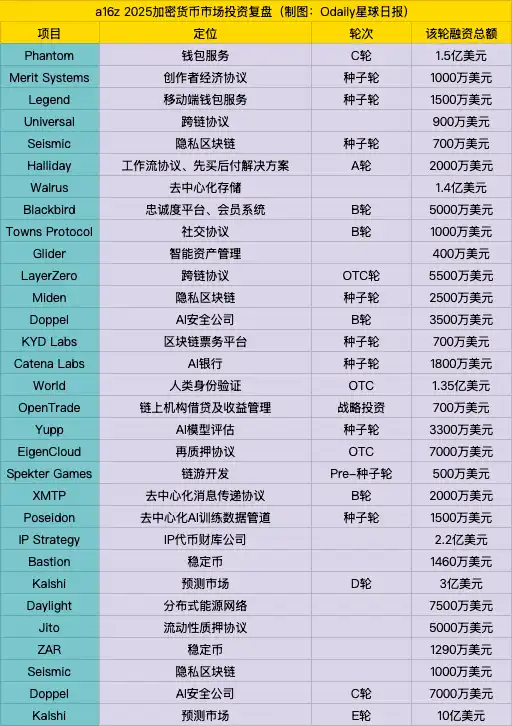
As can be seen from the statistics in the chart above, aside from the heavy bet on prediction markets, wallet services, privacy blockchains, stablecoins, and the intersection of AI and cryptocurrency were the focus of a16z's布局 in 2025. These sub-sectors can be categorized into the blockchain underlying protocols and tools covered by the Infrastructure fund, and the fintech and AI applications covered by the App fund.

a16z's Predictions for 2026

On New Year's Day 2026, a16z Crypto officially published a New Year's outlook article. In the article, a16z mentioned 17 potential developments they are excited about for 2026, which may contain clues to the firm's focus areas for future investments.
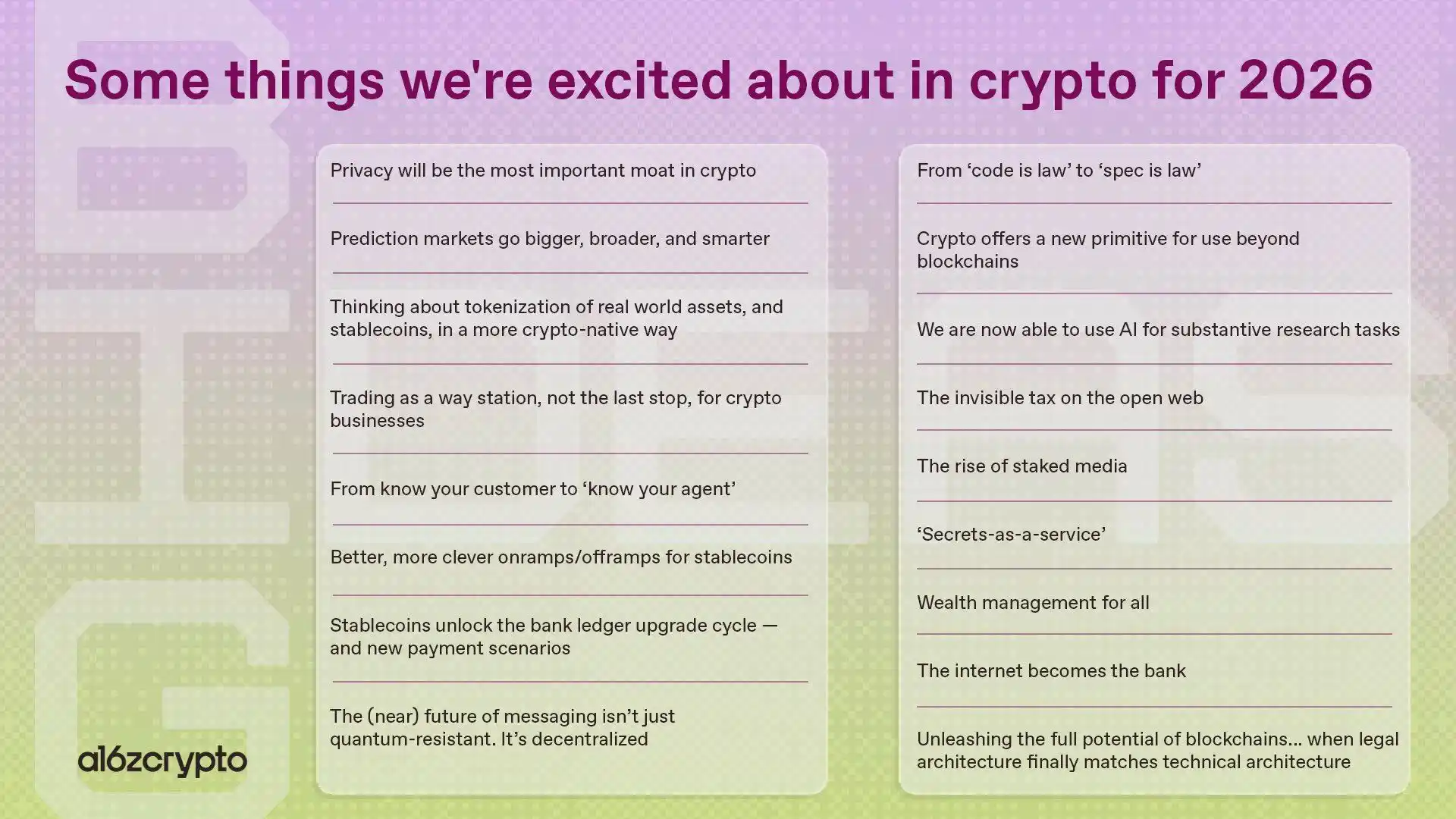
These 17 potential developments are:

  • Privacy will become the most important moat in crypto;
  • Prediction markets will become larger, broader, and smarter;
  • Thinking more "crypto-natively" about real-world asset tokenization and stablecoins;
  • Trading is just a waystation for crypto businesses, not the final destination;
  • From "Know Your Customer" (KYC) to "Know Your Agent";
  • Better, smarter on-ramps and off-ramps for stablecoins;
  • Stablecoins will kick off a bank ledger upgrade cycle and spawn new payment scenarios;
  • The future of instant messaging is not just quantum-resistant, but also decentralized;
  • From "code is law" to "norms are law";
  • Crypto is providing a new kind of foundational primitive whose uses go beyond blockchains themselves;
  • We can now use AI to perform substantive research tasks;
  • The "invisible tax" of the open internet;
  • The rise of Staked Media;
  • "Secrets-as-a-Service";
  • Wealth management for everyone;
  • The internet is becoming the bank;
  • When the legal framework finally matches the technical framework, the full potential of blockchains will be unleashed.

Among these 17 potential developments, some explicitly mention specific business models, including the sectors a16z has already heavily invested in, such as privacy, prediction markets, stablecoins, and AI. a16z also directly provided optimization paths for related models, such as the need for smarter on-ramp and off-ramp solutions for stablecoins.

At the same time, another part of the potential developments belongs to imaginings of future states, such as the internet eventually becoming the bank. However, how these imaginings will be realized is not clearly answered by a16z—this question needs to be left to entrepreneurs who can bring innovative solutions, and they are precisely the targets that a16z's $15 billion is most eager to find.


Preguntas relacionadas

QWhat are the six main directions a16z plans to allocate its new $15 billion funding, and which ones are most relevant to cryptocurrency?

AThe six directions are: American Dynamism ($1.176B), App ($1.7B), Bio + Health ($0.7B), Infrastructure ($1.7B), Growth ($6.75B), and Other Venture Strategies ($3B). The App, Infrastructure, and Growth funds are most relevant to cryptocurrency, focusing on Web3 applications, blockchain protocols, and mature crypto companies respectively.

QWhich cryptocurrency-related sectors did a16z focus on in 2025, and can you name a key company they invested in?

AIn 2025, a16z focused on wallet services, privacy blockchains, stablecoins, and AI-crypto intersections. A key investment was Kalshi, a prediction market platform, where a16z participated in both a $300M Series D (at $5B valuation) and a $1B Series E (at $11B valuation).

QAccording to a16z's 2026 outlook, what are some specific areas they are excited about for cryptocurrency development?

Aa16z's 2026 outlook highlights 17 areas, including privacy as a key moat, expansion of prediction markets, improved stablecoin on/off ramps, 'crypto-native' RWA tokenization, AI agent verification, decentralized communication, and the evolution from 'code is law' to 'norms as law'.

QHow does a16z's Infrastructure fund specifically support the cryptocurrency ecosystem?

AThe Infrastructure fund ($1.7B) supports cryptocurrency by investing in blockchain底层协议 (L1s, L2s), distributed systems, network protocols, and developer tools that form the foundational technology for next-generation applications and platforms in crypto.

QWhat is the overarching mission statement a16z emphasized in their funding announcement regarding future technology competition?

Aa16z's mission is 'to ensure that America wins the next 100 years of technological competition, starting with winning the key architectures of the future—artificial intelligence and crypto technologies.'

Lecturas Relacionadas

As Consensus Accelerates, What Are Young Investors Betting On?

Title: As Consensus Forms Faster, What Are Young Investors Betting On? In the rapid evolution of tech investment, a new generation of young investors is navigating a landscape where AI, robotics, commercial aerospace, and quantum computing are advancing simultaneously. Traditional investment logic based on financial models is giving way to a need for deep technical understanding and the ability to act before industry consensus forms. An analysis of trends from the "WAIC FUTURE TECH" list of young investment leaders reveals key shifts in focus. The first major trend is the movement of AI from the digital screen into the physical world. Investment is shifting from large language models and chatbots towards embodied AI, robotics, AI hardware, and edge computing. While demonstrations generate excitement, the real challenge lies in achieving scalable, reliable, and cost-effective delivery in complex real-world environments like factories and logistics. Success depends not just on algorithms but on the integration of sensors, actuators, and control systems. Second, the competitive focus for large models is moving beyond raw capability toward building an "intelligence flywheel." The goal is to create self-reinforcing systems where user interaction generates data, improving the model, which in turn enhances the user experience and attracts more engagement. Companies that successfully embed AI into workflows to create these closed-loop systems can build lasting value that isn't easily erased by the next model upgrade. Third, facing a potential bottleneck in high-quality human-generated data, investors are looking at new underlying technologies. Reinforcement learning and self-play, as demonstrated by AlphaGo Zero, offer paths for AI to generate its own experience. Scientific foundation models, which aim to build general AI capabilities for fields like life sciences and materials discovery, represent a non-consensus direction that could unlock new frontiers of knowledge and data. Finally, in deep-tech areas like quantum computing, commercial aerospace, and space-based infrastructure, patient capital is essential. These fields have long, uncertain development and validation cycles involving complex engineering, supply chains, and regulations. Investment here requires a long-term view, focusing on foundational team capabilities and the eventual emergence of market demand, even if commercial returns are distant. Collectively, these trends illustrate how young investors are adapting to a new era. They are learning to make earlier, technically-informed judgments, balance hype with real-world viability, and provide the patient capital needed to build the deep-tech foundations of the future.

marsbitHace 5 min(s)

As Consensus Accelerates, What Are Young Investors Betting On?

marsbitHace 5 min(s)

Can Japan Buy Growth with AI? Will the Bond Market Believe It?

Japan's cabinet has introduced the 2026 Basic Policy on Economic and Fiscal Management and Reform, shifting its primary fiscal target. The new framework moves away from the traditional annual primary balance goal and instead prioritizes a stable reduction of the debt-to-GDP ratio. This change is tied to a strategy of increased "responsible proactive fiscal" spending, aiming to boost long-term growth through investments in strategic sectors like AI, semiconductors, energy, and robotics. The government estimates total public and private investment in 62 key technologies could exceed 370 trillion yen by 2040. The market reaction has been mixed and cautious. While equity markets may respond to policy signals, bond markets are focused on fiscal credibility. Concerns center on whether the weakening of the clear primary balance anchor could lead to looser fiscal discipline. If investors doubt that these strategic investments will generate sufficient productivity gains, tax revenue, and nominal growth to outpace rising interest costs, they may demand higher yields on Japanese Government Bonds (JGBs). Recent volatility in the yen and JGB yields, with the 10-year yield briefly reaching 2.9%, reflects this skepticism. The success of this new framework hinges on two factors: whether Japan can achieve a nominal growth rate consistently higher than its long-term interest rates, and whether future budgets demonstrate disciplined control over bond issuance. The government's narrative is that strategic investment is essential to break Japan's cycle of low growth, aging, and labor shortages. However, the bond market will continuously assess the credibility of this plan, pricing the risk that it may represent fiscal expansion rather than a viable growth strategy.

marsbitHace 42 min(s)

Can Japan Buy Growth with AI? Will the Bond Market Believe It?

marsbitHace 42 min(s)

Misjudged A-Shares: Resilience, Expectations, and Confidence

China's A-share market recently faced selling pressure, especially in tech sectors, initially triggered by a global tech sell-off that began in South Korea. However, the article argues this is a case of "mistaken injury" and highlights the market's underlying resilience. This resilience stems from three main pillars: **1) Tech Sector Fundamentals:** Unlike Korea's market dominated by a few memory chip stocks, China's tech sector is diversified across computing, communications, electronics, and semiconductors, supported by dual narratives of global AI supply chains and domestic substitution. Core areas like optical modules and fiber optics continue to show strong earnings growth. **2) "National Team" Support:** State-backed institutions and large corporations have made significant market purchases and announced buybacks, providing liquidity and signaling confidence. This is seen as a stabilizing policy signal, often associated with market bottoms. **3) Broader Market Pillars:** Other major sectors are showing endogenous recovery momentum. Consumer stocks benefit from stabilizing CPI and signs of sector recovery (e.g., liquor price hikes). Cyclical sectors like aluminum have high earnings, potential price increases due to tight supply, and low valuations. The financial sector offers stable dividends and low valuations. The conclusion is that the sell-off was driven by external contagion, not a collapse in fundamentals. With strong policy support and recovering momentum across key sectors, the A-share market possesses the toughness to regain stability.

marsbitHace 1 hora(s)

Misjudged A-Shares: Resilience, Expectations, and Confidence

marsbitHace 1 hora(s)

Trading

Spot
活动图片




