FOLD Second Round Auction Now Live, Interfold Mainnet Launches Network Alpha, Building a New Paradigm for Confidential Coordination

marsbitPublicado a 2026-08-18Actualizado a 2026-08-18

Resumen

Interfold announces two key developments: the launch of the second FOLD token auction and the mainnet deployment of Network Alpha, alongside enabling general FOLD transfers. The second auction, distributing 2% of total FOLD supply via Uniswap's mechanism, runs from August 17 to 19 UTC. Proceeds are allocated to liquidity and protocol development. This event marks the final limited distribution before full token transferability. Interfold's core mission is "confidential coordination"—enabling multiple parties to compute shared, verifiable results from private inputs without exposing underlying data. Network Alpha realizes this vision on mainnet. It utilizes encrypted execution environments (E3s) where inputs remain encrypted, computation occurs on-chain, and results are released via a distributed threshold decryption process. No single node holds full control. FOLD is integral to the network, as node operators stake it to secure the distributed cryptographic processes. The network is already being used for confidential on-chain governance in partnership with Aragon, showcasing practical applications like coercion-resistant voting. With Network Alpha live, Interfold transitions from protocol development to network operation, fostering an ecosystem for privacy-preserving, verifiable collaboration.

Interfold today announced two major milestones: the FOLD second round auction is now live, Network Alpha is officially running on mainnet, and FOLD's general transfer functionality has also been enabled.
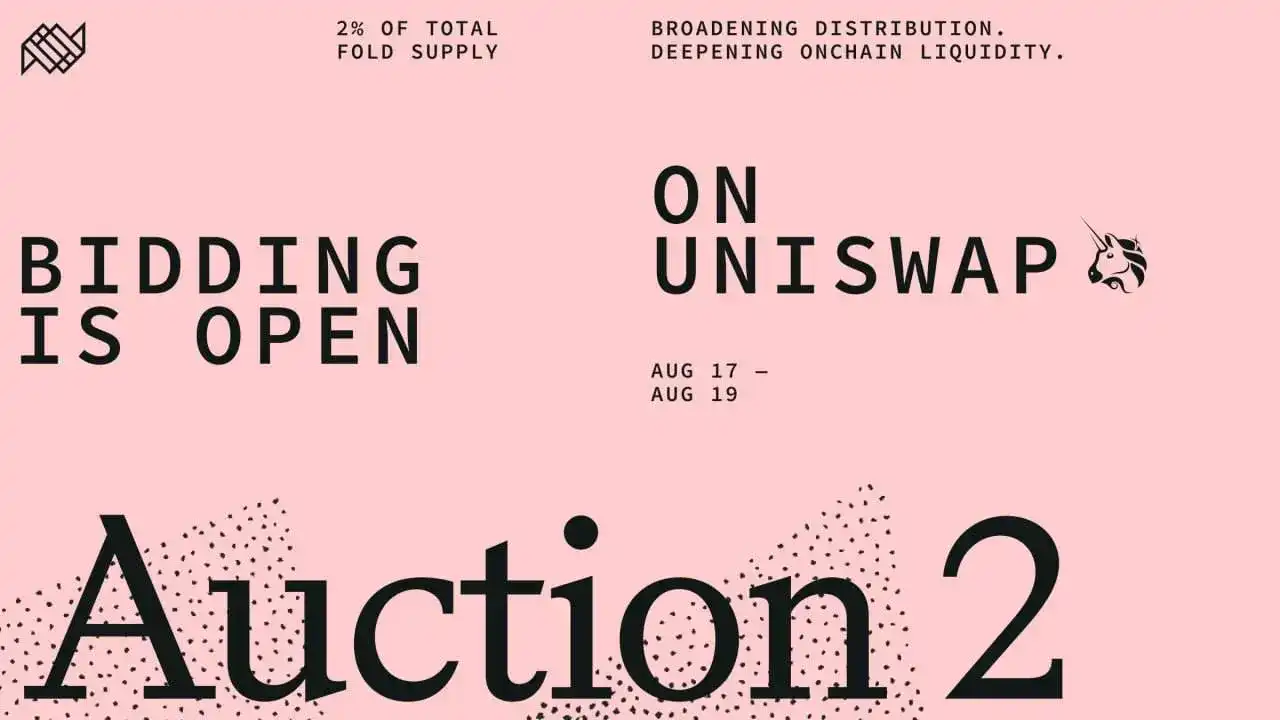
The second round auction, utilizing Uniswap's continuous clearing auction mechanism, offers a limited allocation of 2% of the total FOLD supply. The auction began on August 17th at 14:06 UTC and will run until August 19th at 13:06 UTC, with a starting price of 0.02154816 USDC per FOLD, matching the clearing price from the first auction.

This auction is positioned as the final limited distribution before FOLD's full transferability, aiming to broaden access to the token and enhance market infrastructure around the network. 50% of the auction proceeds will be dedicated to supporting long-term on-chain liquidity.

The Larger Vision: Confidential Coordination

The launch of FOLD serves a larger purpose.

As more global collaboration moves digital and computational, various organizations need to work together while preventing exposure of sensitive information to each other. Markets need to process private information, institutions need to analyze sensitive data, and communities need to hold verifiable elections without revealing individual voting preferences.
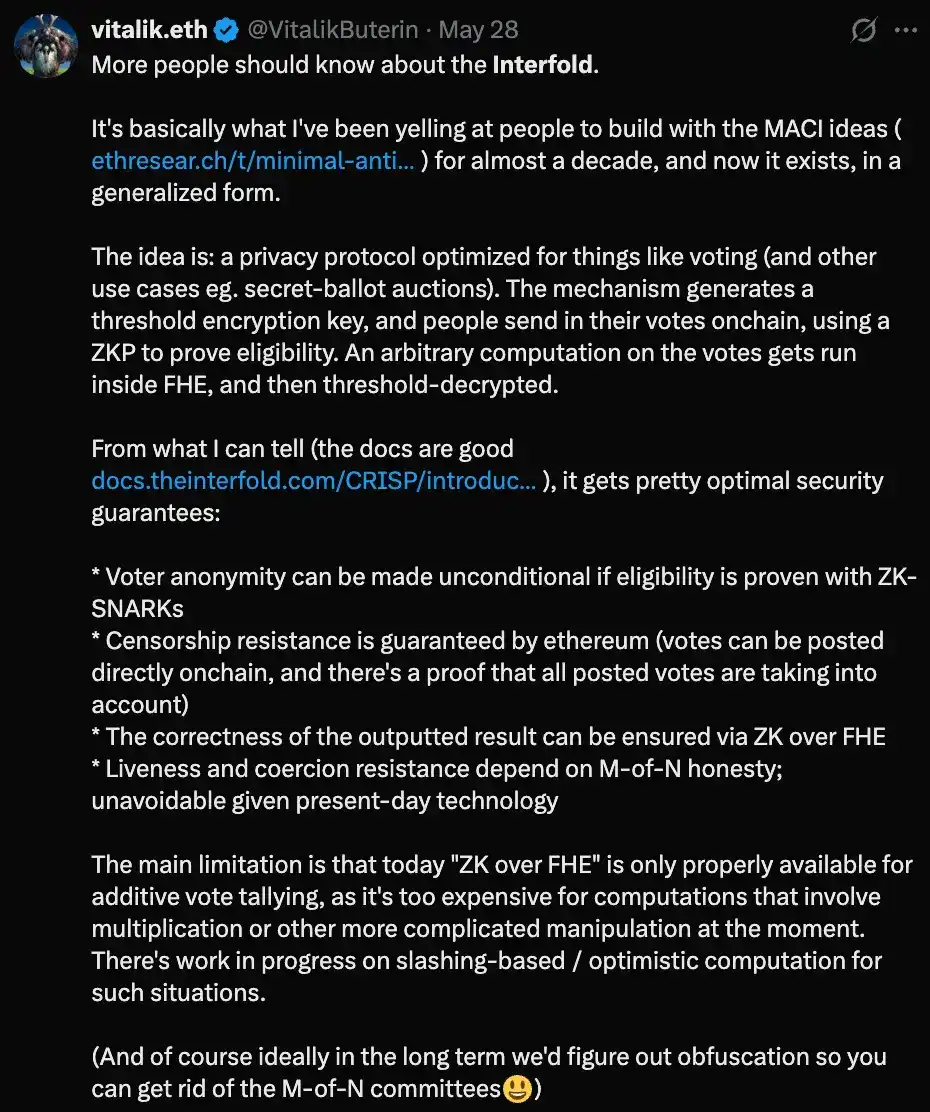
Today, such processes often require participants to hand over sensitive information, computational power, or control to centralized intermediaries. Interfold aims to change that.

Interfold is a decentralized network for confidential coordination: enabling independent parties to generate shared, verifiable outcomes from information they cannot directly reveal to each other.

The goal is simple: to collaboratively achieve a shared outcome without requiring anyone to reveal their underlying information.

Network Alpha Brings the Vision to Mainnet

Network Alpha is the first production version of this vision. On mainnet, encrypted execution environments (E3s) can complete their full lifecycle from deployment to operation. Participants can submit encrypted inputs, computation can proceed on those inputs, and authorized results are released through a distributed threshold process.

No single cryptographic node holds the complete decryption key or can independently control result release. Instead, cryptographic authority is distributed among multiple independent operators.

Through distributed key generation (DKG) and threshold decryption, the network collectively establishes the conditions under which private computation occurs and when authorized results can become public.

This constitutes a novel model for confidential computation: inputs are private, computation is shared, results are publicly verifiable, and the entire process is not controlled by any single machine. Network Alpha is now running this architecture on mainnet.

FOLD Becomes Part of the Network

With the opening of FOLD's general transfer functionality, FOLD enters a new phase. It is more than a transferable asset—cryptographic node operators can stake FOLD to participate in network duties, providing security for the distributed cryptographic processes that E3s rely on.

This directly ties the token to the network's underlying infrastructure. As Interfold grows, FOLD will play roles in distribution, liquidity, and network participation, linking economic incentives closely to the node operators responsible for confidential coordination.

A Network Designed for Real Use Cases

Network Alpha is already in practical use through its integration with Aragon for confidential governance. Votes remain encrypted throughout, while the network can generate end-to-end verifiable results. The system also features 'receipt-freeness,' meaning participants cannot prove their vote choice to others, effectively mitigating risks like coercion and vote-buying.

This is an early example of the broader problem Interfold solves: enabling multiple parties to feed private information into a shared process, while ensuring the original information remains confidential and the final outcome is verifiable.

The same architecture can readily extend to other collaborative scenarios requiring both privacy and verifiability.

Second Round Auction: Limited in Scale, Significant in Meaning

The second auction deliberately limits its size to 2% of the total FOLD supply. Its purpose is not to replicate the first auction, nor is it another large-scale funding round; it's a transitional step connecting initial token distribution to full network operation.

Starting at the clearing price of 0.02154816 USDC per FOLD established in the first round maintains launch continuity. Proceeds are allocated as follows: 25% is directly injected into a Uniswap liquidity pool, 25% is reserved for supplementary liquidity, and 50% goes to the Interfold Foundation treasury for continued protocol development.

This structure clearly points to Interfold's next phase: broader distribution, easier participation, robust liquidity, and a live network where FOLD can truly be used to solve significant privacy problems.

From Token Launch to Network Building

The significance at this moment extends far beyond the auction itself—Interfold is moving from 'building the protocol' into a new phase of 'operating the network.'

This means independent operators are starting to run infrastructure, developers are building confidential applications, participants are contributing to network processes, and organizations are using encrypted computation to collaborate around information that cannot be publicly disclosed.

Network Alpha intentionally starts at a manageable scale, allowing the ecosystem of node operators, supporting tooling, system performance, and use cases to evolve gradually in a live mainnet environment.

A protocol can be deployed at a moment, but a network grows through sustained participation.

The FOLD second round auction and the launch of Network Alpha are the starting points for this journey.

The FOLD second round auction is now open. Network Alpha is live on mainnet. Interfold is building the infrastructure for a world where information can stay private, yet collaboration remains verifiable.

Official Notice

Users should only participate in auctions, claims, transfers, and obtain contract and release information through official Interfold channels. Any unofficial links claiming to offer access to FOLD tokens, registration, verification, or auction participation may be fraudulent. Please exercise extreme caution.

About Interfold

Interfold is a decentralized network for confidential coordination. It enables independent parties to generate shared, verifiable outcomes from private inputs, without third-party custody, data exposure, or reliance on trusted hardware.

Interfold can support secret voting, sealed-bid auctions, and other coordination systems that require private inputs to produce verifiable results without relying on trusted operators.


Criptos en tendencia

Preguntas relacionadas

QWhat are the two major announcements made by Interfold, and what is the significance of FOLD's general transfer functionality being enabled?

AInterfold announced the launch of the second FOLD auction and the mainnet launch of Network Alpha. The enabling of FOLD's general transfer functionality signifies that FOLD is entering a new phase where it is not just a transferable asset, but also a token that node operators can stake to participate in network duties and secure the distributed cryptographic processes for Encrypted Execution Environments (E3s).

QWhat is the core purpose or vision of the Interfold network?

AThe core vision of Interfold is to enable confidential coordination. It is a distributed network that allows independent parties to generate shared, verifiable results from private inputs that cannot be directly revealed to each other. The goal is to achieve coordination around a shared outcome without requiring anyone to disclose their underlying private information.

QHow does Network Alpha realize the vision of confidential coordination on the mainnet?

ANetwork Alpha, the first production version, realizes this vision by allowing Encrypted Execution Environments (E3s) to complete their full lifecycle on the mainnet. Participants can submit encrypted inputs, computations can be performed, and authorized results are released through a distributed threshold process. No single cryptographic node holds the full decryption key or controls the release unilaterally, as cryptographic authority is distributed among independent operators using Distributed Key Generation (DKG) and threshold decryption.

QWhat is a practical use case mentioned for Network Alpha, and what specific problem does it address?

AA practical use case is its integration with Aragon for confidential governance. It allows voting to remain encrypted throughout the process while the network generates end-to-end verifiable results. The system is also 'receipt-free,' meaning participants cannot prove their vote choice to others, thereby mitigating risks like coercion and vote buying.

QWhat are the key details and purpose of the second FOLD auction?

AThe second FOLD auction offers a limited share of 2% of FOLD's total supply via Uniswap's continuous liquidity auction mechanism. It runs from August 17, 14:06 UTC to August 19, 13:06 UTC, starting at 0.02154816 USDC per FOLD. Its purpose is to serve as a transitional step between the initial token distribution and the network's full operation, aiming to broaden token accessibility and enhance market infrastructure. 50% of the proceeds are dedicated to long-term on-chain liquidity support, with 25% directly added to a Uniswap pool and 25% for supplemental liquidity.

Lecturas Relacionadas

After Changxin, Yushu Takes the Lead: The Value and Weight of the First Humanoid Robot Stock

On August 19, 2026, Unitree Robotics (688836.SH), known as China's "first humanoid robotics stock," officially listed on the Shanghai Stock Exchange's STAR Market. The stock opened at 1,100 yuan, a surge of 629.44% from its 150.80 yuan IPO price, with its market capitalization briefly reaching 445 billion yuan. This highlights intense market enthusiasm for the humanoid robot sector. The IPO was characterized by high demand and low circulation, with only 7.44% of shares initially tradable. This scarcity, coupled with strong investor interest (record-high participation and a low 0.0181% lottery win rate), contributed to the dramatic price surge. Founder Wang Xingxing, holding over 31% of shares, saw his wealth exceed 110 billion yuan, making him China's wealthiest "post-90s" entrepreneur. Major institutional backers like Meituan, DeepSeek, Tencent, and Sequoia China also reaped substantial gains. Key to the valuation is Unitree's status as a profitable company in a field where many competitors are not. In 2025, it achieved 600 million yuan in adjusted net profit and delivered over 5,500 humanoid robots, ranking first globally in shipments. However, over 70% of its humanoid revenue still comes from R&D and education, with industrial applications accounting for only about 9%, indicating early-stage commercialization. The company faces competition from global players like Figure AI (est. $39-40B valuation), Boston Dynamics, and Tesla's Optimus, as well as domestic rivals like Zhiyuan and Ubtech. To become the "global humanoid robotics leader," its market cap would need to exceed 500 billion yuan. Market opinions on its future are divided: optimists cite its profitability, leading shipments, and strategic tie-up with DeepSeek; the cautious point to high valuations and unproven mass-market adoption; a neutral view expects a post-surge consolidation into an "earnings verification phase." Risks include high valuation digestion pressure, slower-than-expected commercialization in industrial/household settings, potential US FCC regulatory impacts on new models, intense competition, rapid technological iteration, and short-term stock volatility. The IPO marks a significant milestone, but Unitree's path to becoming a global leader remains challenging.

Odaily星球日报Hace 14 min(s)

After Changxin, Yushu Takes the Lead: The Value and Weight of the First Humanoid Robot Stock

Odaily星球日报Hace 14 min(s)

Token Economy Surges, Have Ordinary People Got a Slice of the Pie?

Token Frenzy: Is the Average Person Getting a Piece of the Pie? As AI adoption soars in China, daily Token consumption—the basic unit for AI text processing—has skyrocketed, exceeding 140 trillion. This "Token economy" is often measured like GDP, touted as a sign of progress. However, this metric primarily reflects supply-side activities: corporate investment, infrastructure scaling, and platform revenues. The crucial question of whether this growth translates into tangible benefits for ordinary citizens—higher wages, better jobs, improved public services, or increased leisure—remains largely unanswered. The article argues there's a fundamental mismatch. Policy, exemplified by subsidies in Beijing's Yizhuang district, often stimulates "demand" by incentivizing companies to consume more Tokens (an intermediate business cost), rather than by boosting household income or final consumer spending. This creates a closed loop where growth in Token usage justifies further production capacity expansion, without necessarily extending value to the broader population. Several disconnects are highlighted. High Token usage doesn't equal completed tasks, increased profits, or macroeconomic productivity gains. Even when corporate efficiency improves, the benefits may not trickle down due to existing economic structures favoring investment over household consumption. The risk is that AI, a genuinely productive technology, becomes another tool for supply-side expansion within a system adept at measuring output (like server capacity and call volumes) but less focused on distributing the gains widely. Drawing a parallel to Henry Ford's assembly line, the piece notes that Ford's revolution combined ruthless production efficiency with a social compact (higher wages, stability) that enabled mass consumption. Today's "Token economy" narrative enthusiastically champions the first part—process re-engineering and cost reduction—but lacks a credible mechanism for the second: ensuring that productivity gains lead to broader societal welfare. The ultimate challenge is not whether Tokens have value, but whether their economic benefits can escape a system that excels at building supply but struggles to cultivate its own demand.

marsbitHace 1 hora(s)

Token Economy Surges, Have Ordinary People Got a Slice of the Pie?

marsbitHace 1 hora(s)

Overnight Global Shock: Why Did AI Stocks Plunge Across the Board?

Overnight, U.S. AI-related stocks fell sharply, with the Nasdaq down 1.33% and the Philadelphia Semiconductor Index plunging nearly 5%. Panic spread globally, dragging down Asia-Pacific markets. Key negative drivers included: 1. **Geopolitical Tension & Macro Pressure:** Escalating U.S.-Iran tensions pushed oil prices higher, fueling inflation fears and expectations of prolonged high interest rates. Rising bond yields pressured high-valuation, capital-intensive AI stocks, especially as soaring AI infrastructure financing costs became evident. 2. **AI Commercialization Concerns:** OpenAI's Q2 results showed slowing revenue growth and widening losses, dampening market optimism about near-term AI application profitability. This shifted investor focus from pure capital expenditure narratives to actual commercial returns. 3. **Supply Chain Uncertainty:** U.S.-South Korea semiconductor investment disputes intensified. Market fears that Korean memory giants (Samsung, SK Hynix) face a dilemma—either divert capital to costly U.S. production or risk trade barriers—disrupted the critical HBM memory sector, amplifying sell-offs via leveraged ETFs. While long-term AI demand remains, the market is now scrutinizing real profitability, financing costs, and supply chain stability rather than paying premiums for unchecked growth stories. For markets like China's A-shares, the impact is primarily sentiment-driven, requiring distinction between short-term panic and fundamental deterioration.

marsbitHace 1 hora(s)

Overnight Global Shock: Why Did AI Stocks Plunge Across the Board?

marsbitHace 1 hora(s)

Trading

Spot

Artículos destacados

Cómo comprar AUCTION

¡Bienvenido a HTX.com! Hemos hecho que comprar Auction (AUCTION) sea simple y conveniente. Sigue nuestra guía paso a paso para iniciar tu viaje de criptos.Paso 1: crea tu cuenta HTXUtiliza tu correo electrónico o número de teléfono para registrarte y obtener una cuenta gratuita en HTX. Experimenta un proceso de registro sin complicaciones y desbloquea todas las funciones.Obtener mi cuentaPaso 2: ve a Comprar cripto y elige tu método de pagoTarjeta de crédito/débito: usa tu Visa o Mastercard para comprar Auction (AUCTION) al instante.Saldo: utiliza fondos del saldo de tu cuenta HTX para tradear sin problemas.Terceros: hemos agregado métodos de pago populares como Google Pay y Apple Pay para mejorar la comodidad.P2P: tradear directamente con otros usuarios en HTX.Over-the-Counter (OTC): ofrecemos servicios personalizados y tipos de cambio competitivos para los traders.Paso 3: guarda tu Auction (AUCTION)Después de comprar tu Auction (AUCTION), guárdalo en tu cuenta HTX. Alternativamente, puedes enviarlo a otro lugar mediante transferencia blockchain o utilizarlo para tradear otras criptomonedas.Paso 4: tradear Auction (AUCTION)Tradear fácilmente con Auction (AUCTION) en HTX's mercado spot. Simplemente accede a tu cuenta, selecciona tu par de trading, ejecuta tus trades y monitorea en tiempo real. Ofrecemos una experiencia fácil de usar tanto para principiantes como para traders experimentados.

200 Vistas totalesPublicado en 2024.12.12Actualizado en 2026.06.02

Cómo comprar AUCTION

Discusiones

Bienvenido a la comunidad de HTX. Aquí puedes mantenerte informado sobre los últimos desarrollos de la plataforma y acceder a análisis profesionales del mercado. A continuación se presentan las opiniones de los usuarios sobre el precio de AUCTION (AUCTION).

活动图片