Five Meme Coins Soar Against the Market Trend, Which Is the Next Potential Star?

marsbitPublicado a 2025-12-18Actualizado a 2025-12-18

Resumen

Despite a generally bearish crypto market, five tokens have recently surged against the trend. PIPPIN, an AI concept token, saw a 1000% rise driven by insider accumulation and coordinated buying, with internal addresses controlling up to 80% of supply. FOLKS, a DeFi protocol token, surged nearly 24x from its low following an incentive announcement but later dropped 80%. BEAT, a Web3 AI entertainment token on BNB Chain, rapidly grew from a $25M to $440M market cap. AIA, a decentralized AI agent token, plummeted 90% after Binance delisted its futures but rebounded 160% post-contract migration. RAVE, a music and culture DAO, gained over 410% after support from Donald Trump Jr. and CZ, alongside listings on major exchanges. These tokens share traits like low initial market caps, hype-driven pumps, and significant volatility, often influenced by insider activity or major announcements.

Original / Odaily Planet Daily (@OdailyChina)

Author / Wenser(@wenser2010)
The cryptocurrency market continues to fluctuate and trend lower. However, even in a sluggish market, a few tokens defy the trend, maintaining their own independent rhythm of "sharp rises and falls." Odaily Planet Daily will梳理 (sort out) the recent "meme coins" with impressive price performance in this article, attempting to summarize common characteristics to help discover the next investment target with potential for a surge.

PIPPIN: The Orphan of the AI Agent Craze, a Masterpiece of "Insider Trading"

From late last year to January this year, AI Agent tokens once captured the absolute focus of the crypto market. Tokens like ai16z(ELIZAOS) and swarms frequently topped the token gain charts. PIPPIN was also a product of the same batch of AI-themed tokens at that time.

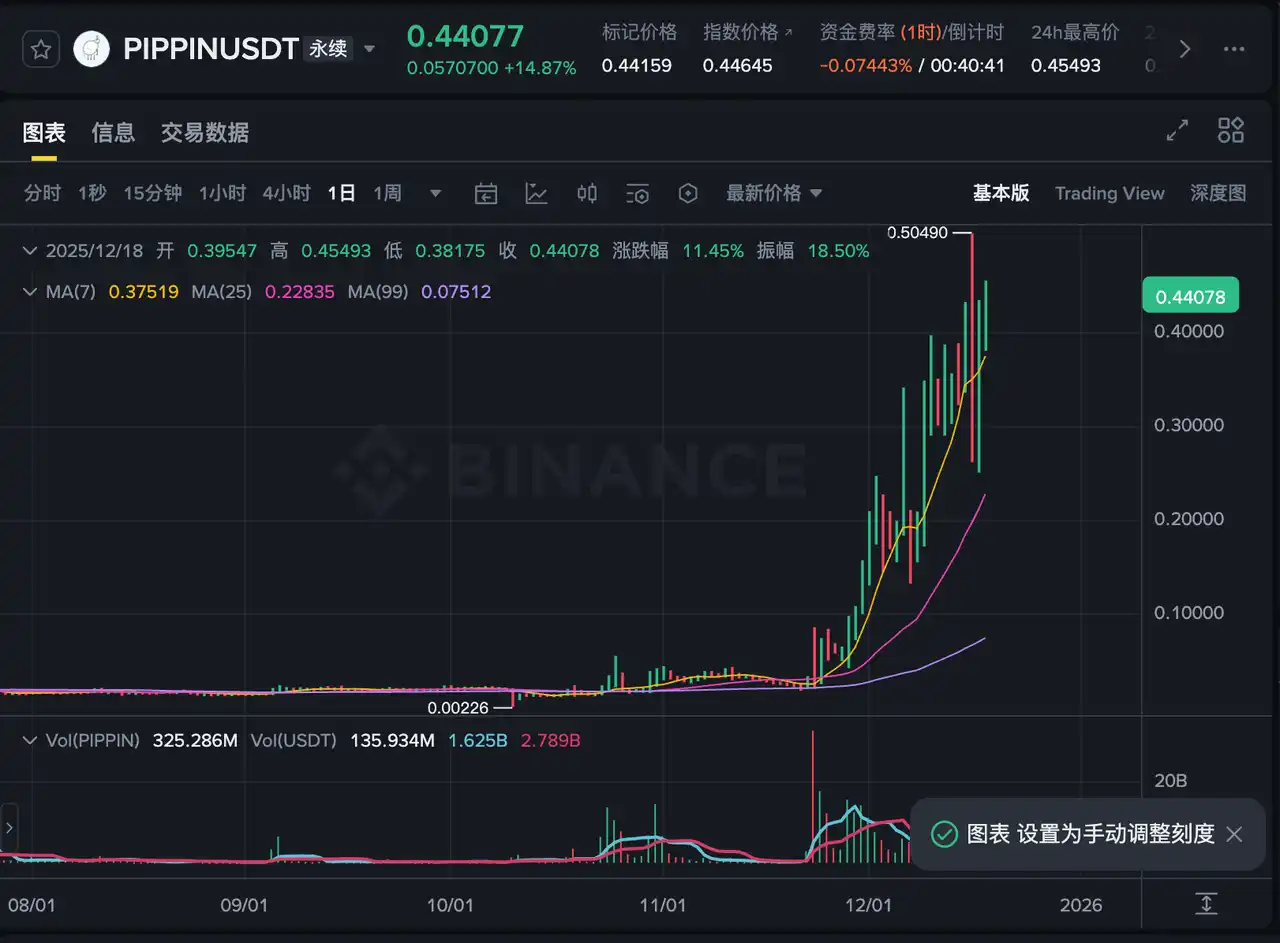
But nearly a year later, only PIPPIN remains, possibly selected by wildcat market makers for its ease of price manipulation. It has been on a upward trend for nearly half a month. It's worth noting that on November 23rd, its price was only around $0.05. Just a week later, its price had skyrocketed to over $0.17:

On December 1st, PIPPIN defied the market trend, surging over 60%, with its price approaching $0.18. At that time, analyst @frontrunnersx提醒 (warned) that PIPPIN showed characteristics of concentrated accumulation. Some addresses continued to buy without significant selling, causing the price to continuously hit short positions during the upward movement, triggering chain liquidations. One address bought about $200,000 worth of PIPPIN 6 days prior, sold after the price doubled, and is currently conducting similar operations with ARC.

On December 2nd, Bubblemaps monitoring revealed that 50 linked addresses purchased PIPPIN tokens worth $19 million. It was also found that 26 addresses withdrew 44% of the PIPPIN token supply, totaling $96 million, from the Gate platform over two months, with most wallets being recently funded. Most PIPPIN token withdrawals occurred on October 24th and November 23rd. By then, the PIPPIN token price had already surged by 1000%, and its insiders controlled half of the token supply, worth $120 million.

In other words, the wildcat market makers' accumulation period for PIPPIN started even a month earlier, with the真正的 (real) violent拉升 (pump) occurring about a month and a week after accumulation began.

Subsequently, a diamond hands address liquidated its previously hoarded 24.8 million PIPPIN tokens, with floating profits shrinking from a peak of $7.6 million to $3.65 million.

On December 6th, Onchain Lens monitoring showed a whale spent 23,736 SOL (worth approximately $3.3 million) to buy 16.35 million PIPPIN at $0.20 over 3 days, with floating profits exceeding $740,000 at that time.

On December 16th, Bubblemaps issued another reminder. The PIPPIN price continued to rise, but internal addresses now held about 80% of the supply, worth approximately $380 million. Bubblemaps pointed out: Since the last disclosure (December 2nd), 16 new wallets with the same pattern have appeared (funded by HTX, received similar amounts of SOL, no history, large withdrawals of PIPPIN from CEX); Another group of 11 wallets linked to Bitget was identified, collectively holding about 9% of the supply. Fund flows and time windows were highly consistent, suspected to be controlled by the same entity.

That night, as the PIPPIN price fell below $0.3, this "meme coin spectacle"宣告 (declared) a阶段性 (phase)收网 (wind-down). But the next day, December 17th, PIPPIN一度 (once) surged to around $0.5, causing another large-scale short squeeze. It has to be said, the violent methods of bear market wildcat makers are堪称 (can be called) brutal.

As of writing, the PIPPIN price is temporarily reported at $0.44, with a 24-hour increase of over 15%. Its performance continues.
FOLKS: Cross-Chain DeFi Protocol Token, Up Nearly 24x From Low Point Due to S2 Incentive Announcement

As a cross-chain DeFi protocol providing lending, staking, and trading services, primarily operating on the Algorand chain, Folks Finance originally had few followers. But with the official launch of the S2 incentive activity, market enthusiasm for its token reignited.

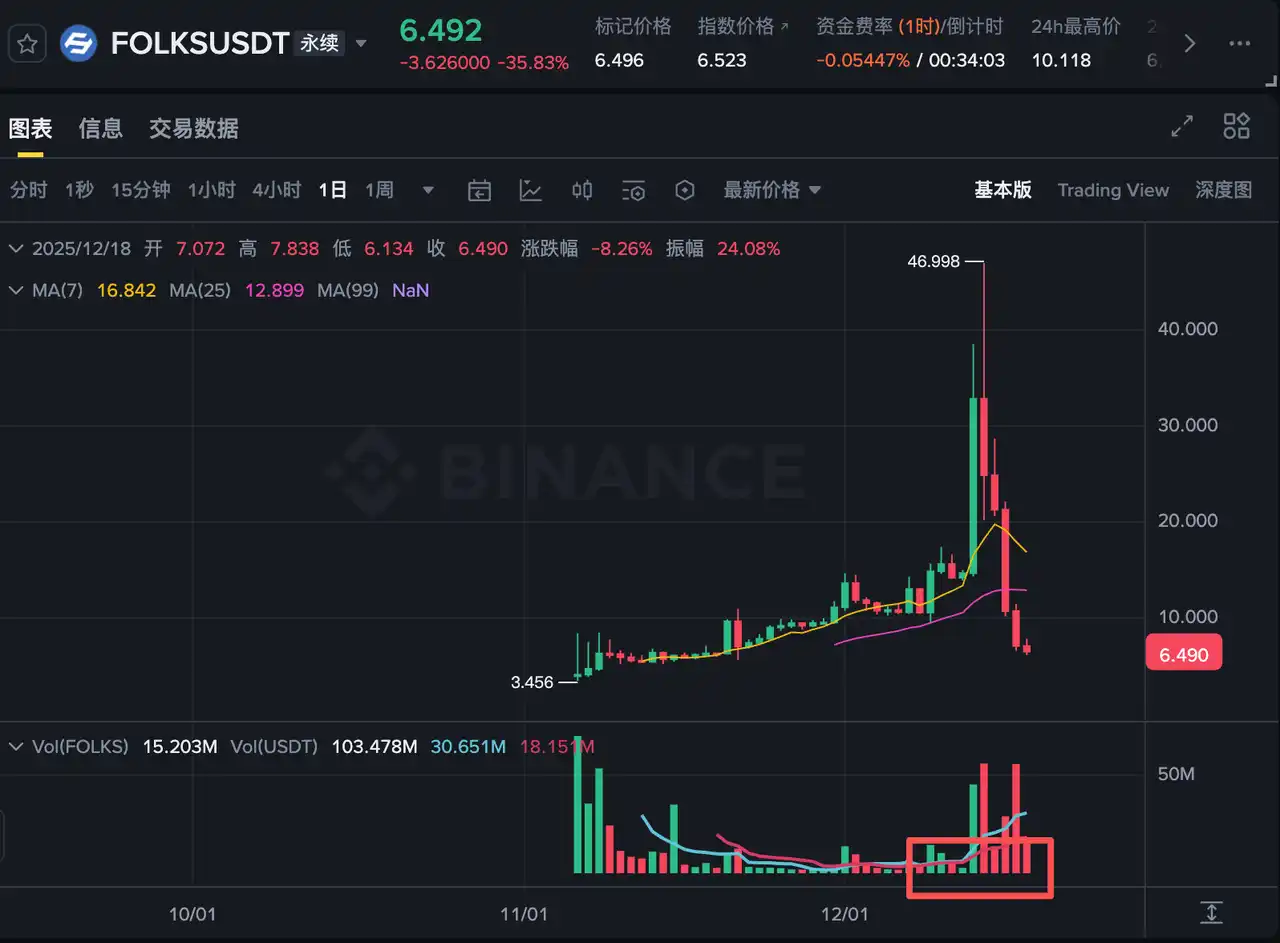
It's worth mentioning that Folks Finance distributed 1.5 million FOLKS tokens during the S1 incentive activity, including Chainlink incentives. On November 6th, FOLKS officially launched on Binance Alpha, with a historical low price of around $2.

After the official announcement from Folks Finance on December 9th, the FOLKS token price soared from under $10;

On December 14th, after nearly a week of speculation, the FOLKS token price broke through $40 for the first time, eventually rising to nearly $47, an increase of nearly 24 times from the low point;

Subsequently, the FOLKS price quickly retreated, falling by about 80%.

As of writing, the FOLKS price is temporarily reported at $6.4, with a 24-hour decrease of over 24%. The circulating supply is 12.7 million tokens (25.4% of total supply), with a temporary market cap of around $81 million.
BEAT: A True Meme Coin Needs Few Words

As another altcoin choosing to root itself in the BNB Chain ecosystem, similar to previous meme coins like MYX and COAI, BEAT's rise is another classic case.

It is worth noting that the official account behind the BEAT token project promotes the concept of a "Web3 AI entertainment platform + IP creation platform" – a repackaged version of hot concepts. After listing on Binance Alpha and futures in early November, BEAT officially claimed over 1.2 million independent on-chain holding addresses. One must say, "Audacity leads to great production."

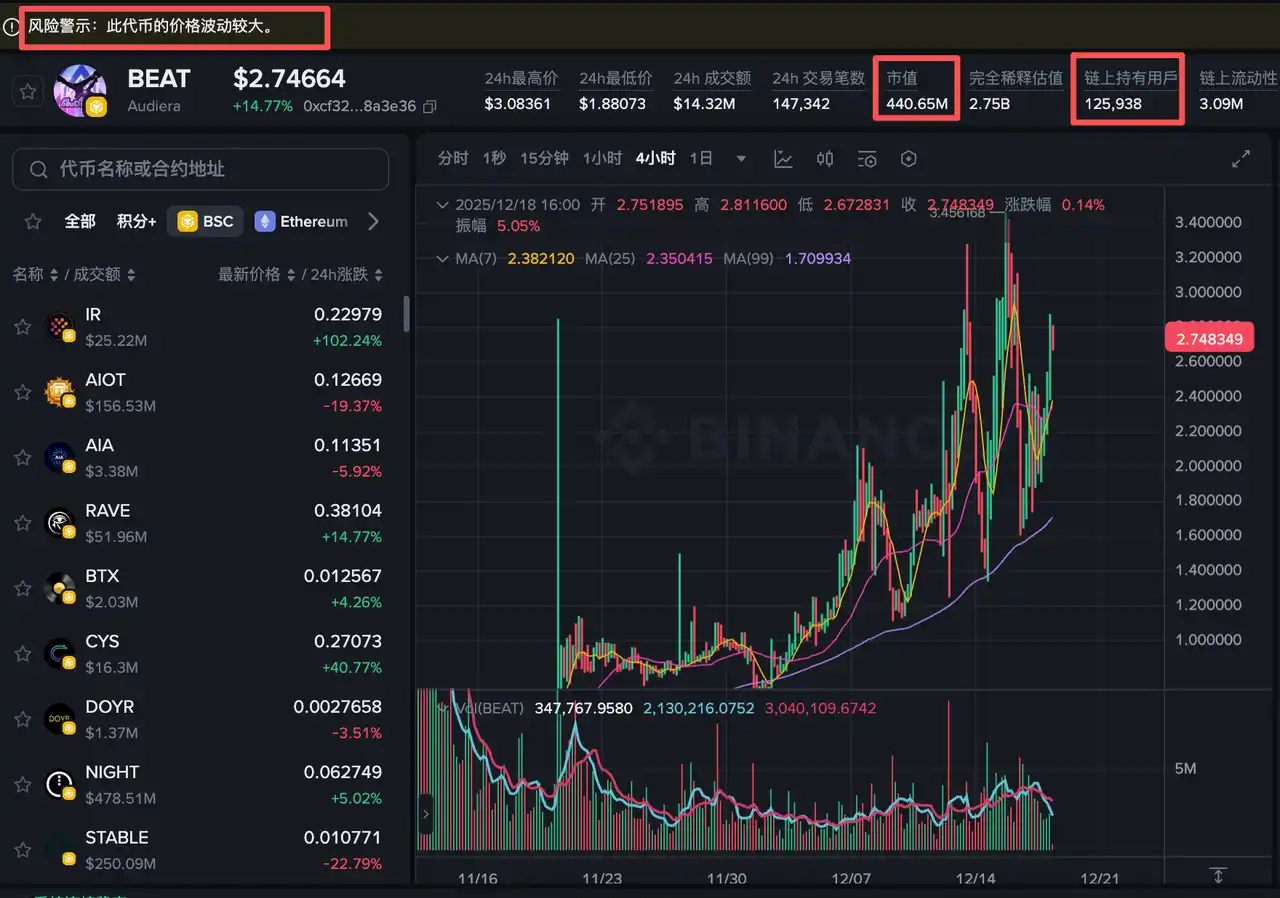
Similar to the price action of previous meme coins, BEAT still started with a low market cap – after an initial rise upon listing on Binance Alpha, its market cap remained around $25 million. Subsequently, the price飞速上涨 (rapidly increased) amidst repeated pumps and dumps.

As of writing, the BEAT price is temporarily reported at around $2.7, with a 24-hour increase of over 14%. The circulating market cap is temporarily reported at $440 million, with about 1.26 million on-chain holding addresses. (Note: Original said 12.6, likely meant 1.26 million based on context)
AIA: Decentralized AI Agent Concept Token, Contract Swap Causes Volatility

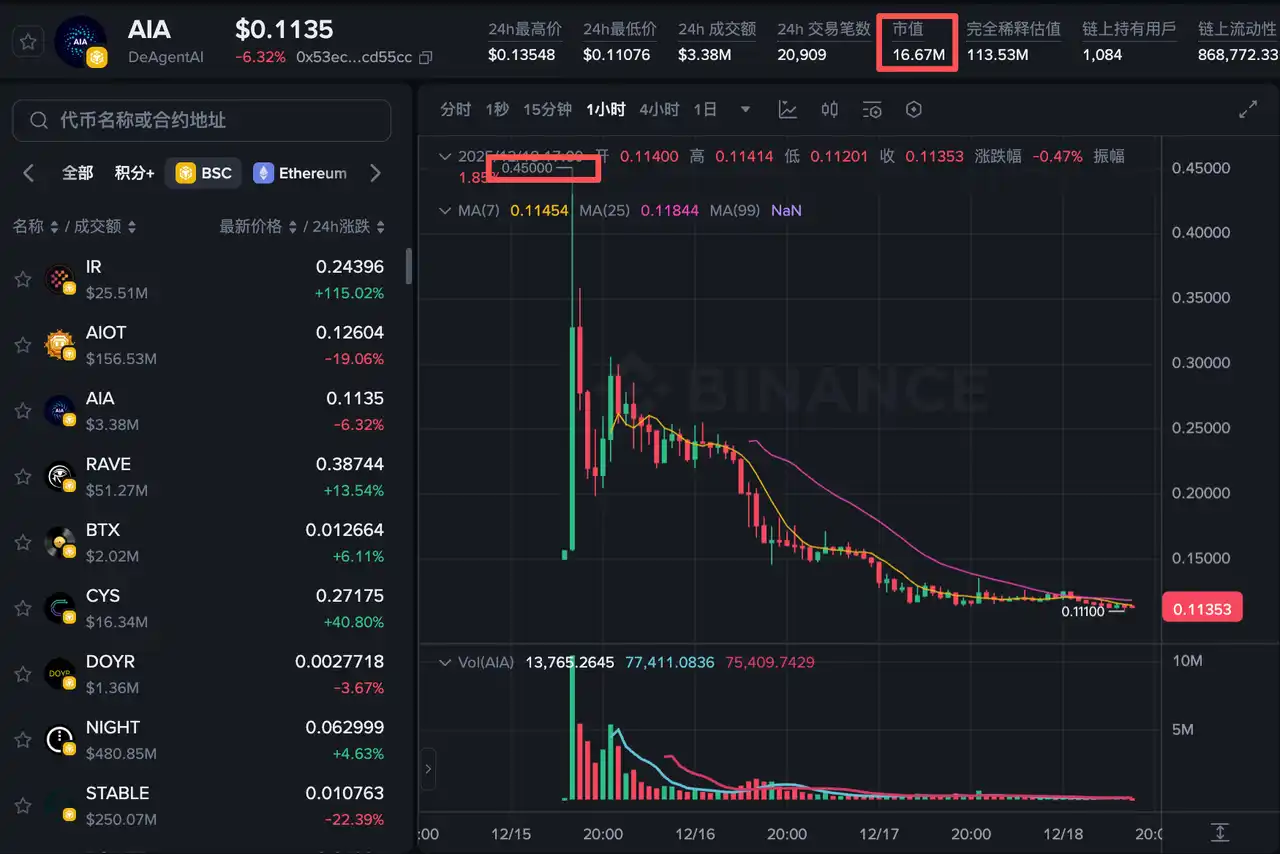
As the project token for DeAgent AI, AIA previously attracted significant market liquidity and attention due to a massive surge after listing on Binance futures, its price once skyrocketing over $1. However, limited by the increasingly quiet market environment and the gradual cooling of the AI concept, the token price gradually fell into silence,阴跌 (slipping downward).

But the incident of "Binance delisting AIA futures" injected volatile energy into its liquidity again.

On December 11th, according to an official announcement, Binance Futures announced it would close all AIAUSDT perpetual contracts at 20:15 (UTC+8) on December 11, 2025, for automatic settlement. After settlement, the contract would be delisted. AIA一度 (once) plummeted over 90%.

But subsequently, Binance announced that Alpha 2.0 would support the contract swap for DeAgentAI (AIA). Starting from 20:00 (UTC+8) on December 11, 2025, Binance Alpha 2.0 had temporarily closed AIA trading to execute this contract swap. The swap would be executed at a 1:1 ratio. The snapshot time was 20:00 (UTC+8) on December 11, 2025. Binance Alpha 2.0 would resume DeAgentAI (AIA) trading at 16:00 (UTC+8) on December 15, 2025.

On December 15th, official data from Binance Alpha showed that DeAgentAI (AIA) had completed the smart contract swap and officially resumed trading at 16:00 (UTC+8) on December 15th. Market data showed AIA surged significantly after opening, with gains一度 (once) exceeding 160%, topping the Binance Alpha sector gain chart.

As of writing, the AIA price is temporarily reported at $0.11, with a 24-hour decrease of 6.3%. The circulating market cap is temporarily reported at $16 million.
RAVE: Offline Community-Driven Culture Platform, Supported by Trump Jr. and CZ Reposts

As a DAO organization promoting the concept of a "decentralized music and culture community and platform ecosystem," RaveDAO's development speed has been like a cheat code. After months of community and project building, RaveDAO has previously completed multiple member NFT sales.

On November 10th, RaveDAO officially announced its token economic model and airdrop details. The official stated that the token aims to connect artists, organizers, and fans through token economics, promoting a decentralized entertainment ecosystem of "culture as protocol." RAVE has a total supply of 1 billion tokens, allocated as follows: Community 30%, Ecosystem 31%, Team & Co-builders 20%, Early Supporters 5%, Liquidity 5%, Airdrop 3%, Foundation & Public Goods Pool 6%. Approximately 23.03% will be in circulation after the Token Generation Event (TGE), with the rest subject to a 12-month cliff and a 36-month linear unlock period.

A month later, on December 10th, Binance Alpha announced it would soon list RaveDAO(RAVE).

The next day, news of RaveDAO receiving support from both the WLFI and Aster ecosystems spread quickly. Within an hour of listing on Binance Alpha on December 12th, trading volume exceeded $25 million.

Moreover, RaveDAO's "upper echelon strategy" was extremely bright – On the evening of the 12th, Trump Jr. reposted and followed the dynamics of Aster's cooperation with USD1. RaveDAO, as one of the cooperation participants, gained massive exposure. CZ also reposted this tweet later. The RAVE price subsequently rose.

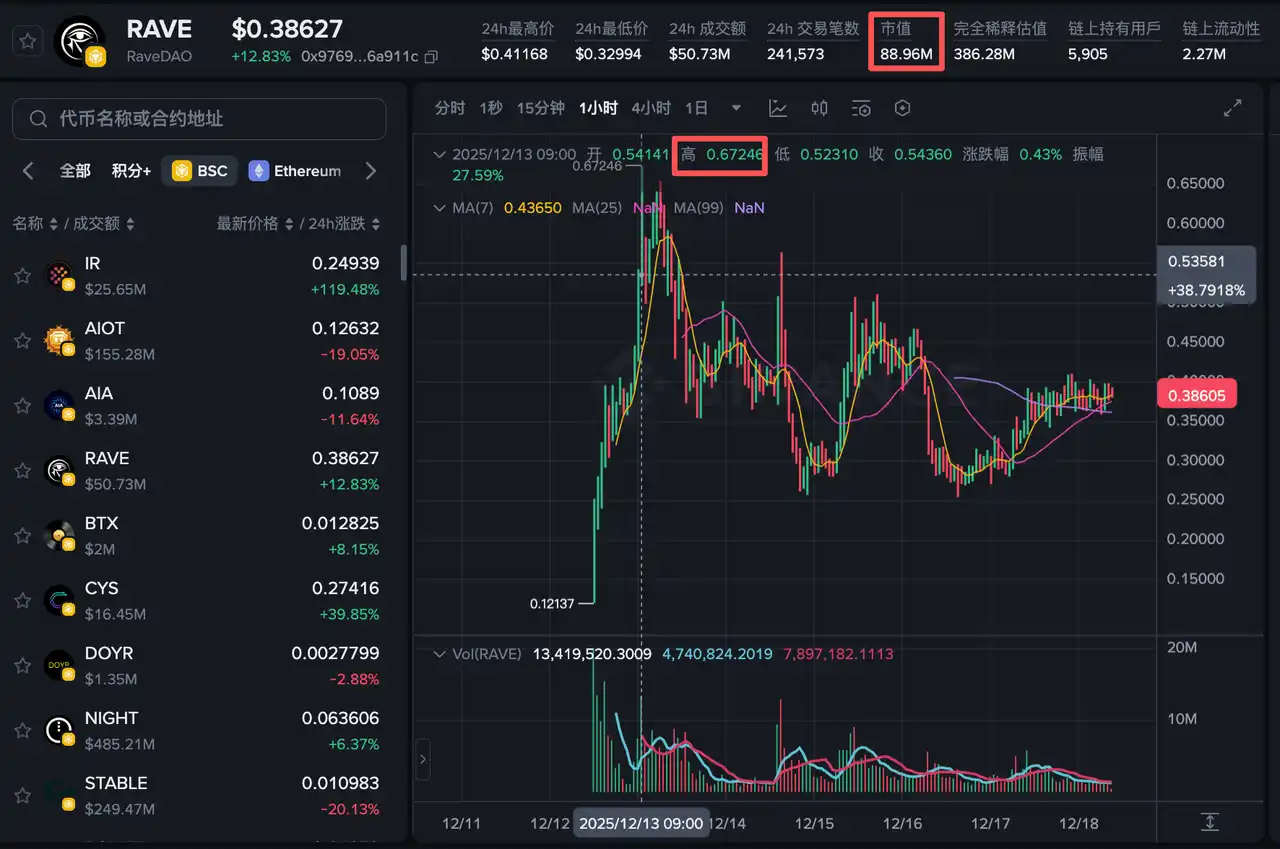
On December 13th, the RAVE price一度 (once) reached $0.67, with a 24-hour increase of over 410%;

On December 14th, Binance Futures launched RAVE U-based contracts;

On December 15th, RAVE was successively listed on centralized exchanges like OKX, Bybit, Bitget, Aster, Gate, Kucoin, and MEXC. The price at that time fell back to around $0.41.

As of writing, the on-chain price of RAVE is temporarily reported at $0.38, with a 24-hour increase of over 12%. The circulating market cap is temporarily reported at $88 million.
Criptos en tendencia

Preguntas relacionadas

QWhat are the five 'meme coins' mentioned in the article that have surged against the market trend?

AThe five coins are PIPPIN, FOLKS, BEAT, AIA, and RAVE.

QAccording to the analysis, what was a key characteristic of PIPPIN's price surge that suggested market manipulation?

AAnalysis by Bubblemaps showed that internal addresses controlled about 80% of the supply, worth approximately $380 million, indicating a high likelihood of manipulation by a single entity.

QWhich coin experienced a near 24x price increase from its low point due to an S2 incentive announcement?

AThe FOLKS token experienced a near 24x price increase from its low point after the Folks Finance protocol announced its S2 incentive program.

QWhat event caused the AIA token to plummet over 90% before it later surged more than 160%?

AThe AIA token plummeted after Binance Futures announced it would delist and settle all AIAUSDT perpetual contracts. It later surged over 160% when trading resumed on Binance Alpha 2.0 following a 1:1 contract swap.

QWhich project's token (RAVE) gained significant exposure and a price boost after receiving social media endorsements from prominent figures?

AThe RAVE token gained significant exposure and a price boost after receiving social media endorsements and a repost from Donald Trump Jr. and a subsequent repost from CZ (Changpeng Zhao).

Lecturas Relacionadas

After Three Consecutive Quarters of Decline, Can the Crypto Market Find a Window for Stabilization in Q3?

The cryptocurrency market has just concluded its worst-performing quarter since 2022, with total capitalization dropping 12.6% to $2.1 trillion. All core metrics indicate capital is leaving the sector, not just rotating within it. Bitcoin fell 14.2% and Ethereum dropped 25.4% in Q2, breaking their previous correlation with US tech stocks. A key driver is the reversal in US spot Bitcoin ETF flows, which saw a net outflow of approximately $4.67 billion in Q2, including a record monthly outflow near $4.5 billion in June. While recent data suggests long-term holders are accumulating again, sustained ETF outflows mean continued selling pressure. Market focus is now singularly on the Federal Reserve. The upcoming July FOMC meeting is seen as the most critical event for Q3. A dovish signal could support Bitcoin reclaiming a $68,000-$84,000 range, while a hawkish stance might establish a new trading band around $50,000-$56,000. Additionally, regulatory uncertainty persists, with the progress of the crucial *CLARITY Act* stalling in the Senate, reducing its perceived 2026 passage probability to 40-45%. Despite the broad downturn, a few sectors showed growth. Prediction markets saw nominal volume surge 48.7% year-over-year to $113.8 billion, and tokenized collectibles transaction volume rose 143% quarterly to $1.4 billion. The Real-World Asset (RWA) tokenization sector also continued steady growth, now representing ~$28.1 billion in on-chain value. The market's foundation for an extreme crash appears limited, with Bitcoin price hovering near its 200-week moving average. However, the trading paradigm has shifted from narrative-driven speculation to decisions based on price action, policy developments, and interest rate expectations, making a broad sentiment-driven rally unlikely in the near term.

marsbitHace 7 hora(s)

After Three Consecutive Quarters of Decline, Can the Crypto Market Find a Window for Stabilization in Q3?

marsbitHace 7 hora(s)

BIT Trading Moment: BTC Still Suppressed by Weekly 200 EMA, Rejection May Restart Decline; Storage and Semiconductors that Surged Last Night Begin Falling in Evening Trading

**Crypto & Stock Market Wrap: Bitcoin Tests Resistance, Stocks Retreat After AI Surge** Bitcoin consolidates around $66,000, facing key resistance near $68,000—an area seen as a major psychological and technical hurdle where previous rallies have failed. Analysts note the cryptocurrency is caught between its 200-week moving average (~$63,333) and 200-week EMA (~$68,328). A clear break above $68k is needed to signal a stronger bullish trend, while a rejection could lead to a retest of $63k support. Market sentiment remains cautious, with low futures open interest pointing to a low-liquidity rebound rather than a full bull market. Bitcoin spot ETFs saw another $203 million inflow. US stock futures pointed lower after a strong Tuesday session led by a massive rebound in semiconductors and memory stocks. The rally was fueled by renewed optimism about AI-driven hardware demand, with Micron, SanDisk, and SK Hynix surging. However, those gains reversed in pre-market trading. Super Micro Computer (SMCI) soared over 20% after hours on strong guidance and a record backlog. Other standouts included Rocket Lab and nuclear energy plays Oklo and X-Energy. Rising oil prices (Brent above $91) and climbing Treasury yields (10-year near 4.64%), however, are reigniting inflation concerns and acting as a headwind for equities. In Asia, markets were mixed. South Korea's KOSPI pared early gains to close slightly higher as semiconductor stocks like SK Hynix gave back initial surges. Japan's Nikkei edged lower as the yen hit a fresh 38-year low against the dollar, raising fears of potential market intervention. Key events to watch include the Samsung Galaxy launch, AMD's AI event, and a slew of major tech earnings from Alphabet, Tesla, and IBM after the close on Wednesday, followed by the ECB meeting and Intel's earnings on Thursday.

marsbitHace 7 hora(s)

BIT Trading Moment: BTC Still Suppressed by Weekly 200 EMA, Rejection May Restart Decline; Storage and Semiconductors that Surged Last Night Begin Falling in Evening Trading

marsbitHace 7 hora(s)

Former CFTC Chairman, Circle President Tarbert: Preaching Long-Termism While Cashing Out $30 Million Himself

Former CFTC Chairman and Circle President Heath Tarbert has consistently advocated for a long-term vision in public, urging patience from investors as Circle’s stock price has fallen significantly from its peak. However, it has been revealed that since Circle’s IPO, Tarbert has continuously sold his CRCL shares through pre-arranged trading plans, cashing out approximately $30 million, without making any public market purchases. This contrast between his public messaging and personal actions has drawn criticism. Tarbert joined Circle in July 2023 as Chief Legal Officer, leveraging his regulatory experience to help guide the company through its IPO and expansion. Despite promoting stablecoins as long-term infrastructure, he established a 10b5-1 trading plan just before Circle went public, leading to substantial stock sales over the following year. In March 2026, he initiated another plan to sell more shares. His career trajectory highlights a pattern of moving between high-level regulatory roles and influential positions in the financial sector. After resigning as CFTC Chairman in early 2021, he joined Citadel Securities as Chief Legal Officer just 27 days later, during a period of intense regulatory scrutiny for the firm. He later joined Circle, aiding its efforts to navigate regulatory challenges for its public listing. While Tarbert's expertise in policy and compliance is valuable to companies like Circle, his actions—advocating long-term confidence while personally divesting—raise questions about the alignment between his public statements and his private financial decisions, leaving investors who followed his advice to bear the market risks.

marsbitHace 7 hora(s)

Former CFTC Chairman, Circle President Tarbert: Preaching Long-Termism While Cashing Out $30 Million Himself

marsbitHace 7 hora(s)

Gate Research Institute: The 'Wall Street-ization' Wave of Crypto Financial Products – Competition or Integration?

The article titled "Gate Research Institute: Are Crypto Financial Products Sparking a 'Wall Street' Wave—Competition or Convergence?" explores the evolving relationship between the crypto ecosystem and traditional finance (TradFi). The piece begins by reflecting on Bitcoin's original 2009 vision of decentralization, disintermediation, and moving away from banks. It then contrasts this with the 2024 landscape, where key crypto assets like Bitcoin are increasingly held through Wall Street products like ETFs issued by giants like BlackRock. The article questions whether this signifies that TradFi is systematically taking over the rights to issue, price, custody, and distribute crypto financial assets. The core argument is that this is not a zero-sum takeover but rather a bidirectional convergence where each side addresses the other's weaknesses. Crypto offers 24/7 global markets, programmable settlement, and open access but lacks compliant channels, institutional-grade custody, deep fiat liquidity, and mainstream distribution. TradFi possesses these but is constrained by legacy systems, limited operating hours, and slow settlement. Two primary convergence paths are highlighted: * **Path A (CEX to TradFi):** Exemplified by Gate, which has progressed from offering tokenized stocks and CFDs to providing direct, real stock trading (US, Hong Kong, South Korea) within its platform, using USDT. * **Path B (TradFi to Crypto):** Exemplified by Robinhood, which has integrated crypto trading, acquired exchanges like Bitstamp, and is moving traditional assets like stocks onto the blockchain via tokenization and its own Layer 2. Both paths are ultimately competing to become the next-generation, unified financial account—a "super account" where users can seamlessly trade cryptocurrencies, stocks, ETFs, RWA (Real World Assets), and tokenized treasury products in one interface. The growth of RWA and tokenized treasuries (e.g., BlackRock's BUIDL) is presented as the asset-layer fusion, providing stable, yield-bearing assets on-chain and acting as a bridge between the two worlds. In conclusion, the "Wall Street-ization" of crypto is framed as a mutual transformation. Decentralized ideals persist in the protocol layer, while at the application layer, a more efficient, global, and accessible unified capital market is emerging from this convergence. The future competition lies not between crypto exchanges and stockbrokers, but between platforms vying to offer the most comprehensive asset coverage, liquidity, and user experience within a single account.

marsbitHace 8 hora(s)

Gate Research Institute: The 'Wall Street-ization' Wave of Crypto Financial Products – Competition or Integration?

marsbitHace 8 hora(s)

Trading

Spot

Artículos destacados

Qué es MEME 2.0

Memecoin 2.0: El Ascenso de $MEME 2.0 en el Mundo de las Criptomonedas Introducción En el panorama siempre cambiante de las criptomonedas, ha surgido un nuevo contendiente. Memecoin 2.0, simbolizada como $MEME 2.0, lleva el concepto de las monedas meme a un emocionante nuevo nivel. Como un subproducto del Memecoin original, este proyecto ha capturado la atención de la comunidad cripto al cambiar el enfoque de los incentivos financieros típicos a una experiencia comprometida y entretenida. Operando en la blockchain de Ethereum, Memecoin 2.0 redefine audazmente la participación de la comunidad en la esfera cripto. ¿Qué es Memecoin 2.0, $MEME 2.0? En su núcleo, Memecoin 2.0 es un proyecto de criptomoneda que prioriza el espíritu comunitario y la diversión asociada con la cultura meme. A diferencia de las criptomonedas convencionales, que se concentran en casos de uso prácticos y beneficios tangibles, Memecoin 2.0 se distingue al abrazar el lado más liviano de la moneda digital. El proyecto existe sin promesas de utilidad, un mapa estructurado o retornos financieros, enfocándose en cambio en fomentar una comunidad vibrante centrada en memes y en el disfrute compartido. Al hacerlo, aprovecha la creciente tendencia de la cultura meme en el espacio en línea, convirtiéndose en un jugador único en el mundo de los activos digitales. Creador de Memecoin 2.0, $MEME 2.0 A pesar de la extensa investigación sobre los orígenes de Memecoin 2.0, la identidad explícita de su creador sigue siendo desconocida. Esta anonimidad no es inusual en la comunidad cripto, donde muchos proyectos son liderados por individuos o grupos que prefieren permanecer en las sombras. La falta de información disponible públicamente sobre el creador podría verse como un movimiento estratégico, poniendo el foco en la participación comunitaria en lugar de la notoriedad individual dentro del espacio. Inversores de Memecoin 2.0, $MEME 2.0 La información sobre los inversores o el respaldo financiero de Memecoin 2.0 es escasa. Esta ausencia de detalles puede sugerir que el proyecto es autofinanciado o que su enfoque en la comunidad en lugar de las estructuras de inversión tradicionales ha atraído a un tipo diferente de apoyo. Dado que el mundo de las monedas meme generalmente involucra una participación más de base en lugar de inversión institucional, este enfoque está alineado con la ética de los proyectos impulsados por la comunidad. ¿Cómo Funciona Memecoin 2.0, $MEME 2.0? Memecoin 2.0 opera completamente en la blockchain de Ethereum, capitalizando sus robustas características de seguridad y escalabilidad. Al aprovechar las fortalezas de Ethereum, Memecoin 2.0 puede ofrecer un entorno seguro para las interacciones de los usuarios, asegurando que las transacciones sean tanto eficientes como rentables. Uno de los atributos únicos de Memecoin 2.0 radica en su estructura impulsada por la comunidad. El valor y la popularidad del token $MEME 2.0 derivan de la participación activa de sus usuarios, en vez de de una utilidad inherente. Este diseño refuerza el enfoque del proyecto en el aspecto de entretenimiento de las criptomonedas, lo que implica que la risa y la participación comunitaria son las verdaderas monedas que impulsan su éxito. Además, el proyecto encaja dentro del ecosistema más amplio de las monedas meme, donde el valor de cada moneda meme oscila basado en la cultura, tendencias y la participación de la comunidad, en lugar de principios económicos tradicionales. Cronología de Memecoin 2.0, $MEME 2.0 Para entender mejor la evolución y los hitos de Memecoin 2.0, aquí hay una cronología que destaca eventos significativos en su historia: 2024: Se reconoce la creación de Memecoin 2.0 como una ramificación del Memecoin original, estableciéndose dentro del contexto próspero de las monedas meme mientras opera en la blockchain de Ethereum. 13 de julio de 2024: Memecoin 2.0 se posiciona oficialmente como una moneda meme centrada en la comunidad en la red de Ethereum, enfatizando su enfoque centrado en el entretenimiento que invita a los usuarios a participar y crecer. Puntos Clave Sobre Memecoin 2.0, $MEME 2.0 Varios rasgos críticos definen a Memecoin 2.0: Enfoque Centrado en la Comunidad: La misión principal de Memecoin 2.0 es crear una experiencia comunitaria divertida y atractiva, capitalizando en el disfrute colectivo derivado de la cultura memética. Construido sobre Ethereum: Operar en la blockchain de Ethereum proporciona al proyecto una infraestructura esencial que garantiza seguridad y escalabilidad. Falta de Utilidad o Hoja de Ruta: En un notable desvío de las criptomonedas tradicionales, Memecoin 2.0 no promete características utilitarias ni retornos financieros, reafirmando su compromiso con la participación comunitaria y el compromiso social. Enfoque en la Cultura Memética: Al abrazar los aspectos humorísticos y culturales del fenómeno meme, Memecoin 2.0 proporciona una plataforma para que los usuarios interactúen con cripto tanto fuera de línea como en línea. Contexto Adicional: La Importancia de las Monedas Meme Las monedas meme han surgido como una clase distinta de criptomonedas, a menudo impulsadas por el humor y un enfoque desenfadado para el comercio. Estas monedas generalmente carecen de una utilidad significativa o hojas de ruta de desarrollo, atrayendo a los usuarios con la promesa de diversión, interacción comunitaria y relevancia cultural. En el panorama del ecosistema cripto más amplio, las monedas meme reviven la importancia de la participación comunitaria, revirtiendo enfoques únicamente motivados por el lucro. Proyectos como Memecoin 2.0 inauguran una era donde el entretenimiento puede armonizar con las aspiraciones financieras, convirtiendo la blockchain en un parque de diversiones para la creatividad y la interacción social. Conclusión Memecoin 2.0, o $MEME 2.0, encarna una nueva ola de criptomonedas que prioriza la participación comunitaria sobre estructuras financieras rígidas. Con un enfoque en el humor y la interacción social, capitaliza sobre la fascinación que rodea la cultura meme. Al operar en la blockchain de Ethereum, Memecoin 2.0 aprovecha las capacidades de la tecnología mientras se mantiene firme en su compromiso con el valor de entretenimiento de la moneda digital. A medida que el espacio alrededor de las criptomonedas continúa evolucionando, Memecoin 2.0 sirve como un testimonio de la noción de que el futuro de los activos digitales podría depender, en gran medida, de experiencias compartidas, risas y sólidas conexiones comunitarias. En el mundo impredecible de las criptomonedas, quizás la alegría pueda ser tan valiosa como la ganancia financiera tradicional.

137 Vistas totalesPublicado en 2024.04.04Actualizado en 2024.12.03

Qué es MEME 2.0

Cómo comprar MEME

¡Bienvenido a HTX.com! Hemos hecho que comprar Memeland (MEME) sea simple y conveniente. Sigue nuestra guía paso a paso para iniciar tu viaje de criptos.Paso 1: crea tu cuenta HTXUtiliza tu correo electrónico o número de teléfono para registrarte y obtener una cuenta gratuita en HTX. Experimenta un proceso de registro sin complicaciones y desbloquea todas las funciones.Obtener mi cuentaPaso 2: ve a Comprar cripto y elige tu método de pagoTarjeta de crédito/débito: usa tu Visa o Mastercard para comprar Memeland (MEME) al instante.Saldo: utiliza fondos del saldo de tu cuenta HTX para tradear sin problemas.Terceros: hemos agregado métodos de pago populares como Google Pay y Apple Pay para mejorar la comodidad.P2P: tradear directamente con otros usuarios en HTX.Over-the-Counter (OTC): ofrecemos servicios personalizados y tipos de cambio competitivos para los traders.Paso 3: guarda tu Memeland (MEME)Después de comprar tu Memeland (MEME), guárdalo en tu cuenta HTX. Alternativamente, puedes enviarlo a otro lugar mediante transferencia blockchain o utilizarlo para tradear otras criptomonedas.Paso 4: tradear Memeland (MEME)Tradear fácilmente con Memeland (MEME) en HTX's mercado spot. Simplemente accede a tu cuenta, selecciona tu par de trading, ejecuta tus trades y monitorea en tiempo real. Ofrecemos una experiencia fácil de usar tanto para principiantes como para traders experimentados.

255 Vistas totalesPublicado en 2024.12.12Actualizado en 2026.06.02

Cómo comprar MEME

Discusiones

Bienvenido a la comunidad de HTX. Aquí puedes mantenerte informado sobre los últimos desarrollos de la plataforma y acceder a análisis profesionales del mercado. A continuación se presentan las opiniones de los usuarios sobre el precio de MEME (MEME).

活动图片














