Five Low-Cost Cryptos Poised to Outperform the Altcoin Market Average Over the Next Two Years

TheNewsCryptoPublicado a 2026-03-23Actualizado a 2026-03-23

Resumen

The article identifies five low-cost cryptocurrencies with strong fundamentals and narratives poised to outperform the altcoin market average over the next two years. Kaspa (KAS) is highlighted as a high-performance Proof-of-Work token with recovery potential, trading at $0.037. The Artificial Superintelligence Alliance (ASI) leverages the AI theme with a market cap of $498 million. Celestia (TIA) offers a modular blockchain design at discounted levels around $0.50. Render (RNDR) represents decentralized GPU computing, trading between $1.35-$1.42. Ozak AI ($OZ) is an early-stage AI infrastructure project in presale at $0.014, integrating AI analytics and DePIN innovation. The conclusion emphasizes that these low-cost, high-conviction tokens with strong utility and narratives are well-positioned for selective capital rotation and potential growth.

As the crypto markets are set to experience a period in which liquidity will rotate selectively rather than flood across all markets, the focus for the investors has increasingly turned to those tokens that are sound fundamentally and offer greater asymmetric potential. With the notion that cheap cryptos, especially those that are blessed with an impressive narrative, are closely set to outperform the broader altcoin market over the next two years, five projects are identified among the numerous candidates.

Kaspa (KAS): High-Performance PoW With Recovery Potential

Kaspa (KAS) is still among the most tracked proof-of-work networks after Bitcoin. Kaspa is currently trading around $0.037 and showing an appreciation of 2.8%-3.8% within the past 24 hours, with regard to the rising buy volumes.

Despite this recent rebound, KAS is still down from its all-time high price of $0.207 seen back in the year 2024. With a market cap of roughly $1.17 billion, Kaspa is positioned among a set of stocks where revival or mining optimization-related stories could fuel extreme rebound percentages within a market already heavily saturated with large caps.

Artificial Superintelligence Alliance (ASI): AI Story & Mid-Cap Stabilizer

The Artificial Superintelligence Alliance (ASI) token is still enjoying the rally from the AI theme, currently at around $0.2137. Over the last 24 hours, ASI has shown an indication of a decline of around 5%. With a market capitalization of around $498 million and a total circulating supply of 2.31 billion, ASI finds itself in the mid-cap range, which gives the altcoin the opportunity to go against the average altcoin performance with lower volatilities, unlike the former group. With the increase in AI-based blockchain projects, ASI could perform better than the average altcoin.

Celestia (TIA): Modular Blockchain at Discounted Levels

Celestia (TIA) is known for innovating modular blockchain design and is currently ranging around $0.50 – $0.51. The token has registered a 0.65% declinein a day, ranging from 0.9% to 1.6%, indicating slight buying after facing a long Market capitalization of TIA currently rests in the region of $436 million to $438 million, which is significantly lower compared to the previous cycle highs. Although it’s less relevant in terms of blockchain scalability, its current low price presents an appropriate entry point if its adoption rate advances in the coming two years.

Render (RNDR):

AI Compute and Volatility Render (RNDR) remains a symbol of the GPU and rendering in the decentralized space. The coin is currently trading in the range of $1.35 and $1.42, but there has been a temporary fall of around 1.2% to 5.8% over the last day. With a market cap ranging from $700-$730 million, RNDR is no longer a low-cap stock, although still relatively cheap relative to its cycle peaks. If the requirement for AI compute continues its expansion, RNDR still has the potential to perform better than the altcoin market.

Ozak AI ($OZ): Early-Stage AI Infrastructure Play with Exponential Growth Potential

Ozak AI ($OZ) is one of the promising low-entry platforms in the AI crypto space. Developed as an AI crypto platform that integrates artificial intelligence and also incorporates a DePIN (Decentralized Physical Infrastructure Network), Ozak AI is poised right at the center of automation, decentralized infrastructure, and tokenized growth.

Currently, the presale cost of this project is at $0.014, thus setting itself within the sub-$0.02 bracket. However, surprisingly, despite this initial cost, the presale process of Ozak AI has gained so much momentum that it is on the cusp of reaching multi-million dollars.

The one thing that gives a strong impetus to the long-term prospects of Ozak AI is its emphasis on analytics based on AI, operability on multiple chains, staking, governance, and a transparent infrastructure. While the trend of AI is expected to hold a prominent place in the stories that will engulf the world of cryptocurrencies in 2026, a valuation on its current early stage means that Ozak AI has a strong potential for market outperformance.

Conclusion

Low-cost, high-conviction strategies are now center stage, and with the selectivity of capital on the rise, cheaper cryptos with rich narratives and infrastructure utility will potentially begin to outperform the altcoin market at large. Of this list of five projects, the first one that catches the eye based on early-stage valuation and the focus on artificial intelligence and DePIN innovation is Ozak AI, and each of the other four—Kaspa, ASI, Celestia, and Render—provides a unique take on the potential for a resurgence or period of growth.

  • Website: https://ozak.ai/
  • Twitter/X: https://x.com/OzakAGI
  • Telegram: https://t.me/OzakAGI

Disclaimer: TheNewsCrypto does not endorse any content on this page. The content depicted in this Press Release does not represent any investment advice. TheNewsCrypto recommends our readers to make decisions based on their own research. TheNewsCrypto is not accountable for any damage or loss related to content, products, or services stated in this Press Release.


TagsBlockchainCryptocurrencyOzak AI

Preguntas relacionadas

QWhat is the main reason the article suggests that low-cost cryptos with strong narratives are poised to outperform the altcoin market?

ABecause liquidity in the crypto markets is rotating selectively rather than flooding all markets, making fundamentally sound tokens with asymmetric potential more attractive.

QWhich cryptocurrency is highlighted for its high-performance Proof-of-Work and potential for a rebound despite being down from its all-time high?

AKaspa (KAS) is highlighted for its high-performance Proof-of-Work and potential for a rebound, as it is currently trading significantly below its all-time high of $0.207.

QWhat unique feature does the Artificial Superintelligence Alliance (ASI) token possess that may help it outperform with lower volatility?

AASI is a mid-cap token, which gives it the opportunity to go against the average altcoin performance with lower volatility compared to smaller or larger cap projects.

QWhy does the article consider Celestia (TIA) to be at 'discounted levels' and a potential good entry point?

ACelestia (TIA) is considered at discounted levels because its current price is significantly lower than its previous cycle highs, presenting an appropriate entry point if its adoption rate advances in the coming two years.

QWhat is the presale price of Ozak AI ($OZ) and what factors contribute to its strong long-term growth potential?

AThe presale price of Ozak AI ($OZ) is $0.014. Factors contributing to its strong long-term growth potential include its focus on AI analytics, multi-chain operability, staking, governance, and transparent infrastructure, positioning it at the center of automation and decentralized innovation.

Lecturas Relacionadas

North Korean Hackers Loot $500 Million in a Single Month, Becoming the Top Threat to Crypto Security

North Korean hackers, particularly the notorious Lazarus Group and its subgroup TraderTraitor, have stolen over $500 million from cryptocurrency DeFi platforms in less than three weeks, bringing their total theft for the year to over $700 million. Recent major attacks on Drift Protocol and KelpDAO, resulting in losses of approximately $286 million and $290 million respectively, highlight a strategic shift: instead of targeting core smart contracts, attackers are now exploiting vulnerabilities in peripheral infrastructure. For instance, the KelpDAO attack involved compromising downstream RPC infrastructure used by LayerZero's decentralized validation network (DVN), allowing manipulation without breaching core cryptography. This sophisticated approach mirrors advanced corporate cyber-espionage. Additionally, North Korea has systematically infiltrated the global crypto workforce, with an estimated 100 operatives using fake identities to gain employment at blockchain companies, enabling long-term access to sensitive systems and facilitating large-scale thefts. According to Chainalysis, North Korean-linked hackers stole a record $2 billion in 2025, accounting for 60% of all global crypto theft that year. Their total historical crypto theft has reached $6.75 billion. Post-theft, they employ specialized money laundering methods, heavily relying on Chinese OTC brokers and cross-chain mixing services rather than standard decentralized exchanges. Security experts, while acknowledging the increased sophistication, emphasize that many attacks still exploit fundamental weaknesses like poor access controls and centralized operational risks. Strengthening private key management, limiting privileged access, and enhancing coordination among exchanges, analysts, and law enforcement immediately after an attack are critical to improving defense and fund recovery chances. The industry's challenge now extends beyond secure smart contracts to safeguarding operational security at the infrastructure level.

marsbitHace 59 min(s)

North Korean Hackers Loot $500 Million in a Single Month, Becoming the Top Threat to Crypto Security

marsbitHace 59 min(s)

Circle CEO's Seoul Visit: No Korean Won Stablecoin Issuance, But Met All Major Korean Banks

Circle CEO Jeremy Allaire's recent activities in Seoul indicate a strategic shift for the company, moving away from issuing a Korean won-backed stablecoin and instead focusing on embedding itself as a key infrastructure provider within Korea’s financial and crypto ecosystem. Despite Korea accounting for nearly 30% of global crypto trading volume—with a market characterized by high retail participation and altcoin dominance—Circle has chosen not to compete for the role of stablecoin issuer. Instead, Allaire met with major Korean banks (including Shinhan, KB, and Woori), financial groups, leading exchanges (Upbit, Bithumb, Coinone), and tech firms like Kakao. This approach reflects a broader industry transition: the core of stablecoin competition is shifting from issuance rights to systemic positioning. With Korean regulators still debating whether banks or tech companies should issue stablecoins, Circle is avoiding regulatory uncertainty by strengthening its role as a service and technology partner. The company is deepening integration with trading platforms, building connections, and promoting stablecoin infrastructure. This positions Circle to benefit regardless of which entity eventually issues a won stablecoin. Allaire also noted the potential for a Chinese yuan stablecoin in the next 3–5 years, underscoring a regional trend of stablecoins becoming more regulated and integrated with traditional finance. Ultimately, Circle’s strategy highlights that future influence in the stablecoin market will belong not necessarily to the issuers, but to the foundational infrastructure layers that enable cross-system transactions.

marsbitHace 1 hora(s)

Circle CEO's Seoul Visit: No Korean Won Stablecoin Issuance, But Met All Major Korean Banks

marsbitHace 1 hora(s)

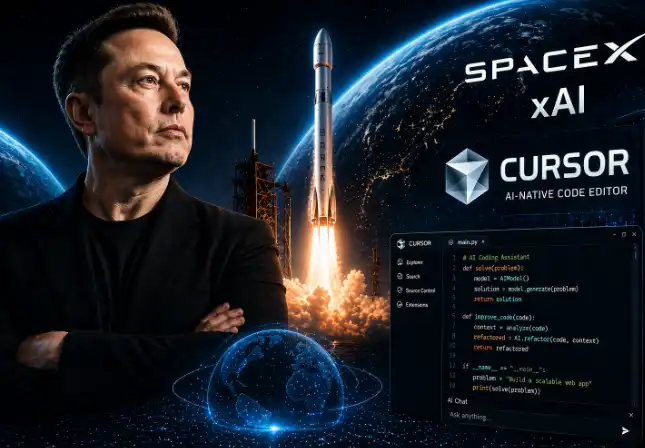
SpaceX Ties Up with Cursor: A High-Stakes AI Gambit of 'Lock First, Acquire Later'

SpaceX has secured an option to acquire AI programming company Cursor for $60 billion, with an alternative clause requiring a $10 billion collaboration fee if the acquisition does not proceed. This structure is not merely a potential acquisition but a strategic move to control core access points in the AI era. The deal is designed as a flexible, dual-path arrangement, allowing SpaceX to either fully acquire Cursor or maintain a binding partnership through high-cost collaboration. This "option-style" approach minimizes immediate regulatory and integration risks while ensuring long-term alignment between the two companies. At its core, the transaction exchanges critical AI-era resources: SpaceX provides its Colossus supercomputing cluster—one of the world’s most powerful AI training infrastructures—while Cursor contributes its AI-native developer environment and strong product adoption. This synergy connects compute power, models, and application layers, forming a closed-loop AI capability stack. Cursor, founded in 2022, has achieved rapid growth with over $1 billion in annual revenue and widespread enterprise adoption. Its value lies in transforming software development through AI agents capable of coding, debugging, and system design—positioning it as a gateway to future software production. For SpaceX, this move is part of a broader strategy to evolve from a aerospace company into an AI infrastructure empire, integrating xAI, supercomputing, and chip manufacturing. Controlling Cursor fills a gap in its developer tooling layer, strengthening its AI narrative ahead of a potential IPO. The deal reflects a shift in AI competition from model superiority to ecosystem and entry-point control. With programming tools as a key battleground, securing developer loyalty becomes crucial for dominating the software production landscape. Risks include questions around Cursor’s valuation, technical integration challenges, and potential regulatory scrutiny. Nevertheless, the deal underscores a strategic bet: controlling both compute and software development access may redefine power dynamics in the AI-driven future.

marsbitHace 2 hora(s)

SpaceX Ties Up with Cursor: A High-Stakes AI Gambit of 'Lock First, Acquire Later'

marsbitHace 2 hora(s)

Trading

Spot
Futuros
活动图片