Five Institutions Outline the 2026 Crypto Blueprint: Will the 'Super App' Arrive? Is the 'Four-Year Cycle' Ending?

marsbitPublicado a 2025-12-25Actualizado a 2025-12-25

Resumen

Five major crypto research institutions (Coinbase, a16z Crypto, Four Pillars, Messari, and Delphi Digital) forecast a shift in 2026, marking the end of the traditional four-year speculative cycle driven by events like Bitcoin halvings. They predict a new era of structural maturity, where value accrues to "ownership tokens" with revenue-sharing models and projects with real utility, not just short-term speculation. Key trends include the rise of an "Agent Economy," where AI agents autonomously manage assets and execute complex DeFi strategies, necessitating new infrastructure like KYA (Know Your Agent) protocols and crypto-native settlement layers for microtransactions. Regulatory clarity in the U.S. is expected to catalyze the development of user-friendly "super apps" that abstract away blockchain complexity, integrating payments, investing, and lending seamlessly with stablecoins. Additional consensus points include the growth of tokenized real-world assets (RWA) with actual utility, the emergence of privacy as a critical competitive advantage for blockchains, and the maturation of social trading. Institutional adoption will deepen via ETFs, cementing crypto as a standard portfolio asset class driven by macro liquidity rather than mere speculation.

Original fromEli5DeFi

Compiled | Odaily Planet Daily Golem(@web 3_golem)

As 2025 draws to a close, major crypto research institutions are releasing reports and making predictions on industry trends for the coming year, forming a new consensus: the era of pure speculation is fading, replaced by structural maturation, driven not by short-term profit motives but by liquidity convergence, infrastructure development, and integration.

Odaily Planet Daily has compiled the core predictions for 2026 from five research institutions—Coinbase, A16Z Crypto, Four Pillars, Messari, and Delphi Digital:

  • End of the Four-Year Cycle: Research institutions unanimously agree that the four-year speculative halving cycle is fading. It is being replaced by structural maturation, where value will flow to "ownership tokens" with profit-sharing models and projects with practical utility, rather than being driven by short-term gains.
  • Rise of the Agent Economy: Major research institutions (Delphi Digital, a16z, Coinbase) predict that AI agents will become primary economic actors. Market focus may shift to KYA (Know Your Agent) identity protocols and machine-native settlement layers.
  • Super Apps: With the clarification of US regulatory policies (Four Pillars, Messari), complex cryptocurrency experiences will be simplified into user-friendly "super apps" and privacy-preserving blockchains, abstracting away the technology to enable mass adoption.

Delphi Digital 2026 Outlook
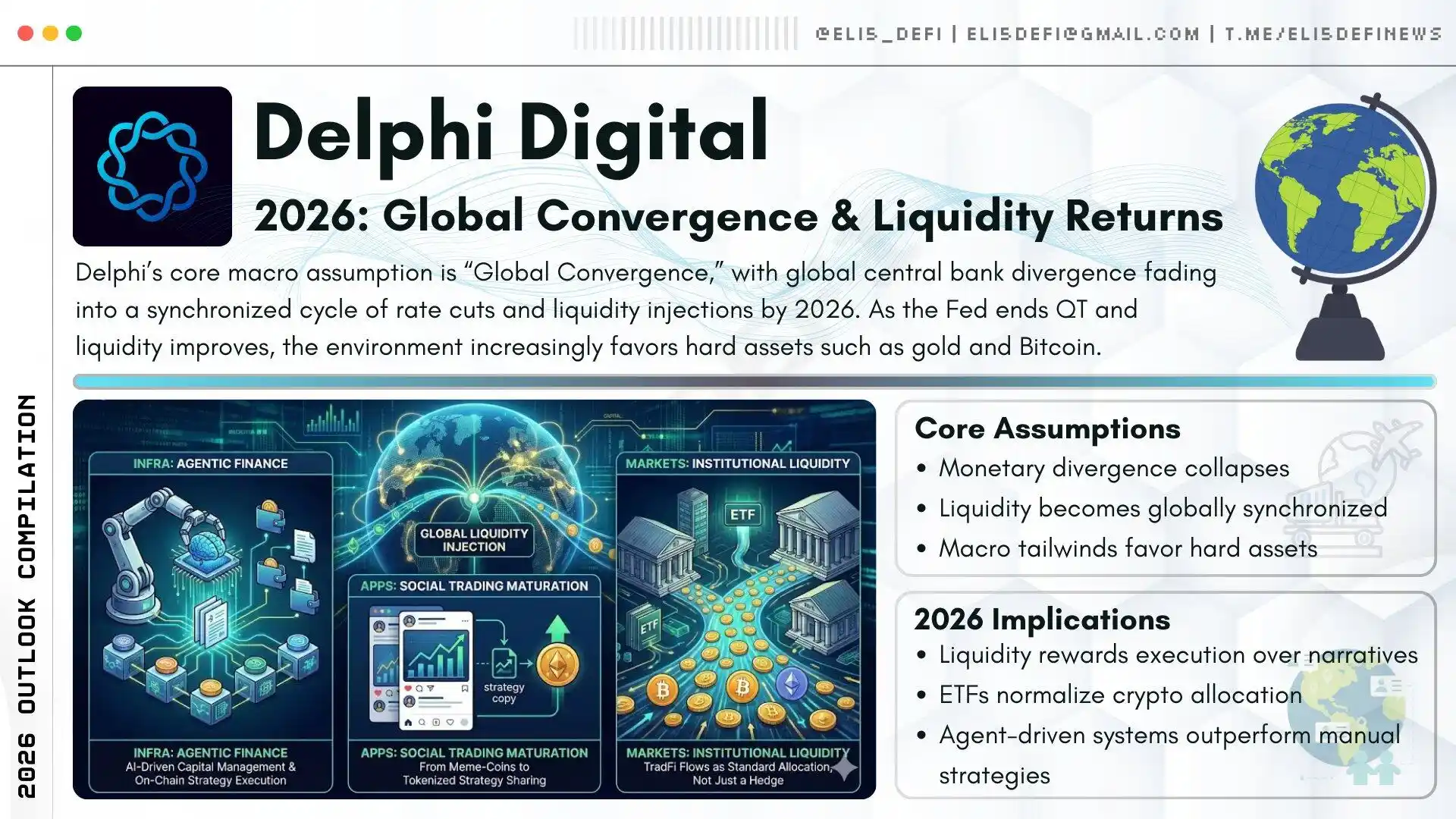
Delphi Digital bases its outlook on a "global convergence" macro assumption. They predict that by 2026, the divergence in global central bank policies will end, shifting towards a unified cycle of interest rate cuts and liquidity injection. As the Federal Reserve ends quantitative tightening (QT) and global liquidity improves, the market environment will favor hard assets like gold and Bitcoin.

Agent Economy

A major expansion of infrastructure is the rise of the "agent economy." AI agents will no longer be just chatbots but will actively manage funds, execute complex DeFi strategies, and optimize on-chain yields without human intervention.

Social Trading and "Pump" Economy

On the consumer application front, Delphi highlighted the user stickiness of platforms like pump.fun and predicted that "social trading" will mature. This trend will evolve from simple meme coin gambling to complex copy-trading tiers, with strategy sharing becoming a tokenized product.

Institutional Liquidity

Market structure will be altered by the deepening adoption of ETFs, with traditional finance liquidity flowing into the crypto market not just as a hedge but as a standard portfolio allocation driven by macro liquidity easing.

Full report link: https://members.delphidigital.io/reports/the-year-ahead-for-infra-2026

Messari 2026 Outlook
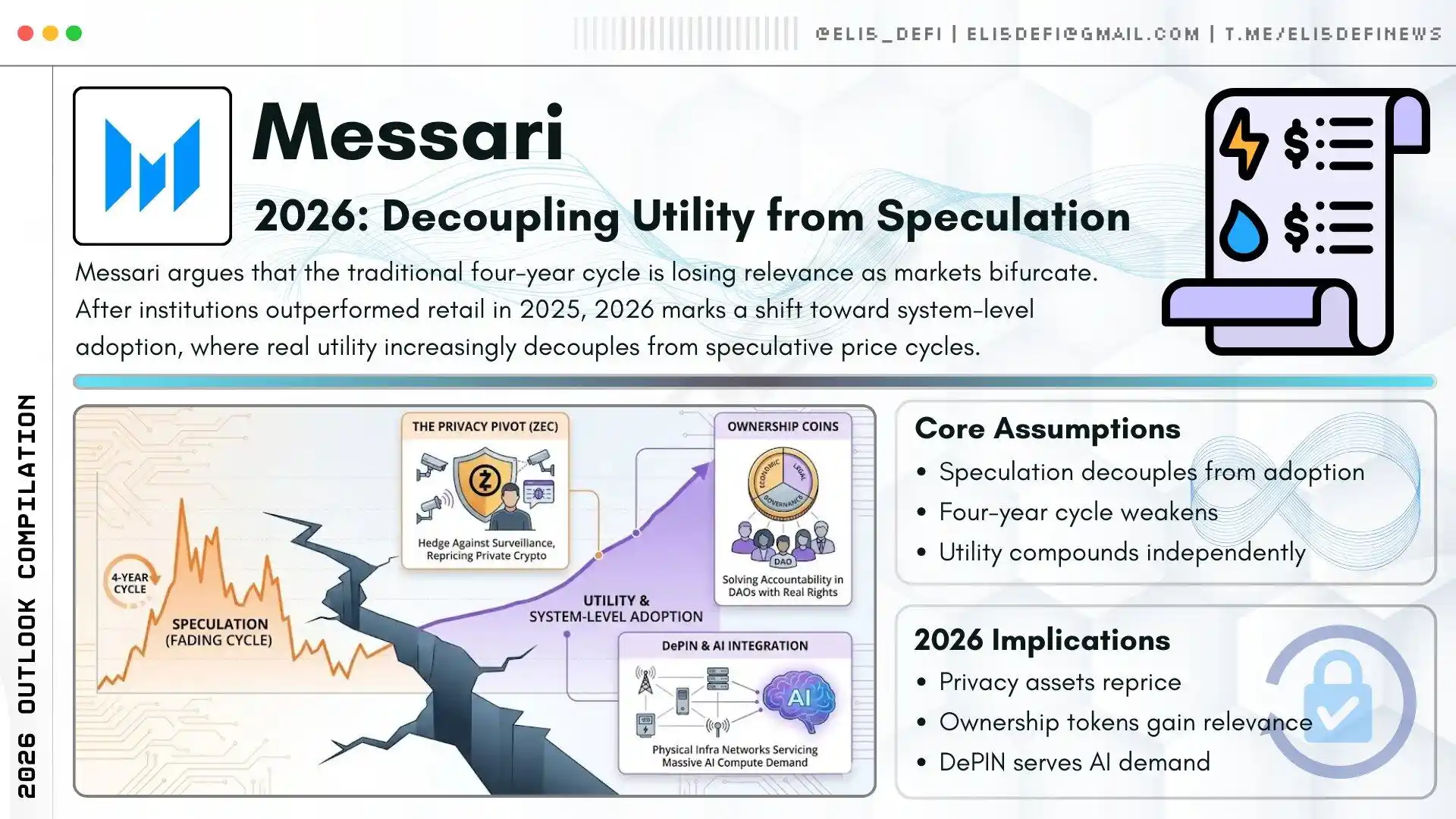
Messari's core thesis is the "decoupling of utility and speculation." They argue that as the market bifurcates, the relevance of the "four-year cycle" model is diminishing. They hypothesize that 2025 was a year where institutional investors won and retail investors struggled, setting the stage for 2026 to be about "system-level adoption" rather than mere asset price speculation.

Rise of Privacy Coins ($ZEC)

A contrarian expansion trend is the renaissance of privacy. Messari emphasizes that Zcash (ZEC) and similar assets are not just "privacy coins" but necessary hedges against growing surveillance and corporate control, predicting a repricing of "private cryptocurrencies."

Ownership Tokens

2026 will see the emergence of a new category—"ownership tokens"—which combine economic, legal, and governance rights. Messari believes these tokens can address the accountability crisis in DAOs and potentially spawn the first billion-dollar projects in this specific niche.

DePIN and AI Convergence

This thesis focuses on DePIN (Decentralized Physical Infrastructure Networks), expecting these protocols to find real product-market fit by meeting the massive computational and data demands of the AI sector.

Full report link: https://messari.io/report/the-crypto-theses-2026

Four Pillars 2026 Outlook
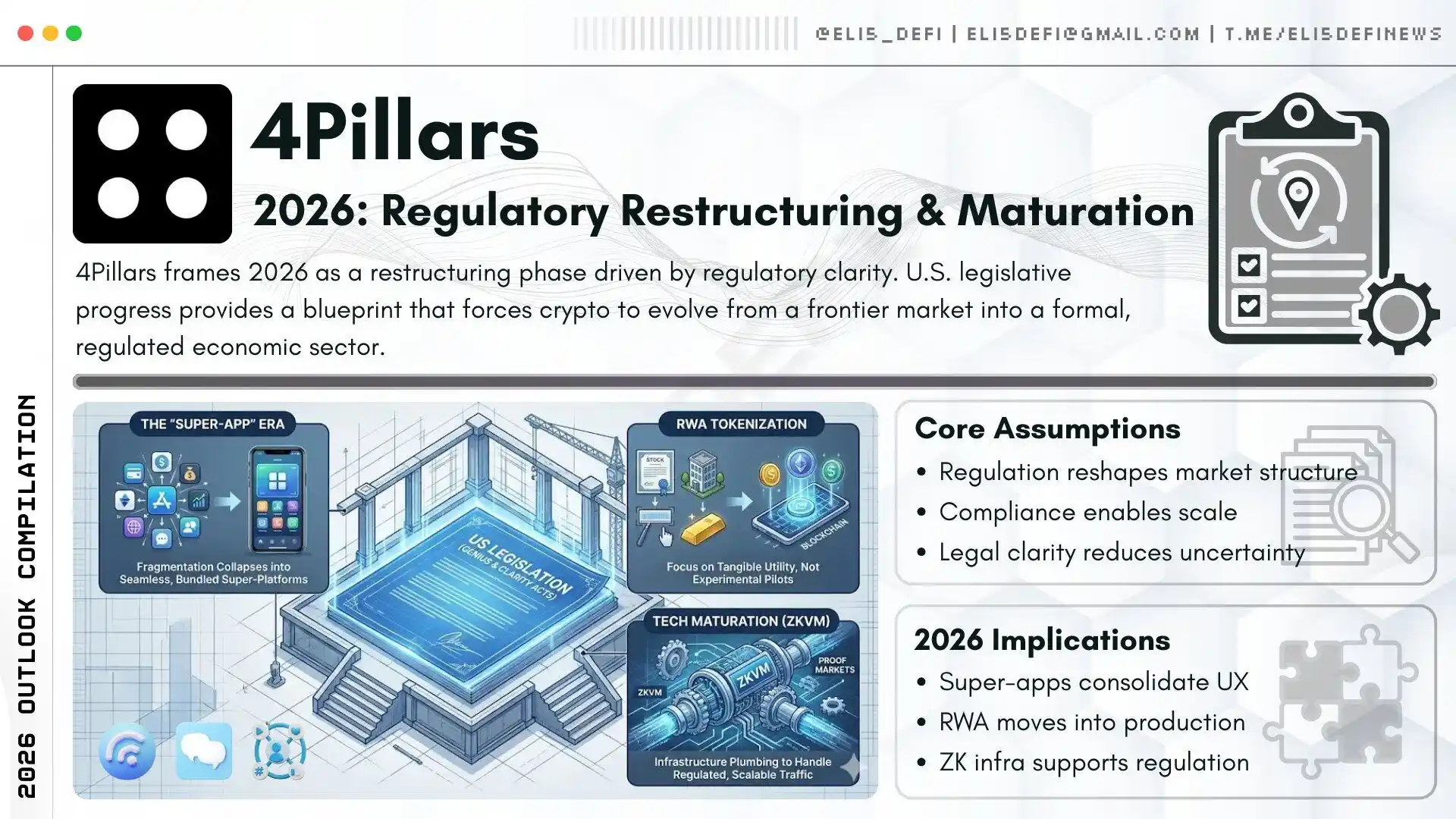
Four Pillars' outlook centers on "regulatory restructuring." Their core assumption is that US legislative initiatives (specifically mentioning the GENIUS Act and CLARITY Act in their predictions) will provide a blueprint for a comprehensive market overhaul.

This regulatory clarity is the catalyst for restructuring the market from a "Wild West" frontier into a formal economic sector.

The Era of "Super Apps"

Four Pillars predicts that the fragmentation of crypto applications will finally coalesce into "super apps"—stablecoin-powered platforms seamlessly integrating payment, investment, and lending functions. The complexity of blockchain will be completely abstracted away.

RWA Tokenization

Restructuring will drive the tokenization of equities and traditional assets, but the focus will be on actual utility, not experimental pilot programs.

Crypto Tech Maturation

On the technology side, they delve into the role of Zero-Knowledge Virtual Machines (ZKVM) on Ethereum and proof markets, seeing them as necessary infrastructure to handle the scale of this new, regulated institutional flow.

Full report link: https://4pillars.io/en/articles/2026-outlook-restructuring-100ys-perspective

Coinbase 2026 Outlook
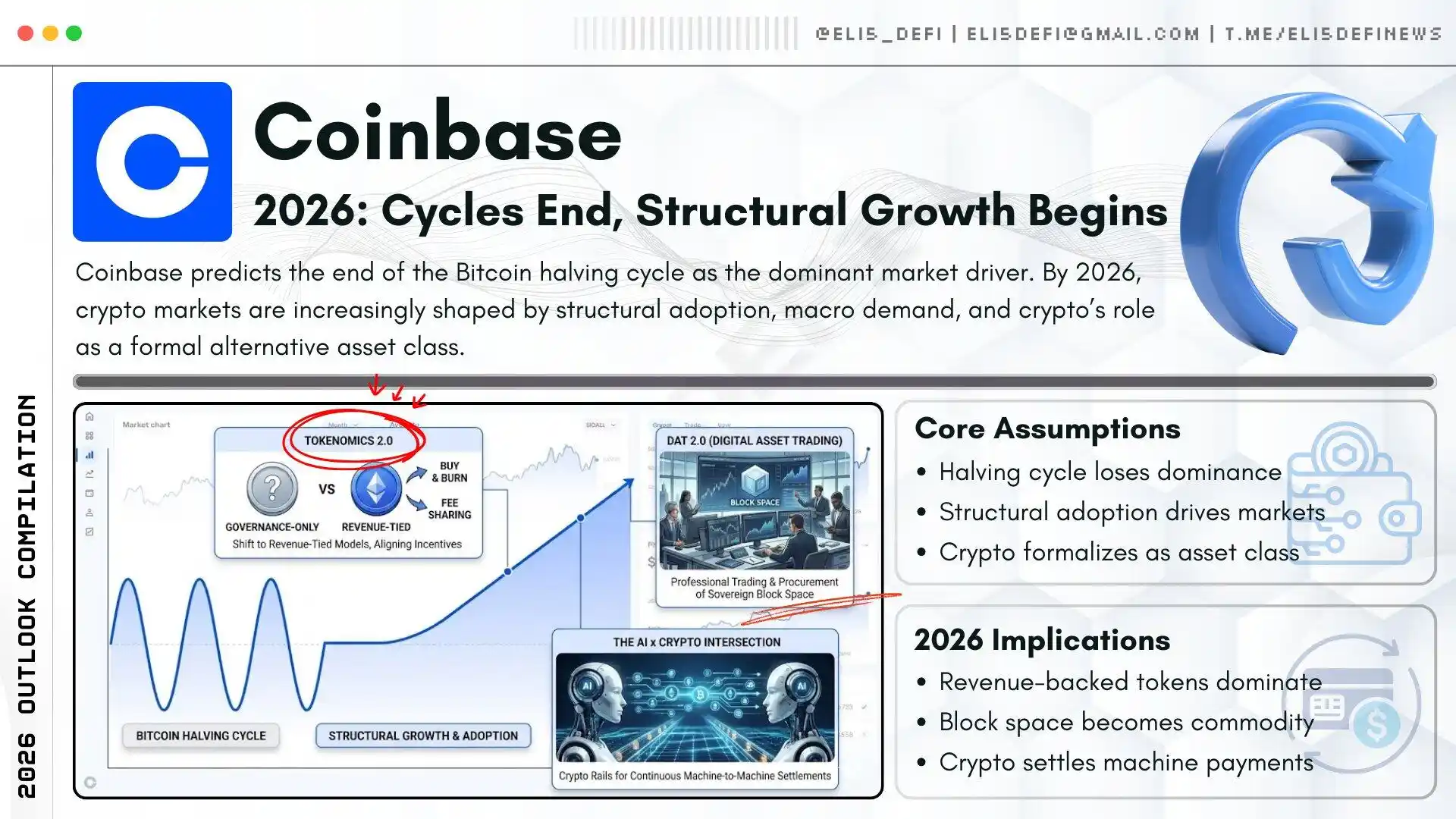
Coinbase's report predicts the "End of the Four-Year Cycle." They state clearly that 2026 will mark the end of the traditional Bitcoin halving cycle theory. Instead, the market will be driven by structural factors, macro demand for alternative stores of value, and the formalization of crypto as a mid-sized alternative asset class.

Tokenomics 2.0

A shift from "governance-only" tokens to "revenue-linked" models. Protocols will increasingly implement buyback-and-burn or fee-sharing mechanisms (compliant with new regulations) to align token holder incentives with platform success.

DAT 2.0 (Digital Asset Trading)

A move towards professionalized trading and "sovereign block space" procurement, treating block space as a key commodity for the digital economy.

AI and Crypto Intersection

Coinbase anticipates significant growth in AI agents using crypto payment rails. They predict the market will need a "crypto-native settlement layer" capable of handling persistent micro-transactions between machines, which traditional payment rails cannot support.

Full report link: https://www.coinbase.com/en-sg/institutional/research-insights/research/market-intelligence/2026-crypto-market-outlook

a16z Crypto 2026 Outlook
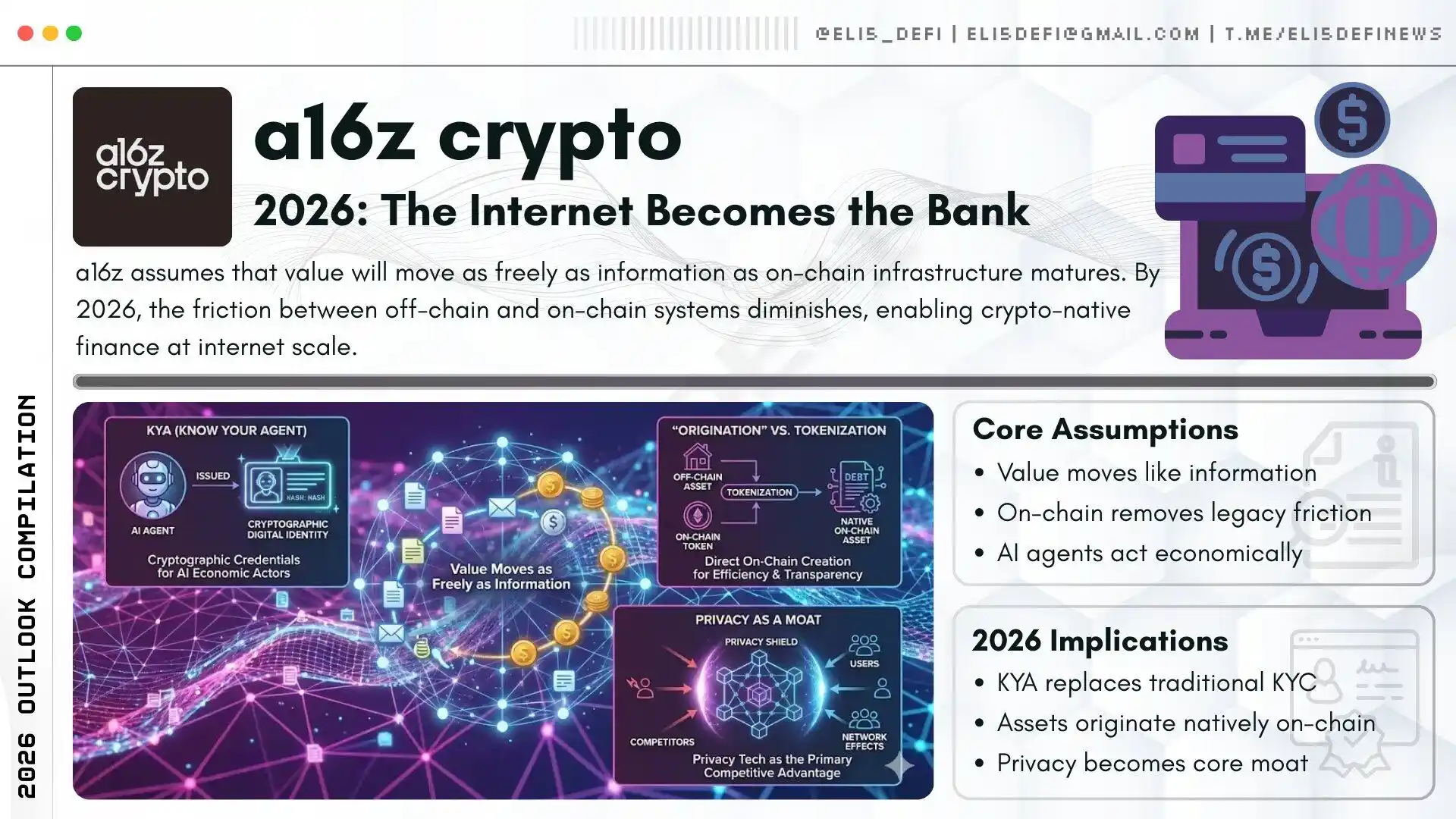
a16z crypto's outlook is that "the internet will become the bank." Their foundational belief is that value is beginning to flow as freely as information. They see the friction between the "off-chain" and "on-chain" worlds as the main bottleneck, and 2026 will see this friction eliminated through better infrastructure.

KYA (Know Your Agent)

A key expansion is the shift from KYC (Know Your Customer) to KYA. As AI agents become primary economic actors, they will need cryptographically signed credentials to transact, creating a new layer of identity infrastructure.

"Native Bonds" vs. Tokenization

a16z predicts a future where instead of tokenizing off-chain assets as in the past (e.g., buying a treasury bill and putting it on-chain), debt and assets will be originated directly on-chain to lower the cost of service and increase transparency.

Privacy Tech Moat

They argue that in the era of open-source code, privacy technology (and the ability to protect state privacy) will become the most important competitive moat for blockchains, creating powerful network effects for privacy-enabled chains.

Wealth Management for All

The combination of AI and crypto infrastructure will democratize complex wealth management strategies (e.g., asset rebalancing, tax-loss harvesting), previously available only to high-net-worth individuals, making them accessible to the masses.

Full report link: https://a16zcrypto.com/posts/article/big-ideas-things-excited-about-crypto-2026/


Criptos en tendencia

Preguntas relacionadas

QWhat is the consensus among major crypto institutions regarding the future of the four-year market cycle?

AMajor research institutions like Coinbase, A16Z Crypto, Four Pillars, Messari, and Delphi Digital agree that the traditional four-year speculative cycle driven by events like Bitcoin halvings is fading. It is being replaced by structural maturation, where value flows to 'ownership tokens' with revenue-sharing models and projects with real utility, rather than being driven by short-term speculation.

QWhat is the 'Agent Economy' predicted by institutions like Delphi Digital and a16z for 2026?

AThe 'Agent Economy' refers to a future where AI agents evolve beyond simple chatbots to become primary economic actors. These agents will autonomously manage funds, execute complex DeFi strategies, and optimize on-chain yields without human intervention. This will necessitate new infrastructure like KYA (Know Your Agent) identity protocols and crypto-native settlement layers for machine-to-machine microtransactions.

QAccording to Four Pillars, what will drive the emergence of 'Super Apps' in crypto?

AFour Pillars predicts that clearer U.S. regulatory policies, such as the potential passing of the GENIUS and CLARITY acts, will act as a catalyst. This regulatory clarity will allow the fragmented crypto application landscape to consolidate into user-friendly 'Super Apps.' These apps will abstract away blockchain's complexity, seamlessly integrating payments, investments, and lending functionalities, all powered by stablecoins.

QWhat new asset class does Messari predict will emerge in 2026, and what problem does it solve?

AMessari predicts the emergence of a new asset class called 'Ownership Tokens.' These tokens combine economic, legal, and governance rights. They are expected to solve the accountability crisis within DAOs (Decentralized Autonomous Organizations) and could potentially birth the first billion-dollar projects in that specific sector by better aligning incentives for token holders.

QHow does a16z Crypto envision the relationship between AI and wealth management evolving by 2026?

Aa16z Crypto envisions that the convergence of AI and crypto infrastructure will democratize sophisticated wealth management. Complex services like asset rebalancing and tax-loss harvesting, which were previously only accessible to high-net-worth individuals, will become available to the masses through automated AI agents operating on crypto payment rails.

Lecturas Relacionadas

Base Under Pressure

**Title: The Pressure Mounts for Base** Base, the Ethereum Layer 2 scaling solution backed by Coinbase, is facing significant pressure and public scrutiny from its leadership following the launch of Robinhood Chain. Base co-founder Jesse Pollak recently acknowledged strategic missteps, admitting that the chain's past focus on social and creator tokens (e.g., through Farcaster, Zora) failed to deliver sustainable adoption. He has refocused on core infrastructure, handing leadership of the Base App back to Coinbase's Cobie. While Base remains a top L2 contender alongside OP Mainnet and Arbitrum, and boasts the highest TVL (nearly $12B), its weaknesses are being highlighted by the new competitor. Key criticisms include its slow progress on decentralization. Base has faced issues with its single sequencer causing block production halts, and L2BEAT is reportedly considering downgrading its decentralization rating from Stage 1 to Stage 0. This contrasts sharply with the rapid initial success of Robinhood Chain, whose DEX quickly entered the top five by volume. The leadership styles of the parent companies are also being compared: Robinhood's CEO actively engages with new projects, while a recent incident where Coinbase's Brian Armstrong briefly changed his profile picture—sparking and then crashing a related meme token—drew community ire and mockery. Pollak stated Base is working with Coinbase on tokenized stocks backed 1:1 by real equity, differentiating it from Robinhood's derivatives model. However, the article argues that Base's most urgent task is to address its long-standing technical and trust issues. With more traditional finance players likely to emulate Robinhood's path, Base must use this competitive pressure to solidify its position as long-term financial infrastructure.

Foresight NewsHace 12 min(s)

Base Under Pressure

Foresight NewsHace 12 min(s)

White House Concession Removes Ethical Hurdle, Clarity Act Races Against Final Window Before Recess?

On July 21st, industry sources reported that the Trump administration has agreed to include an ethics provision in the "Clarity Act" (Digital Asset Market Clarity Act of 2025). This concession addresses the long-standing conflict-of-interest concerns regarding government officials and the crypto industry, potentially removing the final major obstacle to the bill's progress. Additionally, Patrick Witt, the executive director of the White House's Digital Asset Advisory Committee, confirmed he will remain in his role to help finalize the bill, alleviating previous concerns about his potential departure. The Clarity Act aims to establish a unified federal regulatory framework for the U.S. digital asset market. Its core objective is to resolve regulatory ambiguity by defining different types of digital assets (digital commodities, investment contract assets, and permitted payment stablecoins) and clarifying the respective oversight roles of the SEC and CFTC. This would end the long-running jurisdictional dispute between the two agencies and provide clearer compliance paths for the industry. With the ethics issue moving toward resolution, the most urgent challenge now is time. The U.S. Congress is set to begin its August recess in mid-August, leaving only a few working weeks to finalize the text and advance the bill through the Senate. Industry advocates, like the Blockchain Association's Kristin Smith, stress that this is a critical moment. If negotiations conclude successfully in the coming weeks, the Clarity Act could pass a key hurdle before the recess; otherwise, it may face significant delays. If enacted, the Clarity Act could mark a historic turning point in crypto regulation. By providing a clearer and more predictable legal framework, it aims to reduce uncertainty for businesses, developers, and traditional financial institutions looking to enter the digital asset space, potentially setting a global benchmark for market structure regulation.

Odaily星球日报Hace 17 min(s)

White House Concession Removes Ethical Hurdle, Clarity Act Races Against Final Window Before Recess?

Odaily星球日报Hace 17 min(s)

AI Era, Industrial Revolution, and Future Civilization Interview — Zhang Dingwen: The Future Does Not Belong to Chasers

"AI Era, Industrial Revolution and Future Civilization: An Interview with Zhang Dingwen – The Future Does Not Belong to Those Who Chase" In this interview, entrepreneur Zhang Dingwen reflects on his entrepreneurial journey and philosophy, moving beyond discussions of financing or success to emphasize understanding the "era" itself. He argues that true entrepreneurs should not chase short-term trends ("winds"), but position themselves in the direction of long-term technological and societal evolution. Zhang shares key lessons from his early days, including the realization that user value does not automatically translate to commercial value. For him, the core of entrepreneurship is not building a company but constantly upgrading one's own "cognition" – the ability to interpret information, ask the right questions, and understand the underlying "causes" behind business outcomes, not just the effects. His thinking has evolved from a focus on creating good products to a strategic focus on building "entrances" – platforms that naturally connect users to digital services. He sees smart wearables, like watches, not merely as hardware but as potential future gateways combining technological, financial, social, and even fashion attributes to create sustained user relationships and ecosystems. Ultimately, Zhang's vision transcends individual products or companies. He discusses business competition in three stages: product, platform, and finally, "civilization" – where the greatest companies influence how society operates by defining new rules and ways of life. He believes the mission of a truly great enterprise is to solve problems of its time, build enduring trust, and contribute lasting value, leaving behind not just wealth but a positive impact on how the world works. The future, he concludes, belongs not to the fastest, but to those with the correct long-term direction and a commitment to continuous learning and evolution.

marsbitHace 29 min(s)

AI Era, Industrial Revolution, and Future Civilization Interview — Zhang Dingwen: The Future Does Not Belong to Chasers

marsbitHace 29 min(s)

Cryptocurrency & Stock Market Barometer丨Strategy Cash Reserves Increase to $3.23 Billion, Halting BTC Purchases; Vanguard and Other Asset Managers Increase Holdings in Strategy Stock (July 21)

Market Overview & Warnings: The article warns of high volatility in South Korean stocks and continued dependence on U.S. stocks on geopolitics. Chinese A-shares remain under pressure. It advises against using leverage in current equity markets. For crypto-linked stocks, most have limited growth except Robinhood, with caution advised. U.S. Stock Market: Bearish bets on U.S. stocks, particularly targeting AI-related companies, have reached record highs since 2010, signaling deep skepticism about the sustainability of the AI-driven rally. Tech and chip stocks led a market decline, with the Philadelphia Semiconductor Index potentially entering a bear market. Increased expectations for Federal Reserve interest rate hikes and geopolitical tensions contributed to the negative sentiment. Bitcoin Treasury Company Updates: * Strategy: Increased its cash reserves to $3.23 billion and paused Bitcoin purchases. Several major asset managers, including Vanguard Group and Capital Group, increased their holdings of Strategy (MSTR) stock. * Global corporate Bitcoin buying slowed significantly to just $1.33 million last week. * Other notable activity: Strive purchased 21 BTC; ORANGE JUICE raised $40 million for Bitcoin acquisitions; Bitcoin Japan Corp. raised $60 million, allocating $4.08 million for its first BTC purchase. Other Crypto Treasury Holdings: * Ethereum: BitMine increased its ETH holdings to 5.78 million, nearing its 5% of supply goal. Its total crypto assets, cash, and securities are valued at $11.5 billion. * Solana: No significant corporate treasury activity reported. * Altcoins: HypeStrat made no adjustments to its treasury; its mNAV ratio fell to a long-term low. (Note: This summary is for informational purposes only and does not constitute investment advice.)

marsbitHace 29 min(s)

Cryptocurrency & Stock Market Barometer丨Strategy Cash Reserves Increase to $3.23 Billion, Halting BTC Purchases; Vanguard and Other Asset Managers Increase Holdings in Strategy Stock (July 21)

marsbitHace 29 min(s)

Trading

Spot

Artículos destacados

Cómo comprar SUPER

¡Bienvenido a HTX.com! Hemos hecho que comprar SuperFarm (SUPER) sea simple y conveniente. Sigue nuestra guía paso a paso para iniciar tu viaje de criptos.Paso 1: crea tu cuenta HTXUtiliza tu correo electrónico o número de teléfono para registrarte y obtener una cuenta gratuita en HTX. Experimenta un proceso de registro sin complicaciones y desbloquea todas las funciones.Obtener mi cuentaPaso 2: ve a Comprar cripto y elige tu método de pagoTarjeta de crédito/débito: usa tu Visa o Mastercard para comprar SuperFarm (SUPER) al instante.Saldo: utiliza fondos del saldo de tu cuenta HTX para tradear sin problemas.Terceros: hemos agregado métodos de pago populares como Google Pay y Apple Pay para mejorar la comodidad.P2P: tradear directamente con otros usuarios en HTX.Over-the-Counter (OTC): ofrecemos servicios personalizados y tipos de cambio competitivos para los traders.Paso 3: guarda tu SuperFarm (SUPER)Después de comprar tu SuperFarm (SUPER), guárdalo en tu cuenta HTX. Alternativamente, puedes enviarlo a otro lugar mediante transferencia blockchain o utilizarlo para tradear otras criptomonedas.Paso 4: tradear SuperFarm (SUPER)Tradear fácilmente con SuperFarm (SUPER) en HTX's mercado spot. Simplemente accede a tu cuenta, selecciona tu par de trading, ejecuta tus trades y monitorea en tiempo real. Ofrecemos una experiencia fácil de usar tanto para principiantes como para traders experimentados.

235 Vistas totalesPublicado en 2024.12.11Actualizado en 2026.06.02

Cómo comprar SUPER

Discusiones

Bienvenido a la comunidad de HTX. Aquí puedes mantenerte informado sobre los últimos desarrollos de la plataforma y acceder a análisis profesionales del mercado. A continuación se presentan las opiniones de los usuarios sobre el precio de SUPER (SUPER).

活动图片