Fitch Ratings flags risk for US banks with high crypto exposure

cointelegraphPublicado a 2025-12-09Actualizado a 2025-12-09

Resumen

Fitch Ratings warns that US banks with significant cryptocurrency exposure may face negative reassessments of their business models and risk profiles. While crypto integration can offer benefits like improved efficiency and new revenue streams, it also introduces reputational, liquidity, operational, and compliance risks. The agency notes that banks must adequately manage challenges such as crypto volatility, pseudonymity of owners, and security of digital assets. A downgrade from Fitch could lead to lower investor confidence and higher borrowing costs for these banks. The report also highlights systemic risks from the growing stablecoin market, which could impact the broader system and even the Treasury market if adoption expands sufficiently. Major banks like JPMorgan and Bank of America are mentioned as being involved in the sector.

International credit rating agency Fitch Ratings has warned that it may reassess US banks with “significant” cryptocurrency exposure negatively.

In a report posted on Sunday, Fitch Ratings argued that while crypto integrations can boost fees, yields and efficiency, they also pose “reputational, liquidity, operational and compliance” risks for banks.

“Stablecoin issuance, deposit tokenization and blockchain technology use give banks opportunities to improve customer service. They also let banks leverage blockchain speed and efficiency in areas such as payments and smart contracts,” Fitch said, adding:

“However, we may negatively re-assess the business models or risk profiles of U.S. banks with concentrated digital asset exposures.”

Fitch stated that while regulatory advancements in the US are paving the way for a safer cryptocurrency industry, banks still face several challenges when dealing with cryptocurrencies.

“However, banks would need to adequately address challenges around the volatility of cryptocurrency values, the pseudonymity of digital asset owners, and the protection of digital assets from loss or theft to adequately realize the earnings and franchise benefits,” said Fitch.
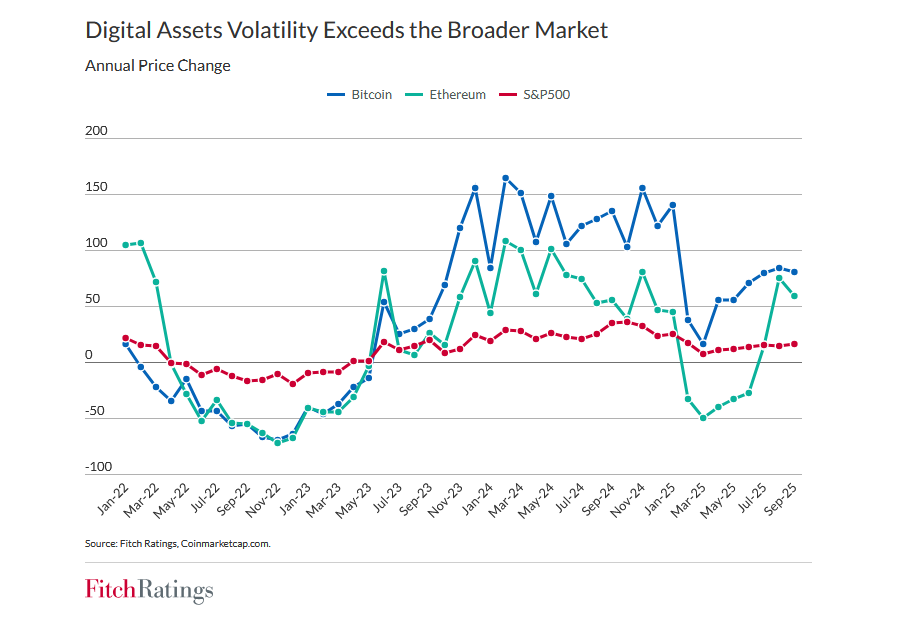
Bitcoin and Ether volatility vs S&P 500. Source: Fitch Ratings

Fitch Ratings is one of the “Big Three” credit rating agencies in the US alongside Moody’s and S&P Global Ratings.

The ratings from these firms — which can be controversial — carry significant weight in the financial world and impact how businesses are perceived or invested in from an economic viability perspective.

As such, Fitch’s downgrading the ratings of a bank with significant crypto exposure could result in lower investor confidence, higher borrowing costs and challenges to growth.

The report highlighted that several major banks, including JPMorgan Chase, Bank of America, Citigroup, and Wells Fargo, are involved in the crypto sector.

Fitch highlights systemic stablecoin risks

Fitch argued that another risk could come from the explosive growth of the stablecoin market, especially if it becomes large enough to influence other areas and institutions.

“Financial system risks could also increase if adoption of stablecoins expands, particularly if it reaches a level sufficient to influence the Treasury market.”

Related: Crypto, TradFi sentiment improves: Will Bitcoin traders clear shorts above $93K?

Moody’s also recently highlighted potential systemic risks of stablecoins in a report from late September, arguing that widespread adoption of stablecoins in the US could ultimately threaten the legitimacy of US dollar.

“High penetration of USD-linked stablecoins in particular can weaken monetary transmission, especially where pricing and settlement increasingly occur outside the domestic currency,” Moody’s said.

“This creates cryptoization pressures analogous to unofficial dollarization, but with greater opacity and less regulatory visibility,” it added.

Magazine: When privacy and AML laws conflict: Crypto projects’ impossible choice

Lecturas Relacionadas

When AI Begins to Audit the World: From Claude Discovering the ZEC Vulnerability, Watching the Encryption Industry Enter the 'Recursive Security Era'

**When AI Audits the World: From Claude's Discovery of a ZEC Vulnerability, Viewing the Crypto Industry Entering a "Recursive Security Era"** This article examines a pivotal shift in the blockchain security landscape, triggered by the convergence of two events: Anthropic's research on AI's "Recursive Self-Improvement" and Claude Opus 4.8's discovery of a critical vulnerability in Zcash's code. Traditionally, crypto security has relied on human experts and automated tools for periodic audits. However, the article argues AI is transitioning from a mere tool to an active participant in understanding and analyzing complex systems. Claude's ability to identify a subtle flaw in Zcash's zero-knowledge proof system demonstrates AI's potential to dramatically lower the cost and time required for risk discovery. This goes beyond finding a single bug; it signals a change in the very mechanism of how vulnerabilities are found. The core thesis introduces the concept of "Recursive Security," drawing a parallel to Anthropic's "Recursive Self-Improvement." Just as AI can accelerate its own development through feedback loops, security systems are evolving towards a continuous cycle of analysis, risk identification, remediation, and re-analysis. Security is becoming a persistent, evolving capability integrated into a system's lifecycle, rather than a one-time pre-launch audit. This shift is particularly urgent for the crypto industry, where system complexity from Layer-2 networks, modular architectures, and ZK-proofs is growing faster than human analysis capacity. AI excels at the pattern recognition and contextual understanding needed to navigate this complexity. Importantly, the article cautions that AI augments both defenders and potential attackers, accelerating the entire threat landscape. The future competitive advantage may not lie in having zero vulnerabilities, but in having the fastest risk discovery, validation, and response capabilities. The Claude-Zcash incident is thus an early signal of an era where AI-driven, recursive security systems become essential for managing risk in an increasingly complex digital world.

marsbitHace 43 min(s)

When AI Begins to Audit the World: From Claude Discovering the ZEC Vulnerability, Watching the Encryption Industry Enter the 'Recursive Security Era'

marsbitHace 43 min(s)

From MSTR to STRC+: Where Is the Limit of the Strategy Universe?

From MSTR to STRC+: The Evolution and Limits of the Strategy Universe This article examines the transformation of Strategy (formerly MicroStrategy) from a simple "Bitcoin treasury" company into a complex financial engineering firm building a BTC-backed credit system. **Core Thesis:** Strategy's true significance lies not just in its massive BTC holdings (~844k BTC), but in its attempt to transform this static reserve into a multi-layered credit curve within traditional capital markets and, subsequently, into on-chain yield infrastructure. **The MSTR Flywheel:** The initial model was a reflexive loop: BTC price rises → MSTR stock rises → company raises capital (debt/equity) at a premium → buys more BTC → increases per-share BTC exposure → MSTR premium grows. This "amplified Bitcoin" equity (MSTR) thrives on bullish momentum but is vulnerable to tightening premiums and rising funding costs. **Building the Credit Curve:** Strategy's innovation is slicing its single BTC balance sheet into different risk/return profiles via specialized securities: * **MSTR:** High-volatility equity layer absorbing full BTC upside/downside. * **STRC:** Key product. A perpetual preferred stock designed as "short duration high yield credit," offering ~11.5% floating monthly dividends. It attracts fixed-income investors seeking yield without direct BTC exposure, funding Strategy's operations. * **STRD/STRK/STRF:** Other preferred/share classes with varying durations, conversion rights, and fixed dividends. **Risks of the STRC Model:** STRC's high yield is not risk-free. Its stability depends on: 1) Sufficient BTC asset coverage, 2) Strategy's continued ability to pay dividends, and 3) Market faith in the MSTR/STRC funding flywheel. Stress points include deep BTC price declines eroding the asset buffer, rising dividend costs if STRC trades below par, and a broken flywheel if MSTR's premium (mNAV) falls persistently. **On-Chain Expansion: STRC+:** Projects like **Saturn** and **Apyx** aim to package STRC's (and other DAT preferred stock) cash flows into on-chain stablecoin yield (e.g., sUSDat, apyUSD). They offer DeFi a new yield source distinct from trading fees or incentives—cash dividends from traditional securities. However, this introduces compounded risks: off-chain custody, issuer credit risk, BTC volatility, and protocol execution risk. **Conclusion: The Ultimate Boundary** Strategy's endgame is not infinite BTC accumulation. It is the market's long-term acceptance of a new credit system where BTC serves as collateral for tradable securities whose cash flows can power on-chain financial applications. Its "universe" expands if this BTC-native credit curve gains legitimacy, but contracts if these instruments are repriced purely as high-risk, yield-bearing credit assets without stablecoin mythology.

marsbitHace 1 hora(s)

From MSTR to STRC+: Where Is the Limit of the Strategy Universe?

marsbitHace 1 hora(s)

Trading

Spot
Futuros
活动图片