Fields Medalist Stumped, Claude Solves 78-Year Mystery, Possibly the Most Important AI Achievement in Mathematics

marsbitPublicado a 2026-08-24Actualizado a 2026-08-24

Resumen

A 78-year-old mathematical problem—whether the six-dimensional sphere (S6) admits a complex structure—has been answered affirmatively in just three days by Harvard mathematician Levent Alpöge with the assistance of Claude, an AI system. The work constructs an explicit complex manifold X and rigorously proves it is diffeomorphic to S6, bypassing decades of inconclusive theoretical debate. Previous attempts by distinguished mathematicians, including Fields Medalist Michael Atiyah, had fallen short. The 108-page proof details a novel geometric construction: starting with a (3,4,∞) triangle group acting on the upper half-plane to form a base sphere with three singular points, then attaching a family of complex 2-tori over most points. The three singularities are filled using distinct classical techniques (Mumford's toric degeneration and Kodaira's logarithmic transformations with multiplicities 3 and 4). The resulting compact complex threefold X is shown to be simply connected with trivial fundamental group, matching the homology of S6. Applying established results by Smale, and Kervaire & Milnor, it is concluded that X is indeed the standard smooth 6-sphere. This achievement is part of a rapid series of breakthroughs by Alpöge using Claude, including a claimed counterexample to the 87-year-old Jacobian conjecture in July and significant progress on the Riemann zeta function in early August. Experts note that while prior AI contributions involved searching or combining existing...

A century-old puzzle that remained unsolved for 78 years was cracked in just three days!

The question was whether a complex structure exists on the 6-dimensional sphere, a problem dating back to 1948. The answer is now: yes.

The solution was presented by Harvard mathematician Levent Alpöge and Claude.
What's even more remarkable is the method they used to break through.

They bypassed the well-trodden paths followed for decades and directly constructed the object, then pointed to it and declared, 'This is the complex structure on S6.'

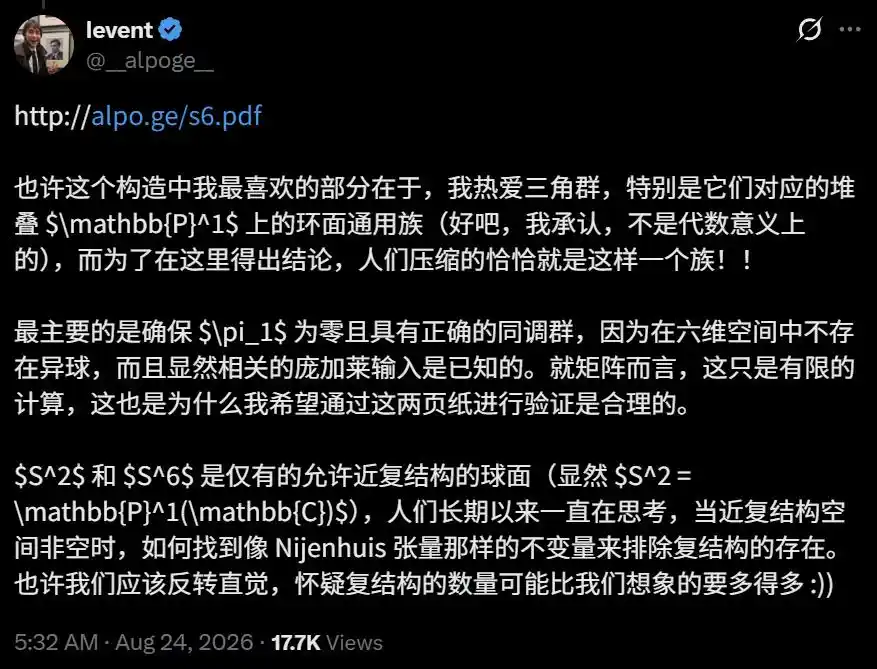
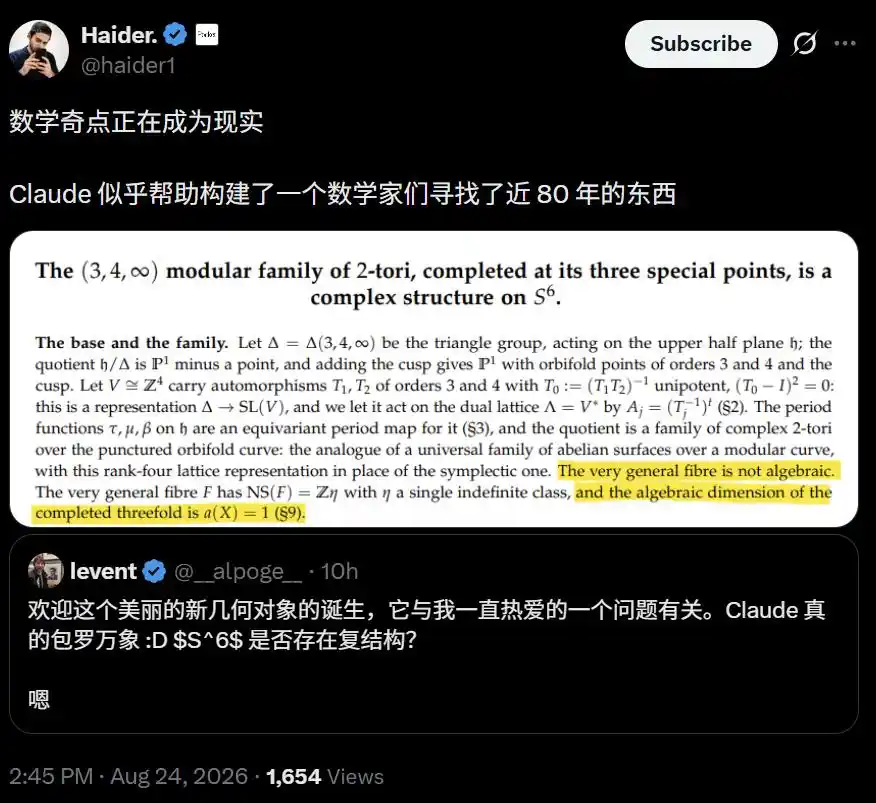
When Alpöge announced it on X, his opening line sounded more like announcing the arrival of a new life—

Welcome this beautiful new geometric object into the world.

Over 70 Years, All Hanging on This One Sphere

Among all spheres, only two qualify to discuss complex structures: S2 and S6; others were ruled out long ago.

S2 is no surprise; it's the most fundamental building block in complex geometry.

So, for over 70 years, all eyes were fixed on this sole candidate, S6.

Some claimed it existed, while others swore it absolutely did not, but both sides stumbled.
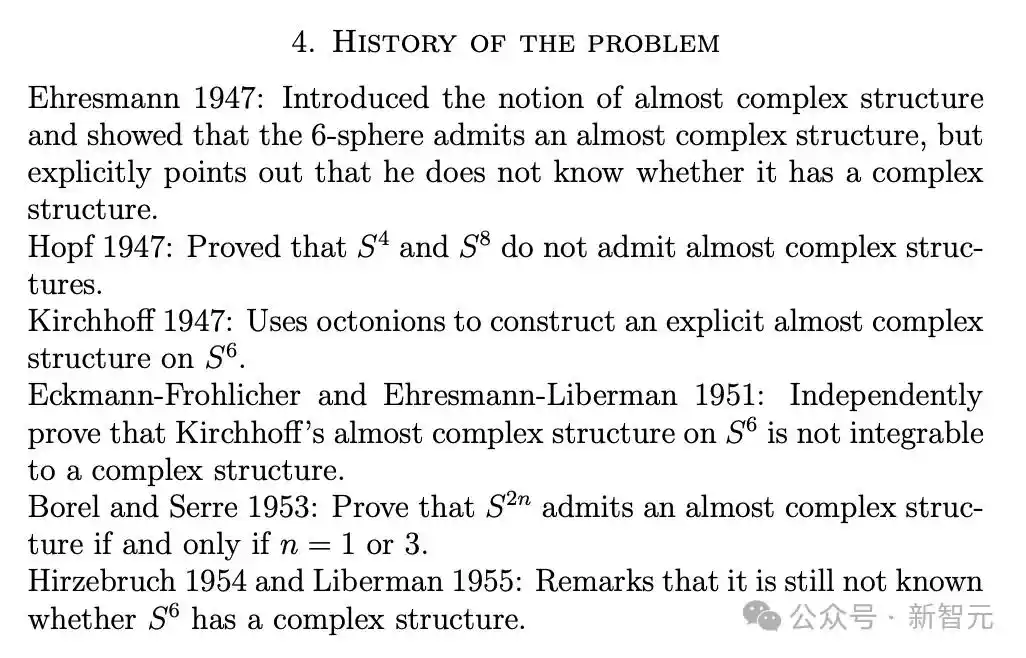
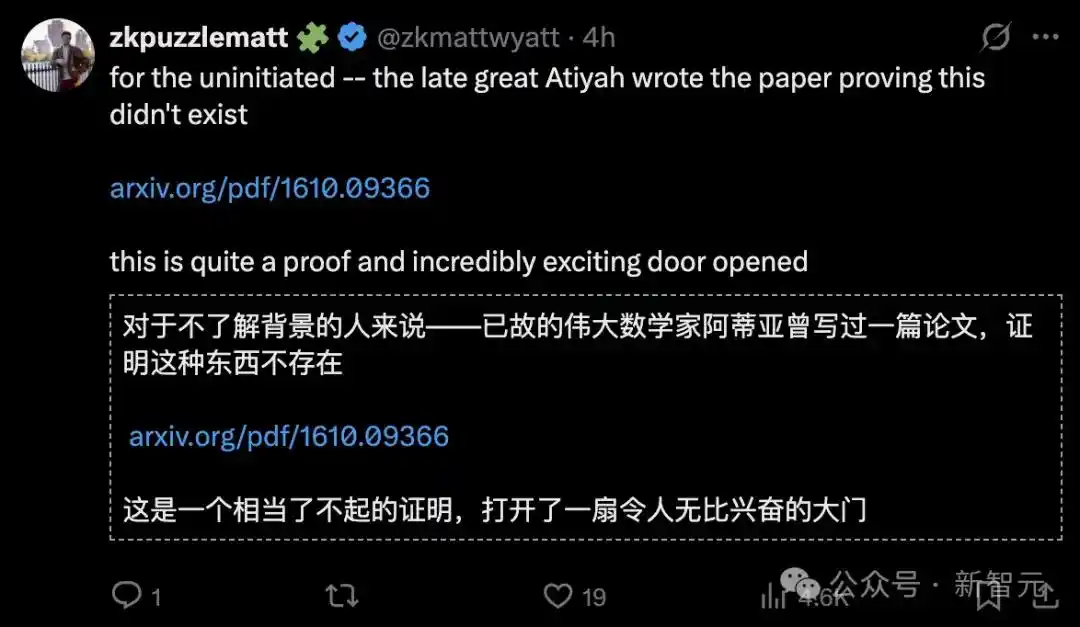
For example, Michael Francis Atiyah, one of the greatest living mathematicians and a Fields Medalist, claimed to have solved it in 2016, but his proof was found to have gaps.
Master mathematician Shiing-Shen Chern also studied this problem in his later years.

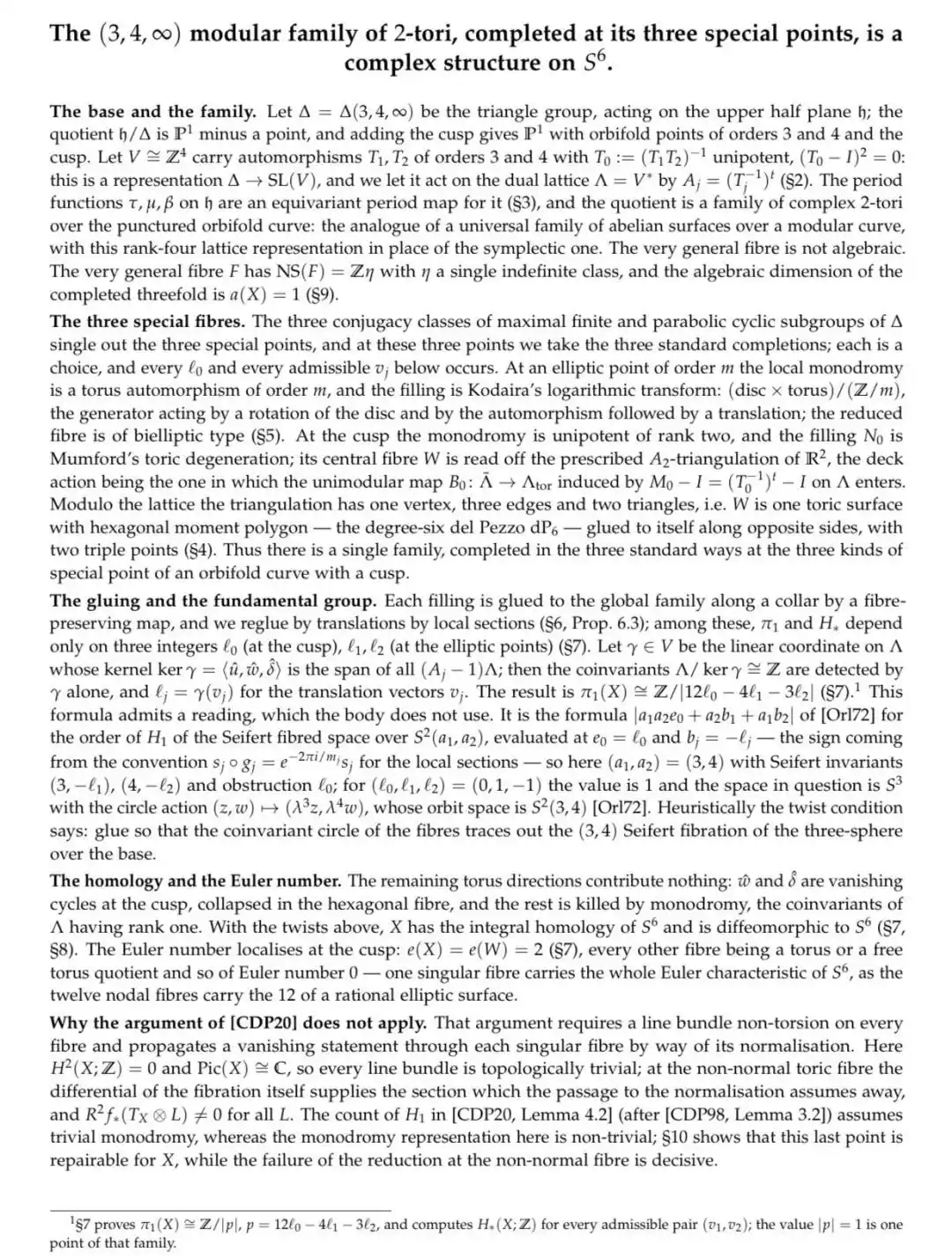
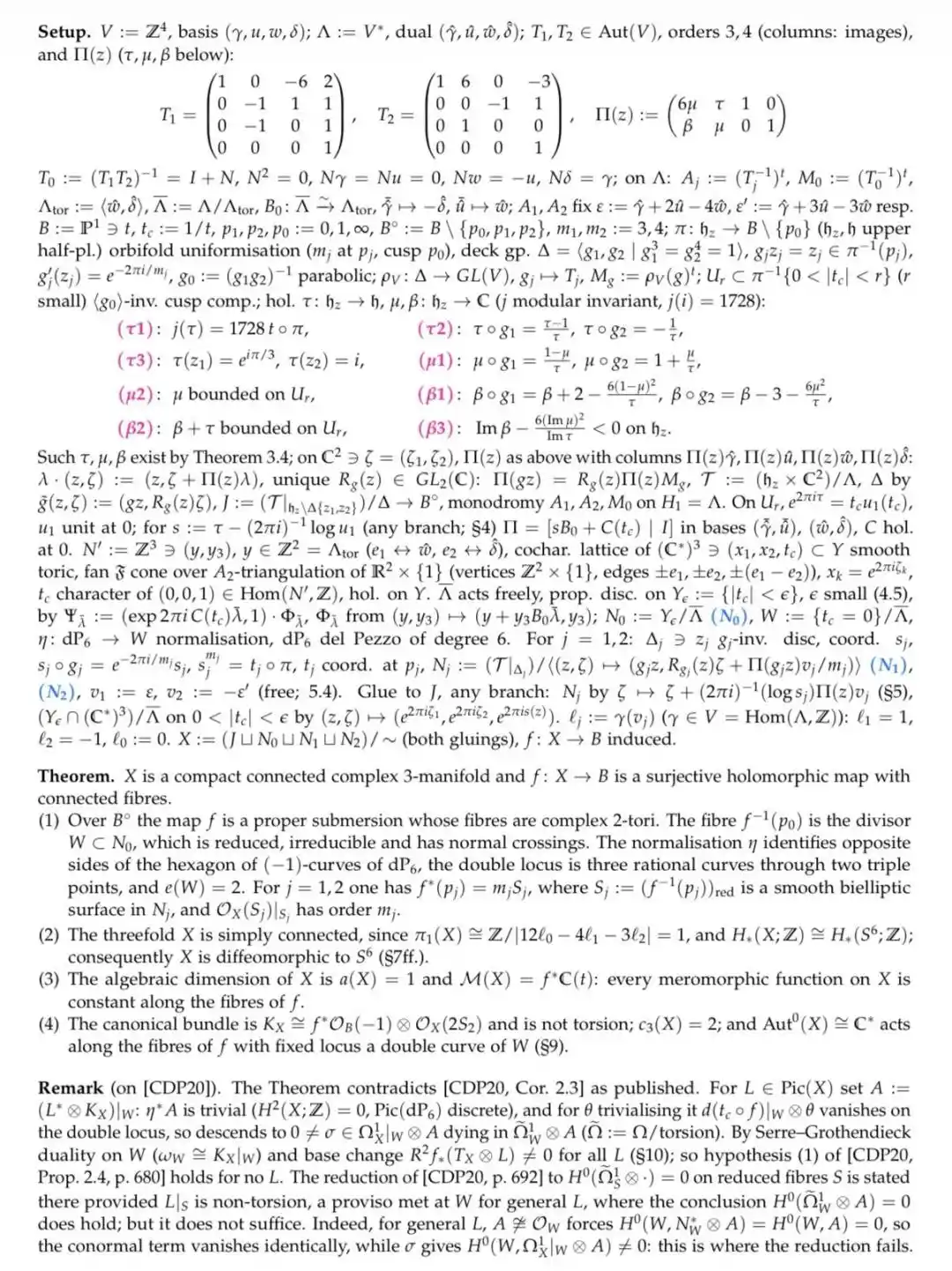
What Alpöge presented this time is a hefty 108-page document.

Every matrix, coordinate chart, and gluing method used in the construction is laid out in black and white.

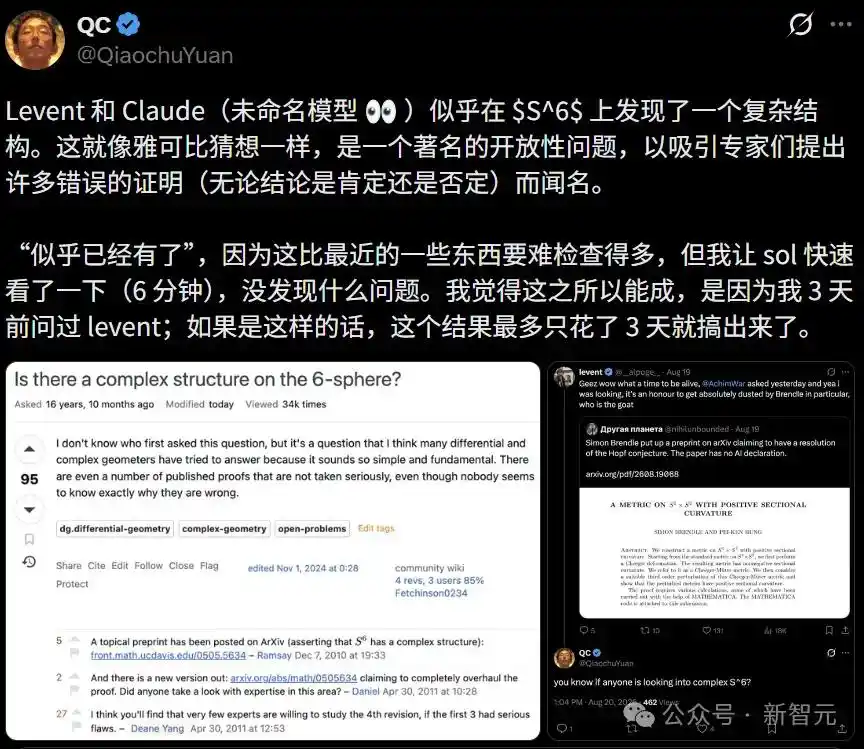
Mathematician Qiaochu Yuan deliberately tried to find flaws using GPT-5.6 Sol. After scrutinizing it for 6 minutes, he found none.

Undeterred, he examined it for another 15 minutes but still couldn't find any issues; instead, he gained a deeper understanding of the argument.

Sol concluded that if these 108 pages hold their ground, this could be the most significant AI achievement in mathematics to date.
If this work were purely human, it would likely win a Fields Medal, if not for its difficulty or fame, then at least for its impact.

Three Integers That Decided the Fate of the Problem

So, how exactly was this new object constructed?

Step 1: Lay the foundation.

Take a (3,4,∞) triangle group and use it to tessellate the upper half-plane. The resulting shape, intuitively, is a sphere.

However, this sphere has three special points pinned to it: a point of order 3, a point of order 4, and a cusp, located at t = 0, t = 1, and t = ∞, respectively.

Alpöge didn't hide his favoritism, stating outright that the triangle group and the family of tori attached to it were his proudest touch.

Step 2: Attach tori to the foundation.

At every point on the base except for the three special ones, attach a complex 2-torus, a structure that is 2-dimensional over the complex numbers (4-dimensional over the reals).

This object attached above a point is called the fiber at that point. The whole X is constructed fiber by fiber in this manner.

After this step, the spots above the three special points remain empty, effectively punching three holes in the sphere.

Step 3: Fill the three holes.

Filling these holes means assigning a fiber to each of these vacant points and stitching them together to form a complete compact manifold.

The clever part is that the three holes are not filled using the same method; each hole precisely falls within the scope of a classical filling technique.

The cusp at t = ∞ is filled using Mumford's toric degeneration; the fiber inserted there is called W, obtained by taking a hexagon boundary of a degree 6 del Pezzo surface and gluing opposite edges in pairs.

The remaining points at t = 0 and t = 1 are filled using Kodaira's logarithmic transformation, with multiplicities 3 and 4, matching the orders 3 and 4 of the base points.

The moment the three holes are filled, a compact complex threefold named X comes into existence.

The Object Is Constructed, But Is It S6?

At this point, X is a perfectly legitimate complex manifold, but the interrogation isn't over.

Section 7 of the paper rigorously computes the fundamental group of X: π1(X) ≅ Z / |12l0 − 4l1 − 3l2|.

Roughly speaking, the fundamental group tells you if there are unavoidable holes in the space. Any loop drawn on a sphere can be contracted to a point, so the sphere's fundamental group is trivial.

The three integers (l0, l1, l2) in the formula record the twisting of the fibers when filling the three holes.

Substituting (0, 1, −1) gives 12×0 − 4×1 − 3×(−1) = −1, whose absolute value is firmly 1.

Z modulo 1 is the trivial group. The fundamental group vanishes here, satisfying the first condition matching X with the sphere.

Since X itself is simply connected, its integral homology matches S6 exactly. Applying the Hurewicz and Whitehead theorems, it is indeed a homotopy 6-sphere. Combined with Smale's generalized Poincaré conjecture from 1961, it is homeomorphic to S6.

Finally, only the smooth structure remains to be verified.

In topology, homeomorphism does not imply diffeomorphism. Two objects might look identical, but the ways calculus works on them might not align. Such imposters have a special name: exotic spheres.

Fortunately, as early as 1963, Kervaire and Milnor settled this account: the six-dimensional world is clean, having exactly zero exotic spheres. In contrast, seven dimensions can produce up to 28 of them.

Thus, homeomorphism here directly upgrades to diffeomorphism. X's true identity is S6.

The Solver Wasn't Originally a Complex Geometer

Alpöge is a Junior Fellow at the Harvard Society of Fellows and concurrently a postdoctoral researcher at Anthropic. His primary field is number theory and arithmetic geometry; he doesn't typically wade into the waters of complex geometry.

Yuan revealed that just three days before solving this problem, he had discussed this deadlock with him.

From Finding Answers to Creating Answers

Solving a 70-year-old problem in three days is already absurd enough.

But this was actually the third time within 35 days.

July 20: Alpöge, using Claude Fable 5, produced a fatal counterexample to the Jacobian conjecture, a problem posed in 1939 that had remained unsolved for 87 years.

Only three weeks later, on August 10: An unreleased research version of Claude, whose identity remains undisclosed, increased the proven proportion of zeros of the Riemann zeta function lying on the critical line from 41.6% to 67.2%.

In that computational battle, it mobilized about 60 sub-agents, executed roughly 2400 shell commands, and consumed 31 million output tokens.

Then came August 24: this S6 result.

For the first two instances, you could still argue that the AI was merely a powerful search engine—one exploring known solution spaces for a counterexample, the other forcibly stitching together two existing papers already in the literature.

This time, however, the nature fundamentally changed.

This geometric object did not previously exist; the model literally created it.

Justin Curry, Associate Professor of Mathematics and Statistics at the University at Albany, SUNY, stated plainly: If the proof holds, this is certainly the most impressive AI achievement in recent memory.

For the past 78 years, everyone was asking the same question: does a complex structure exist on S6?

From this moment on, the question might already be a different one.

How many more are hidden there?

Reference: https://alpo.ge/s6.pdf

This article is from the WeChat public account "Xinzhiyuan"; author: ASI Apocalypse; editor: Moses David


Preguntas relacionadas

QWhat is the key mathematical result presented in the article regarding the six-dimensional sphere?

AThe article presents a purported proof, achieved by mathematician Levent Alpöge and AI Claude, that the six-dimensional sphere (S6) admits a complex structure. This construction and proof is claimed to solve a 78-year-old open problem in mathematics.

QHow did the researchers approach the problem of S6's complex structure differently from previous attempts?

AInstead of following the traditional theoretical approaches to prove or disprove the existence of a complex structure on S6, they directly constructed a specific geometric object (a compact complex threefold X) and then mathematically proved that this object is diffeomorphic to S6.

QWhat role did the AI Claude reportedly play in this discovery according to the article?

AAccording to the article, Claude was a co-author and instrumental tool used by Levent Alpöge. The AI was heavily involved in the reasoning and computational processes that led to the construction and proof, working over a very short timeframe. This is presented as a landmark achievement in AI-assisted mathematical discovery.

QWhich other long-standing mathematical problems were mentioned as being tackled by Levent Alpöge and Claude in recent weeks?

AThe article mentions two other significant results achieved in a short period prior: 1) A counterexample to the 87-year-old Jacobian Conjecture (July 20). 2) Increasing the proven proportion of Riemann zeta function zeros on the critical line from 41.6% to 67.2% (August 10).

QWhy is proving the existence of a complex structure on S6 considered particularly difficult and significant?

AIt has been a major open question in complex and differential geometry for 78 years. Many renowned mathematicians, including Fields Medalist Michael Atiyah, attempted and failed to definitively answer it. The S2 sphere is the only other sphere known to have a natural complex structure, making S6 a unique and critical case. Solving it would fundamentally expand the understanding of complex geometry on spheres.

Lecturas Relacionadas

Bessent's True Agenda

U.S. Treasury Secretary Besant's recent interventions in the bond market are seen by some as an attempt to artificially trigger a massive short squeeze before the midterm elections. The alleged goal is to push the 10-year yield toward 5% initially, then use covering by short sellers to drive it down to around 4.3%, providing political breathing room for the Trump administration. Analysts point to near-record short positions held by CTA trend-following funds. According to Goldman Sachs data, a price rally of two standard deviations could trigger historically large short-covering. Besant's tactics reportedly include bond buybacks, shifting issuance toward shorter-term debt, and potentially canceling ultra-long bond auctions to pressure these market positions. So far, interventions like modest buybacks have had limited effect on yields, with the Treasury later hinting at using its General Account (TGA) cash for support. Critics argue these measures cannot address structural pressures like large deficits and high inflation. Instead, the strategy appears tactical—aimed at buying time and exploiting technical market vulnerabilities rather than reversing the underlying yield trend. The political timeline is clear: achieve lower yields ahead of the midterms to help lower mortgage rates and craft a favorable narrative. However, analysts warn that once the election passes, structural upward pressure on yields and equity valuations could reassert themselves more forcefully. Market signals suggest this potential short-squeeze dynamic could intensify in the coming days.

marsbitHace 46 min(s)

Bessent's True Agenda

marsbitHace 46 min(s)

Jackson Hole Speech Preview: Is the Fed Seeking Justification for a Rate Hike?

"Jackson Hole Speech Preview: Is the Fed Looking for Reasons to Raise Rates?" Ahead of the key Jackson Hole symposium, Federal Reserve officials and the IMF are signaling heightened concern over persistent inflation, with some advocating for tighter policy. Boston Fed President Susan Collins, in a recent article, supported holding rates steady only if evidence of falling inflation continues. Otherwise, she argues for prompt tightening, noting inflation has been above target for over five years and warning that prolonged deviation could entrench consumer expectations. Although not a voting member this year, her stance aligns with several officials; three FOMC voters dissented in July, favoring a rate hike. Richmond Fed's Tom Barkin warned of a future "reckoning" regarding the $40 trillion public debt, while IMF Managing Director Kristalina Georgieva urged central banks to maintain a laser focus on price stability. The core dilemma lies in the sources of inflation: Trump-era tariffs, Middle East conflict-driven oil prices, and surging AI investment. Collins believes the first two factors are fading, but identifies AI infrastructure spending as exerting "upward pressure" on core goods inflation. The problem is that interest rate hikes primarily curb demand, not these supply-side shocks. Georgieva framed it as a "tug of war" between negative supply shocks from the Middle East and positive demand shocks from AI. Meanwhile, economic data shows strain. The August Consumer Confidence Index fell to a seven-month low of 89.4. While the present situation index improved, future expectations plummeted. Consumers expect higher inflation (5.8% vs. 5.6% last month), likely influenced by high gas prices. Other data points are weak: July retail sales saw the largest drop in over a year, and job growth stalled. Key upcoming events include the July PCE inflation data (expected to remain well above the 2% target) and new Fed Chair Kevin Warsh's first major speech at Jackson Hole. Market pricing remains conflicted, showing a high probability of a December hike but expecting no move in September. Gold prices, however, have surged over 7% to near three-month highs, signaling market anxiety.

marsbitHace 1 hora(s)

Jackson Hole Speech Preview: Is the Fed Seeking Justification for a Rate Hike?

marsbitHace 1 hora(s)

Today, HYPE Activates Its Second Buyback Engine

"Hyperliquid Activates Second Buyback Engine with AQAv2 Launch" On August 26th, Hyperliquid officially activated its Aligned Quote Assets v2 (AQAv2) mechanism, introducing a major new source of revenue and buyback power for its native token, HYPE. Unlike the existing revenue stream from trading fees, AQAv2 generates income by sharing approximately 90% of the adjusted reserve earnings from stablecoins (primarily USDC) circulating on the Hyperliquid chain. This income is settled every 30 days and automatically funneled into the Assistance Fund for HYPE buybacks, with the first expected distribution on October 3rd. Through a partnership with Circle (issuer of USDC) and Coinbase (treasury manager), Hyperliquid leverages its user base and financial infrastructure to share in the yield generated by stablecoin reserves. This transforms its liquidity and distribution capabilities into a scalable business model. Initial estimates project AQAv2 could generate $150-200 million in annual buyback funds, based on the current ~$6.43 billion USDC supply on Hyperliquid and an assumed reserve yield. Crucially, this revenue is weakly correlated with trading activity and grows directly with the platform's stablecoin adoption. With HYPE recently reaching an all-time high, AQAv2 provides a new fundamental support layer. It shifts Hyperliquid's value capture beyond just transaction fees, anchoring HYPE's long-term buyback potential to the expanding scale of its stablecoin ecosystem.

marsbitHace 1 hora(s)

Today, HYPE Activates Its Second Buyback Engine

marsbitHace 1 hora(s)

NVIDIA Earnings Preview: The Market No Longer Expects a Positive Surprise

NVIDIA's upcoming earnings report has seen market expectations shift from anticipating big positive surprises to seeking clarity on capital allocation and future growth sustainability. While analysts forecast Q2 revenue near doubling year-over-year to $92.18 billion, option markets are pricing in a relatively muted post-earnings stock move of around 5.4%—the lowest implied volatility in two years. This reflects a growing sense that the phase of massive AI-driven earnings beats and stock surges may be ending. This year, NVIDIA's stock has slightly underperformed the S&P 500 and significantly lagged the semiconductor index. Analysts now emphasize the need for more than just beating estimates. Key investor focuses include details on how NVIDIA will deploy its capital, maintain its exceptional gross margins amid rising costs, and use its substantial free cash flow for investments and share buybacks. The forward P/E ratio of about 21x suggests the market is already pricing in a growth deceleration. NVIDIA's recent strategic moves—like facilitating massive AI financing, guaranteeing loans for data center projects (including a major one for OpenAI), and investing in power infrastructure—have positioned it beyond a mere chipmaker. However, this raises questions about potential "circular financing," where revenue might be artificially supported by lending to customers. The health of its AI clients, like OpenAI which reported slowing revenue growth, is now crucial. The report arrives amid a challenging backdrop: political pushback against AI data centers, rising borrowing costs, and massive debt-funded spending by cloud giants. Investors are keenly watching for signals on the transition to the new Blackwell and upcoming Vera Rubin architectures and, ultimately, whether the explosive demand for AI is losing momentum.

marsbitHace 1 hora(s)

NVIDIA Earnings Preview: The Market No Longer Expects a Positive Surprise

marsbitHace 1 hora(s)

Trading

Spot
活动图片