Fed seeks input on account type attractive to crypto firms

cointelegraphPublicado a 2025-12-22Actualizado a 2025-12-22

Resumen

The US Federal Reserve is seeking public input on a proposed "payment account" or "skinny master account" that would grant fintech and crypto firms access to the central bank's payment system without requiring full master account approvals. Fed Governor Christopher Waller stated these accounts aim to support innovation while maintaining safety, reflecting rapid developments in payments. However, Governor Michael Barr expressed concerns over potential money laundering and terrorist financing risks, especially for institutions not directly supervised by the Fed. Crypto firms like Circle, Coinbase, Kraken, and Block could benefit, potentially bridging crypto and traditional banking. Unlike master accounts, these payment accounts would not earn interest, lack access to Fed credit, and have balance caps. The comment period closes 45 days after Federal Register publication, with operational launch expected in Q4 2026.

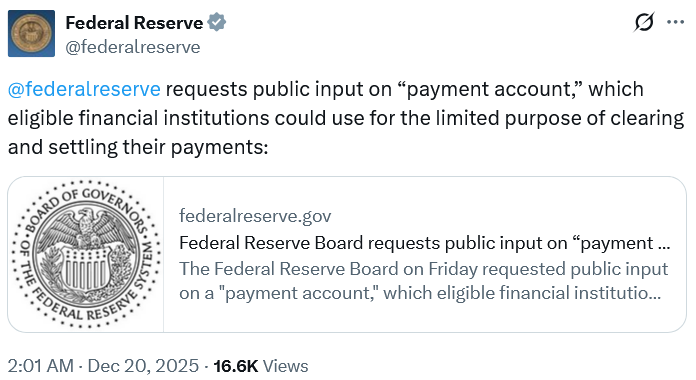
The US Federal Reserve is requesting public input on its proposed “payment account,” dubbed a “skinny master account” which fintechs and crypto firms are drawn to as it would allow access to the central bank without needing the typical approvals.

"These new payment accounts would support innovation while keeping the payments system safe," Fed Governor Christopher Waller said on Friday. In October, Waller recommended that the Fed explore the idea of implementing payment accounts to clear and settle certain transaction activities of eligible financial institutions.

Waller added the Fed is introducing the payment accounts feature to reflect the “rapid developments” in the payments industry that have led to “innovative approaches to banking” and new changes in business models.

“This tailoring could result in lower risk to the payment system and, as a result, requests for payment accounts could generally receive a streamlined review.”

Not all Fed officials agreed with the decision to seek public input, with Governor Michael Barr arguing that it could pose risks if safeguards against money laundering and terrorist financing are not clearly defined, especially for institutions the Fed does not directly supervise.

Several payment-focused crypto firms could be in the running to connect to the Fed’s banking rails, potentially strengthening the bridge between crypto and traditional banking. Among the largest US-based crypto payments companies are Circle, Coinbase, Kraken, and Block, Inc.
Source: Federal Reserve


Inclusion of crypto firms into the Fed’s banking system would mark a significant turnaround for the industry. Crypto companies last year claimed the Biden administration worked to deliberately cut them off from banking services to stifle the industry with what crypto backers have dubbed Operation Chokepoint 2.0.

Waller noted that the Fed has already been experimenting with blockchain-based payment technologies to modernize the US payment system.

Crypto wouldn’t get the same privileges

Payment platforms granted payment accounts, however, won’t receive the same privileges as big banks and Wall Street institutions that currently have master accounts.

Related: US Clarity Act unlikely to be ‘world-shaking’ for Bitcoin’s price: Brandt

Unlike master accounts, the proposed payment accounts would not earn interest, have access to Fed credit, and would be subject to balance caps, among other restrictions.

The comment period to give feedback on the payments account plan will close 45 days after publication in the Federal Register. Waller said last month that the payment account feature is expected to be operational in the fourth quarter of 2026.

Magazine: Bitcoin’s critical level is $82.5K, Ethereum ‘not done yet’: Trade Secrets

Preguntas relacionadas

QWhat is the Federal Reserve proposing that is attractive to crypto firms?

AThe Federal Reserve is proposing a 'payment account,' also known as a 'skinny master account,' which would allow fintechs and crypto firms access to the central bank's payment system without needing the typical approvals required for a full master account.

QAccording to Fed Governor Christopher Waller, what is the purpose of these new payment accounts?

AAccording to Fed Governor Christopher Waller, the purpose of these new payment accounts is to 'support innovation while keeping the payments system safe' and to reflect the rapid developments and innovative approaches in the payments industry.

QWhich Fed official expressed disagreement with the proposal and what was their concern?

AGovernor Michael Barr expressed disagreement, arguing that the proposal could pose risks if safeguards against money laundering and terrorist financing are not clearly defined, especially for institutions the Fed does not directly supervise.

QWhat are some of the key limitations of the proposed 'payment accounts' compared to full master accounts?

AUnlike full master accounts, the proposed payment accounts would not earn interest, would not have access to Fed credit, and would be subject to balance caps, among other restrictions.

QWhen is the Fed's payment account feature expected to become operational?

AFed Governor Waller said the payment account feature is expected to be operational in the fourth quarter of 2026.

Lecturas Relacionadas

From Robinhood to Polymarket: Is the Era of Integrating All Assets on a Single Platform Coming?

From Robinhood to Polymarket: The Era of All-in-One Asset Platforms Is Coming Asset classes are rapidly converging. Platforms that once specialized in single categories—such as stocks, cryptocurrencies, or prediction markets—are now moving toward offering all three. Robinhood pioneered this model, starting with equities, adding crypto in 2018, and prediction markets in 2025. This strategy has proven resilient: when crypto revenues fell, other segments like options and stocks filled the gap. Now, prediction market leaders Polymarket and Kalshi are moving in the same direction, both announcing perpetual futures trading on April 21, 2026, pending regulatory approval. These futures will cover assets like Bitcoin, gold, and stocks such as Nvidia. This trend mirrors the consolidation seen in consumer tech, like smartphones replacing dedicated cameras and MP3 players. Younger users, accustomed to interacting with multiple asset types from an early age, will increasingly demand unified platforms. A key competitive advantage in prediction markets is collateral utilization—idle assets locked during betting periods. Polymarket’s move into perpetuals may be a strategy to generate yield from that capital, similar to earlier DeFi integrations like PolyAave. As the regulatory landscape evolves, traditional finance is also likely to incorporate crypto and prediction markets, further accelerating this convergence.

marsbitHace 35 min(s)

From Robinhood to Polymarket: Is the Era of Integrating All Assets on a Single Platform Coming?

marsbitHace 35 min(s)

OpenAI Goes Left, DeepSeek Goes Right

On April 24, 2026, DeepSeek released V4, a Chinese large language model offering a free "million-token context window," enabling it to process vast amounts of data like entire books or years of corporate documents in one go. In contrast, OpenAI’s GPT-5.5, released around the same time, is more powerful but significantly more expensive, charging up to $180 per million output tokens. DeepSeek’s strategy represents a shift from a pure AI research firm to a heavy-infrastructure player, building data centers in Inner Mongolia’s Ulanqab to bypass U.S. chip export restrictions. This move, supported by Huawei’s Ascend chips and China’s cheap green electricity, highlights a fundamental divergence in AI development models: U.S. firms focus on high-cost, high-margin services, while Chinese players like DeepSeek prioritize accessibility and affordability. Facing intense talent poaching from tech giants, DeepSeek is seeking a $44 billion valuation funding round to retain researchers and scale infrastructure. Meanwhile, Chinese manufacturers are compressing AI models to run on smartphones, making AI accessible offline and across the Global South. Through open-source models and localized solutions, Chinese AI is empowering non-English speakers and low-income users, driving a form of "digital equality." While Silicon Valley builds walled gardens, DeepSeek and others are turning AI into a public utility—like tap water—flowing freely to those previously left behind.

marsbitHace 1 hora(s)

OpenAI Goes Left, DeepSeek Goes Right

marsbitHace 1 hora(s)

Trading

Spot
Futuros

Artículos destacados

Cómo comprar US

¡Bienvenido a HTX.com! Hemos hecho que comprar Talus Network (US) sea simple y conveniente. Sigue nuestra guía paso a paso para iniciar tu viaje de criptos.Paso 1: crea tu cuenta HTXUtiliza tu correo electrónico o número de teléfono para registrarte y obtener una cuenta gratuita en HTX. Experimenta un proceso de registro sin complicaciones y desbloquea todas las funciones.Obtener mi cuentaPaso 2: ve a Comprar cripto y elige tu método de pagoTarjeta de crédito/débito: usa tu Visa o Mastercard para comprar Talus Network (US) al instante.Saldo: utiliza fondos del saldo de tu cuenta HTX para tradear sin problemas.Terceros: hemos agregado métodos de pago populares como Google Pay y Apple Pay para mejorar la comodidad.P2P: tradear directamente con otros usuarios en HTX.Over-the-Counter (OTC): ofrecemos servicios personalizados y tipos de cambio competitivos para los traders.Paso 3: guarda tu Talus Network (US)Después de comprar tu Talus Network (US), guárdalo en tu cuenta HTX. Alternativamente, puedes enviarlo a otro lugar mediante transferencia blockchain o utilizarlo para tradear otras criptomonedas.Paso 4: tradear Talus Network (US)Tradear fácilmente con Talus Network (US) en HTX's mercado spot. Simplemente accede a tu cuenta, selecciona tu par de trading, ejecuta tus trades y monitorea en tiempo real. Ofrecemos una experiencia fácil de usar tanto para principiantes como para traders experimentados.

524 Vistas totalesPublicado en 2025.12.11Actualizado en 2025.12.11

Cómo comprar US

Discusiones

Bienvenido a la comunidad de HTX. Aquí puedes mantenerte informado sobre los últimos desarrollos de la plataforma y acceder a análisis profesionales del mercado. A continuación se presentan las opiniones de los usuarios sobre el precio de US (US).

活动图片