Fed rate cut may pump stocks but Bitcoin options call sub-$100K in January

cointelegraphPublicado a 2025-12-10Actualizado a 2025-12-10

Resumen

Bitcoin derivatives markets show growing skepticism about BTC sustaining a rally above $100,000, despite the Federal Reserve’s recent rate cut and shift toward expansionary policy. Options pricing implies a 70% probability that Bitcoin remains below $100,000 by the end of January. While the Fed’s liquidity measures and bond-buying program may boost stocks and credit markets, Bitcoin continues to underperform compared to assets like gold. Traders cite macroeconomic uncertainty, inflation concerns, and Bitcoin’s perceived lack of safe-haven appeal as factors limiting bullish momentum. Large investors and market makers remain cautious, indicating weak conviction in a sustained Bitcoin breakout.

Key takeaways:

  • BTC derivatives pricing indicates weak conviction in a move above $100,000, reflecting macroeconomic uncertainty and Bitcoin’s underperformance compared to gold.

  • Despite improved liquidity from Federal Reserve actions, whales remain cautious, signaling skepticism toward a durable Bitcoin breakout.

Bitcoin (BTC) derivatives markets are becoming increasingly skeptical that the cryptocurrency can sustain bullish momentum, despite the shift toward an expansionist monetary policy by the US Federal Reserve (Fed). Traders remain wary of risk aversion amid uncertain economic conditions and Bitcoin’s continued underperformance relative to gold.
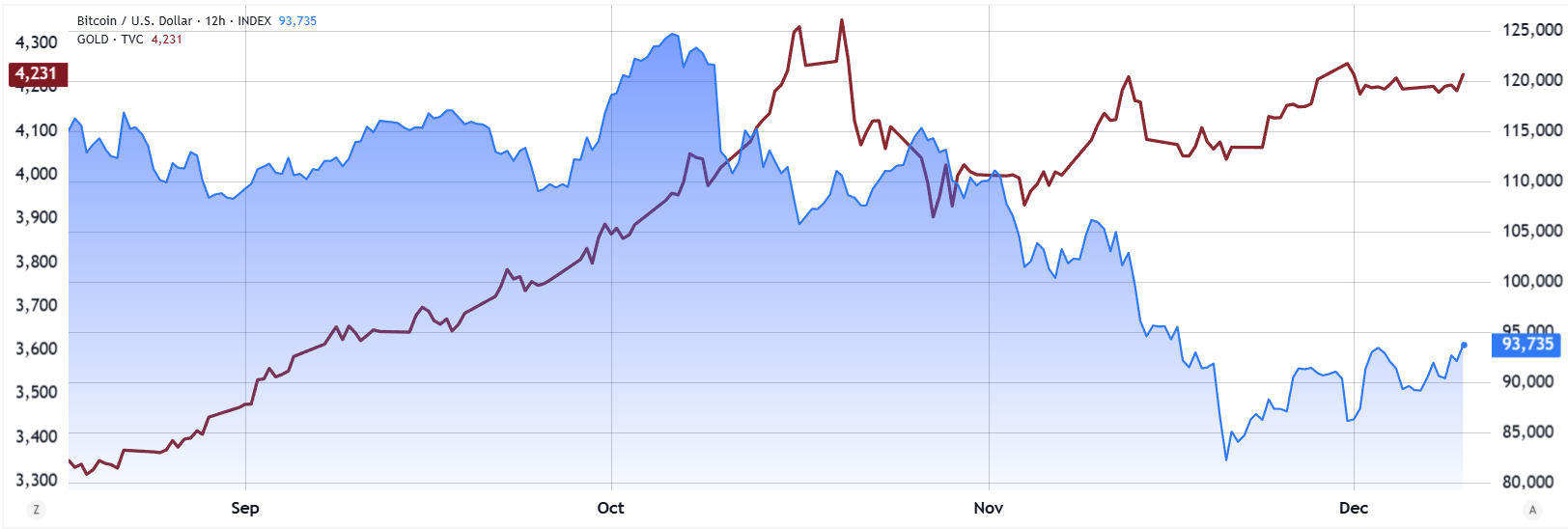
Gold/USD (left) vs. Bitcoin/USD (right). Source: TradingView

The Fed’s split decision on Wednesday to cap interest rates at 3.75% was widely expected, and Fed Chair Jerome Powell struck a restrained tone during the press conference following the committee meeting. Powell highlighted the ongoing risks tied to labor market weakness and stubborn inflation. Two Fed members, however, voted to keep rates at 4%, an unusually sharp divergence for a committee that typically shows strong internal alignment.

More notable was the Fed’s announcement that it will begin purchasing short-dated government bonds to “help manage liquidity levels.” The initial $40 billion program authorized on Wednesday marks a significant reversal from the past couple of years, which were characterized by a steady drawdown of the Fed’s balance sheet, culminating in the current $6.6 trillion after a peak of $9 trillion in 2022.

This added liquidity increases the cash banks can lend, supporting credit growth, boosting business investment, and encouraging consumer borrowing during periods when economic momentum is slowing across the economy.

Bitcoin options imply 70% odds BTC staying under $100,000

The $100,000 BTC call (buy) option implies a 70% probability that Bitcoin will remain at or below $100,000 by Jan. 30, according to the Black & Scholes model.

$100k BTC call option at Deribit, USD. Source: laevitas.ch

To secure the right to acquire Bitcoin at a fixed $100,000 on Jan. 30, buyers must pay a $3,440 premium upfront. For comparison, the same call option traded at $12,700 just one month earlier. The instrument effectively serves as insurance and expires worthless if Bitcoin finishes below the strike price. Still, upside for the holder remains unlimited as long as the market moves decisively above $100,000.

Interestingly, Bitcoin’s monthly options expiry in January falls two days after the next FOMC meeting on Jan. 28. Based on the CME Group FedWatch Tool, traders assign a 24% probability to another interest rate cut in January. Uncertainty increased after the government funding shutdown in November limited visibility into US employment and inflation data.

The stock market benefits directly from the Federal Reserve’s expansionist stance, as companies anticipate a lower cost of capital and easier consumer financing. Bitcoin, however, tends to react less predictably since investors rotating out of safe short-term government bonds are unlikely to view the cryptocurrency as a reliable store of value.
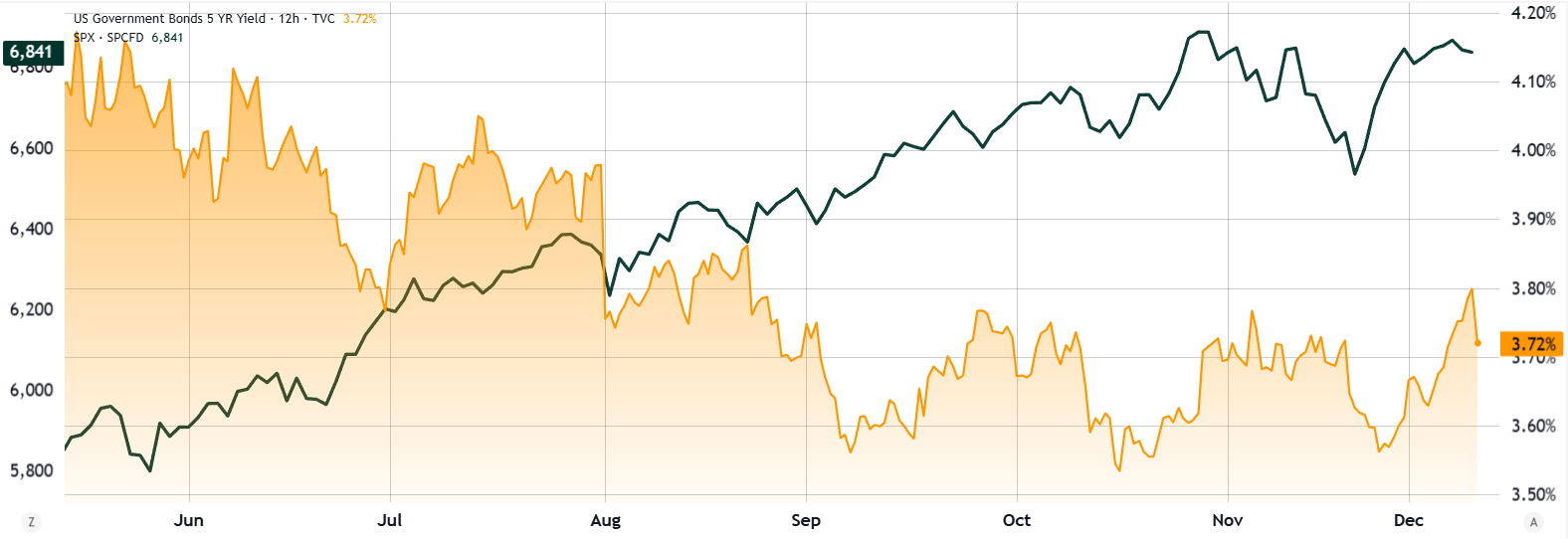
S&P 500 index (left) vs. US 5-year Treasury yield (right). Source: TradingView

Yields on the US 5-year Treasury stood at 3.72% on Wednesday, down from 4.10% six months earlier, while the S&P 500 gained 13% in the same period. Traders worry that the growth of US government debt could weaken the dollar and fuel inflationary pressure, making the relative scarcity of equities more appealing despite concerns about stretched valuations.

What could ignite a Bitcoin rally remains uncertain, but the rising cost of default protection in the artificial intelligence sector might push traders to reduce exposure to stocks.

For now, Bitcoin whales and market makers remain highly skeptical of a sustained move above $100,000, even as the Fed’s policy shift creates more favorable conditions.

Related: Conflicted Fed cuts rates but Bitcoin’s ‘fragile range’ pins BTC under $100K

This article is for general information purposes and is not intended to be and should not be taken as, legal, tax, investment, financial, or other advice. The views, thoughts, and opinions expressed here are the author’s alone and do not necessarily reflect or represent the views and opinions of Cointelegraph. While we strive to provide accurate and timely information, Cointelegraph does not guarantee the accuracy, completeness, or reliability of any information in this article. This article may contain forward-looking statements that are subject to risks and uncertainties. Cointelegraph will not be liable for any loss or damage arising from your reliance on this information.


Criptos en tendencia

Lecturas Relacionadas

Goldman Sachs Research Report Analysis: Circle and USDC Are Moving Beyond the Crypto World, Cross-Border Payments and AI Agents Become New Battlegrounds

Goldman Sachs published a summary of its meeting with Circle Internet Group (issuer of USDC) on July 5th. The core takeaway is that stablecoins, led by USDC, are evolving from a crypto-native tool into foundational infrastructure for traditional finance and the AI economy. USDC's use cases are rapidly expanding beyond crypto trading into cross-border payments, e-commerce, capital market settlements, and notably, payments for AI agents. Circle's management emphasized that stablecoin growth is now decoupled from crypto market cycles, driven by this diversification. They outlined five key application layers and highlighted USDC's network effects, global liquidity depth, and regulatory compliance as competitive moats. Circle distinguishes USDC from bank-issued tokenized deposits, arguing the former is an open, internet-native system without bank credit risk. Strategically, Circle is building a broader fintech platform with its Arc Layer 1 blockchain, the Circle Payments Network for cross-border transfers, and an "Agentic Stack" to serve AI agent economies, where USDC already dominates. Regarding regulation, Circle views potential U.S. legislation like the CLARITY Act as a catalyst for growth rather than a constraint, expecting it to encourage broader institutional adoption and active usage. Goldman Sachs maintains a Neutral rating on Circle with a $96 price target, noting the company's shift from a pure stablecoin issuer to a financial infrastructure provider. Key risks include competition from USDT and potential earnings pressure from declining interest rates on its reserve assets.

marsbitHace 45 min(s)

Goldman Sachs Research Report Analysis: Circle and USDC Are Moving Beyond the Crypto World, Cross-Border Payments and AI Agents Become New Battlegrounds

marsbitHace 45 min(s)

The Robinhood Stock Tokens You Bought Are Just Debts from Jersey Island

The Robinhood stock tokens you buy are essentially debt securities issued by a shell company in Jersey, not real equity. These tokens merely track stock prices like NVIDIA or Apple but grant no shareholder rights like voting or dividends. If the underlying company fails, you have no claim on its assets. Instead, you hold a debt instrument from Robinhood Assets (Jersey) Limited, which promises returns based on stock performance. If this Jersey entity goes bankrupt, you become an unsecured creditor. This complex structure stems from Robinhood's past crisis during the 2021 GameStop short squeeze, where T+2 settlement caused liquidity issues. The blockchain-based tokens enable instant settlement, theoretically preventing such trading halts. The product is classified by the SEC as a "linked security" or structured note, carrying counterparty risk not borne by actual shareholders. It is available globally but excluded from the US, UK, and other major markets, while Robinhood offers a fully compliant, asset-backed token model in Europe under MiFID II. The system relies on oracles for pricing, which poses risks like manipulation and faulty liquidations seen in DeFi exploits. Robinhood profits from spreads and aims to become a full-chain settlement layer. Meanwhile, competitors like Ondo have launched SEC-registered, fully compliant equity tokens in the US with actual voting rights and dividends. Robinhood’s Jersey debt model appears as a transitional, regulatory-arbitrage product, aiming to capture market share ahead of future regulatory clarity.

Foresight NewsHace 1 hora(s)

The Robinhood Stock Tokens You Bought Are Just Debts from Jersey Island

Foresight NewsHace 1 hora(s)

Trading

Spot

Artículos destacados

Cómo comprar PUMP

¡Bienvenido a HTX.com! Hemos hecho que comprar Pump.fun (PUMP) sea simple y conveniente. Sigue nuestra guía paso a paso para iniciar tu viaje de criptos.Paso 1: crea tu cuenta HTXUtiliza tu correo electrónico o número de teléfono para registrarte y obtener una cuenta gratuita en HTX. Experimenta un proceso de registro sin complicaciones y desbloquea todas las funciones.Obtener mi cuentaPaso 2: ve a Comprar cripto y elige tu método de pagoTarjeta de crédito/débito: usa tu Visa o Mastercard para comprar Pump.fun (PUMP) al instante.Saldo: utiliza fondos del saldo de tu cuenta HTX para tradear sin problemas.Terceros: hemos agregado métodos de pago populares como Google Pay y Apple Pay para mejorar la comodidad.P2P: tradear directamente con otros usuarios en HTX.Over-the-Counter (OTC): ofrecemos servicios personalizados y tipos de cambio competitivos para los traders.Paso 3: guarda tu Pump.fun (PUMP)Después de comprar tu Pump.fun (PUMP), guárdalo en tu cuenta HTX. Alternativamente, puedes enviarlo a otro lugar mediante transferencia blockchain o utilizarlo para tradear otras criptomonedas.Paso 4: tradear Pump.fun (PUMP)Tradear fácilmente con Pump.fun (PUMP) en HTX's mercado spot. Simplemente accede a tu cuenta, selecciona tu par de trading, ejecuta tus trades y monitorea en tiempo real. Ofrecemos una experiencia fácil de usar tanto para principiantes como para traders experimentados.

245 Vistas totalesPublicado en 2024.12.12Actualizado en 2026.06.02

Cómo comprar PUMP

Discusiones

Bienvenido a la comunidad de HTX. Aquí puedes mantenerte informado sobre los últimos desarrollos de la plataforma y acceder a análisis profesionales del mercado. A continuación se presentan las opiniones de los usuarios sobre el precio de PUMP (PUMP).

活动图片