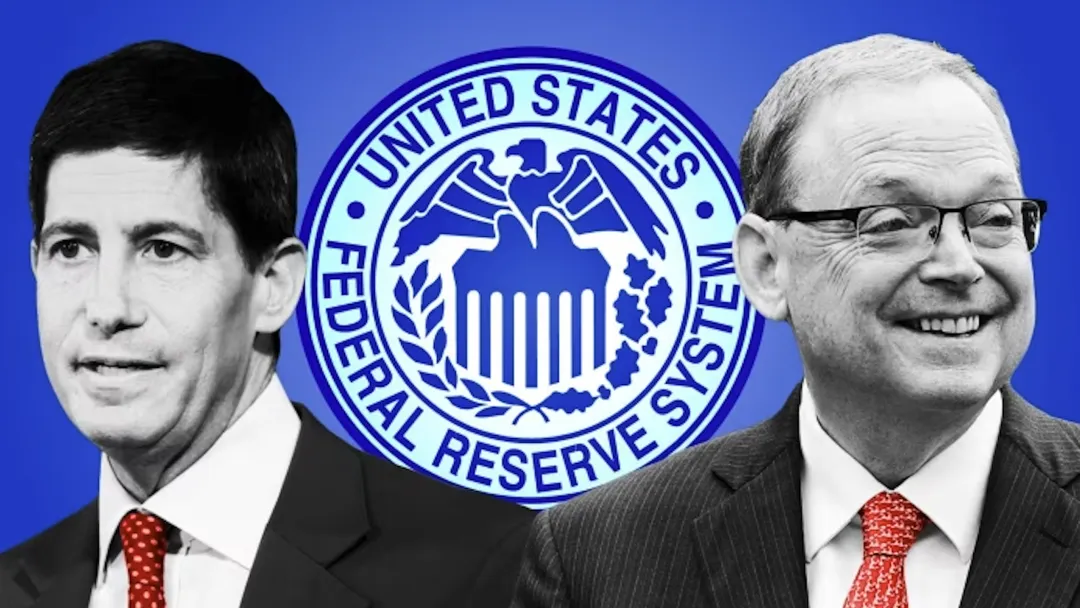
Fed Candidates Warsh and Hassett: Who Is More Beneficial for Us?

marsbitPublicado a 2025-12-16Actualizado a 2025-12-16

Resumen

Amidst inflation pressures and geopolitical uncertainty in 2025, the potential successors to the U.S. Federal Reserve Chair—Kevin Warsh and Kevin Hassett—present sharply contrasting policy approaches. Warsh, a former Fed governor with a hawkish stance, emphasizes financial stability, market discipline, and inflation control, advocating for cautious monetary tightening and reduced intervention risks. In contrast, Hassett, a former White House economic advisor and dovish figure, supports aggressive rate cuts, growth-oriented policies, and closer alignment with presidential agendas, potentially benefiting markets and cryptocurrencies. Market predictions show narrowing odds, with Warsh gaining traction post-Trump’s endorsement, though Hassett retains advantages due to his political ties. The selection will significantly influence long-term economic stability versus short-term growth, testing the Fed’s independence and global financial resilience.

Against the backdrop of inflation pressures, geopolitical uncertainties, and technological changes facing the U.S. economy in 2025, the successor to the Federal Reserve Chair position has drawn significant attention.‍‍‍‍‍‍‍‍‍‍‍‍‍‍‍‍‍‍‍‍‍‍‍‍‍‍‍‍‍‍‍

President Donald Trump recently stated that he is "leaning towards Warsh or Hassett," a remark that has triggered market volatility and widespread discussion.

Kevin Warsh, a former Federal Reserve Governor, is known for his hawkish stance and experience in responding to the financial crisis;


Kevin Hassett, a former White House economic advisor, is renowned for his dovish perspective and pro-growth policies.


Comparing their backgrounds, monetary policy thinking, potential impacts, and current online public sentiment, who has a greater chance of being elected?
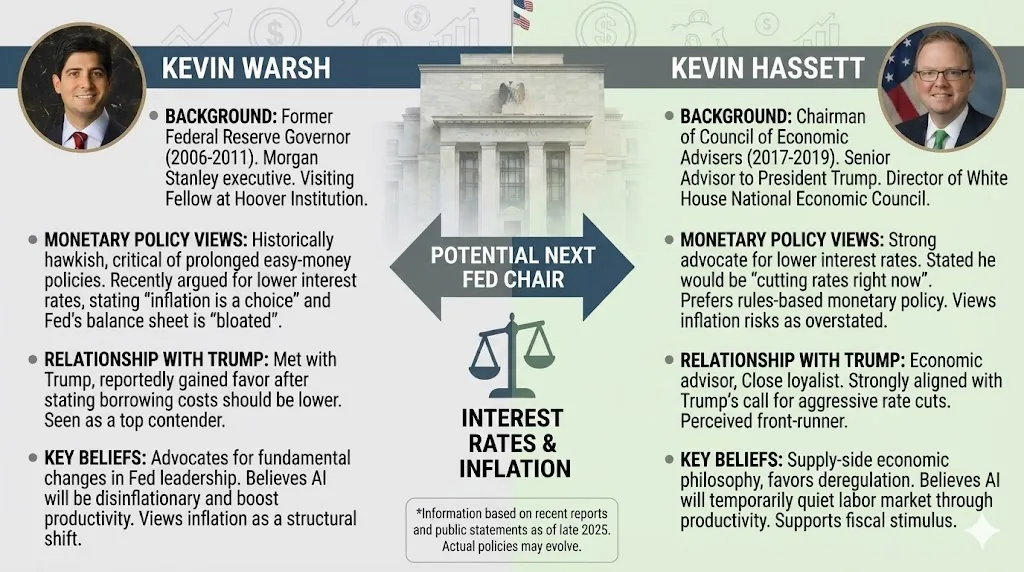

Overview of the Two Candidates' Backgrounds


Kevin Warsh is an experienced financial policy expert, born in 1970, and a graduate of Stanford University and Harvard Law School. He worked as an investment banker at Morgan Stanley and served as Special Assistant to the President for Economic Policy during the George W. Bush administration. From 2006 to 2011, Warsh served as a Federal Reserve Governor, participating in the response to the global financial crisis, including the formulation of quantitative easing (QE) policies. Currently, he is a visiting scholar at the Hoover Institution and serves on the boards of several companies. Warsh's career emphasizes financial stability and market discipline, and he is seen as a representative of conservative economics.


Kevin Hassett is a seasoned economist with a Ph.D. in economics from the University of Pennsylvania. He has taught at Yale University and Columbia University and worked at the conservative think tank American Enterprise Institute. Hassett served as Chairman of the White House Council of Economic Advisers during Trump's first term and as Director of the National Economic Council in the second term. He led the design of the Trump tax reforms and is known for his expertise in macroeconomics and tax policy. Currently, Hassett also serves as an advisor to Coinbase, showing an affinity for cryptocurrencies.

Distinct Contrasts in Monetary Policy Thinking


The differences in monetary policy thinking between Warsh and Hassett are rooted in their philosophical foundations.


Warsh holds a hawkish view, believing that inflation is a result of policy choices rather than simply an outcome of economic growth. He criticizes the Fed for indirectly fueling fiscal deficits through low interest rates and QE, advocating for shrinking the central bank's balance sheet, restoring market discipline, and avoiding the moral hazard of "too big to fail."


Warsh views tariffs as a one-time price shock rather than a sustained driver of inflation, emphasizing that the central bank should intervene in crises but quickly normalize policies to maintain long-term economic stability.


Hassett, on the other hand, leans more dovish, emphasizing that monetary policy should coordinate with fiscal policy, supporting investment growth driven by tax incentives and regulatory certainty. He advocates for aggressive rate cuts, such as recently suggesting a 50-basis-point cut to address slowing growth and inflation below expectations, and criticizes the Fed for potential "anti-Trump partisan bias" if it does not cut rates.


Hassett believes the Fed should not be a "black box," advocating for "slow and steady" interest rate adjustments to boost the stock and cryptocurrency markets.


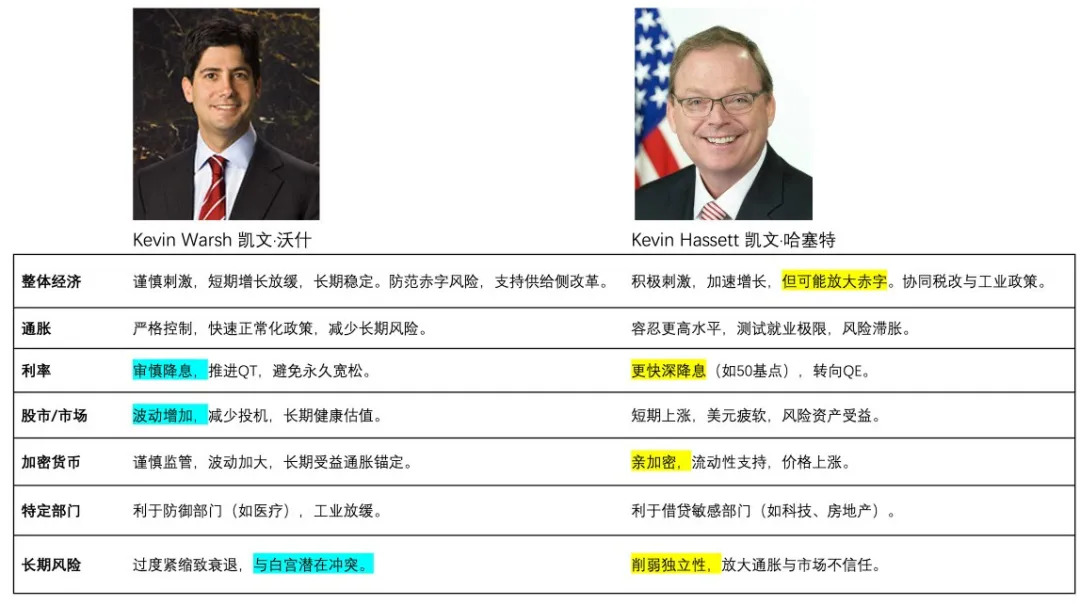
This difference reflects the classic hawk versus dove opposition:Warsh prioritizes controlling inflation and fiscal sustainability, guarding against the risks of excessive easing; Hassett focuses on stimulating economic growth and coordinating with White House policies, potentially being more market-friendly.


If Warsh is elected, the Fed may shift to a more cautious monetary policy framework.In the short term, this could lead to slower economic growth, prudent rate cuts, and the推进 of quantitative tightening (QT), thereby controlling inflation and reducing the risk of asset bubbles. However, it could also exacerbate an economic recession and create political friction with the White House. Stock market volatility may increase, but in the long run, it would promote healthy valuations, benefiting defensive sectors like healthcare and utilities.


Conversely, under Hassett's leadership, the Fed might focus more on short-term prosperity, stimulating consumption and investment through faster rate cuts and ending QT.This would benefit borrowing-sensitive sectors like technology and real estate, driving up stock and cryptocurrency markets, but could amplify deficits and inflation expectations, leading to stagflation risks and weakening the Fed's independence.


Overall, Warsh's policies focus more on long-term stability, while Hassett could amplify short-term market prosperity but increase the risk of political intervention.


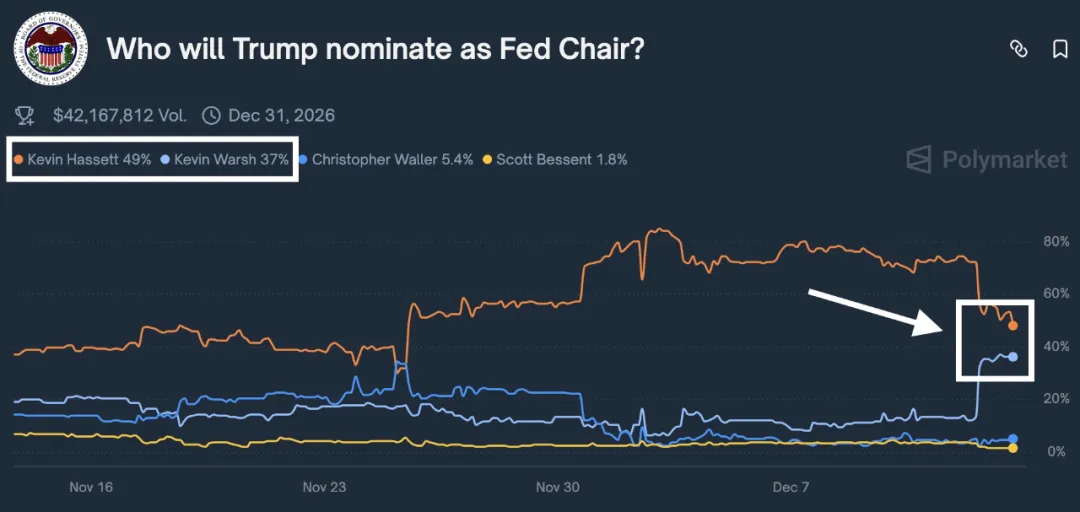
Online Public Sentiment and Election Chance Analysis


As of December 13, 2025, opinion leaders and public sentiment on X platform (formerly Twitter) show that Hassett initially led, but after Trump's statement, Warsh's probability surged from 15% to 37-40%.


Prediction markets like Kalshi and Polymarket show Hassett's probability at around 49%, but the gap is narrowing.

Wall Street Journal reporter Nick Timiraos pointed out that Hassett might "win the race," while financial commentator Steve Grasso emphasized that his pro-rate-cut stance is beneficial for the market.


Crypto analyst MartyParty sees Hassett as a pro-crypto candidate.


Mainstream media reports indicate that Trump views both as "top contenders" and expects an announcement before Christmas.


Warsh has received support from JPMorgan CEO Dimon, enhancing his prestige in financial circles. Currently, Warsh has stronger momentum and a slightly greater chance of being elected, but Hassett's pro-Trump background still gives him an advantage.


The appointment of the Fed Chair will profoundly affect the trajectory of the U.S. economy.


Warsh could bring an era of disciplined stability, while Hassett预示着 more aggressive growth-oriented policies.


Against the backdrop of the Trump administration's emphasis on "America First," who will prevail remains undecided, but regardless of the outcome, this choice will test the Fed's independence and the resilience of global financial markets.


Investors and policy observers should closely monitor subsequent developments to应对 potential market volatility.



Preguntas relacionadas

QWhat are the key differences in monetary policy philosophy between Kevin Warsh and Kevin Hassett?

AKevin Warsh holds a hawkish view, prioritizing inflation control and fiscal sustainability, advocating for market discipline and cautious monetary policy normalization. Kevin Hassett is more dovish, emphasizing growth stimulation through aggressive rate cuts and coordination with fiscal policy, which may favor short-term market prosperity but risks higher deficits and inflation.

QHow did the market and prediction markets react to Trump's preference for Warsh or Hassett?

AFollowing Trump's statement, Kevin Warsh's probability surged from 15% to 37-40%, while prediction markets like Kalshi and Polymarket showed Hassett's probability around 49%, indicating a narrowing gap between the two candidates.

QWhat are the potential economic impacts if Kevin Warsh is appointed as Fed Chair?

AUnder Warsh's leadership, the Fed might adopt a more cautious monetary framework, leading to slower growth, prudent rate cuts, and quantitative tightening. This could control inflation and reduce asset bubbles but may increase recession risks and cause political friction with the White House.

QWhat are the potential economic impacts if Kevin Hassett is appointed as Fed Chair?

AHassett's Fed would likely focus on short-term prosperity through faster rate cuts and ending quantitative tightening, benefiting sectors like tech and real estate. However, this approach could amplify deficits, inflation expectations, and stagflation risks, potentially undermining Fed independence.

QWho are the key supporters of Warsh and Hassett, and how does this influence their chances?

AWarsh gained support from JPMorgan CEO Dimon, enhancing his credibility in financial circles. Hassett is favored for his pro-Trump background and endorsements from figures like crypto analyst MartyParty. Currently, Warsh has slightly stronger momentum, but Hassett's alignment with Trump keeps him competitive.

Lecturas Relacionadas

It's Not Jensen Huang Who Wants to Change the PC, But the PC That's Revolting Against Itself

The 40-year-old PC industry is undergoing a fundamental transformation, driven by the rise of AI PCs. At the GTC Taipei 2026 event, NVIDIA, backed by Microsoft and major PC OEMs, announced the RTX Spark super chip for Windows PCs, marking its official entry into the PC core processor market. This move aims to redefine the AI PC by shifting its core from the CPU to an AI-focused SoC (System on Chip). NVIDIA envisions the PC evolving from a personal computer to a "personal AI"—a platform where local AI Agents can autonomously perform tasks. While Intel pioneered the AI PC concept earlier in 2026, NVIDIA's aggressive push, leveraging its vast CUDA developer ecosystem of 6 million, positions it to potentially reshape the industry's long-standing Wintel (Windows-Intel) power structure. NVIDIA's strategy extends beyond hardware; it's about embedding its CUDA, RTX, and AI software stack into the PC platform itself. The article identifies key shifts: 1) The move from a CPU-centric to an AI SoC-centric architecture, similar to Apple's approach with its M-series chips. 2) The PC's evolution from a human-operated tool to a platform for human-Agent collaboration. 3) The extension of NVIDIA's data center-centric CUDA ecosystem to personal devices via RTX Spark. Ultimately, the change is driven by the broader trend of AI moving to personal devices. Companies like Intel, AMD, Qualcomm, and Apple are all participating in this shift. NVIDIA's entry accelerates the competition, but the core driver is the technology itself finding its optimal expression in the PC. The industry is reinventing itself, with the outcome hinging on execution, ecosystem development, and the creation of compelling local AI applications.

marsbitHace 1 hora(s)

It's Not Jensen Huang Who Wants to Change the PC, But the PC That's Revolting Against Itself

marsbitHace 1 hora(s)

Popular Interaction Collection | Interstate Launches Points Event; Flip Early Waitlist Application (June 12)

**Interstate Launches Points Event, Flip Opens Early Waitlist Applications** *Originally published by Odaily Planet Daily, author Asher.* **Interstate**, an infrastructure platform integrating on-chain transactions for assets like Meme tokens, prediction markets, and xStocks, has launched a points event. Each trade on the platform now rewards users with points. The project has completed a $1.5 million seed round from investors including MH Ventures, Alchemy Ventures, and Marshland Capital. Users can visit the official website to connect their wallets and start earning points through trading tasks (note: the site may experience high traffic). **Flip**, an AI-powered financial assistant, has opened applications for its early waitlist. The platform allows users to manage finances via chat, helping with spending tracking, bill management, investment portfolio monitoring (including stocks and crypto), and more. Flip recently raised $1.4 million in a pre-seed round led by The House Fund and participated in a16z's Speedrun accelerator. Interested users can join the waitlist via the official website. **ArcNova**, an AI-native infrastructure platform for short-form video and entertainment, continues to offer tasks for earning points. Users can sign in daily, complete social and app tasks, and refer friends to accumulate points. The project announced a $15 million funding round in May, backed by Adaverse Ventures, Animoca Brands, and others. The task portal is accessible through the ArcNova website. These updates highlight ongoing opportunities for user engagement and potential rewards across emerging crypto and AI projects.

Odaily星球日报Hace 3 hora(s)

Popular Interaction Collection | Interstate Launches Points Event; Flip Early Waitlist Application (June 12)

Odaily星球日报Hace 3 hora(s)

Trading

Spot
Futuros

Artículos destacados

Cómo comprar US

¡Bienvenido a HTX.com! Hemos hecho que comprar Talus Network (US) sea simple y conveniente. Sigue nuestra guía paso a paso para iniciar tu viaje de criptos.Paso 1: crea tu cuenta HTXUtiliza tu correo electrónico o número de teléfono para registrarte y obtener una cuenta gratuita en HTX. Experimenta un proceso de registro sin complicaciones y desbloquea todas las funciones.Obtener mi cuentaPaso 2: ve a Comprar cripto y elige tu método de pagoTarjeta de crédito/débito: usa tu Visa o Mastercard para comprar Talus Network (US) al instante.Saldo: utiliza fondos del saldo de tu cuenta HTX para tradear sin problemas.Terceros: hemos agregado métodos de pago populares como Google Pay y Apple Pay para mejorar la comodidad.P2P: tradear directamente con otros usuarios en HTX.Over-the-Counter (OTC): ofrecemos servicios personalizados y tipos de cambio competitivos para los traders.Paso 3: guarda tu Talus Network (US)Después de comprar tu Talus Network (US), guárdalo en tu cuenta HTX. Alternativamente, puedes enviarlo a otro lugar mediante transferencia blockchain o utilizarlo para tradear otras criptomonedas.Paso 4: tradear Talus Network (US)Tradear fácilmente con Talus Network (US) en HTX's mercado spot. Simplemente accede a tu cuenta, selecciona tu par de trading, ejecuta tus trades y monitorea en tiempo real. Ofrecemos una experiencia fácil de usar tanto para principiantes como para traders experimentados.

558 Vistas totalesPublicado en 2025.12.11Actualizado en 2026.06.02

Cómo comprar US

Discusiones

Bienvenido a la comunidad de HTX. Aquí puedes mantenerte informado sobre los últimos desarrollos de la plataforma y acceder a análisis profesionales del mercado. A continuación se presentan las opiniones de los usuarios sobre el precio de US (US).

活动图片











