February 2026 Crypto Market Recap: BTC's $60k Extreme Rebound, How Did the Market React on the US Military Airstrike Day?

marsbitPublicado a 2026-03-05Actualizado a 2026-03-05

Resumen

February 2026 Crypto Market Recap: BTC rebounded strongly from a critical $60K support level after a sharp drop from $70K, establishing a trading range between $60K–$70K for most of the month. Key events included a U.S. airstrike on Iran, which caused a brief dip to $62K before a recovery to $68K, and the death of Iran’s leader, interpreted as a market-positive signal. $ZRO surged around its LayerZero conference due to major partnership announcements but later gave back gains. AI-related tokens like $VVV performed well, while scam coins like $PIPPIN and $POWER saw manipulated pumps. The market exhibited bearish traits—short squeezes were common, and altcoin rallies were often brief. Uniswap spiked 40% on a BlackRock partnership announcement but quickly retraced. Other notable events included Base abandoning Optimism, hurting $OP, and strong performances from $MORPHO and $STABLE.

Author: CryptoNarratives (Viktor)

Compiled by: Deep Tide TechFlow

Deep Tide Guide: This monthly recap thoroughly breaks down the key movements in the February crypto market: BTC's extreme $60k rebound, the panic and rapid recovery on the day Iran was attacked, the pre- and post-ZRO conference expectation games, and the manipulative coins thriving in the bear market. Dense with information, it serves as excellent background material for understanding the current market structure.

Full Text Below:

BTC Timeline

Below is the main timeline for February:

Gold saw a significant pullback after reaching a peak in late January, falling from $5600 to $4400. The bottom was hit on February 2nd, followed by a rapid rebound to $5100 within two days. Silver also experienced a peak collapse, plummeting nearly 50% from $121 to $64 on February 6th.

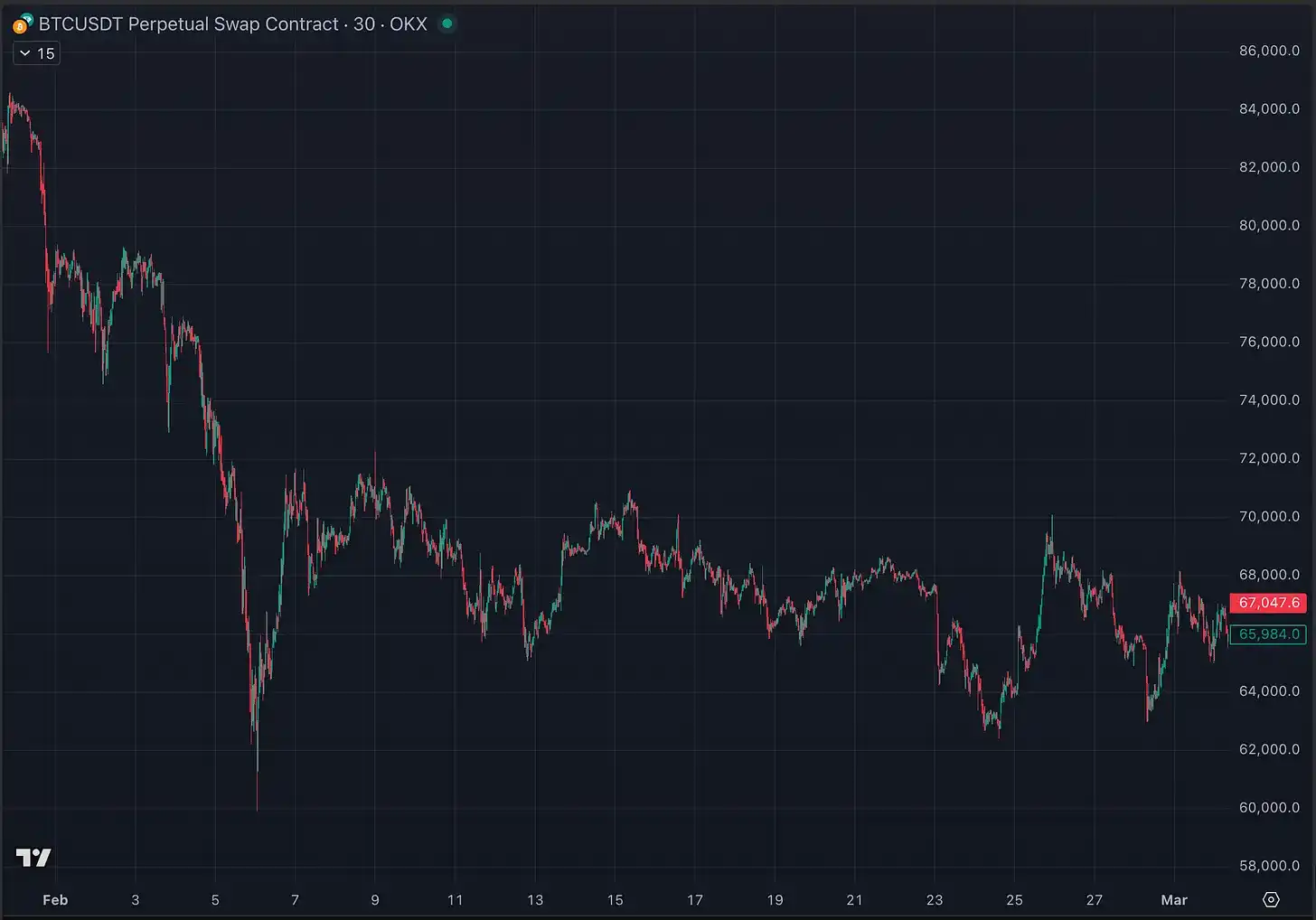
BTC started February on an extremely weak note. After hitting a high of $98k in January, it opened February at $78k, dropped to $70k within 4 days, and then experienced a single-day crash from $70k to $60k on February 5th.

BTC staged a strong rebound at the $60k level, recovering to nearly $72k in less than a day. This complete move defined the trading range for the entire subsequent month, largely fluctuating between $60k and $70k.

After the first week, BTC spent most of the month oscillating around $68k, with only two distinct periods of strength: February 13th-14th and February 25th. These periods each saw some stronger altcoin performances.

On February 27th, BTC dropped from $68k to $65k on rumors of an impending US airstrike on Iran. The attack was officially confirmed a day later. Upon the actual news landing, BTC fell further from $65k to $62k but was met with sustained buying pressure throughout the day, ultimately closing near $68k, which also marked the month's closing price. On the same day, the announcement of Khamenei's death was made, which the market generally interpreted as a bullish signal (as it suggested the US was unlikely to invest excessive resources in this conflict).
ZRO Conference

Almost the only significant narrative in the altcoin space in February was the LayerZero conference on February 10th. $ZRO had been strengthening consistently since the beginning of the year, primarily driven by anticipation for this event. I initially predicted this would be a typical 'sell the news' opportunity, but the reality was slightly different.

On the day, a video announcing the launch of their own blockchain was leaked early, triggering a sell-off and a roughly 20% drop within an hour, which also marked the day's low. Later that day, the official announcement was made – indeed, the launch of their own blockchain "Zero" – but it was accompanied by a slate of heavyweight partnership announcements, including Citadel Securities, Cathie Wood/ARK, DTCC, and ICE.
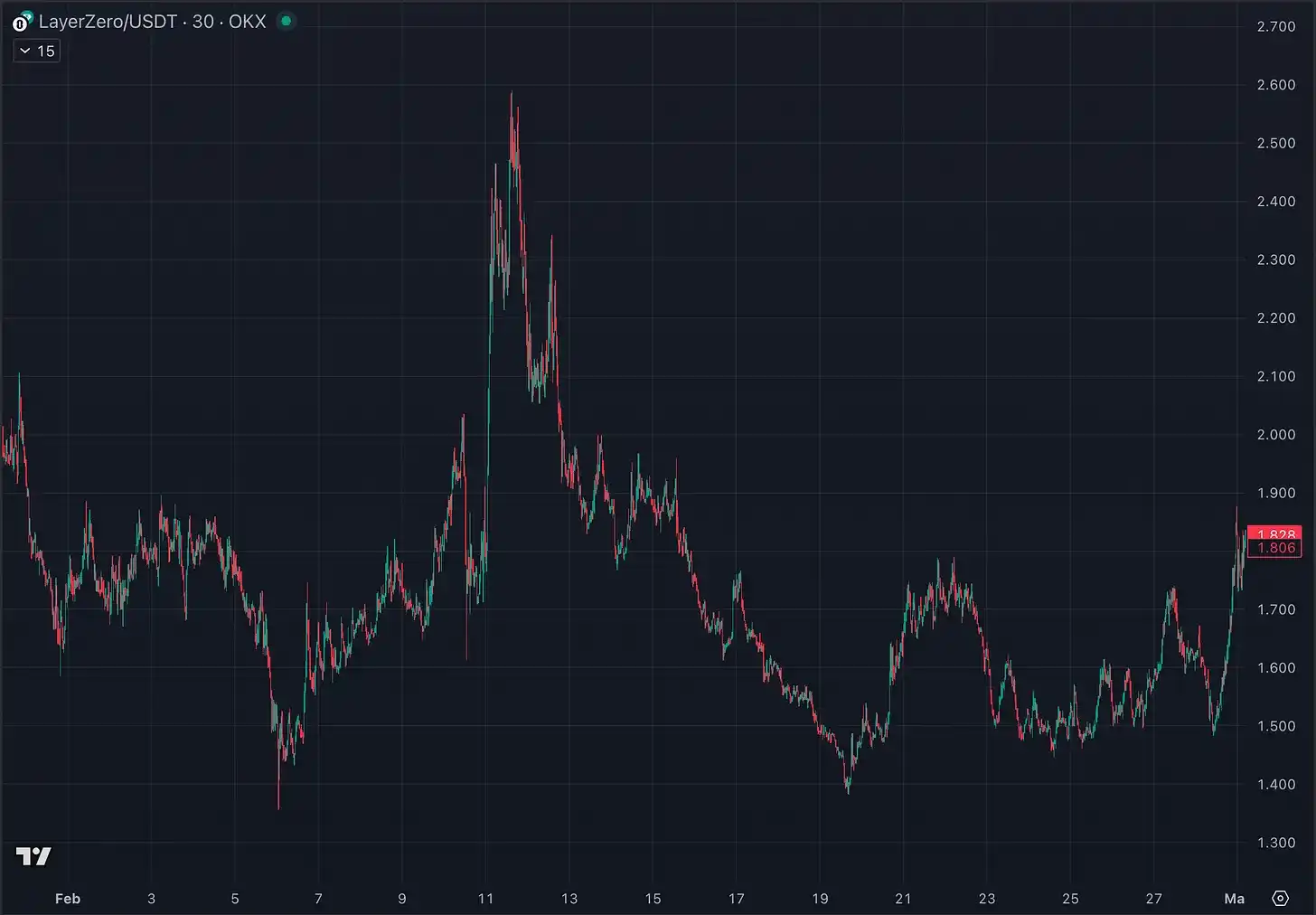
The result was a strong rally post-conference, with $ZRO gaining about 45% in 12 hours, catching many 'sell the news' traders off guard. But subsequently... all gains were erased, and the token slid all the way down to $1.5, a level that currently appears to be forming strong support.

VVV's Abnormal Strength

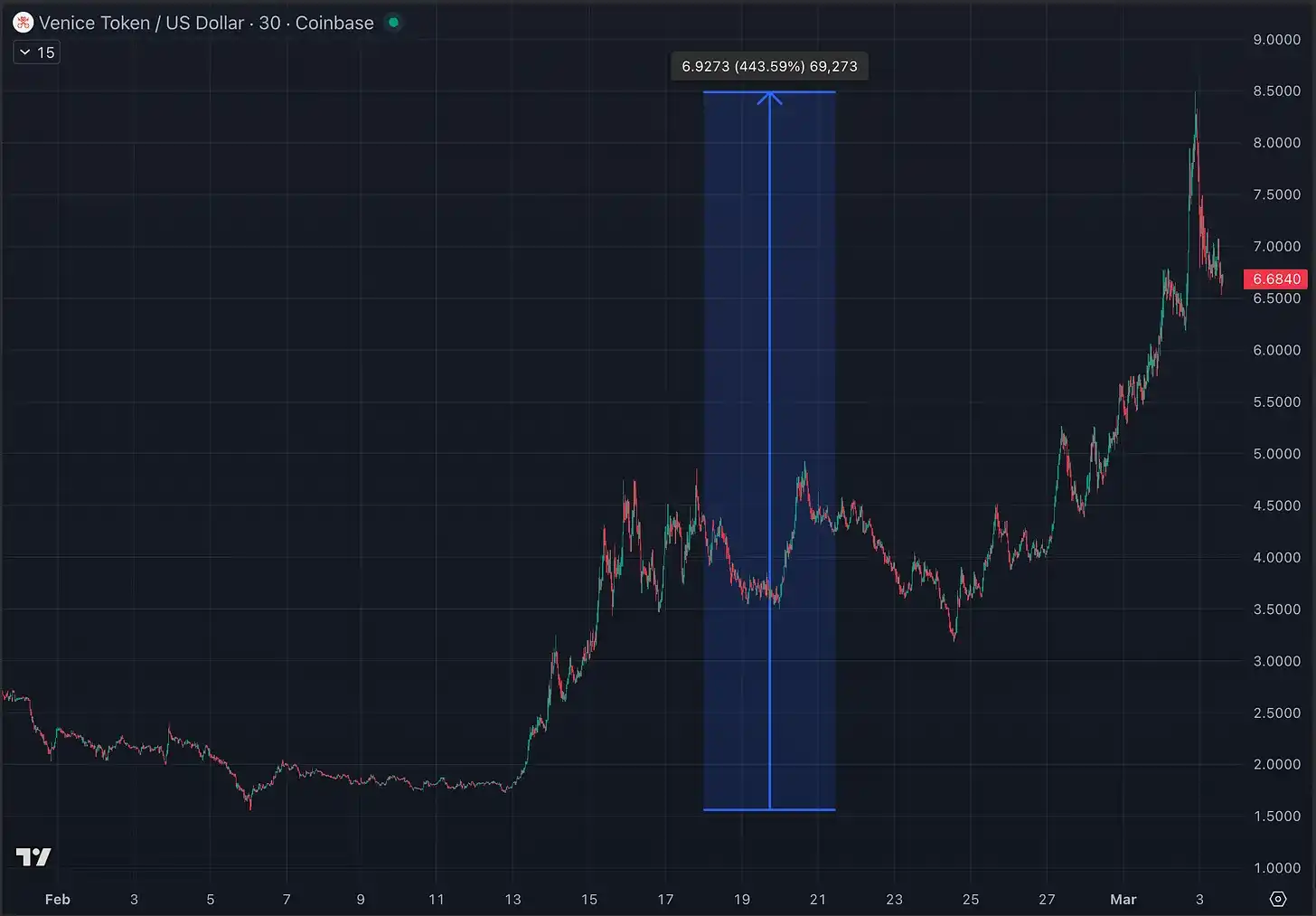
VVV was the best-performing "non-scam" token in February, rising from a bottom of $1.65 to $5.5 by month-end (with a further squeeze to $8 on March 2nd). One catalyst was its status as a legitimate project at the intersection of AI, privacy, and crypto, with a bottom valuation below $100M;另一方面, it also benefited from the tailwind of OpenClaw, as OpenClaw listed Venice as a recommended model supplier in its documentation until just yesterday.

(I'm inclined to think it peaked at the $8.4 squeeze in early March, but I could be wrong)
Other AI tokens briefly awakened late in February, with $SAHARA squeezing +70% in a single day and $GRASS gaining +70% over 4 days.

A Bountiful Month for Scam Coins: $PIPPIN, $SIREN, $POWER

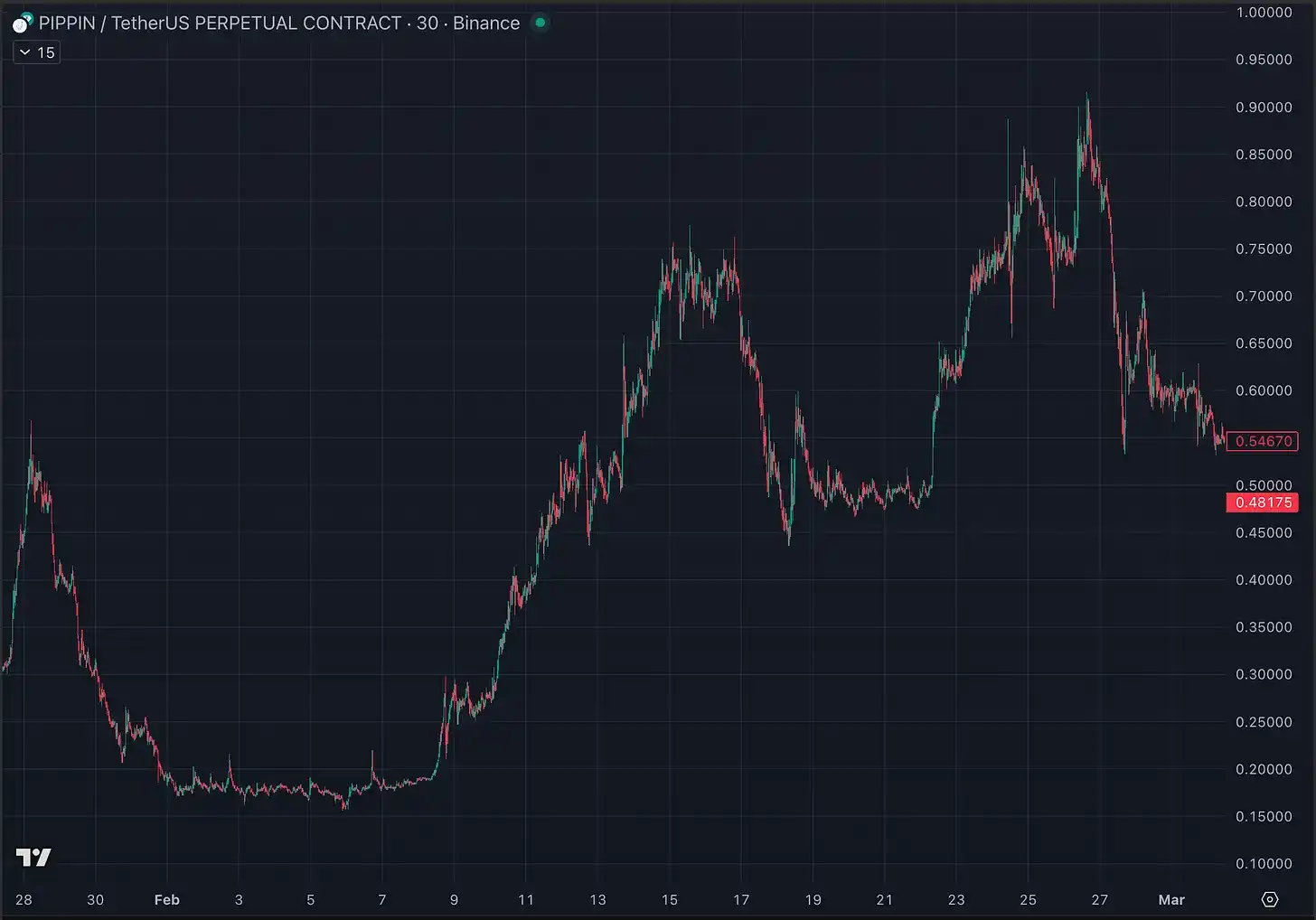
Bear markets seem to provide excellent breeding ground for scam coins. In February, the veteran AI Meme coin $PIPPIN made a comeback – its supply is completely locked by a single entity, and its price action is典型的 of manipulation. $PIPPIN started the month steadily at a $180M market cap, having already experienced a 70% crash over the previous 4 days. It began a strong rally from February 8th, rising +315% in 7 days to set a new high of $750M market cap, then pulled back to $500M before surging again to a new high of $900M. Strangely, its funding rate is no longer negative, making it a relatively less risky (though still risky) short target for a scam coin. Even so, I wouldn't be surprised to see it break the $1bn market cap.
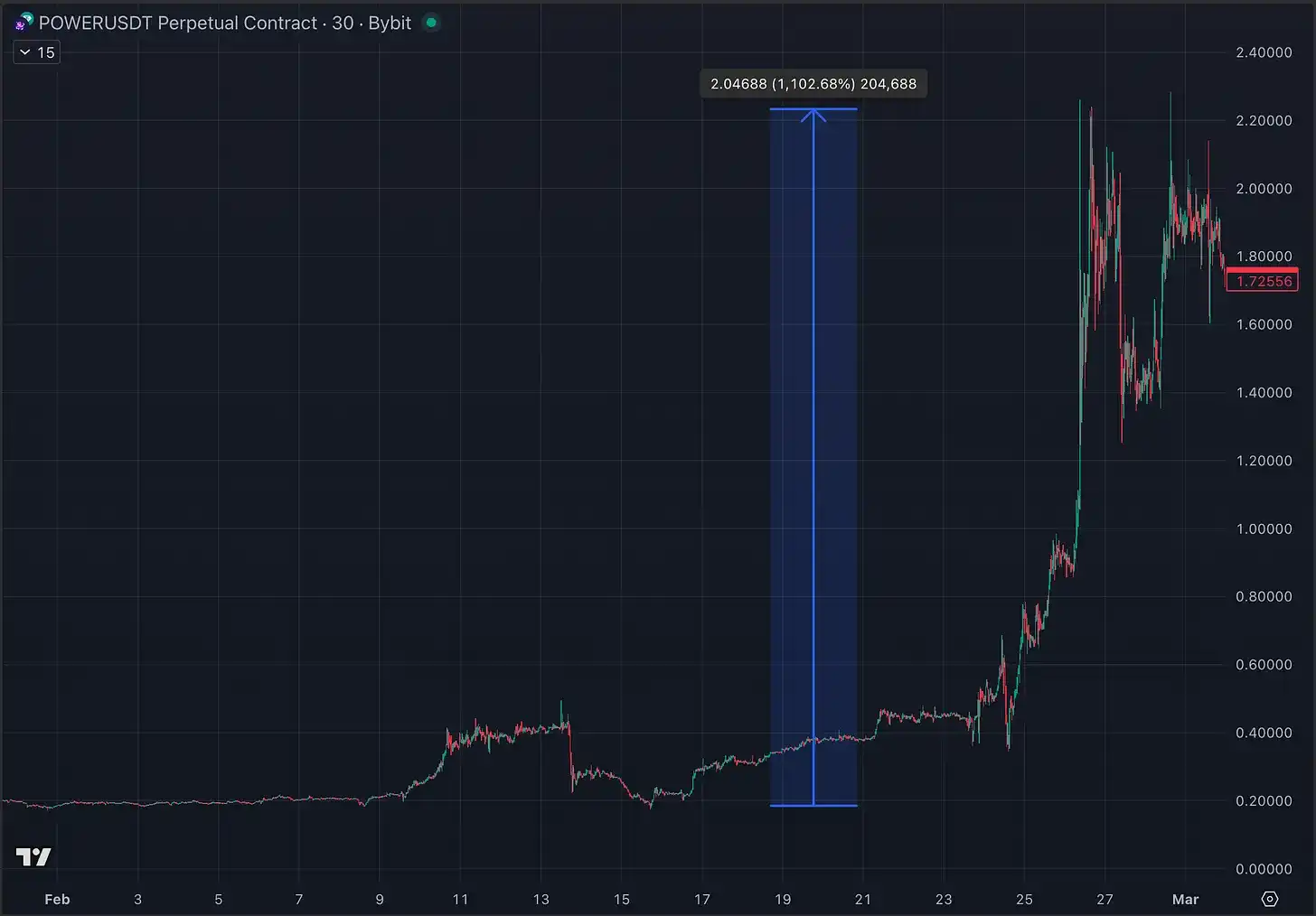
$POWER was one of the new manipulative plays emerging in February, with a 12x move from bottom to top, squeezing to a $2.3bn FDV, with extremely negative funding rates. Be very cautious shorting this.
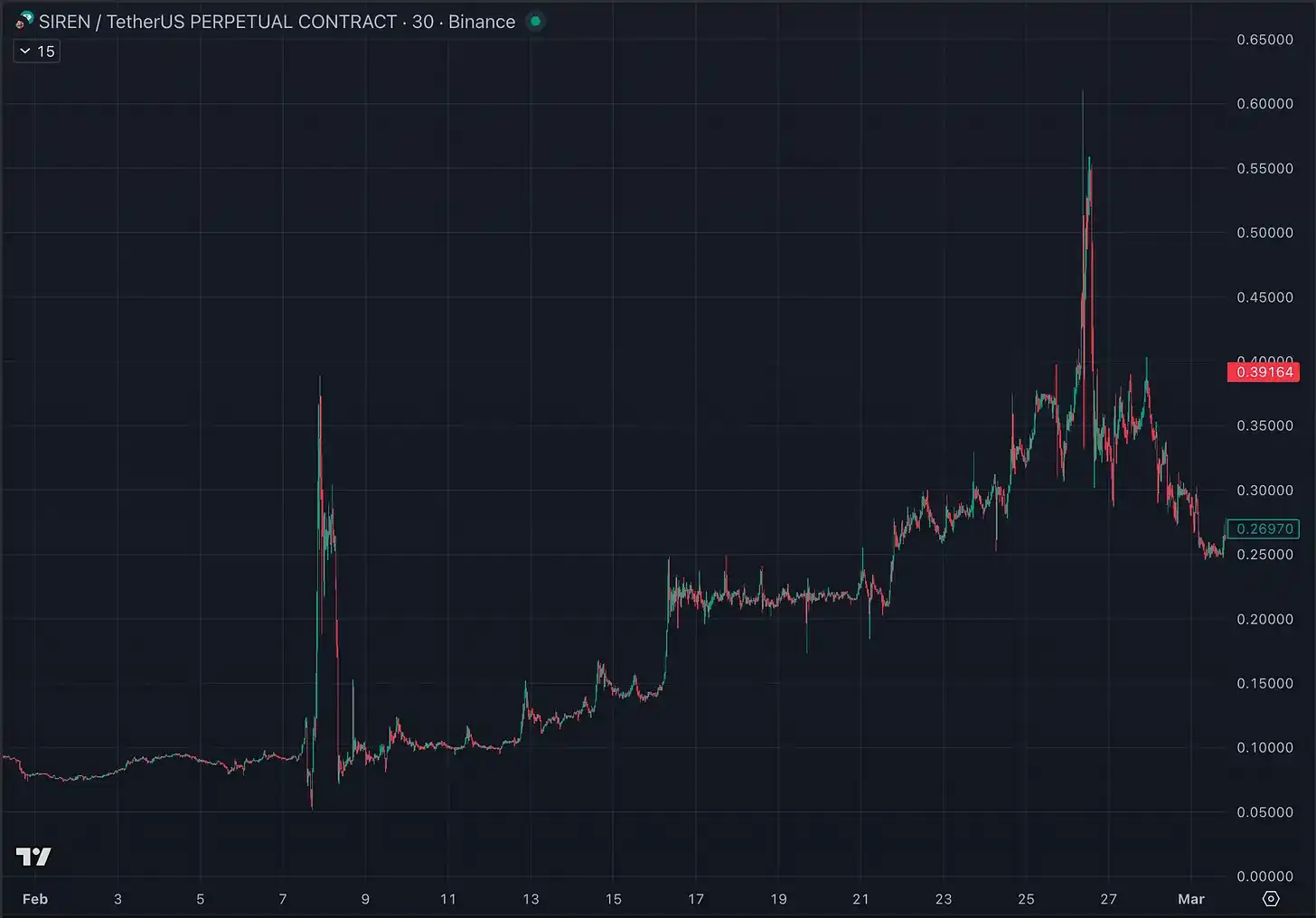
Another notable move was $SIREN, this BSC scam meme coin executed a pump and dump on February 8th – running from $100M market cap to $400M and back to $100M – then spent the rest of February slowly climbing to new highs, eventually executing a major squeeze at a $600M market cap.
It's also worth mentioning $BULLA, which did a 13x run in late January, then crashed 95% in a single day on February 1st, falling from $450M FDV to $25M FDV. $ARC also experienced an 80% collapse after rising from $40M to $130M.

Bear Market Characteristics

We are in a bear market environment: most bullish moves in altcoins are short squeezes that are quickly given back. Here are tokens that exhibited this behavior in February: ZK ZIL LA NIL SONIC DYM ME MOVE 0G INIT RPL ESP AZTEC BIO AGLD SAHARA. These moves typically involve +50% to +100% gains within a single day, accompanied by negative funding rates (making it difficult for shorts), followed by weakness over subsequent days.

Aside from post-crash bounces, altcoins only had two brief periods of strength. The first was February 13th-15th, led by Meme coins (USELESS+50%, PEPE+35%) and AI tokens ($TAO+35%, $VVV+150%, VIRTUAL+25%). The second occurred on February 25th, was extremely brief, and was purely a short squeeze on "dead" large-cap coins, which gained +25% to +30% that day (DOT NEAR UNI APT FIL TIA......).

$HYPE & Perp DEX Sector

$HYPE ended January strongly, rallying from $22 to $34 in a day, and this strength carried over into early February. It reached $38 on February 3rd and was one of the strongest tokens on February 5th, the day of the market-wide crash and liquidation cascade. Its strength was notable – on February 6th it nearly touched $37, as if the market crash never happened for HYPE – but this also marked its top relative to the altcoin market. It slightly underperformed the altcoin market over the next 20 days, pulling back to $26.
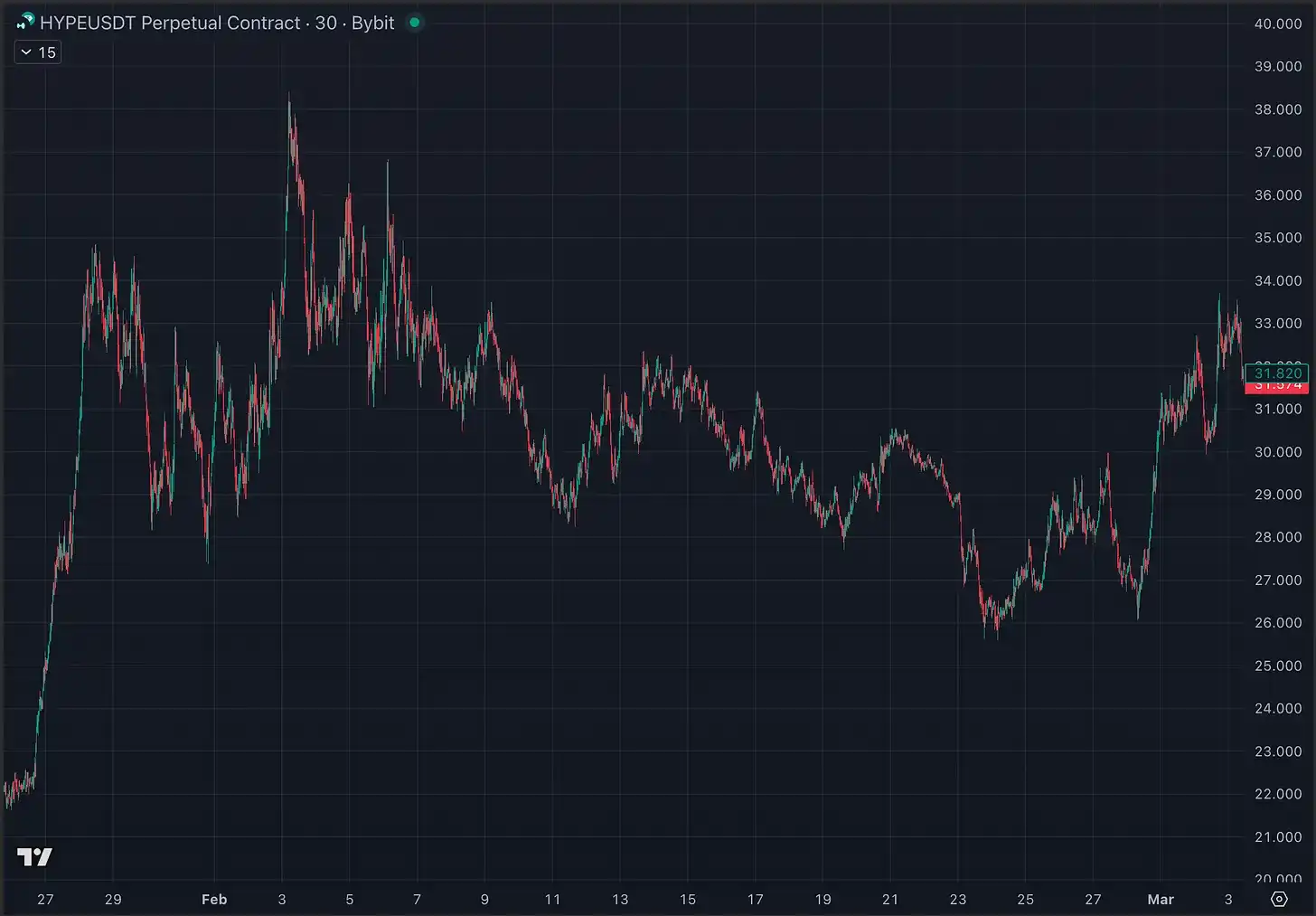
One reason for $HYPE's strength in early February was significant buying by Multicoin over several days, and HSI/PURR (HYPE's DAT) were also accumulating steadily.

In the Perp DEX sector, $LIT continued to show extreme weakness in February, finding support around $1.3, which has been tested four or five times.

$ASTER saw a strong bounce after the February 5th crash, rising from a low near $0.4 to $0.7, then strangely consolidated sideways around $0.7 for the remainder of February. It has a bullish catalyst: the launch of its own L1/blockchain in March.

Uniswap x BlackRock

On February 11th, Uniswap announced a partnership with BlackRock to provide liquidity for the latter's BUIDL product, simultaneously announcing BlackRock's direct investment in $UNI tokens (amount undisclosed). The market reaction was extremely strong, with $UNI gaining +40% in 10 minutes – quite remarkable for a token with an FDV over $30 billion. But the gains were completely erased over the next 10 hours, a classic bear market pump and dump.

Aave went through a period of controversy in February. On February 20th, BGD Labs announced its withdrawal from the Aave DAO due to disagreements over the V4 strategy, causing $AAVE to drop 8%. At the end of the month, Marc Zeller, a well-known figure in the Aave ecosystem, published a critique of Aave Labs, characterizing it as effectively an value extraction vehicle, leading to further token weakness.

Particularly unfavorable for Aave is that its main competitor, $MORPHO, has performed strongly in 2026, gaining nearly +75% in February. The FDV of the two tokens is now roughly equal, around $2bn each.

Other Important Events in February

On February 18th, Base announced it would transition from the Optimism tech stack to building its own. This was devastating for $OP, which fell 40% over 4 days. $ARB was also dragged down by correlation, now with an FDV of "only" $1bn, down 96% from its ATH ($OP is down 97%).

On February 11th, $BERA experienced a very strong short squeeze, gaining +160% in 8 hours, with a extreme discrepancy between spot and futures prices (a 15% gap). This is a weirdly trading token, mostly significantly underperforming the market but occasionally experiencing very strong random squeezes, having already seen a 2x move over 5 days last month.

On February 18th, $WLFI suddenly rose +30% for no apparent reason, simultaneously with open interest (OI) increasing by nearly $100M – this likely means a single entity pulled the price by going long $100M worth of $WLFI. The price then topped out here, has fallen about 20% from the high, and there has been no news since. This entity's move was quite strange, and I expect $WLFI to go much lower in the coming months.

At the end of February 2026, the bankruptcy estate of Terraform Labs sued Jane Street in Manhattan federal court, accusing it of using non-public information during the May 2022 Terra collapse to trade ahead of key UST liquidity events. $LUNC gained +35% in the days following the news.

$ZEC is still digesting its Q4 2025 rally, generally underperforming, but also occasionally seeing powerful squeezes, like the +45% on February 13th-14th. I think it's quite possible it falls to $150 or even $100 in the coming months.

$HNT had a strong 2x move in February. Is this a dead cat bounce for an asset suffering from excessive dilution, or has this DePIN token finally become cheap enough to be a worthwhile buy?

Like last month, $STABLE continued to trade as if its supply is locked, rising +144% from a local bottom of $1.6bn FDV to set a new high near $4bn FDV. DegenSpartan also endorsed it in an article, and given DegenSpartan's rare public commentary lately, this endorsement is quite bullish.

$BCH is a strange token. It consistently rose relative to BTC (outperforming by 40%) for 22-day stretch, then suddenly reversed, giving back all its excess returns in less than a week. Many became bullish on BCH due to the "quantum-resistant" narrative and its overall strength since early 2025, but it now looks like an entity holding a large amount of BCH decided to exit, continuously TWAP selling.

Robinhood listed two altcoins in February: $SNX (February 19th) and $CC. $CC barely reacted, but $SNX gained +42% over several days as a result. Upbit listings remain a very strong catalyst for tokens; $AZTEC (+70%), $ESP (+100%), and $SKR (+40%) all experienced this, with extremely negative funding rates within hours of listing. $BIRB also saw a 2x move after listing on Bithumb on February 3rd.

Two notable TGEs in February were $AZTEC and $ESP (Espresso). Both traded at relatively low valuations (FDV both below $500M, whereas这类 projects easily reached $1bn+ FDV a few months ago), indicating that altcoin premiums are slowly being repriced downward. However, $ESP had a stronger performance, with a +280% move from its late February low to high.

Polymarket announced a partnership with Kaito to launch an attention market. $KAITO rose +13% in 3 minutes after the news, then gave back all gains within an hour.


Preguntas relacionadas

QWhat was the key price range for BTC in February 2026, and what event caused a sharp drop to $60k?

ABTC's price range for most of 2026 was between $60k and $70k. A sharp drop to $60k occurred on February 5th, falling from $70k in a single day.

QHow did the market react to the US airstrike on Iran and the subsequent announcement of Khamenei's death at the end of February?

ABTC initially dropped from $68k to $65k on rumors of the airstrike, then fell further to $62k when the attack was confirmed. However, it was met with strong buying pressure and closed the day near $68k. The announcement of Khamenei's death was interpreted as a bullish signal, as it suggested the US would not heavily invest in further conflict.

QWhat was the market's reaction to the LayerZero (ZRO) conference on February 10th, and what significant partnerships were announced?

AThe market reaction was complex. A leaked video caused a 20% sell-off, but the official announcement of its own 'Zero' blockchain, along with major partnerships including Citadel Securities, Cathie Wood/ARK, DTCC, and ICE, led to a 45% pump in the following 12 hours. However, these gains were later completely erased.

QWhich 'scam coins' or heavily manipulated tokens were highlighted as having significant price action in February?

AThe article highlighted $PIPPIN, $SIREN, and $POWER as notable manipulated 'scam coins'. $PIPPIN saw a 315% pump, $SIREN had a major pump and dump, and $POWER saw a 12x increase from its bottom.

QAccording to the article, what are the characteristics of the altcoin market in this bearish environment?

AThe bear market is characterized by short-lived altcoin squeezes that quickly give up their gains. These pumps, often +50% to +100% in a single day, are typically followed by weakness over subsequent days. Most altcoin strength was limited to two brief periods: February 13-15 and February 25.

Lecturas Relacionadas

Trading

Spot
Futuros

Artículos destacados

Qué es BITCOIN

Entendiendo HarryPotterObamaSonic10Inu (ERC-20) y Su Posición en el Espacio Cripto En los últimos años, el mercado de criptomonedas ha sido testigo de un aumento en la popularidad de las monedas meme, capturando el interés no solo de los comerciantes, sino también de aquellos que buscan compromiso comunitario y valor de entretenimiento. Entre estos tokens únicos se encuentra HarryPotterObamaSonic10Inu (ERC-20), un proyecto intrigante que mezcla referencias culturales en el tejido de las criptomonedas. Este artículo profundiza en los aspectos clave de HarryPotterObamaSonic10Inu, explorando sus mecanismos, ethos impulsado por la comunidad y su relación con el paisaje cripto más amplio. ¿Qué es HarryPotterObamaSonic10Inu (ERC-20)? Como su nombre sugiere, HarryPotterObamaSonic10Inu es una moneda meme construida sobre la blockchain de Ethereum, clasificada bajo el estándar ERC-20. A diferencia de las criptomonedas tradicionales que pueden enfatizar la utilidad práctica o el potencial de inversión, este token prospera en el valor de entretenimiento y la fuerza de su comunidad. El proyecto tiene como objetivo fomentar un entorno donde los usuarios comprometidos puedan reunirse, compartir ideas y participar en actividades inspiradas por diversos fenómenos culturales. Una característica notable de HarryPotterObamaSonic10Inu es su cero impuestos en las transacciones. Este atractivo elemento tiene como objetivo incentivar el comercio y la participación comunitaria, sin cargos adicionales que puedan disuadir a los comerciantes de pequeña escala. El suministro total de la moneda está establecido en mil millones de tokens, una cifra que marca su intención de mantener una circulación sustancial dentro de la comunidad. Creador de HarryPotterObamaSonic10Inu (ERC-20) Los orígenes de HarryPotterObamaSonic10Inu están algo envueltos en misterio; los detalles sobre el creador siguen siendo desconocidos. El desarrollo de este token carece de un equipo identificable o de un plan explícito, lo cual no es inusual dentro del sector de monedas meme. En cambio, el proyecto ha surgido de manera orgánica, con su progreso muy dependiente del entusiasmo y la participación de su comunidad. Inversores de HarryPotterObamaSonic10Inu (ERC-20) En cuanto a inversiones externas y respaldo, HarryPotterObamaSonic10Inu también sigue siendo ambiguo. El token no lista ninguna fundación de inversión conocida o apoyo organizacional significativo. En cambio, la savia del proyecto es su comunidad de base, que informa su crecimiento y sostenibilidad a través de la acción colectiva y el compromiso en el espacio cripto. ¿Cómo Funciona HarryPotterObamaSonic10Inu (ERC-20)? Como una moneda meme, HarryPotterObamaSonic10Inu opera principalmente fuera de los marcos tradicionales que a menudo rigen el valor de los activos. Hay varios aspectos distintivos que definen cómo funciona el proyecto: Transacciones Sin Impuestos: Sin tarifas impositivas en las transacciones, los usuarios pueden comprar y vender el token libremente sin preocuparse por costos ocultos. Compromiso Comunitario: El proyecto prospera en la interacción comunitaria, aprovechando plataformas de redes sociales para crear entusiasmo y facilitar la participación. Las discusiones, el intercambio de contenido y el compromiso son elementos cruciales que ayudan a expandir su alcance y fomentar la lealtad entre los seguidores. Sin Utilidad Práctica: Cabe señalar que HarryPotterObamaSonic10Inu no ofrece utilidad concreta dentro del ecosistema financiero. Más bien, se clasifica como un token principalmente para actividades de entretenimiento y comunitarias. Referencia Cultural: El token incorpora astutamente elementos de la cultura popular para atraer interés, conectando con entusiastas de los memes y seguidores de las criptomonedas por igual. HarryPotterObamaSonic10Inu ejemplifica cómo las monedas meme operan de manera diferente a los proyectos de criptomonedas más tradicionales, ingresando al mercado como construcciones sociales innovadoras en lugar de activos utilitarios. Cronología de HarryPotterObamaSonic10Inu (ERC-20) La historia de HarryPotterObamaSonic10Inu está marcada por varios hitos notables: Creación: El token surgió de un meme viral, capturando la imaginación de muchos entusiastas de las criptomonedas. Las fechas específicas de creación no están disponibles, subrayando su ascenso orgánico. Listado en Exchanges: HarryPotterObamaSonic10Inu ha llegado a varios exchanges, permitiendo un acceso y comercio más fácil por parte de la comunidad. Iniciativas de Compromiso Comunitario: Actividades continuas destinadas a mejorar la interacción comunitaria, incluyendo concursos, campañas en redes sociales y generación de contenido por parte de fanáticos y defensores. Planes de Expansión Futuros: La hoja de ruta del proyecto incluye el lanzamiento de una colección de NFT, mercancía y un sitio de comercio electrónico relacionado con sus temas culturales, involucrando aún más a la comunidad e intentando añadir más dimensiones a su ecosistema. Puntos Clave Sobre HarryPotterObamaSonic10Inu (ERC-20) Naturaleza Impulsada por la Comunidad: El proyecto prioriza la participación colectiva y la creatividad, asegurando que la involucración de los usuarios esté a la vanguardia de su desarrollo. Clasificación como Moneda Meme: Representa la epítome de las criptomonedas basadas en el entretenimiento, diferenciándose de los vehículos de inversión tradicionales. Sin Afiliación Directa con Bitcoin: A pesar de la similitud en el nombre del ticker, HarryPotterObamaSonic10Inu es distinto y no tiene relación con Bitcoin u otras criptomonedas establecidas. Enfoque en la Colaboración: HarryPotterObamaSonic10Inu está diseñado para crear un espacio para la colaboración y el intercambio de historias entre sus poseedores, proporcionando una vía para la creatividad y el vínculo comunitario. Perspectivas Futuras: La ambición de expandirse más allá de su premisa inicial hacia NFTs y mercancías describe un camino para que el proyecto potencialmente ingrese a avenidas más tradicionales dentro de la cultura digital. A medida que las monedas meme continúan capturando la imaginación de la comunidad de criptomonedas, HarryPotterObamaSonic10Inu (ERC-20) se destaca debido a sus lazos culturales y su enfoque centrado en la comunidad. Si bien puede no encajar en el molde típico de un token impulsado por la utilidad, su esencia radica en la alegría y la camaradería fomentadas entre sus seguidores, destacando la naturaleza en evolución de las criptomonedas en una era cada vez más digital. A medida que el proyecto continúa desarrollándose, será importante observar cómo las dinámicas comunitarias influyen en su trayectoria en el cambiante paisaje de la tecnología blockchain.

1.3k Vistas totalesPublicado en 2024.04.01Actualizado en 2024.12.03

Qué es BITCOIN

Cómo comprar BTC

¡Bienvenido a HTX.com! Hemos hecho que comprar Bitcoin (BTC) sea simple y conveniente. Sigue nuestra guía paso a paso para iniciar tu viaje de criptos.Paso 1: crea tu cuenta HTXUtiliza tu correo electrónico o número de teléfono para registrarte y obtener una cuenta gratuita en HTX. Experimenta un proceso de registro sin complicaciones y desbloquea todas las funciones.Obtener mi cuentaPaso 2: ve a Comprar cripto y elige tu método de pagoTarjeta de crédito/débito: usa tu Visa o Mastercard para comprar Bitcoin (BTC) al instante.Saldo: utiliza fondos del saldo de tu cuenta HTX para tradear sin problemas.Terceros: hemos agregado métodos de pago populares como Google Pay y Apple Pay para mejorar la comodidad.P2P: tradear directamente con otros usuarios en HTX.Over-the-Counter (OTC): ofrecemos servicios personalizados y tipos de cambio competitivos para los traders.Paso 3: guarda tu Bitcoin (BTC)Después de comprar tu Bitcoin (BTC), guárdalo en tu cuenta HTX. Alternativamente, puedes enviarlo a otro lugar mediante transferencia blockchain o utilizarlo para tradear otras criptomonedas.Paso 4: tradear Bitcoin (BTC)Tradear fácilmente con Bitcoin (BTC) en HTX's mercado spot. Simplemente accede a tu cuenta, selecciona tu par de trading, ejecuta tus trades y monitorea en tiempo real. Ofrecemos una experiencia fácil de usar tanto para principiantes como para traders experimentados.

4.7k Vistas totalesPublicado en 2024.12.12Actualizado en 2025.03.21

Cómo comprar BTC

Qué es $BITCOIN

ORO DIGITAL ($BITCOIN): Un Análisis Integral Introducción al ORO DIGITAL ($BITCOIN) ORO DIGITAL ($BITCOIN) es un proyecto basado en blockchain que opera en la red Solana, cuyo objetivo es combinar las características de los metales preciosos tradicionales con la innovación de las tecnologías descentralizadas. Aunque comparte un nombre con Bitcoin, a menudo referido como “oro digital” debido a su percepción como un refugio de valor, ORO DIGITAL es un token separado diseñado para crear un ecosistema único dentro del paisaje Web3. Su meta es posicionarse como un activo digital alternativo viable, aunque los detalles sobre sus aplicaciones y funcionalidades aún están en desarrollo. ¿Qué es ORO DIGITAL ($BITCOIN)? ORO DIGITAL ($BITCOIN) es un token de criptomoneda diseñado explícitamente para su uso en la blockchain de Solana. A diferencia de Bitcoin, que proporciona un papel de almacenamiento de valor ampliamente reconocido, este token parece centrarse en aplicaciones y características más amplias. Aspectos notables incluyen: Infraestructura Blockchain: El token está construido sobre la blockchain de Solana, conocida por su capacidad para manejar transacciones de alta velocidad y bajo costo. Dinámicas de Suministro: ORO DIGITAL tiene un suministro máximo limitado a 100 cuatrillones de tokens (100P $BITCOIN), aunque los detalles sobre su suministro circulante no se han divulgado actualmente. Utilidad: Si bien las funcionalidades precisas no están delineadas explícitamente, hay indicios de que el token podría ser utilizado para diversas aplicaciones, potencialmente involucrando aplicaciones descentralizadas (dApps) o estrategias de tokenización de activos. ¿Quién es el Creador de ORO DIGITAL ($BITCOIN)? En la actualidad, la identidad de los creadores y el equipo de desarrollo detrás de ORO DIGITAL ($BITCOIN) sigue siendo desconocida. Esta situación es típica entre muchos proyectos innovadores dentro del espacio blockchain, particularmente aquellos alineados con las finanzas descentralizadas y fenómenos de monedas meme. Si bien tal anonimato puede fomentar una cultura impulsada por la comunidad, intensifica las preocupaciones sobre la gobernanza y la responsabilidad. ¿Quiénes son los Inversores de ORO DIGITAL ($BITCOIN)? La información disponible indica que ORO DIGITAL ($BITCOIN) no tiene patrocinadores institucionales conocidos ni inversiones destacadas de capital de riesgo. El proyecto parece operar en un modelo de peer-to-peer centrado en el apoyo y la adopción de la comunidad en lugar de rutas de financiamiento tradicionales. Su actividad y liquidez se sitúan principalmente en intercambios descentralizados (DEX), como PumpSwap, en lugar de plataformas de trading centralizadas establecidas, lo que resalta aún más su enfoque de base. Cómo Funciona ORO DIGITAL ($BITCOIN) Los mecanismos operativos de ORO DIGITAL ($BITCOIN) pueden elaborarse en función de su diseño blockchain y atributos de red: Mecanismo de Consenso: Al aprovechar el único proof-of-history (PoH) de Solana combinado con un modelo de proof-of-stake (PoS), el proyecto asegura una validación de transacciones eficiente que contribuye al alto rendimiento de la red. Tokenómica: Si bien los mecanismos deflacionarios específicos no se han detallado extensamente, el vasto suministro máximo de tokens implica que podría atender microtransacciones o casos de uso nicho que aún están por definirse. Interoperabilidad: Existe el potencial de integración con el ecosistema más amplio de Solana, incluyendo varias plataformas de finanzas descentralizadas (DeFi). Sin embargo, los detalles sobre integraciones específicas permanecen no especificados. Cronología de Eventos Clave Aquí hay una cronología que destaca hitos significativos relacionados con ORO DIGITAL ($BITCOIN): 2023: El despliegue inicial del token ocurre en la blockchain de Solana, marcado por su dirección de contrato. 2024: ORO DIGITAL gana visibilidad al estar disponible para trading en intercambios descentralizados como PumpSwap, permitiendo a los usuarios comerciar contra SOL. 2025: El proyecto presencia actividad de trading esporádica y potencial interés en compromisos liderados por la comunidad, aunque no se han documentado asociaciones notables o avances técnicos hasta el momento. Análisis Crítico Fortalezas Escalabilidad: La infraestructura subyacente de Solana soporta altos volúmenes de transacciones, lo que podría mejorar la utilidad de $BITCOIN en varios escenarios de transacción. Accesibilidad: El potencial bajo precio de trading por token podría atraer a inversores minoristas, facilitando una participación más amplia debido a oportunidades de propiedad fraccionada. Riesgos Falta de Transparencia: La ausencia de patrocinadores, desarrolladores o un proceso de auditoría conocidos públicamente puede generar escepticismo sobre la sostenibilidad y confiabilidad del proyecto. Volatilidad del Mercado: La actividad de trading depende en gran medida del comportamiento especulativo, lo que puede resultar en una volatilidad de precios significativa y en incertidumbre para los inversores. Conclusión ORO DIGITAL ($BITCOIN) surge como un proyecto intrigante pero ambiguo dentro del ecosistema de Solana en rápida evolución. Si bien intenta aprovechar la narrativa del “oro digital”, su alejamiento del papel establecido de Bitcoin como refugio de valor subraya la necesidad de una diferenciación más clara de su utilidad y estructura de gobernanza previstas. La aceptación y adopción futura dependerán probablemente de abordar la actual opacidad y de definir sus estrategias operativas y económicas de manera más explícita. Nota: Este informe abarca información sintetizada disponible hasta octubre de 2023, y pueden haber ocurrido desarrollos más allá del período de investigación.

83 Vistas totalesPublicado en 2025.05.13Actualizado en 2025.05.13

Qué es $BITCOIN

Discusiones

Bienvenido a la comunidad de HTX. Aquí puedes mantenerte informado sobre los últimos desarrollos de la plataforma y acceder a análisis profesionales del mercado. A continuación se presentan las opiniones de los usuarios sobre el precio de BTC (BTC).

活动图片













