"Fat Apps" Are Dead, Welcome to the Era of "Fat Distribution"

marsbitPublicado a 2025-12-19Actualizado a 2025-12-19

Resumen

The article "Fat Apps Are Dead, Welcome to the Era of Fat Distribution" argues that crypto applications are becoming commoditized infrastructure, shifting value from the applications themselves to the distribution channels and front-end interfaces that control user access. The author traces the evolution of value accumulation theories in crypto, from the 2016 "Fat Protocol" thesis (value accrues to base layers like Ethereum) to the 2022 "Fat App" thesis (value accrues to applications like Uniswap that built liquidity and user experience). By 2025, the thesis has shifted again. Excessive investment in infrastructure has led to diminishing returns; technical improvements (e.g., minor reductions in oracle costs or interest rate optimizations) are now imperceptible to end-users. Users prioritize familiar interfaces over marginally better backend performance. Consequently, applications like Aave and Morpho are increasingly focusing on B2B partnerships, embedding their services as backends within other platforms (e.g., traditional fintech apps like Robinhood). The author posits that convincing an existing platform to integrate a feature is far easier than onboarding millions of new users to complex, native crypto workflows. A case study illustrates this: Coinbase directs its users' borrowing activity to Morpho on Base, even though competitors offer better rates, because the seamless, integrated user experience within the Coinbase app is more valuable to customers than optimizin...

Original Author: Matt

Original Compilation: Chopper, Foresight News

Today, even cryptocurrency applications are gradually becoming standardized infrastructure, serving Web2 and traditional financial institutions with user-friendly front-end interfaces.

Each cryptocurrency cycle gives rise to a new theory about "how value accumulates in the crypto ecosystem," and these theories are reasonable at the time.

  • In 2016, Joel Monegro proposed the "Fat Protocol Theory": value converges toward underlying public chains like Ethereum through shared data, tokens, and network effects.
  • In 2022, Westie proposed the "Fat App Theory": as Layer 2 networks significantly reduce transaction costs, applications like Uniswap, Aave, and OpenSea build liquidity and user experience barriers, earning even more fees than the public chains they belong to.
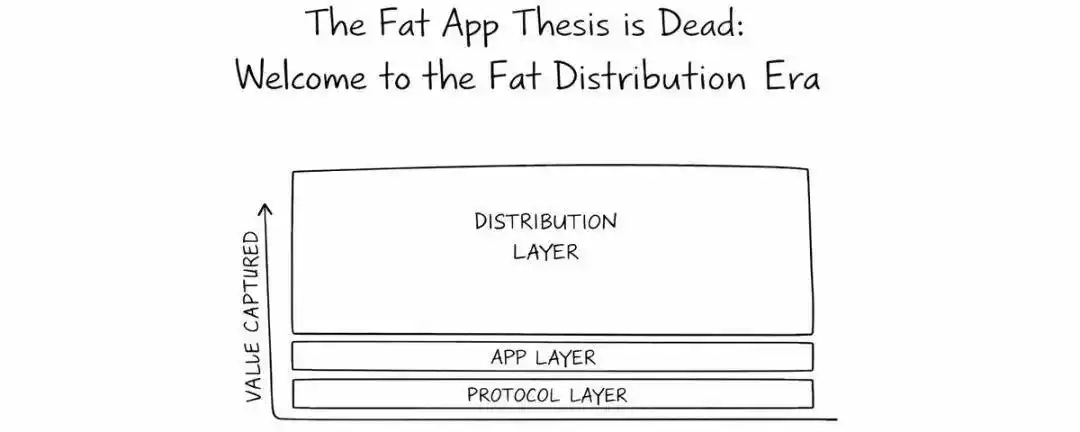
By 2025, the industry has officially entered a new phase: cryptocurrency applications themselves have become replaceable, standardized products.

The reason for this shift is simple: the crypto industry has invested excessive resources in infrastructure and technical optimization. We have relentlessly researched complex automated market maker (AMM) algorithms, innovative liquidation mechanisms, customized consensus protocols, and zero-knowledge proof cost optimizations, but now we are facing diminishing marginal returns. Technical improvements in applications are no longer perceptible to end users.

Users don’t care about a 1-basis-point reduction in oracle data costs, a 10-basis-point increase in lending rates, or improved pricing accuracy in decentralized exchange liquidity pools. What they truly care about is using an interface they already trust and are familiar with.

This trend is becoming increasingly evident: applications like Polymarket, Kalshi, Hyperliquid, Aave, Morpho, and Fluid are investing more time and resources into B2B partnerships. Instead of struggling to attract new users to adapt to cumbersome on-chain operations, they are transforming into backend services embedded in other product ecosystems.
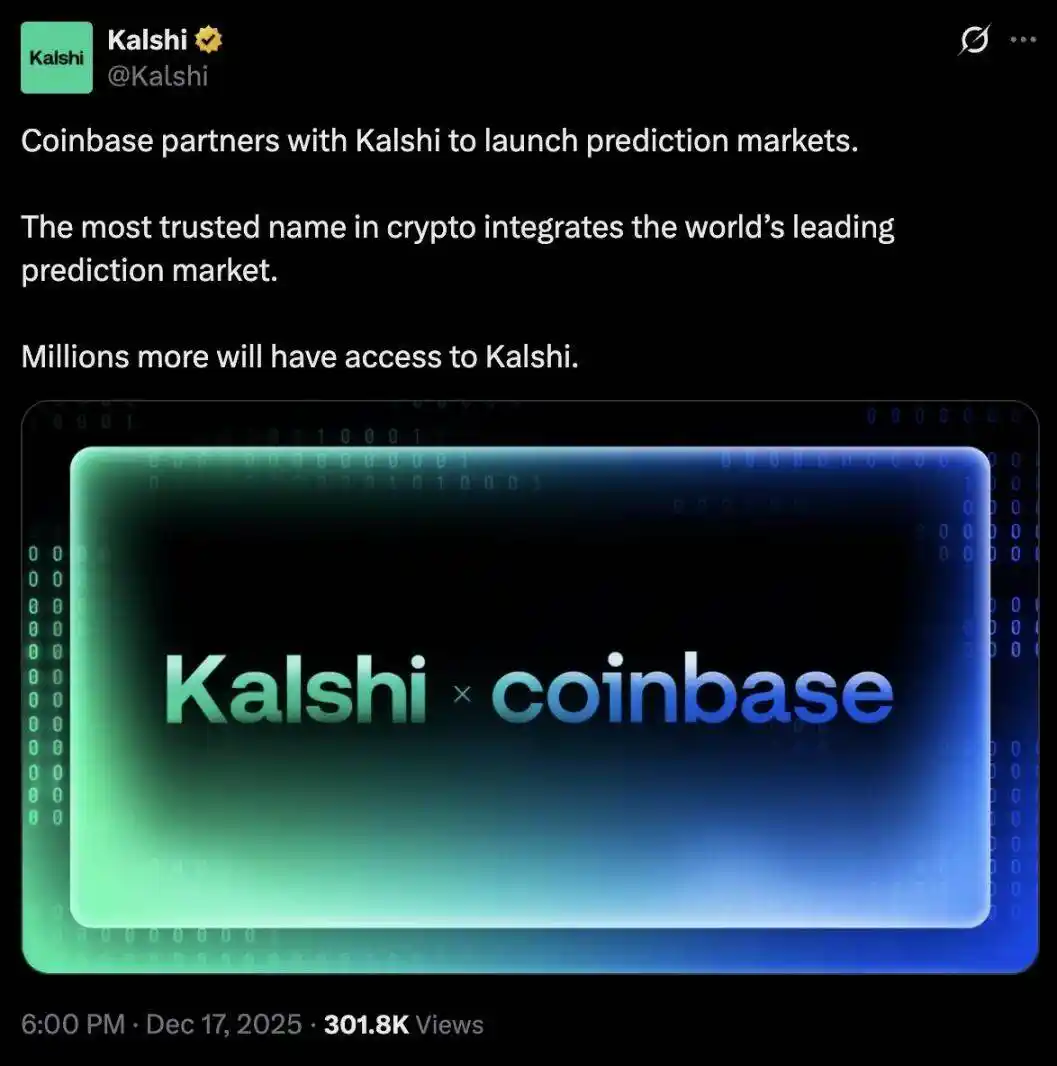
Convincing 25 million new users to download browser extensions, manage private keys, prepare gas fees, transfer assets across chains, and adapt to complex on-chain processes—or having platforms like Robinhood add an "earnings" feature to directly channel user deposits into your lending market. Clearly, the latter is easier to achieve.

Integration partnerships will ultimately win out, distribution channels will ultimately win out, front-end interfaces will ultimately win out; and crypto applications will merely become simple conduits for traffic.

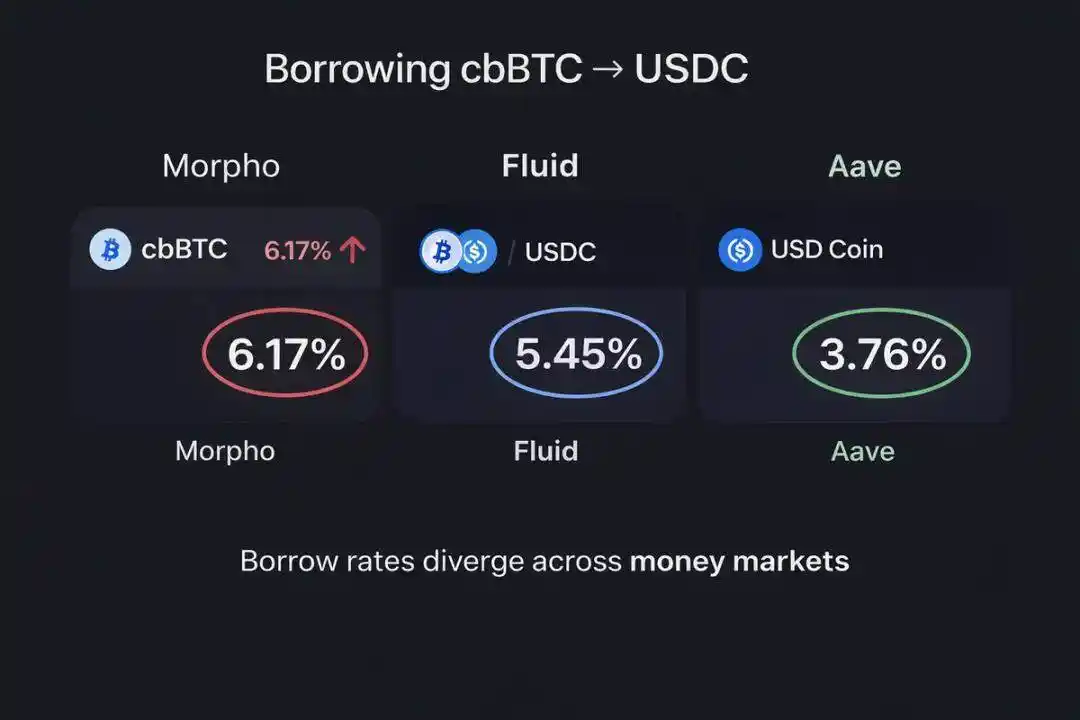
Coinbase’s case perfectly illustrates this: users can borrow USDC by using their platform’s Bitcoin (cbBTC) as collateral, and this transaction flow is directed to the Morpho lending market on the Base chain. Although Aave and Fluid on the Base chain offer significantly better interest rates for borrowing stablecoins using cbBTC as collateral, Morpho still dominates the market. The reason is simple: Coinbase users are willing to pay extra for "immediate and convenient operations."
However, not all applications will become invisible infrastructure. Some will still adhere to the B2C (business-to-consumer) track and will not adopt B2B2C (business-to-business-to-consumer) as their primary profit model. But they must undergo a complete transformation: adjusting core priorities, restructuring profit logic, building new competitive barriers, optimizing marketing strategies and development plans, and rethinking the core pathways for users to enter the crypto space.

This does not mean that infrastructure-type applications can no longer create value, but rather that the front-end platforms that truly control user traffic will capture a larger share of the value.

In the future, competitive barriers will no longer be built around liquidity or crypto-native user experience but will focus on distribution capabilities.


Preguntas relacionadas

QWhat is the main shift described in the article regarding the evolution of crypto applications?

AThe article describes a shift from 'fat applications' to 'fat distribution,' where crypto applications are becoming standardized infrastructure, and value is increasingly captured by front-end platforms that control user distribution rather than the applications themselves.

QAccording to the article, why are technical improvements in crypto applications becoming less impactful for end users?

ATechnical improvements, such as minor reductions in oracle data costs or slight increases in lending rates, have reached a point of diminishing returns and are no longer perceptible or meaningful to end users, who prioritize familiar and trusted interfaces.

QHow does the examples of Polymarket, Kalshi, and Aave illustrate the trend mentioned in the article?

AThese applications are increasingly focusing on B2B partnerships, embedding their services as back-end infrastructure into other products rather than directly attracting users with complex on-chain processes, highlighting the shift toward distribution-driven value capture.

QWhat example does the article use to demonstrate that users prefer convenience over optimal rates?

AThe article cites Coinbase users opting to borrow USDC using cbBTC as collateral through Morpho on Base, despite better rates being available on Aave or Fluid, because they value the convenience of a familiar interface.

QWhat will be the primary competitive barrier in the future, as stated in the article?

AThe primary competitive barrier will shift from liquidity or crypto-native user experience to distribution capabilities, with front-end platforms that control user traffic capturing a larger share of value.

Lecturas Relacionadas

Understanding Hash in One Article: The "Browser Miner" on Ethereum

Hash is an Ethereum-based ERC-20 token described as a "browser-minable post-quantum token." Its key features include enabling browser-based GPU mining without specialized hardware, a fixed supply cap of 21 million tokens, immutable and permissionless smart contracts with no team allocation or pre-mining, and an emphasis on post-quantum security using Keccak256 hashing. The mining mechanism is a simplified on-chain proof-of-work where miners solve unique challenges tied to their wallet address. Key design elements prevent answer theft, with epochs resetting every 100 blocks (~20 minutes) and a per-block minting limit. Emission follows a Bitcoin-like halving schedule every 100,000 mints, starting at 100 tokens per mint. Projections suggest all tokens could be mined within approximately 294 days if a target rate of one mint per minute is sustained. Hash emphasizes "post-quantum" security by leveraging hash-based primitives like Keccak256, which are considered more resistant to quantum attacks compared to elliptic-curve cryptography. While not a fully post-quantum asset, it aligns with Ethereum's broader post-quantum research narrative. The project completed its Genesis sale at $0.03 and began trading on Uniswap, with its price reaching around $0.19. The initial circulating supply is small, with 5% sold in Genesis and 5% allocated to liquidity. The majority (47.6% of total supply) is allocated to early-stage mining, leading to a front-loaded emission schedule. This structure, combined with low initial liquidity, makes Hash a high-volatility, high-risk project dependent on sustained miner participation and market demand to absorb new supply.

marsbitHace 3 min(s)

Understanding Hash in One Article: The "Browser Miner" on Ethereum

marsbitHace 3 min(s)

OpenAI's Largest Internal Wealth Creation: 600 People Cash Out a Total of $6.6 Billion, 75 Take Home the Maximum $30 Million Each

A Wall Street Journal report reveals OpenAI's unprecedented pre-IPO wealth creation. In a single employee stock sale last October, over 600 current and former employees sold shares, collectively cashing out approximately $6.6 billion. Due to high investor demand, the company tripled the individual sale cap to $30 million, with about 75 employees selling the maximum amount. This event represents the largest such transaction in tech industry history for a private company. OpenAI's valuation was $500 billion for this tender offer. Employees with over two years of tenure were eligible, allowing many post-ChatGPT hires their first liquidity event. The company's stock has reportedly grown over 100-fold in seven years. Following a restructuring, employees collectively hold about 26% of OpenAI. The scale of executive wealth is also staggering. In court testimony related to Elon Musk's lawsuit, President and co-founder Greg Brockman confirmed his OpenAI stake is worth around $30 billion. Analysis indicates about 165 current and former employees hold a combined ~$164.9 billion in equity, averaging nearly $1 billion per person in paper wealth. OpenAI's per-employee stock-based compensation is estimated to be 34 times the average of major tech firms before their IPOs. OpenAI continues its rapid ascent, closing a $122 billion funding round at an $852 billion valuation in March. With monthly revenue hitting $2 billion, over 900 million weekly ChatGPT users, and plans for a potential trillion-dollar IPO in late 2026, this wealth-creation engine shows no signs of stopping.

链捕手Hace 25 min(s)

OpenAI's Largest Internal Wealth Creation: 600 People Cash Out a Total of $6.6 Billion, 75 Take Home the Maximum $30 Million Each

链捕手Hace 25 min(s)

Understanding CPO (Co-Packaged Optics) in One Article: Why Nvidia Is Willing to Spend $3.2 Billion on a Fiber?

NVIDIA and Corning announced a multi-year strategic partnership on May 6, 2026, with NVIDIA committing up to $3.2 billion to support Corning's U.S. expansion. This investment will triple Corning's manufacturing plants and significantly boost its optical fiber and communications production capacity. The core driver behind this massive investment is the fundamental shift from copper to optical interconnect technology within AI data centers. As GPU clusters scale, copper wires face critical limitations: severe signal attenuation over distance, high energy consumption for signal integrity, and excessive heat generation. Optical fiber, transmitting light instead of electrical signals, solves these issues with minimal loss, near-light speed, and lower power needs. The article outlines a three-stage evolution of data center interconnect: 1. **Traditional Copper Interconnects:** The mainstream solution of the 2010s, now being phased out due to scaling bottlenecks. 2. **Pluggable Optical Modules:** The current mainstream, where modules convert electrical signals to light externally. This process still introduces energy loss and latency. 3. **CPO (Co-Packaged Optics):** The next-generation technology where the optical engine is integrated directly with the GPU chip package. This drastically reduces the electrical signal travel distance to mere millimeters, slashing power consumption and latency while boosting data density. NVIDIA CEO Jensen Huang has identified CPO as an essential core technology for AI infrastructure. NVIDIA's investment signifies a strategic shift from being a buyer to actively controlling its supply chain for critical components. With demand for specialized optical fiber far outstripping supply—evidenced by soaring prices—securing long-term manufacturing capacity has become a competitive necessity. While Corning's expansion may pressure some suppliers, a projected global fiber supply gap of 5-15% over the next few years creates a significant opportunity window, particularly for Chinese manufacturers competitive in optical preforms, chips, and modules. Ultimately, NVIDIA's move is not about chasing a trend but an engineering imperative. The transition to light-based interconnects like CPO is driven by the physical limits of copper, marking a definitive step in the ongoing AI computing revolution.

marsbitHace 50 min(s)

Understanding CPO (Co-Packaged Optics) in One Article: Why Nvidia Is Willing to Spend $3.2 Billion on a Fiber?

marsbitHace 50 min(s)

Trading

Spot
Futuros

Artículos destacados

Cómo comprar ERA

¡Bienvenido a HTX.com! Hemos hecho que comprar Caldera (ERA) sea simple y conveniente. Sigue nuestra guía paso a paso para iniciar tu viaje de criptos.Paso 1: crea tu cuenta HTXUtiliza tu correo electrónico o número de teléfono para registrarte y obtener una cuenta gratuita en HTX. Experimenta un proceso de registro sin complicaciones y desbloquea todas las funciones.Obtener mi cuentaPaso 2: ve a Comprar cripto y elige tu método de pagoTarjeta de crédito/débito: usa tu Visa o Mastercard para comprar Caldera (ERA) al instante.Saldo: utiliza fondos del saldo de tu cuenta HTX para tradear sin problemas.Terceros: hemos agregado métodos de pago populares como Google Pay y Apple Pay para mejorar la comodidad.P2P: tradear directamente con otros usuarios en HTX.Over-the-Counter (OTC): ofrecemos servicios personalizados y tipos de cambio competitivos para los traders.Paso 3: guarda tu Caldera (ERA)Después de comprar tu Caldera (ERA), guárdalo en tu cuenta HTX. Alternativamente, puedes enviarlo a otro lugar mediante transferencia blockchain o utilizarlo para tradear otras criptomonedas.Paso 4: tradear Caldera (ERA)Tradear fácilmente con Caldera (ERA) en HTX's mercado spot. Simplemente accede a tu cuenta, selecciona tu par de trading, ejecuta tus trades y monitorea en tiempo real. Ofrecemos una experiencia fácil de usar tanto para principiantes como para traders experimentados.

303 Vistas totalesPublicado en 2025.07.17Actualizado en 2025.07.17

Cómo comprar ERA

Discusiones

Bienvenido a la comunidad de HTX. Aquí puedes mantenerte informado sobre los últimos desarrollos de la plataforma y acceder a análisis profesionales del mercado. A continuación se presentan las opiniones de los usuarios sobre el precio de ERA (ERA).

活动图片












