Farewell to 'Storytelling' for Funding: What Kind of Projects Can Survive Beyond 2026

marsbitPublicado a 2026-01-16Actualizado a 2026-01-16

Resumen

Title: Beyond Storytelling: What Projects Will Survive Beyond 2026 The venture capital landscape in crypto has fundamentally shifted. In 2025, top market maker and investor Wintermute Ventures approved only 4% of the 600 projects it reviewed. This reflects a broader trend: total crypto VC deals plummeted 60% from 2024, with capital concentrating heavily in later-stage rounds (56% of total funding). The driver is a radical change in market structure. Institutional capital now dominates (75% of liquidity), but it is largely trapped in major assets like BTC and ETH. The altcoin narrative cycle collapsed from 61 days to just 19-20 days, leaving little time for money to flow to smaller projects. The traditional four-year bull cycle is broken; a 2026 recovery requires a major catalyst. Consequently, VC investment logic has moved from "spray and pray" to a survival-of-the-fittest model. Funding now targets projects that can prove viability from the seed stage. Key requirements for survival include: 1. **Hard Proof of Product-Market Fit:** Real data points are mandatory, such as 1,000+ active users or $100k+ in monthly revenue, with a DAU/MAU ratio above 50%. 2. **Capital Efficiency & Default Alive Status:** Startups must achieve "default alive" status, with monthly burn not exceeding 30% of revenue. Large, cash-burning teams are untenable. 3. **AI Integration & Technical Sophistication:** AI is no longer optional; it's essential for reducing development cycles and optimizing ...

Author: Nikka / WolfDAO (X: @10xWolfdao)

I: The Dramatic Shift in VC Investment Logic
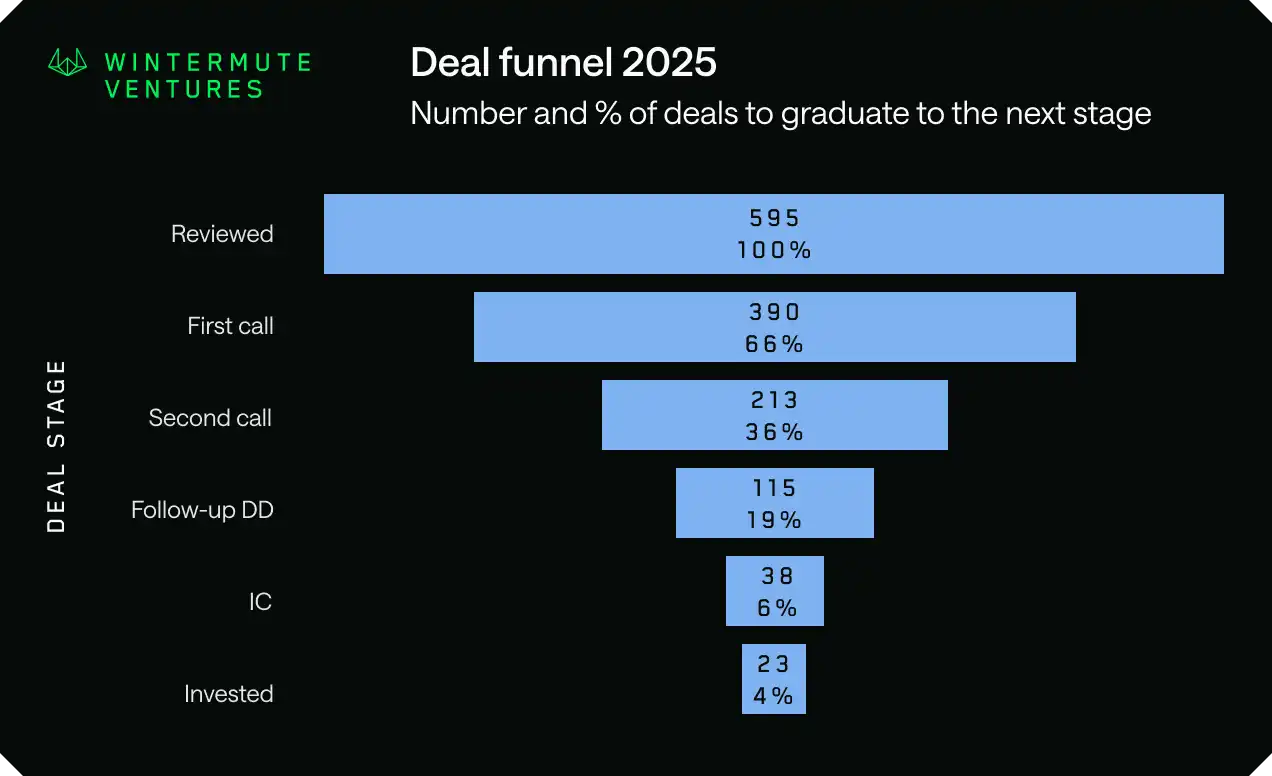
Data from Wintermute Ventures in 2025 reveals a harsh reality: this top market maker and investment firm reviewed about 600 projects throughout the year, ultimately approving only 23 deals, an approval rate of just 4%. Even more extreme, only 20% of projects even made it to the due diligence stage. Founder Evgeny Gaevoy bluntly stated that they have completely moved away from the "spray and pray" model of 2021-2022.

This shift is not unique to Wintermute. The entire crypto VC ecosystem saw deal count plummet by 60% in 2025, from over 2,900 deals in 2024 to about 1,200. While capital is still flowing—global crypto VC total investment even reached $4.975 billion—this money is increasingly concentrated in a smaller number of projects. Later-stage investments accounted for 56% of the total, compressing the share of early seed rounds to a historical low. Data from the US market is even more telling: deal count fell by 33%, but the median investment size grew 1.5 times to $5 million. This means VCs would rather place heavy bets on a few select ventures than cast a wide net.
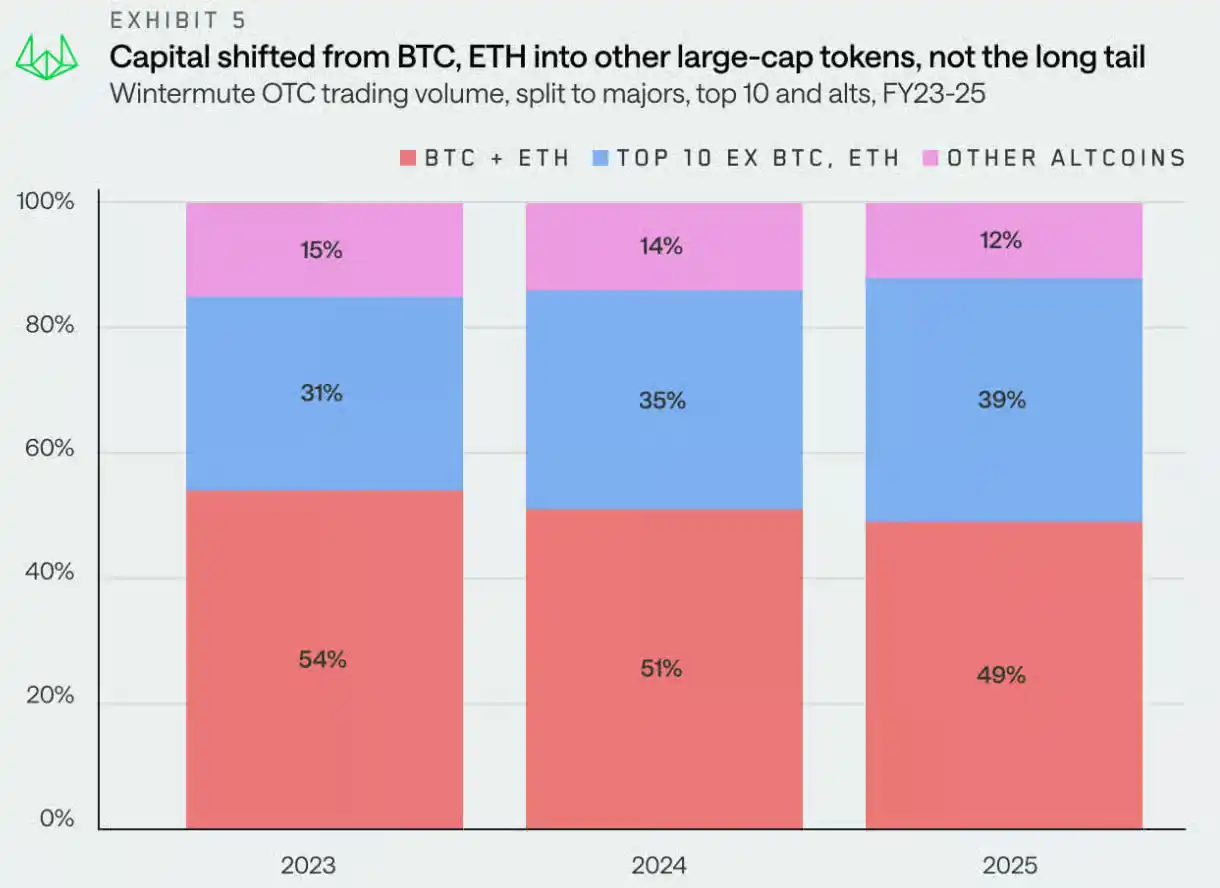
The root cause of this dramatic change is the high concentration of market liquidity. The 2025 crypto market exhibited extreme "narrow-range" characteristics: institutional funds accounted for 75% of the capital, but this money was largely trapped in large-cap assets like BTC and ETH. OTC trading data shows that while the share of BTC and ETH decreased from 54% to 49%, the overall share of blue-chip assets actually grew by 8%. More critically, the altcoin narrative cycle crashed from 61 days in 2024 to just 19-20 days in 2025, leaving no time for capital to spill over into small and mid-sized projects. Retail investors are also no longer chasing cryptocurrencies with the same frenzy as before; they have shifted their attention to AI and tech stocks, resulting in a lack of incremental funds for the crypto market.

The traditional "four-year bull cycle" has completely broken down. Wintermute's report clearly states that a recovery in 2026 will not arrive naturally as it did in the past; it will require at least one powerful catalyst: either the expansion of ETFs to assets like SOL or XRP, BTC breaking through the $100,000 psychological barrier again to trigger FOMO sentiment, or a new narrative reigniting retail enthusiasm. In this environment, VCs cannot afford to bet on projects that only know how to "tell stories." They need projects that can prove, even at the seed stage, their ability to survive until listing and access institutional liquidity.

This is why the investment logic has shifted from "invest in 100 to hit one 100x return" to "only invest in the 4 that can survive to listing." Risk aversion is no longer conservative; it's a necessity for survival. Top funds like a16z and Paradigm are reducing early-stage investments and shifting to mid-to-late stage rounds. The high-profile projects that raised funds in 2025—Fuel Network dropping from a $1 billion valuation to $11 million, Berachain plummeting 93% from its peak, Camp Network evaporating 96% of its market cap—are all delivering a bloody lesson to the market: narrative is dead, execution is king.

II: The Critical Demand for Seed-Stage Profitability

Under this extremely precise scrutiny, the biggest challenge for startup teams is: the seed round is no longer a starting point for burning cash, but a line of survival where you must prove your ability to be self-sustaining.

Profitability first manifests in the hard validation of Product-Market Fit (PMF). VCs are no longer satisfied with beautiful business plans or grand vision statements; they want to see real data: at least 1,000 active users, or monthly revenue exceeding $100,000. More crucial is user retention rate—if your DAU/MAU ratio is below 50%, it shows users simply aren't buying in. Many projects fail here: they have slick whitepapers, cool tech architectures, but just can't provide evidence that users are actually using and willing to pay for their product. Many of the 580 projects Wintermute rejected died at this stage.

Capital efficiency is the second life-or-death threshold. VCs predict that 2026 will see a surge of "profit zombies"—companies with an ARR of only $2 million and annual growth of only 50%, utterly unable to attract Series B funding. This means seed-stage teams must achieve a "default alive" status: monthly burn rate should not exceed 30% of revenue, or better yet, achieve profitability early on. This sounds harsh, but in a liquidity-starved market, it's the only way to survive. Teams need to be lean, under 10 people, prioritize using open-source tools to reduce costs, and even supplement cash flow through side ventures like consulting services. Projects with teams of dozens and alarming burn rates will basically fail to secure the next round of funding in 2026.

Technical requirements are also escalating. 2025 data shows that for every dollar VCs invested, 40 cents flowed into crypto projects also working on AI, a proportion double that of 2024. AI is no longer a nice-to-have; it's a necessity. Seed-stage projects need to demonstrate how AI helps them shorten development cycles from 6 months to 2 months, how AI agents drive capital transactions, or optimize DeFi liquidity management. Simultaneously, compliance and privacy protection must be embedded at the code level. With the rise of RWA (Real World Asset) tokenization, projects need to use technologies like zero-knowledge proofs to ensure privacy and reduce trust costs. Projects that ignore these requirements will be seen as "a generation behind."

The most critical requirement is liquidity and ecosystem compatibility. Crypto projects need to plan their exchange path clearly from the seed stage, defining how they will access institutional liquidity channels like ETFs or DATs. The data is clear: institutional funds accounted for 75% in 2025, the stablecoin market surged from $206 billion to over $300 billion, while the funding difficulty for purely narrative-driven altcoin projects increased exponentially. Projects need to focus on ETF-compatible assets, establish early partnerships with exchanges, and build liquidity pools. Teams thinking "get the money first, worry about listing later" basically won't survive 2026.

Combined, these requirements mean the seed round is no longer a trial but a comprehensive exam. Teams need interdisciplinary配置—engineers, AI experts, financial experts, compliance advisors are all essential. They need to iterate rapidly using agile development, speak with data instead of stories, and rely on sustainable business models instead of funding lifelines. 45% of VC-backed crypto projects have already failed, 77% have monthly revenue under $1,000, 85% of tokens launched in 2025 are underwater—these numbers tell us that projects lacking profitability simply won't survive to the next funding round, let alone achieve a listing exit.

III: Warnings and Strategic Shifts for Investment Institutions

For strategic investors and VC institutions, 2026 is a watershed: either adapt to the new rules or be eliminated from the market. Wintermute's 4% approval rate isn't boasting about their selectivity; it's a warning to the entire industry—institutions still using the old "spray and pray" model will lose badly.

The core of the problem is that the market has shifted from speculation-driven to institution-driven. When 75% of the funds are trapped in institutional channels like pension funds and hedge funds, when retail investors have fled to trade AI stocks, when the altcoin rotation cycle shortens from 60 days to 20 days, VCs who continue making scattergun investments in projects that only tell stories are actively giving money away. GameFi and DePIN narratives fell over 75% in 2025, AI-related projects fell an average of 50%, and the October liquidation cascade event saw $19 billion in leverage wiped out—all pointing to one thing: the market no longer pays for narrative, only for execution and sustainability.
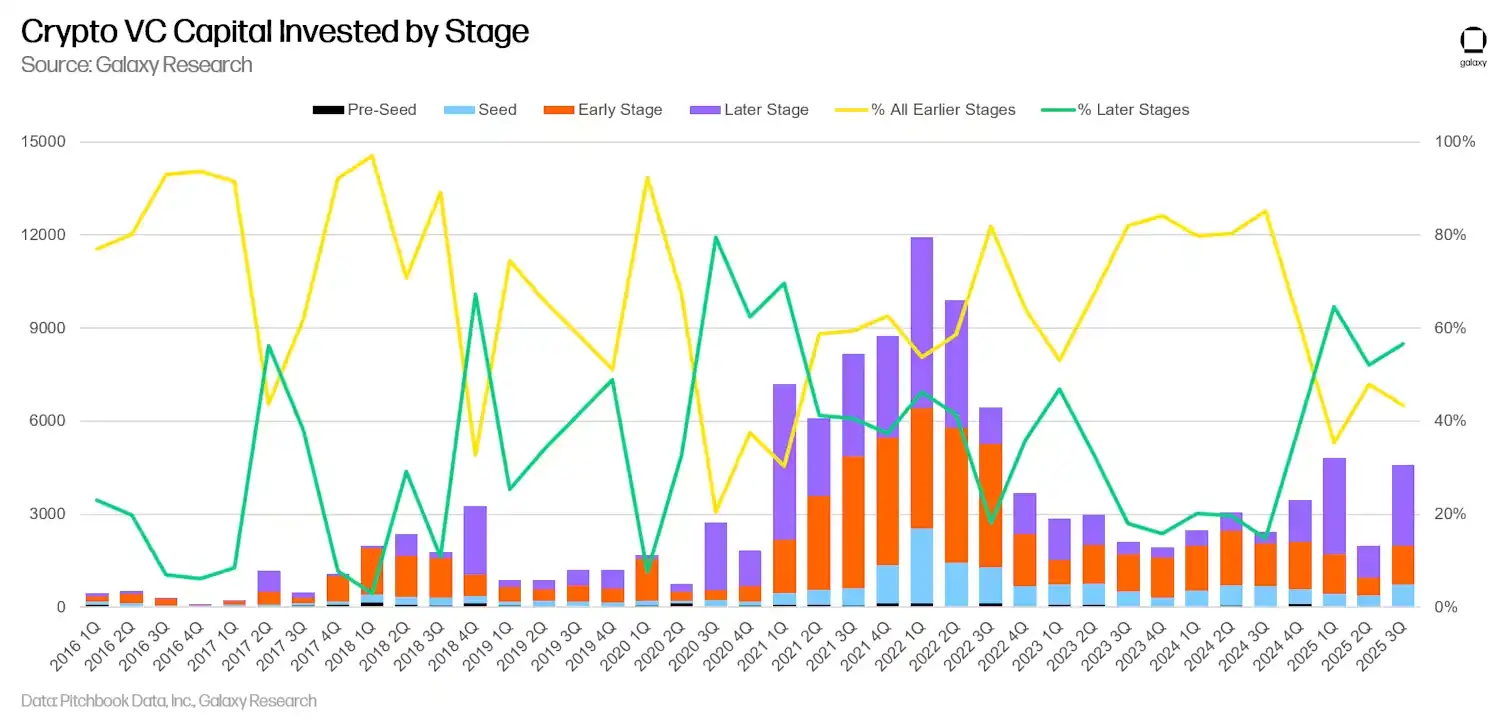
Institutions must change direction. First is a fundamental change in investment criteria: from "how big can this story get" to "can this project prove profitability at the seed stage." They can no longer sprinkle large amounts of capital in the early stages, but must either heavily back a few high-quality seed projects or simply shift to mid-to-late stage rounds to reduce risk. Data shows that later-stage investments already accounted for 56% in 2025; this is no coincidence but the result of the market voting with its feet.

More important is the repositioning of investment sectors. The fusion of AI and crypto is not a trend; it's reality—investment in the AI-crypto crossover space is expected to exceed 50% in 2026. Institutions still investing in purely narrative-driven altcoins, still ignoring compliance and privacy, still disregarding AI integration will find their projects unable to access liquidity, list on major exchanges, let alone exit.

Finally, there is the evolution of investment methodology. Active outbound sourcing must replace passively waiting for business plans (BPs), accelerated due diligence must replace lengthy evaluation processes, and response speed must replace bureaucracy. Simultaneously, they must explore structural opportunities in emerging markets—AI Rollups, RWA 2.0, stablecoin applications for cross-border payments, fintech innovation in emerging markets. VCs need to shift from a "gamble for 100x returns" gambler mentality to a "select the survivors" hunter mentality, using a 5-10 year long-term vision rather than short-term speculative logic to screen projects.

Wintermute's report is essentially sounding the alarm for the entire industry: 2026 is not a natural continuation of the bull market, but a winner-take-all battlefield. Those players—whether entrepreneurs or investors—who adapt early to this precise scrutiny will occupy the high ground when liquidity returns. Those still using the old models, old thinking, and old standards will find their invested projects breaking down one after another, their held tokens going to zero one by one, and their exit channels closing one after another. The market has changed, the rules of the game have changed, only one thing remains constant: only projects that are truly profitable, that can truly survive to listing, are worthy of capital in this era.


Preguntas relacionadas

QWhat was the approval rate for projects reviewed by Wintermute Ventures in 2025, and what does this indicate about the VC investment landscape?

AThe approval rate was only 4%, with just 23 deals approved out of approximately 600 projects reviewed. This indicates a dramatic shift from the 'spray and pray' model of 2021-2022 to an extremely selective, risk-averse investment strategy focused on survival and proven execution over narrative.

QAccording to the article, what are the three key requirements for a seed-stage project to demonstrate 'hemostatic capability' or self-sufficiency?

AThe three key requirements are: 1) Hard validation of Product-Market Fit (PMF) with metrics like 1,000 active users or $100k monthly revenue and a DAU/MAU ratio above 50%. 2) High capital efficiency, achieving a 'default alive' status with a burn rate not exceeding 30% of revenue or early profitability. 3) Advanced technical integration, particularly with AI to shorten development cycles and ensure compliance and privacy from the code level.

QWhat major shift in market liquidity is driving the change in VC investment logic, and what is its impact on altcoins?

AThe market is characterized by extreme 'narrow liquidity,' with 75% of funds coming from institutional investors that are primarily concentrated in major assets like BTC and ETH. This has caused the altcoin narrative cycle to collapse from 61 days in 2024 to just 19-20 days in 2025, leaving little time for funds to flow into smaller projects and making it extremely difficult for narrative-driven altcoins to succeed.

QWhat does the term 'profit zombie' refer to in the context of the 2026 investment landscape?

AA 'profit zombie' refers to a company that has achieved some revenue (e.g., $2 million ARR) and modest growth (e.g., 50% annually) but is unable to attract Series B funding because its metrics are not strong enough to stand out in a highly competitive and selective market where only the most efficient and scalable projects survive.

QWhat is the new core investment thesis for VCs, as stated in the article, and what must it replace?

AThe new core thesis is 'only invest in the 4 that can survive to listing,' which replaces the old model of 'invest in 100 to bet on one 100x return.' This signifies a move away from speculative, narrative-based betting towards a focused, execution-oriented strategy that prioritizes a project's ability to reach an exchange and access institutional liquidity from the seed stage.

Lecturas Relacionadas

As Consensus Accelerates, What Are Young Investors Betting On?

Title: As Consensus Forms Faster, What Are Young Investors Betting On? In the rapid evolution of tech investment, a new generation of young investors is navigating a landscape where AI, robotics, commercial aerospace, and quantum computing are advancing simultaneously. Traditional investment logic based on financial models is giving way to a need for deep technical understanding and the ability to act before industry consensus forms. An analysis of trends from the "WAIC FUTURE TECH" list of young investment leaders reveals key shifts in focus. The first major trend is the movement of AI from the digital screen into the physical world. Investment is shifting from large language models and chatbots towards embodied AI, robotics, AI hardware, and edge computing. While demonstrations generate excitement, the real challenge lies in achieving scalable, reliable, and cost-effective delivery in complex real-world environments like factories and logistics. Success depends not just on algorithms but on the integration of sensors, actuators, and control systems. Second, the competitive focus for large models is moving beyond raw capability toward building an "intelligence flywheel." The goal is to create self-reinforcing systems where user interaction generates data, improving the model, which in turn enhances the user experience and attracts more engagement. Companies that successfully embed AI into workflows to create these closed-loop systems can build lasting value that isn't easily erased by the next model upgrade. Third, facing a potential bottleneck in high-quality human-generated data, investors are looking at new underlying technologies. Reinforcement learning and self-play, as demonstrated by AlphaGo Zero, offer paths for AI to generate its own experience. Scientific foundation models, which aim to build general AI capabilities for fields like life sciences and materials discovery, represent a non-consensus direction that could unlock new frontiers of knowledge and data. Finally, in deep-tech areas like quantum computing, commercial aerospace, and space-based infrastructure, patient capital is essential. These fields have long, uncertain development and validation cycles involving complex engineering, supply chains, and regulations. Investment here requires a long-term view, focusing on foundational team capabilities and the eventual emergence of market demand, even if commercial returns are distant. Collectively, these trends illustrate how young investors are adapting to a new era. They are learning to make earlier, technically-informed judgments, balance hype with real-world viability, and provide the patient capital needed to build the deep-tech foundations of the future.

marsbitHace 27 min(s)

As Consensus Accelerates, What Are Young Investors Betting On?

marsbitHace 27 min(s)

Can Japan Buy Growth with AI? Will the Bond Market Believe It?

Japan's cabinet has introduced the 2026 Basic Policy on Economic and Fiscal Management and Reform, shifting its primary fiscal target. The new framework moves away from the traditional annual primary balance goal and instead prioritizes a stable reduction of the debt-to-GDP ratio. This change is tied to a strategy of increased "responsible proactive fiscal" spending, aiming to boost long-term growth through investments in strategic sectors like AI, semiconductors, energy, and robotics. The government estimates total public and private investment in 62 key technologies could exceed 370 trillion yen by 2040. The market reaction has been mixed and cautious. While equity markets may respond to policy signals, bond markets are focused on fiscal credibility. Concerns center on whether the weakening of the clear primary balance anchor could lead to looser fiscal discipline. If investors doubt that these strategic investments will generate sufficient productivity gains, tax revenue, and nominal growth to outpace rising interest costs, they may demand higher yields on Japanese Government Bonds (JGBs). Recent volatility in the yen and JGB yields, with the 10-year yield briefly reaching 2.9%, reflects this skepticism. The success of this new framework hinges on two factors: whether Japan can achieve a nominal growth rate consistently higher than its long-term interest rates, and whether future budgets demonstrate disciplined control over bond issuance. The government's narrative is that strategic investment is essential to break Japan's cycle of low growth, aging, and labor shortages. However, the bond market will continuously assess the credibility of this plan, pricing the risk that it may represent fiscal expansion rather than a viable growth strategy.

marsbitHace 1 hora(s)

Can Japan Buy Growth with AI? Will the Bond Market Believe It?

marsbitHace 1 hora(s)

Misjudged A-Shares: Resilience, Expectations, and Confidence

China's A-share market recently faced selling pressure, especially in tech sectors, initially triggered by a global tech sell-off that began in South Korea. However, the article argues this is a case of "mistaken injury" and highlights the market's underlying resilience. This resilience stems from three main pillars: **1) Tech Sector Fundamentals:** Unlike Korea's market dominated by a few memory chip stocks, China's tech sector is diversified across computing, communications, electronics, and semiconductors, supported by dual narratives of global AI supply chains and domestic substitution. Core areas like optical modules and fiber optics continue to show strong earnings growth. **2) "National Team" Support:** State-backed institutions and large corporations have made significant market purchases and announced buybacks, providing liquidity and signaling confidence. This is seen as a stabilizing policy signal, often associated with market bottoms. **3) Broader Market Pillars:** Other major sectors are showing endogenous recovery momentum. Consumer stocks benefit from stabilizing CPI and signs of sector recovery (e.g., liquor price hikes). Cyclical sectors like aluminum have high earnings, potential price increases due to tight supply, and low valuations. The financial sector offers stable dividends and low valuations. The conclusion is that the sell-off was driven by external contagion, not a collapse in fundamentals. With strong policy support and recovering momentum across key sectors, the A-share market possesses the toughness to regain stability.

marsbitHace 1 hora(s)

Misjudged A-Shares: Resilience, Expectations, and Confidence

marsbitHace 1 hora(s)

Trading

Spot
活动图片




