Exploring Bitcoin Valuation in 2026 from Macro and On-Chain Structural Perspectives

marsbitPublicado a 2026-04-22Actualizado a 2026-04-22

Resumen

Tiger Research analyzes Bitcoin's valuation outlook for 2026 from macro and on-chain perspectives. Despite a 27% price drop in Q1, the macro environment remains supportive. Global M2 hit a record $13.44 trillion, but Chinese liquidity, which contributed over 60% of M2 growth, has limited access to Bitcoin markets. The Iran conflict pushed oil prices higher, raising March CPI to 3.3% and narrowing the Fed's rate cut path. However, the easing direction remains intact. Bitcoin ETF flows turned positive in March after five months of outflows, and corporate accumulation continues. On-chain metrics show a shift from undervaluation to early equilibrium. Key indicators like MVRV-Z and NUPL have exited panic zones. The critical resistance is at $78k, the long-term holder cost basis, while the key support is at $54k. Although transaction counts increased, active addresses and average transfer size declined, indicating superficial growth rather than real network expansion. BTCFi ecosystem growth has weakened, leading to a -10% adjustment in fundamental metrics. The 12-month price target is set at $143k, based on a $132.5k neutral benchmark adjusted by -10% (fundamentals) and +20% (macro). This represents a 103% upside from current levels. Short-term catalysts include a break above $78k, sustained ETF inflows, and a Fed policy shift post-geopolitical de-escalation.

Author: Tiger Research

Compiled by: AididiaoJP, Foresight News

Key Takeaways

The macro environment remains supportive, albeit at a slower pace: Global M2 has reached a new all-time high of $13.44 trillion, and Bitcoin ETF flows have turned net positive for the first time in 14 months. However, the oil shock triggered by the Iran conflict pushed March CPI to 3.3%, narrowing the Fed's rate cut path.

Bitcoin on-chain metrics are shifting from undervalued to early equilibrium: Key on-chain indicators have moved out of the Q1 panic zone. The current price of $70.5K is about 13% below the Long-Term Holder average cost basis of $78K. A decisive break above this level would be a key signal for a short-term trend reversal.

The $143K price target and 2x upside potential remain valid: Based on a neutral baseline of $132.5K, adjusted by -10% for fundamentals and +20% for macro factors. This is a downward revision from the Q1 target of $185.5K, but the significant spot price correction means the actual upside potential from the current price has actually increased.

Macro Tailwinds Persist, But Momentum Has Slowed

Since the release of the Q1 report, Bitcoin has fallen approximately 27%, with the average price hovering around $70.5K in early April. The Iran conflict introduced a new variable, but the overall macro environment remains favorable. What changed is not the direction, but the speed.

Liquidity Hits Record Highs, But Fails to Translate Effectively to Bitcoin

As of February 2026, global M2 continued to expand to near a record high of $13.44 trillion. Yet Bitcoin is down 27% from Q1. Liquidity and price are moving in opposite directions.
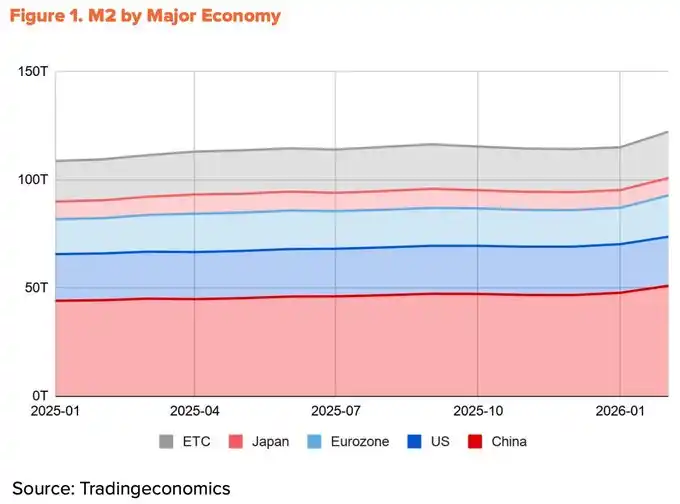
The source of this liquidity explains the divergence. Over the past year, over 60% of the M2 growth from the four major economies (China, US, Eurozone, Japan) came from China, benefiting from the PBoC's RRR cuts and its formal shift to an easing stance in Q1.

The US contribution was only 10%. The problem is that channels for China-sourced liquidity to enter the Bitcoin market are limited. Domestic crypto trading restrictions remain, and indirect channels through Hong Kong and Singapore primarily serve institutional capital. Global liquidity is at historic peaks, but the share that can actually reach the Bitcoin market is shrinking.

Iran Conflict Slows Fed Rate Cut Pace

With the transmission of China-sourced liquidity blocked, dollar liquidity remains the primary driver for Bitcoin. But even this part has been delayed by the Iran conflict.
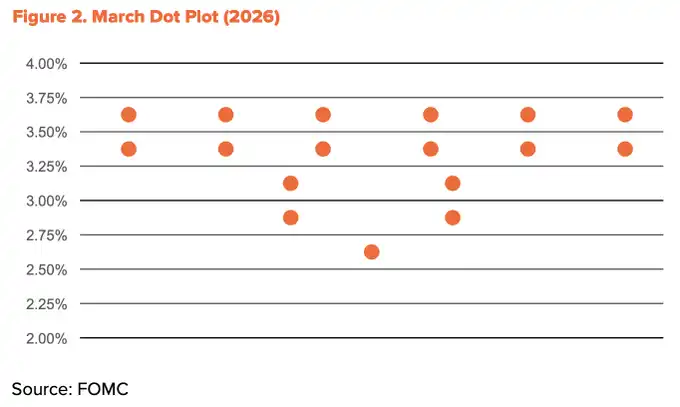
Following the US-Israel strikes on Iran on February 28th, the Strait of Hormuz was blocked. Brent crude surged to $118/barrel in mid-March, and Dubai crude hit a record high of $166/barrel. This shock directly pushed inflation higher. US March CPI rose to 3.3% from 2.4% in February, a two-year high. The Fed's room for rate cuts subsequently narrowed. The March dot plot reduced 2026 rate cut expectations to just one.

Nevertheless, the direction of easing has not changed. In mid-April, the Strait of Hormuz partially reopened, and oil prices fell sharply to around $90. Core CPI stabilized at 2.6%, indicating the shock had not yet broadly spread through the economy. President Trump formally nominated Kevin Warsh as the next Fed Chair at the end of January, with Senate confirmation hearings ongoing. Powell's term ends on May 15th, and an easing bias is highly likely to continue. The number of cuts may be reduced, but the direction remains.

Institutional Flows Begin to Reverse
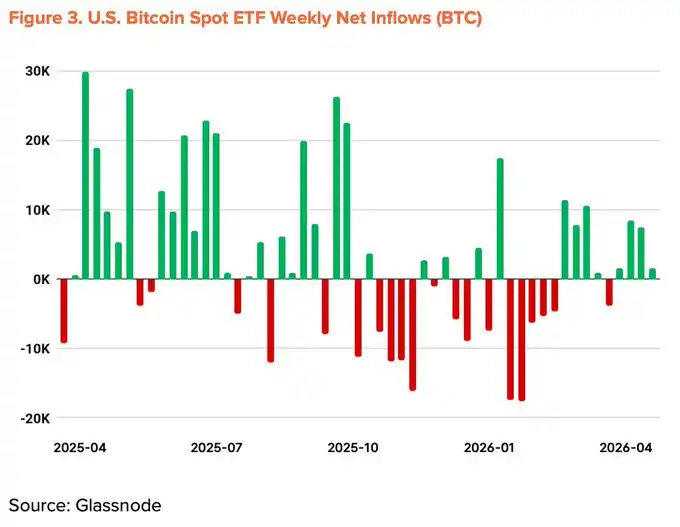
The institutional outflows that drove the Q1 decline have begun to reverse. Bitcoin spot ETFs recorded their worst monthly outflows since their November 2025 launch and were in net outflow for five consecutive months. However, since March, monthly net inflows have turned positive. As of mid-April, year-to-date cumulative flows turned positive, with total AUM recovering to $96.5 billion.

Corporate accumulation is also accelerating. Strategy purchased 34,164 BTC for $2.54 billion in a single week (April 13-19), increasing its total holdings to 815,061 BTC. However, the number of companies participating in this trend has not increased significantly.

Macro Indicator Adjusted Down to +20%

Structural tailwinds remain intact: liquidity expansion, policy easing bias, institutional flows back on track, and progress on the US CLARITY Act. Recent headwinds—the Iran-induced oil shock and slower Fed cuts—partially offset these positives. The Q2 macro indicator is adjusted down 5 percentage points from Q1, set at +20%.

Shifting from Undervalued to Early Equilibrium

On-chain metrics have moved out of the extreme panic zone and are transitioning towards the border between undervalued and equilibrium. Key indicators like MVRV-Z, NUPL, and aSOPR have exited the Q1 panic area into an early recovery phase. While a sharp rally like those from panic zones is less likely, historical data shows that the average one-year return starting from this region consistently remains in the double digits. The risk-reward ratio at this point remains among the most favorable.

Notably, the average cost basis for Short-Term Holders (STH) is gradually declining. This suggests speculative capital is exiting, while new buyers are accumulating at lower prices. The timing aligns with the restart of ETF net inflows and Strategy's large purchases, supporting the view that institutional investors are consistently accumulating in the discounted range, thereby pulling down the average entry cost.

The key risk level is $54K, the network's average cost basis. A break below this level would put the entire network into an unrealized loss state, forming a bottom in an extreme scenario. The strongest resistance is at $78K, coinciding with the Long-Term Holder average cost basis.

The current price of $70.5K is about 13% below this resistance level, leaving a significant amount of recently entered short-term capital in unrealized loss. A decisive break above $78K in the short term is worth close attention.

Superficial Growth, Underlying Stagnation

Bitcoin's average daily transaction count reached 564,000 in the first half of April, up 37.9% year-on-year. The surface data is impressive, but the details tell another story.

Active addresses fell to 428,000 in the same period, down 13.2% year-on-year and 4.2% quarter-on-quarter. The average transfer size per transaction fell to 1.19 BTC, down 34.1% from 1.80 BTC last quarter. Transaction count is rising, but both participants and value per transaction are declining. This pattern reflects a small number of users repeatedly making small transfers, rather than broad economic utilization of the network. A significant portion of the transaction growth likely comes from mechanical flows like exchange deposits, unrelated to real growth.

The Q1 report maintained the fundamental indicator at 0%, based on expectations of BTCFi ecosystem expansion. Entering Q2, this thesis has clearly weakened. According to The Block's "2026 Digital Asset Outlook," Bitcoin L2 TVL has fallen 74% year-to-date, total BTCFi TVL is down 10%, accounting for only 0.46% of total Bitcoin supply (91,332 BTC). While individual protocols like Babylon and Lombard have seen growth, the overall ecosystem has contracted.

Fundamental Indicator Adjusted Down to -10%

Superficial growth has failed to translate into real network expansion, and the underlying data supporting the BTCFi thesis has weakened. The balance of offsetting positive and negative signals present in Q1 has been broken. The Q2 fundamental indicator is adjusted down from 0% to a baseline of -10%.

Target Price $143K, 2x Upside Potential Remains

Using the TVM method, the neutral baseline calculated from the average price in early April 2026 is $132.5K. Applying the fundamental adjustment of -10% and macro adjustment of +20%, the 12-month target price is set at $143K.

This figure is about 23% lower than the Q1 target of $185.5K. However, the actual upside potential has instead increased. Calculated from the average price, the upside has expanded from +93% in Q1 to +103% in Q2.

The lower target price does not represent pessimism. The macro direction and on-chain structure still support a medium-to-long term bull thesis.

Three short-term watch points:

  • A decisive break above the network's mid-term equilibrium level of $78K;
  • Sustained net inflows into ETFs;
  • A Fed policy pivot following the easing of geopolitical risks.

If these three conditions materialize simultaneously, the $143K target remains achievable.

Preguntas relacionadas

QWhat is the 12-month target price for Bitcoin according to the Tiger Research report, and what is the upside potential from the current price?

AThe 12-month target price for Bitcoin is $143,000, representing an upside potential of approximately 103% from the current price of around $70,500.

QHow did the Iran conflict and oil shock impact the U.S. Federal Reserve's monetary policy outlook?

AThe Iran conflict and subsequent oil shock, which pushed Brent crude to $118/barrel, caused the U.S. March CPI to rise to 3.3%. This narrowed the Fed's path for interest rate cuts, leading its March dot plot to reduce 2026 rate cut expectations to just one.

QWhat is the significance of the $78,000 price level for Bitcoin's short-term trend reversal?

AThe $78,000 level represents the average entry cost for Long-Term Holders (LTHs). The current price is about 13% below this level. A decisive break above $78,000 would be a key signal for a short-term trend reversal as it would put a significant portion of recently entered short-term capital back into a state of unrealized profit.

QWhy was the fundamental indicator for Bitcoin adjusted down to -10% from 0% in the previous quarter?

AThe fundamental indicator was adjusted down because the growth in transaction count was not accompanied by real network expansion. Active addresses declined, and the Bitcoin DeFi (BTCFi) ecosystem contracted, with L2 TVL falling 74% and total BTCFi TVL representing only 0.46% of the total Bitcoin supply.

QWhat was the primary reason for the divergence between record global M2 liquidity and the 27% decline in Bitcoin's price in Q1?

AThe divergence occurred because over 60% of the M2 growth from the top four economies came from China, where strict domestic crypto trading restrictions limit the flow of that liquidity into the Bitcoin market. The U.S. contribution was only 10%, and this dollar-based liquidity is the primary driver for Bitcoin.

Lecturas Relacionadas

The AI Stock Genius Who Made 60x Bets $7.7 Billion on Nvidia Topping Out

An AI-focused hedge fund named Situational Awareness LP, known for its 60x returns, has taken a significant bearish stance on semiconductor stocks in Q1 2026. Its 13F filing reveals a massive 148% quarterly increase in nominal exposure to $13.677 billion, with over 60% of the new exposure directed towards put options on major chip players. Key bearish bets include $2.04 billion in puts on the VanEck Semiconductor ETF (SMH) and $1.56 billion on NVIDIA, alongside positions against Broadcom, Oracle, AMD, and others. The fund simultaneously increased its long equity holdings in AI infrastructure and compute providers like CoreWeave and Bitcoin mining companies repurposing for compute. The core thesis behind this positioning is a shift in the primary constraint for AI expansion. The fund argues that while GPU supply was the critical bottleneck in previous years, the new limiting factors for large-scale AI cluster deployment are physical infrastructure: electrical grid access (with multi-year backlogs in the US), power availability, land, and data center construction timelines. The fund is not betting against AI's success but rather hedging against potential valuation corrections in semiconductor stocks whose prices may have run ahead, while directly investing in the downstream physical bottlenecks—power and data center capacity—it believes will capture value next. This move translates a previously theoretical narrative about infrastructure constraints into a concrete, high-conviction portfolio structure.

链捕手Hace 2 hora(s)

The AI Stock Genius Who Made 60x Bets $7.7 Billion on Nvidia Topping Out

链捕手Hace 2 hora(s)

Trading

Spot
Futuros

Artículos destacados

Qué es BITCOIN

Entendiendo HarryPotterObamaSonic10Inu (ERC-20) y Su Posición en el Espacio Cripto En los últimos años, el mercado de criptomonedas ha sido testigo de un aumento en la popularidad de las monedas meme, capturando el interés no solo de los comerciantes, sino también de aquellos que buscan compromiso comunitario y valor de entretenimiento. Entre estos tokens únicos se encuentra HarryPotterObamaSonic10Inu (ERC-20), un proyecto intrigante que mezcla referencias culturales en el tejido de las criptomonedas. Este artículo profundiza en los aspectos clave de HarryPotterObamaSonic10Inu, explorando sus mecanismos, ethos impulsado por la comunidad y su relación con el paisaje cripto más amplio. ¿Qué es HarryPotterObamaSonic10Inu (ERC-20)? Como su nombre sugiere, HarryPotterObamaSonic10Inu es una moneda meme construida sobre la blockchain de Ethereum, clasificada bajo el estándar ERC-20. A diferencia de las criptomonedas tradicionales que pueden enfatizar la utilidad práctica o el potencial de inversión, este token prospera en el valor de entretenimiento y la fuerza de su comunidad. El proyecto tiene como objetivo fomentar un entorno donde los usuarios comprometidos puedan reunirse, compartir ideas y participar en actividades inspiradas por diversos fenómenos culturales. Una característica notable de HarryPotterObamaSonic10Inu es su cero impuestos en las transacciones. Este atractivo elemento tiene como objetivo incentivar el comercio y la participación comunitaria, sin cargos adicionales que puedan disuadir a los comerciantes de pequeña escala. El suministro total de la moneda está establecido en mil millones de tokens, una cifra que marca su intención de mantener una circulación sustancial dentro de la comunidad. Creador de HarryPotterObamaSonic10Inu (ERC-20) Los orígenes de HarryPotterObamaSonic10Inu están algo envueltos en misterio; los detalles sobre el creador siguen siendo desconocidos. El desarrollo de este token carece de un equipo identificable o de un plan explícito, lo cual no es inusual dentro del sector de monedas meme. En cambio, el proyecto ha surgido de manera orgánica, con su progreso muy dependiente del entusiasmo y la participación de su comunidad. Inversores de HarryPotterObamaSonic10Inu (ERC-20) En cuanto a inversiones externas y respaldo, HarryPotterObamaSonic10Inu también sigue siendo ambiguo. El token no lista ninguna fundación de inversión conocida o apoyo organizacional significativo. En cambio, la savia del proyecto es su comunidad de base, que informa su crecimiento y sostenibilidad a través de la acción colectiva y el compromiso en el espacio cripto. ¿Cómo Funciona HarryPotterObamaSonic10Inu (ERC-20)? Como una moneda meme, HarryPotterObamaSonic10Inu opera principalmente fuera de los marcos tradicionales que a menudo rigen el valor de los activos. Hay varios aspectos distintivos que definen cómo funciona el proyecto: Transacciones Sin Impuestos: Sin tarifas impositivas en las transacciones, los usuarios pueden comprar y vender el token libremente sin preocuparse por costos ocultos. Compromiso Comunitario: El proyecto prospera en la interacción comunitaria, aprovechando plataformas de redes sociales para crear entusiasmo y facilitar la participación. Las discusiones, el intercambio de contenido y el compromiso son elementos cruciales que ayudan a expandir su alcance y fomentar la lealtad entre los seguidores. Sin Utilidad Práctica: Cabe señalar que HarryPotterObamaSonic10Inu no ofrece utilidad concreta dentro del ecosistema financiero. Más bien, se clasifica como un token principalmente para actividades de entretenimiento y comunitarias. Referencia Cultural: El token incorpora astutamente elementos de la cultura popular para atraer interés, conectando con entusiastas de los memes y seguidores de las criptomonedas por igual. HarryPotterObamaSonic10Inu ejemplifica cómo las monedas meme operan de manera diferente a los proyectos de criptomonedas más tradicionales, ingresando al mercado como construcciones sociales innovadoras en lugar de activos utilitarios. Cronología de HarryPotterObamaSonic10Inu (ERC-20) La historia de HarryPotterObamaSonic10Inu está marcada por varios hitos notables: Creación: El token surgió de un meme viral, capturando la imaginación de muchos entusiastas de las criptomonedas. Las fechas específicas de creación no están disponibles, subrayando su ascenso orgánico. Listado en Exchanges: HarryPotterObamaSonic10Inu ha llegado a varios exchanges, permitiendo un acceso y comercio más fácil por parte de la comunidad. Iniciativas de Compromiso Comunitario: Actividades continuas destinadas a mejorar la interacción comunitaria, incluyendo concursos, campañas en redes sociales y generación de contenido por parte de fanáticos y defensores. Planes de Expansión Futuros: La hoja de ruta del proyecto incluye el lanzamiento de una colección de NFT, mercancía y un sitio de comercio electrónico relacionado con sus temas culturales, involucrando aún más a la comunidad e intentando añadir más dimensiones a su ecosistema. Puntos Clave Sobre HarryPotterObamaSonic10Inu (ERC-20) Naturaleza Impulsada por la Comunidad: El proyecto prioriza la participación colectiva y la creatividad, asegurando que la involucración de los usuarios esté a la vanguardia de su desarrollo. Clasificación como Moneda Meme: Representa la epítome de las criptomonedas basadas en el entretenimiento, diferenciándose de los vehículos de inversión tradicionales. Sin Afiliación Directa con Bitcoin: A pesar de la similitud en el nombre del ticker, HarryPotterObamaSonic10Inu es distinto y no tiene relación con Bitcoin u otras criptomonedas establecidas. Enfoque en la Colaboración: HarryPotterObamaSonic10Inu está diseñado para crear un espacio para la colaboración y el intercambio de historias entre sus poseedores, proporcionando una vía para la creatividad y el vínculo comunitario. Perspectivas Futuras: La ambición de expandirse más allá de su premisa inicial hacia NFTs y mercancías describe un camino para que el proyecto potencialmente ingrese a avenidas más tradicionales dentro de la cultura digital. A medida que las monedas meme continúan capturando la imaginación de la comunidad de criptomonedas, HarryPotterObamaSonic10Inu (ERC-20) se destaca debido a sus lazos culturales y su enfoque centrado en la comunidad. Si bien puede no encajar en el molde típico de un token impulsado por la utilidad, su esencia radica en la alegría y la camaradería fomentadas entre sus seguidores, destacando la naturaleza en evolución de las criptomonedas en una era cada vez más digital. A medida que el proyecto continúa desarrollándose, será importante observar cómo las dinámicas comunitarias influyen en su trayectoria en el cambiante paisaje de la tecnología blockchain.

1.5k Vistas totalesPublicado en 2024.04.01Actualizado en 2024.12.03

Qué es BITCOIN

Cómo comprar BTC

¡Bienvenido a HTX.com! Hemos hecho que comprar Bitcoin (BTC) sea simple y conveniente. Sigue nuestra guía paso a paso para iniciar tu viaje de criptos.Paso 1: crea tu cuenta HTXUtiliza tu correo electrónico o número de teléfono para registrarte y obtener una cuenta gratuita en HTX. Experimenta un proceso de registro sin complicaciones y desbloquea todas las funciones.Obtener mi cuentaPaso 2: ve a Comprar cripto y elige tu método de pagoTarjeta de crédito/débito: usa tu Visa o Mastercard para comprar Bitcoin (BTC) al instante.Saldo: utiliza fondos del saldo de tu cuenta HTX para tradear sin problemas.Terceros: hemos agregado métodos de pago populares como Google Pay y Apple Pay para mejorar la comodidad.P2P: tradear directamente con otros usuarios en HTX.Over-the-Counter (OTC): ofrecemos servicios personalizados y tipos de cambio competitivos para los traders.Paso 3: guarda tu Bitcoin (BTC)Después de comprar tu Bitcoin (BTC), guárdalo en tu cuenta HTX. Alternativamente, puedes enviarlo a otro lugar mediante transferencia blockchain o utilizarlo para tradear otras criptomonedas.Paso 4: tradear Bitcoin (BTC)Tradear fácilmente con Bitcoin (BTC) en HTX's mercado spot. Simplemente accede a tu cuenta, selecciona tu par de trading, ejecuta tus trades y monitorea en tiempo real. Ofrecemos una experiencia fácil de usar tanto para principiantes como para traders experimentados.

4.9k Vistas totalesPublicado en 2024.12.12Actualizado en 2025.03.21

Cómo comprar BTC

Qué es $BITCOIN

ORO DIGITAL ($BITCOIN): Un Análisis Integral Introducción al ORO DIGITAL ($BITCOIN) ORO DIGITAL ($BITCOIN) es un proyecto basado en blockchain que opera en la red Solana, cuyo objetivo es combinar las características de los metales preciosos tradicionales con la innovación de las tecnologías descentralizadas. Aunque comparte un nombre con Bitcoin, a menudo referido como “oro digital” debido a su percepción como un refugio de valor, ORO DIGITAL es un token separado diseñado para crear un ecosistema único dentro del paisaje Web3. Su meta es posicionarse como un activo digital alternativo viable, aunque los detalles sobre sus aplicaciones y funcionalidades aún están en desarrollo. ¿Qué es ORO DIGITAL ($BITCOIN)? ORO DIGITAL ($BITCOIN) es un token de criptomoneda diseñado explícitamente para su uso en la blockchain de Solana. A diferencia de Bitcoin, que proporciona un papel de almacenamiento de valor ampliamente reconocido, este token parece centrarse en aplicaciones y características más amplias. Aspectos notables incluyen: Infraestructura Blockchain: El token está construido sobre la blockchain de Solana, conocida por su capacidad para manejar transacciones de alta velocidad y bajo costo. Dinámicas de Suministro: ORO DIGITAL tiene un suministro máximo limitado a 100 cuatrillones de tokens (100P $BITCOIN), aunque los detalles sobre su suministro circulante no se han divulgado actualmente. Utilidad: Si bien las funcionalidades precisas no están delineadas explícitamente, hay indicios de que el token podría ser utilizado para diversas aplicaciones, potencialmente involucrando aplicaciones descentralizadas (dApps) o estrategias de tokenización de activos. ¿Quién es el Creador de ORO DIGITAL ($BITCOIN)? En la actualidad, la identidad de los creadores y el equipo de desarrollo detrás de ORO DIGITAL ($BITCOIN) sigue siendo desconocida. Esta situación es típica entre muchos proyectos innovadores dentro del espacio blockchain, particularmente aquellos alineados con las finanzas descentralizadas y fenómenos de monedas meme. Si bien tal anonimato puede fomentar una cultura impulsada por la comunidad, intensifica las preocupaciones sobre la gobernanza y la responsabilidad. ¿Quiénes son los Inversores de ORO DIGITAL ($BITCOIN)? La información disponible indica que ORO DIGITAL ($BITCOIN) no tiene patrocinadores institucionales conocidos ni inversiones destacadas de capital de riesgo. El proyecto parece operar en un modelo de peer-to-peer centrado en el apoyo y la adopción de la comunidad en lugar de rutas de financiamiento tradicionales. Su actividad y liquidez se sitúan principalmente en intercambios descentralizados (DEX), como PumpSwap, en lugar de plataformas de trading centralizadas establecidas, lo que resalta aún más su enfoque de base. Cómo Funciona ORO DIGITAL ($BITCOIN) Los mecanismos operativos de ORO DIGITAL ($BITCOIN) pueden elaborarse en función de su diseño blockchain y atributos de red: Mecanismo de Consenso: Al aprovechar el único proof-of-history (PoH) de Solana combinado con un modelo de proof-of-stake (PoS), el proyecto asegura una validación de transacciones eficiente que contribuye al alto rendimiento de la red. Tokenómica: Si bien los mecanismos deflacionarios específicos no se han detallado extensamente, el vasto suministro máximo de tokens implica que podría atender microtransacciones o casos de uso nicho que aún están por definirse. Interoperabilidad: Existe el potencial de integración con el ecosistema más amplio de Solana, incluyendo varias plataformas de finanzas descentralizadas (DeFi). Sin embargo, los detalles sobre integraciones específicas permanecen no especificados. Cronología de Eventos Clave Aquí hay una cronología que destaca hitos significativos relacionados con ORO DIGITAL ($BITCOIN): 2023: El despliegue inicial del token ocurre en la blockchain de Solana, marcado por su dirección de contrato. 2024: ORO DIGITAL gana visibilidad al estar disponible para trading en intercambios descentralizados como PumpSwap, permitiendo a los usuarios comerciar contra SOL. 2025: El proyecto presencia actividad de trading esporádica y potencial interés en compromisos liderados por la comunidad, aunque no se han documentado asociaciones notables o avances técnicos hasta el momento. Análisis Crítico Fortalezas Escalabilidad: La infraestructura subyacente de Solana soporta altos volúmenes de transacciones, lo que podría mejorar la utilidad de $BITCOIN en varios escenarios de transacción. Accesibilidad: El potencial bajo precio de trading por token podría atraer a inversores minoristas, facilitando una participación más amplia debido a oportunidades de propiedad fraccionada. Riesgos Falta de Transparencia: La ausencia de patrocinadores, desarrolladores o un proceso de auditoría conocidos públicamente puede generar escepticismo sobre la sostenibilidad y confiabilidad del proyecto. Volatilidad del Mercado: La actividad de trading depende en gran medida del comportamiento especulativo, lo que puede resultar en una volatilidad de precios significativa y en incertidumbre para los inversores. Conclusión ORO DIGITAL ($BITCOIN) surge como un proyecto intrigante pero ambiguo dentro del ecosistema de Solana en rápida evolución. Si bien intenta aprovechar la narrativa del “oro digital”, su alejamiento del papel establecido de Bitcoin como refugio de valor subraya la necesidad de una diferenciación más clara de su utilidad y estructura de gobernanza previstas. La aceptación y adopción futura dependerán probablemente de abordar la actual opacidad y de definir sus estrategias operativas y económicas de manera más explícita. Nota: Este informe abarca información sintetizada disponible hasta octubre de 2023, y pueden haber ocurrido desarrollos más allá del período de investigación.

83 Vistas totalesPublicado en 2025.05.13Actualizado en 2025.05.13

Qué es $BITCOIN

Discusiones

Bienvenido a la comunidad de HTX. Aquí puedes mantenerte informado sobre los últimos desarrollos de la plataforma y acceder a análisis profesionales del mercado. A continuación se presentan las opiniones de los usuarios sobre el precio de BTC (BTC).

活动图片














