Experts Predict Bitcoin Crash to $10,000 This Year. Is There a Rescue?

bitcoinistPublicado a 2025-12-17Actualizado a 2025-12-17

Resumen

Bitcoin's price decline below $90,000 has reignited fears of a potential drop to $10,000, driven by a shift in market sentiment away from riskier assets. Amid this uncertainty, attention is turning toward practical infrastructure solutions rather than speculative narratives. Bitcoin Layer 2 technologies, such as Bitcoin Hyper, are gaining traction as they address key limitations of the Bitcoin network—high fees, slow throughput, and limited programmability. Bitcoin Hyper, which integrates Solana Virtual Machine (SVM), aims to provide faster execution and lower latency, enabling DeFi, NFTs, and dApps on Bitcoin without compromising its security. The project has already raised over $29.5 million in its presale, indicating significant investor interest. As market cycles emphasize utility over hype, infrastructure projects like Bitcoin Hyper could play a crucial role in Bitcoin's next growth phase, even amid bearish predictions.

The market has switched again from "eternal growth" mode to "all is lost" mode. This week, $BTC fell below $90,000 amid deteriorating risk appetite: investors were frightened by signals that the AI spending boom might generate profits slower than expected, meaning pressure on risky assets is returning.

Against this backdrop, the most "toxic" price target in crypto has resurfaced: $10,000 for Bitcoin. It is actively promoted in the media by Mike McGlone from Bloomberg Intelligence — he links the risk of a significant drawdown to a deflationary scenario following a period of inflation. The idea is not that "tomorrow it will be $10k," but that when the cycle turns, the market can overshoot downward just as aggressively as it overshot upward.

But here's what many discussions miss: even if you believe in the long-term growth of $BTC, in the short term you still need infrastructure that makes Bitcoin a working tool, not just a "ticker on Twitter." High fees, limited throughput, and almost zero native programmability are a basic UX pain. And this time, "rescue" on the market is more often sought not in another meme story, but in Bitcoin Layer 2 and the infrastructure around it (yes, it sounds less exciting — but much more practical). Projects from this niche regularly make it into lists of the best coins for 2025.

This leads to a logical bridge to Bitcoin Hyper: if the next market phase is about efficiency, speed, and applications on Bitcoin, then projects that provide $BTC with a proper execution layer will gather attention — even if someone is simultaneously drawing horror stories about $10,000. In previous cycles, similar logic has already worked: when growth slows, the market begins to value what brings real utility.

BUY BITCOIN HYPER

How Layer 2s Become a Stress Test for $BTC

When volatility increases, capital becomes more selective. Investors stop buying narratives for the sake of narratives and start looking at where real activity will appear: transactions, fees, liquidity, developers. Reuters is just noting a shift towards more cautious strategies and the market's attempts to "mature" after sharp movements.

Right now, Bitcoin Layer 2 is a race for two goals simultaneously: scaling payments and launching a full-fledged on-chain economy (DeFi, NFTs, games) around Bitcoin, all without losing trust in the base asset. Solutions have different approaches: Lightning handles micropayments, rollup approaches promise computations "off L1," and the BitVM narrative pushes the market towards more complex constructions without changing the L1 consensus. But the user demand is the same: "give us speed and fees at the level of modern networks, without breaking trust in $BTC."

And this is where Bitcoin Hyper appears as one of the bets on "Bitcoin with normal speed and programmability" — without the need to convince people to abandon $BTC for another L1. It sounds reasonable. And it's precisely such utilitarian stories that usually start "preparing" the next rotation of the cycle.

Why Bitcoin Hyper Could Launch a New Cycle for All of Bitcoin

Bitcoin Hyper promotes a clear idea: a modular architecture where Bitcoin L1 remains the settlement and trust layer, and execution moves to a fast L2 with Solana Virtual Machine integration. SVM is a bet on high performance and a developer-friendly stack, especially if you need to quickly launch DeFi mechanics, NFT platforms, or gaming dApps.
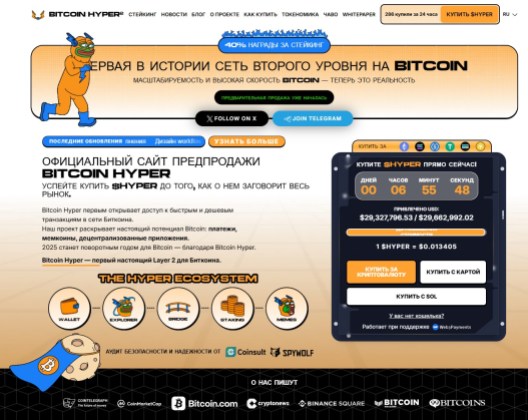
The project's key message is formulated very directly: "the first Bitcoin Layer 2 with SVM integration," which aims for ultra-low execution latency. This is important for a very practical reason: without fast smart contracts, the Bitcoin economy almost inevitably leaks to other ecosystems — to places where you can do swaps, lending, staking, and more complex strategies without waiting for blocks and without the pain of fees. And if the next market cycle is indeed about utility, then infrastructure often wins over noise — a boring thought, but a working one (and traders who track such shifts usually notice it first).

Interest in the story is also fueled by presale numbers: the project has already raised $29,556,732.75, with a token price of $0.013435. This is not a guarantee of success — it's just a marker of demand. The activity of large wallets also looks interesting: whale tracking has spotted two notable purchases totaling about $396k, with the largest transaction being approximately $53k from November 19, 2025.

The final touch is the staking mechanics after TGE: a high APY is announced (without disclosing the rate), instant launch, a 7-day vesting period for presale stakers, and a focus on rewards for community participation. The risk here is obvious: without specific yield parameters, the market will demand transparency, otherwise expectations can easily turn into disappointment. This is not a "project minus," but rather a test of communication maturity — how prepared the Bitcoin Hyper team is to disclose details on time.


Preguntas relacionadas

QWhat is the main reason for the recent decline in Bitcoin's price below $90,000?

AThe decline is due to a shift in market sentiment from 'eternal growth' to 'all is lost,' driven by reduced risk appetite among investors. They were spooked by signals that the boom in AI spending might generate profits slower than expected, leading to renewed pressure on risky assets.

QWho is promoting the $10,000 Bitcoin price target and what is their reasoning?

AMike McGlone from Bloomberg Intelligence is promoting the $10,000 Bitcoin price target. He links the risk of a deep decline to a deflationary scenario following a period of inflation, suggesting that the market could aggressively overcorrect downward when the cycle turns, just as it overcorrected upward.

QWhat is Bitcoin Hyper and what problem does it aim to solve?

ABitcoin Hyper is a Bitcoin Layer 2 solution that aims to address the UX pain points of high fees, limited throughput, and near-zero native programmability on the Bitcoin network. It provides a fast execution layer with Solana Virtual Machine (SVM) integration to enable speed, low fees, and programmable functionality like DeFi, NFTs, and dApps without sacrificing trust in Bitcoin.

QHow much funding has Bitcoin Hyper raised in its presale and what is the current price of its token?

ABitcoin Hyper has raised $29,556,732.75 in its presale, and the current token price is $0.013435.

QWhat is the key message of the Bitcoin Hyper project and why is it significant?

AThe key message of Bitcoin Hyper is that it is 'the first Bitcoin Layer 2 with SVM integration,' targeting ultra-low execution latency. This is significant because without fast smart contract capabilities, Bitcoin's economy risks leaking to other ecosystems that offer faster transactions, lower fees, and more complex financial strategies, making this infrastructure crucial for Bitcoin's utility in the next market cycle.

Lecturas Relacionadas

$292 Million KelpDAO Cross-Chain Bridge Hack: Who Should Foot the Bill?

On April 18, 2026, an attacker stole 116,500 rsETH (worth ~$292M) from KelpDAO’s cross-chain bridge in 46 minutes—the largest DeFi exploit of 2026. The stolen assets were deposited into Aave V3 as collateral, causing $177–200M in bad debt and triggering a cascade of losses across nine DeFi protocols. Aave’s TVL dropped by ~$6B overnight. This legal analysis argues that KelpDAO and LayerZero Labs share concurrent liability, with fault apportioned 60%/40%. KelpDAO negligently configured its bridge with a 1-of-1 decentralized verifier network (DVN)—a single point of failure—despite LayerZero’s explicit recommendation of a 2-of-3 setup. LayerZero, which operated the compromised DVN, failed to secure its RPC infrastructure against a known poisoning attack vector. Both protocols’ terms of service cap liability at $200 (KelpDAO) or $50 (LayerZero), but these limits are likely unenforceable due to unconscionability, gross negligence exceptions, and potential securities law invalidation (if rsETH is deemed a security under the Howey test). Aave’s governance also faces fiduciary duty claims for raising rsETH’s loan-to-value ratio to 93%—far above competitors’ 72–75%—without adequately assessing bridge risks, amplifying the systemic fallout. Practical recovery targets include LayerZero Labs (a registered Canadian entity), KelpDAO’s founders, auditors, and identifiable Aave governance delegates. The incident underscores escalating legal risks for DeFi protocols, infrastructure providers, and governance participants.

marsbitHace 23 min(s)

$292 Million KelpDAO Cross-Chain Bridge Hack: Who Should Foot the Bill?

marsbitHace 23 min(s)

Insider Trading in War: 5 People Involved, the Highest Earner Was Arrested

On April 24, the U.S. Department of Justice arrested U.S. Army Special Forces Staff Sergeant Gannon Ken Van Dyke for insider trading related to the capture of Venezuelan President Nicolás Maduro on January 3. Van Dyke allegedly profited over $400,000 by placing bets on a prediction market, Polymarket, using insider knowledge of the covert operation. According to the indictment, Van Dyke registered an account (0x31a5) on December 26 and made a series of bets predicting Maduro’s capture and U.S. military involvement in Venezuela. He withdrew most of his funds on the day of the operation and attempted to obscure his tracks by transferring assets through crypto and brokerage accounts. This case marks the first time the DOJ has prosecuted insider trading on Polymarket. PolyBeats had previously identified five suspicious accounts, including Van Dyke’s—the highest earner—in January. The other accounts, with profits ranging from $34,000 to $145,000, remain under unofficial scrutiny but have not been charged. Their lower profits, indirect access to information, and unclear legal boundaries may complicate prosecution. Polymarket has since strengthened its market integrity rules, explicitly prohibiting trading based on confidential or insider information. Van Dyke’s arrest, nearly four months after his trades, signals increased regulatory attention and the persistent traceability of blockchain-based transactions.

marsbitHace 25 min(s)

Insider Trading in War: 5 People Involved, the Highest Earner Was Arrested

marsbitHace 25 min(s)

Bitwise: Bullish on Bitcoin's Performance in the Second Half of the Year, AI and Regulation Will Spark a New Altcoin Season

Bitwise CIO Matt Hougan and Research Lead Ryan Rasmussen express strong bullish sentiment on Bitcoin's long-term prospects, suggesting that its $1 million price target may be too conservative. They argue Bitcoin serves a dual role: as digital gold and a potential global settlement asset, especially amid declining trust in traditional monetary systems. Despite a weak Q1 2026 where nearly all crypto assets and prices saw double-digit declines, the analysts remain optimistic due to strong forward-looking catalysts, including institutional adoption via Bitcoin ETFs from major firms like Morgan Stanley and Goldman Sachs. Geopolitical instability, such as Iran’s mention of using Bitcoin for international payments, increases the value of Bitcoin’s “out-of-the-money call option” as a non-political, global settlement currency. This enhances its appeal beyond a mere store of value. . Additionally, Hougan highlights that a clearer regulatory token framework under current SEC leadership, combined with AI efficiency gains and high-performance blockchains, could fuel a new “altseason” by late 2026. This may lead to a wave of legitimate, value-capturing token projects, unlike the earlier ICO boom. . Bitwise also announced an Avalanche ETF, citing its unique architecture and rapid growth in real-world asset (RWA) tokenization, which has surged 10x to nearly $30 billion in two years. The firm believes Layer 1 blockchains are still early in their growth cycle, with significant potential ahead.

marsbitHace 1 hora(s)

Bitwise: Bullish on Bitcoin's Performance in the Second Half of the Year, AI and Regulation Will Spark a New Altcoin Season

marsbitHace 1 hora(s)

Trading

Spot
Futuros

Artículos destacados

Cómo comprar CFG

¡Bienvenido a HTX.com! Hemos hecho que comprar Centrifuge (CFG) sea simple y conveniente. Sigue nuestra guía paso a paso para iniciar tu viaje de criptos.Paso 1: crea tu cuenta HTXUtiliza tu correo electrónico o número de teléfono para registrarte y obtener una cuenta gratuita en HTX. Experimenta un proceso de registro sin complicaciones y desbloquea todas las funciones.Obtener mi cuentaPaso 2: ve a Comprar cripto y elige tu método de pagoTarjeta de crédito/débito: usa tu Visa o Mastercard para comprar Centrifuge (CFG) al instante.Saldo: utiliza fondos del saldo de tu cuenta HTX para tradear sin problemas.Terceros: hemos agregado métodos de pago populares como Google Pay y Apple Pay para mejorar la comodidad.P2P: tradear directamente con otros usuarios en HTX.Over-the-Counter (OTC): ofrecemos servicios personalizados y tipos de cambio competitivos para los traders.Paso 3: guarda tu Centrifuge (CFG)Después de comprar tu Centrifuge (CFG), guárdalo en tu cuenta HTX. Alternativamente, puedes enviarlo a otro lugar mediante transferencia blockchain o utilizarlo para tradear otras criptomonedas.Paso 4: tradear Centrifuge (CFG)Tradear fácilmente con Centrifuge (CFG) en HTX's mercado spot. Simplemente accede a tu cuenta, selecciona tu par de trading, ejecuta tus trades y monitorea en tiempo real. Ofrecemos una experiencia fácil de usar tanto para principiantes como para traders experimentados.

278 Vistas totalesPublicado en 2026.03.19Actualizado en 2026.03.19

Cómo comprar CFG

Qué es WL

I. Introducción al ProyectoWorldLand es una L2 o cadena lateral de Ethereum, diseñada como una solución de abajo hacia arriba para mejorar el ecosistema de Ethereum.II. Información del Token1) Información BásicaNombre del token: WL (WorldLand)III. Enlaces RelacionadosSitio web:https://worldland.foundation/Exploradores:https://bscscan.com/address/0x8aaB31fbc69C92fa53f600910Cf0f215531F8239Redes Sociales:https://x.com/WorldLand_space Nota: La introducción del proyecto proviene de los materiales publicados o proporcionados por el equipo oficial del proyecto, que es solo para referencia y no constituye asesoramiento de inversión. HTX no se hace responsable de ninguna pérdida directa o indirecta resultante.

134 Vistas totalesPublicado en 2026.03.28Actualizado en 2026.03.28

Qué es WL

Cómo comprar WL

¡Bienvenido a HTX.com! Hemos hecho que comprar WorldLand (WL) sea simple y conveniente. Sigue nuestra guía paso a paso para iniciar tu viaje de criptos.Paso 1: crea tu cuenta HTXUtiliza tu correo electrónico o número de teléfono para registrarte y obtener una cuenta gratuita en HTX. Experimenta un proceso de registro sin complicaciones y desbloquea todas las funciones.Obtener mi cuentaPaso 2: ve a Comprar cripto y elige tu método de pagoTarjeta de crédito/débito: usa tu Visa o Mastercard para comprar WorldLand (WL) al instante.Saldo: utiliza fondos del saldo de tu cuenta HTX para tradear sin problemas.Terceros: hemos agregado métodos de pago populares como Google Pay y Apple Pay para mejorar la comodidad.P2P: tradear directamente con otros usuarios en HTX.Over-the-Counter (OTC): ofrecemos servicios personalizados y tipos de cambio competitivos para los traders.Paso 3: guarda tu WorldLand (WL)Después de comprar tu WorldLand (WL), guárdalo en tu cuenta HTX. Alternativamente, puedes enviarlo a otro lugar mediante transferencia blockchain o utilizarlo para tradear otras criptomonedas.Paso 4: tradear WorldLand (WL)Tradear fácilmente con WorldLand (WL) en HTX's mercado spot. Simplemente accede a tu cuenta, selecciona tu par de trading, ejecuta tus trades y monitorea en tiempo real. Ofrecemos una experiencia fácil de usar tanto para principiantes como para traders experimentados.

223 Vistas totalesPublicado en 2026.03.28Actualizado en 2026.03.28

Cómo comprar WL

Discusiones

Bienvenido a la comunidad de HTX. Aquí puedes mantenerte informado sobre los últimos desarrollos de la plataforma y acceder a análisis profesionales del mercado. A continuación se presentan las opiniones de los usuarios sobre el precio de A (A).

活动图片