Every Vote on the CLARITY Act Will Be Scored: 3 Million Crypto Supporters Want Senators to Vote 'Yes'

cryptonews.ruPublicado a 2026-07-27Actualizado a 2026-07-27

Resumen

The advocacy group Stand With Crypto announced it will track and publicize U.S. senators' votes on the CLARITY Act, incorporating them into public legislator scorecards for its 3 million members to use ahead of the November elections. The group is urging a "yes" vote, stating the bill has mobilized cryptocurrency owners who seek regulatory clarity. Their pre-election survey indicates nearly 80% of crypto owners are highly likely to vote, with 70% saying a candidate's crypto stance influences their choice, and 59% identifying as swing voters—potentially making the issue decisive in tight races. The bill, which passed the Senate Banking Committee in May, now awaits a full Senate vote. However, its path is uncertain, with Galaxy Research lowering its 2026 passage odds to 30% due to timing, bipartisan support challenges, and unresolved provisions on ethics and consumer protection.

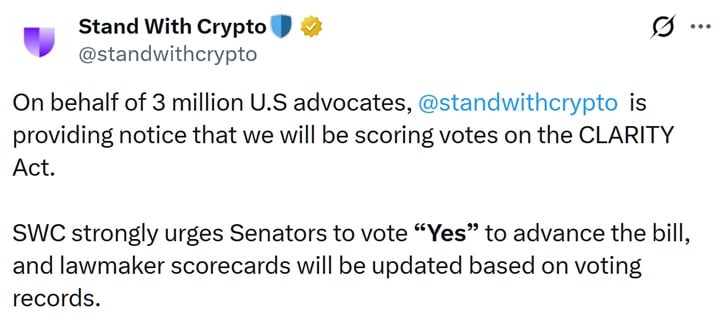
Stand With Crypto, an American cryptocurrency community advocacy organization, announced on X on July 27 that senators' votes on the CLARITY Act bill will be recorded in its public ratings on behalf of 3 million American crypto supporters.

The organization stated that each senator's vote will become part of its public legislator ratings, which cryptocurrency owners can use to compare candidates ahead of the November elections. It also urged lawmakers to vote 'yes' on this bill.
"The CLARITY Act has mobilized millions of cryptocurrency owners who eagerly await the passage of market structure legislation that will provide certainty regarding the technology they rely on," added Stand With Crypto, noting:

"Cryptocurrency-owning voters across the country are watching to see which legislators stand with them at this critical moment."

The updated ratings will record whether each senator supported advancing the bill; the vote on the CLARITY Act will be added to Stand With Crypto's existing ratings based on lawmakers' actions and public stances on cryptocurrency. The CLARITY Act vote will be one of the most prominent positions in these ratings ahead of the November midterm elections.

The organization has expanded its midterm-focused campaign, placing its scoring system at the center of efforts to transform cryptocurrency policy positions into voter-focused political achievements.

Public Scorecards Put Senators' Votes in the Spotlight

With less than 100 days until the midterm elections, Stand With Crypto's report on pre-midterm voter sentiment showed that nearly eight in ten cryptocurrency owners believe they will almost certainly vote.

Nearly 70% indicated that a candidate's stance on cryptocurrency would influence their choice, while 73% were closely following the digital asset policies legislators supported. Another 59% identified themselves as voters who do not consistently support one party, potentially giving cryptocurrency policy greater significance in tight congressional election races.

These findings reinforce the potential impact of the scorecards, especially in competitive races where politically unaffiliated cryptocurrency owners can compare candidates using their recorded positions on the CLARITY Act.

The campaign is taking place during the two-week legislative window before the August recess, with ethics provisions regarding public officials remaining a central issue in negotiations between lawmakers. Several Democratic lawmakers are pushing for stricter ethics measures and consumer protections, complicating vote counting as supporters need to secure the 60 senator votes typically required to advance a bill.

Galaxy Research lowered its assessment of the likelihood of the CLARITY Act passing in 2026 to 30%, as the Senate vote faces challenges related to timing, bipartisan support, and unresolved provisions.

Next Stage: Senate Floor

On May 14, the Senate Committee on Banking, Housing, and Urban Affairs approved the revised market structure bill with a vote of 15 to 9, sending it to the full Senate for consideration. This bipartisan committee vote reflected the outcomes of negotiations on federal oversight, investor protection, enforcement authority, and operational requirements for digital asset companies. The bill now awaits a full Senate vote.

Under the proposed framework, federal regulators would receive clearly defined authority over various digital assets, and exchanges and intermediaries would be required to comply with registration, disclosure, and customer protection requirements.

For senators, the upcoming vote carries two significant implications: it will determine whether the bill moves forward, and it will establish a result that Stand With Crypto will present to millions of supporters.


Preguntas relacionadas

QWhat is the main purpose of the organization Stand With Crypto's announcement regarding the CLARITY Act?

AThe main purpose is to announce that each U.S. Senator's vote on the CLARITY Act will be recorded in their public legislator scorecards, representing 3 million American crypto supporters, to help voters compare candidates ahead of the November elections.

QAccording to Stand With Crypto's pre-midterm report, what percentage of crypto owners are 'almost certain' they will vote, and why does their vote matter for tight races?

ANearly eight in ten (almost 80%) crypto owners are almost certain they will vote. Their vote matters because 59% identify as non-straight-ticket voters, meaning crypto policy positions could significantly influence their choice in competitive congressional races.

QWhat was the outcome of the CLARITY Act vote in the Senate Banking Committee, and what is the next step for the bill?

AThe Senate Banking Committee approved the amended market structure bill with a 15-9 vote, sending it to the full Senate. The next step is a floor vote in the full Senate.

QHow does Galaxy Research currently assess the likelihood of the CLARITY Act passing in 2026, and why?

AGalaxy Research has lowered its assessment of the bill's chances of passing in 2026 to 30%. This is due to challenges with timing, securing bipartisan support, and unresolved provisions related to ethics and consumer protection.

QWhat are two key implications of the upcoming Senate floor vote on the CLARITY Act for senators, according to the article?

AFor senators, the upcoming vote has two key implications: 1) It will determine whether the bill moves forward in the legislative process. 2) It will establish a result that Stand With Crypto will present to its millions of supporters as part of their public scorecards.

Lecturas Relacionadas

Bitcoin Withdrawals Continue: 8 Years of Storage in a Coldcard Cold Wallet Ended in Zero

Coldcard Hardware Wallet Hacked: Losses Mount Due to Vulnerable Seed Generation A critical vulnerability in Coldcard hardware wallets has led to a continued wave of fund thefts. According to Galaxy Research, the total stolen has reached 1,367.05 BTC (approx. $88.6 million) from 4,585 addresses, a significant increase from the initial 594.5 BTC reported on July 30, 2026. Most of the stolen funds remain on the attackers' addresses. The issue is not with the current firmware, which Coinkite has updated, but with seed phrases generated on vulnerable devices between March 2021 and the release of fixed firmware versions. Due to a programmer error, devices switched from using a hardware random number generator to the software-based Yasmarang generator, which was initialized with publicly accessible data like the chip's serial number. This made the seed phrases predictable through offline brute-force attacks, meaning wallets remain at risk until funds are moved to a new wallet generated with the patched firmware. Affected devices include Mk2/Mk3 with firmware 4.0.1–4.1.9 (and up to 5.0.3), Mk4/Mk5 up to version 5.6.0, and Q models up to 1.5.0Q. The only exceptions are seeds created with a high-entropy method like at least 50 independent dice rolls or a strong unique BIP-39 passphrase. All other owners must generate a new seed on the fixed firmware and transfer their assets. A case highlighting the human impact involves a 39-year-old long-term investor who lost 2 BTC (approx. $130,000) in minutes. He had accumulated the Bitcoin over eight years through physical labor, viewing it as a financial lifeline and a retirement plan in a country suffering from hyperinflation. His story underscores that even conservative "buy and hold in cold storage" strategies can be compromised by such underlying technical flaws. From a technical perspective, this incident echoes historical failures where weak random number generators undermined cryptographic security, challenging the assumption that offline storage is automatically foolproof.

cryptonews.ruHace 2 hora(s)

Bitcoin Withdrawals Continue: 8 Years of Storage in a Coldcard Cold Wallet Ended in Zero

cryptonews.ruHace 2 hora(s)

Trading

Spot
活动图片




