Even Facing Gunshots and Jail, Why Do Small-Town Americans Still Oppose AI Data Centers?

marsbitPublicado a 2026-04-14Actualizado a 2026-04-14

Resumen

Residents in small American towns are fiercely opposing AI data center projects, even resorting to extreme measures like shooting at officials' homes. The backlash is driven by concerns over massive resource consumption, lack of transparency, and disproportionate economic impact. For instance, Festus, Missouri, voted to recall half its city council after approving a $6 billion project without public hearings. A single data center can consume 3.6 times more electricity and significant water compared to a small city’s residential use, threatening local resources. Organized opposition groups have grown from 142 to 188 in a year, halting or delaying projects worth $162 billion. The bottleneck for AI expansion is shifting from power contracts to local politics, where grassroots resistance is intensifying.

On April 7, voters in Festus, Missouri, ousted four out of eight city council members in a single recall election. The trigger was the council's approval of a $6 billion AI data center project in late March by a 6-2 vote. The project, led by CRG, the data center development arm of Clayco, spans 360 acres, with the end customer being an undisclosed Fortune 100 company (codenamed Project Cumulus).

The council approved it without holding public hearings. Subsequently, the local resident group Wake Up JeffCo sued the city government and CRG in St. Louis County Court, and a petition to recall the mayor has also been initiated. According to a summary by Tom's Hardware, around the same time, the home of Indianapolis city councilor Ron Gibson was shot at with over a dozen bullets at the end of 2025, with a note left at the doorstep saying, "No Data Centers."

Festus is not an isolated case. Not long ago, Indianapolis city councilor Ron Gibson's home was hit by 13 shots in the middle of the night, waking his 8-year-old son. A handwritten note was left at the door: "No data centers." The FBI has launched an investigation. Jordyn Abrams, a researcher at George Washington University's Program on Extremism, pointed out that data centers are becoming targets for anti-tech, anti-government extremists.

Advocacy group Data Center Watch, in its Q2 2025 report, updated the number of organized opposition groups from 142 (across 24 states) a year ago to 188 (across 40 states). The value of projects halted or delayed increased from $64 billion to $162 billion. On April 1, 2026, Port Washington, Wisconsin, passed the nation's first referendum explicitly targeting data centers, with 66% of voters approving a mandatory referendum threshold for TIF subsidies exceeding $10 million.

These events collectively answer the same question: Could the real bottleneck in AI capacity expansion be stuck at the county and city ballot box?

Widespread Backlash

Plotting events from the past 23 months on a U.S. map reveals two levels of backlash. One is at the state level, where eight states have submitted or passed data center moratorium bills, including Maine (passed the House 82-62, lasting until 2027), Vermont (paused until July 2030), Virginia (submitted by Democratic Representative Irene Shin, paused until 2028), Georgia, Maryland, South Dakota, Wisconsin, and Minnesota. This layer involves legislative action, with the broadest impact but the slowest progress.
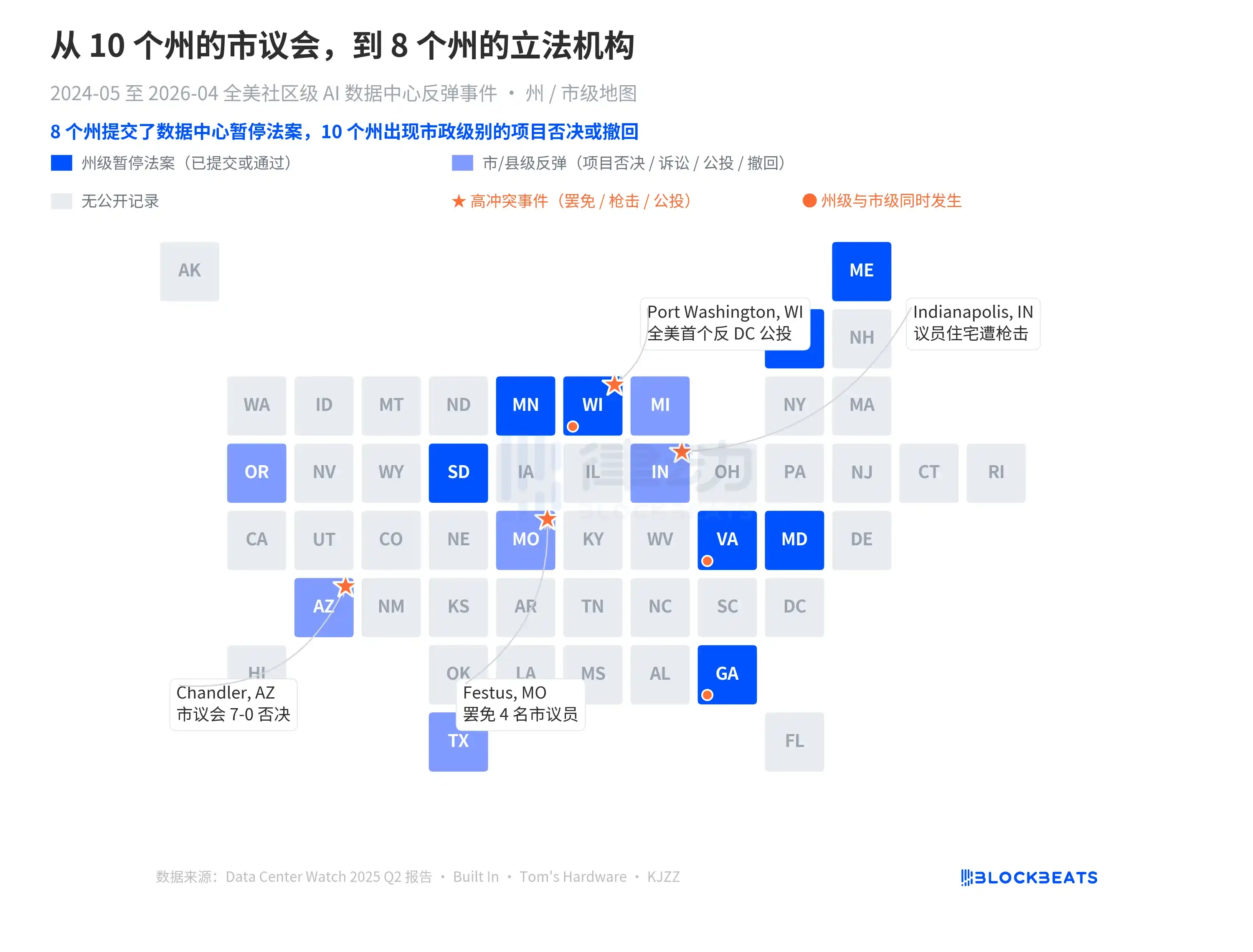
The other is at the city and county level, where backlash is denser and more intense. The Chandler, Arizona city council unanimously rejected Active Infrastructure's $2.5 billion project in December 2025 (lobbied by former federal senator Kyrsten Sinema). The Tucson city council is currently reviewing data center zoning restrictions in April 2026, with public comment open until the end of the month. Hays County / San Marcos, Texas, rejected a $1.5 billion project by a 5-2 vote. Oregon's Cascade Locks, Indiana's Chesterton, Virginia's Catlett Station, Missouri's Peculiar, Michigan's Lansing. According to Data Center Watch, at least 10 states have seen direct municipal rejections or developer withdrawals.

More than half of the high-conflict incidents are concentrated in the Midwest and Midsouth. This region has relatively ample grid capacity over the past decade and was a hotspot for the previous wave of data center expansion. The backlash now focused in the same area, from another perspective, is the supply side spreading from "states with power surplus" and hitting the most sensitive layer of local politics.

$6 Billion Is Not on the Same Scale

Festus's fiscal scale means the $6 billion figure simply cannot be processed normally by the city council. According to local newspaper myleaderpaper citing municipal budget documents, Festus's FY2025 general fund plus public safety operating budget is $17.64 million, FY2024 total municipal expenditure was $37.41 million, and reserve funds at the end of FY2025 are projected at $28.09 million.

The data center project's $6 billion is about 340 times the annual operating budget, or $450,000 per resident for the city's 13,200 people. In relative terms, this is not a local development project to be discussed, but a small town being plugged into a capital pipeline completely unrelated to itself.
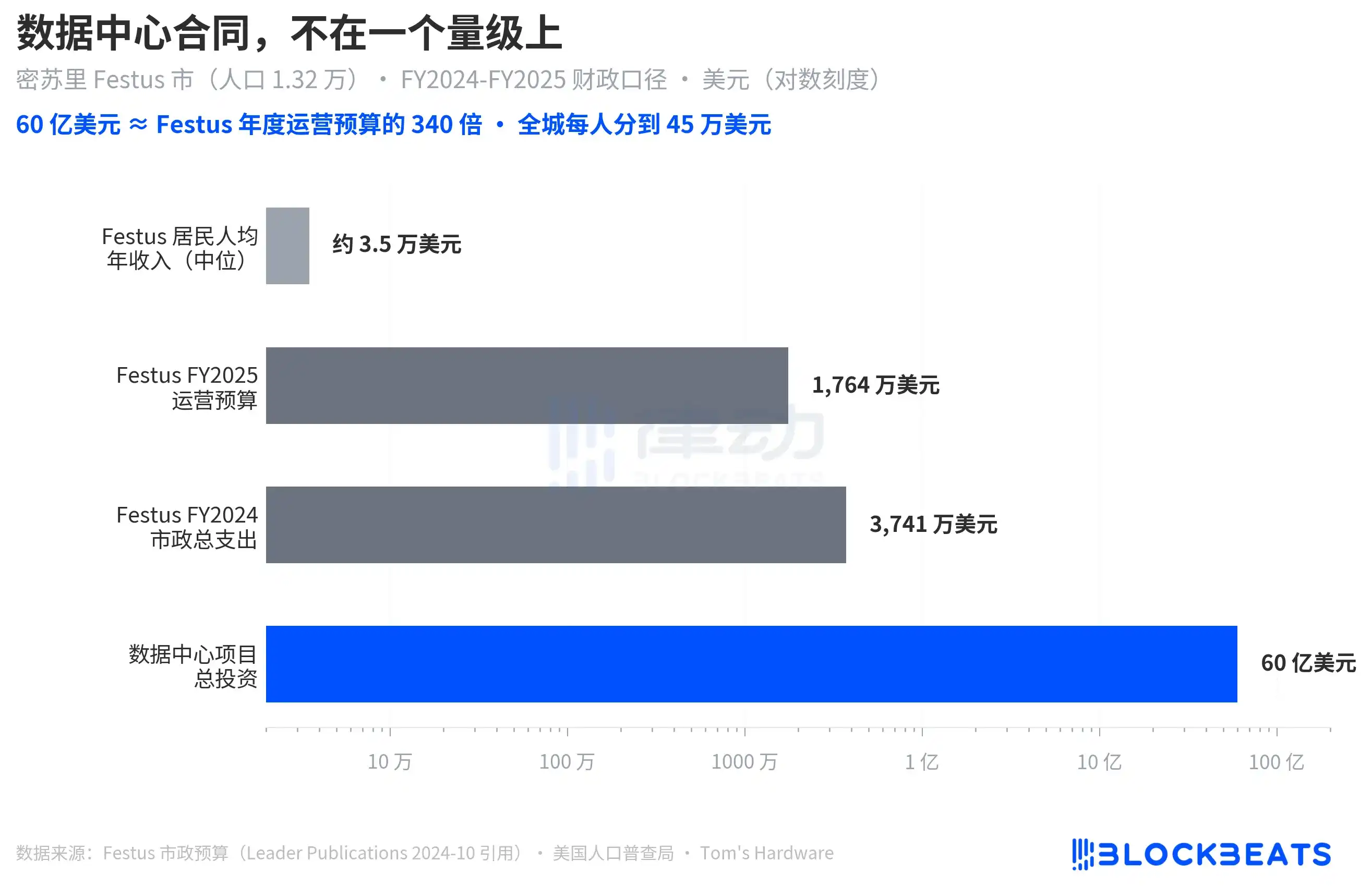
Comparing it to Festus residents' median annual income—about $35,000 in Missouri non-metro areas—makes the issue clearer. Any decimal point in the data center contract is larger than the entire community's lifetime per capita disposable income. Local officials lack experience in balancing such numbers procedurally. The Festus council resolution was criticized for "not holding public hearings" technically because such projects typically operate under commercial confidentiality clauses (developer and end customer identities undisclosed), making normal council procedures unable to review confidential contracts. This is a structural loophole, not negligence by individual council members.

Precisely because of the scale gap, breaking down the data center contract into manageable pieces for local councils is inherently unworkable. This is why, over the past 12 months, the backlash path hasn't been internal resolution but external weapons: recall, litigation, and referendum. Festus's recall of four council members, simultaneous lawsuit by residents in St. Louis County Court, and initiation of a mayor recall petition are a rare case of all three paths triggering at once.

One Data Center, Consuming a Small Town

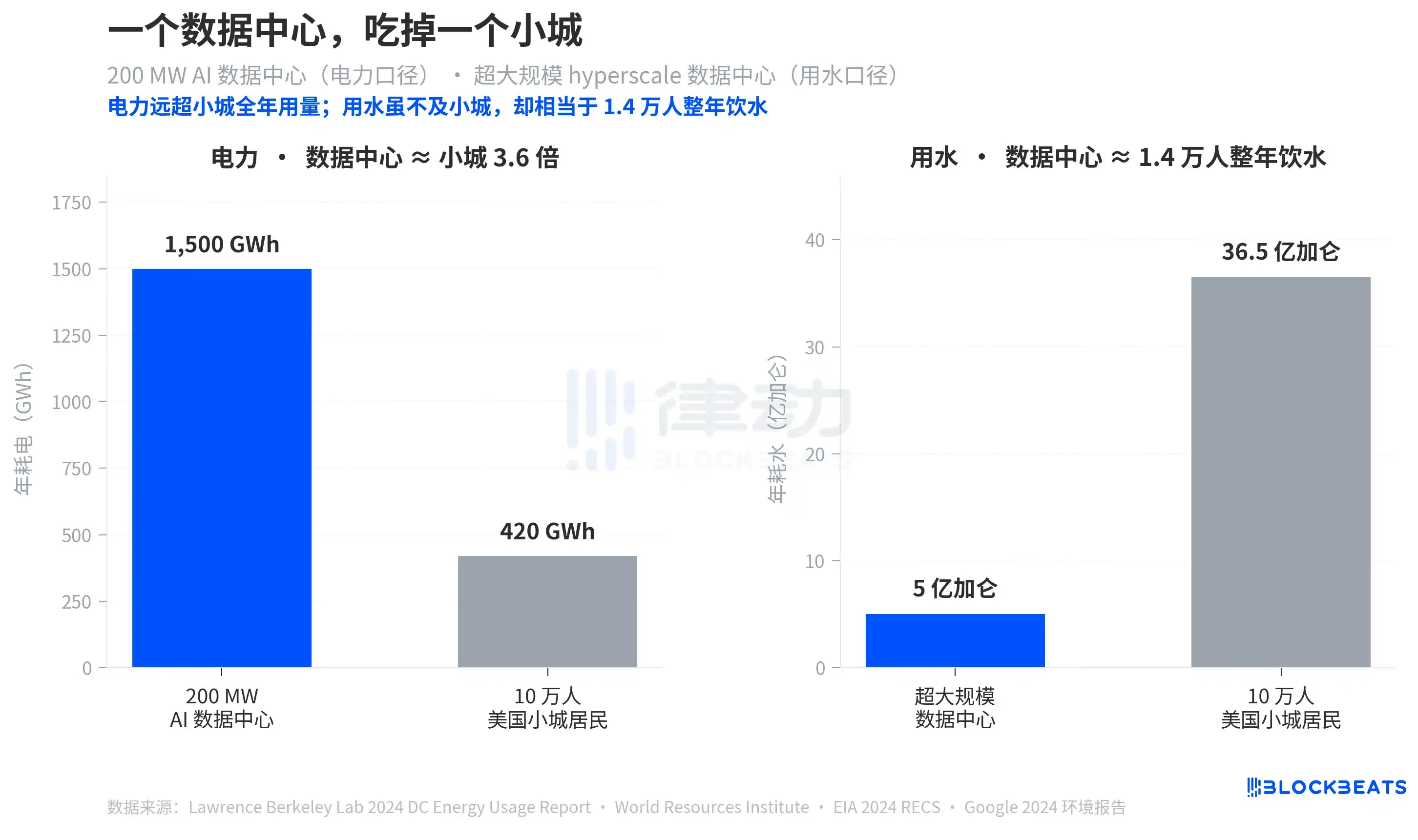
The power consumption of an AI data center is best felt using a small U.S. town for comparison. A fully loaded 200 MW AI data center, at 86% load factor, consumes about 1,500 GWh annually. A 100,000-person small U.S. town's residential electricity consumption is about 420 GWh per year (based on EIA's average residential electricity use of 10.5 MWh per household, 2.5 persons per household). The data center uses 3.6 times the electricity of the town's residents. And this is just electricity, not counting cooling and ancillary water use.

The water comparison is reversed but even more直观. According to USGS typical residential water use (100 gallons per person per day), a 100,000-person town uses about 3.65 billion gallons annually. A hyperscale AI data center, per Google's Council Bluffs (the largest Google data center in the U.S.), uses 500 million gallons per year. In absolute terms, the data center uses 13.7% of the town's water, but on another scale, it's equivalent to the annual drinking water for 14,000 people. For a town with 10,000 to 50,000 residents, it means ceding a substantial portion of the city's water supply to one user. According to Lawrence Berkeley Lab's 2024 data center energy report, U.S. data centers used 17 billion gallons directly for cooling in 2023, and 211 billion gallons indirectly (for power generation), with direct water use expected to double or quadruple by 2028.
The most common protest cry is "our wells will run dry." Numerically, this is not an emotional expression. In Loudoun County, Virginia (the most data center-dense county in the U.S.), potential data center water use in 2023 was 899 million gallons, about 10% of the county's total water use, according to local water data cited by Sierra Club and Grist. If this is the case at the county level, the numbers for towns will only be more extreme.

Planned Capacity Entering the Backlash Window

Actually operational U.S. data center capacity, per FERC and Wood Mackenzie Q4 2025 data, is about 50 GW. The planned pipeline totals 241 GW, with 33% (about 80 GW) in active development and the remaining 67% (about 161 GW) not yet started. BloombergNEF predicts the U.S. will add 97 GW from 2025 to 2030, with data center electricity peak reaching 106 GW by 2035. All these numbers point to one fact: the vast majority of capacity is still on drawing boards, not yet落地.
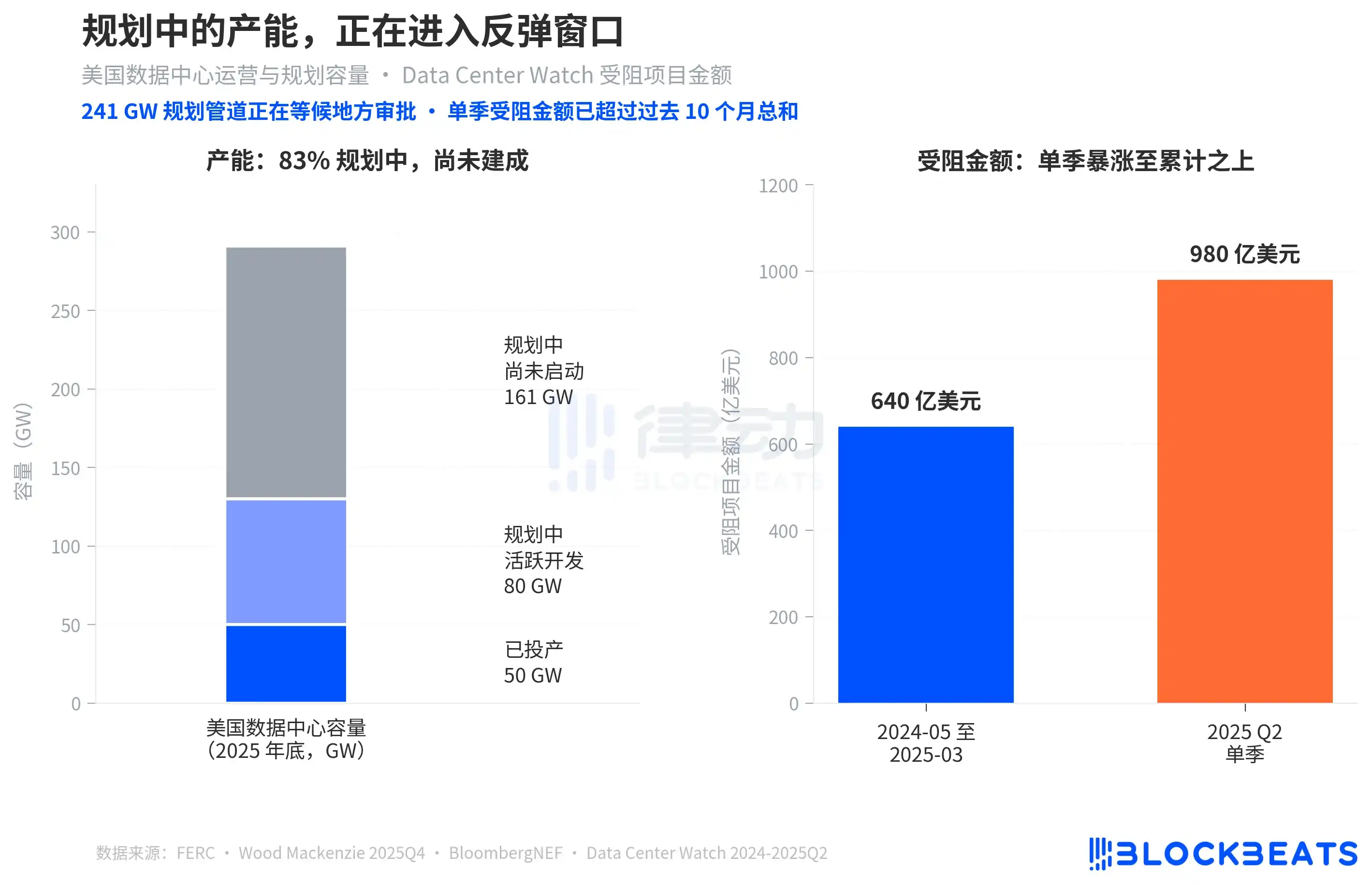
According to data disclosed by Sightline Climate via TechRadar, 30% to 50% of the 16 GW originally planned for 2026 commissioning is expected to be canceled or delayed. Meanwhile, Data Center Watch data shows that from May 2024 to March 2025, organized opposition blocked or delayed $64 billion in data center projects. In Q2 2025 alone, this figure was $98 billion, corresponding to 20 projects. The quarterly受阻 amount already exceeds the cumulative total of the previous 10 months.

This creates a timing mismatch. Capital has committed to multiplying U.S. data center capacity several times over the next five years, but新增 capacity must pass through county and city approvals one by one. The more planned capacity, the larger the surface area vulnerable to backlash. Cases like Festus escalating from council vote to recall and lawsuit in a month are not because it's special, but because the number of opposition groups increased by 46 in a year (per Data Center Watch Q2 2025 report), and they share templated legal tools跨州, including TIF subsidy referendums, zoning lawsuits, and councilor recall petitions. Whether the long-term power contracts signed by frontier labs will be fulfilled depends on which counties they land in and what kind of residents are watching those counties' councils.

The bottleneck in AI capacity expansion has, for the first time, jumped outside the power contract negotiation table and appeared on the recall ballots of 13,200 people.


Preguntas relacionadas

QWhy did the residents of Festus, Missouri, vote to recall four city council members?

AThe residents voted to recall four city council members because the council approved a $6 billion AI data center project without holding a public hearing, which was seen as a lack of transparency and disregard for community input.

QWhat are the primary concerns driving the organized opposition to AI data centers in small towns?

AThe primary concerns include the massive consumption of local resources, such as electricity and water, which can dwarf the usage of entire small towns, potential environmental impacts like drying up wells, and the lack of democratic process in approving these large-scale projects.

QHow does the scale of a typical AI data center project compare to the budget of a small town like Festus?

AThe $6 billion AI data center project in Festus is approximately 340 times the city's annual operating budget of $17.64 million, highlighting a massive financial disparity that makes it difficult for local governments to manage or negotiate such projects effectively.

QWhat legislative actions have been taken at the state level in response to data center expansion?

AEight states have submitted or passed data center moratorium bills, including Maine (passed by the House until 2027), Vermont (paused until July 2030), Virginia (submitted by a Democratic representative until 2028), Georgia, Maryland, South Dakota, Wisconsin, and Minnesota, aiming to temporarily halt new data center developments.

QWhat is the projected impact of organized opposition on planned data center capacity in the United States?

AOrganized opposition has led to $640 billion in data center projects being blocked or delayed from May 2024 to March 2025, with an additional $980 billion受阻 in Q2 2025 alone. It is estimated that 30% to 50% of the 16 GW of capacity planned for 2026 may be canceled or postponed due to these protests.

Lecturas Relacionadas

The "Impossible Triad" Is Fundamentally a Pseudo-Problem

The article argues that blockchain's fundamental limitation is not the scalability trilemma (decentralization, scalability, security), which has been largely solved, but the lack of **privacy** and, until recently, clear **legitimacy**. Blockchain is described as a slow, expensive, globally shared computer whose core value is censorship resistance and verifiability. While ideal for native digital assets like money (e.g., stablecoins), its default transparency acts as a **tax**, exposing all transactions and enabling MEV extraction, which deters serious institutional capital. Simultaneously, its permissionless nature created regulatory ambiguity. The piece contends that **privacy** is the missing critical feature. It rejects the false choice between total transparency and complete anonymity. Modern cryptography (like zero-knowledge proofs) enables **compliant privacy**: users can prove facts (solvency, KYC status, compliance) without revealing the underlying sensitive data (specific holdings, identities). This preserves auditability for regulators and eliminates the leak of financial information. With recent regulatory progress (e.g., the GENIUS Act) addressing legitimacy, adding default, provably compliant privacy becomes a pure upgrade. It transforms blockchain from a costly, public ledger into a confidential settlement layer, finally bridging the gap to mainstream institutional and individual adoption of on-chain finance.

链捕手Hace 10 hora(s)

The "Impossible Triad" Is Fundamentally a Pseudo-Problem

链捕手Hace 10 hora(s)

Optical Chips: Collective Capacity Expansion

The global optical chip industry is experiencing a massive wave of expansion driven by surging AI data center demand. Major players across the US, Japan, Europe, and China are aggressively investing to ramp up production capacity. In the US, Coherent is expanding its 6-inch Indium Phosphide (InP) semiconductor fab in Texas, supported by CHIPS Act funding and a $2 billion strategic investment from NVIDIA. Lumentum is building a new factory for InP optical devices, and Nokia is scaling its advanced photonic chip packaging and testing capabilities. NVIDIA's investments aim to secure future supply of critical lasers and optical interconnect products for AI infrastructure. Japan's JX Advanced Metals, a leading InP substrate supplier, plans a multi-billion yen investment to increase its capacity 7-10 times, strengthening its grip on the crucial upstream materials market. In Europe, IQE and Tower Semiconductor settled a patent dispute and signed a multi-year InP epitaxial wafer supply agreement, highlighting that next-generation silicon photonics platforms will integrate high-performance InP components. STMicroelectronics and Sivers Semiconductors are also expanding silicon photonics production and partnerships. China is rapidly building out its domestic supply chain. Dongshan Precision's subsidiary, Source Photonics, announced a $12 billion project to expand optical chip and module production. Companies like Sanan Optoelectronics and Yunnan Germanium are scaling up InP chip manufacturing and substrate production, moving towards vertical integration from materials to modules. While debate continues around the exact future architecture—whether CPO (Co-Packaged Optics), NPO, or pluggables will dominate—analysts like Morgan Stanley argue the underlying driver is unchangeable: the explosive growth in bandwidth demand. This will inevitably increase the volume of optical engines, lasers, and related content per GPU, regardless of the final technical path. The competition for "more light" in the AI era has intensified into a global, full-chain capacity race.

marsbitHace 12 hora(s)

Optical Chips: Collective Capacity Expansion

marsbitHace 12 hora(s)

Stablecoins Finally Find Real Yield: An In-Depth Look at On-Chain Reinsurance Re | A Conversation with Re Founder Karan Saroya

Stablecoin Real Yield Found: A Deep Dive into On-Chain Reinsurance with Re's Karan Saroya As stablecoin supply exceeds $170 billion, the search for sustainable, non-speculative yield intensifies. Re, an on-chain reinsurance platform, provides an answer: connecting stablecoin capital to the trillion-dollar traditional reinsurance market. Re operates as a regulated reinsurer, accepting stablecoin deposits as collateral to back US insurance companies. These insurers pay premiums, generating yield that flows back to on-chain depositors. Currently supporting 35 insurers and underwriting $500 million, Re projects scaling to over $1 billion soon. Key insights from a Bankless podcast with founder Karan Saroya and investor Avichal of Electric Capital: 1. **Uncorrelated, Real-World Yield:** Re offers stablecoin holders access to reinsurance returns (targeting 12-14%+), an asset class entirely separate from crypto or equity markets. 2. **Operational Efficiency via Smart Contracts:** Re replaces traditional, labor-intensive capital fundraising with smart contracts, allowing a ~12-person team to compete with industry giants. 3. **Regulatory Leverage:** For every $1 of collateral, regulations allow backing $5-7 in written premiums. This leverage amplifies returns from the underlying risk-free rate. 4. **DeFi Integration:** Depositors receive receipt tokens, which can be used in protocols like Morpho for "looping," potentially pushing yields to 18-20%+. 5. **The "DeFi Mullet" Model:** A compliant front-end (regulated reinsurer) paired with a decentralized back-end (smart contracts, DeFi capital markets). 6. **RE Governance Token:** Modeled on Lloyd's of London, the token governs the central capital pool's allocation, counterparty acceptance, and parameters. 7. **Real Economic Impact:** Capital funds real-world productivity (factories, clinics, businesses) via insurance, moving beyond crypto's internal loops. The discussion highlights a pivotal moment: DeFi's supply-side infrastructure is now met by real demand for productive yield, potentially kickstarting a flywheel where vast on-chain stablecoin capital seeks these real-world returns.

链捕手Hace 13 hora(s)

Stablecoins Finally Find Real Yield: An In-Depth Look at On-Chain Reinsurance Re | A Conversation with Re Founder Karan Saroya

链捕手Hace 13 hora(s)

1996 or 1999? Walsh's First Test is 'How to View AI'

"1996 or 1999? Wall's First Big Test Is 'How to View AI'" Federal Reserve Chairman Wall's initial challenge is not whether to raise or cut rates, but a more fundamental judgment: what kind of boom is the current AI boom? This will determine the Fed's policy path and define his legacy. Economics is split between two opposing views, according to reporter Nick Timiraos. One sees imminent productivity gains that will increase supply and cool inflation, allowing the Fed to hold steady. The other argues that while productivity benefits are distant, demand shocks are here now, and waiting for data confirmation risks missing the intervention window, forcing sharper rate hikes later. Wall has signaled a leaning toward the first view, echoing 1996-era Alan Greenspan, who embraced strong, productivity-driven growth without fear of inflation. However, Wall faces a different macro environment than Greenspan did, with tariff pressures, expanding fiscal deficits, and diminishing globalization benefits, which could force more significant inflation pressures even if AI benefits materialize. Wall's logic, expressed before taking office, is that AI-driven productivity gains won't show in official data for years. If the Fed waits for confirmation, it might mistakenly tighten policy and choke off the very growth that could suppress inflation. This argues for using forward-looking narratives over lagging data. Chicago Fed President Austan Goolsbee presents a key counter-argument. He distinguishes between expected and unexpected productivity booms. A widely anticipated boom, like the current AI wave, can cause people to spend future wealth gains in advance, overheating the economy before productivity actually rises, thus requiring preemptive rate hikes. He cites rising costs for AI data centers as evidence of such overheating. Fed Governor Christopher Waller offers a rebuttal to Goolsbee, noting the "expected spending" mechanism only works if people can borrow against future income, which many households cannot do due to borrowing constraints. Wall also faces a paradox related to his desire to reduce the Fed's use of "forward guidance" (pre-announcing policy moves). This practice was established in 1999 when Greenspan began signaling hikes to avoid market shocks. If the economy follows a less optimistic path, Wall may be forced to choose between using the guidance he wants to abolish or risking market volatility by staying silent. The ultimate question defining Wall's first major test remains: Is this 1996 or 1999?

marsbitHace 15 hora(s)

1996 or 1999? Walsh's First Test is 'How to View AI'

marsbitHace 15 hora(s)

Trading

Spot
Futuros
活动图片