ETHZilla moves into onchain housing finance with 15% Zippy acquisition

cointelegraphPublicado a 2025-12-10Actualizado a 2025-12-10

Resumen

ETHZilla (ETHZ) has acquired a 15% stake in digital housing lender Zippy for $5 million in cash and $16.1 million in stock, marking its second acquisition in a week as part of a broader move into real-world asset (RWA) markets. The partnership aims to integrate Zippy’s loan-origination and AI-powered systems with ETHZilla’s tokenization platform to bring manufactured-home loans onchain. As part of the deal, ETHZilla gains a board seat and a 36-month exclusivity agreement with Zippy. Despite this expansion, ETHZilla’s stock has declined roughly 10% following the announcement, continuing a downward trend seen across several Ether treasury companies amid falling ETH prices.

Former biotech company ETHZilla (ETHZ) is doubling down on its push into real-world asset markets, taking a 15% stake in digital housing lender Zippy to bring manufactured-home loans onchain. The deal marks the company’s second acquisition in a week.

According to Wednesday’s announcement, ETHZilla will pay $5 million in cash and $16.1 million in stock for a 15% stake in Zippy, a US-based lender founded in 2021 that originates manufactured-home loans through a digital platform.

The companies plan to link Zippy’s loan-origination and AI-powered systems with ETHZilla’s tokenization stack for onchain distribution of manufactured-home chattel loans, including potential forward-flow sales to institutional investors.

As part of the transaction, ETHZilla will gain a board seat at Zippy and secure a 36-month exclusivity period requiring Zippy to conduct all blockchain infrastructure, digital asset issuance and tokenization through ETHZilla’s platforms.

ETHZilla, the sixth-largest Ether (ETH) treasury company according to CoinGecko data, said the investment builds on its broader push into real-world asset (RWA) markets.
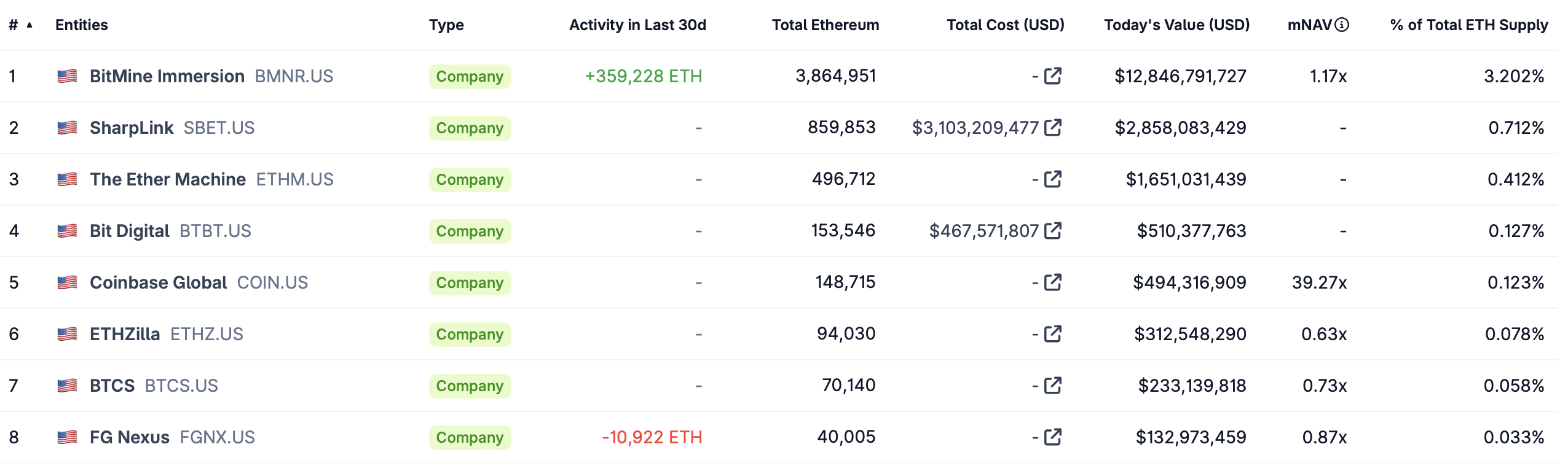
Top Ethereum treasury companies. Source: CoinGecko

The announcement comes one week after ETHZilla acquired a 20% fully diluted stake in auto-finance startup Karus for $10 million in cash and stock.

ETHZilla’s stock price was down around 10% at the time of writing, according to Yahoo Finance data.
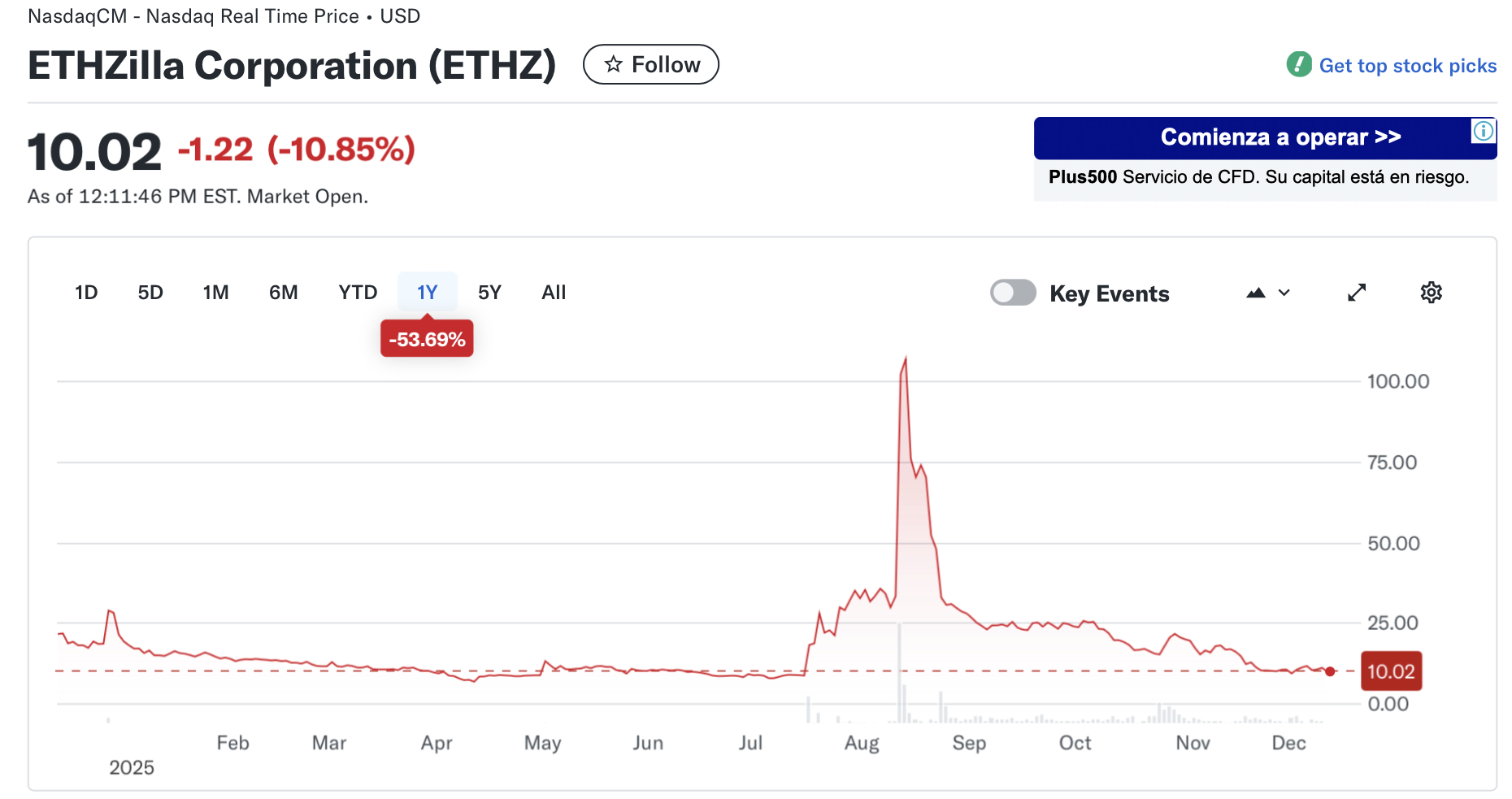
Source: Yahoo Finance

Related: Ethereum rising to $3.3K proves bottom is in: Is 100% ETH rally next?

Ether treasury stocks face steep declines

Several public companies that adopted Ether as a balance-sheet asset this year have seen sharp share-price reversals as the token price has fallen from its peak, ETHZilla among them.

ETHZilla, formerly 180 Life Sciences Corp, announced its pivot to an Ether treasury company on July 29. Its stock climbed from a $45 open that day to a $107 close by Aug. 13. However, the stock has declined roughly 91% since then, trading around $10 at this writing.

SharpLink Gaming launched an Ethereum treasury strategy in May, alongside a $425 million private placement that included Consensys as an investor and coincided with the nomination of Ethereum co-founder Joseph Lubin as chairman.

The company’s stock climbed more than 130% on the news to $79.21 on May 29, but has since dropped sharply to trade around $11.77 on Wednesday, according to Yahoo Finance data.
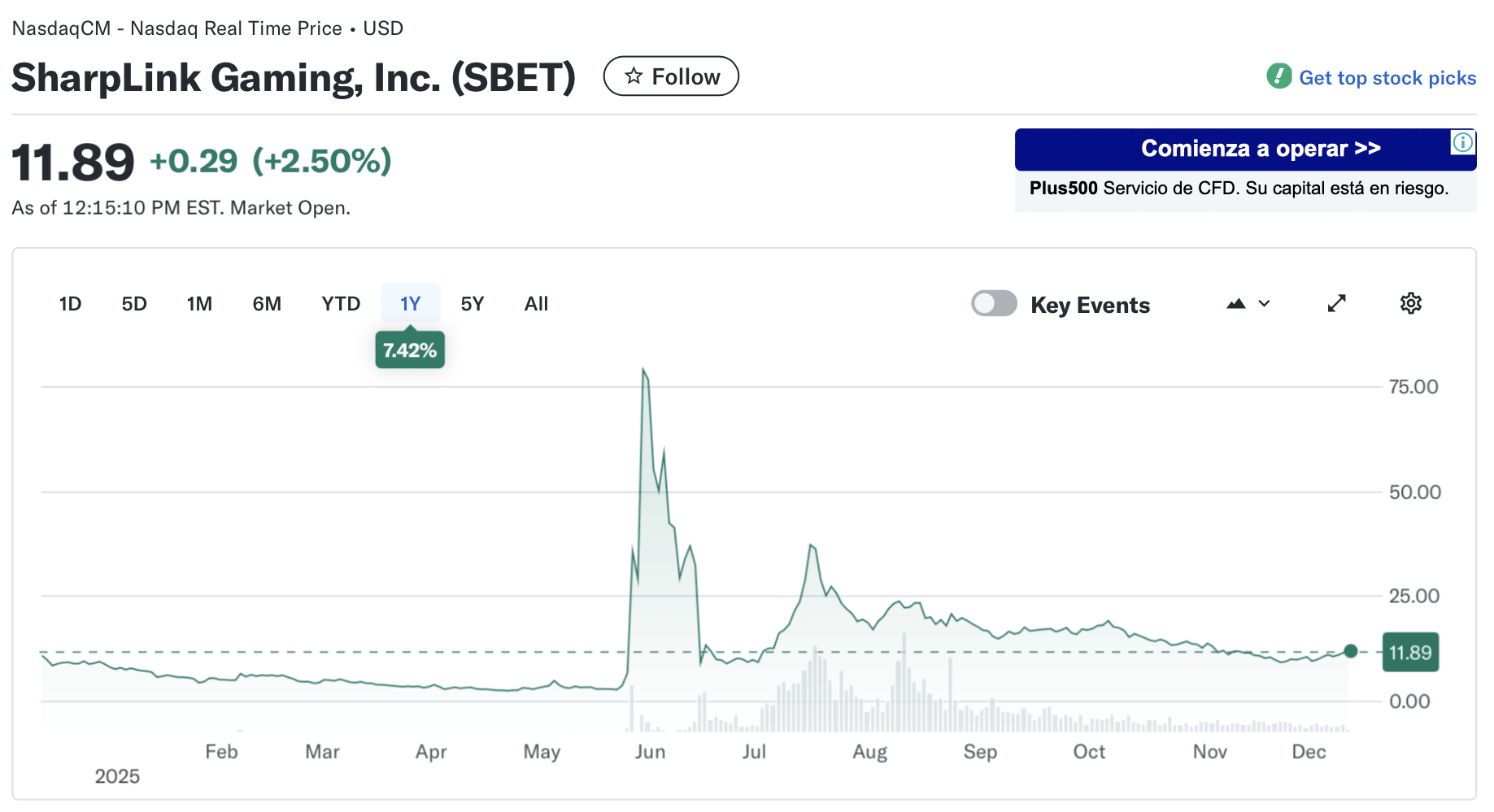
Source: Yahoo Finance

Bitmine Immersion, an Ether treasury company led by Fundstrat’s co-founder Tom Lee, has also struggled in recent months. Its stock hit an all-time high of $135 in July, but has since fallen to around $40 at this writing.
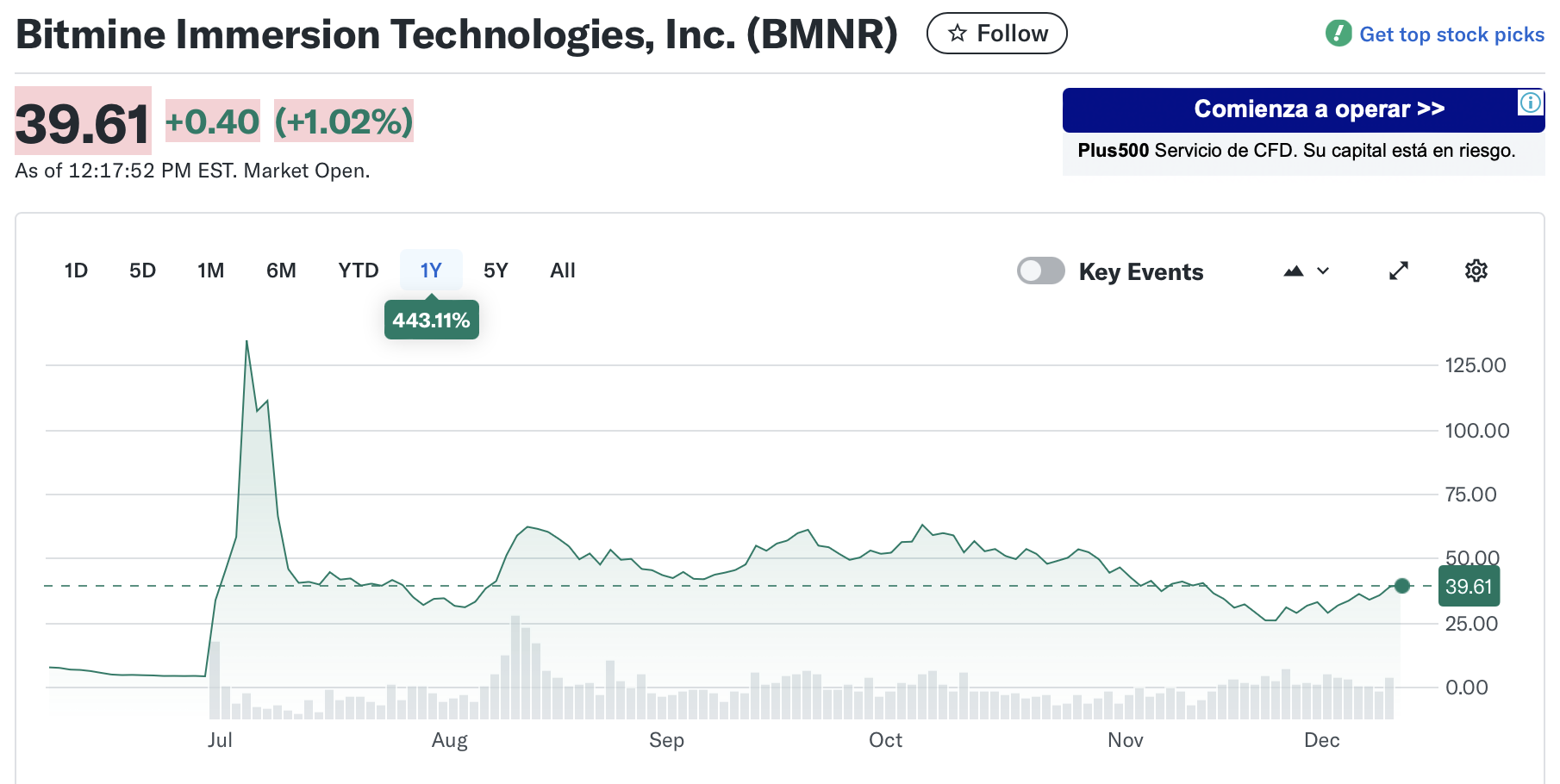
Source: Yahoo Finance

In August, Komodo Platform chief technology officer Kadan Stadelmann told Cointelegraph that companies adopting ETH treasury strategies face structural risks, and warned that a downturn in the market could force liquidations and amplify selling pressure on the token.

Ether has fallen since its all-time high of $4,946.05 on Aug. 24 and now trades at $3,365, according to CoinGecko data.

Magazine: Meet the onchain crypto detectives fighting crime better than the cops



Lecturas Relacionadas

Google and Amazon Simultaneously Invest Heavily in a Competitor: The Most Absurd Business Logic of the AI Era Is Becoming Reality

In a span of four days, Amazon announced an additional $25 billion investment, and Google pledged up to $40 billion—both direct competitors pouring over $65 billion into the same AI startup, Anthropic. Rather than a typical venture capital move, this signals the latest escalation in the cloud wars. The core of the deal is not equity but compute pre-orders: Anthropic must spend the majority of these funds on AWS and Google Cloud services and chips, effectively locking in massive future compute consumption. This reflects a shift in cloud market dynamics—enterprises now choose cloud providers based on which hosts the best AI models, not just price or stability. With OpenAI deeply tied to Microsoft, Anthropic’s Claude has become the only viable strategic asset for Google and Amazon to remain competitive. Anthropic’s annualized revenue has surged to $30 billion, and it is expanding into verticals like biotech, positioning itself as a cross-industry AI infrastructure layer. However, this funding comes with constraints: Anthropic’s independence is challenged as it balances two rival investors, its safety-first narrative faces pressure from regulatory scrutiny, and its path to IPO introduces new financial pressures. Globally, this accelerates a "tri-polar" closed-loop structure in AI infrastructure, with Microsoft-OpenAI, Google-Anthropic, and Amazon-Anthropic forming exclusive model-cloud alliances. In contrast, China’s landscape differs—investments like Alibaba and Tencent backing open-source model firm DeepSeek reflect a more decoupled approach, though closed-source models from major cloud providers still dominate. The $65 billion bet is ultimately about securing a seat at the table in an AI-defined future—where missing the model layer means losing the cloud war.

marsbitHace 30 min(s)

Google and Amazon Simultaneously Invest Heavily in a Competitor: The Most Absurd Business Logic of the AI Era Is Becoming Reality

marsbitHace 30 min(s)

Computing Power Constrained, Why Did DeepSeek-V4 Open Source?

DeepSeek-V4 has been released as a preview open-source model, featuring 1 million tokens of context length as a baseline capability—previously a premium feature locked behind enterprise paywalls by major overseas AI firms. The official announcement, however, openly acknowledges computational constraints, particularly limited service throughput for the high-end DeepSeek-V4-Pro version due to restricted high-end computing power. Rather than competing on pure scale, DeepSeek adopts a pragmatic approach that balances algorithmic innovation with hardware realities in China’s AI ecosystem. The V4-Pro model uses a highly sparse architecture with 1.6T total parameters but only activates 49B during inference. It performs strongly in agentic coding, knowledge-intensive tasks, and STEM reasoning, competing closely with top-tier closed models like Gemini Pro 3.1 and Claude Opus 4.6 in certain scenarios. A key strategic product is the Flash edition, with 284B total parameters but only 13B activated—making it cost-effective and accessible for mid- and low-tier hardware, including domestic AI chips from Huawei (Ascend), Cambricon, and Hygon. This design supports broader adoption across developers and SMEs while stimulating China's domestic semiconductor ecosystem. Despite facing talent outflow and intense competition in user traffic—with rivals like Doubao and Qianwen leading in monthly active users—DeepSeek has maintained technical momentum. The release also comes amid reports of a new funding round targeting a valuation exceeding $10 billion, potentially setting a new record in China’s LLM sector. Ultimately, DeepSeek-V4 represents a shift toward open yet realistic infrastructure development in the constrained compute landscape of Chinese AI, emphasizing engineering efficiency and domestic hardware compatibility over pure model scale.

marsbitHace 1 hora(s)

Computing Power Constrained, Why Did DeepSeek-V4 Open Source?

marsbitHace 1 hora(s)

Trading

Spot
Futuros
活动图片




