Ethereum Reduced to a Chinese Concept Stock

marsbitPublicado a 2026-05-26Actualizado a 2026-05-26

Resumen

The article titled "Ethereum Becomes a Chinese Concept Stock" presents a critical analysis of Ethereum's perceived decline in market confidence and its structural parallels to Chinese companies listed on US stock exchanges. It begins by noting significant sell-offs by early investors like Wanxiang and key figures like Bankless's Hoffman in 2026, despite Ethereum's strong fundamental activity. The piece questions the erosion of trust in Vitalik Buterin and the Ethereum Foundation (EF), arguing that while other ecosystems have faced founder controversies, Ethereum's issues stem from its internal governance model. The author draws a direct comparison to "China concept stocks," which are Chinese businesses operating globally but reliant on foreign capital and listings. Similarly, Ethereum, funded early by Chinese capital like Wanxiang, developed a strong institutional framework from its IXO to its PoS transition. The core problem, according to the article, is a leadership vacuum regarding price and direction. Vitalik's move to make the EF smaller and less active is framed as a mistake. While he advocates for ETH as a "commodity," the ecosystem lacks a clear entity to steward its price stability, creating tension within the PoS system, as seen with Lido's challenges. The narrative suggests that excessive abstraction and a hands-off approach from the EF have left the community adrift, contrasting with more proactive foundations like Solana's. The article then examines emerging t...

In 2023, early Ethereum investor Wanxiang sold tokens multiple times, at an average price of $2,047. In May 2026, Bankless founder Hoffman fully liquidated his ETH holdings, also at an average price of around $2,000.

Bankless can be considered Ethereum's external propaganda department, single-handedly amplifying the top-tier meme concept of 'ETH is Money.' During the 2021 bull market, fervor for ETH equated to a firm bullish stance on the future of blockchain.

Perhaps due to its importance, or perhaps due to eight consecutive departures from the Ethereum Foundation, Ethereum's founder and spiritual leader, Vitalik Buterin, wrote a long confessional article. He candidly stated that the EF (Ethereum Foundation) controls only 0.16% of the ETH supply and should not hold a position superior to other ecosystem nodes. He also mentioned he would gradually withdraw from operations, returning freedom to Ethereum.

Ethereum Has No Killer

ETH is Money?

Whether you believe it or not, I certainly do.

But how did all this vanish? I'm referring to the market's confidence in $ETH's price, and holders' trust in the Ethereum Foundation and Vitalik. In terms of fundamental activity, now is arguably Ethereum's strongest period of dominance. So why is there so much discontent? Is it just because of the token price?

If $BTC plunges, it's seen as a good buying opportunity. If $SOL drops sharply, its extreme rebound post-FTX has proven its value. If $HYPE falls, one can trade the waves with Arthur Hayes.

Attributing it to Vitalik personally is a convenient reason. However, there's no shortage of abstract public chain founders and foundations. Solana founder Anatoly proactively hard-pitches Perp DEX concepts within the Hyperliquid community. Multiple Ripple founders engaged in wholesale dumping of $XRP. Let alone the proliferation of L2 founders in this era, mostly ego-inflated masters of TGE, seen with the Movement clique.

Upon careful comparison, while Vitalik might be abstract and the EF might be 'inefficient,' it's hard to say they created Ethereum's current predicament. If they are not the problem themselves, then perhaps the broader environment is.
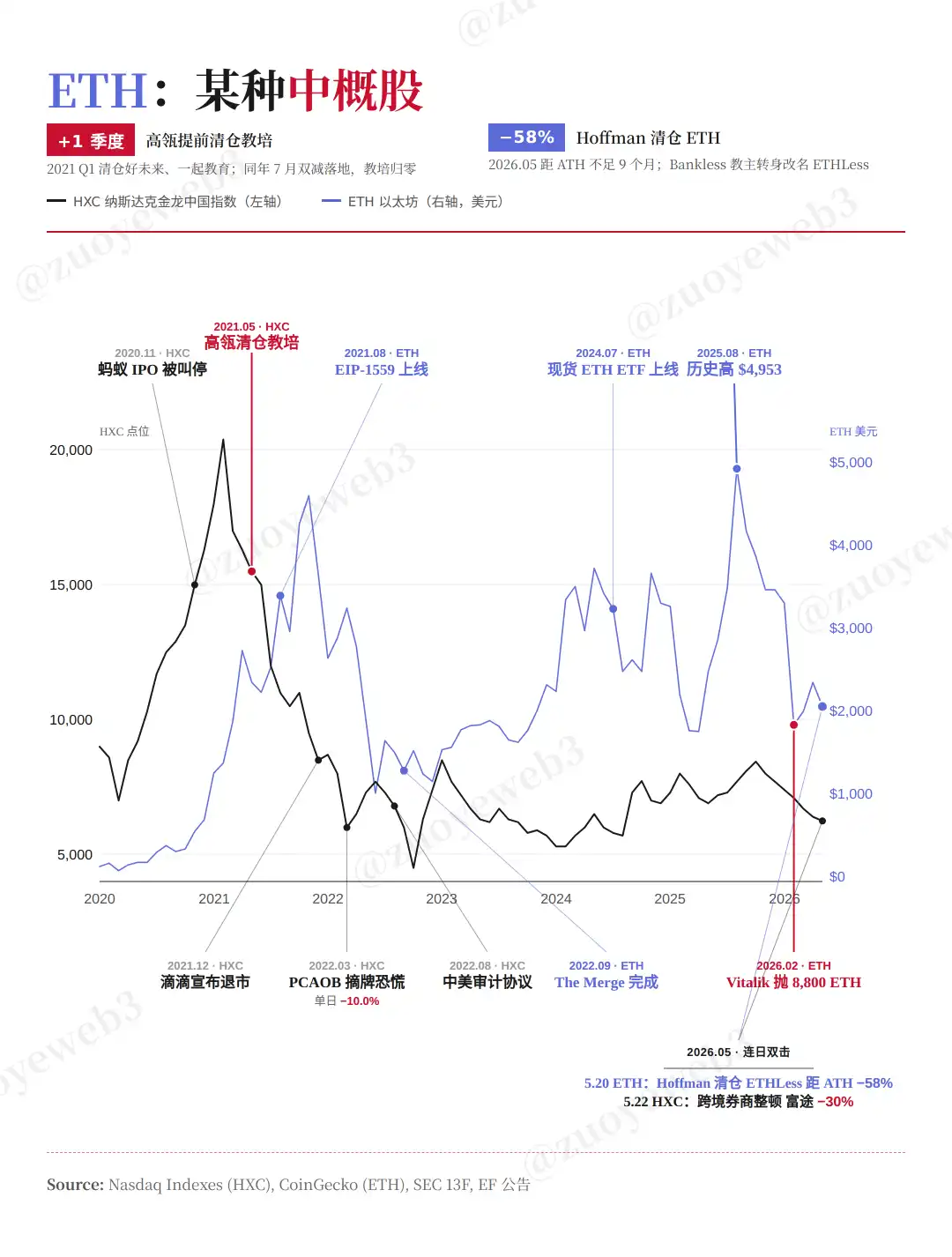
Image Caption: ETH is Money?

Image Source: @zuoyeweb3

The most typical case is Chinese concept stocks. Offshore structures + dollar funds + US IPO created a wealth myth over the past 20 years. Setting aside trial products like Brilliance Auto and China.com, the true first Chinese concept stock was Sina.com in 2000, formally initiating the wave.

The division of labor model of 'US concept + Chinese implementation' we see today is a legacy of this system. Even Ethereum itself is the last remnant of a certain type of Chinese implementation that went global.

In 2014/15, Vitalik first became a guest of Shen Bo and then received a $500,000 investment from Wanxiang, led by Xiao Feng. Unlike Bitcoin's mining model, Ethereum's IXO fundraising, PoW mining, and later PoS staking pulled three waves of passengers onto one vehicle.

In other words, ETH has been a system with relatively strong institutional involvement from the start. I don't mean to say ETH is a heavily manipulated token, and Vitalik indeed wishes for the EF to be just an ordinary node. However, within the Ethereum ecosystem, there absolutely does not exist a state of equal status uniformly distributed among all nodes. It wasn't before, isn't now, and won't be in the future.

Under these circumstances, the public chain founder and foundation actually need to take on more functions. This is unrelated to the token price. Precisely because Ethereum is fragmented with competing powers, someone must stand up and use relatively strong appeal to curb the system's disorderly entropy increase.

But Vitalik chose to first let the EF become bloated, from 'Infinite Garden' to the 'Ladder' theory. Excessive abstraction has left token holders at a loss, especially during the rsETH incident where Aave founder Stani essentially became the 'Duke Huan of Qi,' acting in the name of the king to pacify the lords.

Even the Solana Foundation set aside past grievances to actively endorse DeFi United, only to be met with the EF's routine token sales and Vitalik's personal silence.

Doing too much is centralization. But doing nothing, being overly restrained, is also an abuse of a dominant position—deliberately suppressing oneself, premised on 'the self believing it is important.'

Therefore, Vitalik's choice to make the EF smaller is a mistake. The correct approach would be for Vitalik to recede into the background as a mysterious figure and hand the foundation over to strong institutional players, more pragmatically focused on Ethereum's future.

Apart from Bitcoin, all other public chains need to face the practical demands of ecosystem development and adoption rates. On this point, the Ethereum Foundation holds no special status. The enthusiasm for DeFi and ETH is precisely a memory of past times, not pure wealth effect.

In terms of ecological prosperity and real-world adoption, Ethereum's 'killers' have never succeeded. Solana might be anxious about Hyperliquid, but Ethereum is not, just as BTC isn't anxious about Ethereum.

But this preferential treatment is fading. The crisis does not come from external forces but from within. The real distinction lies in: who is responsible for ETH's price, and who is responsible for Ethereum's direction?

Now, Vitalik is choosing to go all-in on privacy, but he should not 'prevent' others from taking responsibility for the token price.

New Narratives Await the Right Price

Commodity or Productive money?

After the $rsETH incident and the approval of staking ETFs, players like BitMine are rapidly building their own Staking services. Meanwhile, LST players like Lido are increasingly focusing on the 'productive ETH' narrative, with protocols like Spark only recognizing Lido's $wstETH product.

Everything is being reassessed. Lido is not as comfortable as it claims. With ETH prices lingering around $2,000, the marginal effect of continuing to scale diminishes, while the pressure to maintain APR returns increases, casting a shadow over the productivity narrative as well.

This highlights the importance of price—or rather, who is responsible for ETH's price. Currently, the situation is that the EF is not responsible, Lido cannot be responsible, and the entire Ethereum PoS system operates in this awkward environment.

Drawing another parallel to Chinese concept stocks: after US stock markets effectively ceased to be viable exit channels, ChangXin Memory Storage latched onto the AI concept, DeepSeek transformed with state capital taking the lead, and aerospace/robotics concepts oscillate between A-shares and H-shares. Whether you like it or not, this is the new narrative framework.
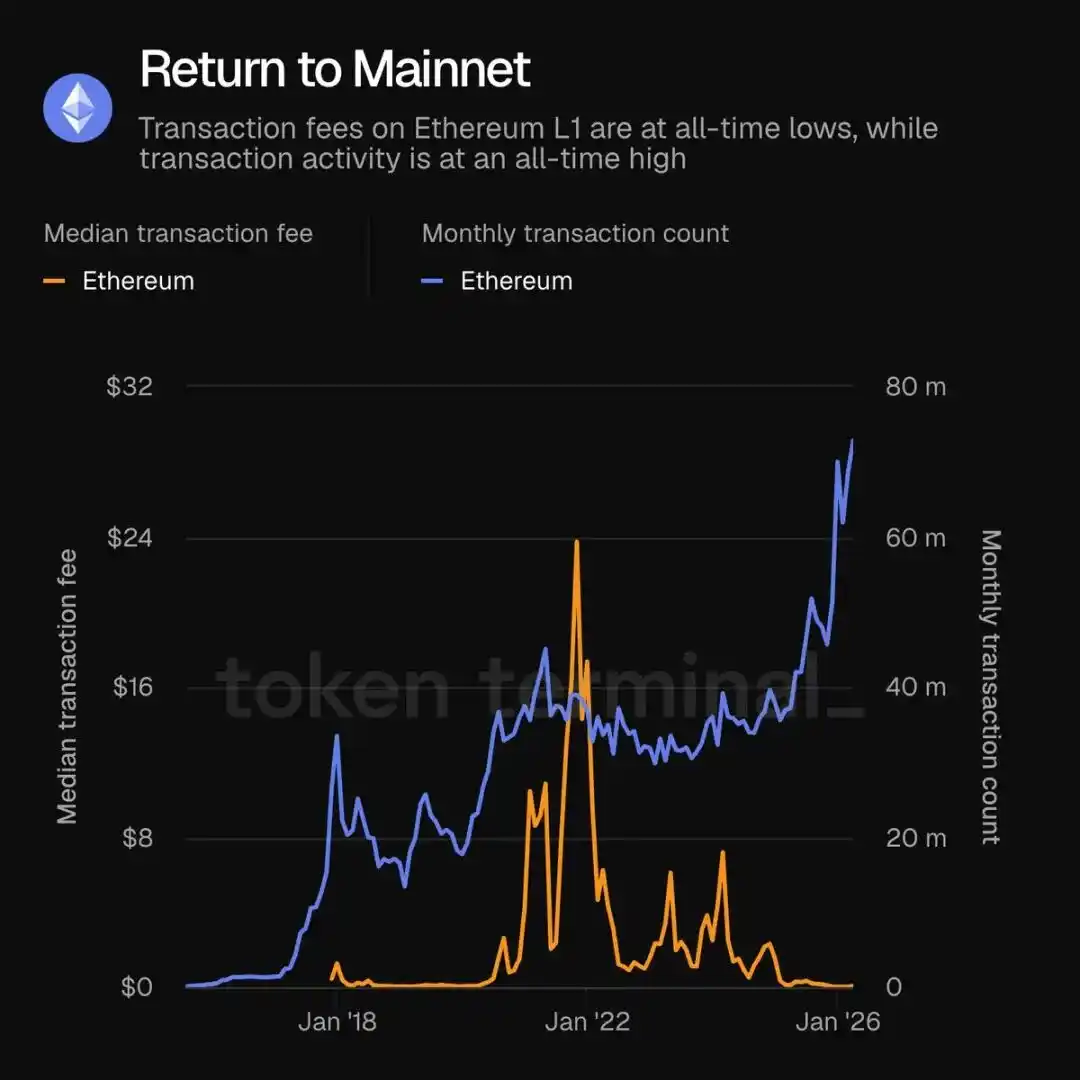
Image Caption: Return to Mainnet.

Image Source: @tokenterminal

With Ethereum's shift back to focusing on L1, mainnet activity exploded. Yet, you don't feel the Ethereum ecosystem is genuinely improving, let alone the token price rising. Something is clearly wrong, but people can't define the problem.

So, what about the current Ethereum technical narratives?

  1. Privacy: Everything can be ZK, the last bastion of decentralization ideals.
  2. AI: Teams like dAI are migrating centralized architectures on-chain, focusing on small model on-device deployment and Agent invocation.
  3. L1: Complete abandonment of the L2-centric model, with all competition over speed and revenue returning to L1.

Compared to the 'world computer' and smart contract technical synergy, Ethereum now needs to forge more connections with reality. Beyond the three above, there are stablecoins, RWA, and many other narratives. But these are not how Ethereum views the world; rather, it's Ethereum's place *within* the world.

The subject and object are inverted, or rather, its position in the new world is unclear. The grand ambition of 'everything can go on-chain' and 'blockchain fights for the future' is gone. Yet, there's always a feeling blockchain can do more. This contradiction, entanglement, and repetition form the threefold chorus of current market sentiment. People hope to see a better Ethereum, but seeing a good Ethereum seems unlikely.

After over a decade of striving, Ethereum did not become the world computer, but it is truly an open computer. Any activity or idea can be experimented with and run on it. While Bankless promoted 'ETH is Money,' Vitalik insisted 'ETH is a Commodity,' a digital product carrying specific functions.

On this point, no one can accuse Vitalik of lying. When Vitalik sold 8,800 tokens in February 2026, he did so slowly via CowSwap. He didn't follow Curve's founder by staking $CRV for stablecoins, nor did he emulate Justin Sun's tactics with $USDD to fleece retail investors.

But as in the Chiang Mai dialogue in January 2026, when asked if given a chance to turn back time ten years, would one choose blockchain or AI, Vitalik didn't give a firm answer. Yet, the reality is set: more and more crypto project teams are pivoting to AI, skillfully applying Go-To-Market methodologies.

  • Hermes Agent broke into the mainstream AI developer circle, with the founding team from Nous Research.
  • xBubble is developed by DappOS, combining AI + intent execution frameworks.
  • OpenRouter founder Alex Atallah is from OpenSea.

You'll find crypto project teams' marketing capabilities aren't limited to on-chain activities. Even in the globally watched AI trend, they can repeatedly keep pace. Even the transit hub model intertwines with stablecoins, traffic distribution, and operations.

But all this has a weak connection to Ethereum. Although dAI and virtuals jointly proposed ERC-8183, attempting to define an autonomous Agent economic activity framework, it's not that the team isn't working. It feels more like active adaptation rather than a leading posture.

If we consider the present a moment for narrative bottom-fishing, the core question is: what value does a public chain hold in the AI era?

Claude repeatedly attacks SaaS, security, and external Agent frameworks. Imagine an absurd scenario: if Claude created its own chain, what would happen to Ethereum?

Under the PoS mechanism, asset migration costs are low enough. But in terms of compliance costs, Claude would still be bound by human legal constraints. An unrestricted free financial testing ground might be Ethereum's most unique value proposition.

Just as when Mythos hammered Palantir's stock, QiAnXin would surge against the trend because hitting the opponent triggers an arms race among counterparts across the ocean, creating an infinite loop.

In other words, in a world of increasing polarization, the demand for connecting the globe will persist long-term. Canton belongs to Wall Street, but Ethereum belongs to all humanity. Just as people in the Sahara have no shoes, pessimists exit, and optimists rejoice.

However, the golden age of $ETH will not return. Wanxiang, the EF, and other institutions will continue to sell. But ETH at $2,000 is at least ten times $200. We stand at a new starting point; we just need a course to sail.

Conclusion

Destined to be alike, ETH truly shares a fate similar to Chinese concept stocks. Both are assets from Country A, invested in by Country B's capital, and exited on Country B's secondary markets. Country A only bears market and channel value.

This is the best of times. Under such fragmentation, new markets will be born. Following Country B's dynamics, similar assets in Country A will experience analogous cycles. Amidst the fragmentation, both A and B still need new connection points. Ethereum remains the best choice.

Preguntas relacionadas

QWhat is the main argument presented in the article regarding Ethereum's current predicament?

AThe article argues that Ethereum's core problem is not its technology or competitors, but a lack of clear leadership and responsibility for its price and direction. It draws a parallel to Chinese concept stocks (中概股), suggesting Ethereum suffers from a similar disconnect where its primary value accrual (price/exit) happens in a market (B country/crypto speculation) separate from its core development and user base (A country/decentralized ethos). Vitalik Buterin and the Ethereum Foundation's move towards excessive abstraction and minimal intervention, rather than proactive stewardship, has created a leadership vacuum and eroded confidence.

QAccording to the article, how does the 'ETH is Money' narrative conflict with Vitalik Buterin's own view?

AThe 'ETH is Money' narrative, heavily promoted by entities like Bankless, positioned ETH as a form of currency or sound money during the 2021 bull market. However, the article states that Vitalik Buterin himself has consistently viewed ETH not as 'money' but as a 'Commodity'—a digital product designed to carry specific functions (like paying for gas fees) within the Ethereum ecosystem.

QWhat three key technical narratives is Ethereum currently pursuing, as mentioned in the article?

AThe article lists three key technical narratives for Ethereum: 1. Privacy: Focusing on zero-knowledge (ZK) proofs as the last bastion of decentralization. 2. AI: Projects like dAI aim to bring centralized AI architectures on-chain, focusing on small model on-device deployment and Agent invocation. 3. L1 Focus: Shifting away from an L2-centric roadmap and refocusing competition on Layer-1 speed and revenue generation.

QWhat analogy does the article make between Ethereum and Chinese concept stocks (中概股)?

AThe article draws a direct analogy, stating Ethereum has become like a Chinese concept stock. Both are seen as 'A-country assets' (Ethereum's tech/decentralized ideals / China's companies) funded by 'B-country capital' (global crypto VCs / US dollar funds) with their primary exit and valuation mechanism in the 'B-country secondary market' (global crypto exchanges / US stock markets). The 'A-country' (core ecosystem/China) mainly provides market access and utility, but doesn't fully capture the financial value creation.

QWhat does the article suggest is Ethereum's unique and enduring value proposition in the current landscape?

AThe article suggests Ethereum's unique value is as a 'limitless financial testing ground' and a global, permissionless linking layer. In an increasingly fragmented world with rising geopolitical tensions, the need for a neutral, global financial and coordination platform persists. While projects like Canton Network serve institutional Wall Street, Ethereum belongs to 'all of humanity,' offering a space for uncensored experimentation that centralized entities or AI models like Claude, bound by human laws, cannot replicate.

Lecturas Relacionadas

Just Now, Chinese AI Enters Top 2 in Global Programming, Only Claude Remains Ahead

**China's AI Ranks Second Globally in Programming, Trailing Only Claude** Today, Alibaba's Qwen3.7-Max achieved a score of 1541 on the Code Arena benchmark, securing fourth place globally and surpassing top models like GPT-5.5 and Gemini 3.5 Flash. Among the top positions, it is now the only non-Claude model, placing second overall after Anthropic's Opus models. Before this official ranking, Qwen3.7-Max had already gained recognition overseas. In practical tests, it outperformed rivals on tasks like creating a self-training Tetris AI and generating complex 3D models, often at a significantly lower cost. Developers praised its ability, especially when integrated with tools like Hermes Agent and OpenCode, to effectively replace models such as GPT-5.5. In a hands-on challenge to create a 3D racing game from a detailed prompt, Qwen3.7-Max delivered a fully playable HTML file in the first attempt, requiring only minor bug fixes. It uniquely included a start menu and sound effects—details missed by other models. While competitors like Gemini 3.5 Flash and Claude Opus 4.6 produced less polished or functional versions, and GPT-5.5 had its own quirks, Qwen3.7-Max stood out for its initial completeness and playability. This performance stems from its design as an "Agent Base Model," built for long-duration, autonomous task execution. Internal tests show it can run continuously for 35 hours, making over 1158 tool calls without context degradation or instruction drift. Key technical advancements include "environment expansion" training, which improves adaptability across different frameworks, and "long-horizon autonomous execution" training, enabling sustained strategic decision-making. By entering the top tier of the programming arena, Qwen3.7-Max demonstrates that Chinese AI models are not just catching up but are becoming defining competitors, challenging the long-standing dominance of Silicon Valley in this field.

marsbitHace 21 min(s)

Just Now, Chinese AI Enters Top 2 in Global Programming, Only Claude Remains Ahead

marsbitHace 21 min(s)

From a Lunch Table to an Infinite Universe: Fei-Fei Li Bets on AI's Next Dimension

From a Lunch Table Conversation to an Infinite Universe: Fei-Fei Li Bets on AI's Next Frontier - Spatial Intelligence In an era dominated by large language models, AI pioneer Fei-Fei Li argues that true understanding requires spatial intelligence — the ability to perceive, reason, and interact within the physical 3D/4D world. She points to evolutionary history: spatial perception drove the Cambrian explosion 540 million years ago, while language is a far more recent, inherently "lossy" way to encode reality. Current models struggle with basic spatial tasks a child can do, like counting chairs in a video. Her company, World Labs, is pioneering this shift with "Marble," a model that generates navigable, consistent 3D worlds from text, images, or simple 3D inputs—distinct from video generators like Sora. Though smaller than models like GPT-5, due to scarce 3D data and early-stage scaling laws, Marble is already used in gaming, robot training (by NVIDIA), architectural design, and personalized therapy for conditions like OCD and acrophobia. Li envisions this technology enabling "infinite universes" for creativity, social interaction, and more. However, she cautions against utopian or dystopian extremes, advocating for a measured vision where AI enhances human dignity and prosperity, akin to how electricity transformed civilization. The journey is long — as evidenced by the 20-year path to viable autonomous vehicles — but the direction is clear: for AI to move from merely talking about the world to truly understanding and acting within it.

marsbitHace 24 min(s)

From a Lunch Table to an Infinite Universe: Fei-Fei Li Bets on AI's Next Dimension

marsbitHace 24 min(s)

X Stock Market Investment & Trading: A 'Noise-Free' List of 50 Key Accounts

Titled "A 'Noise-Reduction' List of 50 Top US Stock Market Influencers on X," this article curates a selection of accounts for investors seeking quality information beyond follower counts. The list prioritizes accounts that have consistently discussed US stocks, ETFs, earnings, macroeconomics, options, and tech/AI/semiconductor topics over the past 90 days. Selection criteria focused on genuine informational value, stable analytical frameworks over mere news aggregation, and a clear relevance to US equity markets, with tighter filtering for crypto-heavy accounts. The final 50 accounts are categorized into three groups: - **Core US Stocks/Trading (31 accounts)**: Covering market trends, individual stocks, earnings, valuation, options, macroeconomics, and trading strategies. - **Tech/AI/Semiconductors (18 accounts)**: Focused on tech stocks, AI supply chains, semiconductor cycles, data centers, and cloud capital expenditure. - **News Source (1 account)**: Useful as a news radar, not for standalone decision-making. Presented alphabetically by handle, the list includes analysts, traders, and researchers such as @amy6tina (options/CFA), @dylan522p (semiconductors/AI infrastructure), @gerberkawasaki (tech stocks), @jimcramer (market commentary), and @tengyanai (semiconductors/AI trends). The article suggests using the list to: 1) complete one's information sources on US markets and specific sectors, 2) observe narrative linkages between AI, semiconductors, earnings, macro liquidity, and stock prices, and 3) "de-noise" and enhance the quality of one's X feed. It clarifies this is not investment advice or an endorsement, but a snapshot of content relevance and informational value for US equity investors.

marsbitHace 31 min(s)

X Stock Market Investment & Trading: A 'Noise-Free' List of 50 Key Accounts

marsbitHace 31 min(s)

Trading

Spot
Futuros

Artículos destacados

Qué es ETH 2.0

ETH 2.0: Una Nueva Era para Ethereum Introducción ETH 2.0, conocido ampliamente como Ethereum 2.0, marca una actualización monumental para la blockchain de Ethereum. Esta transición no es solo una mejora superficial; busca mejorar fundamentalmente la escalabilidad, seguridad y sostenibilidad de la red. Con un cambio del mecanismo de consenso intensivo en energía Prueba de Trabajo (PoW) a una Prueba de Participación (PoS) más eficiente, ETH 2.0 promete un enfoque transformador para el ecosistema blockchain. ¿Qué es ETH 2.0? ETH 2.0 es un conjunto de actualizaciones interconectadas y distintivas centradas en optimizar las capacidades y el rendimiento de Ethereum. La reestructuración está diseñada para abordar desafíos críticos que el mecanismo actual de Ethereum ha enfrentado, particularmente en lo que respecta a la velocidad de transacción y la congestión de la red. Objetivos de ETH 2.0 Los objetivos principales de ETH 2.0 giran en torno a mejorar tres aspectos clave: Escalabilidad: Con el objetivo de aumentar significativamente el número de transacciones que la red puede manejar por segundo, ETH 2.0 busca superar la limitación actual de aproximadamente 15 transacciones por segundo, potencialmente alcanzando miles. Seguridad: Las medidas de seguridad mejoradas son fundamentales para ETH 2.0, particularmente a través de una mejor resistencia contra ciberataques y la preservación del ethos descentralizado de Ethereum. Sostenibilidad: El nuevo mecanismo PoS está diseñado no solo para mejorar la eficiencia, sino también para reducir drásticamente el consumo de energía, alineando el marco operativo de Ethereum con consideraciones ambientales. ¿Quién es el Creador de ETH 2.0? La creación de ETH 2.0 se puede atribuir a la Fundación Ethereum. Esta organización sin fines de lucro, que desempeña un papel crucial en el apoyo al desarrollo de Ethereum, es liderada por el notable cofundador Vitalik Buterin. Su visión de un Ethereum más escalable y sostenible ha sido la fuerza motriz detrás de esta actualización, involucrando contribuciones de una comunidad global de desarrolladores y entusiastas dedicados a mejorar el protocolo. ¿Quiénes son los Inversores de ETH 2.0? Si bien los detalles sobre los inversores de ETH 2.0 no se han hecho públicos, se sabe que la Fundación Ethereum recibe apoyo de varias organizaciones e individuos en el ámbito de blockchain y tecnología. Estos socios incluyen firmas de capital de riesgo, compañías tecnológicas y organizaciones filantrópicas que comparten un interés mutuo en apoyar el desarrollo de tecnologías descentralizadas e infraestructura blockchain. ¿Cómo Funciona ETH 2.0? ETH 2.0 se distingue por introducir una serie de características clave que lo diferencian de su predecesor. Prueba de Participación (PoS) La transición a un mecanismo de consenso PoS es uno de los cambios más destacados de ETH 2.0. A diferencia de PoW, que se basa en la minería intensiva en energía para la verificación de transacciones, PoS permite a los usuarios validar transacciones y crear nuevos bloques de acuerdo con la cantidad de ETH que apuestan en la red. Esto conduce a una mayor eficiencia energética, reduciendo el consumo en aproximadamente un 99.95%, convirtiendo a Ethereum 2.0 en una alternativa considerablemente más verde. Cadenas Shard Las cadenas shard son otra innovación crítica de ETH 2.0. Estas cadenas más pequeñas operan en paralelo con la cadena principal de Ethereum, lo que permite que múltiples transacciones sean procesadas simultáneamente. Este enfoque mejora la capacidad general de la red, abordando las preocupaciones de escalabilidad que han afectado a Ethereum. Cadena Beacon En el núcleo de ETH 2.0 se encuentra la Cadena Beacon, que coordina la red y gestiona el protocolo PoS. Funciona como un organizador de cierta manera: supervisa a los validadores, asegura que los shards permanezcan conectados a la red y monitorea la salud general del ecosistema blockchain. Cronología de ETH 2.0 El viaje de ETH 2.0 ha estado marcado por varios hitos clave que trazan la evolución de esta importante actualización: Diciembre 2020: El lanzamiento de la Cadena Beacon marcó la introducción de PoS, preparándose para la migración hacia ETH 2.0. Septiembre 2022: La finalización de “La Fusión” representa un momento crucial en el que la red Ethereum se trasladó exitosamente de un marco PoW a uno PoS, anunciando una nueva era para Ethereum. 2023: El lanzamiento esperado de cadenas shard tiene como objetivo mejorar aún más la escalabilidad de la red Ethereum, consolidando a ETH 2.0 como una plataforma robusta para aplicaciones y servicios descentralizados. Características Clave y Beneficios Escalabilidad Mejorada Una de las ventajas más significativas de ETH 2.0 es su escalabilidad mejorada. La combinación de PoS y cadenas shard permite que la red expanda su capacidad, permitiendo acomodar un volumen mucho mayor de transacciones en comparación con el sistema heredado. Eficiencia Energética La implementación de PoS representa un gran paso hacia la eficiencia energética en la tecnología blockchain. Al reducir drásticamente el consumo de energía, ETH 2.0 no solo disminuye los costos operativos, sino que también se alinea más estrechamente con los objetivos de sostenibilidad global. Seguridad Mejorada Los mecanismos actualizados de ETH 2.0 contribuyen a mejorar la seguridad en toda la red. El despliegue de PoS, junto con las medidas de control innovadoras establecidas a través de cadenas shard y la Cadena Beacon, asegura un mayor grado de protección contra posibles amenazas. Costos Más Bajos para los Usuarios A medida que la escalabilidad mejora, los efectos sobre los costos de transacción también serán evidentes. Se espera que una mayor capacidad y una menor congestión se traduzcan en tarifas más bajas para los usuarios, haciendo que Ethereum sea más accesible para transacciones cotidianas. Conclusión ETH 2.0 marca una evolución significativa en el ecosistema blockchain de Ethereum. A medida que aborda problemas fundamentales como la escalabilidad, el consumo de energía, la eficiencia en las transacciones y la seguridad general, la importancia de esta actualización no puede ser subestimada. La transición a la Prueba de Participación, la introducción de cadenas shard y el trabajo fundamental de la Cadena Beacon son indicativos de un futuro donde Ethereum puede satisfacer las crecientes demandas del mercado descentralizado. En una industria impulsada por la innovación y el progreso, ETH 2.0 se erige como un testimonio de las capacidades de la tecnología blockchain para allanar el camino hacia una economía digital más sostenible y eficiente.

166 Vistas totalesPublicado en 2024.04.04Actualizado en 2024.12.03

Qué es ETH 2.0

Qué es ETH 3.0

ETH3.0 y $eth 3.0: Un Examen Profundo del Futuro de Ethereum Introducción En el paisaje en rápida evolución de las criptomonedas y la tecnología blockchain, ETH3.0, a menudo denotado como $eth 3.0, ha surgido como un tema de considerable interés y especulación. El término abarca dos conceptos principales que merecen aclaración: Ethereum 3.0: Esto representa una posible actualización futura destinada a aumentar las capacidades de la blockchain existente de Ethereum, enfocándose particularmente en mejorar la escalabilidad y el rendimiento. ETH3.0 Meme Token: Este proyecto de criptomoneda distinto busca aprovechar la blockchain de Ethereum para crear un ecosistema centrado en memes, promoviendo la participación dentro de la comunidad de criptomonedas. Comprender estos aspectos de ETH3.0 es esencial no solo para los entusiastas de las criptomonedas, sino también para aquellos que observan tendencias tecnológicas más amplias en el espacio digital. ¿Qué es ETH3.0? Ethereum 3.0 Ethereum 3.0 se presenta como una actualización propuesta para la red de Ethereum ya establecida, que ha sido la columna vertebral de muchas aplicaciones descentralizadas (dApps) y contratos inteligentes desde su inicio. Las mejoras previstas se concentran principalmente en la escalabilidad, integrando tecnologías avanzadas como sharding y pruebas de conocimiento cero (zk-proofs). Estas innovaciones tecnológicas tienen como objetivo facilitar un número sin precedentes de transacciones por segundo (TPS), potencialmente alcanzando millones, abordando así una de las limitaciones más significativas que enfrenta la tecnología blockchain actual. La mejora no es meramente técnica, sino también estratégica; está destinada a preparar la red de Ethereum para su adopción generalizada y utilidad en un futuro marcado por una mayor demanda de soluciones descentralizadas. ETH3.0 Meme Token En contraste con Ethereum 3.0, el ETH3.0 Meme Token se aventura en un ámbito más ligero y juguetón al combinar la cultura de memes de internet con la dinámica de las criptomonedas. Este proyecto permite a los usuarios comprar, vender e intercambiar memes en la blockchain de Ethereum, proporcionando una plataforma que fomenta la participación comunitaria a través de la creatividad y los intereses compartidos. El ETH3.0 Meme Token tiene como objetivo demostrar cómo la tecnología blockchain puede intersectarse con la cultura digital, creando casos de uso que son tanto entretenidos como financieramente viables. ¿Quién es el Creador de ETH3.0? Ethereum 3.0 La iniciativa hacia Ethereum 3.0 es impulsada principalmente por un consorcio de desarrolladores e investigadores dentro de la comunidad de Ethereum, incluyendo notablemente a Justin Drake. Conocido por sus ideas y contribuciones a la evolución de Ethereum, Drake ha sido una figura prominente en las discusiones sobre la transición de Ethereum a una nueva capa de consenso, denominada “Beam Chain.” Este enfoque colaborativo para el desarrollo significa que Ethereum 3.0 no es el producto de un creador singular, sino más bien una manifestación de ingenio colectivo centrado en avanzar la tecnología blockchain. ETH3.0 Meme Token Los detalles sobre el creador del ETH3.0 Meme Token son actualmente inidentificables. La naturaleza de los tokens de memes a menudo conduce a una estructura más descentralizada y dirigida por la comunidad, lo que podría explicar la falta de atribución específica. Esto se alinea con la ética de la comunidad cripto más amplia, donde la innovación a menudo surge de esfuerzos colaborativos en lugar de individuales. ¿Quiénes son los Inversores de ETH3.0? Ethereum 3.0 El apoyo a Ethereum 3.0 proviene principalmente de la Fundación Ethereum junto con una entusiasta comunidad de desarrolladores e inversores. Esta asociación fundamental proporciona un grado significativo de legitimidad y mejora la perspectiva de una implementación exitosa, ya que aprovecha la confianza y credibilidad construidas a lo largo de años de operaciones en la red. En el clima cambiando rápidamente de las criptomonedas, el apoyo de la comunidad juega un papel crucial en impulsar el desarrollo y la adopción, posicionando a Ethereum 3.0 como un contendiente serio para futuros avances en blockchain. ETH3.0 Meme Token Si bien las fuentes actualmente disponibles no proporcionan información explícita sobre las fundaciones o organizaciones de inversión que respaldan el ETH3.0 Meme Token, es indicativo del modelo de financiamiento típico para tokens de memes, que a menudo depende del apoyo de base y la participación comunitaria. Los inversores en tales proyectos suelen consistir en individuos motivados por el potencial de innovación impulsada por la comunidad y el espíritu de cooperación que se encuentra dentro de la comunidad cripto. ¿Cómo Funciona ETH3.0? Ethereum 3.0 Las características distintivas de Ethereum 3.0 radican en su implementación propuesta de sharding y tecnología zk-proof. Sharding es un método de particionamiento de la blockchain en piezas más pequeñas y manejables o “shards,” que pueden procesar transacciones de manera concurrente en lugar de secuencial. Esta descentralización del procesamiento ayuda a prevenir la congestión y asegura que la red permanezca receptiva incluso bajo una carga pesada. La tecnología de prueba de conocimiento cero (zk-proof) contribuye con otra capa de sofisticación al permitir la validación de transacciones sin revelar los datos subyacentes involucrados. Este aspecto no solo mejora la privacidad, sino que también aumenta la eficiencia general de la red. También se habla de incorporar una Máquina Virtual de Ethereum de conocimiento cero (zkEVM) en esta actualización, amplificando aún más las capacidades y utilidad de la red. ETH3.0 Meme Token El ETH3.0 Meme Token se distingue al capitalizar la popularidad de la cultura de memes. Establece un mercado para que los usuarios participen en el comercio de memes, no solo por entretenimiento sino también por el posible beneficio económico. Al integrar características como staking, provisión de liquidez y mecanismos de gobernanza, el proyecto fomenta un entorno que incentiva la interacción y participación de la comunidad. Al ofrecer una mezcla única de entretenimiento y oportunidad económica, el ETH3.0 Meme Token tiene como objetivo atraer a una audiencia diversa, que abarca desde entusiastas de las criptomonedas hasta conocedores casuales de memes. Línea de Tiempo de ETH3.0 Ethereum 3.0 11 de noviembre de 2024: Justin Drake insinúa la próxima actualización de ETH 3.0, centrada en mejoras de escalabilidad. Este anuncio significa el comienzo de las discusiones formales sobre la futura arquitectura de Ethereum. 12 de noviembre de 2024: Se espera que la propuesta anticipada para Ethereum 3.0 se desvele en Devcon en Bangkok, preparando el escenario para una mayor retroalimentación de la comunidad y posibles próximos pasos en el desarrollo. ETH3.0 Meme Token 21 de marzo de 2024: El ETH3.0 Meme Token se lista oficialmente en CoinMarketCap, marcando su incursión en el dominio público de las criptomonedas y mejorando la visibilidad de su ecosistema basado en memes. Puntos Clave En conclusión, Ethereum 3.0 representa una evolución significativa dentro de la red de Ethereum, enfocándose en superar las limitaciones en términos de escalabilidad y rendimiento a través de tecnologías avanzadas. Sus actualizaciones propuestas reflejan un enfoque proactivo hacia las demandas y la usabilidad futura. Por otro lado, el ETH3.0 Meme Token encapsula la esencia de la cultura impulsada por la comunidad en el espacio de las criptomonedas, aprovechando la cultura de memes para crear plataformas atractivas que fomentan la creatividad y participación del usuario. Comprender los distintos propósitos y funcionalidades de ETH3.0 y $eth 3.0 es fundamental para cualquiera interesado en los desarrollos en curso dentro del espacio cripto. Con ambas iniciativas abriendo caminos únicos, subrayan colectivamente la naturaleza dinámica y multifacética de la innovación en blockchain.

178 Vistas totalesPublicado en 2024.04.04Actualizado en 2024.12.03

Qué es ETH 3.0

Cómo comprar ETH

¡Bienvenido a HTX.com! Hemos hecho que comprar Ethereum (ETH) sea simple y conveniente. Sigue nuestra guía paso a paso para iniciar tu viaje de criptos.Paso 1: crea tu cuenta HTXUtiliza tu correo electrónico o número de teléfono para registrarte y obtener una cuenta gratuita en HTX. Experimenta un proceso de registro sin complicaciones y desbloquea todas las funciones.Obtener mi cuentaPaso 2: ve a Comprar cripto y elige tu método de pagoTarjeta de crédito/débito: usa tu Visa o Mastercard para comprar Ethereum (ETH) al instante.Saldo: utiliza fondos del saldo de tu cuenta HTX para tradear sin problemas.Terceros: hemos agregado métodos de pago populares como Google Pay y Apple Pay para mejorar la comodidad.P2P: tradear directamente con otros usuarios en HTX.Over-the-Counter (OTC): ofrecemos servicios personalizados y tipos de cambio competitivos para los traders.Paso 3: guarda tu Ethereum (ETH)Después de comprar tu Ethereum (ETH), guárdalo en tu cuenta HTX. Alternativamente, puedes enviarlo a otro lugar mediante transferencia blockchain o utilizarlo para tradear otras criptomonedas.Paso 4: tradear Ethereum (ETH)Tradear fácilmente con Ethereum (ETH) en HTX's mercado spot. Simplemente accede a tu cuenta, selecciona tu par de trading, ejecuta tus trades y monitorea en tiempo real. Ofrecemos una experiencia fácil de usar tanto para principiantes como para traders experimentados.

4.1k Vistas totalesPublicado en 2024.12.10Actualizado en 2025.03.21

Cómo comprar ETH

Discusiones

Bienvenido a la comunidad de HTX. Aquí puedes mantenerte informado sobre los últimos desarrollos de la plataforma y acceder a análisis profesionales del mercado. A continuación se presentan las opiniones de los usuarios sobre el precio de ETH (ETH).

活动图片